
You are currently browsing the tag archive for the ‘Carlo Vinci’ tag.
Director: Ralph Bakshi
Release date: August 8, 1973
Rating: ★★
Review:
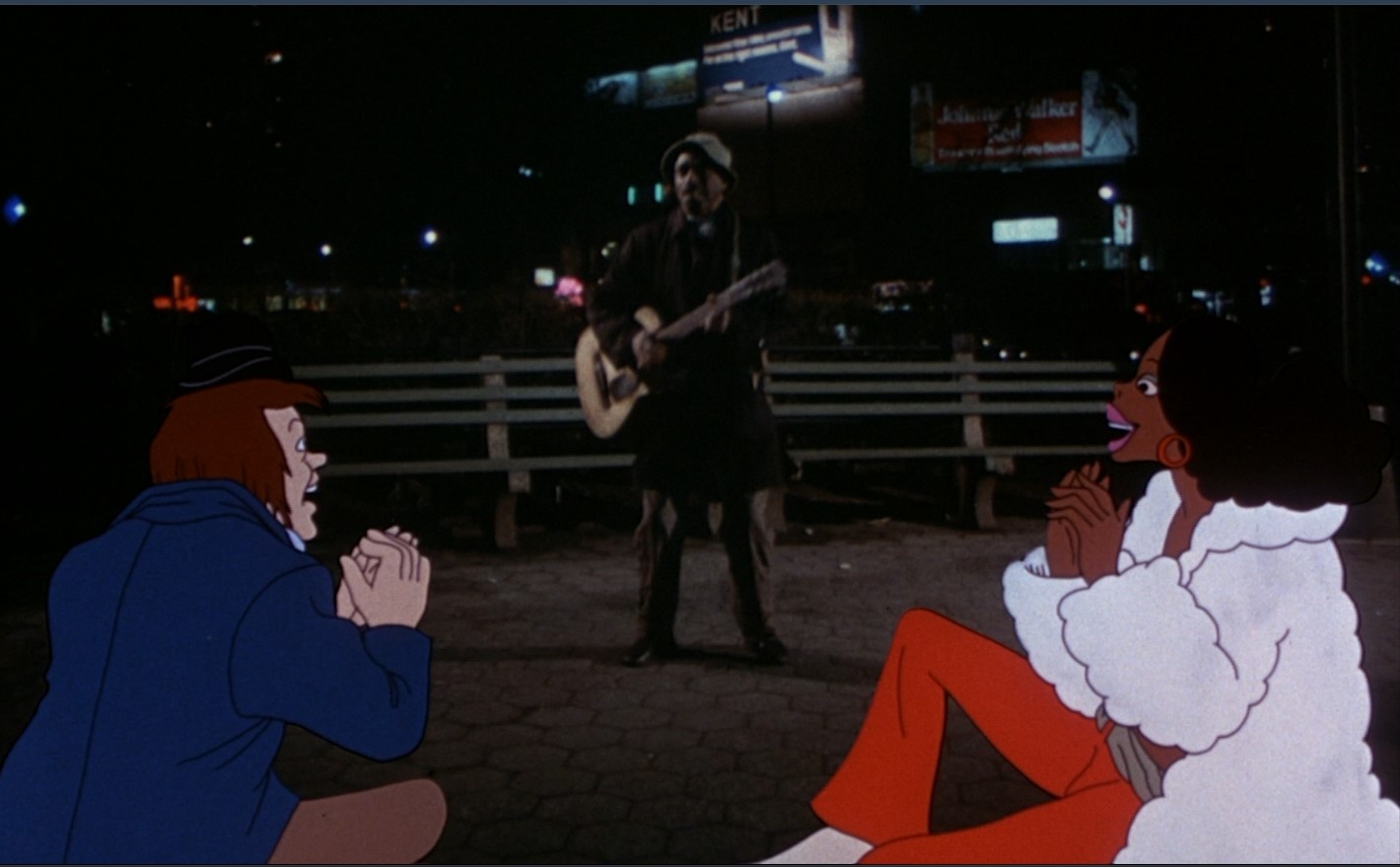
Ralph Bakshi arrived on the scene when American classic studio animation was in steady decline, reaching its low point in the 1970s and early 1980s. In this dry period, Bakshi tried to reinject classic animation with new energy, most notably by ripping it of its association with children. Now, in the golden age animation never had been solely associated with children, but due to the advent of the Saturday-morning cartoon in the mid-1960s American animation more and more became something just for kids.
Bakshi, on the other hand, saw the full potential of the medium, and enriched the animation world with several animated features aimed at adult audiences, thus bypassing the middle ground of the family film, which was Disney’s monopoly at the time, anyway. Thus, Bakshi is sometimes seen as the savior of animation during the medium’s dark ages, but I find it hard to subscribe to that opinion, and that’s because his films are sadly just not good.
Now, I will not talk about the abysmal ‘The Lord of the Rings’ (1977), which is a disgrace to the medium, but even ‘Heavy Traffic’, his supposed masterpiece, fails on several key features.
‘Heavy Traffic’ was written by Bakshi himself and has strong autobiographical elements. Set in New York the feature film tells of Michael Corleone, a young and aspiring underground cartoonist, who stills live with his quarreling parents (a Jewish mother and an Italian father), and who dates a black girl called Carole.
The film uses a voice over and the images of a pinball machine as bridging elements, but this cannot hide the fact that the film is a loose bag of scenes, and hardly goes anywhere. Sure, the film is depressing and draws a dark picture of the Big Apple, but its fourteen scenes have little to do with each other and are more about atmosphere than storytelling.
It certainly doesn’t help that none of the characters are remotely sympathetic. Even Michael himself, our supposed hero, is more of a self-centered jerk than anything else. For example, the comics he shows a publisher, wouldn’t interest anyone with a sane mind.
Worse, ‘Heavy Traffic’ falls for the misguided idea that making a film for an adult audience means it must contain sex and violence. ‘Heavy Traffic’ was not the first film to fall into this trap, and certainly not the last one (the unappealing ‘Sausage Party’ from 2016 comes to mind), but Bakshi clearly indulges in both, not only in this film, but also in ‘Fritz the Cat’ from the year before, ‘Wizards’ (1977) and ‘Cool World’ (1992), to name a few, which, to me, only proofs his immaturity. In ‘Heavy Traffic’, for example, bare breasts pop up from everywhere, with little other purpose than arousing the male audience.
Bakshi’s character designs are a mixed bag, sometimes reminiscent of the work of Mort Walker, as in the design of Michael’s father, at other times very cartoony, and reminiscent of DePatie-Freleng (e.g. the gay drag queen Snowflake), at other times quasi-realistic (Carole). Especially ill-conceived is Michael himself, whose quasi-realistic design is as mediocre as it is unappealing.
The background art too is a strange mix of drawings and photographs to a gritty effect. There are even some real live action footage elements from old films, like ‘Red Dust’ (1932) and ‘The Gang’s All Here’ (1943). In the end, the characters change into their live action counterparts, and suddenly one asks himself why this gritty film was not filmed in live action in the first place, as Bakshi’s animation adds surprisingly little.
Now, ‘Heavy Traffic’’s animator list features such illustrious names like Tom Ray, Carlo Vinci, Irv Spence, Manny Gould and Dave Tendlar, and it’s admirable that Bakshi kept these animation greats at work, but I doubt how many people watch ‘Heavy Traffic’ for its beautiful animation, for there’s hardly any. There’s manic animation, there’s outrageous animation, there’s fair animation, and there’s a lot of rotoscoping, but I’d prefer ‘Robin Hood’ from the same year anytime, even if that is the poorest of all classic Disney features.
For a supposed masterpiece, ‘Heavy Traffic’ feels like a sad affair, wasting a lot of animation talent on an egotistical document too heavy-handed for its own good, a film that is as depressing as it is boring and unappealing.
No, to me, Bakshi was more like the wrong guy at the right time: he could not save animation, for he lacked both the talent and the vision to do so. His films never transcend the dark ages, but are firmly rooted in them, and because of Bakshi’s limited view on what an adult film can be, the whole concept never really took off in the United States. This is an infinite pity, for this is one of the reasons we still must deal with the narrowminded view of animation being equal to family entertainment, today.
Watch the theatrical trailer for ‘Heavy Traffic yourself and tell me what you think:
‘Heavy Traffic’ is available on Blu-Ray and DVD
Directors: William Hanna & Joseph Barbera
Airing Date: September 30, 1960
Stars: The Flintstones
Rating: ★★★½
Review:
 ‘The Flintstone Flyer’ was the very first Flintstone episode aired on television. The story was one of two already conceived before the series went to production and used to sell the series (the other one was ‘The Swimming Pool‘).
The episode establishes many aspects of the series: the setting may be in the stone age, this is a rather poor excuse for a suburban situation comedy depicting very a very standard family from mid-20th century indeed, complete with modern inventions like cars, telephone and television (how the latter two work is never revealed). This is little wonder, as the series was modeled after ‘The Honeymooners’ (aired 1955-1956), which features remarkably similar characters (for example, they love bowling, too).
Hanna and Barbera’s stone age is one of pure fantasy, and features dinosaurs coexisting with humans, despite the fact that dinosaurs had died out 65 million years before the dawn of man. In that respect ‘The Flintstones’ stand in a long tradition: dinosaurs co-existing with man could be seen in e.g. Willis O’Brien’s short ‘R.F.D. 10,000 B.C.’ (1916), in the Alley Oop comics (starting in 1932), in ‘Daffy Duck and the Dinosaur‘ (1939), in ‘Prehistoric Porky’ (1940), and Fleischer’s Stone Age cartoons from 1940.
The Flinstones tells about Fred Flintstone and Barney Rubble. The two are neighbors in some suburban area of ‘Bedrock’ (population 2500). They both love bowling, and are willing to lie to their wives (Wilma and Betty, respectively) to go out to play their favorite game. When bowling, Fred has a particular walk on his toes, and when excited he shouts ‘Yabba-dabba doo!’.
In this particular episode, the guys want to go bowling, while they have to go to the opera with their wives. So, Fred pretends to be ill and then the two literally fly off to the bowling alley, using a flying machine Barney has invented before. The opera itself is a typical mismatch of Wagnerian costume and bel canto singing, a trope frequently encountered in cartoons.
The complete cartoon moves at a steady pace, and by 2018 one can only conclude that the humor is rather dated. One cannot resist the thought what poor marriages these must be that one cannot be honest to each other. This sets the tone of many episodes to come: by now they only seem to demonstrate the inequality between men and women at the time.
Moreover, little to nothing is done with the stone age concept: we watch monkeys grabbing the pins, and a soda machine that’s operated by a man, but that’s about it.
No, despite Warner Bros. veterans Warren Foster and Michael Maltese working on the stories, the classic status of this very first animated series to be aired on prime time must come from its appealing designs by Ed Benedict (who had designed cavemen before, for Tex Avery’s ‘The First Bad Man’ from 1955), clever layouts by Dick Bickenbach and Walt Clinton, and great background artwork (e.g. featuring olive skies) by Art Lozzi, Fernando Montealegre, Robert Gentle and Dick Thomas. Even the limited animation (by the likes of top-animators Ken Muse, Carlo Vinci, Ed Love, Don Patterson and Dick Lundy) remains quite interesting throughout, even if the designs are rather off at times.
Watch an excerpt from ‘The Flintstone Flyer’ yourself and tell me what you think:
This is the first Flintstones Episode. To the demo episode: The Flagstones
To the next Flintstones episode: Hot Lips Hannigan
‘The Flintstone Flyer’ is available on the DVD-set ‘The Flintstones: The Complete First Season’


 Dr. Grob's Animation Review