You are currently browsing the tag archive for the ‘musical’ tag.
Director: Nina Paley
Release date: February 11, 2008
Rating: ★★★★★
Review:
Unlike the European and Japanese animation field, the American animation studio system is unkind to author films. Walt Disney’s ‘Lilo & Stitch’ (Chris Sanders, 2002) probably comes closest, apart from several feature films based on animated television series. Thankfully, some individual artists have filled this gap, most notably Bill Plympton, releasing no less than seven features. Other notable artists are Don Hertzfeldt (‘It’s Such a Beautiful Day’ from 2012), and Nina Paley. Amazingly, all these artists mostly work totally alone, which makes their accomplishments even more stunning.
Nina Paley ‘Sita Sings the Blues’ for example, is written, directed and produced by Paley alone, which took her five to six years, and which could only be finished with help from crowd-funding, being one of the first animated projects to use this type of fund raising.
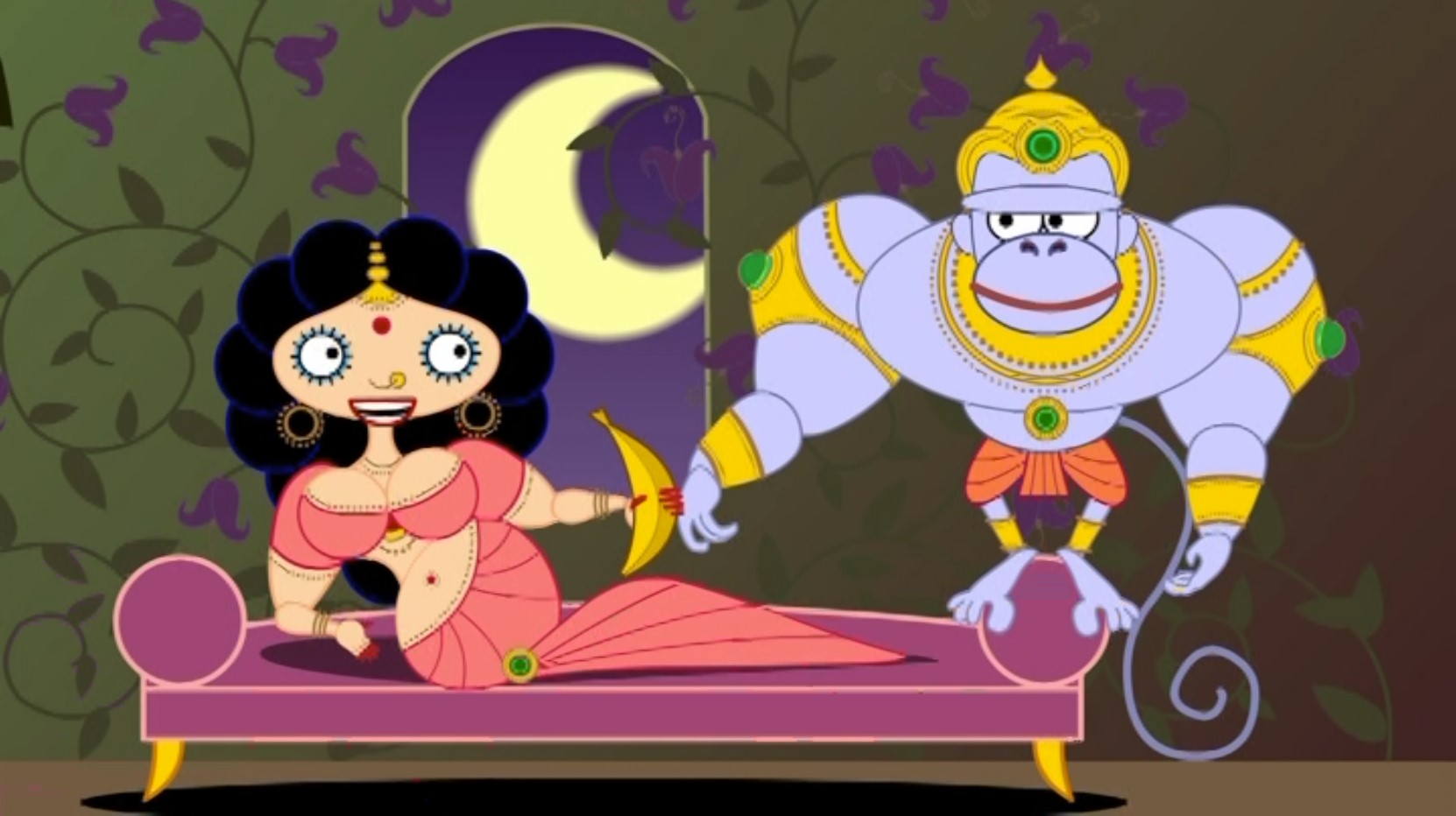
‘Sita Sings the Blues’ retells the Indian epic ‘The Ramayana’, but it’s also a personal film, in which Paley links her own situation to that of Sita, the perfect wife to the hero Rama. The most incongruous element are the eleven songs by 1920s jazz singer Annette Hanshaw, an artist sadly almost forgotten, whom Paley had discovered prior to the film making. The linking of these sweet and gentle tin pan alley songs to the Ramayana is as odd as it is effective, and the pairing certainly contributes to the uniqueness of the film.
The film uses several different animation styles: Nina Paley’s own personal story is told in a traditional scribbly animation style, with sets based on photographic material. These parts are the least attractive of the lot, even though Paley shows to be a very able animator in this classic cartoon style. The Ramayana is retold by three Indians (Aseem Chhabra, Bhavana Nagulapally and Manish Acharya) who are depicted as traditional shadow puppets of Hanuman, Sita, and Rama, respectively. The story they are telling together is shown in tongue-in-cheek cut-out animation.
The ‘official’ story is also told in cut-out animation, using very attractive recreations of traditional Indian paintings. But the best parts to look at are the songs, which are done in a most attractive cartoon modern design. In these song parts Paley reuses a lot of animation cycles, but actually she makes excellent use of the flash medium, and she makes the most of her limited animation.
Apart from these five alternating styles, there’s also a short sequence using rotoscope and a much more pop-art influenced videoclip-like filming style. All these are apparently done in Macromedia flash.
As said, ‘Sita Sings the Blues’ retells the Ramayana, reducing the huge epic to its barest elements. For example, Lakshmana is hardly mentioned, and the monkey king Sugriva not at all. Moreover, unlike the traditional poem, the focus is on Sita, not Rama, and Paley highlights the questionable parts from the original poem (one at the end of the Yuddha Kanda, and another in the Uttara Kanda), in which Rama treats Sita very unfairly indeed, just like Paley’s own partner does in real life. This makes ‘Sita Sings the Blues’ a feminist film, which sheds a welcome critical light on the traditional depiction and treatment of women, then and now.
As the story is told by three people, who remember the story differently and interpret it in different ways, this leads to some very funny moments. But Paley adds some humor, too, in the ‘official’ story part, for example when the female rakshasa (a sort of demon) Shurpanakha tells her brother Ravana about the beauty of Sita, comparing all her body parts with lotuses.
As said, the Annette Hanshaw songs boast the most attractive designs, and like traditional opera arias, they shed an emotional light on the events. However, Paley cleverly propels the story forward even during these sequences. Yet, as the songs are featured in their entirety, typically lasting ca. 3 minutes, they also drag the film down. As there are eleven of them, one tends to grow a little weary of them as the film progresses. Nevertheless, ‘Sita Sings the Blues’ does a great job in restoring interest in this almost forgotten singer. Unfortunately, the Hanshaw songs were not free from copyright, causing Paley a lot of trouble, and eventually causing her to release the film completely free from copyright.
The Annette Hanshaw songs are juxtaposed to some Indian pop music, mostly by artist Masaladosa. Particularly strong is the angry song which follows the scene in which Paley gets dumped by email. The complete soundtrack is as attractive as the film’s visual designs, and the two complement each other very well.
In all, ‘Sita Sings the Blues’ is not without its flaws, but as it is made by a single woman, it’s no less than a tour-de-force, and the result is a very interesting personal film, which makes one think. Moreover, the film shows the great power and endless possibilities of animation, and single-handedly puts Paley into the pantheon of the medium’s greats. In 2018 Paley made yet another feature called ‘Seder-Masochism’, which unfortunately has attracted much less attention.
Watch the trailer for ‘Sita Sings the Blues’ yourself and tell me what you think:
‘Sita Sings the Blues’ is available on DVD
Director: Trey Parker
Release date: June 30, 1999
Rating: ★★★★★ ♕
Review:
The South Park television series was only midway in its third season when its first (and only!) theatrical feature film was released. Thus, the film contains many of the quirks so typical of the earliest seasons but long since forgotten, like Kenny’s obligatory death, Kyle performing the act of ‘kick the baby’ with his little brother Ike or Stan compulsory vomiting on meeting Wendy.
Also prominent are characters that years ago have disappeared from the sitcom like Chef and Mr. Hat. Moreover, Cartman’s personality as a complete and pretty evil ass is not yet defined here, and although he’s already a jerk, he’s just one of the gang here.
The animation, too, retains much more of its cut-out origins than later seasons, although in the feature film the all too primitive animation is juxtaposed to a swirling 3D computer animation, especially in the hell scenes, which gives the film extra grandeur, but which would become more of a style element in later seasons of the series.
The South Park series always was at its best in social commentary, and it that respect, ‘South Park: Bigger, Longer & Uncut’ delivers big time. The film painfully clearly shows America’s obsession to prevent their children to experience anything subversive, except gun violence (incidentally by now the major death cause of American youth). It’s best not to reveal the plot, but it’s enough to know that when the kids go see the new Philip and Terrance movie ‘Asses on Fire’, things quickly go out of hand.
The film also introduces the idea that Terrance and Philip are Canadian, and that all Canadians have disjointed heads and square hands, so the difference between the designs of the main characters and that of their favorite television show turns out not be one of style, but one of ‘nature’. This ridiculous idea is played out well, and was continued in the television series, too.
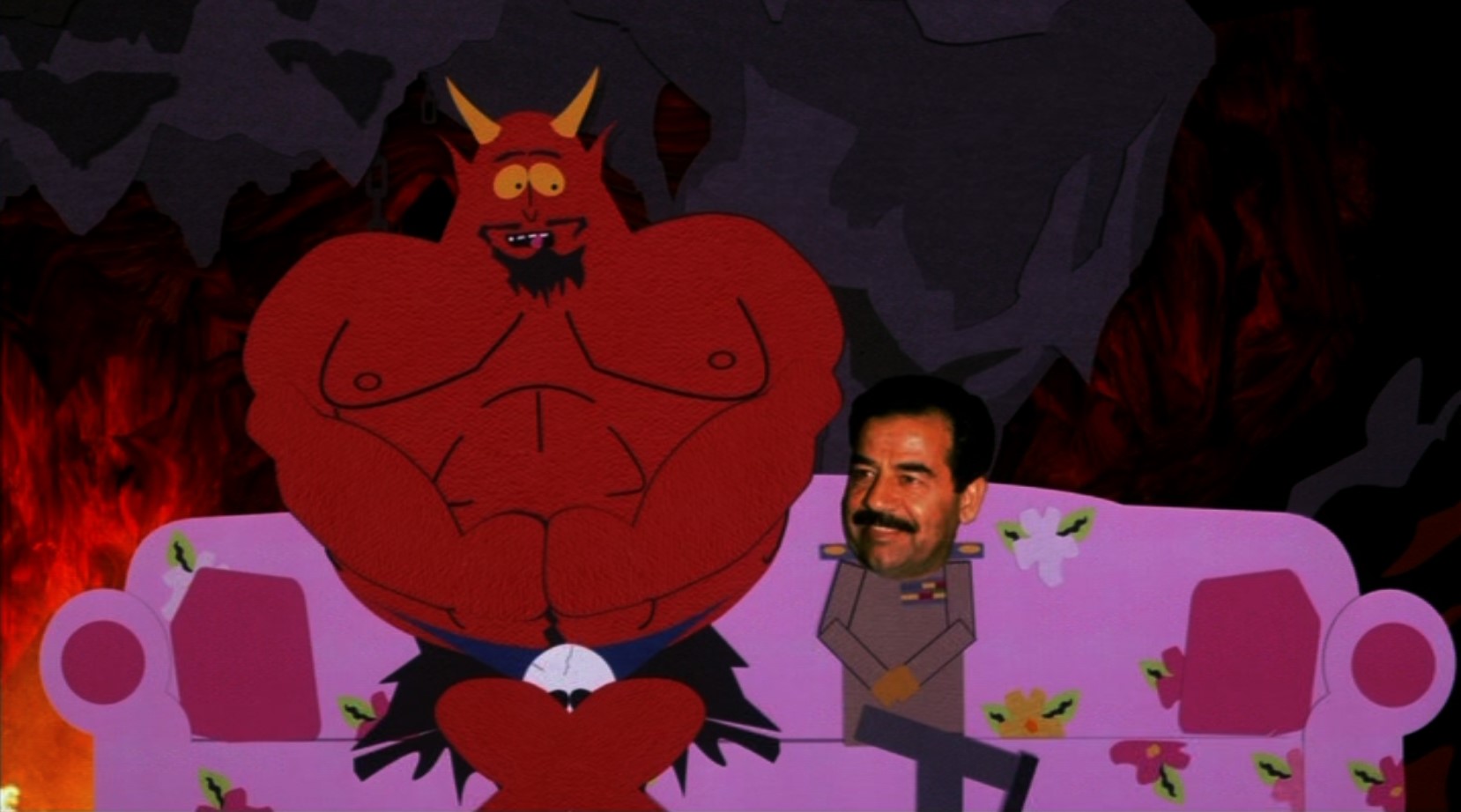
Kenny dies, of course, but for the first time we see what happens to him after his death, and quite a bit of the action takes place in hell, where Satan and Saddam Hussein get involved in the plot. Now, the Iraqi dictator was very much alive back then, and the film is a testimony of the US’ frustration they didn’t remove the villain from the office in the first Gulf War (1990-1991).
Because of Hussein Iraq was included in George Bush jr.’s nonsensical ‘Axis of evil’ (together with its arch enemy Iran), which ultimately lead to the misguided and very questionable invasion of Iraq in 2003. In ‘South Park: Bigger, Longer & Uncut’ Saddam Hussein is shown as being even more evil than Satan himself, dominating the prince of darkness in a toxic relationship. Of course, the inclusion of Saddam Hussein ages the film more than necessary, as do other references to real people, like Brian Boitano (whom I as a non-American had never heard of).
Yet, the biggest surprise of ‘South Park: Bigger, Longer & Uncut’ is not its high level of satire, nor its excellent plot, nor the introduction of elements that would become more familiar later on in the series. No, the biggest surprise of the film is that it is in fact, a musical, and a very good one at that, too. The film literally bursts with songs (there are fourteen of them), all ranging from good to excellent.
It seems Trey Parker knew exactly how to write a musical song: yes, practically all his songs are parodies of musical tropes, but his own creatures have such beautiful and memorable melodies they perfectly stand on their own. Absolutely top are ‘What would Brian Boitano do?’ and Satan’s Jesus Christ Superstar-like ‘Up there’. And then there’s a great musical moment when the Les misérables-like song ‘La résistance’ suddenly gets intermixed by four other songs, including a new one sung by soldiers, and the outstanding ‘Blame Canada’. This latter song, which was introduced much earlier in the film, is the undisputed highlight of the feature and was nominated for an academy award for best original song (which it unjustly lost to the bland ‘You’ll Be in My Heart’ Phil Collins composed for Disney’s ‘Tarzan’).
In fact, ‘South Park: Bigger, Longer & Uncut’ is so good at being a musical that it can easily be counted among the best animated musicals ever. Main composer Trey Parker, at least got on a new career as a musical writer. No, there were no other South Park movies to come, but not only did more and more songs creep into the South Park series itself, but Parker made another musical with the bizarre puppet movie ‘Team America: World Police’ (2004) and even hit Broadway with the stage musical ‘The Book of Mormon’ (2011).
In all, South Park: Bigger, Longer & Uncut’ is great satire, it’s a great musical, and it’s a great proof that feature films based on television series could (and should) be an improvement on the original series.
Watch the trailer for ‘South Park: Bigger, Longer & Uncut’ yourself and tell me what you think:
‘South Park: Bigger, Longer & Uncut’ is available on Blu-Ray and DVD
Director: Masaaki Yuasa
Release date: April 7, 2017
Rating: ★★★★★
Review:

Japan knows several distinguished animation directors, from Hayao Miyazaki to Mamoru Hosoda, but perhaps no feature director* is so original as Masaaki Yuasa. He created quite a stir with ‘Mind Game’ (2004) and kept on pouring out original work since then.
What’s striking about Yuasa’s films is that they don’t follow the general anime aesthetic, at all, on the contrary. ‘Night Is Short, Walk on’ is an excellent example in that respect. This mind-blowing feature film boasts human designs that are very different from your typical anime, highly original color schemes, more offbeat background art, interludes in a line-less style with vibrant digital coloring, wild, even grotesque animation (for example, watch people swallow in the first scene), and a highly original, almost stream-of-consciousness-like way of storytelling, using unpredictable editing techniques, and an occasional split screen, surprising camera angles, extreme perspectives, and moving background art, when necessary (there’s a very impressive example when Senpai runs up an exterior staircase).
Apart from Yuasa’s way of storytelling the plot of ‘Night Is Short, Walk on’ is highly original in its own right. The two main protagonists don’t even have names but are referred to as Otome (maiden) and Senpa (senior). We follow the two for one night, a night in which apparently anything can happen. Otome, a young woman, is ready to discover the adult world, while Senpa, who’s madly in love with her, has decided to finally express his feelings to her. Meanwhile, during this one night, both people meet a plethora of strange people, bizarre situations, and odd gatherings in a free-flowing narrative that nevertheless can be cut into four parts, which naturally flow into each other. Nevertheless, it’s best not to know anything about the plot, and just let it come to you. You’ll be in for quite a ride. What’s more, despite all its weirdness, ‘Night Is Short, Walk on Girl’ is essentially a film about love, and unexpectedly gentle despite all the mayhem surrounding the main story.
Surprisingly for such a visually stunning film, ‘Night Is Short, Walk on Girl’ is based on a novel, by Tomihiko Morimi. His novel was divided into four seasons, which explains the high number of events in the film version. Morimi was also responsible for the novel on which Yuasa’s earlier series ‘The Tatami Galaxy’ (2010) was based, and the series and ‘Night Is Short, Walk on Girl’ are very similar in visual style and general atmosphere.
In all ‘Night Is Short, Walk on Girl’ is hardly like anything you’ve seen before, and a great testimony of what can be done in animation. In my opinion this is one of the most important animation films of the decade. Highly recommended.
* There are also several highly original independent Japanese directors of shorts, e.g. Kōji Yamamura, Atsushi Wara & Mirai Mizue. Check them out!
Watch the trailer for ‘Night Is Short, Walk on Girl’ yourself and tell me what you think:
‘Night Is Short, Walk on Girl’ is available on Blu-Ray and DVD
Director: Rosto A.D.
Release date: June 10, 2011
Rating: ★★★★
Review:
One of the most virtuoso and most idiosyncratic animated film makers ever to emerge from The Netherlands was Rosto (real name Robert Stoces). His films ‘(the rise and fall of the legendary) Anglobilly Feverson’ (2002) and ‘Jona/Tomberry’ created quite a stir, the latter winning the Grand Prix Canal+ prize at the Cannes Film Festival. In these fantastic films Rosto mixed live action, puppetry, and computer animation into a seamless mix. Moreover, they showed a unique if erratic voice that was completely its own.
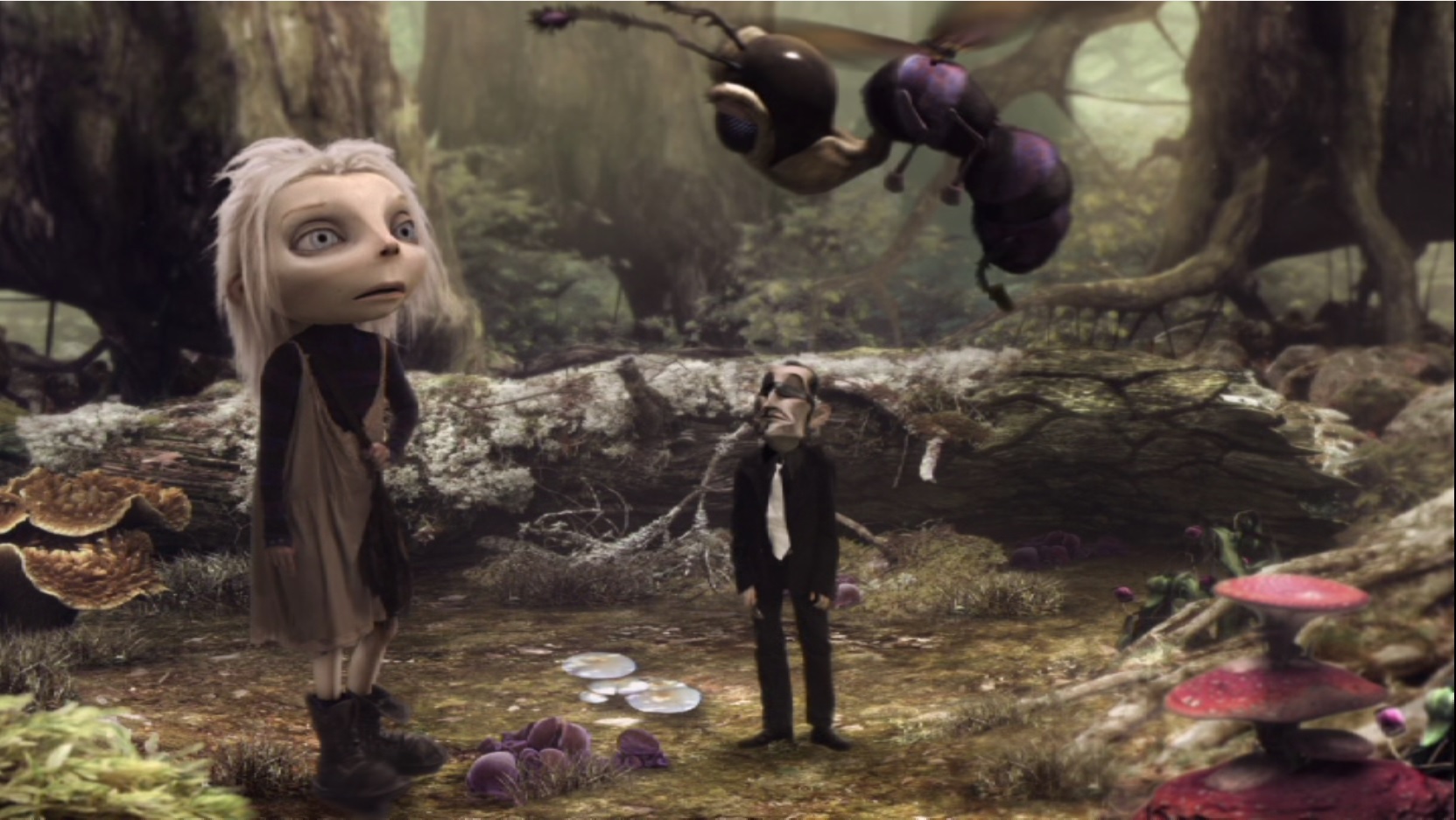
‘The Monster of Nix’, Rosto’s most ambitious project, is no different. The film lasts half an hour and took six years to make. The short is essentially a musical with a rather post-modern tale-biting story, vaguely reminiscent of ‘The Neverending Story’. The film stars a boy called Willy (based on Rosto’s own son Max and aptly voiced by Joe Eshuis), who lives with his grandmother in a small village, surrounded by woods. Short after the film starts, Willy can’t find his grandmother. Even worse, many villagers have lost people and things, so Willy goes on a quest to seek his grandma and to find the evil monster behind this, finding strange creatures like Virgil, a giant swallow with human hands for claws and the woody “langemen” on his way.
‘The Monster of Nix’ boasts collaborators like Terry Gilliam (voicing a wood ranger), Tom Waits (voicing Virgil) and The Residents (performing two songs), as well as high production values. As expected from a Rosto film, the visuals are very strange, but compelling and overwhelming, seamlessly merging live action and animation to a unique mix. There are several rock music references, which are also typical of Rosto’s style, and there’s a spooky atmosphere akin to Tim Burton.
Rosto even composed the songs himself. Unfortunately, his score is more weird than attractive, and his story isn’t entirely convincing, either, reaching a rather dead point half way, never to recover entirely. But because of its unique atmosphere the film is well worth a watch.
Sadly, Rosto died in 2019, only fifty years old. His death is a grave loss to the Dutch animation world.
Watch the trailer for ‘The Monster of Nix’ yourself and tell me what you think:
‘The Monster of Nix’ is available on DVD
Director: Henry Selick
Release Date: October 29, 1993
Rating: ★★★

Tim Burton’s ‘The Nightmare Before Christmas’ is an impressive film. Combining replacement techniques with puppets with complex armatures, computer-controlled camera movements, and a bit of drawn animation, Burton’s team takes the art of stop-motion to new heights.
Moreover, the film is surprisingly elaborate, and uses nineteen stages, 230 sets, sixty characters, and hundreds of puppets to tell its story. The opening scene alone is a tour-de-force of mind-blowing images, with too much happening to register it all.
The result is a stop motion film with the highest production values thus far, and simply bursting with stunning visuals. Together with Aardman’s ‘The Wrong Trousers’ from the same year the feature easily sets new standards for stop-motion.
So why don’t I give this film a five-star rating? The main reason is the songs. ‘The Nightmare Before Christmas’ was made at a time when American animation film practically equaled musical, but even so in this film soundtrack composer Elfman takes the musical idea to the max. There are no less than eleven songs within the 68 minutes the feature lasts, taking a staggering 43% of the screen time.
But Elfman is no Alan Menken, and all his songs are terribly meandering and forgettable, slowing down the action, with characters halting to express their emotions, like in a Baroque opera.
Low point arguably is Sally’s song, which could have been a moving expression of feelings, but turns out to be an all too short and completely aimless bit of music, lasting only 96 seconds. If one compares Elfman’s absent song-craft to the strong melodies of Menken’s ‘Beauty and the Beast’ (1991) or ‘Aladdin’ (1992), it becomes clear that Elfman’s efforts don’t add to the story, but drag it down, to a point that one screams to be freed from the omnipresent singing.
The film is typical Burton with its friendly take on horror, and Burton’s head animator Henry Selick rightly calls the film’s overall style a mix of “German expressionism and Dr. Seuss”. Selick and his team manage to make Burton’s pen and ink drawings come to life in believable puppets, despite the often very long limbs and unsteady balance of some of the characters.
With this animation effort Selick turned out to be a strong new voice in the animation field, and after ‘The Nightmare Before Christmas’ he continued to impress, first with ‘James and the Giant Peach’ (1996), then with ‘Coraline’ (2009), although his feature ‘Monkeybone’ (2001) was much less of a success.
Burton’s story is based on an original idea, but is not worked out too well. The idea of Holiday lands is a good one, but how does one return from Christmas land to Halloween land? And there is a focus problem: ‘The Nightmare Before Christmas’ follows two main characters, Jack Skellington and Sally, without choosing one as its principal character.
Jack is a bit of a problematical character anyhow: he’s king of his land, but remarkably bored, and he’s willing to take a huge risk to fill his own feelings of emptiness. Moreover, his selfish plans means a year without Halloween, not to mention the disastrous Christmas he makes. Jack does develop during the film, but his remorse and recovery come too quickly to be entirely convincing.
In the end, it’s Sally who turns out to be the most interesting character of the two: when we first watch her, she literally falls apart. She’s controlled and hold back by her maker, the possessive Dr. Finkelstein, and naturally very shy, but during the movie she becomes bolder and more venturous.
The film’s villain, The Bogeyman, is scary, but his role in Burton’s universe is obscure: why is he the only nightmarish character that is genuinely scary and unfriendly? I have no idea. A nice touch are the Cab Calloway influences on this character. He even literally quotes Calloway when saying “I’m doing the best I can” like Calloway did in the Betty Boop cartoon ‘The Old Man from the Mountain’ (1933).
The film’s story flaws would certainly be forgivable, given the film’s stunning visuals, if it were not for the songs. The biggest problem of ‘The Nightmare Before Christmas’ remains its unappealing soundtrack, reducing an otherwise fantastic film into a hardly tolerable one. An immense pity, for one remains wondering what the film could have been if it had not been the obligate and ugly musical it turned out to be.
Watch an excerpt from ‘The Nightmare Before Christmas’ yourself and tell me what you think:
‘The Nightmare Before Christmas’ is available on DVD and Blu-Ray
Directors: Roger Allers & Rob Minkoff
Release Date: June 15, 1994
Rating: ★★★★★ ♕

When ‘The Lion King’ was released I went to see the film three times in a row. At the time I lived on the tiny Caribbean isle of Tobago, and I went three times, partly because there was little else to do, partly because the film would disappear from the screen in ca. five days, anyway, but most importantly because the film made a deep impression on me. Strangely enough, I hadn’t seen the movie since, so after 25 years it has become high time.
Luckily, the film holds up very well after all these years. Indeed, not only was ‘The Lion King’ the highest grossing animation film thus far on its release, the movie still is one of the most popular animation films of all time. For example, it takes place 34 at IMDb’s top rated movie, as the second animated movie, after ‘Spirited Away’ on place 27, checked on November 21, 2020).
In that regard ‘The Lion King’ can be seen as the pinnacle of the Disney renaissance, because it tops an excellent row of Disney features (‘The Little Mermaid’ from 1988, ‘Beauty and the Beast’ from 1990, and ‘Aladdin’ from 1992), while the subsequent Disney movies of the nineties, while still good, would not reach the same heights again, nor stir the same sensation as these first four features did.
According to Mark Mayerson in ‘Animation Art’ this was partly because Disney’s success “caused other companies to start producing animated features. This diluted the talent pool and forced up wages and budgets” prompting management to interfere more in the film making process. Mayerson also detects pretentiousness and a lack of warmth in these later pictures (Animation Art, p. 305).
What certainly didn’t help was Toy Story’s big hit in 1995, suddenly shifting the future of animation from traditional to computer generated animation, a process that more or less was completed ten years later, after which traditionally animated features would become extremely rare, at least in the United States.
Indeed, even in ‘The Lion King’ one of the biggest stirs among audiences (including me) was the computer generated stampede of wildebeests. This tour-de-force of computer animation was an impressive feat on the big screen, and though computer animation has been pushing the envelope ever forward since, the scene still holds up today, interestingly partly because the wildebeests are based on hand drawn designs.
There are more technical stunts to be found in ‘The Lion King’, both aided by the computer and not. Especially the opening scenes are literally stuffed with them, showing a sequence of mind-blowing images of African nature to the song ‘The Circle of Life’.
But much more impressive in the end is the character animation, which is top notch throughout, and which has an apparent effortlessness to it that never ceases to amaze. Especially the work by Andreas Deja and his team on Scar is impressive, making him a worthy successor of that other outstanding feline villain of the silver screen, Shere Khan (Jungle Book, 1967), greatly helped by his voice artist Jeremy Irons, who gives the character the perfect mix of self-pithy, sarcasm and sinister slyness.
Another stand out in the voices are Mufasa’s voice, which is deep and commanding, yet fatherly and compassionate, and which is provided by James Earl Jones of Darth Vader fame. Yet another is Whoopi Goldberg as the leader of a villain trio of hyenas.
Being a nineties Disney film, ‘The Lion King’ of course is a musical, a genre that certainly is not my favorite, but I must admit that Elton John’s and Tim Rice’s songs hold up very well, greatly aided by the imagery. ‘The Circle of Life’, as said, makes an impressive opener; ‘I Just Can’t Wait to Be King’ is spiced by very bold colors, and stylized background art (as well as anteaters, which do not occur in Africa – a strange and unnecessary error); Scar’s song ‘Be prepared’ is accompanied by evil greens and purples in a clear echo of Maleficent in ‘Sleeping Beauty’ (1959), and the love ballad ‘Can You Feel the Love Tonight’ is rescued from sappiness by the inclusion of Timon and Pumbaa mourning the loss of their friend. All these songs propel the story forward, none more so than the best song of all, ‘Hakuna Matata’, which neatly changes the infant Simba into the adult one.
Which brings me to the main reason the film still is a great classic: it’s told so well. The pace of the film is almost flawless, with exciting and more relaxing scenes distributed in perfect fashion. The only implausible scenes come at the end of the film: first there is Rafik’s all too simple cure of Simba’s guilt complex. I bet many psychiatric patients would die for such a quick resolution of their youth inflicted mental problems. Moreover, this scene includes a very unconvincing mystical dialogue between Simba and his deceased father. The finale uses two little too evident symbols of change and renewal (fire and rain), and how Simba manages to turn the wasteland of his kingdom into a prosperous country again remains an utter mystery.
Nevertheless, the guilt that haunts Simba makes him an interesting and relatable lead character – like Aladdin he isn’t a flawless hero. And while it’s understandable that he embraces Pumbaa’s and Timon’s relaxed lifestyle, it clearly cannot cure him from the haunts of his past. He just has to face them in the end, which means he has to overcome his biggest fears and insecurities.
It’s a great feat that the film makers have managed to weave such a deep theme into the more classic usurper tale, which is notably dark: we watch both a murder and a dead body on the screen, in what must be the most harrowing scene in a Disney animation film since the death of Bambi’s mother in ‘Bambi’ (1942), the film with which ‘The Lion King’ has most in common: both follow the main protagonist in his youth and in his adult life, both depict a very romantic concept of nature, and both have ‘the circle of life’ as their main theme, with ‘The Lion King’’s opening and closing scenes being undisputed echoes of the closing scene of the classic from the 1940s.
Because ‘The Lion King’ is a rather serious tale, it’s a little low on comedy. Indeed, there are very few real gags in this film, one of them unusually self-parodying: at one point a caged Zazu (Rowan Atkinson) starts singing ‘it’s a small world after all’, which immediately prompts Scar in an anxious ‘No, no, anything but that!’. The other great gag of the movie is when Timon refers to the sad Simba as ‘He looks blue’, on which Pumbaa replies ‘I’d say brownish gold’. That said, the film is absolutely balanced in its mix of humor and drama, and never becomes heavy-handed.
In all, ‘The Lion King’ has hold up after these 25 years, and has his rightful place as one of the greatest films of all time, animated or not. And I seriously wonder why a remake was at all necessary or welcome, for in my opinion the original cannot be topped.
Watch the trailer for ‘The Lion King’ yourself and tell me what you think:
‘The Lion King’ is available on DVD and Blu-Ray
Director: Tim Burton & Mike Johnson
Release Date: September 23, 2005
Rating: ★★★★
Review:
 The shy Victor and Victoria are forced by their unsympathetic parents to marry each other.
Luckily, they actually like each other, but then Victor accidentally marries the deceased Emily who takes him to a world underground, while Victoria is forced to marry the evil lord Barkis…
‘Corpse Bride’ is a typical Tim Burton film, especially in its art direction, in its 19th century, gothic setting, in its dark humor, and in its jolly portrait of death. Because the film is also a Danny Elfman-penned musical, it feels like a successor to ‘The Nightmare before Christmas‘ (1993). Nevertheless, it is far more enjoyable than that sometimes tiresome film: ‘Corpse Bride’ features only three songs, two of which help to tell the story. So, even though one could do without the musical element, it doesn’t dominate the complete film.
Also, the art of ‘Corpse Bride’ is a great improvement on ‘Nightmare before Christmas’. The dull greys and blues of the living world contrast greatly with the vivid colors of the underworld, which is clearly more fun to ‘live’ in. The designs of the puppets are extreme, and their almost flawless animation is jawdroppingly rich and expressive. The story is lean, and focuses on the three protagonists, Victor, Victoria and Emily, who all three are very likable characters. The voice cast is impressive, and includes Johnny Depp (Victor), Emily Watson (Victoria), Helena Bonham Carter (Emily) and Christopher Lee (Pastor Gallswells).
All this make ‘Corpse Bride’, together with that other stop-motion film ‘Wallace and Gromit: the Curse of the Were-Rabbit‘, the best animated feature of 2005/2006, surpassing all computer animated films of those years. It proves that traditional animation is still viable and relevant in the computer age.
Watch the tailer for ‘Tim Burton’s Corpse Bride’ yourself and tell me what you think:
Director: Wilfred Jackson
Release Date: September 16, 1933
Rating: ★★★★
Review:

‘The Pied Piper’ is a vivid re-telling of the original fairy tale in operetta fashion.
Thus ‘The Pied Pier’, together with ‘King Neptune‘ (1932) and ‘Father Noah’s Ark‘ (1933), belongs to the operetta- like Silly Symphonies. In its score, composed by Leigh Harline, practically all dialogue is sung, making ‘The Pied Piper’ an animated mini-opera.
Its human designs are way more detailed and anatomically correct than in ‘King Neptune’ or ‘Father Noah’s Ark’, making these two films looking old-fashioned, already. Disney was advancing towards the later realism of ‘Snow White and the Seven Dwarfs’ (1937) with a lightning speed…
Unfortunately, at the same time, a sugary approach is unleashed, as well. For example, the rats are not drown, but caught in an imaginary cheese. Likewise, the children, who are depicted as virtual slaves in Hamelin, do not just disappear, but they’re lured into ‘Joyland’, where even the crippled get cured. So, in the end, practically no harm is done to anyone.
And so, like the contemporary ‘Lullaby Land‘, ‘The Pied Piper’ is a strange mixture of ever advancing animation and rather infantile material. A great deal of the remaining Silly Symphonies would share this mixture, and even Disney’s first features, like ‘Snow White and the Seven Dwarfs’ and ‘Bambi‘ (1942) are not immune to it.
The children designs used here would pop up in numerous sugary cartoons from the 1930s, including those from other studios. And, unfortunately, there would be a lot of them…
Watch ‘The Pied Piper’ yourself and tell me what you think:
This is Silly Symphony No. 39
To the previous Silly Symphony: Lullaby Land
To the next Silly Symphony: The Night before Christmas
Director: David Hand
Release Date: June 29, 1935
Rating: ★★★★★ ♕
Review:
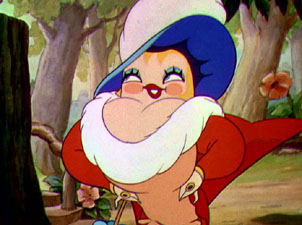 ‘Who Killed Cock Robin?’ is a musical mystery very loosely based on the nursery rhyme of the same name. Its source material notwithstanding, ‘Who Killed Cock Robin’ is the most adult Silly Symphony ever made.
True to the Silly symphony concept, all characters either sing or speak in rhyme to Frank Churchill’s music (with Jenny Wren’s sensual blues as a highlight), but in a bare seven minutes the cartoon manages to mock both the law, racialism and gay people, while displaying an unusual eroticism through Jenny Wren, who is a very fine caricature of famous Hollywood actress Mae West, a tour de force by Joe Grant (design) and Hamilton Luske (animation).
These features are especially striking when one bears in mind that the Hays Code was already active in 1935. Due to his self-censorship of the movie industry sex and violence were banned from the movies. To illustrate its effect: due to this code an erotic cartoon character like Betty Boop had to be tuned down and was turned into a goody-goody and quite a bland character. Yet, ‘Who Killed Cock Robin’ displays its satire and eroticism in full glory.
When Cock Robin has been shot by a mysterious shadow, the Keystone Cop-like police randomly arrests some bystanders: a tough-looking guy, a black bird (in those days blacks were easily arrested just because of their color) and a cuckoo who resembles Harpo Marx. They’re treated very roughly, being knocked by the cops almost all the time. And when Jenny exclaims that justice should be done, the judge simply orders to hang all verdicts even though nobody knows who’s guilty!
It’s Cupid, an obvious caricature of a homosexual, who prevents this cruel sentence. Cock Robin appears to be alive, and finally he and Jenny Wren reunite in a hot kiss. Thus ends one of the most spectacular cartoons of the 1930s.
Watch ‘Who Killed Cock Robin?’ yourself and tell me what you think:
This is Silly Symphony No. 54
To the previous Silly Symphony: The Cookie Carnival
To the next Silly Symphony: Music Land
Director: Burt Gillett
Release Date: April 8, 1933
Stars: Clarabelle Cow, Goofy, Mickey Mouse, Minnie Mouse
Rating: ★★★★½
Review:
 Mickey and the gang are staged in many different times and places in their cartoons. Yet, this medieval short is the only cartoon in which they are introduced as actors performing their parts.
This idea of Mickey being an actor was first coined in ‘The Wayward Canary’ (1932) and played out to the max in ‘Mickey’s Gala Premier’ (1933). This cartoon nevertheless is played without any awareness of the public.
Minnie is the princess of Lalapazoo, and forced by her father to marry prince Goofy from Pupupadoo. Minnie refuses and is locked up in the high tower. Fortunately, there is minstrel Mickey to save her and to battle the evil prince, chasing him through the window, and marrying the princess himself. This adventure film cliche Disney already had visited in the Oswald cartoon ‘Oh, What A Knight‘, but it is expanded and improved in ‘Ye Olden Days’.
Like ‘Building a Building’ and ‘The Mad Doctor’ from the same year, this cartoon is partly a musical with lots of parts sung. It also contains a very anachronistic guillotine and an elaborately designed horse that shows the aspirations of the studio to master more lifelike designs and animation.
Goofy, who is introduced as Dippy Dawg, is quite miscast here, playing the villain, whom he acts out more sillily than threateningly. It seems that the animators didn’t really know what to do with the character, so far only funny because of his typical voice. So, after this film they dropped him for more than a year.
Watch ‘Ye Olden Days’ yourself and tell me what you think:
This is Mickey Mouse cartoon No. 55
To the previous Mickey Mouse cartoon: Mickey’s Mellerdrammer
To the next Mickey Mouse cartoon: The Mail Pilot
Director: Wilfred Jackson
Release Date: April 8, 1933
Rating: ★★★½
Review:
 The biblical story of Noah has been quite popular with the Disney Studio: it has retold the story three times on film .
‘Father Noah’s Ark’ is its first version, the others are a stop motion film from 1959 (‘Noah’s Ark‘) and a sequence from ‘Fantasia 2000’ featuring Donald Duck.
This cartoon belongs to Disney’s operetta phase (see also ‘King Neptune‘) and tells the age old story as a musical, including some gospel singing. The story is quite straightforward and the short contains only a few mild gags, the best of which are in the building sequence, e.g. the wives using an assembly line of porcupines and some monkeys using a rhinoceros to make planks out of a log.
The designs seem to be halfhearted: Father Noah’s sons look ridiculously cartoony, wearing Mickey Mouse type gloves, for instance. His sons’ wives, on the other hand, are designed in art deco fashion.
The animals, too, are in different stages of naturalism, but the cows portrayed are much more realistic than the ones featured in the Mickey Mouse shorts of the same time. Moreover, when the animals flee into the ark, we see some unprecedentedly realistic giraffes, sealions and lions.
The most stunning naturalism is found in the animation of the sea when the ark is at the mercy of the waves. This is a spectacular scene by any standards. The storm part also features a complex scene of several animals rolling from side to side. There’s a good sense of weight in this sequence, with the elephant moving last.
Watch ‘Father Noah’s Ark’ yourself and tell me what you think:
This is Silly Symphony No. 35
To the previous Silly Symphony: Birds in the Spring
To the next Silly Symphony: Three Little Pigs


 Dr. Grob's Animation Review