
You are currently browsing the tag archive for the ‘Norman McLaren’ tag.
Directors: Norman McLaren & Evelyn Lambart
Release date: 1965
Rating: ★★★★
Review:
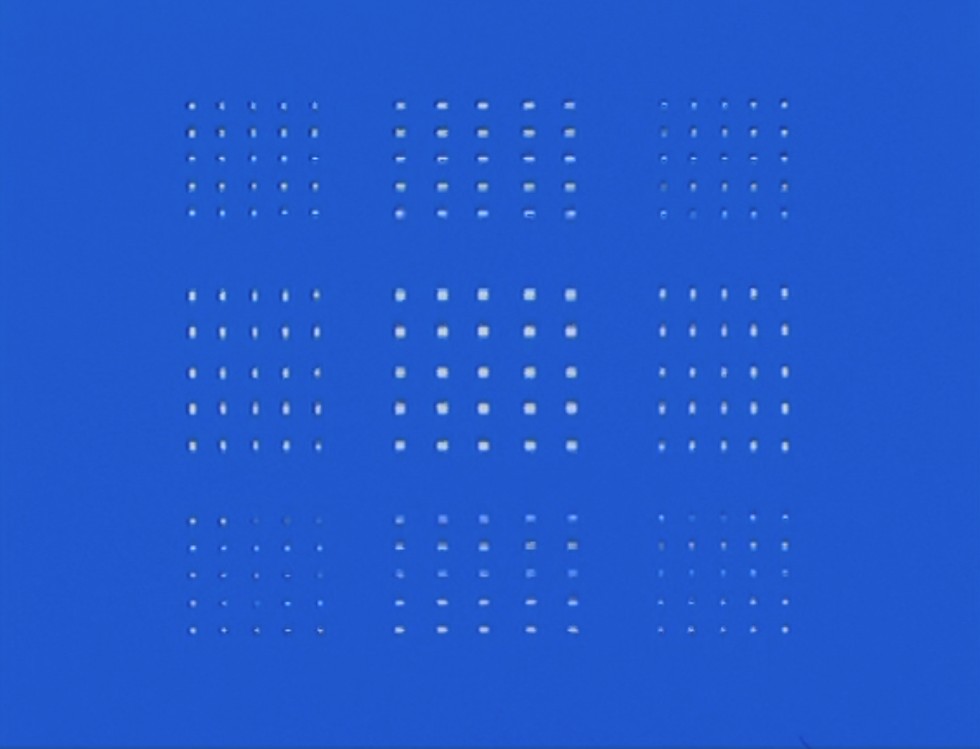
‘Mosaic’ starts with Norman McLaren himself entering an empty stage with a ball, while whistling. When he places the ball in empty air, it soon turns into a dot, which quickly splits into four dots, then nine, then sixteen and so on, until very complex patterns of dots fill the screen. The result is somewhat like a moving Piet Mondriaan painting, with the dots forming endless patterns, which change color over time.
It’s thanks to McLaren’s and Evelyn Lambart’s geniuses that this highly abstract film remains entertaining throughout, and seems to follow some inner logic. Indeed, McLaren himself said that ‘Mosaic’, like ‘Lines Vertical‘ and ‘Lines Horizontal‘ followed the structure of Hindu classical music, which also start with an easy pattern (a raga), which becomes increasingly complex and fast moving.
Watch ‘Mosaic’ yourself and tell me what you think:
‘Mosaic’ is available on the DVD-box ‘Norman McLaren – The Master’s Edition’
Directors: Norman McLaren & Evelyn Lambart
Release date: 1962
Rating: ★★★
Review:

‘Lines Horizontal’ is essentially ‘Lines Vertical‘ from 1960, but turned 90 degrees, re-colored and with a new, rather folky soundtrack by Peter Seeger. Even though the patterns are essentially the same, the result feels like a new film, especially because the horizontal lines cause some different effects to the eye, like creating non-existent triangles.
‘Lines Vertical’ and ‘Lines Horizontal’ both are extreme films in that they only use parallel lines, but Norman McLaren and Evelyn Lambart are able to turn this extreme concepts into intriguing films, thanks to their timing and overall structure, which follows an inner logic.
Watch ‘Lines Horizontal’ yourself and tell me what you think:
‘Lines Horizontal’ is available on the DVD-box ‘Norman McLaren – The Master’s Edition’
Director: Norman McLaren
Release date: 1961
Rating: ★★★½
Review:

‘New York Lightboard’ is a direct-on-film animation film that was never meant for the cinema. Instead, it was a commercial film commissioned by the Canadian Governmental Tourism Office to be projected in an endless loop on a big screen on Times Square in New York City.
The film is both in black and white and silent, but McLaren makes the commercial a very playful one, with letters bouncing and playing with each other, and metamorphosis running wild (we watch. e.g. the letters Canada change into a fish, which turns into a bird, which becomes a smiling sun, etc.).
Most of the film is pretty abstract, but there’s also some fine animation of swimming fish, a galloping horse, a man in a canoe and of Hamlet and Laertes fighting. Apart from the words Canada and ‘Dial PL 7-4917’ (for more information), the most recurring elements are animated fireworks.
The whole film seems a little too playful and too experimental for a general audience, but it certainly must have drawn attention. There’s also a short equally silent documentary called ‘New York Lightboard Record’ in which we watch the film on a screen on Times Square, and some of the responses of the audience watching it.
Watch ‘New York Lightboard’ & ‘New York Lightboard Record’ yourself and tell me what you think:
‘New York Lightboard’ and ‘New York Lightboard Record’ are available on the DVD-box ‘Norman McLaren – The Master’s Edition’
Director: Norman McLaren
Production date: March 17, 1966
Rating: ★★★
Review:

‘The Seasons’ is an unfinished film in which Norman McLaren tried to emulate the Canadian landscape in several moving paintings.
The ever changing pastel paintings never cease to amaze, with their metamorphosis of clouds, seascapes and landscapes, but McLaren deemed the film too abstract to entertain and never finished it. Thus, we are left with loose images without a soundtrack, and indeed, in this state, the result is still a little too boring to sit out, despite its short length of only four minutes. And yet, the images themselves are so beautiful it’s a pity this short never reached a final state.
‘The Seasons’ is available on the DVD-box ‘Norman McLaren – The Master’s Edition’
Director: Norman McLaren
Production date: ca. 1961
Rating: ★
Review:

This unfinished film from ca. 1961 must be the most extreme Norman McLaren ever made. In fact this is one of the most extreme films in the entire history of cinema. The film consists of a black and a white image only that are altered in different rhythms to cause a flickering effect. The electronic soundtrack matches the flickering.
It’s a testimony of McLaren’s genius that even such an extreme film contains some rhythm and variation, and even a sense of a build-up, but the idea remains too extreme to be entertaining, and the continuous stroboscope effect quickly wears done the viewer.
‘The Flicker Film’ is available on the DVD-box ‘Norman McLaren – The Master’s Edition’
Directors: Norman McLaren & Evelyn Lambart
Release Date: 1960
Rating: ★★★½
Review:

‘Lines Vertical’ is one of the most extreme films Norman McLaren ever made.
Together with collaborator Evelyn Lambart he manages to make a film consisting of vertical lines only, made directly on film. The whole film consists of white vertical lines moving across the screen against monochrome backgrounds. The film starts with one line, then two, then three, and so on, until ca. twenty lines fill the screen in a constant ballet.
At one point the lines get a three-dimensional quality, resembling rotating columns. The movements of the lines follow Maurice Blackburn’s serene score, which is clearly inspired by Chinese classical music. It’s a testimony of the genius of both McLaren & Lambart that they can even pull off such a boring concept, and turn it into a successful film, even if it’s not the most engaging one.
Watch ‘Lines Vertical’ yourself and tell me what you think:
‘Lines Vertical’ is available on the DVD-box set ‘Norman McLaren – The Master’s Edition’
Director: Norman McLaren
Release Date: 1959
Rating: ★★★½
Review:
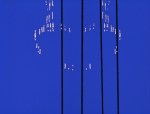 In ‘Short and Suite’ a jazzy score for clarinet, piano and double bass by E. Rathburn is interpreted by dots, shapes and lines, scratched directly on film.
The film knows no narrative, and is highly abstract, but at one point one can clearly see flowers and even human shapes. The film consists of several episodes, following more or less frantic parts within the score. McLaren’s images are very well-timed to the music, and the shapes get extra dimensions by the shadows they cast on the black and monochrome backgrounds.
‘Short and Suite’ may not be among McLaren’s best, it’s still a nice example of his great art.
Watch ‘Short and Suite’ yourself and tell me what you think:
‘Short and Suite’ is available on the DVD-box set ‘Norman McLaren – The Master’s Edition’
Director: Norman McLaren
Release Date: 1959
Rating: ★★★
Review:
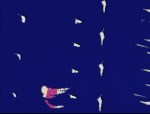 ‘Serenal’ is a film made directly on film and set to a Caribean score by the Grand Cunucaya String Orchestra Trinidad.
The images consist mostly of purely abstract shapes flashing on a black screen. The shapes are very rough, but surely colorful (the film was hand-colored), and the end result is a nice piece of abstract expressionism, if still one of McLaren’s less engaging films.
Watch ‘Serenal’ yourself and tell me what you think:
‘Serenal’ is available on the DVD-box set ‘Norman McLaren – The Master’s Edition’
Director: Norman McLaren
Release Date: 1959
Rating: ★★★★
Review:
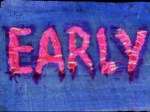 ‘Mail Early for Christmas’ is a short commercial, the message of which is in the title.
Set to a rather loud dixieland score McLaren has put his expressionistic and frantic direct-on-film style into action to make this message come across. The film lasts only 39 seconds and was made in chronological order, without any cuts. The film thus has a very spontaneous feel and features all kinds of abstract shapes splashing from the screen. In between we can see the words ‘Mail early for Xmas’ appearing and disappearing again.
It’s a wonder that such avant-garde film making was used for a message directed at such a general public.
Watch ‘Mail Early for Christmas’ yourself and tell me what you think:
‘Mail Early for Christmas’ is available on the DVD-box set ‘Norman McLaren – The Master’s Edition’
Director: Norman McLaren
Release Date: 1958
Rating: ★★★★
Review:
 ‘Le Merle’ is based on a French-Canadian addition song, in which a blackbird loses body parts, but regains them manyfold.
Sung by le trio lyrique, this spirited song is illustrated by cut-out animation of the simplest shapes, which together form the bird, which hops and flies around. However, during the film the bird undergoes constant metamorphosis, forever changing into pure abstract patterns and back again, and losing and gaining body parts, following the song closely. All the action takes place against a simple surreal, but long vertical background, which suggests that during the song the bird moves skyward, past the clouds and into a starry night. There’s also a mind-blowing scene in which the bird travels through the starry space.
‘Le Merle’ is as mesmerizing as it is pure fun. The film takes the cartoon modern style to the max in its elementary designs, and must be counted among McLaren’s masterpieces.
Watch ‘Le Merle’ yourself and tell me what you think:
‘Le Merle’ is available on the DVD-box set ‘Norman McLaren – The Master’s Edition’
Director: Norman McLaren
Release Date: 1956
Rating: ★★★★
Review:
 With ‘Rythmetic’ McLaren attempted to make arithmetic more fun for children.
Indeed, the complete film consists of additions and subtractions of numbers up to 8. The white numbers slowly fill the blue screen, accompanied by McLaren’s trademark rhythmical electronic sounds, which he made by scratching directly on film.
The complete film may be a little dry, it is nevertheless surprisingly playful, especially given the fact one watches only one blue screen filling with numbers and equations. McLaren manages to evoke something human in those numbers, through subtle animation. For example, in the end some zeros start fooling around, disrupting the equations, much to the distress of some equation marks who repeatedly try to get the zeros back in line. This finale in itself is so much fun to watch, it alone makes watching the film worthwhile.
Watch ‘Rythmetic’ yourself and tell me what you think:
‘Rythmetic’ is available on the DVD-box ‘Norman McLaren – The Master’s Edition’
Director: Norman McLaren
Release Date: 1938
Rating: ★★★½
Review:
 ‘Mony a Pickle’ is a compilation film for the British ‘General Post Office’, made by several directors. In his contribution Norman McLaren turns to his homeland Scotland to tell a story about a poor young couple, still living with their family, but dreaming of a place of their own.
The dream sequence transforms the poor and crowded living room into a new stylish one, and uses a lot of stop motion of furniture. There’s a humorous sequence in which the two lovers argue about the legs of a table, which change back and forth for our very eyes. Unfortunately, in the end a little brother scatters all their dreams and puts them back into reality again.
‘Mony a Pickle’ is a nice blend of live action and stop-motion. The stop motion sequences in a long tradition of furniture animation, which started with Stuart J. Blackton’s ‘The Haunted Hotel’ (1908). McLaren’s animation is not too remarkable, but effective, and completely in service of the story.
‘Mony a Pickle’ is available on the DVD-box set ‘Norman McLaren – The Master’s Edition’
Director: Norman McLaren
Production Date: 1938
Rating: ★★★★★
Review:
 In the late 1930s Scottish film maker Norman McLaren made several films for the British Post, like the promotional live action films ‘Book Bargain’ (1937) about how telephone books were made, and ‘News for the Navy’ about how letters were delivered worldwide.
Much more interesting than these films, however, is the small advertisement film McLaren made for Empire Air Mail, ‘Love on the Wing’. The film is clearly strongly influenced by the surreal movement. It uses, for example, music from Jacques Ibert’s quirky ‘Divertissement’, which was by that time only eight years old, and the film’s opening images are reminiscent of works by Max Ernst and Salvador Dalí.
In ‘Love on the Wing’ McLaren’s exploits his trademark technique of drawing direct on film, and he combines these images with beautiful painted and highly surreal backgrounds, reminiscent of the otherworldly landscape paintings by Giorgio De Chirico and Yves Tanguy.
The film tells a little love story, but is wildly associative, with metamorphosis and symbolism simply exploding from the screen. The three protagonists change into letters and back again, as well in numerous other symbols of love. So much is happening in the mere four minutes, it leaves the viewer breathless.
‘Love on the Wing’ surely must be one of the most avant-garde advertisement films ever made, and the short is without doubt McLaren’s first animated masterpiece. Unfortunately, the film displeased the authorities of the post office, and they never distributed this extraordinary short.
Watch ‘Love on the Wing’ yourself and tell me what you think:
‘Love on the Wing’ is available on the DVD-box set ‘Norman McLaren – The Master’s Edition’
Director: Oskar Fischinger
Production Date: 1930-1931
Rating: ★★★★★ ♕
Review:
 In Fischinger’s study No. 7 , made in 1930-1931, the shapes of Study No. 6 move to the 5th Hungarian dance by Johannes Brahms.
Like Study No. 6 Fischinger made this film with charcoal on paper. In this short the synchronization of music and movement is even better than in Study No. 6. Fischinger uses less diverse shapes than in No. 6, making the film more consistent. Some of them look like fluttering and folding pieces of paper.
According to William Moritz this particular film prompted four film makers into animation: Norman McLaren, Alexandre Alexeieff, Claire Parker and Len Lye. These four all became major players in avant-garde animation. This fact makes Study No. 7 one of the most important animation films in history.
Watch ‘Studie nr. 7’ yourself and tell me what you think:
‘Studie nr. 7′ is available on the DVD ‘Oskar Fischinger: Ten Films’


 Dr. Grob's Animation Review