You are currently browsing the tag archive for the ‘pacifism’ tag.
Directors: Troy Quane & Nick Bruno
Release date: December 4, 2019
Rating: ★★★
Review:

In the opening scenes of ‘Spies in Disguise’ we are introduced to young boy Walter Beckett, the son of a single mom, who’s a police officer. Walter is a ‘weirdo’ to his class mates, but secretly a genius, inventing all kinds of surprisingly peaceful weapons for his mom. Fourteen years later, he has found employment at ‘H.T.U.V.’, a non-existing American spy agency, as one of the inventors cooking up new weaponry for the organization’s spies.
Superstar among these spies is Lance Sterling. Voiced by Will Smith, Sterling is a black version of James Bond: clear-headed, cool and on the cocky side. But things quickly turn against him, when an unknown villain takes his identity, and Sterling becomes hunted by his own agency. To redeem his name, he unwillingly has to team up with Walter and his pacifist weaponry, which includes a very unlikely transformation of the hero…
‘Spies in Disguise’ was adapted from the 2009 animated short ‘Pigeon: Impossible’ and is for the most part standard spy fare, taking place in faraway places like Mexico and Venice. The buddy theme is also tried material, and there are the obligate scenes of almost every American animated feature film of the era, like the obligate breakup scene, and a ‘all hope is lost’ moment. No, the most original aspect of ‘Spies in Disguise’ lies in its strong pacifist theme. As Walter puts it: “when you fight fire with fire, we all get burned”. Even the villain, who certainly meant the worst, is spared in the end.
Artistically the film remains on safe grounds. The human designs are dull and uninspired. For example, Walter is yet another variation on ‘the clumsy young man’ design, akin to Linguini in ‘Ratatouille’ (2007) or Johnny Loughran in ‘Hotel Transylvania’ (2012), while Lance Sterling is too clearly modelled on Smith’s coolest film roles, like that of agent J in ‘Men in Black’ (1997). The rest of the designs are on the angular side, without ever venturing into bold stylization. The color palette is perhaps the most interesting aspect of the film.
Unfortunately, Blue Sky wasn’t allowed to show if it could venture into more exciting territories, because ‘Spies in Disguise’ was the last feature film by the ill-fated animation studio. When Disney bought 20th Century Fox in March 2019 it acquired the animation studio with it. Of course, Disney had no use for yet another animation studio, and thus ‘Blue Sky’ was closed in 2021, officially due to the consequences of the covid pandemic…
Watch the first trailer of ‘Spies in Disguise’ yourself and tell me what you think:
‘Spies in Disguise’ is available on Blu-Ray and DVD
Director: Osamu Tezuka
Release date: November 1962
Rating: ★★★
Review:

‘Tales of a Street Corner’ was Osamu Tezuka’s first animated film, and the first production of his company Mushi productions, which Tezuka founded in 1961, after his contract ended at Toei Animations, Japan’s most important animation studio of that time.
The film immediately shows Tezuka’s high ambitions. First, ‘Tales of a Street Corner’ is of considerable length, clocking 39 minutes. Second, its designs echo the cartoon modern style of Europe, unlike anything previous in Japan. Third, Tezuka’s storytelling is highly poetical, reminiscent of Paul Grimault, avoiding tried story cliches. Fourth, the film has a strong anti-militaristic and pacificist tone, and is more than just mere entertainment.
It’s striking to note that, unlike Tezuka’s Astro Boy television series from a year later, ‘Tales of a Street Corner’ lacks any Japanese character. Instead, the film feels very European, both in its looks and in its music. Even the town in which the story takes place is clearly European, as are the poster violinist and pianist. These two characters form the heart of a romantic tale that Tezuka spins, with other protagonists being a little mouse, a moth, and even a broken lantern and a tree.
The whole tale is set in motion when a little girl drops her teddy bear in a gutter, but Tezuka’s story is anything but straightforward, and allows for some poetic moments, as well two series of silly gags involving numerous posters. The animation ranges from full animation to zooming into still images, with everything in between, and it is quite possible that Tezuka’s choices in the complexity of animation were motivated not only by its artistic value, but also by cost reduction.
‘Tales of a Street Corner’ is certainly charming, but as would later be more often the case with Tezuka, the director wants too much within one short. In fact, the short is overlong, and it’s unclear what he wanted the resulting film to be: a children’s film? A romance? A comedy? An anti-war statement? Now, the film is all this and thus none of that at the same time. Nevertheless, ‘Tales of a Street Corner’ remains a delight to look at throughout, and with this film Japan surely entered a new phase in animation, even if the film is still copying its European models.
Watch ‘Tales of a Street Corner’ yourself and tell me what you think:
‘Tales of a Street Corner’ is available on the DVD ‘The Astonishing Work of Tezuka Osamu’
Director: Carlos Saldanha
Release date: December 10, 2017
Rating: ★★★
Review:

The classic children’s book ‘The Story of Ferdinand’ by writer Munro Leaf and illustrator Robert Lawson appeared in 1936, and already in 1938 Walt Disney turned, quite faithfully, the story into an animated short called ‘Ferdinand the Bull’.
Of course, for its twelfth feature length film the Blue Sky studio had to expand the story. Like in the book and like Disney’s film Ferdinand is a flower loving bull who refuses to fight, but who ends up in the arena, anyway. There the similarities stop. To this core the studio added a lot of characters and complications. In the process the book’s essentially pacifistic character has been replaced by a more generic message that being gentle, friendly, and helpful doesn’t mean that one is weak, on the contrary. Also added is that all-American dream that one can change the world oneself (“It does not have to be this way” one can hear repeatedly in the movie).
The studio transfers the story to present day Spain and adds a background story of young Ferdinand growing up in a place called ‘Casa del toro’. Young Ferdinand sees his father off into the arena, never to return. This prompts the peaceful calf to escape, and somewhere in the neighborhood of Ronda (the town’s famous Puente Nuevo can be seen in some of the background views from Ferdinand’s flower hill) Ferdinand is found and adopted by a girl called Nina and her father Juan, a flower farmer.
After thirteen minutes young Ferdinand turns into his adult counterpart, and he has grown into a big bull, indeed. When he ends up at ‘Casa del Toro’ again, Ferdinand has a hard time keeping his pacifist ideals, and even worse, he learns a terrible truth about bullfighting, prompting him to rescue his fellow casa inmates.
Woven into this story are a lot of extra characters, rather crowding the story. At Nina’s place there’s a dog called Paco (weakly voiced by Jerrod Carmichael), while ‘Casa del Toro’ features five other bulls, a female “calming” goat called Lupe (a nice voice job by Kate McKinnon), three German horses, and three hedgehogs, which are strange enough rendered in purples and blues. The three German horses add to the fun, but are hardly essential to the plot, and particularly the three hedgehogs come across as stock characters. These three drive a car in a scene that seems directly stolen from ‘Toy Story 2’ in which other small characters manage to drive together.
True, ‘Ferdinand’ is well told, and knows no dead moments. But it doesn’t hold any surprises, either, and the film feels frustratingly run-of-the-mill. Even the gags are disappointingly predictable. The chase scene in Madrid is inspired, but the all too sweet finale is a letdown: there’s absolutely no drama or conflict left in the end. Meanwhile, the charm of the original book gets completely lost in all the antics of Ferdinand’s co-stars, and the sometimes gross out humor (for example, Lupe repeatedly throws up things). It’s also worthwhile to mention that the film is less anti-bullfighting than one would hope.
The film also feels lackluster visually: there are no interesting character designs, and even some ugly ones (some of the humans, a problem troubling the studio since its first Ice Age movie). There is some stylization (for example the bark of the tree on Ferdinand’s hill, a cartoony bee and an almost mechanical butterfly), but this is not carried through consistently. The rendering, too, feels poor, especially when compared to the contemporary ‘Coco’, giving the characters a hard edge and all too saturated colors. The background art, too, is rather simple and uninspired. Even worse, some of the animation is shockingly stiff, especially that of Nina and Juan. On the upside, there are some nicely staged scenes, like Ferdinand entering the slaughterhouse, or Ferdinand entering the ring. In the latter scene, the camera swoops around Ferdinand while he walks into the arena, capturing both the overwhelming scenery and Ferdinand’s reaction to it.
In all ‘Ferdinand’ is not bad, but it’s no classic, either, as the film is as entertaining as it is forgettable.
Watch the trailer for ‘Ferdinand’ yourself and tell me what you think:
‘Ferdinand’ is available on Blu-Ray and DVD
Director: Hugh Harman
Release Date: December 9, 1939
Rating: ★★★★
Review:
 ‘Peace on Earth’ is a Christmas cartoon, but a highly unusual one.
With ‘Peace on Earth’ Hugh Harman daringly combines the world of cute animals to gloomy and surprisingly realistic images of war and devastation (which, incidentally have more in common with World War I than with World War II).
It’s Christmas time, and the short opens with scenes of a village of squirrels, whose houses are made of helmets. Grandpa squirrel tells his two grandchildren what men were, for they have disappeared from the Earth. His tale is one of war (oddly between meat-eaters and vegetarians) and extermination. This section contains the grimmest war images ever put into an animated cartoon. In Harman’s world cute animals shall inherit the earth, but the film’s message is clear. Released when World War II had been going on for three months, this message came none too soon. Unfortunately, much, much worse was still to come…
‘Peace on Earth’ is a surprisingly daring film for its time, with its clear pacifistic message and dark war imagery – no ordinary feat for a Hollywood cartoon! For today’s standards the animal scenes may be too saccharine, the staging too melodramatic, and the message too obvious, but the war images and the atmosphere of doom make ‘Peace on Earth’ a film that still impresses today. The short was rightfully nominated for an Academy Award.
Watch ‘Peace on Earth’ yourself and tell me what you think:
https://www.dailymotion.com/video/x2ekaww
‘Peace on Earth’ is available on the DVD ‘Warner Bros. Home Entertainment Academy Award-Nominated Animation: Cinema Favorites’
Director: Dick Rickard
Release Date: November 25, 1938
Rating: ★★★½
Review:

This gentle film is based on the children’s book ‘The Story of Ferdinand’ (1936) by Munro Leaf and Robert Lawson, and tells about Ferdinand, a gentle Spanish bull, who loves to sit quietly and smell the flowers.
One day “five men with funny hats” come along, in search of suitable bull for a bullfight, and because the unfortunate Ferdinand has sat on a bee, his ferocious antics make him the one. However, once inside the arena, Ferdinand refuses to fight, much to the dismay of the matador.
Ferdinand is a really peaceful, pacifistic character, and a remarkable persona in 1938, when war already was around the corner. This character must have been an inspirational one at the time, and the film won an Academy Award. The short has a friendly atmosphere, and the only really funny part is the matador trying to persuade Ferdinand to fight by making faces, a scene animated with gusto by Ward Kimball.
Yet, there’s room for some more fun, as the banderilleros and picadors are caricatures of Disney personnel, drawn by Ward Kimball. We watch Ham Luske, Jack Campbell, Fred Moore, Art Babbitt as banderilleros, Bill Tytla as the second of the picadores (the other two are probably caricatures, too, but I don’t know of whom), and Ward Kimball himself as the moza de espada, carrying the matador’s sword. All humans are animated very well, proof that after ‘Snow White and the Seven Dwarfs’, the animators were more confident with the human body than ever.
Nevertheless, the human designs range from from very cartoony, like the Matador, to quite realistic, like the Spanish ladies, who all look like copies of Snow White. No wonder, as they were animated by Jack Campbell, who had been a key assistant to both the two units that animated the title heroine.
‘Ferdinand the Bull’ was the first Disney cartoon not to be part of any series. It could have been a Silly Symphony, as in 1938 that series had not ended, yet, but apparently, the studio chose the film to be no part of that. Perhaps, because in ‘Ferdinand the Bull’, music doesn’t play an important part, belying the series’ origin. Instead, the film uses a voice over to tell the tale, being the first Disney short to do so. The voice over technique is a rather lazy narrative device, but the Disney studio adopted it whole-heartedly. And so, unfortunately, voice overs would be deployed in many non-star Disney shorts and parts of package features of the 1940s and 1950s.
‘Ferdinand the Bull’ is the first of only two Disney shorts directed by Dick Rickard, the other one being ‘The Practical Pig‘ (1939). Rickard had been a story artist, working on a few Silly Symphonies and ‘Snow White and the Seven Dwarfs’ between 1936 and 1939. Otherwise he remains an enigmatic figure, as I cannot find any other information about him…
In December 2017 Blue Sky released their feature length adaptation of ‘Ferdinand the Bull’. I haven’t seen this film, yet, and therefore cannot compare the two films. Can you?
Watch ‘Ferdinand the Bull’ yourself and tell me what you think:
‘Ferdinand the Bull’ is available on the DVD set ‘Disney Rarities – Celebrated Shorts 1920s-1960s’
Director: Victor Gromov
Release Date: 1949
Rating: ★★
Review:
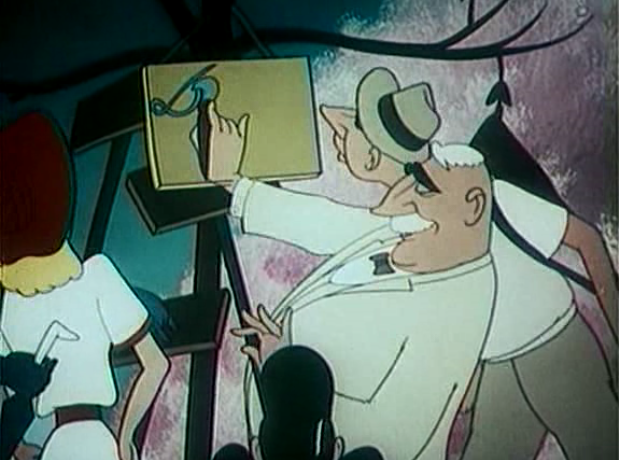 Mr. Wolf is a Russian propaganda film. The film is an oddball in director Gromov’s small animation output. His other seven films are fantastic fairy tales and children’s films
The film tells about Mr. Wolf, a rich American, who is fed up with weapons and war. He retreats with his unwilling family to a peaceful island. But then oil is discovered on the island. Immediately, Mr. Wolf and his family are overpowered by greed, and the American only too gladly drops his pacifism.
‘Mr Wolf’ is based on a comedy by Evgeny Petrov. Although drowned in caricature, this blatant propaganda film is hardly funny: its animation is elaborate, but painstakingly slow, and too excessive. Moreover, it is not too clear what the message is. Are all Westerners blinded by greed? Is pacifism senseless in a world of war? Are oil and peace at odds with eachother? I’ve no idea.
Watch ‘Mr. Wolf’ yourself and tell me what you think:
‘Mr. Wolf’ is available on the DVD box set ‘Animated Soviet Propaganda’


 Dr. Grob's Animation Review