
You are currently browsing the tag archive for the ‘propaganda’ tag.
Director: Jack Kinney
Release Date: July 30, 1943
Stars: Goofy, Pluto (cameo)
Rating: ★★★★★
Review:
 ‘Victory Vehicles’ is the only entirely war-themed Goofy short (although the end of ‘How to be a Sailor’ (1944) refers to the war, too). It’s no army cartoon, however. Instead, the cartoon parodies propagandistic shorts of the time, using a patriotic voice over and dealing with the (real) problem of rubber shortage.
‘Victory Vehicles’ introduces various silly inventions that should replace the car as a form of transportation. The solution finally settles on the pogo-stick: “the answer to a nation’s needs”.
‘Victory Vehicles’ is a very enjoyable cartoon in its silly satire. It’s also a nice window to the shortage problems of World War II America. The film contains a very catchy theme song called ‘Hop on your Pogo Stick’, and a short cameo by Pluto.
‘Victory Vehicles’ is an important landmark in the Goofy series, because it marks Goofy’s graduation from single character to the prototypical everyman. In this short various types of Goofies can be seen, including women and children. They are provided with different voice overs, emphasizing that every Goofy we see is a different one.
Of all evolutions of a cartoon star, this is the most remarkable one. The thirties Goof, with his all too recognizable character traits has been transformed into an everyman who could be anybody, and, at the same time, still be Goofy.
Other directors would return to the original Goofy in cartoons like ‘Foul Hunting‘ (Jack Hannah, 1947) and ‘The Big Wash‘ (Clyde Geronimi, 1948), but Jack Kinney would stick to the everyman Goofy, making the most hilarious cartoons with this character.
This is Goofy cartoon No. 10
To the previous Goofy cartoon: How to Fish
To the next Goofy cartoon: How to be a Sailor
Director: Jack King
Release Date: July 30, 1942
Stars: Minnie Mouse, Pluto
Rating: ★★★
Review:
 ‘Out of the Frying Pan into the Firing Line’ is a short propaganda film aimed at American housewives.
In this propaganda short, Minnie is just about to give Pluto some hot bacon grease, when the narrator interrupts, telling housewives of America to save their kitchen fats in order to deliver them at a “neighborhood meat dealer, who is patriotically cooperating”. The fats are apparently used to make glycerine, which is used in ammunition.
This short contains a rare picture of Mickey as a soldier at the front. Otherwise, Mickey was left out of the propaganda, leaving that role to Donald Duck.
‘Out of the Frying Pan into the Firing Line’ is an interesting example of how the American government tried to make every citizen help in the war effort. It shows how World War II entered the life of the average citizen: even kitchen grease could be useful… It offers no one-liner, however, at the likes of the contemporary slogans ‘Save Your Scraps to Bomb the Japs’ or ‘Is Your Trip Really Necessary?”
Watch ‘Out of the Frying Pan into the Firing Line’ yourself and tell me what you think:
Director: Ben Sharpsteen
Release Date: July 21, 1942
Stars: The Three Little Pigs (in a cameo)
Rating: ★★★★
Review:
 Arguably the most ridiculous of all war time propaganda cartoons, ‘Food Will Win the War’ tells us about the successes of American agriculture.
A bombastic narrator makes all kinds of outrageous comparisons to illustrate the farmer’s huge production. Examples are baking all fruits of America into one big pie or frying all America’s meat on four Vesuvius volcanoes. The result is so absurd and its message so out to lunch that the short is actually great fun to watch.
Throughout the cartoon the animation is very limited, almost absent. The limited animation gives the short a poster-like quality. Full animation is limited to four short sequences:
1) a bowling ball bowling down skittles which resemble Hitler, Mussolini and a Japanese general
2) a giant pie thrown at the earth
3) Chickens laying eggs
4) The three little pigs leading an army of pigs.
‘Food Will Win the War’ was the last animated short directed by Ben Sharpsteen. In the 1940s he had moved more and more towards production. He would supervise the production of a.o. ‘Fun and Fancy Free‘ (1947), ‘Cinderella‘ (1950) and ‘Alice in Wonderland‘ (1951) before moving to live action, working on Disney’s True-Life Adventures (1948-1960). He retired in 1962.
Watch ‘Food Will Win the War’ yourself and tell me what you think:
Director: Leonid Amalrik & Olga Khodataeva
Release Date: 1942
Rating: ★★★★
Review:
 ‘Kino-Circus’ (also called Cinema Circus) is the most inspired of the anti-fascist war propaganda cartoons made in the Soviet Union.
The short is called ‘a cartoon satire in three acts’ and features a Charlie Chaplin-like character, who introduces us to three staged satires, all featuring Adolf Hitler:
In the first, ‘Adolf the dog trainer and his pooches’, Hitler throws a bone at his three dogs, Benito Mussolini, Miklós Horthy and Ion Antonescu, the leaders of his allies Italy, Hungary and Romania, respectively.
In the second, ‘Hitler visits Napoleon’, Hitler asks Napoleon’s tomb for advice, but the deceased drags him into the tomb. It’s the most prophetic of the three, for indeed both Napoleon and Hitler were defeated in Russia.
In the third, ‘Adolf the juggler on powder kegs’, Hitler juggles with several burning torches on a pile of powder-barrels, representing the countries he has occupied. When he accidentally drops one of the torches, the barrels explode. The animation is particularly silly in this sequence and a delight to watch.
After the grim political posters from 1941, ‘Kino-Circus’ is more lighthearted. The film ridicules Hitler more than it makes him threatening. Quite surprising since in1942 Nazi Germany was still a serious threat to the Soviet Union: Leningrad suffered under a long siege, and the Soviet Union had only just begun its counter-attack.
Interestingly, both directors of ‘Kino-Circus’ later became famous for their sweet fairy tale films.
Watch ‘Kino-Circus’ yourself and tell me what you think:
‘Kino-Circus’ is available on the DVD box set ‘Animated Soviet Propaganda’
Director: Panteleimon Sasonov
Release Date: 1941
Rating: ★★½
Review:
 ‘The Vultures’, like ‘4 newsreels‘ and ‘Fascist Boots on our Homeland‘ is a so-called political poster. Like the other two films from 1941 it is soviet propaganda at its most aggressive.
‘The Vultures’ is the least interesting of the set. Its opening shot is its best part: opening with two eyes in the dark, just like ‘The Skeleton Dance‘ (1929). These eyes appear to belong to a fascist vulture. he and the other fascist vultures (battle planes) are chased away and destroyed by the Soviet airfleet in a rather silly and playful-looking air battle, accompanied by heroic march music.
About the director of ‘The Vultures’, Panteleimon Sasonov (1895-1950), little can be found. Giannalberto Bendazzi tells us in his excellent book ‘Cartoons – one hundred years of cinema animation’ that he made an animation film called ‘The Tale of the Pope and Baldo his Servant’ in 1939.
Watch ‘The Vultures’ yourself and tell me what you think:
‘The Vultures’ is available on the DVD box set ‘Animated Soviet Propaganda’
Directors: Aleksandr Ivanov & I. Vano
Release Date: 1941
Rating: ★★★½
Review:
 Like ‘4 Newsreels‘, ‘Fascist Boots on our Homeland’ is a so-called ‘political poster’, a short propaganda film that knows no competition in its vicious imagery.
In ‘Fascist Boots on our Homeland’ a horrific fascist pig marches on, trembling several European countries until he gets beaten by the Red Army. The film also contains a very patriotic song and rather associative imagery, including that of Russian soldiers riding horseback, a heroic image from the Russian civil war (1917-1923).
It’s interesting to compare the Soviet images of Nazis with that of American propaganda films from the same era. Whereas in American propaganda, like ‘Der Fuehrer’s Face‘ fascist leaders were caricatured and ridiculed, in the Soviet Union they were depicted as monsters and swines. The whole difference may be that the Soviet Union was invaded, while the United States were not.
Indeed, the US were less kind to the Japanese, who did stain American soil: they were all portrayed as silly, but treacherous Untermenschen, whom one could easily kill without remorse (e.g. in ‘Bugs Bunny nips the Nips’ from 1944 and the Popeye film ‘You’re a sap, Mr. Jap‘ from 1942).
Watch ‘Fascist Boots on our Homeland’ yourself and tell me what you think:
‘Fascist Boots on our Homeland’ is available on the DVD box set ‘Animated Soviet Propaganda’
Directors: Valentina Brumberg, Zinaida Brumberg, Aleksandr Ivanov, Olga Khodataeva and Ivan Ivanov-Vano
Release Date: 1941
Rating: ★★★
Review:
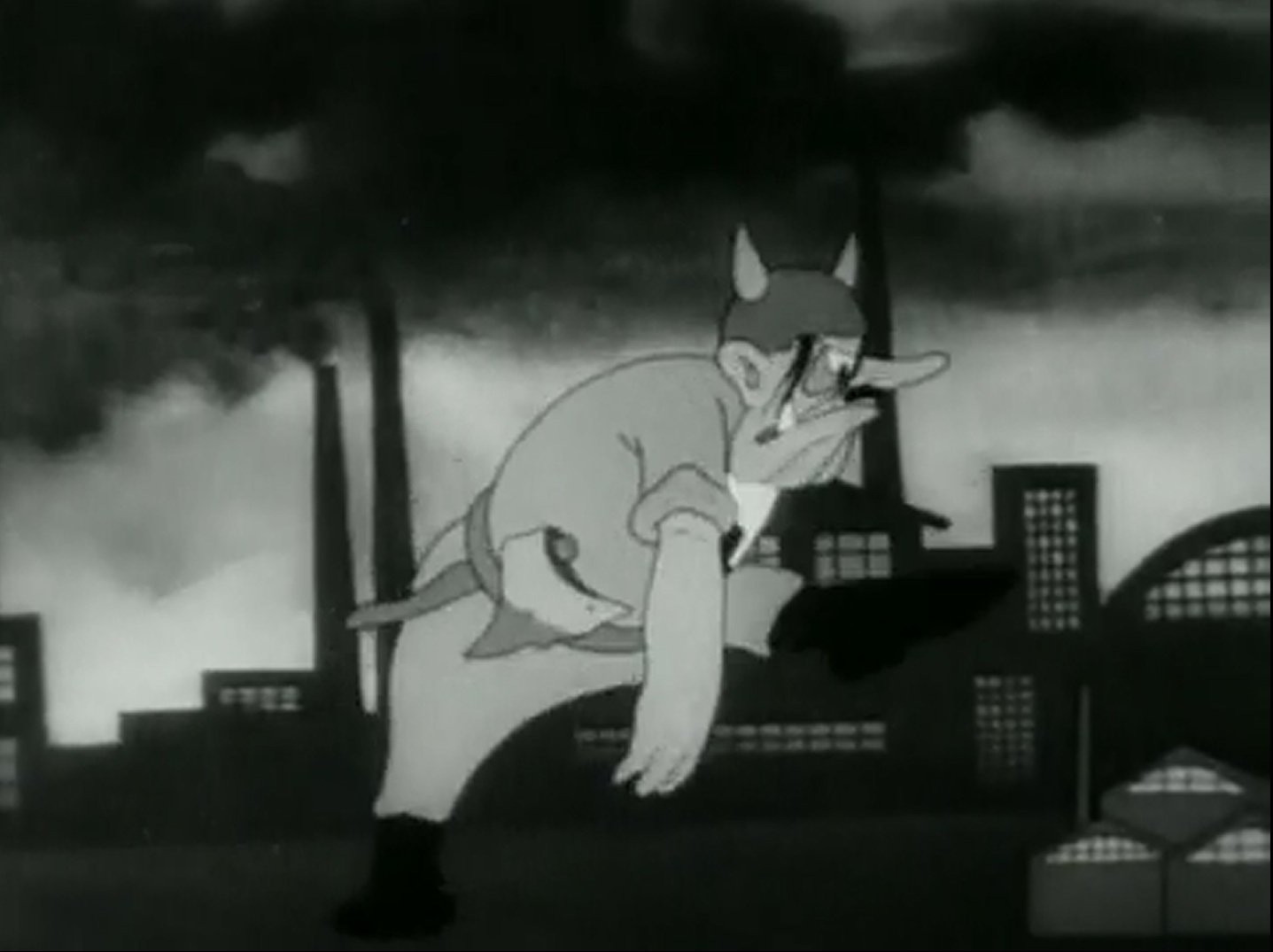 The Soviet propaganda film ‘4 Newsreels’ consists of four so-called ‘political posters’, which are as blatant as propaganda can get.
The first, ‘What Hitler wants’, shows us an extremely ugly and vicious caricature of Hitler marching towards the Soviet Union until he is pierced by the Soviet bayonet.
In the second, ‘Beat the fascist pirates’, sea serpent-like German submarines are defeated by the Soviet fleet.
The third, ‘Strike the Enemy on the front and at home’, is typical for the paranoid society Stalinist Russia was, warning against treacherous fascist spies, foreign agents and saboteurs: “Be vigilant! Remember, our enemy is cunning!”.
The fourth, ‘A mighty handshake’, tells us about the union between England and the Soviet Union against Nazi Germany, showing two mighty giant soldiers shaking hands and crushing a tiny rat-like Hitler in doing so.
Obviously, Germany’s invasion of the Soviet Union left no room for subtleties.
‘4 Newsreels’ was directed by five veterans of animated Soviet propaganda. All had made animated films since the 1920s. Of the five, Ivan Ivanov-Vano (1900-1987) would become the most successful, directing animated films up to the 1970s. Luckily, he and Olga Khodataeva would be able to show a gentler side in numerous animated fairy tale films for children.
Watch ‘4 Newsreels’ yourself and tell me what you think:
‘4 Newsreels’ is available on the DVD box set ‘Animated Soviet Propaganda’
Director: Vyacheslav Kotyonochkin
Release Date: 1967
Rating: ★★★
Review:
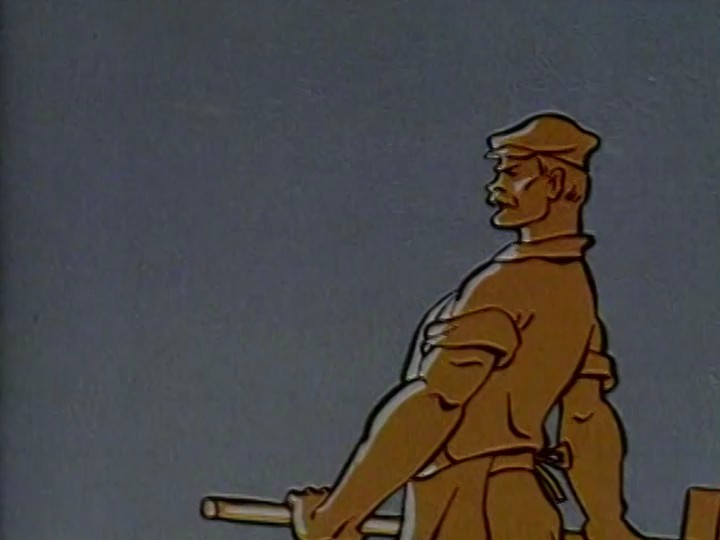 ‘Prophets and Lessons’ is a Soviet propaganda film. It tells us how every time the Western world predicted the Soviet Union to fail, but that these predictions never came true.
Its chapters are all conceived in the same order: first we see animated capitalist predict something, then we see a giant Soviet blacksmith strike his mighty hammer and finally we see live action footage of the Soviet Union’s successes.
The separate chapters are the Soviet revolution, the civil war, the five year plans, the Second World War, the reconstruction after the war and the Soviet space program. The action is silent, and the imagery rather outdated (more like that of the 1920s than of the 1960s).
‘Prophets and Lessons’ is one of the most obviously propagandistic animation films ever made in the Soviet Union. Its overtly propagandistic message, its repetitive character, and its outdated symbolism make it rather tiresome to watch.
Surprisingly, two years later, the director of this humorless film, Vyacheslav Kotyonochkin, would launch a successful series of comic cartoons, called ‘Ну, Погоди!’ (‘Just Wait!’), featuring a very cartoony wolf.
Watch ‘Prophets and Lessons’ yourself and tell me what you think:
‘Prophets and Lessons’ is available on the DVD box set ‘Animated Soviet Propaganda’
Director: Vitold Bordzilovsky
Release Date: 1966
Rating: ★★★½
Review:
 ‘Proud Little Ship’ is a Soviet propaganda film, which is clearly directed to children.
Three little boys make a small red ship as a copy of the famous cruiser ‘The Aurora’. This little ship sails the seas and is greeted with enthusiasm among all the people of the world.
There are some mean militarists who try to destroy the little ship, but they do not succeed. These militarists are drawn extremely silly, while the rest of the people are drawn rather realistically and appear as noble and gentle. Nevertheless, these drawing styles blend surprisingly well. Moreover the design and choreography of movement is often gorgeous.
All the action is silent, while the story is told by a narrator, who provides the clearest propagandistic message of the film: “the proud little ship sailed as a messenger of a happy life, which, as spring after winter, would certainly come to all people”.
Although ‘Proud Little Ship’ is overtly propagandistic, it’s also an enjoyable and beautiful film. One almost forgets that the message is not concerning world peace, but the ‘glorious’ communist revolution…
Watch ‘Proud Little Ship’ yourself and tell me what you think:
‘Proud Little Ship’ is available on the DVD box set ‘Animated Soviet Propaganda’
Director: Winsor McCay
Release Date: July 1918
Rating: ★★★★★ ♕
Review:
 McCay’s fourth venture into animation is even more curious than the preceding three (‘Little Nemo‘, ‘How A Mosquito Operates‘ and ‘Gertie the Dinosaur‘). It’s an almost real time report of the sinking of the passenger steamer ‘The Lusitania’ by a German submarine in May 1915.
Like McCay’s earlier films, ‘The Sinking of the “Lusitania”‘ starts with some live action footage of the artist at work, helped by one Mr. Beach who provides McCay with the details on the sinking. Yet, this live action introduction is brief, and soon we cut to the real event.
The action depicted is explained by the title cards, who tell us when and how the ship was hit by two torpedoes fired from a German U-boat. The film also tells us about the number of passengers who perished, and singles out four of them. The tone of the title cards is agitated, and angry, pointing to Germany as a cruel and merciless enemy, and ending ending with the bold sentence “And they tell us not to hate the Hun!“. This message no doubt was rather welcome in a time in which the United States joined the war effort.
McCay’s animation is of a startling realism: the rolling waves, the steamer and U-boat moving in perspective, the explosions and smoke are totally convincing, and at the same time retain their graphic quality. The impact of the images is greatly enhanced by the use of cels (‘The Sinking of the “Lusitania” is the first McCay film to do so), and lovely background art of ocean skies. Despite the fine animation, the action is on the slow side, with people sometimes falling in slow motion into the sea. Yet, the slowness adds to the terrifying experience of the cruelty depicted.
The staging is superb: McCay uses only a few ‘camera angles’, most of them possible in real life, enhancing the idea of an objective record of events. Only two shots escape the documentary style: one shot of two fish fleeing from an approaching torpedo, and a final shot of a mother with child sinking into the sea. Clearly, McCay wanted the viewer to have the feeling he was witnessing the event in real time, as if he was there. Of course, the documentary style only enhances the clear propagandistic message against Germany. The bold propaganda may not have aged very well, McCay’s images certainly have: such command of perspective, such elegance of drawing and such dramatic yet convincingly ‘realistic’ staging is still impressive, one hundred years later. ‘The Sinking of the “Lusitania”‘ thus is a great example of how animation can be used in documentaries to show events that could not or have not been put on film. Strangely, this use of animation was not seen again, until the 21st century, when ‘Waltz with Bashir’ (2008) entered the cinemas.
In all, ‘The Sinking of the “Lusitania”‘ is an astonishing film, which may be both the first animated propaganda film and the first animated documentary. It’s totally unique in its drama, and, despite the propaganda, an all time masterpiece of animation.
Watch ‘The Sinking of the “Lusitania”‘ yourself and tell me what you think:
This is Winsor McCay’s fourth film
To Winsor McCay’s third film: Gertie The Dinosaur
To Winsor McCay’s fifth, unfinished film: The Centaurs
‘The Sinking of the “Lusitania”‘ is available on the DVD ‘Winsor McCay the Master Edition’
Director: Jack Kinney
Release Date: January 1, 1943
Stars: Donald Duck
Rating: ★★★★★ ♕
Review:
 In ‘Der Fuehrer’s Face’ Donald is apparently a citizen of ‘Nutziland’, a fascist country where even trees and clouds are swastika-shaped.
Donald is awoken by a silly march band singing the sarcastic title song (penned by Disney composer Oliver Wallace and sung with gusto by Spike Jones). Then he has breakfast that consists of only one coffee bean, ‘aroma de bacon & eggs’ and a slice of wooden bread. All too soon he has to work at the assembly line, making shells and saluting to images of Adolf Hitler.
In the end, it appears that it was all just a dream, and Donald, in his Stars and Striped-colored room, sighs, embracing a golden copy of the statue of liberty: “Am I glad to be a citizen of the United States of America”. This closing scene is rather corny and the satire of the film misses some points: most of the (German) citizens of Nazi Germany were not poor and did not have to work like slaves, as is suggested here. Instead, the Nazis used forced labor forces from their occupied territories.
Nevertheless, ‘Der Fuehrer’s Face’ was both artistically and commercially the most successful of the Disney war time propaganda films. It even won an academy award for being the best animated short of 1943. It’s so successful, because, unlike most other propaganda shorts, it’s outrageously funny: its satire is so zany, its depiction of ‘Nutzi land’ so wacky, and the scene at the assembly line so out-to-lunch, that one cannot stop laughing. When Donald goes mad, these segments are even topped by a brightly colored, rather avantgardistic and very surrealistic stream-of-consciousness-like scene, which resembles similar dream sequences in ‘Dumbo‘ (1941) and ‘The three Caballeros‘ (1944).
This short was not directed by any of the two regular Donald Duck directors of the time, Dick Lundy and Jack King, who both preferred a more unassuming type of humor, but by Jack Kinney, who is most famous for directing Goofy, and who was undoubtedly the wackiest of the Disney directors, of which this film certainly is proof.
Watch ‘Der Fuehrer’s Face’ yourself and tell me what you think:
This is Donald Duck cartoon No. 38
To the previous Donald Duck cartoon: Bellboy Donald
To the next Donald Duck cartoon: Donald’s Tire Trouble


 Dr. Grob's Animation Review