
You are currently browsing the tag archive for the ‘Pyotr Ilyich Tchaikovsky’ tag.
Director: George Pal
Release Date: March 27, 1942
Rating: ★★★½
Review:
 ‘Sky Princess’ tells the tale of a prince rescuing a princess from a witch, who holds her in a castle in the sky.
In the beginning the story is told by a voice over. But all too soon the prince arrives, serenading his love with a violin. The love between the two destroys the witch’s power, and a great deal of the cartoon is devoted to the couple dancing in the castle in the sky. This sequence reflects the MGM musicals of the era, and excels in lighting and staging. Yet, as nothing really is happening, it’s also a bit boring. In the end we watch the couple sail away on the prince’s sky ship.
‘Sky Princess’ is a lovely cartoon, full of pretty colors, and a feast for the eye. The score makes great use of Pyotr Ilyich Tchaikovsky’s Flower Waltz. What the short lacks in story, it covers with its beautiful looks and dreamlike atmosphere.
‘Sky Princess’ is available on the Blu-Ray ‘The Puppetoon Movie’
Director: Osamu Tezuka
Release Date: 1987
Rating: ★★★★★
Review:
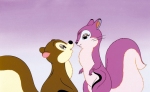 ‘Legend of the Forest’ is Tezuka’s longest and most ambitious short film.
Like many of his films it shows Tezuka’s concern with environmental issues. However, foremost, this film is Tezuka’s answer to Disney’s ‘Fantasia’ (1940). Based on the first and last movement of Pyotr Ilyich Tchaikovsky’s 4th Symphony it portraits the fight of forest creatures against the demolition of their forest.
The first movement tells about the struggle of a lone flying squirrel against one lumberjack and against the jealous fellow-forest animals. This part is the most extraordinary for its diversity in styles. It is as if Tezuka wanted to show the evolution of animation itself within his emotional story. At first, the story is told in manga-images only. There’s no movement, even though the realistic images are very lively. The next episode is in Émile Cohl’s style, followed by a very convincing homage to Winsor McCay’s ‘Gertie the Dinosaur‘ (1914). This is followed by a scene in which the little squirrel looks like Otto Messmer’s Felix the Cat or as an early Disney character. This episode is particularly beautifully animated. When a man comes into the forest with a chainsaw, Tezuka’s jumps to the style of Fleischer’s Popeye, including Fleischer’s tabletop-technique for 3d effects.
It’s followed by the first episode in color, in which the squirrel finds a female companion. This part starts as a clear tribute to the very first animation film in technicolor, Disney’s ‘Flowers and Trees‘ (1932), but is mostly drawn like a 1940s cartoon. The final episode of the first part, in which the man shoots his girl and the squirrel sacrifices himself, is quite Bambi-like. Interestingly, throughout the episode, the backgrounds and the staging retain a typical anime-like character.
The second part, using the symphony’s final movement, is less impressing than the first part. It starts with a very Fantasia-like fairy scene, but when we watch very anime-like breasted foxes, we know we’re in a different film. This part tells how magical forest characters (including a few dwarfs) win a war over a forest from a Hitler-like foreman. This part in particular resonates in several Ghibli-films with similar themes, like ‘Pom Poko‘ (1994) or ‘Princess Mononoke’ (1997).
The complete film is an original and unique statement, which deserves to be much more famous than it actually is. Tezuka’s animated output was of a high quality anyhow, but this film may stand as a particularly artistic highlight within his extraordinary career.
Watch ‘Legend of the Forest’ yourself and tell me what you think:


 Dr. Grob's Animation Review