You are currently browsing the tag archive for the ‘son’ tag.
Director: Friz Freleng
Release date: September 1, 1962
Stars: Yosemite Sam
Rating: ★★
Review:
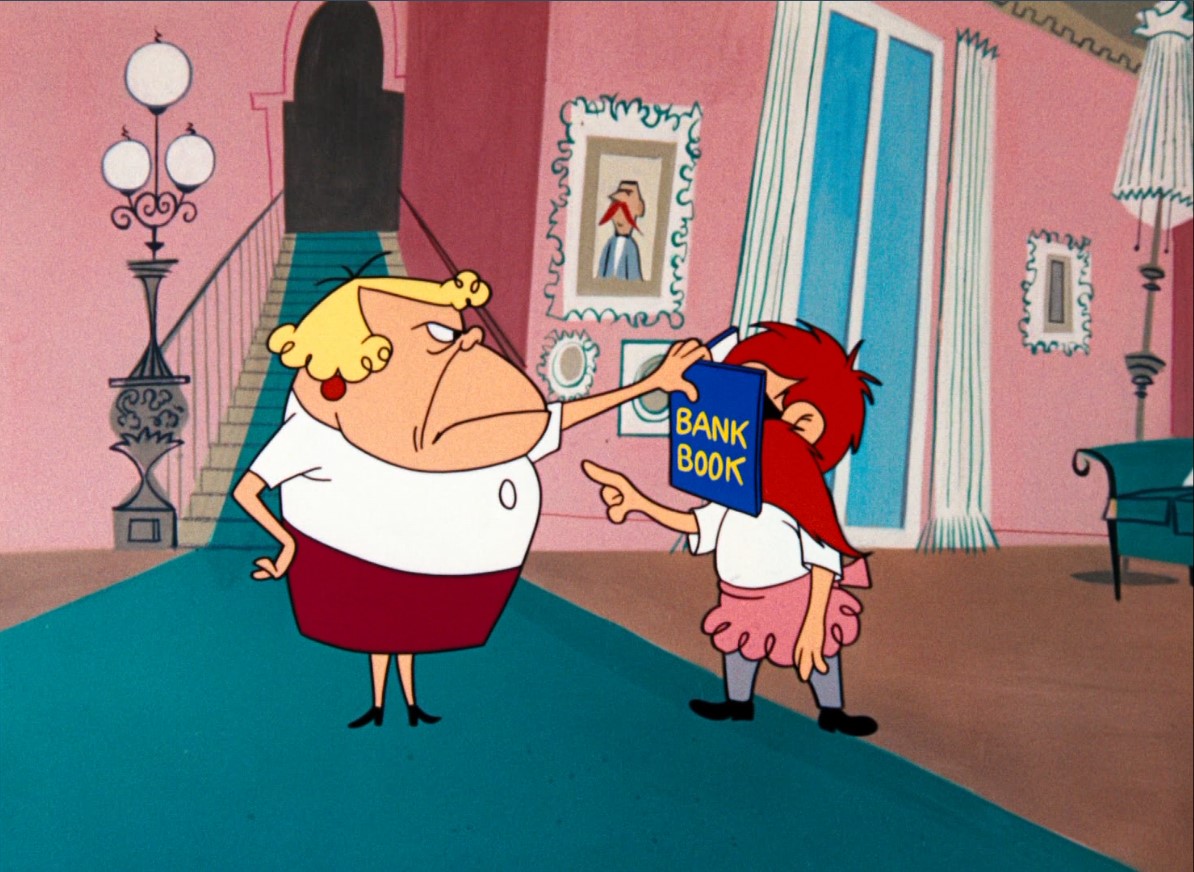
‘Honey’s Money’ opens with Yosemite Sam reading about a local widow inheriting five million dollars. He sets out to court the lady immediately, and marries her too, despite the fact that she is ugly. But married life isn’t what Sam had expected, and then he has to meet his oversized baby son Wentworth…
‘Honey’s Money’ is a remake of the earlier Friz Freleng cartoons ‘His Bitter Half’ (1950) and ‘Hare Trimmed’ (1953). The short is noteworthy for being Yosemite Sam’s only solo cartoon, and only one of two not co-starring Bugs Bunny, the other one being ‘Along Came Daffy’ from 1947.
Unfortunately, the short can hardly be called a classic within the Looney Tunes canon: Yosemite Sam is particularly unpleasant in this short, his sole motive being greed. And as he apparently can’t even spend the money, this motive becomes a muddled one. Moreover, the character designs and animation are only fair, and the gags mediocre.
One thus has ample time to admire Hawley Pratt’s layouts and Tom O’Loughlin’s background art, which form the highlight of an otherwise run-of-the-mill cartoon. Another highlight is the card crediting Friz Freleng, which features a caricature of the director on a dollar bill.
Watch ‘Honey’s Money’ yourself and tell me what you think:
‘Honey’s Money’ is available on the Blu-Ray and DVD ‘Looney Tunes Platinum Collection Volume Three’
Director: Mari Okada
Release date: February 24, 2018
Rating: ★★★
Review:

The Japanese animation industry apparently is so rich that new interesting films can pop up seemingly out of nowhere. For example, ‘Maquia: When the Promised Flower Blooms’ (from now on ‘Maquia’) is made by the P.A. Works studio, which since its founding in 2000 focused on television series, and which only made four feature films, the first being based on a video game, the second made for television, the third for training purposes, and the fourth based on a television series.
So, their fifth feature film to be a completely original story, not based on a video game, television series or even a manga, comes as a surprise. It seems that ‘Maquia’ was the pet project by its director Mari Okada, who wrote the story herself. Okada, apparently is somewhat of a modern legend as she has written for over fifty television series since 2001, and is called by Wikipedia “one of the most prolific writers currently working in the anime industry”. She’s one of the brains behind ‘Anohana: The Flower We Saw That Day’ (2011), one of only two anime television series I have watched, and it comes to no surprise to me that the ‘Maquia’s’ story style has something in common with that series. Both series and film have a strong focus on human drama, with emotions reigning uncontrolled, and tears flowing frequently. In fact, despite the high fantasy setting, ‘Maquia’ has a strong element of melodrama, and the rather forced emotions, so different from the more restrained style in studio Ghibli, or the films by Yasujirō Ozu for that matter, actually made it harder for me to relate with these people.
‘Maquia’ is a fantasy film, set in a rather Middle Earth-like world, and starts with the depiction of a society of near-immortals called Lorphs, whose surroundings are particularly like the depictions of elven kingdoms in Peter Jackson’s adaptation of The Lord of the Rings. These Lorphs write their memories by weaving cloths and live far away from more mortal men. One of these, a young girl called Maquia (from which the English film title takes its name) rather out of nowhere complaints she is so alone. Shortly after this scene of distress the eternal city is attacked by an army of men, and Maquia soon finds herself in the outside world, where she adopts a baby, whose mother is killed.
From then on, the film takes an episodic nature, showing us various stages of the mother-son relationship until the son, whom Maquia calls Ariel, has matured, while his mother, in contrast, has retained the same teen appearance she had in the beginning.
The film apparently tries to say something about how to love is to lose and to let go, how to find beauty in the short lives we have, and how relationships form the most important part of life, but the film’s messages get deluded in a rather complex story, in which we do not only follow Maquia, but also her childhood friend Leilia, who is forced to become a queen by her abductors, the captain who destroyed the Lorph city in the first place and one Lang, a boy/man with whom Maquia spent her first years in the mortal world. The bigger story, and all its subplots are far less interesting than Maquia’s relationship to her adopted son, and both prolong and distract the film unnecessarily.
Apart from being unfocused and very, very emotional, ‘Maquia’ is also hampered by an overblown score by Kenji Kawai, all too forcefully guiding the viewer in which emotion to feel. Even worse, are the rather lazy and utterly generic human designs, which nowhere transcend your average anime television series. The animation, too, is fair, but not outstanding. There’s also a small dose of computer animation that is used sparingly and effectively. No, the film’s highlights are not the story, music, character designs or the animation, but the background art and the lighting, which are both no less than magnificent, and which both give ‘Maquia’ a splendor that make the film a delight to watch, even when the characters and events themselves don’t.
I like ‘Maquia’ being an original story, and its theme of what it means to be (im)mortal is interesting, but the film is too long, too episodic, too meandering and too dramatic to entertain, and I am pretty sure in the end I will not remember either the film’s story or its characters, but the beautiful background art and superb lighting, which the make the film a standout, after all.
Watch the trailer for ‘Maquia: When the Promised Flower Blooms’ yourself and tell me what you think:
‘Maquia: When the Promised Flower Blooms’ is avaiable on Blu-Ray and DVD
Directors: Charlie Bean, Paul Fisher & Bob Logan
Release date: September 22, 2017
Rating: ★★
Review:

One of the biggest feature animation surprises of 2014 was ‘The Lego Movie’. On paper this joint venture between Warner Animation and the famous toy company from Denmark should have been something terrible. After all, it was based on an existing toy line, a recipe for disaster. But the opposite happened and ‘The Lego Movie’ turned out to be one of the funniest, most sophisticated, and deepest animation film of the 21st century. The film was followed in 2017 by the equally funny ‘The Lego Batman Movie’, deepening the title character as he appeared in ‘The Lego Movie’. Warner Animation and Lego were clearly on a roll.
Or were they? Appearing in the very same year as ‘The Lego Batman Movie’, ‘The Lego Ninjago Movie’ uses several of the ingredients of the previous films, but with a remarkably disappointing result. True, there are some good gags, especially those referring to the characters being made of Lego, but more often such gags feel like they have been done before, and better. Even worse, compared to the two earlier films, both the story, the world and the characters are very weakly developed. Apparently, the film was based on a long-lasting television series, but the film hardly betrays that fact. Instead, the movie feels as only half-baked, and assembled too quickly for its own good.
The problems of ‘The Lego Ninjago Movie’ are legion. The film uses elements of both wuxia and mecha films, but can’t satisfy lovers of either genre, as the film makers do very little with these elements. The whole setting of Lloyd being both the leader of the Ninjago squad and the son of Garmadon, the very nemesis they continually combat, is preposterous to start with. That these Ninjago warriors are also some teenager friends at a high school (even though one is a robot) only adds to the implausibility. So does the fact that Garmadon has four hands. The plot gets particularly silly when ‘the monster’ arrives, but when the Ninjago squad goes on a quest in a forest, the film seriously starts to drag. The son-dad relationship becomes a tried and tiresome cliché, and halfway one realizes he doesn’t care for these characters, at all. And then the overlong finale must start, yet…
On the top side the film starts with Jackie Chan, who is always pleasant to watch, even though he’s completely wasted in this film. And the textures of the Lego elements are surprisingly good, rendering them very tactile, indeed. Moreover, the film makes some surprising and rather silly choices in its use of pop music. But it should be clear that none of this can rescue a sloppy, lazy film that seriously lacks the heart and attention given to the first two Lego movies.
Watch the trailer for ‘The Lego Ninjago Movie’ yourself and tell me what you think:
‘The Lego Ninjago Movie’ is available on Blu-Ray and DVD
Director: Ryszard Czekała
Release date: 1970
Rating: ★★★
Review:
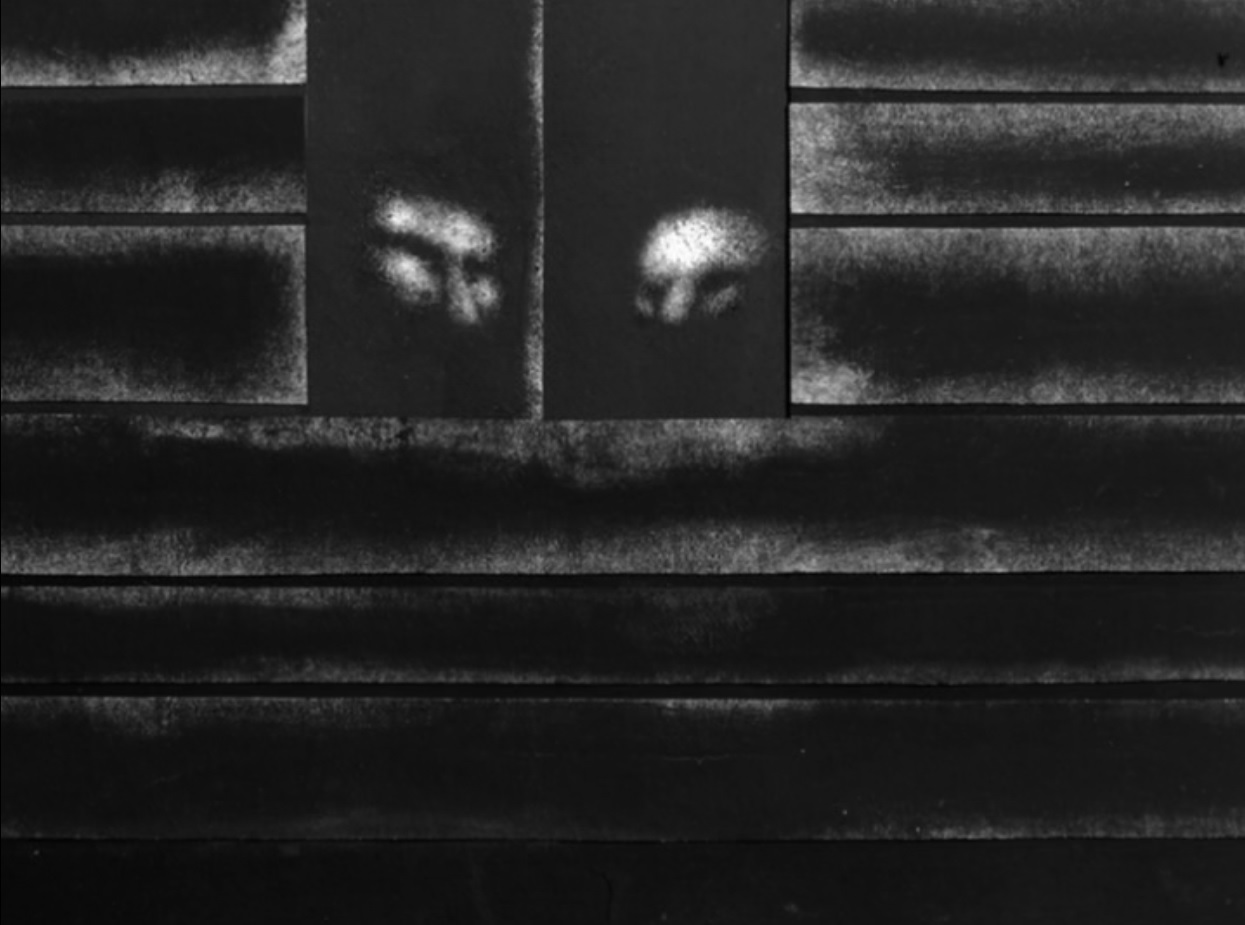
In ‘Syn’ (The Son) an old couple at the countryside wait for their son, who has gone off to lead a different life in the city. But when he arrives at his parental home, his visit turns out to be a deception.
‘Syn’ shows Ryszard Czekała’s original style: the film is in black and white, and features a very original cinematography: altering extreme close-ups of hands, ears and such with strange depictions of the barren wintery landscape, with the ground filling up almost the complete frame.
The story is told without dialogue, and because of Czekała’s extreme graphical style, rather hard to follow. Most striking is the sound design, which arguably is as important as the imagery. The result is a puzzling, but quite unsettling and bleak short.
Watch ‘The Son’ yourself and tell me what you think:
‘The Son’ is available on the DVD-set ‘Anthology of Polish Animation’
Director: Kevin Lima
Release Date: April 7, 1995
Stars: Goofy, Max, Pete
Rating: ★★★
Review:

‘A Goofy Movie’ arguably is the least known of Disney’s theatrical movies from the studio’s Renaissance period. The film is not even in its official canon of animated features. Maybe because it was Disney’s first animated theatrical feature based on a television series, in this case ‘Goof Troop’, which run from September to December 1992.
Now I’ve never seen an episode of this television series myself, but I comprehend that it does resolve around Goofy being a single father of his son, Maximilian (in short Max), and being neighbor to Pete, who is a single father of a son, too, Pete Junior or P.J. in short. ‘A Goofy Movie’ uses exactly this premise, focusing on the relationship between Goofy and his son, with Max being the undisputed main character of the movie.
Now, Goofy’s family life has always been odd, being the classic Disney character that changed the most during his career. And indeed, he has been seen having a son in a few of his classical cartoons, starting with ‘Fathers are People’ from 1951, but by that time Goofy had transformed into everyman George J. Geef, and this son clearly isn’t Max, as he’s called George Geef jr. In both ‘Goof Troop’ and ‘A Goofy Movie’ Goofy once again is his clumsy self, so he has evolved once more. Pete, too, has had a son in earlier entries, most notably in ‘Bellboy Donald’ from 1942. In ‘A Goofy Movie’ he’s not really the villain of the old days of old, but still a disruptive voice, not taking Goofy for full, and giving him ill advice.
Voice artist Bill Farmer reprises his role as Goofy from ‘Goof Troop’ and is an excellent successor to Pinto Colvig. Max is voiced by Jason Marsden, a different voice than in ‘Goof Troop’, in which he was voiced by a woman (Dana Hill). But this is understandable as the events in ‘A Goofy Movie’ take place several years after the ones in ‘Goof Troop’. Max’s singing voice is provided by Aaron Lohr.
Added to the mix, and apparently not present in ‘Goof Troop’, is Max’s love interest Roxanne, and the film starts with Max’s last day at school, on which he tries to impress Roxanne, in which he succeeds, and he manages to ask her on a date to a party. Unfortunately, his father, realizing he might be losing grip on his son, has planned a trip for two to some fishing lake, and Max invents a totally unconvincing lie of why he has to cancel the date, involving both Max’s and Roxanne’s pop idol Powerline (who, voiced by Tevin Campbell, sounds a little like Michael Jackson).
As said, the father-son relationship between Goofy and Max is the focal point of the cartoon, and as such the film is surprisingly realistic and down to earth, with Max being ashamed of his old-fashioned, awkward and clumsy father, and Goofy uncomprehending of Max’s interests as an independent teenager. However, the two learn to know and to respect each other on a rather forced road trip through America. In this respect, one can see ‘A Goofy Movie’ as a forerunner of ‘Finding Nemo’ (2003), which explores a similar theme.
The road trip, which takes place on Route 66, and which takes the two Goofs all through America, forms the main part of the film, and it’s surprising to note that this piece of Americana was animated in studios in Paris, France and Sydney, Australia. Unfortunately, ‘A Goofy Movie’ defies all realism in several scenes, hampering the heartfelt story with outlandish scenes, like the two Goofs encountering Bigfoot, falling off a cliff with their car, and escaping a waterfall in an all too improbable and inconsistent series of events.
Moreover, for a film starring Goofy there’s surprisingly little humor – it’s all not that goofy. Yet, the team has managed to keep Goofy’s optimistic and naive character, while adding some depth to the former simpleton, mostly his struggle in being a father to Max. Indeed, the film is at its best when keeping focus on the relationship between Goofy and Max. This focal point remains interesting despite the deviations from reality.
As a film of the early nineties, ‘A Goofy Movie’ is an obligate musical, and the movie knows three nice if forgettable songs by Carter Burwell, sung by Max, with Goofy joining in in two of them. They at least succeed in not being obnoxious.
The animation is of a very high quality, with considerable attention detail. There are some nice touches, like Max’s reflection in a window, or colors turning blue when Goofy gets sad.
In all, ‘A Goofy Movie’ is a nice little movie with a surprisingly mature theme. The film may not be a masterpiece, it’s of enough quality to be worth a watch.
Watch the trailer for ‘A Goofy Movie’ yourself and tell me what you think:
‘A Goofy Movie’ is available on Blu-Ray and DVD
Director: Clyde Geronimi
Release Date: February 28, 1942
Stars: Pluto
Rating: ★★
Review:
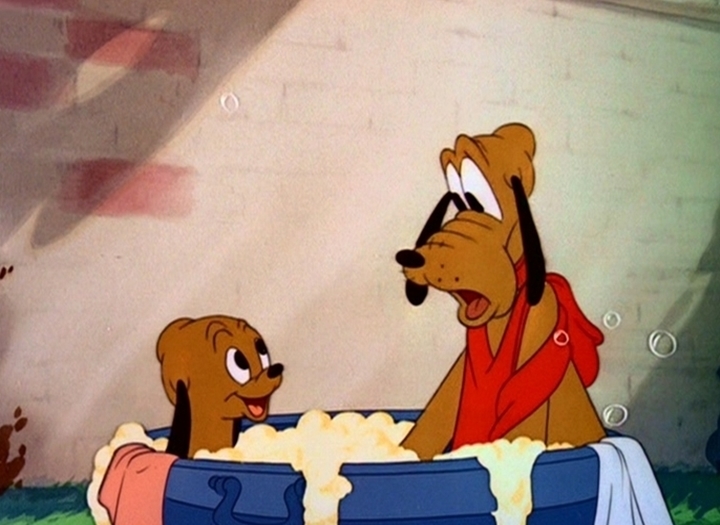 In this cartoon Pluto has only one son (instead of five as in ‘Pluto’s Quin-Puplets’ from 1937).
We watch this pup playing with a ball, a balloon, a caterpillar and a bird, which leads him into a distressful position on a clothes-line. Only then Pluto, who had been asleep all the time, comes into action. Pluto rescues his son and both fall into a wash-tub.
The best sequence of the cartoon involves Pluto’s antics on the clothes-line. It’s clear that he is a far funnier character than his son, which is only cute. Indeed, after this cartoon Pluto jr. was never seen again.
Watch ‘Pluto Junior’ yourself and tell me what you think:
This is Pluto cartoon No. 5
To the previous Pluto cartoon: Pluto’s Playmate
To the next Pluto cartoon: The Army Mascot
Director: Jack Kinney
Release Date: October 21, 1951
Stars: Goofy
Rating: ★★★★
Review:
 This third cartoon of the Mr. Geef-series starts with our hero announcing to his colleagues that he has become a father.
We quickly move to several years later, when his son has become a hyper-active and extremely playful young boy, who troubles his father a lot. Like the other George Geef cartoons the humor of the cartoon stems mostly from its recognisability. Fathers can connect immediately to Mr. Geef’s problems with his son.
Although it’s not brought with great bravado, ‘Fathers are People’ is a milestone within the Disney catalog: for the first time a Disney star becomes a parent. Although it may be debatable whether Mr. Geef really is Goofy, the son is his, he’s not some nephew or whatever, like Huey, Dewey and Louie are. This is a very rare happening in the complete cartoon universe. True, Oswald became a father in ‘Poor Papa’ (1927), but this was a pilot film, and Oswald wasn’t a star, yet. And indeed, Pete was the first Disney cartoon character shown to be a father, having a son in ‘Bellboy Donald‘, 1942, but that cartoon didn’t celebrate a birth.
Anyway, George Geef jr. would return the next year in ‘Father’s Lion’. But in ‘A Goofy Movie’ (1995) Goofy had a very different and older son called Max, so maybe George Geef and Goofy weren’t one and the same, after all…
Watch ‘Fathers are People’ yourself and tell me what you think:
https://www.dailymotion.com/video/x2qvw04
This is Goofy cartoon No. 32
To the previous Goofy cartoon: Get Rich Quick
To the next Goofy cartoon: No Smoking
Directors: William Hanna & Joseph Barbera
Release Date: October 1, 1949
Stars: Tom & Jerry, Spike & Tyke
Rating: ★★★★★
Review:
 Tom’s chases of Jerry disturb Spike’s son Tyke. If Tom is at it again, Spike “will tear him apart”. Needless to say, Jerry takes advantage of this situation.
‘Love that pup’ is one of the most hilarious Tom & Jerry cartoons. The gags come in fast and plenty, and Scott Bradley’s music is particularly inspired, perfectly matching the fast action. Highlight may be the running gag involving Tom rushing into several garden tools.
‘Love That Pup’ marks Tyke’s debut. He has no name, yet. But then again, even Spike is still called Butch in this cartoon. Spike and Tyke would become Tom and Jerry regulars in the fifties, even starring two films without the cat and the mouse in 1957.
Watch ‘Love That Pup’ yourself and tell me what you think:
https://www.dailymotion.com/video/x3imryc
This is Tom & Jerry cartoon No. 44
To the previous Tom & Jerry cartoon: The Cat and the Mermouse
To the next Tom & Jerry cartoon: Jerry’s Diary


 Dr. Grob's Animation Review