
You are currently browsing the tag archive for the ‘time travel’ tag.
Director: Mike Mitchell
Release date: February 2, 2019
Rating: ★★★
Review:

One of the surprises of 2014 was ‘The Lego Movie’, a surprisingly funny and sophisticated movie, making clever use of the source material, and transcending by far the product placement it actually was. Its huge success spawned the equally great ‘The Lego Batman Movie’ and the much weaker ‘The Lego Ninjago Movie’ (both from 2017), but one had to wait for five years for the true sequel: The Lego Movie 2: The Second Part.
This second movie immediately starts with a new threat to Bricksburg, the city in which Emmett lives, this time from the planet Duplo. In a toddler’s voice the new arrivals claim: “We are from the Planet Duplo, we are here to destroy you”. After some mayhem we jump to five years later, in which Bricksburg has apparently been destroyed and rebuilt as ‘Apocalypseburg’, a Mad Max-like post-apocalyptic world in which according to his girlfriend Lucy there’s no place anymore for niceness and optimism, although Emmett is still full of these things, despite having nightmares of “Armamageddon” (sic).
To make matters worse, a new, almost indestructible alien arrives with the name of General Mayhem, messenger of the shape-shifting Queen Watevra Wa’Nabi from the “Systar System”. What follows is another adventure full of references to other movies (e.g. The Wizard of Oz), which takes place both in the LEGO world and in live action, and in which Emmett meets a though guy called Rex Dangervest, who teach Emmett to grow up, or does he?
Unfortunately, this movie strives too hard to play a similar trick to the LEGO world as the first film, but it does all too obviously so. For example, we could see the origin of ‘Systar system’ from miles away. A huge talent like Maya Rudolph is wasted on the live action scenes, which remain formulaic and unspontaneous. The film’s message, too, is brought right in your face and lacks all the subtleties of the first film. There are some nice touches (for example, Bruce Willis playing a Lego version of himself, some nice 2D animation and a couple of pleasant songs), but overall the film never transcends mediocrity, despite all the evident effort. Thus one must conclude that after two films most of the inspiration for LEGO movies had died out.
Watch the trailer for ‘The Lego Movie 2: The Second Part’ yourself and tell me what you think:
‘The Lego Movie 2: The Second Part’ is available on Blu-Ray and DVD
Director: Piet Kroon
Release date: October 13, 2018
Rating: ★★
Review:

The Dutch animated feature film industry long consisted of one movie only, ‘Als je begrijpt wat ik bedoel’ (The Dragon That Wasn’t (Or Was He?)) from 1983. But in recent years several other films saw the light, mostly directed at youngsters: ‘Nijntje de film’ (Miffy the Movie) from 2013 , ‘Pim & Pom: Het Grote Avontuur’ and ‘Trippel Trappel – Dierensinterklaas’, which are both from 2014, and more recently ‘Knor’ (‘Oink’) from 2022 and ‘Vos en haas redden het bos’ from 2024. An oddball within this recent canon is ‘Heinz’ from 2018.
‘Heinz’ was a comic strip by René Windig and Eddie de Jong that run in Dutch newspapers from 1987 to 2000 and again from 2004 to 2006. The comic strip was about a cat, Heinz, who quickly got more anthropomorphized until he became a sort of everyman. The strip knew some continuities but remained first and foremost a gag strip. Nevertheless, the authors dreamt of an animation film at least since the early 2000s.
Although film studio Zig Zag film started working on a film already in 2002, Windig’s and De Jong’s dream never amounted to anything. That is, until the project got new backing and new support from veteran animator Piet Kroon in 2015.
Piet Kroon had ample experience in America, having directed the animation for ‘Osmosis Jones’ (2001) and having worked on stories for a wide variety of animated feature films, e.g. ‘The Iron Giant’ (1999), ‘The Tale of Despereaux’ (2008), ‘Rio’ (2011) and ‘Ferdinand’ (2017). Kroon wrote a completely new story for the film, and with this much of the charm of the original comic strip got lost, and I doubt whether Windig and De Jong are pleased with the end result.
The first aspect of the original comic strip that went out of the window was its family-friendly nature, despite being produced by Burny Bos, who produced some of the best Dutch live action children’s movies. The feature film is clearly directed to adults and has little to offer for younger audiences (in the Netherlands the film is advised for 12 years and older, that says enough). The second major change Kroon made was the setting. The original comic strip takes place in an undefined fantasy Netherlands, but the movie Heinz clearly lives in the center of Amsterdam, which incidentally is also the residence of the comic strip’s two authors.
A more profound and more disturbing change than these two is the change of character of the cat himself. In the comic strip Heinz certainly is cranky, and sometimes insufferable, but in the movie, he is a downright irresponsible drunkard and deadbeat. In fact, in the early scenes the cat is so unsympathetic one wonders why he must watch the cat’s immature antics in the first place. Heinz’s voice by Ruben van der Meer, on the other hand, is well-chosen.
Heinz’s girlfriend Dolly fares little better, as she has changed from a sweet love to a working-class shrew, while Heinz’s friend Frits is nastier and more unsympathetic than his comic book counterpart. Frits also suffers from a bad voice choice (Reinder van der Naalt). In fact, one must look hard for any sympathetic character in the film…
Kroon certainly has tried to put as many characters from the original comic strip as possible into the film, and thus the movie is simply crowded with characters, who mostly make little to no sense to anyone not familiar with the source material. These characters and the rather random inclusion of some gags from the original comic strip make the film too much of an inside joke. On the other hand, the story itself is entertaining enough: it involves time travel, takes Heinz to a remote volcano island and to New York, where he must battle an evil scientist from outer space. But the unsympathetic leads, the plethora of characters, and the random, and often repeated gags make the film a tiresome watch.
The film’s stylistic choices don’t help. The background art is pretty ugly and consists of reworked photo material against which the characters don’t read very well. The ocean is even live action footage. Again, with this method much of the original charm of the comic strip gets lost. The computer animation is a mixed bag. There are a lot of animation cycles, and especially the numerous background characters walk around like automatons with little to no life in them.
No doubt, these technical drawbacks result from an all too tight budget, as it’s a marvel that the film came about in the first place. Most charming are the depictions of Heinz’s fantasies, which consist of traditional animation of René Windig’s idiosyncratic drawings. It’s too bad only these little sequences were made this way.
In all, ‘Heinz’ is a disappointing movie that will attract small audiences, neither satisfying fans of the original comic strip nor anyone else. I cannot find any figures, but I am pretty sure the movie turned out to be a box office flop, and I regret to say unsurprisingly so.
Watch the Dutch trailer for ‘Heinz’ yourself and tell me what you think:
‘Heinz’ is available on DVD (Dutch only)
Airing Date: April 27, 1996
On April 27, 1996 the series ‘Dexter’s Laboratory’ started in earnest, creating quite a stir, and influencing many television animation film makers with its original blend of 1950s design and animation, and cinematic anime influences. The series lasted four seasons, spread over eight years, but alas, alas, only the first season has been released on DVD.
In the first season every episode consisted of two Dexter’s Laboratory parts, bridged by an episode of either ‘Dial M for Monkey’ or ‘The Justice Friends’. Neither bridging series amounted to much more than filler material, and they were almost completely dropped in the second series.
Dee Deemensional
Director: John McIntyre
Stars: Dexter, Dee Dee
Rating: ★★★★★
Review:

‘Dee Deemensional’ opens spectacularly with Dexter trying to battle a giant monster in his lab to no avail. To save the day he sends his sister back into time to warn him. But as may be expected his past self takes little heed to all Dee Dee has to say to him, and even a humiliating surrender won’t help him in the end. ‘Dee Deemensional’ is a delightful play with the concept of time travel, even though Dexter’s attempt to alter the future appears to be doomed.
Dial M for Monkey: Magmanamus
Directors: Paul Rudish & Genndy Tartakovsky
Stars: Dial M for Monkey
Rating: ★★★
Review:

‘Dial M for Monkey: Magmanamus’ introduces an off-spin character from the Dexter’s Laboratory universe. It appears that Dexter’s unassuming test monkey secretly is a superhero. This episode is penned by Craig McCracken of later Powerpuff Girls-fame, and it already shows his passion for superheroes and monster movies. Monkey has to battle an annoyed lava monster called Magmanamus, who only tries to sleep, but who’s pretty annoyed by all human noises.
This episode is noteworthy for its very limited animation, with some shots being practically stills. Only Magmanamus himself is animated quite broadly, but his character unfortunately is all too talkative and rather tiresome.
Monkey never got the same status as the surrounding Dexter episodes, and was dropped halfway the first season, although the character remained in Dexter’s Laboratory, and got one episode in Season Two. Indeed, ‘Dial M for Monkey: Magmanamus’ hardly fulfils its premise, and is more entertaining as a spoof of cheap 1960s superhero shows than as entertainment in itself.
Maternal Combat
Directors: Rob Renzetti & Genndy Tartakovsky
Stars: Dexter, Dee Dee
Rating: ★★½
Review:

Dexter’s mother is ill, so Dexter builds a ‘momdroid’ to help to clean the house. All goes well, until Dee Dee grabs the remote. ‘Maternal combat’ is one of the less inspired Dexter’s Laboratory episodes: part of it is devoted to Dee Dee’s cooking, which is hardly related to the main story, and the episode fizzles out as if the studio was out of ideas. The best part is when Dexter’s Dad returns home, and greets his wife three times, unaware that two of them are, in fact, robots.
‘Deedeemensional/Dial M for Monkey: Magmanamus/Maternal Combat’ is available on the DVD ‘Dexter’s Laboratory Season One: All 13 Episodes’
Director: Peter Avanzino
Airing Date: April 13, 1996
Stars: Duckman
Rating: ★★★★★
Review:
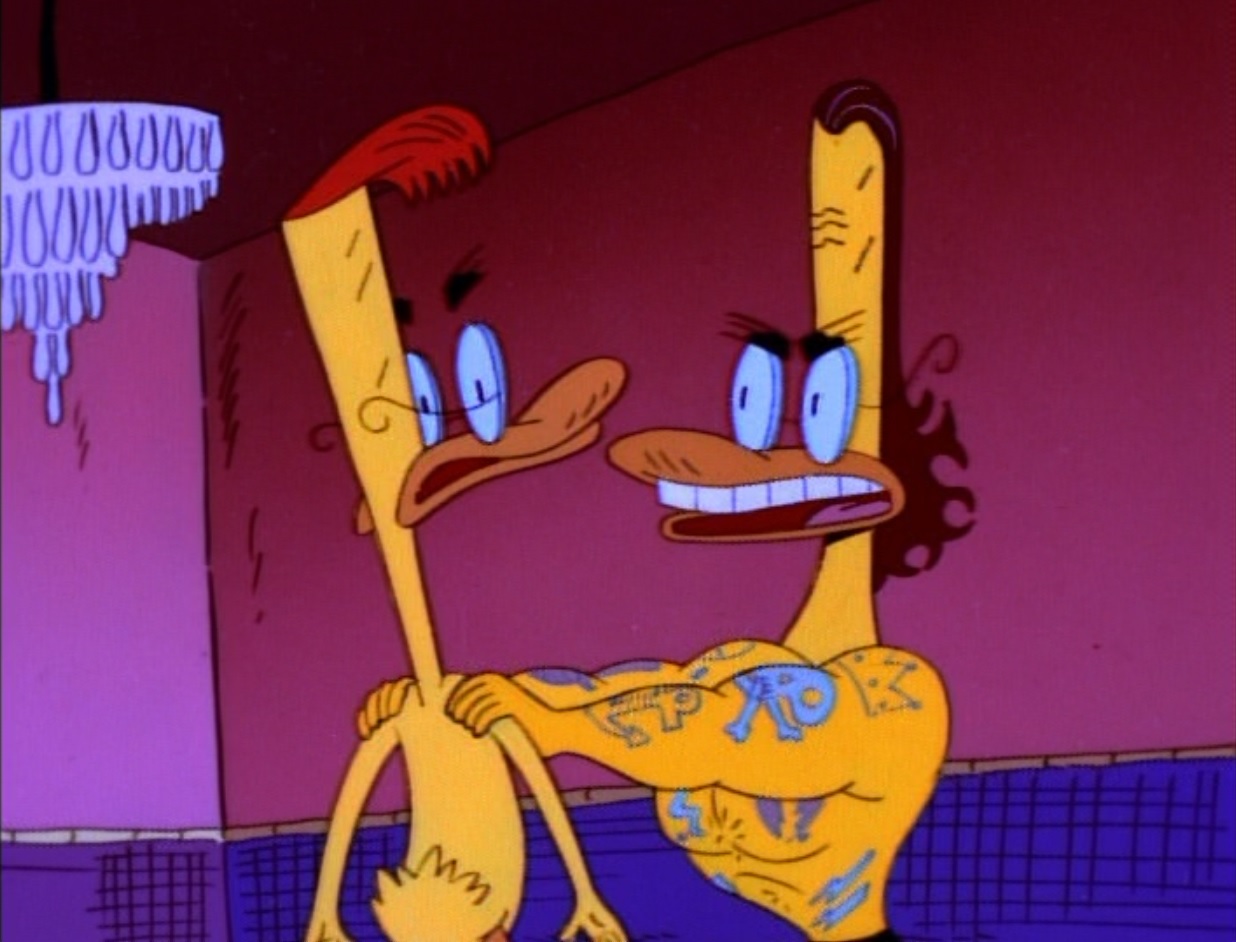
This episode starts with a simple promise by Duckman to attend the recital by the tuba-playing Mambo and Charles. But then Ajax accidentally creates a hole in the space-time continuum, which allows Duckman to gets a visit from his future self who tells him what will happen if he does go to the recital…
Before soon we’re right in the middle of a surprisingly sophisticated, even complicated episode on destiny and the consequences of one’s actions, involving multiple future selfs of Duckman, one even more outlandish than the other. At one point their appearances creates a scene of mayhem that’s got to be seen to be believed.
In short, ‘The Once and Future Duck’ is one of the best written and best directed of all Duckman episodes, relying less on wise-cracking asides, and more on the development of the inner logic of its own absurdist premises. The result is as profoundly philosophical as it is hilariously zany.
Watch ‘The Once and Future Duck’ yourself and tell me what you think:
This is Duckman episode no. 34
To the previous Duckman episode: Pig Amok
To the next Duckman episode: The One with Lisa Kudrow in a Small Role
‘The Once and Future Duck’ is available on the DVD-box ‘Duckman – The Complete Series’
Director Tomohiko Itō
Airing of first episode: January 8, 2016
Rating: ★★★½
Review:

‘Erased’ (the Japanese title translates as “The Town Where Only I Am Missing”) is an anime miniseries consisting of a mere twelve episodes and telling about young adult Satoru, who’s apparently often transported a few moments back in time to prevent some horrible disaster.
This is a weird concept to start with, especially because it’s never explained nor used consistently during the series. But this is the starting point of the complete series. Anyhow, when a mysterious killer goes rampant, threatening Satoru’s own very existence, he’s suddenly sent back not a few moments back into time, but way back to February 1988, when Satoru was eleven years old. Moreover, Satoru’s transferred to a different place, as well, his childhood hometown of Chiba, near Tokyo.
Satoru, who keeps his adult mind, knows he must do something about his classmate Kayo, a girl who has visible bruises because she’s molested by her mother, but who also is the first victim of a child-abducting serial killer that terrorizes the neighborhood, something Satoru knows beforehand, because he relives the past. He has only a few days to set things right. Will he be able to rescue Kayo and the other children from the clutches of the murderer, this time?
The series thus plays with the wish to go back in time to do things differently than you have had before. Satoru certainly changes the behavior of his eleven-years old self, changing from a rather distant, lonesome child into one who becomes a responsible and valuable friend, discovering the power of friendship along the way.
Now this is the first anime series I’ve seen in its entirety, so to me it’s difficult to assess the series’ value compared to others. In the distant past I’ve seen episodes from ‘Heidi’ (1974), ‘Angie Girl’ (1977-1978), and ‘Candy Candy’ (1975-1979), as well as ‘Battle of the Planet’s (1978-1980), the Americanized version of ‘Gatchaman’, but that’s about it – the only other more recent series I’ve seen is ‘FLCL’ (2000-2001), but I’ve only seen the first couple of episodes, so I cannot judge that series in its entirety.
Nevertheless, ‘Erased’ receives a high rating on IMDb, thus is clearly valued as one of the better series. And I can see why. The series is very good with cliffhangers, and there’s enough suspense to keep you on the edge of your seat most of the time. Moreover, apart from the time travelling and killer plot, there’s a sincere attention to the horrid effects of child abuse. Even better still, the series shows how being open and friendly towards others can make a significant positive change to their lives, as well as to your own. This is a rare and very welcome message, which the series never enforces on the viewer, but shows ‘by example’.
I particularly liked the fact that each episode starts with an intro, which is not an exact recapture of events in the previous episode, but which contains new footage, subtly shedding new light on the events. Nevertheless, ultimately, the thriller plot, which its red herrings, false alarms, and rather unconvincing villain, is less impressive than the subplots on child abuse and friendship.
Indeed, the series’ best parts all play in February-March 1988, not in the present, with the gentle eight episode, ‘Spiral’ forming the series emotional highlight. The creators succeed in giving these school parts an air of nostalgia, as exemplified by the leader of the series, which is intentionally nostalgic, focusing on Satoru’s childhood, before becoming more confused, indicating a lot, without revealing anything. Oddly, the intro is accompanied by neo-alternative guitar rock, suggesting more the early nineties than late 1980s.
Anyhow, when focusing on the relationships between the children the series is at its very best. In fact, I wonder why the creators didn’t make this series without the rather enforced killer plot. In my opinion the series needn’t any, although it certainly accounts for some chilling moments, like when Satoru becomes a victim of child abduction himself…
Unfortunately, the creators of ‘Erased’ are better in building its subplots than ending them. The last three episodes become increasingly unconvincing. They quickly lost me, making me leave the series with a rather sour taste in my mouth. The finale certainly stains the whole series and diminishes its power.
I have difficulties to say something about the design and animation. The animation, typically for television anime, is rather limited, but still looks fine, as does the staging. The character designs and background painting, however, don’t transcend the usual Japanese conventions, and are indeed pretty generic. In that respect, ‘FLCL’, the only other anime series I can say something about, is much more cutting edge.
In all, ‘Erased’ is a gripping series with a very welcome attention to the horrors of child abuse and the benefits of friendship. I’d certainly say it deserves a watch, even if it can turn out a little disappointing one, given the series’ potential.
Watch the trailer for ‘Erased’ and tell me what you think:
‘Erased’ is available on Blu-Ray and DVD
Director: René Laloux
Release Date: January 28, 1988
Rating: ★★½
Review:
 ‘Gandahar’ was to be René Laloux’s last feature, and like his former two feature films, ‘La planète sauvage‘ (1973) and ‘Les maîtres du temps‘ (1982), it’s a science fiction film set on a strange planet.
The film is especially related to ‘Les maîtres du temps’. Not only in visual style, but also with its story line involving mindless oppressors and time travelling. This time we’re on the paradise-like planet Gandahar, which is suddenly attacked by a powerful, yet unknown force. Soldier Sylvain is send away to find out who these enemies are…
‘Gandahar’ is the least successful of Laloux’s features. Its story, based on a 1969 novel by Jean-Pierre Andrevon, is entertaining enough, but the film’s narrative style is terrible. Practically everything that’s happening is explained by the main characters to us, even when we as viewers had come to our own conclusions. This is most preposterous in an early scene in which Sylvain finds his love interest Airelle, who immediately exclaims she’s falling in love with our hero. This must be one of the worst love scenes ever put to the animated screen.
The film’s ultimate villain is rather surprising, as is his downfall, even though he’s killed off ridiculously easily. Strangely enough the creature is given a long death scene, before the film abruptly ends. We don’t even watch Sylvain reunite with his love interest! Not that we did care, anyway, for the film’s main protagonists are as characterless as possible.
It’s a pity, for the film’s aesthetics are quite okay for a 1980s film. The animation, by a North-Korean studio, is fair, if not remarkable, and the designs by French comic book artist Philippe Caza are adequately otherwordly. Sure, he’s no Moebius, let alone a Roland Topor, and he never reaches the strangeness of the latter’s fantastic planet from 1973. In fact the film rarely succeeds in escaping the particularly profane visual style of the 1980s (e.g. ‘Heavy Metal’). Most interesting are the backgrounds, and Gabriel Yared’s musical score, which is inspired and which elevates the film to a higher level.
Watch ‘Gandahar’ yourself and tell me what you think:


 Dr. Grob's Animation Review