
You are currently browsing the category archive for the ‘Black and White Films’ category.
Director: Dave Fleischer
Release Date: May 27, 1938
Stars: Betty Boop, Pudgy
Rating: ★★
Review:
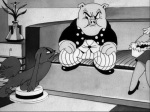
 ‘The Swing School’ marks a return of Betty Boop to the animal world she came from in the early 1930s.
In this cartoon she runs a swing school for anthromorpic kid animals, including an elephant, a hippo, a giraffe, and Pudgy. Pudgy, like Pluto, had been only a half anthropomorphized dog and wasn’t able to speak. So in this cartoon, in which he’s more treated as a little kid than as a dog, all these animals are devoid of speech. However, they can sing and play the piano.
Unfortunately, Pudgy is not doing well at all, singing Betty Boop’s trite Lalala song way out of tune. So Betty makes him sit in the dunce’s corner. But when a female dachshund takes pity on the pup, and kisses him, Pudgy suddenly bursts into some serious scatting, making the whole class swing.
‘The Swing School’ surfs on the swing craze, which was in full swing (pardon the pun) by 1938. Although the catchy scatting part is a warm welcome back to Betty Boop’s early jazz days, most of the cartoon is terribly slow and extremely childish, and so tiresome that it comes close to the point of being unwatchable. In no sense the cartoon comes close to the Fleischers’ greatest swing cartoons, like ‘Swing, You Sinners!‘ (1930) or ‘Minnie the Moocher‘ (1932).
Only two weeks later, Warner Bros. would release ‘Katnip Kollege‘ covering the same subject, but with much, much more spirit.
Watch ‘The Swing School’ yourself and tell me what you think:
This is Betty Boop cartoon No. 74
To the previous Betty Boop cartoon: Out of the Inkwell
To the next Betty Boop cartoon: Pudgy the Watchman
‘Out of the Inkwell’ is available on the Blu-Ray ‘Betty Boop: The Essential Collection, Vol. 4’ and the French DVD Box Set ‘Betty Boop Coffret Collector’
Director: Dave Fleischer
Release Date: April 22, 1938
Stars: Betty Boop
Rating: ★★★½
Review:
 ‘Out of the Inkwell’ starts with live action footage of a black cleaner reading a book on hypnosis.
Hypnosis as conceived by the Fleischers is more like a magic spell, and has the power of making things come alive. The cleaner hypnotizes a pen that then draws an old-style Betty. He hypnotizes this miniature Betty, too, but she turns the tables on him, hypnotizing the broom and the fan, and finally, the man himself, making him clean the room rapidly.
‘Out of the Inkwell’ returns to the origins of Max Fleischer’s career, blending animation and live action using a character born out of ink. The result surely is one of the more original latter day Betty Boop cartoons, and a delightful mix of live action, stop motion and traditional animation.
The cartoon delivers less than it promises, however, and is particularly hampered by the black man’s extremely stereotyped lazy voice, which sounds like it has been dubbed. Highlight is the hypnotized Betty, who dives and swims in mid air, and who is animated extraordinarily rubbery.
Watch ‘Out of the Inkwell’ yourself and tell me what you think:
This is Betty Boop cartoon No. 73
To the previous Betty Boop cartoon: Be Up To Date
To the next Betty Boop cartoon: The Swing School
‘Out of the Inkwell’ is available on the French DVD Box Set ‘Betty Boop Coffret Collector’
Director: Dave Fleischer
Release Date: January 28, 1938
Stars: Betty Boop, Pudgy
Rating: ★★
Review:
 In ‘Riding the Rails’ Pudgy, Betty Boop’s cute puppy, follows Betty on her way to work.
He loses her on the subway, where he causes havoc. When he’s being chased by a rather poorly designed and ditto animated conductor he lands on the rails, where he’s almost killed. He hurries off home, and straight back into his bed.
Betty’s ride on the subway recalls a similar bus ride in ‘Judge for a Day’ (1935), and is most enjoyable in its depiction of subway annoyances. However, most of the cartoon deals with Pudgy’s terror, and plays on melodrama, not laughs. This makes ‘Riding the Rails’ a sympathetic, yet rather forgettable cartoon.
Watch ‘Riding the Rails’ yourself and tell me what you think:
This is Betty Boop cartoon No. 71
To the previous Betty Boop cartoon: Zula Hula
To the next Betty Boop cartoon: Be Up To Date
‘Riding the Rails’ is available on the Blu-Ray Betty Boop: The Essential Collection Vol. 3 and on the French DVD Box Set ‘Betty Boop Coffret Collector’
Director: Dave Fleischer
Release Date: April 25, 1938
Stars: Popeye, Olive Oyl
Rating: ★★★
Review:
 The title character of this cartoon is a stereotype Indian chief who longs for a squaw, as he immediately tells us in his opening song.
Enter Popeye and Olive on a stubborn donkey. At one point the donkey kicks Olive inside the Indian camp, and she seems to fall for the chief’s advances. The Indians, meanwhile, order Popeye to perform some difficult tasks, and with spinach he does them much better than his Indian rivals.
‘Big Chief Ugh-Amugh-Ugh’ is an uneven cartoon, and suffers from inadequate storytelling, and severe stereotyping. The cartoon is saved by Jack Mercer’s constant mumbling, which is particularly inspired.
Watch ‘Big Chief Ugh-Amugh-Ugh’ yourself and tell me what you think:
This Popeye film No. 59
To the previous Popeye film: The House Builder Upper
To the next Popeye film: I Yam Love Sick
‘Big Chief Ugh-Amugh-Ugh’ is available on the DVD Box Set ‘Popeye the Sailor 1933-1938’
Director: Dave Fleischer
Release Date: March 18, 1938
Stars: Popeye, Olive Oyl, Wimpy
Rating: ★★★★
Review:
 ‘The House Builder Upper’ opens with Olive crying on her doorstep.
It’s soon revealed why: as the camera zooms out, it’s revealed her complete house has burnt down. Firemen Popeye and Wimpy arrive way too late, but they offer to help her build a new house. Enter a series of building gags, which elaborate on the Laurel and Hardy two-reeler ‘The Finishing Touch’ (1928). Like Laurel & Hardy, Popeye and Wimpy are lousy construction workers, with Wimpy excelling in silly acts, accompanied by a particularly goofy tune. So it’s no wonder, the complete house falls apart upon finishing.
Enter that mysterious ingredient, spinach. After swallowing the contents of the can, Popeye builds a new house in a second. But even spinach isn’t sacred: even this house falls apart! So, the cartoon ends with Popeye promising to try again.
‘The House Builder Upper’ is one of those pleasant Popeye cartoons in which the Bluto-Popeye-Olive love triangle has no part at all. It’s a great gag-orientated cartoon, and the gags come in plenty, with the bizarre finale as a highlight within the complete series.
Watch ‘The House Builder Upper’ yourself and tell me what you think:
This Popeye film No. 58
To the previous Popeye film: Learn Polikeness
To the next Popeye film: Big Chief Ugh-Amugh-Ugh
‘The House Builder Upper’ is available on the DVD Box Set ‘Popeye the Sailor 1933-1938’
Director: Dave Fleischer
Release Date: February 18, 1938
Stars: Popeye, Olive Oyl, Bluto
Rating: ★★★★
Review:
 Olive takes Popeye to Prof. Bluteau’s school of etiquette.
The opening scene shows Prof.’s Bluteau’s large office, with help of Fleischer’s 3d tabletop background. Bluteau of course is Bluto and in this scene he’s already established as a fraud. Indeed, he hardly behaves gentleman-like when Olive and Popeye enter. True, he does know more manners than Popeye, but he clearly fancies Olive, and when trying to kiss her, he almost strangles her.
So, Popeye doesn’t have to win Olive back, he really has to rescue her from the brute. Interestingly, this time the spinach gives Popeye some manners besides strength, and there’s some great animation on Popeye clobbering Bluto in deft poses, on the tune of ‘Stars and Stripes Forever’.
Bluto’s design is somewhat off in this cartoon – the studio clearly experimented with new eyes on the character, which are not really steady yet. Maybe the studio grew a little tired of the character, for Bluto wasn’t seen again in the rest of 1938, only to return in ‘Customers Wanted’ (1939) [see Bobb Edwards’s comment below ‘Big Chief Ugh-Amugh-Ugh’ for a more plausible reason]. Indeed, in the mean time the studio proved it could come up with wonderful cartoons without him.
Watch ‘Learn Polikeness’ yourself and tell me what you think:
This Popeye film No. 57
To the previous Popeye film: Let’s Celebrake
To the next Popeye film: The House Builder Upper
‘Learn Polikeness’ is available on the DVD Box Set ‘Popeye the Sailor 1933-1938’
Director: Dave Fleischer
Release Date: January 21, 1938
Stars: Popeye, Olive Oyl, Bluto, Wimpy
Rating: ★★★★½
Review:
 It’s New Year’s Eve, and Popeye and Bluto ride a sleigh to Olive’s house to take her to a New Year’s party at the Happy Hour Club.
However, Popeye hates to see Olive’s granny sitting alone at Olive’s home at New Year’s Eve, and takes her with them. At the club Bluto dances with Olive, while Popeye dances with grandma. When Wimpy, dressed like Santa, announces a dancing contest, Popeye has to enter with the deaf old lady. But with the help of some spinach, the duo clears the floor, literally, in a very long and enjoyable dance scene on some nice swing music, which features an excerpt from ‘Happy Days Are Here Again’.
‘Let’s Celebrake’ is very joyous cartoon, in tune with the New Year’s spirit, and it’s one of those rarer Popeye cartoons in which there’s no conflict between Bluto and Popeye, at all. Even more interesting, Popeye doesn’t eat the spinach himself here, leaving that to grandma.
Watch ‘Let’s Celebrake’ yourself and tell me what you think:
This Popeye film No. 56
To the previous Popeye film: Fowl Play
To the next Popeye film: Learn Polikeness
‘Let’s Celebrake’ is available on the DVD Box Set ‘Popeye the Sailor 1933-1938’
Director: Dave Fleischer
Release Date: December 17, 1937
Stars: Popeye, Olive Oyl, Bluto
Rating: ★★½
Review:
 In ‘Fowl Play’ Popeye brings Olive a parrot to remember him by when he’s at sea.
The parrot, which too smokes a pipe, sings a love song for Olive, and she immediately grows attached to the bird. But then Bluto appears. He lets the bird free, and then tries to kill it with an ax, so Popeye has to save the day.
‘Fowl Play’ is one of the more routine Popeye cartoons. Bluto is nothing but a big bully here, while the parrot adds little to the classic love triangle. The complete cartoon is rather slow and predictable. Its best gag is when Popeye repeatedly has to leave the fighting cloud to save Olive from falling while fainting. This scene contains some wild takes on Olive, while an earlier scene features a very wild double-take on Popeye.
Watch ‘Fowl Play’ yourself and tell me what you think:
This Popeye film No. 55
To the previous Popeye film: Popeye the Sailor meets Ali Baba’s Forty Thieves
To the next Popeye film: Let’s Celebrake
‘Fowl Play’ is available on the DVD Box Set ‘Popeye the Sailor 1933-1938’
Directors: Ben Hardaway & Cal Dalton
Release Date: May 1, 1939
Stars: Porky Pig
Rating: ★★★½
Review:
 In ‘Porky and Teabiscuit’ Porky is the son of a farmer.
Porky’s father sends him away to the race track to sell hay. By accident Porky buys a sick horse, called ‘Tea Biscuit’, a salute to Seabiscuit, the most famous race horse of its time. Despite the horse’s illness, Porky enters a steeple chase with it, end even wins the race.
‘Porky and Teabiscuit’ pays tribute to Floyd Gottfredson’s classic Mickey Mouse comic ‘Mickey Mouse and Tanglefoot’ (1933). Where Tanglefoot won by his fear of wasps, Tea Biscuit wins by being startled by blows. Unfortunately, Hardaway & Dalton add nothing to this premise, and the result is a rather mediocre cartoon, albeit a quite entertaining one.
Watch ‘Porky and Teabiscuit’ yourself and tell me what you think:
This is Porky Pig cartoon no. 55
To the previous Porky Pig cartoon: Chicken Jitters
To the next Porky Pig cartoon: Kristopher Kolumbus, jr.
‘Porky and Teabiscuit’ is available on the DVD-set ‘Looney Tunes Golden Collection Volume Three’
Director: Bob Clampett
Release Date: June 25, 1938
Stars: Porky Pig
Rating: ★★★★
Review:
 By 1938, the Warner Bros. Studio really started to hit its stride. ‘Porky’s Party’ is a good example of the studio’s new, confident and unique style, which owed virtually nothing to the Disney convention.
In ‘Porky’s Party’, Porky celebrates his own birthday. His party is hindered by a silk worm he gets as a present from uncle Phineas Pig. When one exclaims ‘sew’, the worm immediately starts sewing clothes out of nowhere, including a bra. It may be clear that once Porky says ‘So!’, the worm does the same thing. Another problem is Porky’s dog, who gets drunk on his hair tonic, and who’s mistaken of being mad. Porky’s guests aren’t helping either: one is a penguin who eats all his food, the other a particularly loony duck goose.
‘Porky’s Party’ is rather disjointed, but its atmosphere is strikingly silly, and the gags come in fast and plenty. Only the gag in which the penguin swallows a worm-produced silk hat, is milked too long. But mostly, ‘Porky’s Party’ is an early testimony of Warner Bros.’ unique, wacky style, which would dominate the war years.
Watch ‘Porky’s Party’ yourself and tell me what you think:
This is Porky Pig cartoon no. 42
To the previous Porky Pig cartoon: Porky the Fireman
To the next Porky Pig cartoon: Porky’s Spring Planting
‘Porky’s Party’ is available on the DVD-set ‘Looney Tunes Golden Collection Volume Three’
Director: Frank Tashlin
Release Date: April 17, 1937
Stars: Porky Pig, Petunia Pig
Rating: ★★★
Review:
In ‘Porky’s Romance’ Porky tries to court Petunia Pig, but she remains indifferent.
Porky then attempts to commit suicide by hanging himself on a tree. The attempt fails, but it knocks him unconscious, and leads him into a dream sequence which shows what would become of a possible marriage with Petunia. This turns out to be a bachelor’s nightmare: Porky has to do all the housework and is bullied by an enormously fat Petunia. When he’s awake, Petunia is at his sight, now ready for marriage, but Porky rushes off into the distance, only to return to kick Petunia’s obnoxious dog.
‘Porky’s Romance’ is still from a transitional period for the Warner Bros. studio. It’s most probably inspired by the Mickey Mouse cartoons ‘Puppy Love’ (1933) and ‘Mickey’s Nightmare‘ from 1932. ‘Puppy Love’ uses the same setting, including a Pekingese dog, while ‘Mickey’s Nightmare’ shares a dream sequence that quickly becomes bachelor’s nightmare. In this way the cartoon still looks back. Moreover, both Porky’s design and voice are still rather unappealing, and the design of Petunia’s pesky Pekingese is primitive and awkward.
On the other hand, this cartoon features remarkably modern backgrounds, which show very streamlined and rather futuristic architecture. And as Leonard Maltin shows in ‘Of Mice and Magic’, Frank Tashlin experiments with remarkably rapid cutting, speeding up storytelling at Warner Bros., and in cartoons in general.
However, the film’s most striking feature is it opening sequence in which Petunia Pig is pompously introduced as the new Warner Bros. star. We then watch her nervously trying to give say to the radio audience that she hopes that they’ll like her picture. When an off-screen voice whispers to her not to get excite, she explodes and yells into the camera: “Who’s excited!!!”. Only then the opening titles appear!
More than anything this kind of self-conscious gags would become a hallmark of Warner Bros.’ own brand of humor.
Watch ‘Porky’s Romance’ yourself and tell me what you think:
http://www.dailymotion.com/video/x41ct72
This is Porky Pig cartoon no. 21
To the previous Porky Pig cartoon: Picador Porky
To the next Porky Pig cartoon: Porky’s Duck Hunt
‘Porky’s Romance’ is available on the DVD-set ‘Looney Tunes Golden Collection Volume Three’
Directors: Rollin Hamilton & Tom McKinson
Release Date: November 3, 1933
Stars: Cubby the Bear
Rating: ★
Review:
 ‘The Gay Gaucho’ was the second of two Cubby Bear films made by the California-based Harman-Ising studio.
Like the first, ‘Cubby’s World Flight‘, it looks back, not forward, bringing back in mind the first Merrie Melodie, ‘Lady, Play Your Mandolin‘ (1931) and the early Mickey Mouse cartoons ‘Gallopin’ Gaucho‘ (1928) and ‘The Cactus Kid‘ (1930).
The setting is Argentine, and Cubby (Bosko, but in a different design) is a gaucho. He visits a canteen, where his girlfriend is a dancer. Then a Peg Leg Pete-like character enters, kidnapping the girl, with Cubby pursuing him. This story already was uninspired and routine, but Harman and Ising top its triteness by revealing it was all just a dream.
‘The Gay Gaucho’ is well-animated (by Friz Freleng and Paul Smith), but utterly forgettable, and it only proves that Cubby was so devoid of character, he couldn’t inspire at all. The result is one of the most forgettable films of 1933.
Watch ‘The Gay Gaucho’ yourself and tell me what you think:
‘The Gay Gaucho’ is available on the Blu-Ray ‘The Complete Animated Adventures of Cubby Bear’ and on the DVD ‘The Complete Adventures of Cubby Bear’
Director: Dave Fleischer
Release Date: February 2, 1934
Stars: Betty Boop
Rating: ★★★★
Review:
 It’s a cold winter night, and to get warm Betty lights a fire.
Soon, however, it gets too hot, and the fire roasts her two chickens. Betty herself soon dreams she’s in hell, dressed only in her nightgown. In a short scene the fires of hell reveal her legs through her nightgown. Later, when the devils watch her perform a sexy dance to a jazzy score, they get hot. But Betty gives them the cold shoulder (literally), which causes them and all hell to freeze completely over.
‘Red Hot Mamma’ is one of the last Betty Boop cartoons to glorify her sexuality, and to have a jazzy score. However, the humor is already much less compelling than from the 1931-1933 cartoons, lacking the weird surrealism of that period. As a result ‘Red Hot Mamma’ is amusing, but far less funny than it might have been, were it produced only a few months earlier…
Watch ‘Red Hot Mamma’ yourself and tell me what you think:
This is Betty Boop cartoon No. 25
To the previous Betty Boop cartoon: She Wronged Him Right
To the next Betty Boop cartoon: Ha! Ha! Ha!
‘Betty Boop’s May Party’ is available on the Blu-Ray Betty Boop: The Essential Collection Vol. 2 and on the French DVD Box Set ‘Betty Boop Coffret Collector’
Director: Dave Fleischer
Release Date: May 12, 1933
Stars: Betty Boop, Bimbo, Koko
Rating: ★★★
Review:
 ‘Betty Boop’s May Party’ is one the Fleischer studio’s most surreal cartoons, and one of the last ones containing this type of weird humor, so typical for the studio in the early 1930s.
The short starts with Betty Boop on a boat trip to her own amusement park. There we watch her perform ‘Here We Are’, a hit song made famous by Annette Hanshaw in 1929. The rest with the cartoon is filled with pictures of animals frolicking in the amusement park. Little of the cartoon makes any sense, but there are surreal gags all over the place, like a boat climbing down a ladder while descending a waterfall, a jetty walking towards the arriving boat, and somebody on a swing changing passing elephants into camels.
However, the cartoon runs totally berserk, when an elephant accidentally hits a rubber tree. The sprouting rubber turns everything in sight rubbery, including the moon and the whole scenery, with weird and wild consequences. For example, Bimbo and Koko perform a bizarre dancing scene, and when Betty joins in the trio completely twist the background around. Meanwhile we can hear the intoxicating jazz of Duke Ellington’s ‘It don’t mean a thing if it ain’t got that swing’ in the background. Most of the cartoon is fun to watch, but this finale is on a league of its own, and turns ‘Betty Boop’s May Party’ into a near-classic.
Watch ‘Betty Boop’s May Party’ yourself and tell me what you think:
This is Betty Boop cartoon No. 15
To the previous Betty Boop cartoon: Betty Boop’s Birthday Party
To the next Betty Boop cartoon: Betty Boop’s Big Boss
‘Betty Boop’s May Party’ is available on the French DVD Box Set ‘Betty Boop Coffret Collector’
Director: Dave Fleischer
Release Date: December 17, 1933
Stars: Popeye, Olive Oyl, Bluto
Rating: ★★½
Review:
 ‘Seasin’s Greetinks!’ is Popeye’s first Christmas cartoon. It must be one of the least typical Christmas cartoons around: we watch Bluto and Popeye clobbering each other, while wishing each other ‘Merry Christmas’ and ‘A Happy New Year’, respectively.
Most of the time we watch the trio skating. When Olive gives him the cold shoulder, Bluto cuts off the ice on which she sits, and she immediately drifts towards a waterfall. Luckily, Popeye saves her in a rather bizarre way. The cartoon ends with Olive and Popeye watching a Christmas tree, decorated by the stars from the blow Popeye gave Bluto.
‘Seasin’s Greetinks’ is the first mediocre Popeye cartoon. Compared to earlier entries this cartoon is rather low on gags, and the love triangle already becomes predictable. Luckily, the Fleischers came up with enough variations to keep the series fresh, even if not in all its entries.
‘Seasin’s Greetinks!’ is noteworthy for introducing the skating-near-a-waterfall plot, which Disney would copy in ‘On Ice‘ (1935) and the ‘Once upon a Wintertime’ sequence of ‘Melody Time’ (1948). This plot idea in itself seems to be borrowed from the finale of the D.W. Griffith melodrama ‘Way Down East’ (1920), which doesn’t feature any skating, but certainly a breathtaking rescue from someone floating on ice towards a waterfall.
Watch ‘Seasin’s Greetinks!’ yourself and tell me what you think:
http://www.dailymotion.com/video/xmu6iw
This Popeye film No. 4
To the previous Popeye film: I Eats My Spinach
To the next Popeye film: Wild Elephinks
‘Seasin’s Greetinks!’ is available on the DVD Box Set ‘Popeye the Sailor 1933-1938’
Director: Dave Fleischer
Release Date: November 17, 1933
Stars: Popeye, Olive Oyl, Bluto, Wimpy
Rating: ★★★½
Review:
 ‘I Eats My Spinach’ is the first cartoon in which an instrumental version of Popeye’s theme music accompanies the opening titles.
The short opens with the very walking cycle with which Popeye appeared for the first time on the screen in ‘Popeye the Sailor‘. He walks towards Olive’s house, and together they go to a rodeo to watch the “Great Bluto” perform. Immediately, Popeye challenges and outperforms the bearded brute. He wrestles a badly drawn bull, and fights another one. The cartoon ends with Popeye knocking a bull into a meat market in a rather shocking metamorphosis gag.
The designs in this short are more primitive than in other Popeye cartoons, making it look rather old-fashioned, even when compared with contemporary Popeye cartoons like ‘Blow Me Down!‘ or ‘Season’s Greetinks!‘. Surprisingly, this cartoon marks a return to the animal world of Betty Boop’s earliest cartoons, being the last short to do so.
Popeye would fight a bull again in ‘Bulldozing the Bull‘ (1938), but now most unwillingly and without harming the animal. By then Popeye had become on example to youngsters, both in comics and on film, and his aggression was toned down, luckily without losing its spunk.
Watch ‘I Eats My Spinach’ yourself and tell me what you think:
This Popeye film No. 3
To the previous Popeye film: Blow Me Down!
To the next Popeye film: Seasin’s Greetinks!
‘I Eats My Spinach’ is available on the DVD Box Set ‘Popeye the Sailor 1933-1938’
Director: Dave Fleischer
Release Date: October 27, 1933
Stars: Popeye, Olive Oyl, Bluto
Rating: ★★★★½
Review:
 Like the previous two cartoons, ‘Blow Me Down!’ (another of Popeye’s oneliners from E.C. Segar’s comic strip) opens with Popeye singing his own theme song, now while riding a shark to Mexico.
In Mexico Popeye visits a canteen, where Olive is a dancer, performing a dance, that’s taken straight from Segar’s strip from March 1932, including the gag in which she lands with her feet into two spittoons. Then Bluto enters, shooting everything in sight, and within seconds, Popeye is the only other person in the canteen. The two engage into a strange duel, then Bluto tries to harass Olive, but like in ‘I Yam What I Yam’ she appears pretty much in control when Popeye comes to rescue her. In a spectacular finale, Popeye knocks Bluto around the world.
‘Blow Me Down’ covers no new story grounds, its premise harking all the way back to ‘Gallopin’ Gaucho‘ (1928). Yet, it’s by all means a delightful cartoon, and it’s over before you know it. It contains a very original bird-eye shot of Popeye ascending the stairs. Olive’s voice is by Bonnie Poe, and very different from Mae Questel’s later version.
Watch ‘Blow Me Down!’ yourself and tell me what you think:
This Popeye film No. 2
To the previous Popeye film: I Yam What I Yam
To the next Popeye film: I Eats My Spinach
‘Blow Me Down!’ is available on the DVD Box Set ‘Popeye the Sailor 1933-1938’
Director: Dave Fleischer
Release Date: September 29, 1933
Stars: Popeye, Olive Oyl, Wimpy
Rating: ★★★½
Review:
 ‘I Yam What I Yam’ was the second cartoon starring Popeye, and the very first in his own series, taking its title from one of Popeye’s most famous lines in E.C. Segar’s comic strip.
The short opens with an original opening tune that would only last two cartoons: ‘Strike up the band for Popeye the sailor’. After ‘Blow Me Down!‘ this peppy leader was replaced by Popeye’s own song, which he also sings in the opening scene, with Olive Oyl rowing a bark to an unknown island. When they’ve washed ashore, Popeye punches a bunch of trees into a log cabin.
This film introduces his famous sidekick from the comic strip, the gluttonous freeloader Wellington Wimpy. In his first dialogue, Wimpy quotes a classic line from Segar’s strip “Come on in for a duck dinner. You bring the ducks”. So, Popeye goes forth in search of ducks. However, within seconds Olive and Wimpy are threatened by Indians. Luckily Popeye comes to the rescue. In a spectacular finale Popeye knocks down every Indian in sight, even their gigantic chief, whom Popeye punches into Mahatma Gandhi…
Interestingly, before Popeye arrives, Olive appears very much in control, knocking down Indians by the minute, while crying for help. It’s nice to watch a female cartoon character being portrayed so strong and independent, far from the cliched damsel in distress, as portrayed by e.g. Minnie Mouse.
Popeye’s and Olive’s designs are still rather unstable in this short, but Olive’s voice sounds much more familiar than in ‘Popeye the Sailor’. The cartoon makes little sense, but is very enjoyable, nonetheless. Its joy is enhanced by an excellent musical score.
Watch ‘I Yam What I Yam’ yourself and tell me what you think:
This Popeye film No. 1
To Popeye’s introduction in the Betty Boop cartoon ‘Popeye the Sailor‘
To the next Popeye film: Blow Me Down!
‘I Yam What I Yam’ is available on the DVD Box Set ‘Popeye the Sailor 1933-1938’
Director: Dave Fleischer
Release Date: July 14, 1933
Stars: Betty Boop, Popeye, Olive Oyl, Bluto
Rating: ★★★
Review:
 1933/1934 marked a watershed for American animated cartoons: not only did the sex and horror rich cartoons of 1933 have to make way for the much more prudish content of the Hays code era – during the same period many studios traded their old stars in for new ones.
In this period Iwerks dropped Flip the Frog in favor of Willie Whopper, Warner Bros. saw the departure of Bosko, and introduced Buddy, Van Beuren said farewell to Tom & Jerry and welcomed Cubby the Bear and The Little King. Even at the Walt Disney studio Mickey Mouse, the biggest star of all, would steadily lose popularity to the 1934 newcomer Donald Duck. The relay race was most visible at the Fleischer studio. In their 1933 cartoon ‘Popeye the Sailor’ Betty Boop literally gave way to Popeye.
True, like Mickey, Betty would keep on starring cartoons after 1933, but due to the Hays code, her sexuality, her biggest feat, was toned down, and by 1934 her heydays were clearly over. Popeye, on the other hand, would grow into arguably the most successful cartoon star of all, starring more than 200 cartoons, and lasting well into the 1950s, before embarking on a career in television.
Of course, Popeye already had been a star before he was introduced to the animated screen, having quickly grown into the leading character of Elzie Segar’s Thimble Theater comics since his introduction in 1929. But when the Fleischers started their films, he quickly became one of the most familiar cartoon stars of all time, still recognizable to present day audiences, where Buddy, Willy Whopper and Cubby Bear rapidly fell into oblivion.
In their pilot Popeye cartoon, officially part of the Betty Boop series, the Fleischers appear very well aware of the potentials of their new hero. The short opens with a newspaper announcing that Popeye now is a movie star. The accompanying illustration immediately comes to life, and then we watch an iconic scene: Popeye singing his own new theme song, while socking things into tiny little things, in a string of metamorphosis gags. Popeye’s theme song is irresistably catchy, but who would have thought at the time that it would be still a familiar tune in the 21st century?
During the main section of the film, it’s shore leave, and Popeye, Bluto and Olive visit a carnival. Because it’s de facto a Betty Boop cartoon, the human trio is oddly staged in Betty’s animal world, which she, too, would abandon within a few months. Betty’s role is minimized to that of a sexy hula dancer, in reused footage from ‘Betty Boop’s Bamboo Isle‘ (1932). Popeye joins in, sharing Betty’s rotoscoped movements.
The cartoon introduces the basic story arc that would be varied upon in many years to come: Popeye and Olive are sweethearts, but Bluto craves for Olive, too, creating friction between the two strong men. There’s a lot of clobbering, and at one point Popeye grabs for a can of spinach to give him extra strength. This premise is very different from Segar’s Comic Strip, with its melodramatic stories which could easily last for months.
Both Bluto and spinach were taken from Segar’s strip, but there they had played minor roles. Bluto, in fact, only appeared a couple of weeks in September/October 1932, never to return to Segar’s comic strip. In the Fleischer cartoons, however, he was promoted to one of the three starring roles, easily eclipsing Wimpy. During his first cartoon, Bluto’s theme music is ‘Barnacle Bill’, extensively used in the cartoon of the same name from 1930. Unlike Popeye’s tune, this theme music would not return in later Popeye cartoons. The love triangle, of course, was far from new, and had been employed in e.g., several Oswald and Mickey Mouse cartoons. But the Fleischers managed to keep this premise surprisingly fresh, delivering several of the funniest cartoons of the 1930s.
The importance of Popeye’s move to the movie screen for cartoon history cannot be overestimated: for the first time in the sound era a comic strip star was successfully put to the screen, for the first time a strong idiosyncratic character appeared on the animated screen, for the first time cartoon violence was not incidental, but a vital part of the series. Strong characters and cartoon violence would recur more often and often when the 1930s progressed and would become essential to cartooning during the 1940s. Indeed, other characters, most notably Donald Duck and Daffy Duck, contributed to the evolution of a brassier style, but it was Popeye who had shown the way.
Watch ‘Popeye the Sailor’ yourself and tell me what you think:
https://www.dailymotion.com/video/x1ocnv7
This is Betty Boop cartoon No. 18
To the previous Betty Boop cartoon: Mother Goose Land
To the next Betty Boop cartoon: The Old Man of the Mountain
This the first film featuring Popeye
To the first Popeye film in his own series: I Yam What I Yam
‘Popeye the Sailor’ is available on the DVD Box Set ‘Popeye the Sailor 1933-1938’
Director: Tom Palmer
Release Date: September 23, 1933
Rating: ★★★
Review:
 ‘I’ve Got to Sing a Torch Song’ was the first Merrie Melodie of Leon Schlesinger’s erratic fledgling studio after Harman & Ising quit making cartoons for him.
The short is the second of only two cartoons directed by Tom Palmer, the other being ‘Buddy’s Day Out‘. Like in ‘Buddy’s Day Out’ Palmer is completely at loss as a director, delivering a completely aimless and meandering cartoon. So, soon Schlesinger fired him. Palmer went to Van Beuren where he (co-)directed eighteen more cartoons.
‘Ive Got to Sing a Torch Song’ is a blackout gag cartoon on radio. It features numerous caricatures of radio and movie stars, like Bing Crosby, Ed Wynn, Joan Blondell, James Cagney, and even of Benedetto Mussolini and George Bernard Shaw. The title song only kicks in after five minutes, introduced by the Boswell sisters, and sung by Greta Garbo, Zasu Pitts and Mae West. Garbo even says ‘That’s All Folks!’ at the very end of the cartoon. This last gag undoubtedly is the funniest of the complete short, despite the presence of some typical Warner Bros. gags, like a conductor conducting a phonograph. The complete film makes no sense, but at least it’s well animated, thanks to Jack King, whom Schlesinger had hired away from Walt Disney.
Watch ‘I’ve Got to Sing a Torch Song’ yourself and tell me what you think:
http://www.dailymotion.com/video/x2fbb11
‘I’ve Got to Sing a Torch Song’ is available on the DVD-set ‘Looney Tunes Golden Collection Volume Five’


 Dr. Grob's Animation Review