
You are currently browsing the category archive for the ‘Black and White Films’ category.
Director: Dave Fleischer
Release Date: August 22, 1931
Stars: Betty Boop, Bimbo
Rating: ★★
Review:
 In this Talkartoon Bimbo is a moving man, moving Betty Boop’s household together with a horse, a cat and a hippo.
The short features ca. no story and consists of a string of unrelated throwaway gags. The animation, too, is at times completely random. For example, there’s some totally unnecessary and incomprehensible flexible animation on Bimbo’s van in the opening scene. This total lack of direction hampers ‘Bimbo’s Express’, and it fails to fulfil any promise.
The cartoon’s most stunning scene is that of Betty Boop cutting her toenails. But even more striking is Sammy Timberg’s music, which is loosely jointed from numerous familiar tunes, and which anticipates Carl Stalling’s techniques by several years.
This cartoon is billed ‘Bimbo & Betty’, indicating Betty’s rising star. In the next cartoon, ‘Minding the Baby‘, it would be ‘Betty Boop and Bimbo’, and in ‘Mask-A-Raid‘, it’s already “Betty Boop in ‘Mask-A-Raid’ with Bimbo’…
Watch ‘Bimbo’s Express’ yourself and tell me what you think:
This is Talkartoon No. 24
To the previous Talkartoon: Bimbo’s Initiation
To the next Talkartoon: Minding the Baby
‘Bimbo’s Express’ is available on the French DVD Box Set ‘Betty Boop Coffret Collector’
Director: Chuzo Aoji
Release Date: 1931
Stars: Momotaro
Rating: ★★★½
Review:
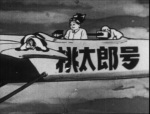 In ‘Momotaro’s Sky Adventure’ (also known as ‘Aerial Momotaro’) Japanese animation pioneers Aoji and Yasuji Murata tell a tale about that great and friendly warrior from Japanese folklore, Momotaro, who had been brought to the animated screen by Takamasa Eigasha in ‘Momotaro the Undefeated’ (1928).
Surprisingly, Aoji and Murata move our hero into the present. Momotaro is visited by a couple of Antarctic island birds who call for help against an evil (American?) eagle. Together with his loyal friends, monkey, dog and pheasant, he flies to the remote island in a propeller plane, being fueled twice by birds on the way. When the quartet arrives, they battle the eagle in the air in an overlong fighting sequence, which at times is strangely reminiscent of a modern computer game. Momotaro finally decides to capture the fiend alive, and he’s celebrated as a hero by the grateful birds.
‘Momotaro’s Sky Adventure’ is Japan’s very first propaganda cartoon. It shows an early form of nationalism and anti-Americanism. Momotaro would grow very popular during World War II, representing Japan in many wartime films, and starring Japan’s very first animated feature, ‘Momotaro’s Divine Sea Warriors’ (1945), commissioned by the Japanese navy. This transformation of the folk hero into a nationalistic figure begins with this cartoon from 1931. Indeed, ultra-nationalism and militarism overtook Japan in the early 1930s, which e.g. resulted in the annexation of Manchuria in the summer of 1931.
Importantly, ‘Momotaro’s Sky Adventure’ shows Japan’s national hero as the military strong friend of its weaker neighbors. This portrait of Japan as a benevolent big brother to all other Asian nations was played out throughout Japan’s militaristic period, and this propaganda story indeed managed to delude people like for example those Malay who, when Japan invaded their country in 1941, at first welcomed the Japanese as liberators from colonial Britain, only to find them far worse oppressors than the British had ever been…
‘Momotaro’s Sky Adventure’ is available on the Japanese DVD Box Set ‘Japanese Anime Classic Collection’.
Director: Dave Fleischer
Release Date: July 24, 1931
Stars: Bimbo, Betty Boop
Rating: ★★★★★ ♕
Review:
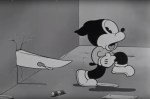 ‘Bimbo’s Initiation’ is probably the most famous Betty Boop cartoon, apart from ‘Snow-White‘ (1933).
Nevertheless, Betty only plays a small part in the cartoon, which is really about Bimbo. In his previous cartoon, ‘The Herring Murder Case’, Bimbo had been redesigned. He’s now more clearly a dog character, with a predominant black coloring instead of the earlier white. This redesigned Bimbo has some character in his rather original looks, but he’s still far from a character, remaining only a foil for the things happening around him.
In no cartoon this is so clear as in ‘Bimbo’s Initiation’. In the first scene we watch him walking on the street, when he suddenly falls into a well and is being caught in a scary underworld beneath the street. There bearded guys repeatedly ask him whether he wants to be a member of their secret order. Bimbo keeps saying no, and he tries to flee, but he cannot escape the nightmarish world, in which every deadly room leads to another one. These scenes are accompanied by a hot jazz version of ‘Tiger Rag’. Luckily, the last room features Betty, and when she asks him whether he wants to be a member, Bimbo gives in. Then all the bearded figures appear to be duplicates of her!
Betty Boop is completely blank in this cartoon and she still has dog ears here. But the nightmarish world is absolutely inspired. It’s both claustrophobic and funny, and we feel with Bimbo, who’s now victim of a world, in which no law, whether human or natural, applies. No other cartoon was so far removed from the happy world of Walt Disney, and arguably no other cartoon before Tex Avery’s ‘Northwest Hounded Police‘ (1946) and Chuck Jones’s ‘Duck Amuck‘ (1953) would be so compelling in portraying the anguish of a trapped cartoon character. Despite its primitive looks, the cartoon hasn’t aged at all, and it’s an undisputed classic within the complete cartoon canon.
‘Bimbo’s initiation’ undoubtedly has been the inspiration of the scary cartoon sequence in which a girl is caught in Joe Dante’s episode in the theatrical version of ‘The Twilight zone’ (1983).
Watch ‘Bimbo’s initiation’ yourself and tell me what you think:
This is Talkartoon No. 23
To the previous Talkartoon: The Herring Murder Case
To the next Talkartoon: Bimbo’s Express
‘Bimbo’s initiation’ is available on the French DVD Box Set ‘Betty Boop Coffret Collector’ and on Betty Boop: Essential Collection 2′
Director: Dave Fleischer
Release Date: April 16, 1931
Rating: ★★★½
Review:
 ‘Any Little Girl That’s A Nice Little Girl’ is a Screen Song about a cat who’s dating several girls at the same time.
First we watch him dating his girls through the telephone, then he goes through a bunch of photographs and chooses to visits hot Lulu Belle. When he tries to sneak out, Lulu Belle hits him with the couch. Enter the Screen Song, which is accompanied with images of e.g. a naked woman in a bath(!) and a picture of Betty Boop, who otherwise does not appear in this cartoon.
Only the first scene features lip-synch, and the scene with Lulu Belle also features an excerpt from the 1929 hit song ‘What Wouldn’t I Do for That Man’, popularized by Annette Hanshaw and Ruth Etting. This excerpt is much more interesting than the 1910 vaudeville title song. The last chorus features some nice interplay between the words and the animated characters, typical for the Screen Songs of this era.
Watch ‘Any Little Girl That’s A Nice Little Girl’ yourself and tell me what you think:
‘Any Little Girl That’s A Nice Little Girl’ is available on the French DVD Box Set ‘Betty Boop Coffret Collector’
Director: Burt Gillett
Release Date: January 23, 1931
Rating: ★★½
Review:
 Following Van Beuren’s ‘A Romeo Robin‘ (1930) Disney devoted a whole Silly Symphony on birds.
The short follows the half-story formula introduced in ‘Playful Pan‘ with the first part consisting of more rhythmical movement to music than real dancing. The film starts with quite uninspired and tiresome gags about several birds moving randomly to music (opening with swans and a peacock moving to Jacques Offenbach’s barcarolle), but after 5’10 these give way to a small story about a baby chick who is taken away by an eagle but saved by a group of small birds.
The birds are drawn cartoony and not at all naturalistic. But such naturalism eventually would occur in Disney’s films, within only a couple of years, with ‘Birds in the Spring‘ being the prime example. It’s interesting to compare these two cartoons, which are only two years apart. The comparison makes ‘Birds of a Feather’ look primitive and dated, but even this cartoon knows one complex scene, in which the flock of small birds attacks the eagle. In this scene the movement of the circling birds is animated beautifully and quite convincingly, as well.
Watch ‘Birds of a Feather’ yourself and tell me what you think:
This is Silly Symphony No. 16
To the previous Silly Symphony: Playful Pan
To the next Silly Symphony: Mother Goose Melodies
‘Mother Goose Melodies’ is available on the DVD ‘Walt Disney Treasures: Silly Symphonies’
Director: Ub Iwerks
Release Date: August 29, 1931
Stars: Flip the Frog
Rating: ★★★
Review:
 ‘Movie Mad’ starts with Flip the Frog reading a book titled ‘How to be a Movie Actor’ and imitating Charlie Chaplin.
With his newfound talent he tries to enter a film studio, but he’s thrown out again and again by the guard. Flip even reuses an Oswald trick from ‘Bright Lights‘ (1928), trying to sneak in under a man’s shadow. When he finally’s inside, the cartoon actually fails to deliver its premise. Flip gets caught in a Western, in some 1001 Arabian Nights setting, and in a Russian drama, but that’s pretty much it. The Russian drama scene is undoubtedly inspired by the 1915 Charlie Chaplin comedy ‘His New Job’.
Although the cartoon fails to make full use of its Hollywood setting, it contains a great corridor scene. This scene expands on the one in the Mickey Mouse cartoon ‘The Gorilla Mystery‘ (1930), adding more zaniness to it. It is a direct ancestor to the marvelous corridor scene in Tex Avery’s ‘Lonesome Lenny’ (1946). Besides this there are some great caricatures of Laurel and Hardy, depicted as dogs. These may very well be the first animated caricatures of Laurel and Hardy ever put on screen. They would return in the very last Flip the Frog cartoon, ‘Soda Squirt‘ (1933), along with several other Hollywood caricatures.
‘Movie Mad’ may turn out to be rather disappointing, it does feature great music by Carl Stalling, and it lays out the story plan for both the Donald Duck cartoon ‘The Autograph Hound‘ (1939) and the Looney Tune ‘You Ought To Be in Pictures‘ (1940).
Watch ‘Movie Mad’ yourself and tell me what you think:
This is Flip the Frog cartoon No. 12
To the previous Flip the Frog cartoon: The New Car
To the next Flip the Frog cartoon: The Village Specialist
‘Movie Mad’ is available on the DVD ‘Cartoons That Time Forgot – The Ub Iwerks Collection Vol. 2’
Director: Ub Iwerks
Release Date: May 2, 1931
Stars: Flip the Frog, Honey
Rating: ★★★
Review:
 ‘Ragtime Romeo’ initially seems to revisit a theme that Ub Iwerks had explored before with Walt Disney in the Oswald the Lucky Rabbit film ‘Rival Romeos‘ and the Mickey Mouse short ‘The Barn Dance‘ (both 1928), when we watch both Flip and a Pete-like character ride their anthropomorphized cars to Honey’s house.
But when Flip starts to serenade Honey, events take a different turn. Flip serenades her on a guitar, while yodeling and whistling, and on a piano, waking up all the neighbors. Surprisingly, they all respond enthusiastically, urging Flip to play more, except for one, who desperately tries to block out the noise. In the end she calls the police, which arrests the still performing Flip and Honey.
This short contains a piquant scene, in which Flip’s portrait watches Honey undressing. Later, the real Flip watches her naked silhouette through the window curtains. Iwerks’s studio would add more of these risque moments in future shorts, like ‘What a Life‘, ‘The Office Boy‘ and most notably ‘Room Runners‘ (all from 1932).
Watch ‘Ragtime Romeo’ yourself and tell me what you think:
This is Flip the Frog cartoon No. 10
To the previous Flip the Frog cartoon: Laughing Gas
To the next Flip the Frog cartoon: The New Car
‘Ragtime Romeo’ is available on the DVD ‘Cartoons That Time Forgot – The Ub Iwerks Collection Vol. 2’
Director: Burt Gillett
Release Date: April 11, 1931
Rating: ★★½
Review:
 ‘Mother Goose Melodies’ is one of those Silly Symphonies showing the enormous strides the Walt Disney studio was taking to advance animation forward.
The cartoon easily outdoes all its contemporaries. The cartoon is extremely rich for its time, introducing us to countless characters, with only a few being stock models (the spider, some mice and some pigs). Some of the scenes are quite elaborate, like the finale, in which the book collapses and we watch all nursery rhyme figures dancing to the joyous music.
But the opening scene, which takes its time to introduce Old king Cole, is the most remarkable: it’s one long parade scene, looping the background, but otherwise remaining fresh by introducing new nursery rhyme characters all the time. Indeed, Walt Disney reused this device (and a lot of its animation) in the color cartoon ‘Parade of the Award Nominees‘ (1932), a special short for the fifth Academy Award ceremony, and in ‘The Standard Parade’ (1939), a commercial for Standard Oil.
Moreover, for the first time since ‘El Terrible Toreador‘ (1929) the studio takes its chances at the human form again. And although King Cole and his nursery rhyme friends are no ‘Snow White’, they’re a great deal more convincing than the humans in the earlier cartoon. The designs are more elaborate, and there’s much more sense of weight.
‘Mother Goose Melodies’ is also the very first Silly Symphony to feature singing characters, anticipating the operetta cartoons of 1932-1935. The short simply bursts with ideas, and is a cartoon of sheer joy. On the other hand, it’s just that: by taking the ‘song-and-dance routine’-concept to the max, this cartoon offers singing and dancing only. There is no story, there are no gags, and the short features a lot of repetitive animation. This makes ‘Mother Goose Melodies’ strangely awesome and a little boring at the same time. Nevertheless, the cartoon was so successful, Disney would revisit its theme two times, in the Silly Symphonies ‘Old King Cole‘ (1933) and ‘Mother Goose goes Hollywood’ (1938).
Watch ‘Mother Goose Melodies’ yourself and tell me what you think:
This is Silly Symphony No. 17
To the previous Silly Symphony: Birds of a Feather
To the next Silly Symphony: The China Plate
‘Mother Goose Melodies’ is available on the DVD ‘Walt Disney Treasures: Silly Symphonies’
Director: Hugh Harman
Release Date: September 19, 1931
Stars: Bosko
Rating: ★★★
Review:
 ‘Bosko Shipwrecked!’ opens with a great cartoon gag, in which the title card is washed away to show us a stormy scene, with Bosko at the rudder.
In the next scene Bosko is washed ashore a tropical island. When fleeing from a lion, Bosko enters a cannibal settlement. Luckily our hero can escape certain death by climbing on a rhino in a lake.
‘Bosko Shipwrecked!’ is hampered by long scenes, which are surprisingly low on gags. The animation, on the other hand, is fluent, and at times no less than outstanding, with the lion chase scene as a particular highlight. The film’s best gag is when out of the cooking pot a skeleton appears to shake hands with Bosko: “Come on in, the water is fine!“.
Watch ‘Bosko Shipwrecked!’ yourself and tell me what you think:
‘Bosko Shipwrecked!’ is available on the DVD ‘Uncensored Animation 2: Cannibals!’
Director: Svend Noldan
Release Date: 1930
Rating: ★★★★
Review:
 Hein Priembacke was a cartoon character conceived and animated by Svend Noldan. Noldan had his origins in the German dadaist avant-garde scene, something that is not visible in this cartoon.
‘Hein Priembacke in Afrika’ is a silent film and uses German title cards in rhyme. Hein Priembacke is a sailor who’s washed ashore an African desert. Being hungry he first tries to retrieve a coconut, which turns out to be a wallaby. Later he goes to a settlement (which was visible in the background all the time), where he pulls two turnips, which turn out to be Negroes (forgive me the word – it’s used as such in the film itself). The angered cannibals soon chase our hero (“Jetzt wird’s bedenklich, lieber Christ. Der Neger ist kein Pazifist” reads the title card, which translates as “Now it becomes questionable, dear Christ, for the negro is no pacifist“), but he manages to escape to his homeland, hanging on the legs of a stork.
The animation is surprisingly well done, although the action is at times ridiculously slow. The film’s highlight are the animation of the waves and of the landscape on Priembacke’s flight back home. Done with cut outs, the landscape moves stunningly realistically under our hero, creating a great sense of depth, predating Disney’s multi-plane camera by seven years.
Indeed, special effects turned out to be Noldan’s expertise. His star rose when the National Socialists came to power in 1933, and many film makers left Germany. He later provided special effects for German propaganda films, like Leni Riefenstahl’s ‘Triumf des Willens’ (1935), and ‘Der ewige Jude’ (1939). During World War II he worked for the German war industry. Although his role in Nazi Germany is dubious to say the least, he survived the war unscathed, and returned to making films, which he kept on doing until the end of the 1960s.
Watch ‘Hein Priembacke in Afrika’ yourself and tell me what you think:
‘Hein Priembacke in Afrika’ is available on the DVD ‘Uncensored Animation 2: Cannibals!’
Directors: Harry Bailey & John Foster
Release Date: July 6, 1930
Stars: Waffles and Don
Rating: ★★★
Review:
 ‘Jungle Jazz’ features that unsung duo, Waffles and Don, introduced three months earlier in ‘The Haunted Ship‘. This time we watch the tall cat and the small dog walking through a jungle.
In this cartoon the duo’s ‘personalities’ are well-established: Waffles is continually scared, while Don remains unimpressed. The film’s highlight is an early scene in which Waffles and Don encounter all kinds of bizarre, psychedelic animals. Waffles and Don hide from these in a cabin, where they find an organ, which Waffles starts to play immediately. This prompts the cartoon’s obligate dance routine, with all kinds of (normal African) animals dancing.
Then, suddenly, they’re surrounded by cannibals! Don even helps them lighting the fire under their cooking pot. But he also somehow manages to scare them away, and the last scene is for four animals forming a barbershop quartet.
‘Jungle Jazz’ is a loosely jointed and erratic short, and it’s a pity the animators didn’t elaborate on the psychedelic animals in the beginning of the cartoon.
Watch ‘Jungle Jazz’ yourself and tell me what you think:
‘Jungle Jazz’ is available on the DVDs ‘Uncensored Animation 2: Cannibals!’ and ‘The Complete Animated Adventures of Van Beuren Studio’s Tom and Jerry’
Directors: Harry Bailey & John Foster
Release Date: July 5, 1931
Rating: ★★★
Review:
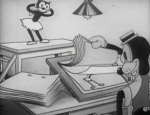 ‘Making ‘Em Move’ is a surprisingly original cartoon, being about animation itself. It’s astonishing that this early cartoon about its own industry comes from the Van Beuren studio, the least developed American animation studio in business those days.
The film is a strange mix of accuracy and nonsense. We watch a fat lady visiting an animated cartoon studio, where several animals are animating ridiculously fast and as if in an assembly line. Among the less accurate scenes are an animator animating a dancing cat who’s dancing right in front of him, and a humanized camera filming the flip-books animators are running in front of it. Meanwhile a jazz band is playing, whose sound is recorded directly on film.
In the second half of the film we watch a public cartoon screening: “Fable Animals present Little Nell’, a crude animation of a classic melodrama with stick figures, predating Tex Avery’s similar ‘Porky’s Preview’ by eleven years(!).
‘Making ’em Move’ is a remarkable cartoon, being about the cartoon industry itself, which remained a rare feat. Unfortunately, the film is neither very educational nor funny. It’s in fact rather directionless, making it to fall short as a classic.
Watch ‘Making ‘Em Move’ yourself and tell me what you think:
‘Making ‘Em Move’ is available on the DVD ‘Aesop’s Fables – Cartoon Classics from the Van Beuren Studio’
Director: Rudolf Ising
Release Date: August, 1931
Stars: Foxy
Rating: ★★★½
Review:
 After twelve Looney Tunes, all starring Bosko, Harman and Ising started a new cartoon series for Warner Bros. with the clearly Silly Symphonies-inspired name ‘Merrie Melodies’.
Unlike the Looney Tunes, the Merrie Melodies would be one-off cartoons, each one promoting a different song from the Warner Bros. song catalog. Indeed, the Merrie Melodies should at least feature one complete chorus of a Warner Bros.-owned tune. This rule continued until the end of the 1930s, and rather hampered the series, for the obligate song sequence would often stop the action of the cartoon.
‘Lady Play Your Mandolin’ is the very first of the Merrie Melodies. It features the title song, which is sung twice during the cartoon. Without explanation, the cartoon features a Mexican cafe setting, which is visited by the hero, Foxy, who was to be Warner Bros.’ answer to Mickey Mouse.
Although not as blatant an imitation as Van Beuren’s Milton Mouse (see ‘Circus Capers‘ and ‘The Office Boy‘), Foxy clearly is Mickey Mouse but with pointed ears and a fluffy tail. Indeed, when watching this cartoon my girlfriend thought it was an early forerunner of Mickey. Foxy never came near Mickey’s popularity, however, and was abandoned after a mere three cartoons.
‘Lady Play Your Mandolin’ is the character’s great testimony. The film is completely plotless, but simply bursts with joy. The short features a lot of flexible animation and everyone moves to Frank Marsales’s peppy music (played by Abe Lyman’s Brunswick Recording Orchestra), including the tables, the cacti, the trees and the cafe itself. There are plenty of gags all around, the most extraordinary one being Foxy’s drunken horse playing its own head as a trombone.
Foxy also started a long Warner Bros. tradition of Al Jolson imitations, when singing the main melody, while his girlfriend (Minnie Mouse but with pointed ears) boop-oop-a-doops. None of the cartoon makes any sense, but its sheer joy makes watching it a highly entertaining experience.
Watch ‘Lady, Play Your Mandolin’ yourself and tell me what you think:
‘Lady, Play Your Mandolin’ is available on the DVD ‘Little Caesar’
Director: Dave Fleischer
Release Date: March 21, 1931
Rating: ★★★
Review:
 ‘In My Merry Oldsmobile’ is a rather odd commercial for Oldsmobile, done in Screen Song fashion. The cartoon will be familiar of readers of Leonard Maltin’s ‘Of Mice and Magic’, for his book features several stills from this film.
The film starts weird to begin with. We watch an evil male character sneak upon a woman undressing(!). Luckily she reveals countless dresses under each other. The creepy guy sneaks into her home and asks the terrified woman for a ride, which she unsurprisingly refuses. Then suddenly a little guy arrives offering her a ride in his Oldsmobile outside. This section uses a lot of dialogue, but no lip synch whatsoever.
The little guy’s invitation for a ride prompts the barbershop title song (a hit song from 1905) and the bouncing ball, so typical of Fleischer’s Screen Songs. The song is accompanied by images of a couple riding an Oldsmobile Curved Dash from 1904, the car celebrated in the song. Then we watch the cartoon characters riding this car, and suddenly there’s a lot of metamorphosis of words into the car etc. The film ends as oddly as it started: when the couple gets married, they’re immediately in a boxing match, indicating that marriage is one long fight.
One wonders how such a story would help Oldsmobile selling more cars. Moreover, none of their latest models is featured in the cartoon, only their first model, which by 1931 was of course extremely outdated.
Watch ‘In My Merry Oldsmobile’ yourself and tell me what you think:
‘In My Merry Oldsmobile’ is available on the DVD ‘Fleischer Classics featuring Gulliver’s Travels’
Director: Dave Fleischer
Release Date: May 23, 1931
Stars: Bimbo, Betty Boop
Rating: ★★★
Review:
 In ‘Silly Scandals’ Bimbo wants to visit a theater, where Betty Boop performs.
Unfortunately he’s broke, but he finally succeeds in sneaking into the theater by walking backwards along the leaving crowd. Inside we watch Betty singing the 1930 hit song ‘You’re driving me crazy’. Like in ‘Mysterious Mose‘ her sexiness is well explored, as her dress falls off during the performance, revealing her bra.
After Betty’s performance, Bimbo ends up being hypnotized by a magician, who makes our unfortunate hero dance against his will. The cartoon ends in a short, but zany and nightmarish dream sequence.
‘Silly Scandals’ is a transitional cartoon that shows the potential of Fleischer’s fledgling cartoon star Betty Boop, but failing to explore it to the max, still focusing on the rather bland Bimbo. We hear her name for the very first time. Yet, Bimbo is still the only billed star of the cartoon. But the Fleischers were quick learners, and with almost every subsequent Talkartoon Betty’s star would rise, and her screen time increase.
Watch ‘Silly Scandals’ yourself and tell me what you think:
This is Talkartoon No. 21
To the previous Talkartoon: Twenty Legs under the Sea
To the next Talkartoon: The Herring Murder Case
‘Silly Scandals’ is available on the French DVD Box Set ‘Betty Boop Coffret Collector’
Director: Dave Fleischer
Release Date: April 3, 1931
Stars: Bimbo, Betty Boop
Rating: ★★½
Review:
 Bimbo is a train robber who holds up a train. Unfortunately for him, his stout wife, Betty Boop (called Nan McGrew in this cartoon), is also on this train.
She confronts him and in the end Bimbo unwillingly reunites with his wife, fleeing with her into the distance on the locomotive.
‘The Bum Bandit’ lacks the wild surrealism of earlier Talkartoons, like ‘Barnacle Bill‘ and ‘Mysterious Mose‘ (both 1930), and is thus less interesting to watch. The best scene is when Bimbo practices shooting, e.g. shooting a cow from the sky. There is also some nice and flexible animation on the riding train. Betty Boop has a distinctly different voice here, which was not repeated after this cartoon.
Watch ‘The Bum Bandit’ yourself and tell me what you think:
This is Talkartoon No. 18
To the previous Talkartoon: The Cow’s Husband
To the next Talkartoon: The Male Man
‘The Bum Bandit’ is available on the French DVD Box Set ‘Betty Boop Coffret Collector’
Director: Wilfred Jackson
Release Date: July 28, 1931
Rating: ★★★½
Review:
 A cat is put out. When he tries to catch a bird, he falls down and gets knocked unconscious by a wind-flower.
Enter a nightmarish sequence, in which the cat imagines his lives are fleeing him, and that he’s being attacked by giant birds, hooting owls, bats, giant spiders and hollow trees. Luckily, in the morning it all appears to have been a dream.
‘The Cat’s Out’ is not devoid of dance routines (there are two dance scenes featuring scarecrows and a bat), but it has a surprisingly clear story, unmatched by earlier Silly Symphonies. It is arguably the first Silly Symphony with such a clear story, anticipating the straightforward storytelling of ‘The Ugly Duckling‘ of the end of the same year. This makes the short one of the most interesting Silly Symphonies of 1931.
Watch ‘The Cat’s Out’ yourself and tell me what you think:
This is Silly Symphony No. 20
To the previous Silly Symphony: The Busy Beavers
To the next Silly Symphony: Egyptian Melodies
‘The Cat’s Out’ is available on the DVD ‘Walt Disney Treasures: More Silly Symphonies’
Director: Burt Gillett
Release Date: December 16, 1930
Rating: ★★★★½
Review:
 With his double pipe, Pan makes all animals and plants, yes, even trees and clouds move and dance. The latter cause a fire with their lightning, but Pan lures the flames away to the lake, as if he were the pied piper.
Like ‘Springtime‘ (1929) ‘Playful Pan’ can be regarded as a forerunner of Disney’s groundbreaking cartoon ‘Flowers and Trees‘ (1932). The short is especially interesting for the introduction of the anthropomorphized flames, so typical of cartoons about fire. ‘Playful Pan’ is more entertaining than earlier Silly Symphonies, because half way the dance routine gives way to some kind of story, in which fire threatens the forest. This fire sequence is actually rather exciting. The fire itself is well animated, and the flames form a real threat: they do kill a humanized tree, and make all the animals flee.
The story formula of ‘Playful Pan’, in which the second half has some kind of story, was explored in many more Silly Symphonies from 1931 (e.g. ‘Birds of a Feather‘, ‘The China Plate‘. ‘The Busy Beavers‘). One had to wait until ‘The Ugly Duckling‘, from the end of that year, to watch a Silly Symphony to feature a concise story from start to end.
Watch ‘Playful Pan’ yourself and tell me what you think:
This is Silly Symphony No. 15
To the previous Silly Symphony: Winter
To the next Silly Symphony: Birds of a Feather
‘Playful Pan’ is available on the DVD ‘Walt Disney Treasures: More Silly Symphonies’
Director: Burt Gillett
Release Date: October 22, 1930
Rating: ★
Review:
 Among the earliest Silly Symphonies there was a cycle devoted to the four seasons. ‘Winter’ is the last of these four season cartoons.
Following the artistic success of ‘Autumn‘, ‘Winter’ is unfortunately as dull and plotless as the earlier ‘Springtime‘ or ‘Summer‘. The cartoon both starts an ends with a winter storm. In between we watch animals skating and dancing on Emile Waldteufel’s Skaters’ Waltz. This scene features some deer, which are a far cry from ‘Bambi‘ (1942), but who are more comfortable on ice than Bambi would ever be twelve years later. The cartoon ends when a groundhog sees his shadow again, and cold and snowy winds drive the animals back to their hiding places.
Luckily, ‘Winter’ formed the end of an era. Already with the next Silly Symphony, ‘Playful Pan‘ the Disney studio would aim to exchange the endless dance routines for more experiment, and this level of experiment would only increase from 1931 onwards…
Watch ‘Winter’ yourself and tell me what you think:
This is Silly Symphony No. 14
To the previous Silly Symphony: Monkey Melodies
To the next Silly Symphony: Playful Pan
‘Winter’ is available on the DVD ‘Walt Disney Treasures: More Silly Symphonies’
Director: Burt Gillett
Release Date: September 2, 1930
Rating: ★★
Review:
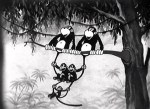
The Silly Symphonies were to be a series of great innovation, but in 1930 this was not so clear, yet, as the entries of that year were mostly preoccupied with dance routines.
The ‘innovation’ of ‘Monkey Melodies’, for example, is the embryonic story of its second half. But only with ‘Playful Pan‘ from the end of the year, some real experimentation was to kick in.
‘Monkey Melodies’ opens with monkeys, apes and parrots frolicking in the jungle in a long dance routine. After several minutes we follow two monkeys in love, who frolic to the tune of Rudy Wiedoeft’s Narcissus. The two go on a boat ride on a log, and manage to escape a crocodile, a hippo, a snake and a leopard.
‘Monkey Melodies’ is a very standard Silly Symphony, typical of 1930, the ‘story’ of the second half notwithstanding, and to be frank, the short is rather dull. Its highlight may be the effect animation of a crocodile swimming under water.
Watch ‘Monkey Melodies’ yourself and tell me what you think:
This is Silly Symphony No. 13
To the previous Silly Symphony: Midnight in a Toy Shop
To the next Silly Symphony: Winter
‘Monkey Melodies’ is available on the DVD ‘Walt Disney Treasures: More Silly Symphonies’


 Dr. Grob's Animation Review