
You are currently browsing the category archive for the ‘European films’ category.
Director: Kazimierz Urbański
Release date: 1962
Rating: ★★
Review:

‘Playthings’ is a film on fighting. The film knows only monochrome yellow and red backgrounds and silhouetted, abstracted human figures and weapons.
The film starts with some designs based on ancient cave paintings. We watch a group of human figures hunt a deer. When one is killed, another group of more tangram-like humans, arrives, and the fighting starts, with more and more advanced weaponry, like cannons, machine guns, tanks, bomber planes. As can be expected, in the end everybody is killed by a giant, probably nuclear explosion. The message of ‘Playthings’ is crystal clear, but the short is too one-dimensional to make a lasting impression.
Watch ‘Playthings’ yourself and tell me what you think:
‘Playthings’ is available on the DVD-set ‘Anthology of Polish Animated Film’
Director: Jan Lenica
Release date: 1961
Rating: ★★★★
Review:
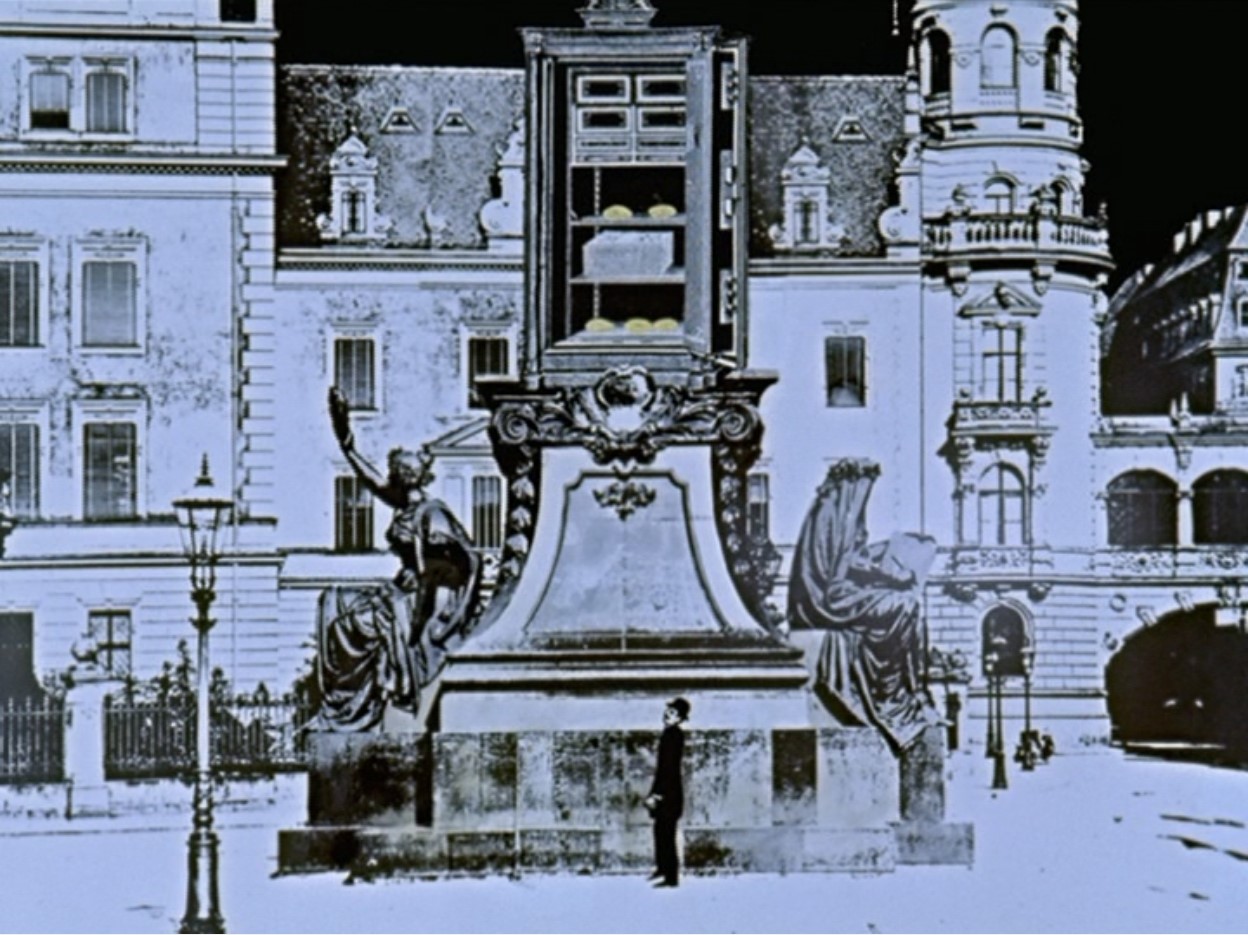
In ‘Labirynt’ a man flies into a seemingly abandoned city, only to find it to be a dangerous place, terrorized by strange creatures and machines, alike.
This is one of those rare animation films from Eastern Europe depicting what it’s like to live in an oppressive communist state. The film is highly surreal, featuring strange creatures, often mixes of animal and human parts, but I am still surprised the film got past the censors. For example, at one moment the man is captured by a bearded machine-man and thoroughly examined. At one key scene we watch is thoughts roaming freely inside his head, only to get barred by a strange contraption. The end, too, in which the man tries to escape the paranoid city is telling enough.
Jan Lenica’s world is based on partly colored old photographs and engravings. His animation is emblematic, but at one point we surely feel the man’s fear, as he tries to flee from his oppressors. The surrealist atmosphere is enhanced by Jan Radlicz’s sound design and by Włodzimierz Kotoński’s score.
Watch ‘Labirynt’ yourself and tell me what you think:
‘Labirynt’ is available on the DVD-set ‘Anthology of Polish Animated Film’
Director: Denis Do
Release date: June 11, 2018
Rating: ★★★½
Review:
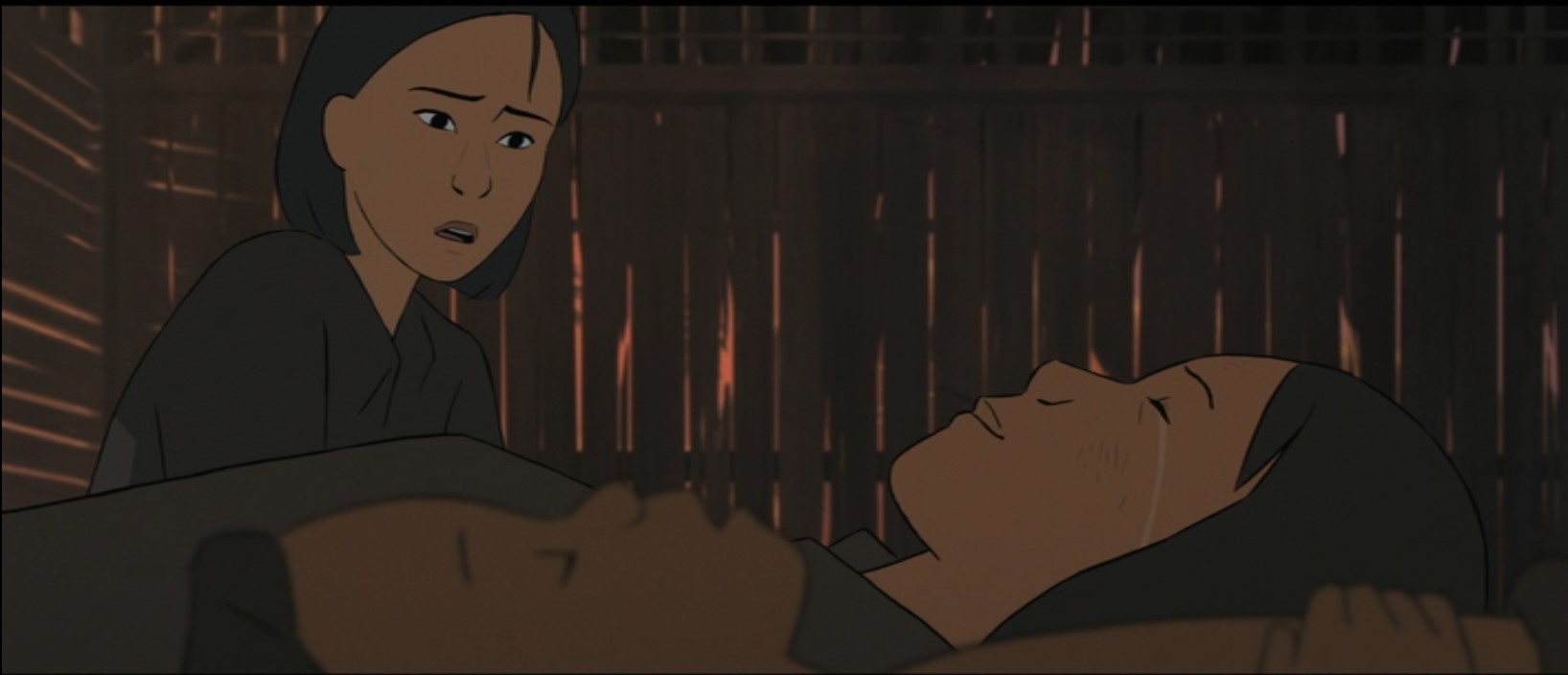
‘Funan’ is a film by Denis Do, a French film maker of Cambodian descent, and the film is partly based on the memories of his own mother.
‘Funan’ means ‘the new people’ in the Khmer language, and this is an apt description of the radical ideology of the Khmer Rouge, an extreme communist movement that took power in Cambodia from 1975 to 1979, only to plunge the nation in one of the severest mass killings in human history, with the ultimate goal to rise as a ‘new nation’ of autarkic, non-intellectual people.
‘Funan’ thus tells about Cambodia’s darkest years, and does so by following one family from Phnom Penh, which almost immediately falls apart, and which succumbs one by one to various aspects of the terror, be it brutal murder, forced labor, famine or rape. We especially follow a couple, Chou and Khuon, and their son Sovanh, who gets separated from his parents near the start of the film.
Luckily, the film eschews gross images, keeping the watch tolerable, but strangely enough, this also means one feels the hardship and sorrow less than one should. The film’s rather episodic nature certainly doesn’t help, and one has a little trouble relating to these people, perhaps because they aren’t introduced very well (the happy bliss of pre-Khmer rouge existence is shown all too shortly), and because the film is told in a plethora of very short scenes, instead of a few well-chosen longer ones. Especially Sovanh’s story is too fragmentary to follow, and his experiences are only hinted at, although it’s clear that the young boy sees a lot of cruelty and death.
The 2D animation is fair, with the human character designs rooted in the French ligne claire tradition, while the background is painted and lineless. Both coloring and lighting are clearly digitally done, and to be frank, rather uninteresting.
I suspect the film could be more daring and more idiosyncratic in its designs and storytelling, especially when compared to Elsa Duhamel’s similar, but far more interesting short ‘Bach-Hong’, which tells of the coming of the communists to Saigon, Vietnam. Duhamel cleverly sticks to a single story, illustrating the regime’s cruelty by one, ostensibly minor detail in the nation’s history.
Do, on the other hand, seems to want to tell everything, and indeed he succeeds in painting a picture of these black years, but I suspect he had better chosen less scenes, and less characters, for now, unfortunately, the film remains at an emotional distance, and that can hardly be the film maker’s purpose. Yet, I am glad personal films like this are being made, for films like ‘Funan’ save tragedies like that of Cambodia from oblivion, and remind us that peace and safety aren’t guaranteed, at all.
Watch the trailer for ‘Funan’ yourself and tell me what you think:
‘Funan’ is available on Blu-Ray and DVD
Director: Jan Švankmajer
Release date: January 26, 2018
Rating: ★★
Review:
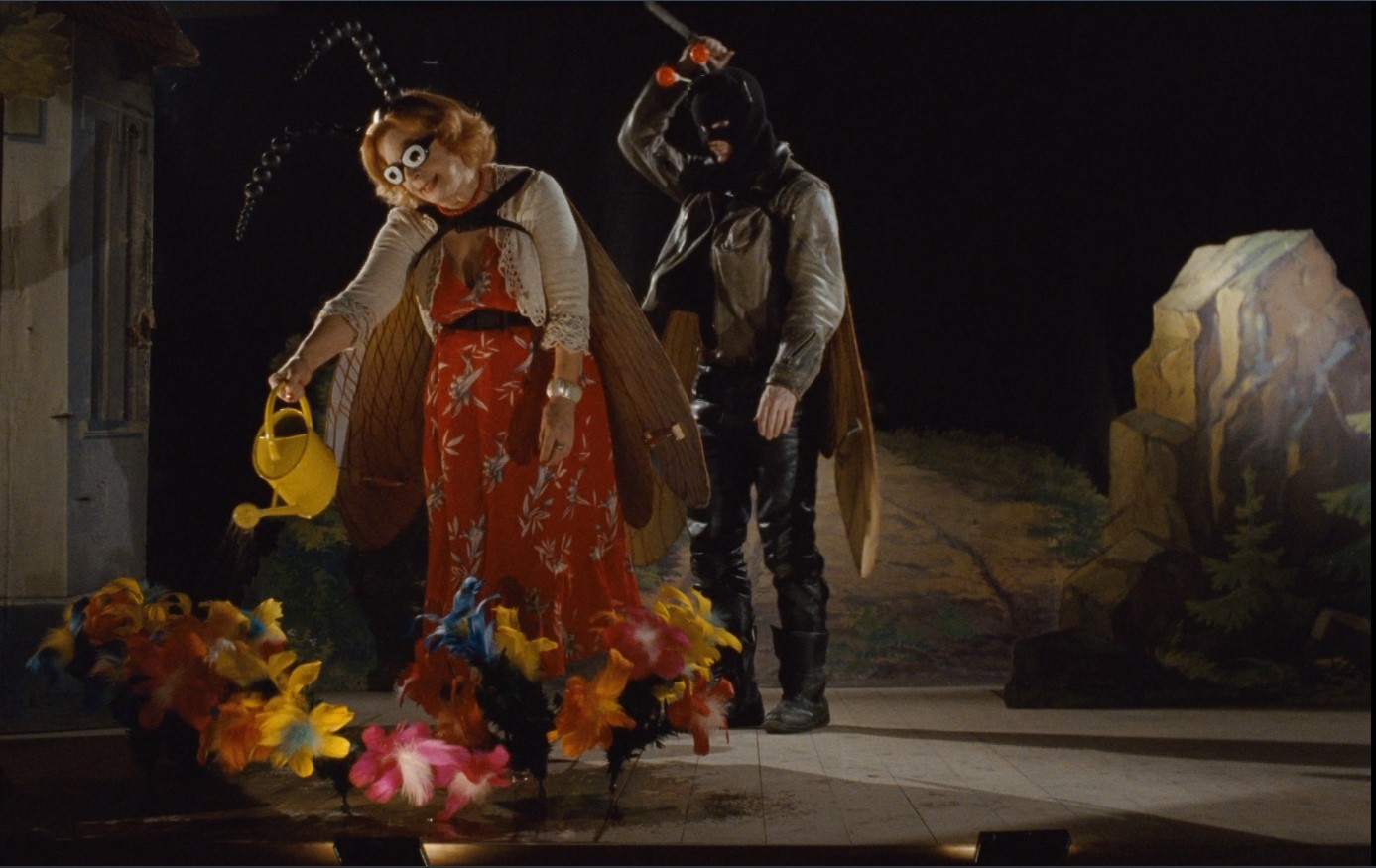
‘Insect’ is Jan Švankmajer’s last film. Even though at the time of writing the Czech master of surrealist cinema is still alive, he announced this film as such. It sure was a difficult film to make, as even crowdfunding was needed to finish the movie.
Unfortunately, the film is not a grand finale to Švankmajer’s glorious oeuvre. Sure, the film’s main story is interesting enough and shows all elements of the Czech director’s idiosyncratic style: surrealist events, morbid humor, extreme close-ups, claustrophobic spaces, a preoccupation with food, and even a splash of stop-motion and cut-out animation, rarely seen since the 1980’s.
In this story an amateur company rehearses the 1921 play ‘Pictures from the Insects’ Life’ by the Čapek brothers. Only part of the troupe is present, and the film features only six characters, who are cramped into a dark, poorly lit space, which give the film an eerie feeling the actors are trapped like insects themselves. Four actors are bullied by an overt ambitious director, while the sixth sleeps through most of the rehearsal. While the inapt actors act out a few scenes from the play, strange events start happening, like insects appearing everywhere, and a dummy coming to life, and several of the actors don’t live through the end of the rehearsing.
This story shows a strong unity of time and space, and is told by Švankmajer with gusto, while his actors delight in portraying the clumsy actors, one even worse on the stage than the other. The actor’s antics are often accompanied by the beginning of Bedřich Smetana’s overture to ‘The Bartered Bride’ (1866), the lively sounds of which contrast heavily with the bad acting on the stage. The sound design, too, is excellent, with its well-chosen unpleasant sounds, as of crawling insects.
However, apparently this main story wasn’t enough material to fill a complete feature length film, and thus the action is constantly interrupted by behind-the-scene footage, showing how the film was made, as well as the real actors telling about their dreams. These scenes often reveal the tricks involved in the film making, and thus spoil the fun of the surrealist main story. But more importantly, they greatly disrupt the main narrative, and the viewer is constantly thrown in and out of the story, which makes the film a frustrating watch, indeed. This choice of adding an extra layer to the film actually makes it a weaker product than it could have been, and although it’s nice to watch Jan Švankmajer at work, it makes the film a sad farewell to his illustrious career.
Watch the trailer for ‘Insect’ yourself and tell me what you think:
‘Insect’ is available on Blu-Ray and DVD
Director: Nick Park
Release date: January 20, 2018
Rating: ★★
Review:
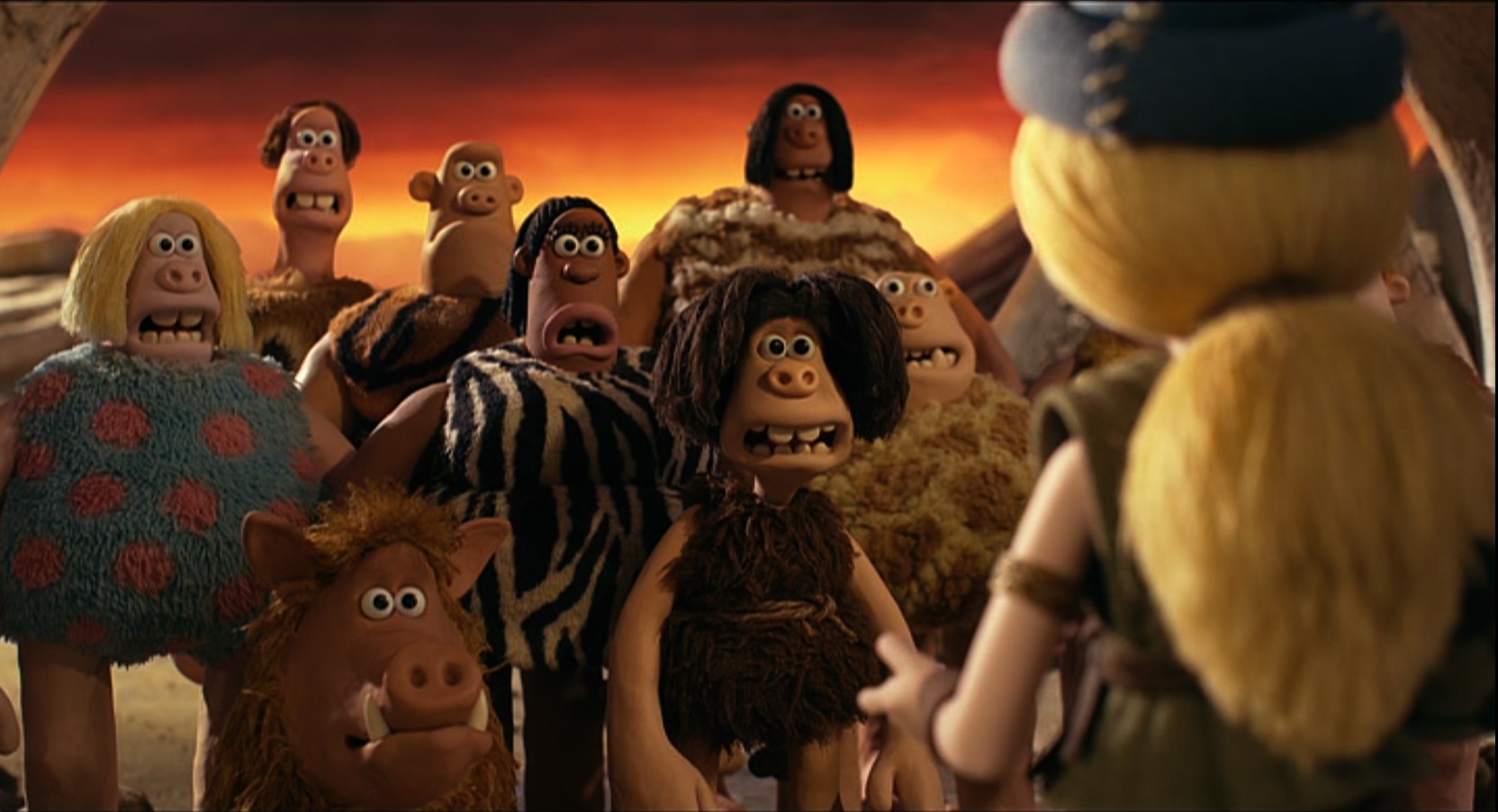
In ‘Early Man’ some cavemen have to play a soccer match to save their village from oblivion. ‘Early Man’ was Aardman’s seventh feature film, and the fifth using the studio’s trademark Claymation, but when compared to the wonderful movies ‘Wallace & Gromit: The Curse of the Were-Rabbit’ (2005) or ‘Shaun the Sheep Movie’ (2015) ‘Early Man’ is frustratingly lackluster.
Sure, the film is wonderfully made, and clearly with a lot of love, and has the charm of fingerprints being visible on the clay puppets. Moreover, by now, the Aardman studio clearly makes its animation style look easy. Then there are the typical Aardman quirks, like the way replays are shown, or some funny side remarks, the best of which is “Sliced bread? That’s the best thing since… well, ever!”. I particularly liked the idea of the message bird, which not only repeats all that is said to him, but all the accompanying actions, as well. These little touches at times made me laugh out loud.
Unfortunately, the story is not half as good: it’s one long sum of cliches, never venturing into new or surprising story ideas, making the film surprisingly dull. Especially, the football match ticks all the familiar boxes of the sports film, and there are team effort scenes and unconventional training scheme scenes as we had seen already a thousand times, most recently in ‘Kung Fu Panda 3’ (2016) and ‘Cars 3’ (2017), which were both also frustrating affairs story-wise. The characters, too, are in no sense original, and feel emblematical, instead of rounded. Even the main hero Dug is appallingly onedimensional.
As said, ‘Early Man’ especially follows the sports film trope of the underdog winning against all odds but it does so in the laziest way. For example, at one point Goona makes clear to the cavemen that they may have a chance because they can be a team while their opponents are just a bunch of individuals. Now, there’s a chance to make the cavemen’s win believable. And what is done with this idea? Absolutely nothing. As soon as the real match starts, the so-called big difference between the behavior of the star players and the cavemen team on the field disappears. It’s disheartening to watch this saving element being left unused.
The world-building, too, leaves a lot to be desired. ‘Early Man’ doesn’t really play in the stone age, or the bronze age, or whatever. It is set in some fantasy sword-and-sorcery world with bare rocks and active volcanoes. Even the time period of the prologue makes no sense, set in the non-existing ‘Neo-Pleistocene’ and showing us cavemen living next to dinosaurs (in a nice little nod to Willis O’Brien, although the two creatures were apparently called Ray and Harry after that other great stop motion monster animator, Ray Harryhausen).
By the time the main story starts, the dinosaurs have disappeared, but some Flintstones-like gags remain, like little crocodiles as clothespins and a beetle as an electric razor. But then the studio adds some creatures that in no world make any sense whatsoever, like a giant woodlouse, a giant spider, a giant duck with teeth and some giant caterpillars. With these the film makers lost all consistency and believability of a world that was rather shaky to start with.
For example, the only green spot in this world is where ages ago a meteorite struck, but it’s in this world the cavemen live. How the other people survived in the highly hostile environment of the rest of the planet remains an utter mystery. It doesn’t help that most of this world is rendered in the ugliest and laziest computer animation, which contrasts greatly with the fine Claymation.
It seems the film makers too much wanted to make a football (soccer) movie, and got blind for the film’s flaws, which are instantly recognizable to any viewer. Instead, they should have thought things over, both about their story and their world, because the final film is a formulaic drag, and, not surprisingly, became a box office bomb.
Watch the trailer for ‘Early Man’ yourself and tell me what you think:
Director: Sarah Smith
Release date: November 11, 2011
Rating: ★★½
Review:

After making ‘Flushed Away’ (2006) in cooperation with Dreamworks, the British animation studio Aardman made another computer animated film, this time in cooperation with Sony, as part of a three year contract with the American production company. Upon its release ‘Arthur Christmas’ was a box office success, but since then it has rather went into oblivion, and I can see why, because the film unfortunately is a flawed one.
In the world of ‘Arthur Christmas’ Father Christmas is not an eternal figure, but a dynasty, with Santa Clauses succeeding each other in time. The film tells about Arthur, whose father is the current Santa Claus, but whose mission are much controlled by his son, Arthur’s elder brother Steve, with military precision. In contrast, Arthur is clumsy, cowardly, afraid of heights and thus totally useless to the Santa Claus clan. Or is he? When, despite all military precision, one present is not delivered, Arthur comes into action.
I’ve once read an article in which someone from Aardman complained that ‘Arthur Christmas’ was not even nominated for an Academy Award, blaming it on the fact that their film was overlooked because it was a holiday film. But the truth is, ‘Arthur Christmas’ is just not that good.
The film’s characters aren’t that sympathetic. The current Santa is as incapable, as he is irresponsible. His son Steve is more ambitious than he is caring, and Arthur may have his heart in the right place, he stumbles through most of the film, which is rather tiring to watch. The finale, in which all elder Santa Clauses realize Arthur’s worth, feels forced and obligatory, and one hardly believes Arthur’s clumsy days are now over.
But the film’s biggest problem is its lack of originality. The film lacks the quirky charm of the British studio’s stop motion work (there are some nice touches here and there, like a wobbly toy on Grandsanta’s sleigh, but these are rare). And despite the British voice cast and mostly European setting, the film feels very, very American. Plot-wise the film ticks all familiar boxes, without straining from tried paths.
Moreover, the designs are erratic and inconsistent: the humans are all cartoony, but the reindeer have realistic designs, and the film features some pretty ugly lions. In fact, the film is utterly unrecognizable as an Aardman product, the only feature film in their catalogue being so generic and bland in its looks.
Luckily, ‘Arthur Christmas’ would be Aardman’s last computer animated movie. With their next project the studio returned to more familiar and much more satisfying waters with ‘The Pirates! In an Adventure with Scientists!’ (2012).
Watch the trailer for ‘Arthur Christmas’ yourself and tell me what you think:
‘Arthur Christmas’ is available on Blu-Ray and DVD
Director: Nick Park
Date: 1978
Rating: ★★★
Review:
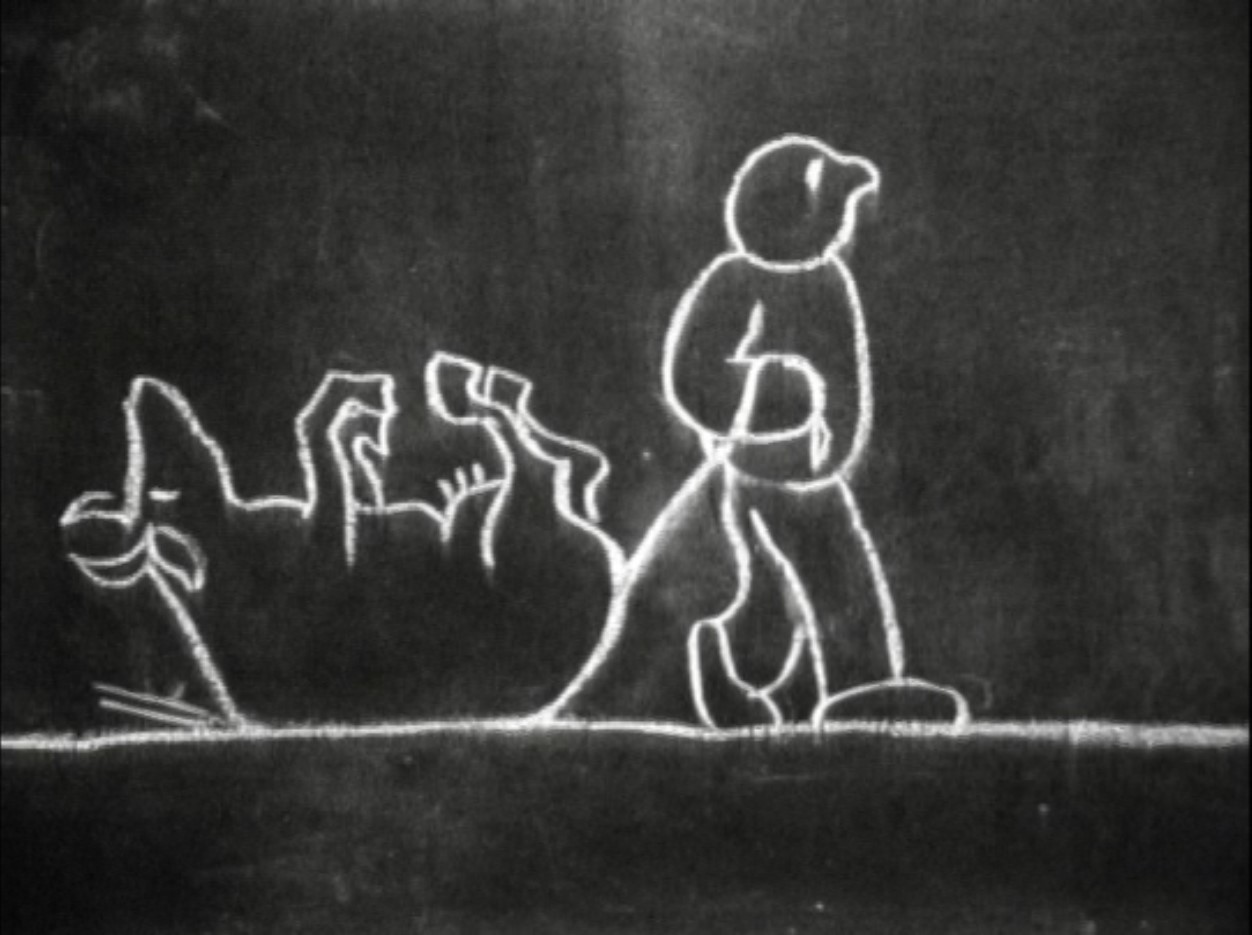
The interesting aspect of the DVD ‘Giants’ First Steps’ is that it shows well known animators and animation directors were not always that good. They had to start somewhere, and their early films show where they already succeeded and where they faltered.
With the charcoal animation of ‘Jack and the Beanstalk’ (made at the Sheffield Art School) Nick Park returns to the very origin of animation, with its earliest films using a blackboard. Nick Park retells the classic fairy tale in an original, stream of consciousness-like manner, with a lot of metamorphosis and weird sound effects.
Even though Park’s animation is crude, the film is pleasantly odd and original throughout. For example, Jack shoots a cow from the sky, and puts in a vending machine to obtain his magic bean, which turns out to be huge. My favorite part is a little guy talking gibberish into a microphone before the titles appear.
Park, of course, would later become world famous with his ‘Creature Comforts’ and Wallace and Gromit films, made at Aardman.
‘Jack and the Beanstalk’ is available on the DVD ‘Giants’ First Steps’
Director: Paul Driessen
Release date: 1975
Rating: ★★★
Review:
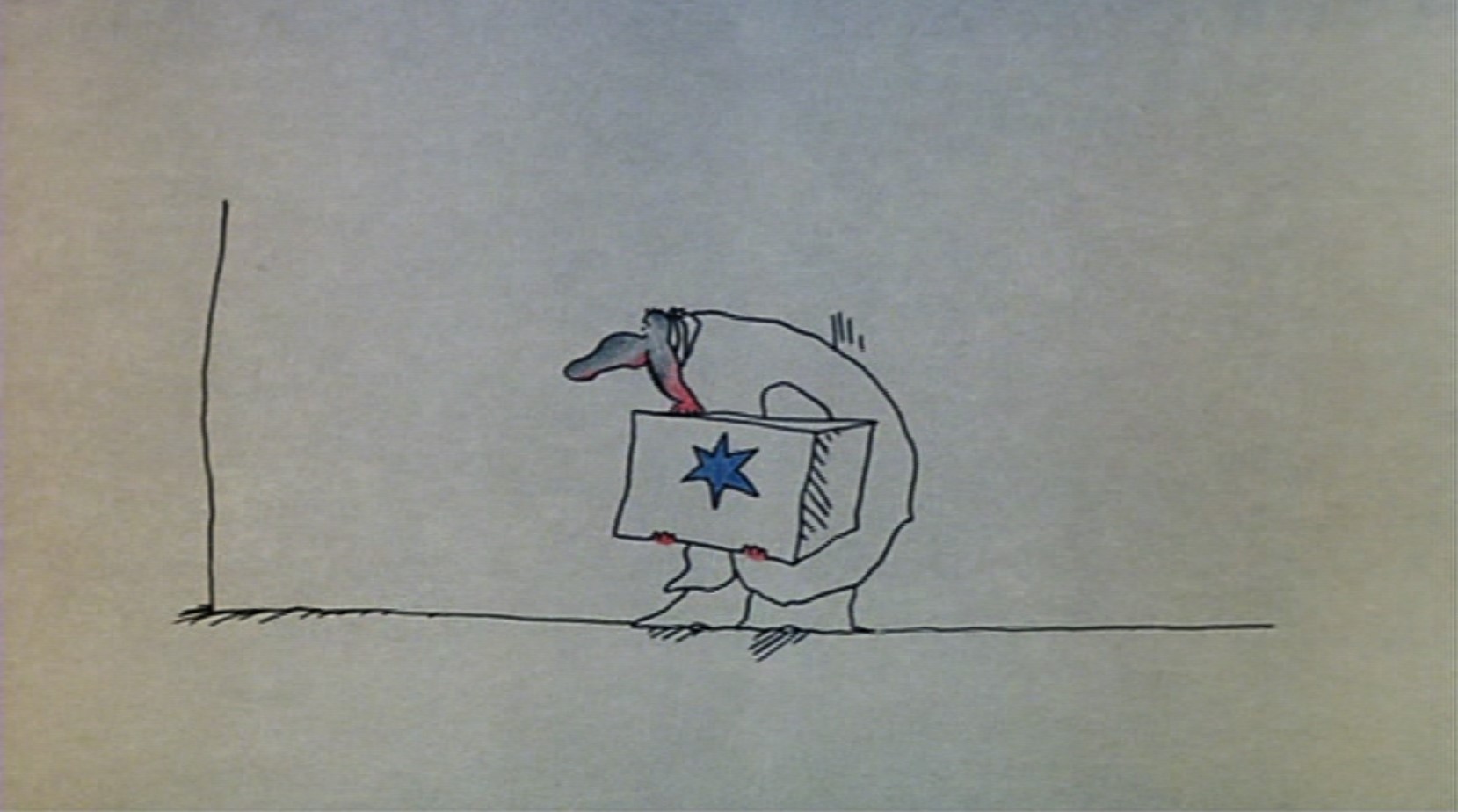
‘An Old Box’ is Paul Driessen’s own variation on the Hans Christian Andersen fairy tale ‘The Little Match Girl’.
In his own film a poor man paints an old box in order to entertain people, but he is at the wrong corner of the town, and nobody passes by, while a short distance away a county fair takes place.
In this short Driessen introduces his idiosyncratic way of showing background art only when necessary. Thus lines indicating backgrounds appear from and dissolve into nothingness as we progress from scene to scene.
Likewise, Driessen’s color use is very limited, emphasizing the most important elements. Only in the very end the animator bursts into a fantastical multi-colored perspective animation before returning to the prevailing depressing grays of the rest of the short.
Watch ‘An Old Box’ yourself and tell me what you think:
‘An Old Box’ is available on the DVD ‘Des histoires pas comme les autres’
Director: Paul Driessen
Release date: 1974
Rating: ★★★
Review:
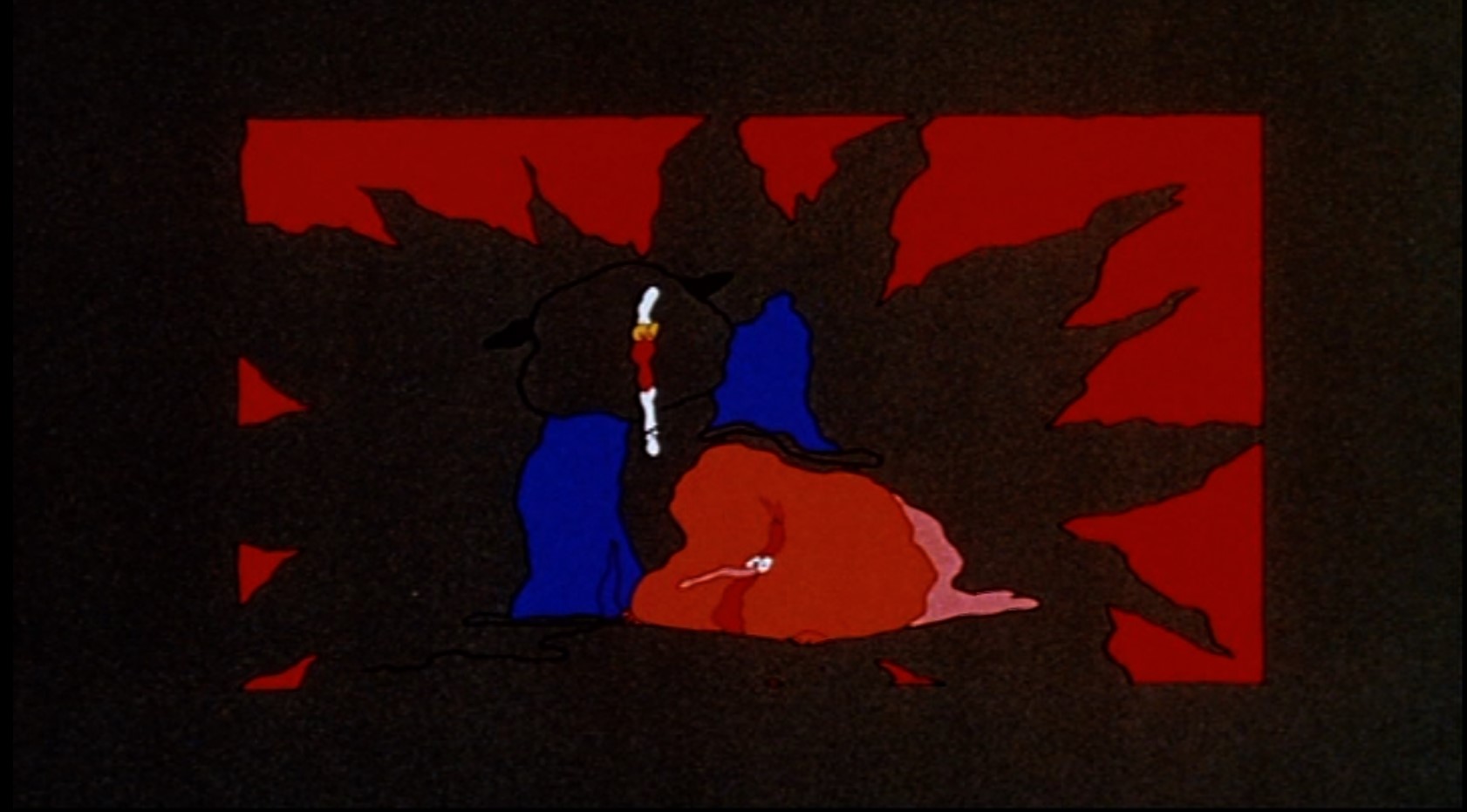
‘Cat’s Cradle’ is an early film by Dutch animator Paul Driessen for the National Film Board of Canada.
This is one of Driessen’s most enigmatic films, in which the images seem to flow in a stream-of-consciousness-like fashion, bridged by a string spun by tiny spider. Somehow the tale, if there is one, has a retrograde character, but it’s hard to make head or tail of Driessen’s narrative in this short.
The background art again is very limited and made of monochromes, and Driessen’s typical morbid humor is very present. For example, the spider is handled by a man, who in turn turns out to hang at a gallows pole.
Watch ‘Cat’s Cradle’ yourself and tell me what you think:
‘Cat’s Cradle’ is available on the DVD ‘Des histoires pas comme les autres’
Director: Paul Driessen
Release date: 1972
Rating: ★★★½
Review:
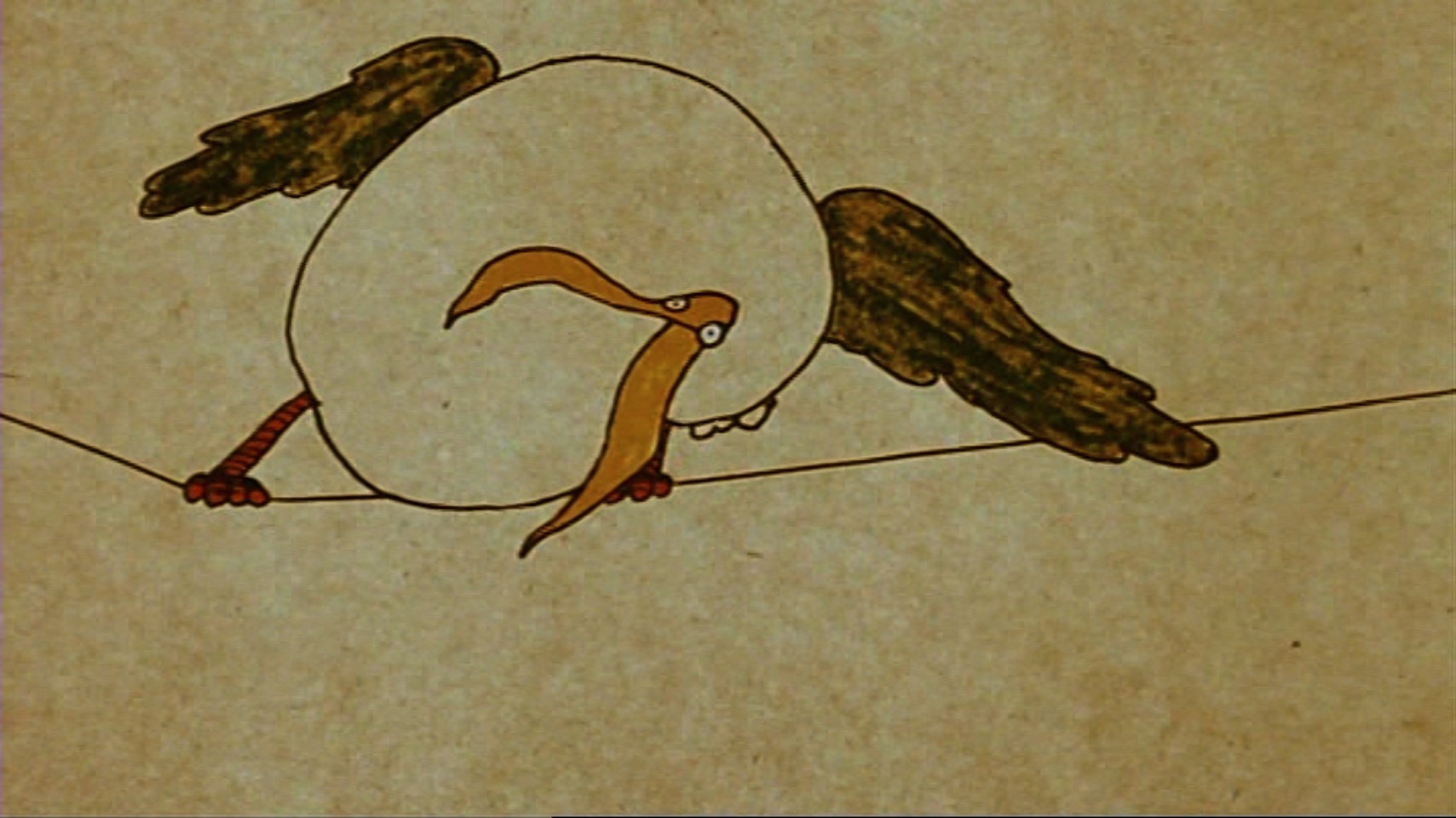
‘Air!’ was the first animated short Dutch animator Paul Driesen made for the National Film Board of Canada. In this very short film (it only takes two minutes) everything and everyone is gasping for air. Only at the very end we experience why.
Driessen makes the most of the barest background art: a monochrome background with a single horizontal line, which in each scene depicts something else. This is an early short by the Dutch master, but the film already showcases Driessen’s idiosyncratic animation style and morbid sense of humor.
Watch ‘Air!’ yourself and tell me what you think:
https://www.nfb.ca/film/air_fr/
‘Air’ is available on the DVD ‘Des histoires pas comme les autres’
Director: Zofia Oraczewska
Release date: 1976
Rating: ★★★
Review:

In ‘Banquet’ a bunch of waiters and chefs are preparing a huge banquet for a large number of guests. But when the guests arrive, the banquet turns out to be very different than expected.
‘Banquet’ has a mixed design: the waiters and chefs are rather classic cartoony figures, while the meals and the guests are collages partly made out of photo material.
Jan Skorża’s cut-out animation is fair, if not outstanding, and the whole film is a little too empty to be memorable. I guess the Polish film makers were less in their game when trying an attempt at humor.
Watch ‘Banquet’ yourself and tell me what you think:
‘Banquet’ is available on the DVD-set ‘Anthology of Polish Animated Film’
Director: Zbginiew Rybczyński
Release date: 1974
Rating: ★★★
Review:

In ‘Soup’ avant-garde film maker Zbigniew Rybczyński shows his fondness of repetitive use of live action material to create startling new images.
Rybczyński would perfect this technique in 1980 with the Academy Award winning short ‘Tango’, but ‘Soup’ already is intriguing and hard to describe. Rybczyński has tinted his source material in stark, contrasting colors, with reds, greens, yellows and blues really popping out of the screen.
The images show the daily routines of a married couple, until it is suggested that the man dies in a train crash. At that point the film burns down. The daily routines are strangely juxtaposed to each other, and there are some very odd touches, like a fork taking a bite out of cheek.
The alienating effect is greatly enhanced by the soundtrack. For sound designer Mieczysław Janik and composer Eugeniusz Rudnik have provided a highly disturbing score full of ordinary sounds amplified to a grotesque effect. For example, when the man brushes his teeth, this rather sounds like a fork scratching on a plate.
I don’t think ‘Soup’ is for everyone, but this intriguing film shows both Rybczyński’s unique approach to film making and the sheer creativity that Communist Poland was in the graphic arts in the 1960s and 1970s.
Watch ‘Soup’ yourself and tell me what you think:
‘Soup’ is available on the DVD-set ‘Anthology of Polish Animated Film’
Director: Mirosław Kijowicz
Release date: 1971
Rating: ★★★
Review:
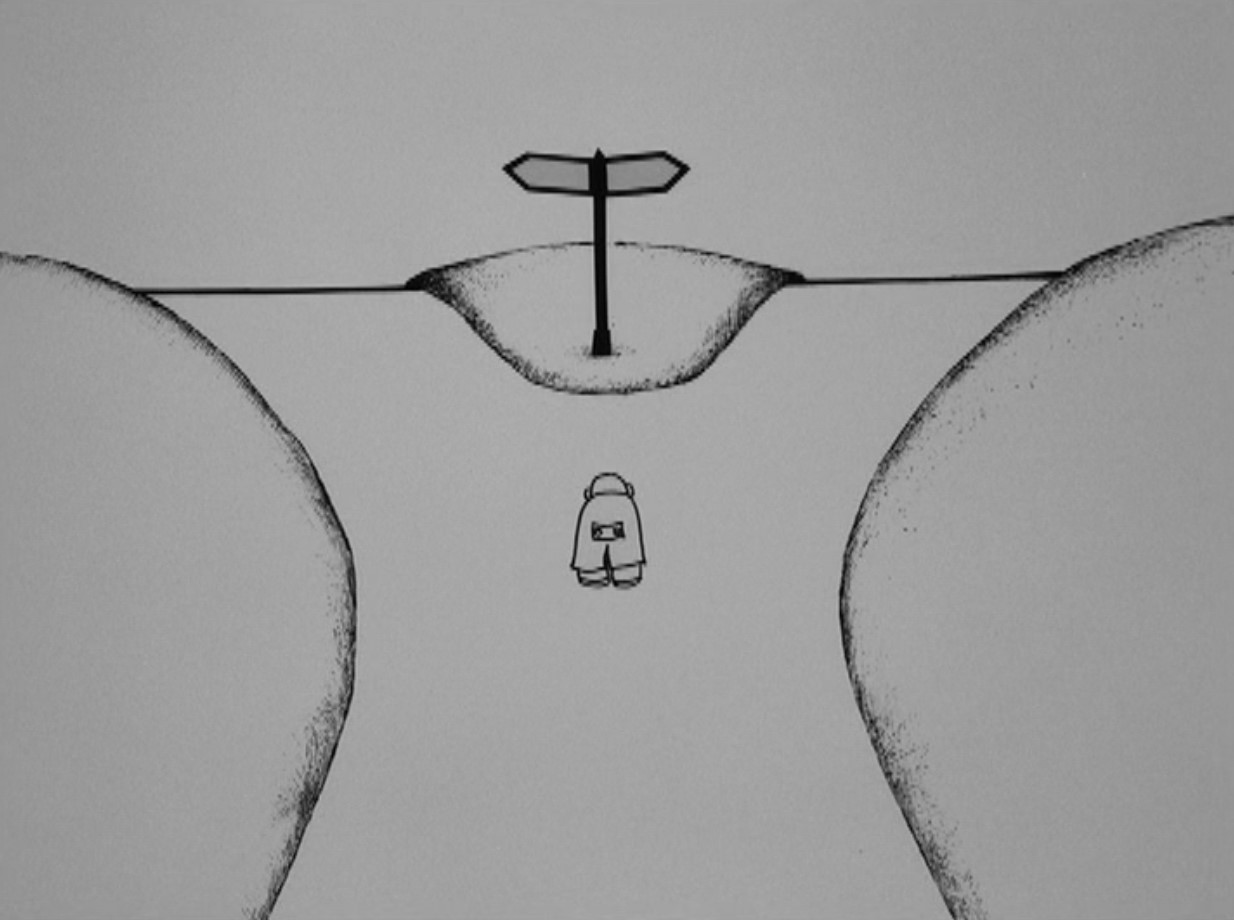
‘The Road’ is a simple little black and white film about a man walking a road, but then he faces a fork in the road.
According to IMDb this is a parable on how choices have consequences, and I can see something in that. Nevertheless the film may be a little too simple, making its message rather vague and puzzling. For example, we only see the man from the back, and only the second choice he has is clearly motivated, with help from a text balloon. Nevertheless, ‘The Road’ is a charming example of the experimental approach to animation in Poland.
Watch ‘The Road’ yourself and tell me what you think:
‘The Road’ is available on the DVD-set ‘Anthology of Polish Animated Film’
Director: Lee Mishkin
Release date: November 8, 1974
Rating: ★★★★½
Review:

This short video clip is an all favorite of mine, perfectly illustrating Roger Glover’s rather hippie-like hit song from his concept album for children ‘The Butterfly Ball and the Grasshopper’s Feast’, which in turn is based on a poem with the same title.
Both the original poem, the record were designed by Alan Aldridge, and so is Halas & Batchelor’s animation film, with charming results. Harold Whitaker has turned these images into charming animation very well, and Lee Mishkin does a good job transferring the lyrics to faithful, if often surprising images.
Young Ronnie James Dio’s voice is given to a minstrel frog, who walks to the Butterfly Ball itself, together with a number of a masked animals. Three drunken salamanders provide some comic relief, as does a fat toad at the ball itself. The slightly surreal images are a delight throughout and the clip is over before you know it. I wish the whole record was transferred into animation this way.
Watch ‘Butterfly Ball (Love Is All)’ yourself and tell me what you think:
‘Butterfly Ball (Love Is All)’ is available on the Blu-Ray ‘The Halas & Batchelor Short Film Collection’
Director: Joško Marušić
Release date: 1979
Rating: ★★★
Review:
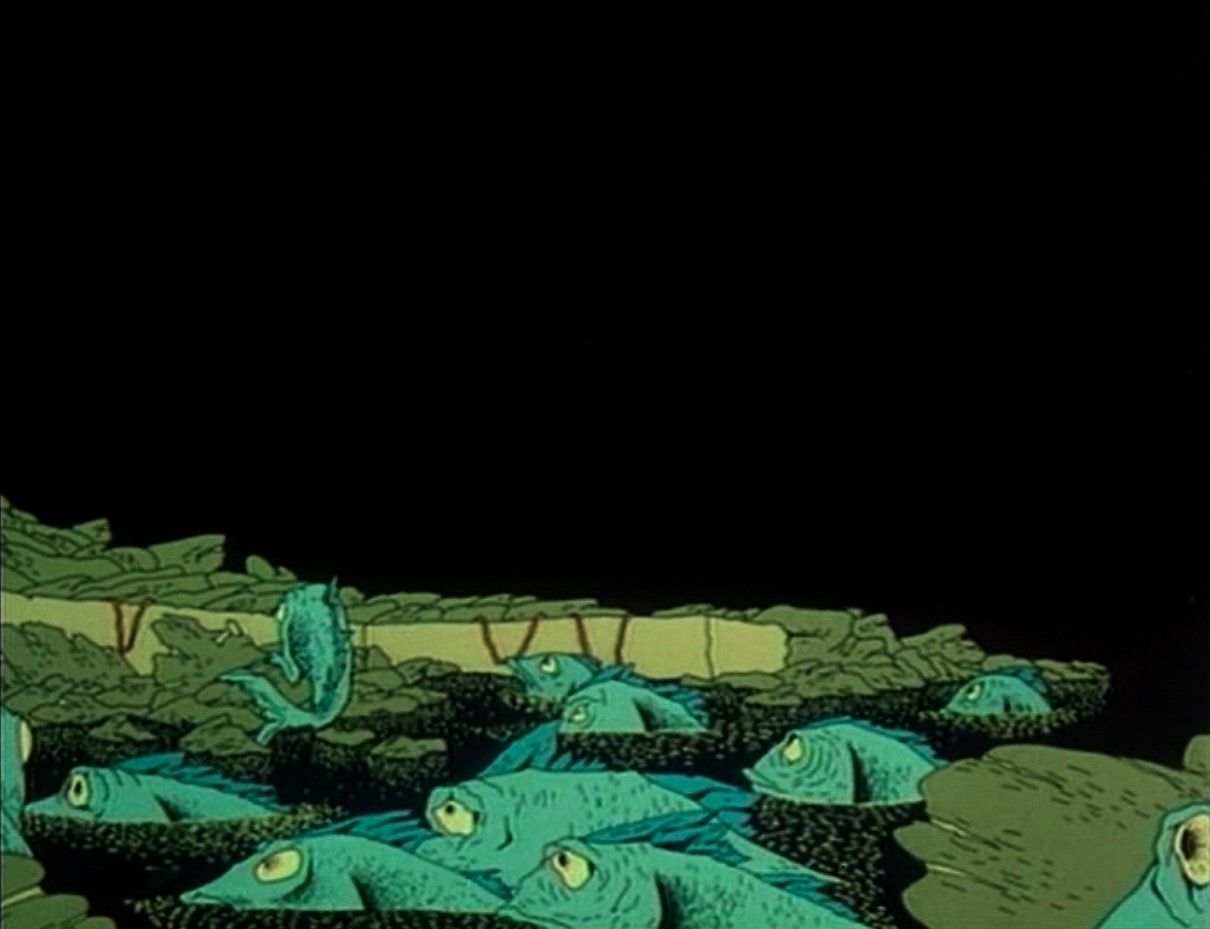
This dark and surreal film starts with fishing villagers saying goodbye to their men who go out fishing on the sea. But when they’re gone, the fish suddenly come to the shore…
‘Fisheye’ is animated very well and knows a sickly color palette with its pale yellows, greens and blues on a black canvas. There’s some great moving perspective animation of the fishing village. The film contains a grim atmosphere, but in the end is too one-dimensional to make a lasting impression. The abrupt and inconclusive ending doesn’t help.
Watch ‘Fisheye’ yourself and tell me what you think:
‘Fisheye’ is available on the DVD ‘The Best of Zagreb Film: Be Careful What You Wish For and The Classic Collection’
Director: Nedeljko Dragić
Release date: 1974
Rating: ★★★★★
Review:
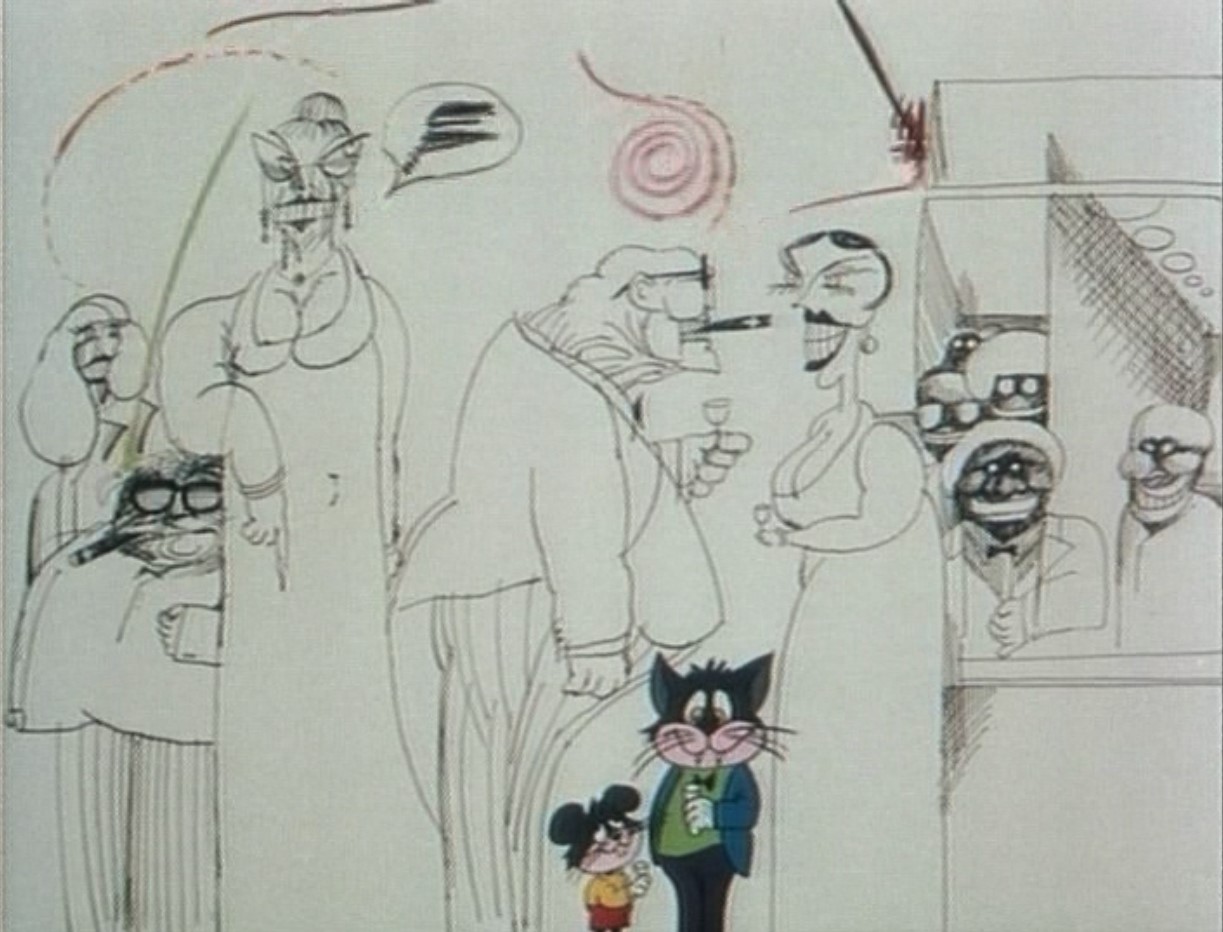
This animated short is very akin to the later ‘Satiemania’ by Zdenko Gašparović. The film features drawings and paintings on a white canvas, which change and morph in a stream-of-consciousness-like fashion.
The short starts with rather Saul Steinberg-like images of a man walking, while changing into all kinds of forms, figurative and abstract. The man then changes into a driver, while all the metamorphosis continues. This part contains some spectacular perspective and moving background animation.
The films then shifts to a party scene, in which a very cartoony mouse and cat form a running gag. From this point the film seems to say something about modern life and modern Western commercialism. As the film progresses, the images get more and more agitated, as if depicting the stressful life in the modern city. The film ends with another walking figure, showing a lonely man on an island inside.
‘Diary’ is a tour de force of imagination, and the images never cease to amaze. Nevertheless, the film’s purpose remains puzzling and leaves the viewer with more questions than answers.
Watch ‘Diary’ yourself and tell me what you think:
‘Diary’ is available on the DVD ‘The Best of Zagreb Film: Be Careful What You Wish For and The Classic Collection’
Director: Zlatko Plavinic
Release date: 1973
Rating: ★★
Review:

This is another very short gag cartoon from the Zagreb studio. In this short a man and a woman haggle for paid sex, or are they?
This cartoon features a monochrome ochre background, cartoonish designs, and dialogue in gibberish and loud nos. The single gag unfortunately is too lame for words.
‘Okay!’ is released on the DVD ‘The Best of Zagreb Film: Be Careful What You Wish For and The Classic Collection’
Director: Radivoje Gvozdanović
Release date: 1972
Rating: ★★★
Review:

This is a very short cartoon not clocking even one minute in which a man gets bunt at a stake. When the flames reach him he starts to pray…
This is a one gag cartoon that is over before you know it and a great example of the quirky humor that prevailed in the Zagreb Film studio.
Watch ‘Prayer’ yourself and tell me what you think:
‘Prayer’ is available on the DVD ‘The Best of Zagreb Film: Be Careful What You Wish For and The Classic Collection’
Director: Zlatko Grgić
Release date: 1971
Stars: Maxicat
Rating: ★★★
Review:
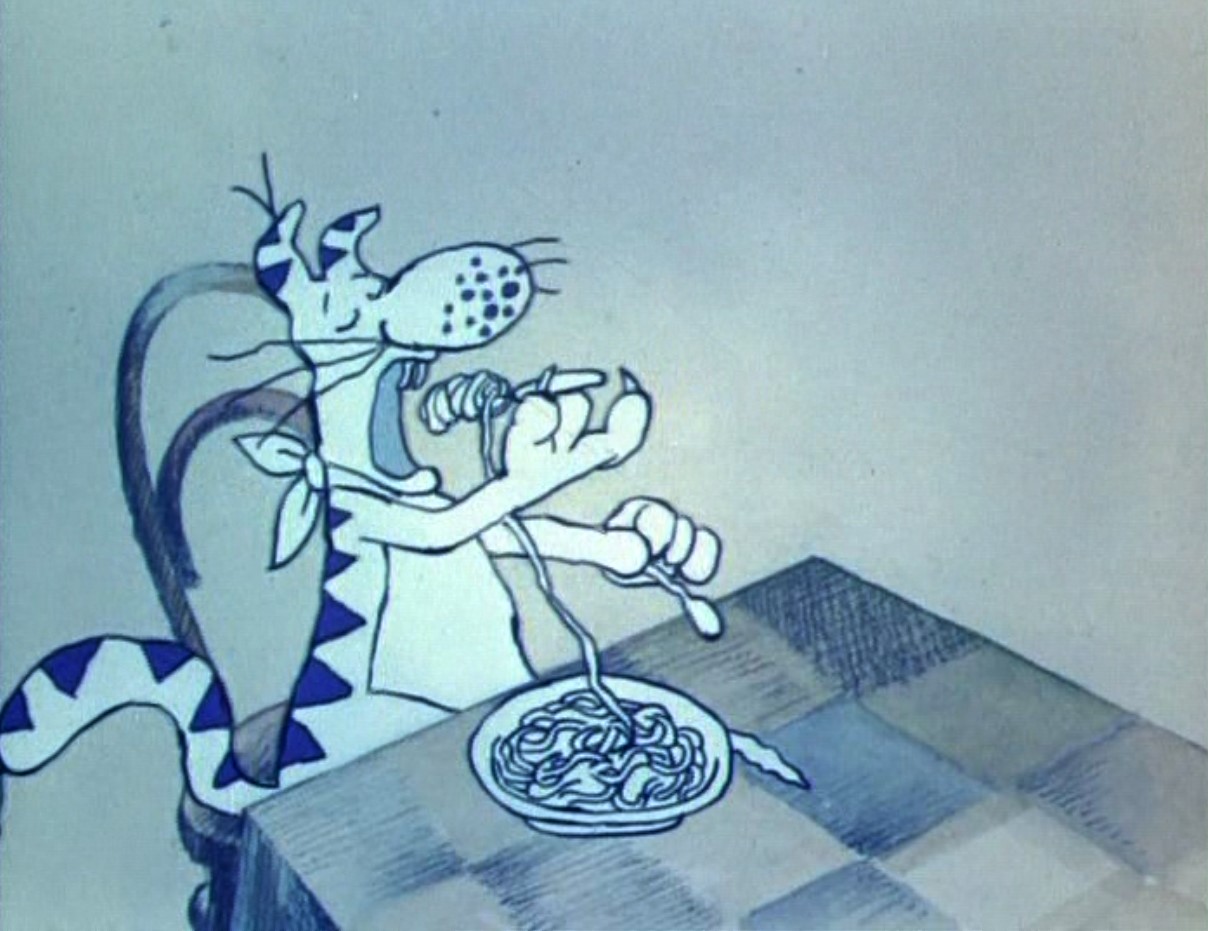
These are three very short episodes of the Maxicat series, which consisted of 24 episodes in total. These feature a very cartoony cat with a big nose experiencing Pink Panther-like adventures on a grey, featureless canvas.
In the first Maxicat finds a magical hat, in the second he eats spaghetti, and in the last he finds a flying broom. All three are short and classic gag cartoons with the dialogue-less action being accompanied by very jolly music. As these three episodes prove, Maxicat is an enjoyable series from the very creative Zagreb Film Studio from Yugoslavia.
Watch some Maxicat episodes yourself and tell me what you think:
These Maxicat episodes are available on the DVD ‘The Best of Zagreb Film: Be Careful What You Wish For and The Classic Collection’
Director: Marcell Jankovics
Release date: May 27, 1977
Rating: ★★★★
Review:

‘The Struggle’ is as short as Jankovics’s previous film, ‘Sisyphus’ (1974), and again in black and white. This time Jankovics uses pencil on a white canvas to depict a sculptor sculpting a human figure. But then the sculpture itself starts sculpting back…
Jankovics’s design is very realistic, and his animation of the highest quality, but the film is less interesting to look at than ‘Sisyphus’ because this time Jankovics shows more than he suggests. Nevertheless, this is a clever little film that like ‘Sisyphus’ shows that Jankovics was one of the greatest and most interesting animators ever.
Watch ‘The Struggle’ yourself and tell me what you think:
‘The Struggle’ is available on the Blu-Ray of ‘Son of the White Mare’


 Dr. Grob's Animation Review