
You are currently browsing the category archive for the ‘Feature films’ category.
Director: Bill Meléndez
Release date: December 4, 1969
Stars: Charlie Brown, Snoopy, Lucy and Linus van Pelt, Schroeder, e.o.
Rating: ★★★★★
Review:
 Made after six television specials, ‘A Boy Named Charlie Brown’ is Meléndez’ first feature film about the Peanuts gang.
It is a film with a slow, but steady pace: unhurried, yet not too slow. Being totally relaxed, the film takes a long time to introduce the characters, citing a lot of Peanut comic strip gags, and showing Charlie Brown’s troubles in flying kites and playing baseball. Only after 30 minutes the head story kicks in, when Charlie Brown enters a spelling bee.
The laid-back feel of the film is further enhanced by two surprising musical numbers: Snoopy’s playing of the American National Anthem and Schroeder’s playing of the complete second movement of Ludwig van Beethoven’s Sonata pathétique, which is arguably the film’s highlight. Snoopy receives a fair deal of screen-time, and two of his fantasies are shown: him as a pilot in World War I and as a skater in Holland and in an ice-hockey game. Nevertheless, the story remains with Charlie Brown and his doomed attempt to gain respect. His frustrations and failure are funny, but remain genuine and heartfelt. This focus make the film a well-made tribute to Charles M. Schulz’s strip of the early 1960s, when Charlie Brown’s frustrations were the strip’s main focal point.
Overall, the designs are gorgeous, especially in the musical interludes, which feature bold, colorful images. The jazzy score, too, is a delight, and enhances the film’s unique atmosphere. In all, ‘A Boy Named Charlie Brown’ is a great film which has a typical 1960s feel without ever getting cheap.
Watch ‘A Boy Named Charlie Brown’ yourself and tell me what you think:
Directors: Clyde Geronimi, Wilfred Jackson & Hamilton Luske
Release Date: June 16, 1955
Rating: ★★★★★
Review:
 ‘Lady and the Tramp’ is a mild and friendly film based both on story ideas by Joe Grant that went as far back as 1939, and a short story by novelist Ward Greene. It tells the story of Lady, an upper class female Cocker Spaniel living around the turn of the century.
Lady’s life of luxury seems to be threatened by the coming of a baby, but it is the babysitter, aunt Sarah, who’s her real nemesis. The cat-loving old lady quickly has Lady muzzled, and it’s up to the tramp to rescue her. They spend a night out together, but in the morning, while they’re chasing chickens “together”, Lady gets caught and ends in the city dogpound. There she discovers that the tramp is quite a ladies’ man. It seems their short-lived relationship is over, but then the tramp helps her catching a rat that has sneaked into the house and into the baby’s room…
‘Lady and the Tramp’ was the first animated feature in Cinemascope. The film uses the new technique to great effects, with the action carefully laid out to the broad screen. Its backgrounds are very beautiful, and remarkably lush or, when necessary, highly dramatic. Only in the love scene they become somewhat stylized, showing a Mary Blair influence otherwise absent from the film.
The high quality animation is a delight to watch and stands out in an age of stylized and limited animation, something the 1950s more and more became to be. Like the animals in ‘Bambi‘ (1942), the dogs have a look and feel of real animals, while, at the same time, being full characters one can relate to, with a complete range of human expressions. Even the minor characters, like the dogs in the dogpound, are perfectly animated in that respect. The voices help in this dualism, often being a combination of human and dog-like sounds.
The humans, on the other hand, are hardly seen, and only the strongly caricatured ones, Aunt Sarah, Tony and Joe, have something of a character. It is telling that the most famous and probably most romantic kiss in animation history can be seen in this movie and is a kiss between two dogs. In this scene Lady and the tramp share a meal of spaghetti, accompanied by romantic music by the two Italian restaurant owners. This scene, animated by Frank Thomas, is the undisputed highlight of the film. Honorable mention goes to the very lifelike fight between the tramp and a large rat, a strongly dramatic scene animated by Wolfgang Reitherman, which can compete with the fighting scene in ‘Bambi’ in its impact.
Watch the dining scene from ‘Lady and the Tramp’ yourself and tell me what you think:
Directors: Ted Berman, Richard Rich & Art Stevens
Release Date: July 10, 1981
Rating: ★★
Review:
 ‘The Fox and the Hound’ tells about a young adopted fox called Tod and a young hound dog called Copper, who become friends, but later enemies, partly due to their nature.
‘The Fox and the Hound’ was the feature in which the last of the nine old men, Frank Thomas and Ollie Johnston, passed on their knowledge and their legacy to a younger generation of animators. In this respect it’s the most transitional film in Disney history. And unfortunately, it shows, because it’s neither an old classic, nor does it have the spirit of a film by young Turks, despite most of the animation being nothing less than great.
On the contrary, the end product is a tame, slow moving and rather tiresome movie more belonging to a time long past than to the 1980s, the decade in which it was made. Its main flaws are in storytelling: none of the actions of the protagonists are very well motivated, the villains are hardly threatening and a lot of screen time is spent on the totally non-related antics of a sparrow called Dinky and a loony, rather annoying woodpecker called Boomer trying to catch a caterpillar. These birds, like the friendly old female owl Big Mama (voiced by black jazz singer Pearl Bailey), do nothing more than watching the main action.
The songs do not propel the action forward, either, but tend to drag the film down. And in the scenes in which Tod tries to survive in the forest, it becomes very difficult to see him interact with birds and furry animals. How he’s going to survive in the forest without killing animals remains unexplained. Finally, at the end of the film, a bear appears out of nowhere, like a deus ex machina, to be the sole reuniter of the two friends.
In fact, the only appeal of ‘The Fox and the Hound’ lies in the quality of the animation itself, and in the film’s beautiful backgrounds. Because of its out-of-time setting the film can be regarded timeless, but a timeless classic it ain’t.
Watch the fight scene from ‘The Fox and the Hound’ and tell me what you think:
Directors: Jill Culton, Roger Allers & Anthony Stacchi
Release Date: September 29, 2006
Rating: ★★★
Review:
 With ‘Open Season’ Sony Pictures joined the American computer animated feature pool, being the fourth major company to do so. And because in this world American animation films from the same year share the same features, ‘Open Season’ is about forest animals living near the civilized world, just like Dreamworks’s ‘Over The Hedge‘.
The story of ‘Open Season’ (a domesticated bear called Boog is left in the wild and tries to find his way back home) is fairly original (although similar to ‘Cars’), but like its setting, its execution is not. Like ‘Shrek’ (2001) and ‘Ice Age‘ (2002) it’s a buddy film full of fast-talking, wisecracking animals, with the sap deer Elliott (voiced by Ashton Kutcher) being all too similar to Donkey in ‘Shrek’.
Moreover, some scenes are rather formulaic, like the break-up scene after the waterfall ride (see also ‘Shrek’, ‘Monsters, Inc.‘), the ‘we-can-do-this-together-scene’ (see ‘A Bug’s Life’, ‘Robots‘), and the almost obligate near-death of Elliott in the end, which goes all the way back to Disney’s ‘The Jungle Book’ (1967).
The film’s designs are okay, and are more akin to Dreamworks and Blue Sky than to Pixar. The studio’s the animation is mostly of a high standard, if not inventive. The effect animation is adequate, with convincing lights, waters and smokes. Especially the furs look good, but the human hairs are very bad, and in one scene one can watch some very unrealistically animated bank notes flying around.
In the end, ‘Open Season’ is an entertaining film, but too standard to be a classic. Its foremost selling-point may be that it is one of those rare animated features in which the main protagonist (Boog) is voiced by an Afro-American (Martin Lawrence).
After this modest start Sony Animation would do better with its next feature, ‘Surf’s Up’ (2007), with its ‘documentary’ style. But the company really hit its stride with ‘Cloudy with a Chance of Meatballs’ (2009) with its overtly cartoony animation approach.
Meanwhile the reuse of formulaic story building blocks like the ones in ‘Open Season’ came to hamper more and more American computer animated features, with Disney’s ‘Planes’ (2013) as the ultimate low-point, as it consists of nothing but cliches…
Watch the tailer for ‘Open Season’ yourself and tell me what you think:
Directors: Tim Johnson & Karey Kirkpatrick
Release Date: May 19, 2006
Rating: ★★★½
Review:
 Based on a comic strip, ‘Over the Hedge’, Dreamworks’s sixth computer animated feature, is a charming, if unassuming film, which belongs to the better half of the Dreamworks features, if barely so.
Unlike the unappealing movie ‘Shark Tale’ (2004) for example, all the actions of the characters have their origin in real animal behavior: they hibernate, they forage and they’re threatened by a human environment to which they have to adapt.
The film’s story is original in that it’s not found in the comic strip on which the movie is based. However, at the same time the story is not too original as it contains some standard, almost obligatory scenes, a feature that hampered more and more American animated feature films from 2005 on.
Nevertheless, the film’s story is well executed: the storytelling is lean, the contrast between the two likable protagonists, the brazen raccoon RJ and the cautious turtle Verne, is well-played, as are the two villains: the mafia-like bear Vincent and the Verminator. Even the side-characters are developed enough to like and to care for them (unlike the many personas in Blue Sky’s ‘Robots‘ (2005), for example).
Even though it contains some very realistic effects, like the animation of fur, the animation generally is not very lifelike, and more akin to the jerky animation of Tex Avery films than to the flow of Disney. Especially, the animation of the ADHD-squirrel Hammy is frantic. This character is also responsible for the highlight of the film, in which Hammy, on caffeine, has sped so much that he sees the world practically motionless.
‘Over The Hedge’ is by no means a classic, but it’s entertaining and well-told. In the world of American computer animated features this is already a plus.
Watch the tailer for ‘Over the Hedge’ yourself and tell me what you think:
Director: Tim Burton & Mike Johnson
Release Date: September 23, 2005
Rating: ★★★★
Review:
 The shy Victor and Victoria are forced by their unsympathetic parents to marry each other.
Luckily, they actually like each other, but then Victor accidentally marries the deceased Emily who takes him to a world underground, while Victoria is forced to marry the evil lord Barkis…
‘Corpse Bride’ is a typical Tim Burton film, especially in its art direction, in its 19th century, gothic setting, in its dark humor, and in its jolly portrait of death. Because the film is also a Danny Elfman-penned musical, it feels like a successor to ‘The Nightmare before Christmas‘ (1993). Nevertheless, it is far more enjoyable than that sometimes tiresome film: ‘Corpse Bride’ features only three songs, two of which help to tell the story. So, even though one could do without the musical element, it doesn’t dominate the complete film.
Also, the art of ‘Corpse Bride’ is a great improvement on ‘Nightmare before Christmas’. The dull greys and blues of the living world contrast greatly with the vivid colors of the underworld, which is clearly more fun to ‘live’ in. The designs of the puppets are extreme, and their almost flawless animation is jawdroppingly rich and expressive. The story is lean, and focuses on the three protagonists, Victor, Victoria and Emily, who all three are very likable characters. The voice cast is impressive, and includes Johnny Depp (Victor), Emily Watson (Victoria), Helena Bonham Carter (Emily) and Christopher Lee (Pastor Gallswells).
All this make ‘Corpse Bride’, together with that other stop-motion film ‘Wallace and Gromit: the Curse of the Were-Rabbit‘, the best animated feature of 2005/2006, surpassing all computer animated films of those years. It proves that traditional animation is still viable and relevant in the computer age.
Watch the tailer for ‘Tim Burton’s Corpse Bride’ yourself and tell me what you think:
Directors: Nick Park & Steve Box
Release Date: September 4, 2005
Stars: Wallace & Gromit
Rating: ★★★★★
Review:
 After three excellent two-reelers British animation heroes Wallace and Gromit were ready for their first feature film.
‘The Curse of the Were-Rabbit’ elaborates primarily on the themes of ‘A Close Shave‘: love and horror. This time Wallace and Gromit are after a giant rabbit threatening the crops breeds for a vegetable contest in the village.
The stop motion animation in this film is practically flawless, elevating the century old technique to the highest standards possible. Indeed, both this film and ‘Tim Burton’s Corpse Bride‘, another stop motion film, were far superior to any computer animated feature film released in 2005 or 2006.
‘The Curse of the Were-Rabbit’ is not only a great animation film, it is great cinema, with excellent camera work, a flawless story, wonderful characterization and lean storytelling that builds to a spectacular climax. Especially the animation of Gromit is stunning, because his acting is completely silent throughout the picture and uses only the eyes to suggest emotion.
Watch ‘Wallace & Gromit: The Curse of the Were-Rabbit’ yourself and tell me what you think:
Director: Chris Wedge
Release Date: March 11, 2005
Rating: ★★½
Review:
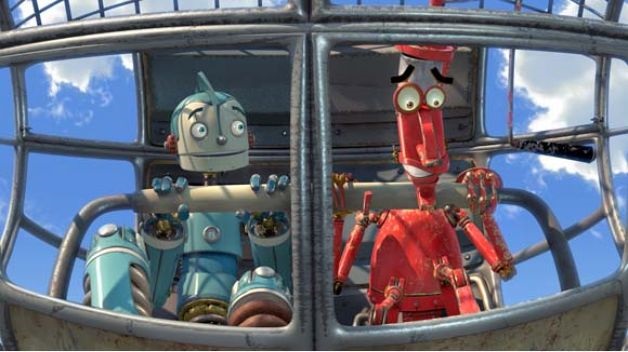 2005 was to be the first weak year in the history of computer animated features. This was a year in which no films were made that felt as if they were better than the last ones.
In fact, both Blue Sky’s ‘Robots’ and Dreamworks’s ‘Madagascar’ are mediocre in the whole catalog of computer animation. Surprisingly, the two most interesting features of 2005 were stop motion films: Aardman’s ‘Wallace and Gromit and the Curse of the Were-Rabbit‘ and Warner Brothers’ ‘Tim Burton’s Corpse Bride‘. This age-old technique defeated the modernity of computer animation, as both films topped the computer animated features in originality and consistency of story and design.
‘Robots’ is unfortunately typical for the regression in the computer animated field. First the animation: the robots are a good excuse for rather jerky motions, and its colorful setting never feels real. This setting is similar to that of ‘Monsters, Inc.‘ (2001): a totally different world, this time inhabited with robots, which at the same time is an exact copy of our own modern urban world. Also, main protagonist Rodney’s arrival in Robot City is very reminiscent of a similar scene in ‘A Bug’s Life’ (1998), and the all too obligatory ‘follow your dream’ story line had already become stale by 2005, too. In all, the film’s story is much more standard than its exotic setting would suggest.
Blue Sky’s storytelling is also very inconsistent and has many flaws in its timing. For example, the big finale never pays off and his topped by a very cloying ending. Worse, Rodney has no less than two love interests, one of which is suddenly dropped, while the love between him and Cappy, the other, is hardly shown. In effect it seems non-existent. Then there are way too many side characters, none of which is well-developed. Most of them are wise-crackers, who place their one-liners in a nasty, unpleasant way. Robin Williams’s character Fender is as tiresome as his genie was delightful in ‘Aladdin’ (1992). Even Rodney’s hero Bigwald is unappealing in his first scene. And it remains unclear why he has retreated in the first place.
All these flaws are such a pity, for one can feel the great joy in the making of ‘Robots’, especially in the transport sequence, where Rodney and Fender are travelling in a giant Rube Goldberg machine. This scene, although unimportant to the story, is the highlight of this otherwise very disappointing film.
Unfortunately, 2006 would be hardly better, with Blue Sky’s weak ‘Ice Age 2: The Meltdown’, and the entertaining, but a little too routine films ‘Over The Hedge‘, ‘Flushed Away’ (Dreamworks) and ‘Open Season‘ (Sony’s debut in the field). Even Pixar would release its then weakest picture with ‘Cars’…
Watch the trailer for ‘Robots’ yourself and tell me what you think:
Director: Ralph Bakshi
Release Date: November 15, 1978
Rating: ★
Review:
 I’m going to spend only a few words on this film: it is not an animation film. It may be drawn, animated it is not. Practically every movement is rotoscoped, with some scenes containing little more than colored live action footage.
The result is a surplus of movement, a severe inconsistency of style, a general feel of cheapness, and, animationwise, absolutely nothing to enjoy. On the contrary: the result is appalling.
Furthermore, the acting is tiresome, the pace painstakingly slow, the characters more often than not rather unsympathetic, the story incomplete, and the settings often in lack of dramatic effect, though I must admit that the film shares some strikingly similar scenes with the Peter Jackson’s later live action version (which incidentally contains much, much more animation than Bakshi’s film).
In short, Bakshi’s ‘The Lord of the Rings’ is by all means a failure, and one of the most hideously ugly films I’ve ever seen in any genre.
Watch the Balrog scene from ‘The Lord of the Rings’ yourself and tell me what you think:
Director: Juan Antin
Release Date: October 3, 2002
Rating: ★★★
Review:
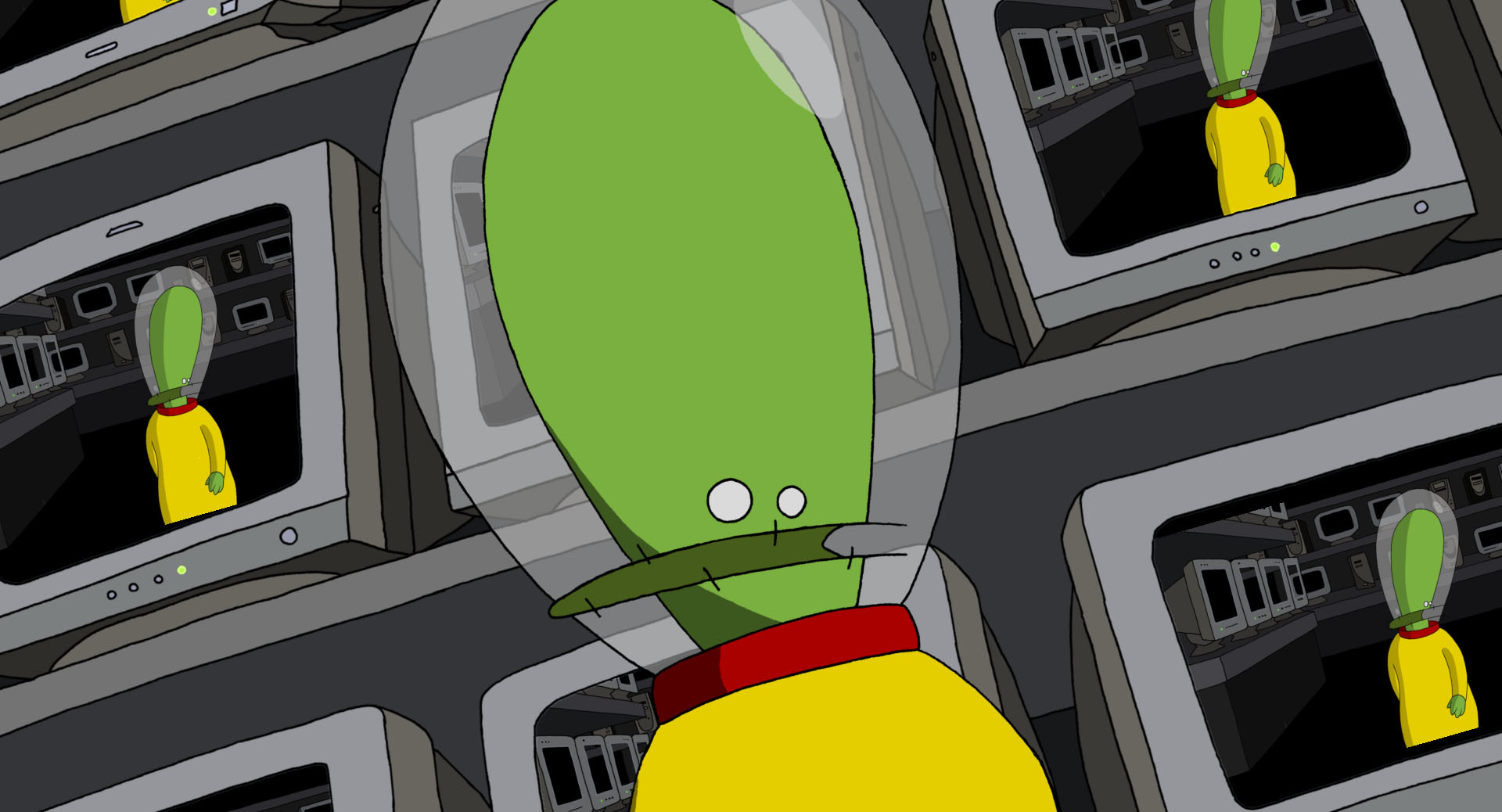 ‘Mercano el Marciano’ is a curious feature film from Argentine about an ugly little Martian who gets stranded in the evil city of Buenos Aires, where he ends up living in the sewer.
Here he builds a virtual Mars to play in for himself on the internet, but soon it is discovered and exploited by businessmen. Together with a nerdy boy and a trio of alternatives Mercano takes revenge. This leads to a silly musical finale.
The film uses original designs and is nicely animated. Unfortunately, it is also hampered by slow timing, poor gags, graphic violence, ugly colors and bad sound design. The result is an original, yet mediocre film, which is not too surprising, when one considers the film was made with a budget of only $250,000 (for comparison: a contemporary Hollywood production like ‘Monsters, Inc’ cost $115 million).
‘Mercano el Marciano’ seems to be an early example of an international movement in animation film, which favors urban settings, violence and rather adult material (e.g. ‘The District!’ (2004) from Hungary, and ‘George the Hedgehog’ (2011) from Poland).
Watch ‘Mercano el Marciano’ yourself and tell me what you think:
Directors: Dean DeBlois & Chris Sanders
Release Date: June 21, 2002
Rating: ★★★★★
Review:
 Stitch is a genetic experiment (called ‘experiment 6-2-6’) designed to destroy, but sentenced into exile by an intergalactic councel.
All too soon our fluffy little mutant escapes and he ends at the Hawaiian island of Kauai, where he befriends lonely little Lilo, who lives a difficult life with her older sister Nani after the death of their parents. Here Stitch learns to tone down his inclination to destruction and how to love and care.
‘Lilo & Stitch’ is a very appealing film. Its designs, based on Chris Sanders’ idiosyncratic story drawings, are round, cuddly and original. Adding to the friendly atmosphere are the lush watercolor backgrounds, the first in a Disney feature since ‘Bambi‘ (1942). The animation is superb throughout, and Lilo, Stitch and Nani are round and instantly likable characters, who have nothing of the wisecracking arrogance of many other animated characters from the era. The film’s familiar family theme never gets cloying and is countered by a lot of humor. The result is a film full of love and joy.
Probably, because it was made in Orlando, Florida, far from the main company, the film also eschews the rather tiresome Disney musical convention, and features an original soundtrack featuring Elvis Presley songs and Hawaiian chants, instead. True, the plot borrows freely from ‘Men in Black’ (1997), and the science fiction setting feels a little awkward in a Disney film, but the story of loneliness, love and acceptance is well-told, and equally appealing to the young and old.
Moreover, the film proves that one can perfectly well make a good movie out of original and typical elements. A film maker like Hayao Miyazaki knows this, off course. But unfortunately, this message has been lost on the American animation studios, as very few of the subsequent American feature films succeeded in displaying this level of originality in characterization, soundtrack and design. Thus ‘Lilo & Stitch’ remains as Disney’s best attempt at an ‘author film’ (not counting the almost forgotten ‘Teacher’s Pet’ from 2004).
Unfortunately, ‘Lilo & Stitch’ seemed to be Disney’s last masterpiece of traditional animation. Even though it was followed by yet two other 2D animation features, it marked an end of an era lasting 65 years. Disney soon jumped the computer animation band wagon with rather mediocre results, arguably only hitting their stride in 2010 with ‘Tangled‘. Luckily, in 2009 the studio made a surprising, but unfortunately isolated return to the traditional medium with the excellent ‘The Princess and the Frog’.
Watch the trailer for ‘Lilo & Stitch’ yourself and tell me what you think:
Director: Chris Wedge
Release Date: March 15, 2002
Rating: ★★★★
Review:
 Set in the last ice age (ca. 20,000 years ago), a mammoth and a ground sloth try to return a human baby to its tribe, helped by a saber-toothed tiger with a hidden agenda.
The Ice Age itself is depicted well, with lots of crispy ice and snow, and fauna that matches the period. We watch various North-American ice age mammals, like mammoths, ground sloths, saber-toothed tigers, Glyptodonts, and even the South American species Macrauchenia (which looks like a llama with a trunk). The only mishaps are the two Brontotheres, mistakenly referred to as “rhinos”, a group of species that had died out 34 million years earlier. Fortunately, the makers didn’t fall for the trap of making dinosaurs co-exist with early humans (although we see one trapped in the ice, in a scene that is nonsensical anyhow).
‘Ice Age’ was Blue Sky’s first feature film. It was made for 20th Century Fox, who had just dumped Don Bluth’s Phoenix Studio. With this film Blue Sky/20th Century Fox posed serious competition to Dreamworks and Pixar with a different, yet equally interesting style of computer animation, which was more based on caricature, exaggerated animation and angular designs. The latter unfortunately lead to rather ugly designed humans.
The story of ‘Ice Age’ has uncanny similarities to the computer animation successes of 2001, ‘Shrek’ (a moody giant and an annoying chatterbox travel together), and ‘Monsters, Inc.‘ (strange creatures trying to get a little human kid home). So in this respect, the film tells us nothing new. Its extras can be found in the cartoony character Scrat, whose antics bridges the main action, and in the numerous gags on evolution.
The highlight of the film, however, is the 2D animation of mural paintings depicting Mannie the mammoth’s painful memory of the loss of his wife and son. This is a stunning tour-de-force of both daring and emotional animation, still a rare feat in computer animated feature films.
‘Ice Age’ was a huge success, and has spawned a number of sequels, none of witch mastered to keep the lean storytelling of the first film. Moreover, the stories had less and less to do with the ice age setting. Even worse, in ‘Ice Age 3’ dinosaurs had to come along, after all…
Watch the trailer for ‘Ice Age’ yourself and tell me what you think:
Director: Bruno Bozzetto
Release Date: October 31, 1968
Rating: ★★★★
Review:

‘Vip mio fratello superuomo’* is Bozzetto’s second feature, and it a great improvement on his first (‘West and Soda‘ from 1965).
The designs are bolder, the pace is higher, the timing sharper, and the story more original. The film starts rightaway with a hilarious history of the VIP superheroes through time. It then introduces our heroes, the superhero SuperVIP and his weak little bespectacled brother, MiniVIP. They end upon an island where a super-villain plans to turn mankind into brainless consumers.
The result is a very nonsensical superhero story, told to a great effect, with the minimum of means and very limited animation. It also shows Bozzetto’s aversion against consumerism, a theme he would expand upon in his masterpiece ‘Allegro non troppo’ (1976). Unlike that latter feature, ‘Vip mio fratello superuomo’ remains virtually unknown. This is a pity, for this funny film deserves a wider audience.
Watch and excerpt from ‘Vip mio fratello superuomo’ yourself and tell me what you think:
* also known as ‘My Brother Superman’
Directors: various
Release Date: June 3, 2003
Rating: ★★½
Review:
The enormous success of ‘The Matrix’ (1999) not only spawned two sequels, but also a direct-to-video release with several animation films, expanding the film’s theme and providing some background history.
‘The Animatrix’ is an American/Japanese/South Korean co-production and consists of nine parts, produced by four different animation film studios (Square, Studio 4°C, Madhouse Studios and DNA). The nine parts differ a lot in style, content and quality, and the end result is pretty uneven to say the least. However, for fans of ‘The Matrix’ it contains very welcome background material to The Matrix universe.
 1. Final Flight of the Osiris
Director: Andy Jones
Rating: ★★★½
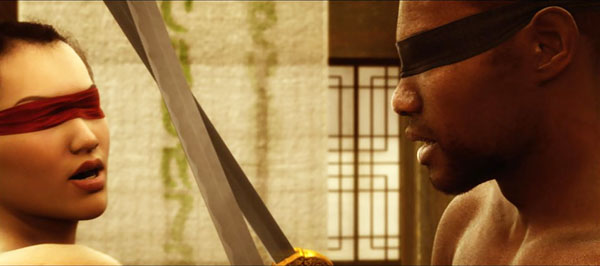
The first of the nine segments of The Animatrix is the most straightforward. It’s a dark action episode that tells what happened to the Osiris, a human vessel that shortly appears in ‘The Matrix’. The Square Studio, then already famous for the groundbreaking animation in ‘Final Fantasy: The Spirits Within’ (2001), tops itself with for 2003 ultra-realistic computer animation, with human characters of a then unsurpassed realism. Especially its opening sequence, an erotic martial arts fight, is impressive and made many viewers doubt whether it was real or not they were looking at.
 2. & 3. The second Renaissance
Director: Mahiro Maeda
★★★½
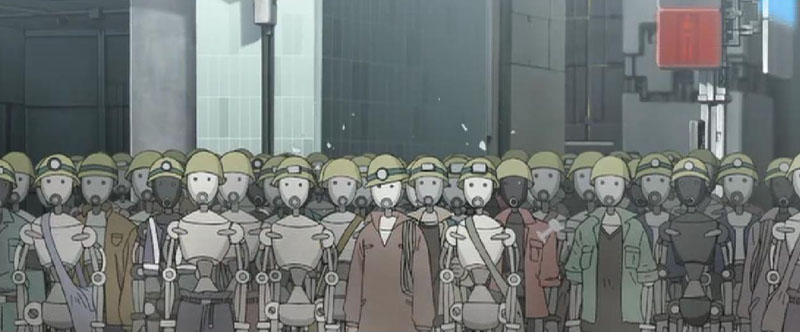
Made by Studio 4°C and brought in two episodes, The Second Renaissance tells us what happened before the Matrix in an American anime-style. It uses a robotic female voice-over to tell us about a robotic revolution and a human-robot-war which ends in defeat for the human population, which is then used as an energy source for the robots. These episodes are the most satisfying as an addition to The Matrix trilogy.
 4. Kid’s Story
Director: Shinichirô Watanabe
Rating: ★
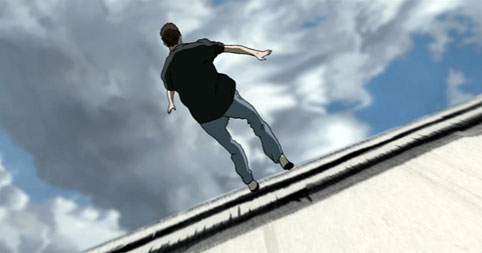
‘Kid’s Story’ is the first of four episodes dealing with people who discover the matrix. This episode is about a teenager who doubts reality and who wakes up in the real world. The episode uses a very realistic, yet graphic style that is very American and rather ugly. Especially the animation (by Studio 4°C) is slow, unsightly and unsteady, making it one of the most unappealing parts of ‘The Animatrix’ to watch.
 5. Program
Director: Yoshiaki Kawajiri
Rating: ★★
‘Program’ is another weak entry in ‘The Animatrix’. Animated by Madhouse Studios and drawn in a rather American comics/anime-style and using sharp shades, it tells about a treacherous character trying to persuade a girl to join him in a Japanese samurai setting (the program the two are in). The whole episode is rather melodramatic and forgettable.
 6. World Record
Director: Takeshi Koike
Rating: ★
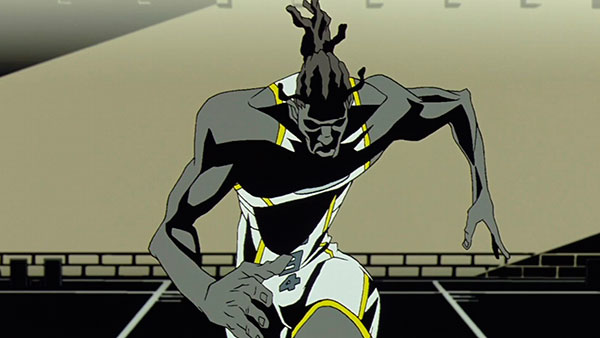
By far the most unappealing of all episodes of ‘The Animatrix’, ‘World Record’, by Madhouse studios, is drawn in a a gruesomely ugly comics design to tell the story of an athlete who discovers the matrix and who has to pay for it.
 7. Beyond
Director: Kôji Morimoto
Rating:★★★★
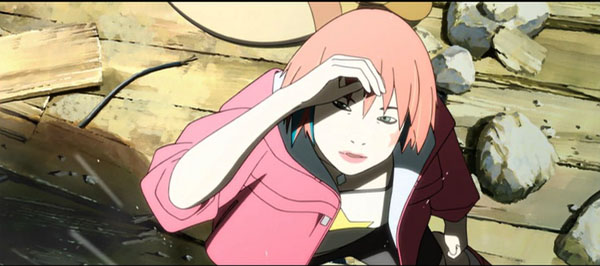
Studio 4°C’s ‘Beyond’ is the third of four Animatrix episodes about people who discover the matrix, and it is easily the best of the lot. Set in Japan, it tells about a young woman, who is looking for her cat Yuki, and who’s led by some kids to a house where the ‘program’ has gone haywire, resulting in some wonderful surreal effects (like objects defying gravity). Unlike the rest, the episode has a lighthearted feel to it, which is enhanced by its appealing graphic anime design and its excellent animation, which makes clever use of 3D-effects. More than in any other part of the Animatrix one has the feeling that this episode is about real people in a real environment. The short is another showcase for Morimoto’s great direction skills, which he had already shown with the ‘Magnetic Rose’ sequence in the compilation feature ‘Memories‘ (1995).
 8. A Detective Story
Director: Shinichirô Watanabe
Rating: ★
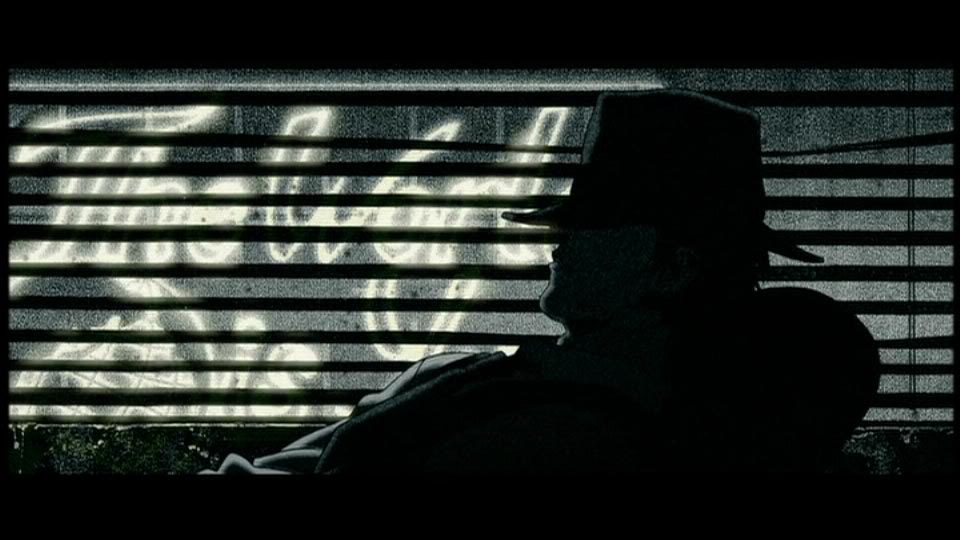
‘A Detective Story’ is the fourth and last episode about people who discover the matrix. This episode is about a private detective and it uses all film noir cliches, including a very trite voice over. The nice black and white backgrounds evoke a forties atmosphere, even though the story is about hackers and chat rooms. But they cannot hide Studio 4°C’s very limited animation or the corny story, making ‘A Detective Story’ one of the weakest episodes of this package film.
 9. Matriculated
Director: Peter Chung
Rating: ★★★★
Penned and directed by Æon Flux-director Peter Chung and produced by the Korean DNA studio, ‘Matriculated’ is the most philosophical of the nine episodes of ‘The animatrix’. The story is set in the ‘real’ world. It deals with humans who try to make robots defending them by making them dream. Although its angular human designs are once again quite unattractive, this episode’s clever story makes it one of the highlights of ‘The Animatrix’.
Watch the trailer for ‘The Animatrix’ yourself and tell me what you think:
Director: Kōji Morimoto, Tensai Okamura & Katsuhiro Otomo
Release Date: December 23, 1995
Rating: ★★★★
Review:
Seven years after ‘Akira‘, Katsuhiro Otomo returned to the animated screen with ‘Memories’, a package film, which impresses, but fails to reach the heights of ‘Akira’. Indeed, the film is much, much less well known than either Otomo’s previous film, or ‘Ghost in the Shell‘, which was the anime hit of 1995.
Based on his own short stories, ‘Memories’ consists of three unrelated parts: ‘Magnetic Rose’, ‘Stink Bomb’ and ‘Cannon Fodder’, which are discussed separately below.
 Magnetic Rose
Director: Kōji Morimoto
Rating: ★★★★★
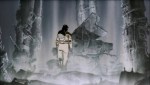
‘Magnetic Rose’ starts the Memories trilogy, and it’s arguably the feature’s most satisfying episode. Animated by Morimoto’s own Studio 4°C, it is the only part that clearly deals with memories.
In this episode a rescuing squad of space garbage collectors is ensnared in the memories of a long deceased opera singer, who still seems alive in her remote satellite home in space, blurring the boundaries of reality. This accounts for an exciting story, greatly enhanced by Yoko Kanno’s superb soundtrack, in which she mixes an eerie choir, ambient guitar work and dark electronic with bites of Giacomo Puccini (the famous aria ‘un bel di vedremo’ and the finale from ‘Madame Butterfly’, an opera set in Japan, and a small soundbite from ‘Turandot’, which is set in China). Also featured is a stage set from Puccini’s ‘Tosca’, in which the opera singer, as Tosca, stabs Heinz, one of the rescuers.
Even though the science fiction setting with its touches of horror is typical anime, the underlying drama is very mature and quite unique. This episode’s screenplay was penned by future director Satoshi Kon. Kon certainly established himself with this screenplay, and he would further explore the theme of memory and loss in ‘Millennium Actress’ (2001), and the blurring of reality and fantasy in both that film and ‘Paprika’ (2006) with even more spectacular results. Director Kōji Morimoto, meanwhile, would prove his worth as a director in ‘Beyond’, the best episode of ‘The Animatrix‘ (2003).
In ‘Magnetic Rose’ the characters are from all over the world, and this is one of the few anime, in which the Japanese character looks distinctively Asian compared to the European characters.
 Stink Bomb
Director: Tensai Okamura
Rating: ★★★
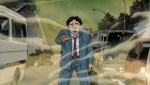
Penned by Katsuhiro Otomo, but directed by Tensai Okamura, and animated by the Madhouse animation studio, ‘Stink Bomb’ feels like a comical interlude between the two more serious outer episodes. The story is set in present day Japan and features a very stupid, but surprisingly indestructible protagonist who turns into a nonsensical weapon of mass destruction. The story is simple: Nobue Tanake, our ‘hero’, works in a biochemical laboratory. To cure his cold one of his colleagues suggests he takes a sample of the new medicine they’ve developed at the lab. But Tanake accidentally swallows the wrong pills, which turn him into a lethal weapon, sweating poisonous gasses that kill everything in sight. Although he remains unaware of this, he becomes the cause of the annihilation of Japan.
This story is rather silly – there’s a lot of broad comic acting, and it even ends with a kind of punch-line. And yet, the episode manages to be unnerving at the same time; the short has some disturbing undertones, with the fear of mass destruction weapons and corrupt governments played out well. The unsettling atmosphere is greatly enhanced by Jun Miayke’s score, in which he uses nervous free jazz saxophones to a great effect.
 Cannon Fodder
Director: Katsuhiro Otomo
Rating: ★★★★½
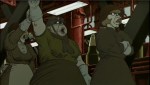
Otomo himself directed the last and most beautiful sequence of Memories. This episode once again is animated by Studio 4°C, but has a distinctive graphic style that doesn’t resemble any other anime. Especially the background art and character design are highly original. But even more startling is the fact that the film is ‘shot’ in one long camera take (with a little bit of smuggling, but very impressive nonetheless). The cinematography is outstanding, and uses a little bit of computer animation. One moving shot of a colonel ascending on a platform is a great piece of character animation. Nevertheless, the boys’ own dream of becoming a colonel himself, done in charming children’s drawings, may be the highlight of the entire film.
‘Cannon Fodder’ deals with an alternative, distinctively European world, where a totalitarian military regime enters every aspect of life. It’s a kind of steam punk, vaguely based on images of the first world war, with its giant cannons, gas masks, and pompous generals. We’re following one day in the life of a single family. They live in a city were all work and school is directed to a war with a mysterious city, which remains unseen throughout the movie. This war is fought entirely by using cannons, fired at the distant enemy.
Despite the caricatured humans, the atmosphere is hardly comical, but dark and disturbing. The unseen foe reminds one of ‘1984’, and one wonders whether the enemy is real – but then, in the end, the air alarm kicks in. ‘Cannon Fodder’ is more a film of concept than of drama, and thus less engaging than ‘Magnetic Rose’. Still, because of its unique style, and strict control of cinematography, ‘Cannon Fodder’ is a small masterpiece.
Watch the trailer for ‘Memories’ yourself and tell me what you think:
‘Memories’ is available on DVD and Blu-Ray
Director: Hayao Miyazaki
Release Date: July 20, 2001
Rating: ★★★★★ ♕
Review:
 After several very fine films, like ‘My Neighbor Totoro‘ (1988) and ‘Princess Mononoke’ (1997), Miyazaki tops himself with his masterpiece ‘Spirited Away’. This film single-handedly places him among the greatest masters of animation of all time.
The film depicts a strange and inexplicable, yet surprisingly complete fantasy world, with a conviction and originality that has rarely been seen since Lewis Carroll’s ‘Alice in Wonderland’. At the same time, unlike several of Miyazaki’s earlier films, one feels that ‘Spirited away’ could only have been made in Japan. Its setting of a public bath, with its numerous gods and demi-gods, is totally Japanese.
Yet, its story about coming of age is universal as is its appeal. The little girl Chihiro (or Sen, as she’s called during most of the film) is the greatest of Miyazaki’s heroines. Like Kiki in ‘Kiki’s Delivery Service’ (1989), she matures during the film, but the fears and terrors she has to conquer are far more alarming than Kiki’s, and her growth is way more convincing. Not only has she to prove herself, she has to regain her name, and most importantly, she has to rescue her parents, who have been transformed into pigs in a particularly horrifying scene. At one scene we see her stricken with traumatic stress. In another we watch her breaking down. Despite some exaggerations (a flood of tears, for example), these scenes are so surprisingly real, they startle the viewer who’s used to the formalized emotions of many commercial animation films, whether Japanese or Western.
However, the character animation of Chihiro is outstanding throughout the film: she is a true girl and not an adult in disguise, and her emotions feel genuine and seem deeply rooted in observation of real human behavior. We identify immediately with her, and she’s strong enough a character to make her extraordinary journey in that strange, mysterious and dreamlike world believable.
Typical for Miyazaki, even in this hostile world our young heroine is not without friends, and even the most unpleasant characters (Yubaba and Without Face) are not without their weaknesses or positive character traits. On the other hand, even the good can look fearsome and unpleasant, as Yaku does in his dragon form. Also typical for Miyazaki is his depiction of children at work (see ‘Laputa – Castle in the Sky‘ (1986) and ‘Kiki’s Delivery Service’). On the other hand, his recurring theme of man versus nature is less apparent in this film, although it does appear in the form of a polluted river god.
In all, ‘Spirited Away’ is a rich film of pure delight and will enchant everyone everywhere in the world.
Watch the trailer for ‘Spirited Away’ yourself and tell me what you think:
Director: Hayao Miyazaki
Release Date: April 16, 1988
Rating: ★★★★★ ♕
Review:
 Set in the early post-war period, ‘My Neighbor Totoro’ is the sister film to ‘Grave of the Fireflies‘, released on the same date as a double bill.
The film is a way more lighthearted affair than ‘Grave of the Fireflies’, however. With ‘My Neighbor Totoro’ Miyazaki definitely entered the children’s world, which he had already explored a little in ‘Laputa: Castle in the Sky‘ (1986). But where the latter film firmly puts the children into an adult world, in ‘My Neighbor Totoro’ Miyazaki explores the children’s world itself.
The film focuses on two little girls: ca. eight year old Satsuki and her sister, four year old Mei. They move with their father to an old ramshackle house in the countryside to be near the hospital where their ill mother is staying. In a giant camphor tree next to this new home Mei and Satsuki meet the Totoros, three forest spirits: a tiny one, a small one and a huge one. When Mei gets lost, the giant Totoro and a cat bus help Satsuki to find her.
‘My Neighbor Totoro’ is a delightful film for children and their parents. There’s no conflict or villain whatsoever, and even when there seems to be drama, when the two children think their mother may be dying, there’s really little to worry about. But like in ‘E.T.’ (1982) we share the children’s point of view, in which there really is a problem. ‘My Neighbor Totoro’ draws us convincingly and irresistibly into this magical world of children. The film knows no dull moments, and is full of wonderful scenes, the best being Satsuki, Mei and the giant Totoro waiting for the bus in the pouring rain. Its strong focus and perfect execution makes ‘My Neighbor Totoro’ arguably the best of all Studio Ghibli films.
At any rate ‘My Neighbor Totoro’ is a gem even among Miyazaki’s films, which are of a constant high quality throughout. He must have felt so himself, for it’s the large Totoro which gave the Ghibli Studio their studio icon.
Watch the trailer for ‘My Neighbor Totoro’ yourself and tell me what you think:
Director: Isao Takahata
Release Date: April 16, 1988
Rating: ★★★★★ ♕
Review:
 Based on the semi-autobiographical novel by Akiyuki Nosaka, ‘Grave of the Fireflies’ is a strong, emotional and immensely sad film. It kicks in right away, when we hear Seita say “September 12, 1945. That was the night I died”.
What follows is Seita’s story: this boy, about fourteen, first loses his mother in the fire raid of Kobe, which destroys the wooden town completely. Then he and his little sister Setsuko try to live at their aunt’s place, but the initially kind woman grows increasingly hostile to them. So Seita decides to find his own living space for him and his sister in an abandoned shelter, first trying to get food by buying it, then by stealing. Unfortunately, Setsuko sickens from malnutrition, and while he finally has a real meal for her, she dies. Seita manages to build her funeral, but although not shown, the film suggests Setsuko’s death has broken his will, leading to his own death as depicted in the first scene.
The rather straightforward story is told with several flashbacks and flash-forwards and with a unique focus on details of everyday life, which really makes the two children come to life. The realism of ‘Grave of the Fireflies’ is unprecedented, the animation of Setsuko in particular being very lifelike, despite a less fluent animation technique. Never before has such a realistic and endearing child entered the animated screen.
The film’s subject matter, which confronts the Japanese viewer with the lowest point in their recent history, is daring and so is its execution, with its concise focus on human suffering, instead of heroism or action. The film makes the viewer really feel the impact of war on innocent civilians: the agony of shortages, hunger and despair, while the rest of the war remains at the background. Takahata focuses on Seita’s love for his little sister, and his struggle to shield her from the effects of war. Seita is a sympathetic character, but not without flaws. His struggle to survive and to nurture his sister is heroic, but his decision to leave his aunt is also iinduced by pride, and it’s partly his own stubbornness that prevents him from reconciling with his aunt, which may have prevented Setsuko’s death. It’s hard to blame him, though, for he’s a child himself, after all.
‘Grave of the Fireflies’ is one of the most serious animation features ever made, dealing with war and death. It’s also very sad, bringing tears to the eyes of almost every viewer. Like ‘Animal Farm‘ (1954), ‘Le planète sauvage‘ (1973) or ‘Watership Down’ (1978), ‘Grave of the Fireflies’ is one of the few truly serious animation features, expanding the medium’s subject matter, and it’s a cinematic masterpiece by any standard.
‘Grave of the Fireflies’ was released as a double bill with ‘My Neighbour Totoro‘, which is equally classic, but very different in tone, indeed.
Watch the trailer for ‘Grave of the Fireflies’ yourself and tell me what you think:
Director: Katsuhiro Otomo
Release Date: July 16, 1988
Rating: ★★★★★ ♕
Review:
 In 2019, 31 years after World War III, which destroyed the old town completely, Neo-Tokyo is even bigger and more urbanized than the old one. And more violent, too. The city is constantly on the brink of anarchy.
We follow Kaneda and Tetsuo, two members of a rough motorbike gang. When Tetsuo is hospitalized and taken away from his friend, Kaneda tries to retrieve him, while getting involved with a girl, who’s a revolutionary and whose troupe is after Tetsuo, too. Tetsuo, meanwhile, discovers he’s getting immense powers. Tetsuo suffers from an inferiority complex, and he realizes it’s payback time. He sets out to seek the mystical Akira, destroying most of Neo-Tokyo along the way. But in the end his powers take control of him, and while he and Akira merge to form a new universe in a very 2001 A Space Odyssey-like ending, Kaneda and his girlfriend Kei can look to a new future in a partly destroyed Neo-Tokyo.
If this plot line may sound a little hard to follow – it is, and I left quite some subplots out of it, too. ‘Akira’ is a violent and action-loaded science fiction film. Its plot may be vague and all too complex, the violent images never cease to impress. The film’s depiction of apocalyptic destruction, its speed, its wide range of characters, and its use of extreme camera angles are unprecedented in any animation film, and sometimes the grandness of the film’s scale is staggering. Some of the scenes are very complicated, with many people animated within one frame. And the story, too, seems to aim to encompass everything within the feature’s 124 minutes. Not surprising, considering that the film is based on a manga story six fat volumes thick.
Although Anime had known earlier masterpieces, it’s ‘Akira’, which set new standards in its home country. Moreover, it’s this film, which put the Japanese animation feature film industry firmly on the map in Western countries, which thus far practically had known the country’s television series, only. Thus, for most Westerners Japanese animation was synonymous to cheap animation, and the use of ridiculously large eyes. However, ‘Akira’ showed the Western world that Japan was perfectly capable of producing films of a high quality and stunning originality. Japanese animation has only grown in popularity since Akira’s release, and has become a major inspiration for many Western films and television series, animated or not.
Watch the trailer for ‘Akira’ yourself and tell me what you think:
‘Akira’ is available on DVD and Blu-Ray
Director: Hayao Miyazaki
Release Date: August 2, 1986
Rating: ★★★★
Review:
 Drawing inspiration from Jonathan Swift’s ‘Gulliver’s Travels’, ‘Laputa, Castle in the Sky’ takes Miyazaki’s love for flying machines to the max, introducing a humongous flying island.
Its story is set in a parallel world, which has a genuinely late 19th century European feel, but where flying machines are very common. The strange machines imagined for the film are both wonderful and convincing.
We follow the two orphan children Pazu, a poor mine worker, and Sheeta, who falls from the sky carrying a mysterious amulet, which reveals that she’s a Laputan princess. Followed by the Dola clan, a gang of pirates led by an old pink-haired woman, and by the military led by the enigmatic gentleman Muska, the children seek out to find the flying island.
Unlike other films by Miyazaki, ‘Laputa’ knows a real villain, the ruthless prince Muska. While the children admire Laputa for its nature, and while the pirates and the soldiers are only after its treasures, Muska seeks the island’s destructive possibilities to obtain world power. On the way, the film moves to a grander and grander scale, with a finale on the floating island that shows us dazzling heights, and which doesn’t eschew many killings, making ‘Laputa: Castle in the Sky’ Miyazaki’s most violent movie.
‘Laputa: Castle in the Sky’ is Studio Ghibli’s very first feature film. It’s akin to the earlier ‘Nausicaä of the Valley of Wind‘ (which predates the studio’s foundation) in its focus on the importance of love and nature and its aversion to short-minded people only interested in power and destruction. Despite its violent finale, ‘Laputa’ is more overtly a film for children than ‘Nausicaä’. Its focus stays with the rather naive children, and it contains more humor, especially in the depiction of the pirates, who are almost used as a comic relief only.
In any sense, ‘Laputa’ is a powerful film: its depiction of an original made-up world is convincing, its animation is outstanding, and its message complex and far from black and white. It once again shows the mastery of Miyazaki and the Ghibli studio.
Watch the trailer for ‘Laputa: Castle in the Sky’ yourself and tell me what you think:


 Dr. Grob's Animation Review