
You are currently browsing the category archive for the ‘Max Fleischer films’ category.
Director: Dan Gordon
Release Date: April 26, 1943
Stars: Superman
Rating: ★★★★★
Review:
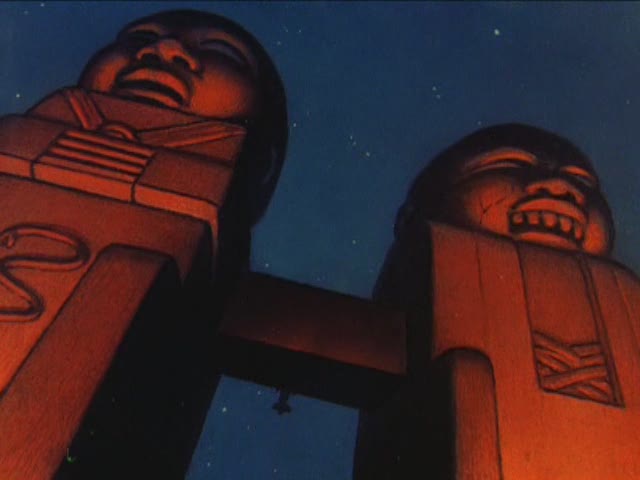 The Superman cartoon ‘Jungle Drums’ blends the war theme with the adventure setting of ‘The Mummy Strikes‘.
This time the setting is a vague African island, populated by scary natives who are under control of some mysterious Nazis. They shoot an American plane out of the sky, which contains Lois and some secrets concerning the American fleet. While the natives try to burn Lois, Clark Kent/Superman only arrives just in time to save her.
Superman beats the Nazis, while Lois warns the US Air Force against Nazi submarines threatening the fleet. The last shot is that of an angered Hitler listening to the radio how his plans were frustrated.
Although this short, like most Superman cartoons, contains a weak and badly built story, it stands out for its great shots of scary natives, with their original camera angles, stark color designs and large shadows. The end result is arguably Superman’s best film.
Watch ‘Jungle Drums’ yourself and tell me what you think:
This is Superman film No. 15
To the previous Superman film: The Mummy Strikes
To the next Superman film: Underground World
Director: Isadore Sparber
Release Date: February 19, 1943
Stars: Superman
Rating: ★★½
Review:
 With ‘The Mummy Strikes’ the Superman series entered the realm of the adventure movie, albeit with rather unsuccessful results.
One doctor Jordan is mysteriously killed in the museum and Clark Kent is invited to investigate the murder. Lois follows him secretly. After a very lengthy explanation, four gigantic mummies come to life, but Superman defeats them in an all too short battle. This finale is not in proportion to the boring explanation scene preceding it.
In all, ‘The Mummy Strikes’ is one of the weaker entries in the Superman series, because of this ill-constructed story. Luckily, Superman’s next adventure, ‘Jungle Drums‘, would be much better.
Watch ‘The Mummy Strikes’ yourself and tell me what you think:
This is Superman film No. 14
To the previous Superman film: Destruction, Inc.
To the next Superman film: Jungle Drums
Director: Isadore Sparber
Release Date: December 25, 1942
Stars: Superman
Rating: ★★★½
Review:
 ‘Destruction Inc’ was Superman’s third war cartoon, after ‘Japoteurs‘ and ‘Eleventh Hour‘ from earlier that year. Like ‘Japoteurs’ it features saboteurs on American soil, a paranoid idea, well-fed by government propaganda.
This time the danger comes from the inside: some American gangster saboteurs threaten a munition plant. Lois discovers them at a factory, but she’s captured and put inside a torpedo. Luckily Superman is in the neighborhood, not as Clark Kent, but as an elderly general. However, he only arrives just in time to rescue Lois from a certain death in a short that belongs to Superman’s more entertaining films.
‘Destruction, Inc’ opens with a shot of someone being murdered. Such a shot would open the next film, ‘The Mummy Strikes‘, too.
Watch ‘Destruction, Inc.’ yourself and tell me what you think:
This is Superman film No. 13
To the previous Superman film: Eleventh Hour
To the next Superman film: The Mummy Strikes
Director: Dan Gordon
Release Date: November 20, 1942
Stars: Superman
Rating: ★★★
Review:
 ‘Eleventh Hour’ is Superman’s second war cartoon, after ‘Japoteurs‘ from earlier that year. It’s one of the earliest World War II cartoons dealing with Japan.
In this short Superman himself is the saboteur, destroying ships, bridges, airports and tanks in Yokohama, Japan. The furious Japanese capture Lois, who stays with Clark Kent in Japan, and threaten Superman to execute her if he doesn’t stop his sabotage.
Superman reads this ultimatum all but too late and he’s only just in time to rescue Lois from the firing squad. Lois returns home, but Clark Kent stays behind, implying that Superman keeps on doing his sabotage work, a message that must have been comforting to the home-front.
The story of this cartoon is quite original, if not very well-constructed. Unfortunately, by now Superman has been reduced to an expressionless figure, making him a boring character to watch.
Watch ‘Eleventh Hour’ yourself and tell me what you think:
This is Superman film No. 12
To the previous Superman film: Showdown
To the next Superman film: Destruction, Inc.
Director: Isadore Sparber
Release Date: Oct 16, 1942
Stars: Superman
Rating: ★★★★½
Review:
 In an original twist to the Superman formula, a sneaky fake Superman steals jewelry for his gangster boss.
Meanwhile Lois and Clark have to report an opera performance. Luckily, the fake superman is there, too, pickpocketing the attendants. Superman captures his look-alike and his boss.
‘Showdown’ clearly has the most original story line of all superman cartoons, and this makes the short arguably the best entry of the series. At least the cartoon contains the funniest line in the series, when Lois makes Clark Kent the sarcastic remark “fine Superman you‘d make”.
Watch ‘Showdown’ yourself and tell me what you think:
This is Superman film No. 11
To the previous Superman film: Japoteurs
To the next Superman film: Eleventh Hour
Director: Dave Fleischer
Release Date: August 26, 1942
Stars: Superman
Rating: ★★★
Review:
 In ‘Terror on the Midway’ Lois is reviewing something as mundane as a circus, when a small monkey accidentally releases a titanic gruesome gorilla.
The gorilla follows her, while Superman’s busy putting other animals back into their cages. He rescues Lois and captures the gorilla, but it remains unclear how he stops the fire that has started, too.
‘Terror in the Midway’ is one of those fortunate Superman shorts without a villain (see also ‘The Arctic Giant’ and ‘Volcano‘ from the same year). However, it also shows Fleischer’s ambivalent realism: it contains some generic Fleischer thirties children designs, which by 1942 really look old-fashioned, but there are also some rare close-ups of Lois and Superman, which add to the drama. The staging, too, is superb, with some spectacular shots.
The gorilla looks like a typical King Kong-like monster, despite the fact that its model sheet was partly based on rotoscoped movements of real gorillas. Apparently, Bambi-like naturalism was wasted on the Fleischers animators.

gorilla modelsheet from ‘Terror on the midway’
Unfortunately, ‘Terror on the Midway’ would be the last Superman cartoon made by the Fleischer studios, before Paramount stole their crew to form their own Famous Studios. Indeed, it was the very last film the Fleischer brothers made together, ending an era that had begun 27 years earlier.
Watch ‘Terror on the Midway’ yourself and tell me what you think:
This is Superman film No. 9
To the previous Superman film: Volcano
To the next Superman film: Japoteurs
Director: Dave Fleischer
Release Date: July 17, 1942
Stars: Superman
Rating: ★★★
Review:
 In the aptly titled short ‘Volcano’, a dormant volcano is starting to erupt again on the island of Monokoa.
Daily Planet reporters Lois and Clarke are present, but Lois steals Clark’s press pass to work alone. She sneaks away to visit the volcano by herself, but when she’s up on the volcano, it suddenly erupts. Superman saves her and the village below by redirecting the lava to the other side.
Together with ‘The Arctic Giant’ and ‘Terror on the Midway‘, ‘Volcano’ is noteworthy for featuring no villain, let alone an evil scientist. Moreover, this Superman short probably contains the most spectacular effect animation within the series in its terrifying depiction of floating lava.
Watch ‘Volcano’ yourself and tell me what you think:
This is Superman film No. 8
To the previous Superman film: Electric Earthquake
To the next Superman film: Terror on the Midway
Director: Dave Fleischer
Release Date: June 15, 1942
Stars: Superman
Rating: ★★½
Review:
 In the seventh Superman short New York is threatened by – whattaya know? – an evil scientist. But this evil scientist is more original than all the others before him: he is of Native American origin and he claims Manhattan for his own people.
Nonetheless, like all other evil scientists before him, he has a machine. His ridiculous machine causes earthquakes by using electricity. Oddly enough, the scientist first makes his threats at the Daily Planet. And when he returns to his secret hideout, Lois, of course, follows him. In his laboratory below sea level the scientist makes Lois watch the destruction of the city.
Luckily, Superman saves Manhattan by destroying the machine. However, he’s only able to rescue Lois because the scientist tells him that she’s still down in his laboratory, which is rapidly filling with water…
In any case the result is yet another routine entry.
Watch ‘Electric Earthquake’ yourself and tell me what you think:
This is Superman film No. 7
To the previous Superman film: The Magnetic Telescope
To the next Superman film: Volcano
Director: Dave Fleischer
Release Date: April 24, 1942
Stars: Superman
Rating: ★★
Review:
 In ‘The Magnetic Telescope’, the sixth entry in the Superman series, yet another evil scientist attracts ‘flaming comets’ with a ridiculously looking magnetic telescope.
As one comet has destroyed part of the city, the police tries to stop the villain from hauling in another one. But their attempts make the professor lose control over the comet, and while destruction is at hand, Lois phones the Daily Planet from the laboratory. When her call ends in a scream, Clark Kent rushes… er… takes a cab to the laboratory. Only when the cab is stopped by one of the comet’s offshoots, he changes into Superman and flies up there…
Superman, of course, saves the day. He first tries to stop the comet itself (which falls remarkably slowly), but surprisingly, this is too much for him, and his antics produce more offshoots, which destroy bridges and such. So, in a bright moment he restores power to the magnetic telescope, telling Lois to put the machine on ‘reverse’… (how Superman came to know how the telescope works, we’ll never know…).
The whole story is amazingly ridiculous, especially because the story is told in the most sincere fashion. It shows the Fleischer studio’s discomfort with realism all too clearly.
The all too powerful comet is a minor surprise within the formulaic Superman series. But ‘The Magnetic Telescope’ has two other deviations from the story formula: in this entry Clark Kent doesn’t say his usual ” this looks like a job for Superman”,’ and Lois manages to kiss Superman, who, unfortunately turns out to be Clark Kent, after all…
Watch ‘The Magnetic Telescope’ yourself and tell me what you think:
This is Superman film No. 6
To the previous Superman film: The Bulleteers
To the next Superman film: Electric Earthquake
Director: Dave Fleischer
Release Date: March 26, 1942
Stars: Superman
Rating: ★★
Review:
 Although it’s only the fifth Superman cartoon, ‘The Bulleteers’ already feels so formulaic, it’s depressing.
Like in Superman’s first two cartoons some evil scientists with some crazy machine threaten the city, Lois gets into trouble, superman saves her and Clark Kent discusses her story in the newspaper with her. This time the novelty is that we’re watching three villains.
The evil trio has invented a ‘bullet car’ (part car, part plane, part rocket), with which they destroy the police headquarters and a power-plant by flying through it. Lois foolishly climbs aboard the car, but Superman drags her and the villains out of it in flight.
The spectacular angular staging and effective lighting in this cartoon cannot hide the fact that with ‘The Bulleteers’ the series had reached an inspirational low point story-wise. Later in 1942, the war became a major theme in the Superman series, which fortunately led to more inspired story ideas.
Watch ‘The Bulleteers’ yourself and tell me what you think:
This is Superman film No. 5
To the previous Superman film: The Arctic Giant
To the next Superman film: The Magnetic Telescope
Director: Dave Fleischer
Release Date: November 21, 1941
Stars: Superman
Rating: ★★★½
Review:
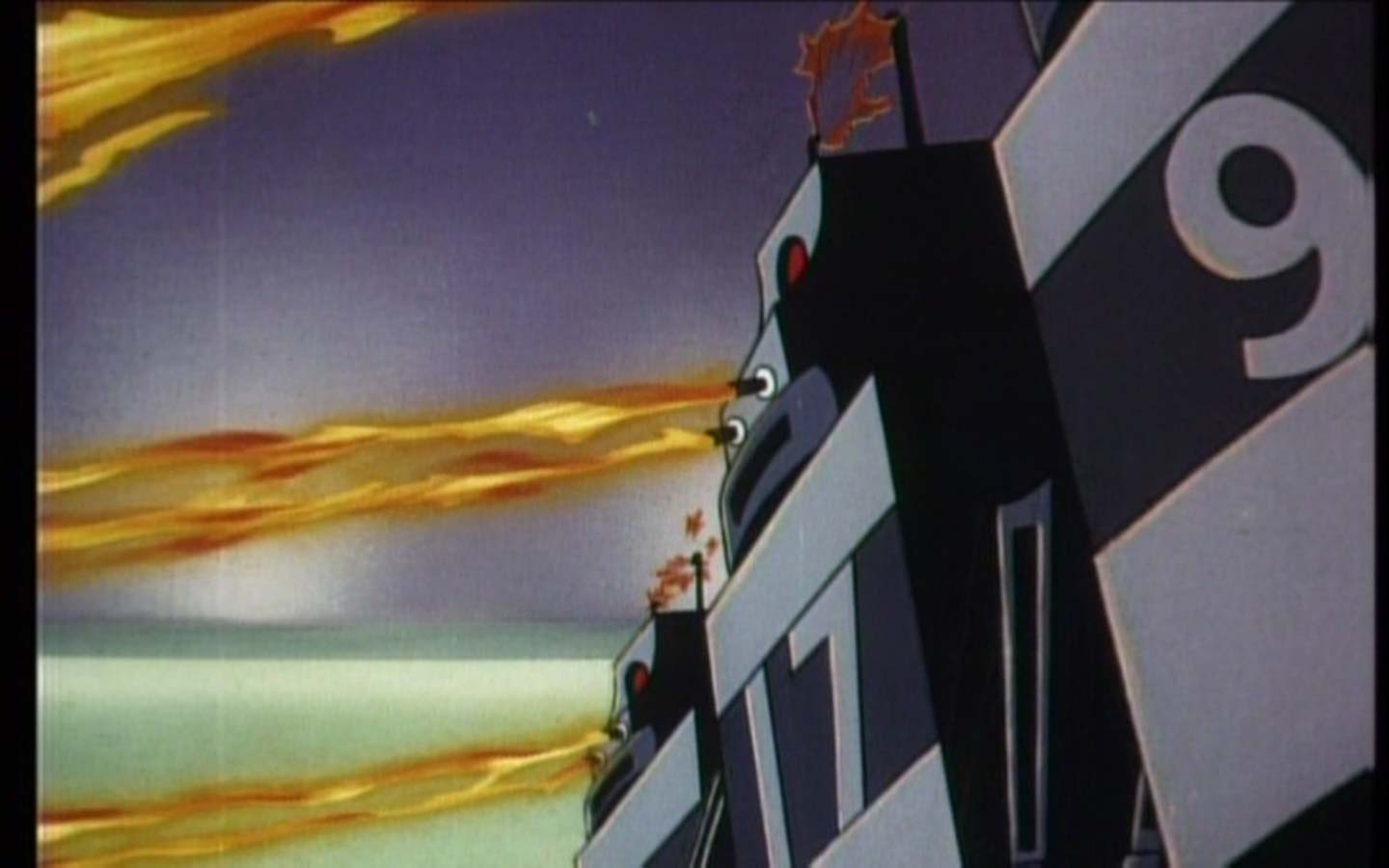 ‘The Mechanical Monsters’ was Superman’s second cartoon, and it is almost a copy of the first one.
Again, there’s an evil scientist, this time a jewel thief, who robs jewelry using huge flying robots. Again, Lois gets herself into trouble by her curiosity and, again, after Superman has saved the day, Lois and Clark discuss Lois’s article in the newspaper.
This copying of a formulaic story format is the main weakness of the Superman series, and it’s saddening to see it already happening in the second cartoon. Luckily, the execution of the formula is better than in the first cartoon. This evil scientist is drawn more realistically, and the sidekick has gone. The elaborate intro has been shortened into a few seconds, leaving more room for the story. Moreover, watching Superman knocking down giant robots is more enjoyable than watching him defeating a ray.
Watch ‘The Mechanical Monsters’ yourself and tell me what you think:
This is Superman film No. 2
To the previous Superman film: Superman
To the next Superman film: Billion Dollar Limited
Director: Dave Fleischer
Release Date: September 26, 1941
Stars: Superman
Rating: ★★★
Review:
 ‘Superman’ is the first Superman cartoon, the very first cartoon series to feature realistic characters, and the Fleischer Studio’s most ambitious cartoon series.
Superman, of course, was based on the comic strip hero who made his debut in 1938. For his screen debut, the studio made a long introduction of the character, which lasts almost two minutes.
After this intro a very simple story develops, which contains many elements to be reused in later Superman cartoons, becoming a routine all too soon:
1) an evil scientist
2) something big to beat (in this cartoon a deadly ray, which Superman ridiculously punches away)
3) Lois getting intro trouble due to her curiosity, and
4) an ending with Lois and Clarke reading a newspaper article written by Lois Lane.
Despite elaborate shadows and special effects, this first realistic theatrical cartoon (not counting the works by Winsor McCay) hasn’t aged very well. The scientist is still half cartoony, and he has an animal sidekick, which mimics his moves.
The rest of the characters are drawn realistically, but also stiff and expressionless. They look forward to the wooden realistic cartoons of the TV era. The character was very popular, however, and inspired a couple of parodies, most notably the Bugs Bunny cartoon ‘Super Rabbit’ (1943). It’s ironic that after Popeye the Fleischer again had to rely on a character created elsewhere to achieve success. Unfortunately, this meant they couldn’t exploit Superman’s popularity as much as they could have with a character of their own.
Superman would star in seventeen cartoons, all from 1941-1943, nine by the Fleischer Studios, and eight by its successor, Famous studios. In 1943 the series was dropped because it was too costly to produce.
Watch ‘Superman’ yourself and tell me what you think:
This is Superman film No. 1
To the next Superman film: The Mechanical Monsters
Director: Dave Fleischer
Release Date: December 26, 1930
Stars: Betty Boop, Bimbo
Rating: ★★★★★
Review:

Bimbo is the uncanny phantom-like Mysterious Mose, who visits a frightened Betty Boop at night.
The cartoon has a jazzy score, using the St. James Infirmary Blues. Like ‘Barnacle Bill‘, it is wildly surrealistic, with all kinds of animals appearing out of nowhere and disappearing into nothingness again, and during the title song there’s metamorphosis all over the place.
‘Mysterious Mose’ is the third cartoon featuring Betty Boop, and the first with her in the starring role. She’s still unnamed here, but her development as as sex object is pushed further, when her night shirt flies off twice, leaving her naked in bed. She’s also animated much better than in her earlier two films, ‘Dizzy Dishes‘ and ‘Barnacle Bill‘. Her looks and moves are more stable, more feminine, and thus, more sexy.
Watch ‘Mysterious Mose’ yourself and tell me what you think:
This is Talkartoon No. 14
To the previous Talkartoon: Up to Mars
To the next Talkartoon: The Ace of Spades
‘Mysterious Mose’ is available on the French DVD Box Set ‘Betty Boop Coffret Collector’
Director: Dave Fleischer
Release Date: August 31, 1930
Stars: Betty Boop
Rating: ★★★★★
Review:
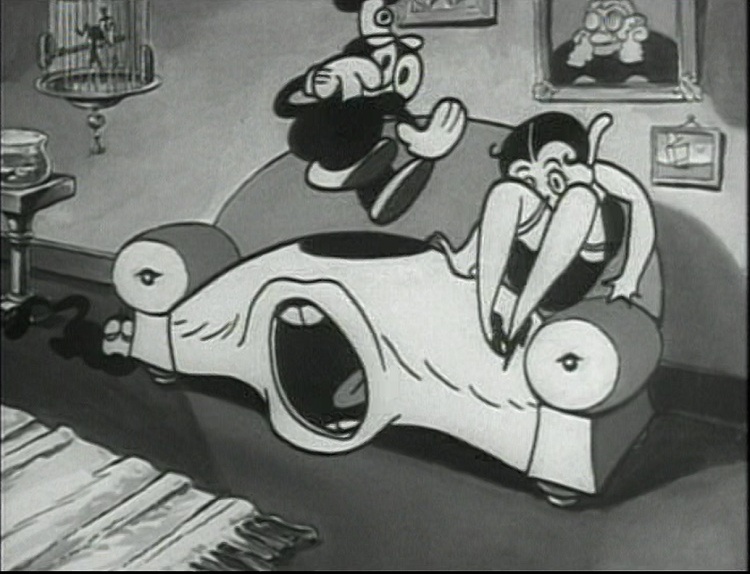
‘Barnacle Bill’ is a literal visual illustration of the folk song of the same name, made famous by Hoagy Carmichael’s 1930 recording.
Barnacle Bill (another version of early Bimbo) is visiting Betty Boop, who’s called Nancy Lee in this cartoon and who apparently is the Captain’s love. All neighbors gossip about it, and when the captain arrives, he chases Barnacle Bill into the sea, where the latter dances with some remarkably humanized mermaids.
‘Barnacle Bill’ is the second cartoon featuring Betty Boop, and it introduces the strong sexual overtones, associated with the character in her early years. One example is Betty’s dress that rolls itself up, exposing her legs. There’s also a couch that itself replaces several chairs when Betty invites Barnacle Bill inside.
‘Barnacle Bill’ uses musical dialogue almost exclusively. It contains some odd perspectives and flexible animation, but most important of all, it is wildly surrealistic, creating a completely original world of utter weirdness. For example, when Barnacle Bill threatens to bust in the door, the door shrinks and hides under the welcome mat. Later, we watch Barnacle Bill swim through the air, and dive into the couch. And when he leaves Nancy Lee’s apartment block, he sails one of the stairs. Touches like these make watching the cartoon a mind-blowing experience. I don’t think it’s considered a classic, but to me it should be.
Watch ‘Barnacle Bill’ yourself and tell me what you think:
This is Talkartoon No. 9
To the previous Talkartoon: Dizzy Dishes
To the next Talkartoon: Swing, You Sinners!
‘Barnacle Bill’ is available on the French DVD Box Set ‘Betty Boop Coffret Collector’
Director: Dave Fleischer
Release Date: August 9, 1930
Stars: Betty Boop (unnamed)
Rating: ★★★
Review:

‘Dizzy Dishes’ is a jazzy cartoon about a waiter in a restaurant who should bring a roast duck to an extremely hungry customer, but who does anything but serving. While the waiter is performing on stage together with the roast duck, the hungry customer eats almost everything in sight.
The cartoon is very typical of Fleischer’s early Talkartoons. The animation is rather crude, and outside the songs there’s no lip synch, but there’s a lot of metamorphosis going on. Apart from that, practically everything can grow hands and feet, creating an urban and surreal world, very different from the merry worlds of nature and farmlands of the rival Walt Disney studio.
‘Dizzy Dishes’ is not too interesting, but it marks the debut of Betty Boop. She’s introduced as an unnamed and rather fat and unappealing dog singer. The animation on her is erratic to say the least, but it already contains some specks of eroticism. She was designed as a caricature of singer Helen Kane, who was the first to sing ‘I Wanna Be Loved By You’, which contains the Boop-Boop-a-Doop-phrases with which Betty Boop became famous.
Betty Boop’s creation is attributed to animator Grim Natwick (1890-1990), a veteran animator, who, according to his fellow animators, was the only animator able to handle the feminine figure. Interestingly enough, Grim Natwick later worked for Walt Disney, animating Snow White, the first realistically animated heroine, in ‘Snow White and the Seven Dwarfs’ (1937).
Betty Boop was in fact the only successful cartoon star conceived by the Fleischer studio after Koko the Clown. Later they had considerable success with Popeye and Superman, but these characters were owned by King Features and DC Comics, respectively.
Betty Boop would become more and more erotic, and she would soon rise to stardom, changing from dog to human in 1931, and getting her own series in 1932, which lasted until 1939. But by then the Fleischer’s years of surrealism and eroticism were long gone.
Watch ‘Dizzy Dishes’ yourself and tell me what you think:
This is Talkartoon No. 8
To the previous Talkartoon: Wise Flies
To the next Talkartoon: Barnacle Bill
‘Dizzy Dishes’ is available on the French DVD Box Set ‘Betty Boop Coffret Collector’
Director: Dave Fleischer
Release Date: May 14, 1937
Stars: Betty Boop, Pudgy
Rating: ★★★★★
Review:
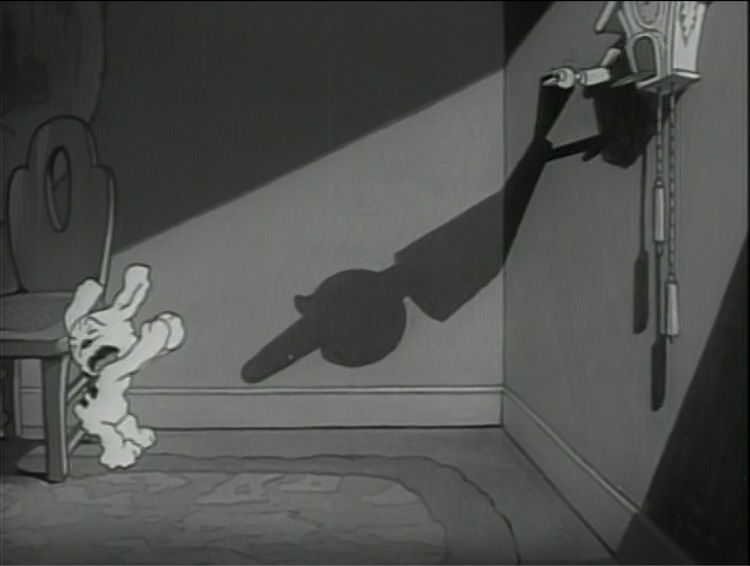 Betty has bought a fox. Pudgy, jealous of the lifeless animal, starts a fight, but after knocking his enemy down, he thinks he has killed it.
What follows is a great depiction of his feeble attempts to revive his foe, and then his genuine horror when he realizes he has killed the animal. His feeling of guilt turns his surroundings into a nightmare.
‘Pudgy picks a Fight’ is undoubtedly the most inspired of all Pudgy cartoons, the nightmare sequence being particularly imaginative. Its theme of guilt and imagination running away with it would be revisited by Disney in ‘Donald’s Crime’ (1945) with equally impressive results.
Watch ‘Pudgy Picks A Fight’ yourself and tell me what you think:
This is Betty Boop cartoon No. 63
To the previous Betty Boop cartoon: Pudgy Takes a Bow-Wow
To the next Betty Boop cartoon: The Impractical Joker
‘Pudgy Picks A Fight’ is available on the French DVD Box Set ‘Betty Boop Coffret Collector’
Director: Dave Fleischer
Release Date: April 24, 1936
Stars: Betty Boop, Pudgy
Rating: ★★½
Review:
 When Betty is gone three kittens cause havoc in Betty’s house. Pudgy gets the blame until the kittens plead guilty.
The three kittens are doubtless inspired by the Walt Disney’s Academy Award-winning cartoon ‘Three Orphan Kittens‘ from 1935, from which it borrows a milk bottle gag. ‘We Did It’ is not half as elaborate as the Disney cartoon. Nevertheless, it shows the Fleischer’s growth in character animation through pantomime. Pudgy, like Pluto, is by design fit for character animation.
Unfortunately, the Fleischer Studio was very inconsistent and this cartoon was followed by many in which character animation is practically absent. And even in ‘We Did It’ the result of this technique is only mildly amusing and hardly impressing.
Watch ‘We Did It’ yourself and tell me what you think:
This is Betty Boop cartoon No. 50
To the previous Betty Boop cartoon: Betty Boop and Little Jimmy
To the next Betty Boop cartoon: A Song a Day
‘We Did It’ is available on the French DVD Box Set ‘Betty Boop Coffret Collector’
Director: Dave Fleischer
Release Date: September 21, 1934
Stars: Betty Boop, Pudgy
Rating: ★★½
Review:
 Betty and her little dog Pudgy are picnicking.
However, Pudgy wrecks the picnic, so Betty sends him home. Unfortunately he’s immediately caught by a dog catcher. Luckily, Pudgy manages to escape together with some other dogs.
‘Betty Boop’s Little Pal’ marks the debut of Betty’s little pup Pudgy, even though he remains unnamed in this cartoon. Though more cute than funny, Pudgy was to be Betty Boop’s most entertaining and long-lasting co-star of the Hays Code era. He was a real character, and, like Pluto, he behaved like a real dog, although he’s as anatomically incorrect as Pluto is. Compared to Pluto, Pudgy is younger, cuter and naughtier. He is as much a child character as a dog character, while Pluto is more mature. Pudgy starred in 23 cartoons, only retiring in 1939. Unfortunately, none of his cartoons can be considered classics, save one: ‘Pudgy Picks a Fight‘ from 1937.
‘Betty Boop’s Little Pal’ is very typical of a trend in the Fleischer films that caught on during 1934 (after the Hays Code was in practice): the story line is very clear, which is a great improvement upon most earlier cartoons, but at the same time all nonsense, weirdness, surrealism, sex and jazz have vanished, too (there’s only one surreal gag, of a car scratching itself). Therefore, this and the other Betty Boop cartoons from 1934 and later are remarkably boring compared with the earlier entries.
Watch ‘Betty Boop’s Little Pal’ yourself and tell me what you think:
This is Betty Boop cartoon No. 32
To the previous Betty Boop cartoon: There’s Something About a Soldier
To the next Betty Boop cartoon: Betty Boop’s Prize Show
‘Betty Boop’s Little Pal’ is available on the French DVD Box Set ‘Betty Boop Coffret Collector’
Director: Dave Fleischer
Release Date: March 2, 1934
Stars: Betty Boop, Koko the Clown
Rating: ★★★★½
Review:

‘Ha! Ha! Ha! was the last cartoon to feature Koko the Clown.
It opens with supposedly Max Fleischer’s hand drawing Betty Boop on a sheet of paper. When Max leaves the studio, Koko comes out of the inkwell for the very last time, and starts eating the candy bar Max had left on the table.
Almost immediately he develops a tootache, so Betty draws a dentist room to operate him, herself acting as the (most sexy) dentist. She first tries to pull Koko’s tooth, but when that doesn’t work, she tries laughing gas.
The laughing gas soon pervades everything, causing not only Koko and herself to laugh, but even the clock, the typewriter, and outside – in the real world – the mailbox, the cars and real people. Even a bridge and some graves join in.
This enjoyable and weird cartoon mixes animation, photographed backgrounds and live action to great results, and it forms a great finale to Koko’s long career, which had lasted fifteen years. Although Koko never had any great roles near Betty, he would be missed, for without Koko and Bimbo (who had his last screen appearance in ‘I Heard‘ from September 1933), Betty became a surprisingly inoffensive and boring character, and none of her remaining 62 films evoked the same fun as ‘Ha! Ha! Ha!’.
Watch ‘Ha! Ha! Ha!’ yourself and tell me what you think:
This is Betty Boop cartoon No. 26
To the previous Betty Boop cartoon: Red Hot Mamma
To the next Betty Boop cartoon: Betty in Blunderland
‘Ha! Ha! Ha!’ is available on the French DVD Box Set ‘Betty Boop Coffret Collector’
Director: Dave Fleischer
Release Date: October 6, 1933
Stars: Betty Boop
Rating: ★★½
Review:
 Rubinoff and his orchestra play the score for this cartoon about a bunch of cats (‘the tom kat social club’) who threaten Betty Boop’s yard full of birds. This orchestra, led by the Russian violinist David Rubinoff, played sweet pseudo-classical music, and this sets the tone for the short.
Based on Franz von Suppé’s overture ‘Ein Morgen, ein Mittag und ein Abend in Wien’ (1844), ‘Morning Noon and Night’ is a very sweet cartoon. It opens with some typical Fleischer gags, like a sun with a hangover, but the overall mood is rather corny and lacking humor. The short is very Silly Symphony-like, and particularly reminiscent of Walt Disney’s ‘Birds in Spring‘ from earlier that year. Both feature a fledgling running away, and encountering a threat.
The cartoon’s finale is a battle scene in which all birds come to the rescue, most notably a boxing rooster. Battle scenes like this could be seen in e.g. the 1932 Silly Symphonies ‘Bugs in Love‘, ‘King Neptune‘, and ‘Babes in the Woods‘. Although ‘Morning, Noon and Night’ doesn’t come near any of these Disney cartoons in quality, it shows that the Disney style was invading the Fleischer studio, and that the brothers were getting more ambitious. This ambition would lead to the launch of the Color Classics in 1934.
Betty is more cute than sexy in this cartoon. The difference in mood between this cartoon and that of ‘I Heard‘ is enormous, although that cartoon was released only one month earlier. The reinforced Hays code would only be installed in the summer of 1934, but ‘Morning, Noon and Night’ shows that already by 1933 its morals had become more and more present in the American film industry’s output.
Watch ‘Morning Noon and Night’ yourself and tell me what you think:
This is Betty Boop cartoon No. 21
To the previous Betty Boop cartoon: I Heard
To the next Betty Boop cartoon: Betty Boop’s Hallowe’en Party
‘Morning Noon and Night’ is available on the French DVD Box Set ‘Betty Boop Coffret Collector’


 Dr. Grob's Animation Review