
You are currently browsing the category archive for the ‘★★½’ category.
Director: Paul J. Smith
Release Date: November 3, 1958
Stars: Woody Woodpecker, Dooley
Rating: ★★½
Review:
 ‘Jittery Jester’ takes place in a medieval castle where Dooley is court jester to a bored king.
Then the King hears Woody Woodpecker singing his own variation on ‘The Woodchuck Song’ from 1904. The king finds our hero infinitely more funny than Dooley, and he orders Dooley to catch the bird. During the obligate chase scene the king is too often the unwilling victim of Dooley’s attempts to catch Woody. In the end Woody is the new jester, using Dooley in his pranks.
Like many other Woody Woodpecker cartoons from 1958 ‘Jittery Jester’ is a rather run-of-the-mill chase cartoon, which features some anachronisms like a speedboat and dynamite. The draw bridge scene is the most inspired, even if it’s as predictable as the other gags in the cartoon.
This is Woody Woodpecker cartoon No. 88
To the previous Woody Woodpecker cartoon: Tree’s a Crowd
To the next Woody Woodpecker cartoon: Tom Cat Combat
‘Jittery Jester’ is available on the DVD-set ‘The Woody Woodpecker and Friends Classic Cartoon Collection Volume 2’
Director: Paul J. Smith
Release Date: September 8, 1958
Stars: Woody Woodpecker
Rating: ★★½
Review:
 Woody rides a bus through Colonel Fleabush’s 60,000 acre estate full of trees.
Woodpeckers are not welcome there, and when the colonel discovers Woody, he orders his big yellow cat Filbur to catch the bird. What follows is a typical chase cartoon in which all the trees are destroyed.
Filbur is distinguished by a typical laugh (provided by Daws Butler), and sounds a little like Muttley from the later Hanna-Barbera television series ‘Wacky Races’ (1968-1969). The chase sequence is very formulaic and has little to offer, especially as Smith’s timing is a little too relaxed to make the gags work. The short also features three puns on trees, while the Latin tree names the colonel utters are all nonsensical.
Watch ‘Tree’s a Crowd’ yourself and tell me what you think:
This is Woody Woodpecker cartoon No. 87
To the previous Woody Woodpecker cartoon: Everglade Raid
To the next Woody Woodpecker cartoon: Jittery Jester
‘Tree’s a Crowd’ is available on the DVD-set ‘The Woody Woodpecker and Friends Classic Cartoon Collection Volume 2’
Director: Paul J. Smith
Release Date: August 11, 1958
Stars: Woody Woodpecker, Gabby Gator
Rating: ★★½
Review:
 ‘Everglade Raid’ opens with Woody Woodpecker reading a newspaper add telling tourists to come to the Everglades to make a fortune on alligator bags.
So Woody goes to Florida, where he encounters a hungry alligator, voiced by Daws Butler as a variation on the Southern wolf from the Droopy cartoon ‘The Three Little Pups‘ (1953). What follows is a chase cartoon with blackout gags, in which the alligator tries to catch Woody, and vice versa. In the end the alligator succeeds, yet it is Woody who has the last laugh.
‘Everglade Raid’ suffers from slow timing and a surplus of dialogue, but some of the animation is very fine, especially the alligator’s walk cycle. Later, the alligator was christened Gabby Gator, and he would return in ‘Southern Fried Hospitality’ (1960). The character lasted until 1963.
Watch ‘Everglade Raid’ yourself and tell me what you think:
https://www.topcartoons.tv/everglade-raid/
This is Woody Woodpecker cartoon No. 86
To Woody Woodpecker’s debut film: His Better Elf
To the next Woody Woodpecker cartoon: Tree’s a Crowd
‘Everglade Raid’ is available on the DVD-set ‘The Woody Woodpecker and Friends Classic Cartoon Collection Volume 2’
Director: Lew Keller
Release Date: October, 1958
Stars: Ham and Hattie
Rating: ★★½
Review:

‘Spring and Saganaki’ is the third cartoon within the short ‘Ham and Hattie’ series.
‘Spring’ is another gentle children’s song by Mel Leven, sung by him accompanied by his ukelele. This part is notable for its very beautiful background art. For the second song Ham changes into Japanese farmer Saganaki, who wants to join an army of Samurai. This part is in fact a story told in rhyme. Unfortunately, the episode is hampered by singer Hal Peary’s mock-Japanese and the more trite song by Mel Leven and Jim Murakami, which is reminiscent of similar pseudo-ethnic swing songs from the 1930s. The result is the weakest of the four Ham and Hattie cartoons. Yet, as the designs are still top notch, ‘Spring and Nagasaki’ remains a delight to watch, if not to listen to.
Watch ‘Spring and Saganaki’ yourself and tell me what you think:
‘Spring and Saganaki’ is available on the DVD box set ‘UPA – The Jolly Frolics Collection’
Directors: Walerian Borowczyk & Jan Lenica
Release Date: 1958
Rating: ★★½
Review:
 ‘Dom’ is an avant-garde film with strong surrealistic images. The film consists of six unrelated ‘scenes’ connected by the image of a woman looking into the camera.
It’s as if Borowczyk and Lenica explored the possibilities of experimental cinema, trying out several techniques in a row. Thus we watch cut-out images of a strange contraption, a pixillated scene of two men fighting, an octopus-like wig destroying a still life setting, a man repeatedly hanging his hat on a coat rack, a sequence of old family pictures and postcards, and a live action scene in which a woman caresses a plaster male head.The film’s weird atmosphere is greatly enhanced by Włodzimierz Kotoński’s modern music, which uses electronics and percussion only.
It’s hard to make sense of it all, but it’s clear that with this film Borowczyk and Lenica proved to be strong new voices in avant-garde cinema.
Watch ‘Dom’ yourself and tell me what you think:
‘Dom’ is available on the DVD-set ‘Anthology of Polish Animated Film’
Directors: William Hanna & Joseph Barbera
Release Date: August 1, 1958
Stars: Tom & Jerry
Rating: ★★½
Review:
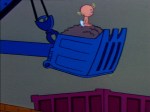
‘Tot Watchers’ was the very last Tom & Jerry cartoon directed by William Hanna and Joseph Barbera.
The short was released in August 1958, but it had already been made in 1956, before MGM closed its animation studio in April 1957. Surprisingly this short was penned by Homer Brightman, instead of Hanna & Barbera themselves.
The cartoon stars a teen-age babysitter who, instead of watching the baby, is hanging on the telephone all the time. It’s up to Tom & Jerry to rescue the baby time and time again, especially when the baby wanders off to a building site. The building site sequence harks back to similar cartoons taking place there, like the Popeye cartoon ‘A Dream Walking’ (1934), the Mickey Mouse cartoon ‘Clock Cleaners’ (1937) and the Bugs Bunny cartoon ‘Homeless Hare‘ (1950).
The baby looks like a Chuck Jones character. Like Jones’ Minah Bird the infant is almost a force of nature, devoid of personality, but with a drive of its own. Unfortunately there’s no conflict between Tom & Jerry themselves in this cartoon (apart from the very beginning), thus ‘Tot Watchers’ lacks the duo’s traditional comedy. Moreover, the short is hampered by the babysitter’s extensive dialogue. In all, this makes ‘Tot Watchers’ a rather disappointing ending to the series.
The short marks Spike’s last screen appearance, who has a very short scene in this cartoon, and only as a cliche bulldog. Tom and Jerry, however, would return to the silver screen, in 1961, with an ill-conceived new series, produced by Gene Deitch’s animation studio in Czechoslovakia. Meanwhile Hanna and Barbera would start a television adventure, founding their now legendary Hanna-Barbera production company in July 1957, and producing television series starring such beloved characters as Huckleberry Hound, Yogi Bear, and the Flintstones, to name just a few.
Watch ‘Tot Watchers’ yourself and tell me what you think:
This is Tom & Jerry cartoon No. 113
To the previous Tom & Jerry cartoon: Robin Hoodwinked
To the next Tom & Jerry cartoon: Switchin’ Kitten
‘Tot Watchers’ is available on the European DVD Box set ‘Tom and Jerry Collection’
Directors: William Hanna & Joseph Barbera
Release Date: May 2, 1958
Stars: Tom & Jerry, Little Quacker
Rating: ★★★
Review:
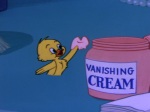 ‘The Vanishing Duck’ marks Little Quacker’s eight and last cartoon appearance.
He enters Tom & Jerry’s house as a gift from George to his wife Joan. This couple apparently are Tom’s owners. As soon as the two are off for an anniversary dinner, Tom enters the house, and within seconds eats Little Quacker, who reenters life by opening Tom’s left eye like a roller blind.
Little Quacker seeks refuge at Jerry’s, but soon discovers ‘vanishing cream’, rendering the two critters invisible, and driving Tom mad. But, for once, Tom gets wise, and applies the vanishing cream to himself, and in the end, it’s Tom who can bully mouse and duck unseen.
‘The Vanishing Duck’ borrows heavily from ‘The Invisible Mouse‘ (1947), in which Jerry becomes invisible. Like other invisibility cartoons the humor suffers because the invisible characters become invincible, and the sympathy shifts to the hapless victim, in this case Tom. In that respect it’s only fitting Tom gets his revenge in the end. Apart from the eye gag the cartoon isn’t very inspired. For example, there’s a nice gag in which Jerry and Little Quacker make Tom think his tail has gone off, but this gag is hardly developed, and dropped all too soon.
Watch ‘The Vanishing Duck’ yourself and tell me what you think:
https://www.dailymotion.com/video/x2o68aw
This is Tom & Jerry cartoon No. 112
To the previous Tom & Jerry cartoon: Royal Cat Nap
To the next Tom & Jerry cartoon: Robin Hoodwinked
‘The Vanishing Duck’ is available on the European DVD Box set ‘Tom and Jerry Collection’
Director: Paul J. Smith
Release Date: March 24, 1958
Stars: Windy & Breezy
Rating: ★★½
Review:
 ‘Salmon Yeggs’ marks the first solo cartoon of Windy and Breezy, the two bears from the Woody Woodpecker cartoon ‘Fodder and Son‘ from 1957.
The short starts as a spot gag travelogue telling about salmon, throwing some puns in the mix. Then we cut to Windy and Breezy. The father bear (who’s Breezy and who’s Windy is quite unclear) doesn’t want to catch salmon the traditional way, and heads for a salmon canning factory, which is unfortunately guarded by a little, very Droopy-like mustached watchman, who fights the father bear with a deadpan expression.
‘Salmon Yeggs’ is one of the most Tex Averyan cartoons to come out of the Walter Lantz studio. The comedy between bear and watchman is very similar to that of Wolf and Droopy in ‘The Three Little Pups‘ or between polar bear and Chilly Willy in ‘The Legend of Rockabye Point‘ (1955). Like in ‘Fodder and Son’ the son does little more than addressing the audience with ‘that’s my pop’, with all the comedy going to the watchman and his father.
In 1961 the watchman would return as ‘Ranger Willoughby’ in ‘Hunger Strife’ (1960) and as ‘Inspector Willoughby in ‘Rough and Tumbleweed‘, starring several cartoons until 1965.
‘Salmon Yeggs’ is available on the DVD-set ‘The Woody Woodpecker and Friends Classic Cartoon Collection Volume 2’
Director: Isadore Sparber
Release Date: March 14, 1958
Stars: Herman and Katnip
Rating: ★★½
Review:
 ‘Frighty Cat’ revisits the premise of ‘From Mad to Worse‘ (1957) and mixes it with the idea of the Tom & Jerry cartoon ‘Fraidy Cat‘ (1942).
Nobody knows why (it’s completely irrelevant to the story), but the setting is the Illside sanatorium, where Herman and his cousins play pool. Then Katnip arrives and manages to trap the four mice in a mouse hole. He decides to ‘wait them out’, while reading a ghost story aloud. This, of course, prompts Herman and his kin to play tricks on the cat, making him believe the house is haunted. In the end Katnip flees into the distance, haunted by his own ghostly image in a mirror.
Even though ‘Frighty Cat’ is one of the more entertaining of the latter day Herman and Katnip cartoons, it’s difficult to praise the cartoon, as it completely fails to live up to its peers (apart from ‘Fraidy Cat’ ‘Mouse Wreckers‘ from 1949). The animation is often subpar, and Herman looks quite misshapen at times. At least some of the background art is nice.
Watch ‘Frighty Cat’ yourself and tell me what you think:
‘Frighty Cat’ is available on the DVD ‘Herman and Katnip – The Complete Series’
Director: Faith Hubley
Release Date: 1991
Rating: ★★½
Review:
 According to the titles this film is inspired by ‘upside down poetry’ by 15th century Indian poet Kabir.
The film shows several ‘upside down’ situations, all introduced by a voice over, like ‘a sheep eats a wolf’, ‘a corpse eats death’, and ‘a fish jumps out of the ocean’. Most interesting is ‘an elephant is tied to an ant’s leg’, which features remarkably classic animation on the elephant, a standout between the circular and flat animation that dominates Hubley’s films.
As always, ‘Upside down’ features Hubley’s gorgeous Miró-like ritualistic designs, but the film is hampered by the trite voice over titles, and Don Christensen’s rather disjointed score. Moreover, the stream-of-consciousness-like scenes are little more than illustrations of the poet’s ideas, and there’s no story whatsoever.
‘Upside Down’ is available on the DVD ‘The Hubley Collection Volume 1’
Director: Émile Cohl
Release Date: 1911
Rating: ★★½
Review:
 ‘Les exploits de Feu Follet’ is the first of only two surviving films Émile Cohl made for French film company Eclipse, the other being ‘Les métamorphoses comiques’.
With this film Cohl returned to the looks of his first films ‘Fantasmagorie‘ (1908) and ‘Le cauchemar de Fantoche‘ (1908): the film is shot in white on black and features a stickman. This stickman flies with a balloon to the moon and falls down into the ocean, where he is swallowed by a whale. Curiously, the whale, moon, and an eagle are drawn much more classically than the stickman, making ‘Les exploits de Feu Follet’ less consistent in its looks than either ‘Fantasmagorie’ or ‘Le cauchemar de Fantoche’.
Cohl’s timing is very sloppy in this film, and unfortunately there’s is little metamorphosis, with Cohl relying much on cut-out shortcuts. There’s practically no story, only a string of events. So, this film is not among Cohl’s best.
Watch ‘Les exploits de Feu Follet’ yourself and tell me what you think:
‘Les exploits de Feu Follet’ is available on the DVDs ‘Émile Cohl – L’agitateur aux mille images’
Director: Émile Cohl
Release Date: 1910
Rating: ★★½
Review:
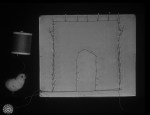 In this film several objects make paintings on an empty canvas, which all turn into photos and films.
Cohl suggests the act of painting by several means, for example by taking away layers op paper snippers or taking away sand to reveal a picture beneath. There’s no story, and in a way this pure animation film is still in the tradition of the trick film, in which the viewer is more concerned with how the trick is done than the actual images themselves. Thus, the film is most interesting because of the nice footage of Paris anno 1910.
Watch ‘Les beaux-arts mystérieux’ yourself and tell me what you think:
‘Les beaux-arts mystérieux’ is available on the DVDs ‘Émile Cohl – L’agitateur aux mille images’
Director: Émile Cohl
Release Date: May 21, 1910
Rating: ★★★
Review:
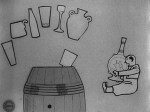 In this film the waiter of a cafe falls asleep during work, and dreams of glasses, bottles, wine, beer and absint all haunting him.
As may be expected in an Émile Cohl film the dream sequence is done in animation, in a quite remarkable blend of cut-out and pen animation. Cohl uses his trademark metamorphosis technique and imagination to make all kinds of associations with alcohol, in a rather directionless sequence. But as this is supposed to be a dream, this stream-of-consciousness-like approach works pretty well.
In the end, the waiter is awoken by four card-playing guests, who spray spray water on the hapless victim.
Watch ‘Le songe du garçon de café’ yourself and tell me what you think:
‘Le songe du garçon de café’ is available on the DVDs ‘Émile Cohl – L’agitateur aux mille images’
Director: Émile Cohl
Release Date: 1909
Rating: ★★½
Review:
 ‘Affaires de coeur’ is a film about love using hearts as a common thread.
Even the frame in which all action takes place is heart-shaped. In this film Cohl uses every animation technique known at the time to tell a rather abstract story of love. We watch hearts filling cards, cards playing badminton, and a male heart courting and eventually marrying a female heart, and even dueling a rival heart with a mustache.
Despite the clear theme, the film is one of Cohl’s less successful efforts. There’s an aimlessness in this film, which only halfway forms some sort of story. Moreover, none of the animation is particularly noteworthy, even though the hearts in love have some charm.
Watch ‘Affaires de coeur’ yourself and tell me what you think:
‘Affaires de coeur’ is available on the DVDs ‘Émile Cohl – L’agitateur aux mille images’
Director: Émile Cohl
Release Date: 1909
Rating: ★★½
Review:
 ‘Les chapeaux des belles dames’ is one of Émile Cohl’s tableau films.
Whereas Cohl’s other tableau films from 1909, like ‘L’éventail animé‘ and ‘Les couronnes‘ consisted of elaborate tableaux vivants, ‘Les chapeaux des belles dames’ is much simpler. The film only shows several ladies wearing hats from different ages. Within a vignette we watch the bustes of the ladies circling around, showing the hats from all sides. Thus we watch hats from 1400 to 1825, with emphasis on the 15th and 18th century (strangely enough the 17th century is skipped altogether).
The whole film may be insightful, the short is remarkably static, and only entertaining because of the sometimes extraordinary hats. It doesn’t help that the surviving copy is badly damaged, rendering some of the images more or less invisible.
Watch ‘Les chapeaux des belles dames’ yourself and tell me what you think:
‘Les chapeaux des belles dames’ is available on the DVDs ‘Émile Cohl – L’agitateur aux mille images’
Director: Émile Cohl
Release Date: 1907-1909
Rating: ★★½
Review:
 Somewhere before or after his groundbreaking ‘Fantasmagorie’ Cohl explored the older animation technique of stop motion. ‘Japon de faintasie’ is an ultrashort venture into this technique, and the only reason of its existence seems to be the exploration of its possibilities.
Despite its short length of a mere one minute, the film consists of three clear sections: two Japanese figurines moving, a bee moving, and a face changing into a mask that sprouts mice. The film feels like a study, and is not as sophisticated as Cohl’s stop motion films from 1908, like ‘Le cerceau magique‘ or ‘Les frères Boutdebois‘, which points to an early production date.
Watch ‘Japon de fantaisie’ yourself and tell me what you think:
‘Japon de fantaisie’ is available on the DVDs ‘Émile Cohl – L’agitateur aux mille images’
Director: J. Stuart Blackton
Release Date: July 15, 1907
Rating: ★★½
Review:
 ‘Lightning Sketches’ is the third surviving film by J. Stuart Blackton in which he used drawn animation.
Unfortunately the film has less in common with his ground-breaking film ‘Humorous Phases of Funny Faces‘ (1906), and much more with his first trick film ‘The Enchanted Drawing’ from 1900: Once again Blackton himself appears on screen, and not only his hand. As in the earliest film, he now draws with a brush on paper, replacing the chalk and chalkboard.
Compared to ‘Humorous Phases of Funny Faces’ ‘Lightning Sketches’ is by all means the lesser product: there is less animation or movement (the best is of a bottle of champagne and a bottle of soda water filling a glass). Worse, Blackton’s first gag involves a stereotype ‘coon’ and Jew, but no animation at all.
In no sense ‘Lightning Sketches’ did propel the medium of animation forward, and it was up to others pioneers, like Émile Cohl, Winsor McCay and J.R. Bray to advance upon the new technique.
Watch ‘Lightning Sketches’ yourself and tell me what you think:
‘Lightning Sketches’ is available on the DVD/Blu-Ray ‘Cartoon Roots’
Directors: The Blackheart Gang
Release Date: March 2006
Rating: ★★½
Review:
 ‘The Tale of How’ is a tale about birds trapped on an island by a large sea monster, but rescued by a mouse.
In this short the Blackheart Gang has used a mix of 2D and 3D computer techniques to make a film that is baroque in its complexity of images and intricate designs. The combination of weird surrealism and quasi-medieval ornamentation give the film its unique atmosphere. Unfortunately, the film’s story is less compelling than the images: the tale is sung in an all too uninteresting quasi-operatic style and very hard to follow, indeed.
Watch ‘The Tale of How’ yourself and tell me what you think:
‘The Tale of How’ is available on the French DVD box set ‘Annecy – Le coffret du 50e anniversaire’
Director: Chuck Jones
Release Date: May 9, 1942
Rating: ★★½
Review:
 In 1942 Chuck Jones found his own voice as a director. Gone were the Disneyesque characters and settings. Instead, Jones put forward his own recognizable character designs, a very original animation approach based on strong poses, and an unprecedented emphasis on facial expressions.
Gone, too, were the cute, childish subjects, now replaced by wild, mature and gag rich stories. Suddenly Jones became one of the most recognizable directors in the field, equaled only by Bob Clampett. The most obvious example of this change is ‘The Dover Boys‘ from September 1942, but the new style is already very present in the Conrad Cat cartoons from January/February (‘The Bird Came C.O.D.’, ‘Conrad the Sailor‘ and ‘Porky’s Cafe’ ).
‘The Draft Horse’, from May, is also a nice example of Jones’s new self-assurance. The short features a plow horse who, after reading a billboard saying ‘Horses wanted for US Army’ plows all the way to the next army training camp to get himself enlisted. His race is depicted marvelously: we don’t see the horse himself, but we watch several images of the countryside wrecked by his plow, accompanied by a frantic rendering of Gioacchino Rossini’s William Tell overture.
Besides an example of Jones’s new style, ‘The Draft Horse’ was also the first Warner Bros. cartoon penned by Tedd Pierce, after his return from his move to the Max Fleischer studios. Highlight of the cartoon is the horse acting out a complete war scene for the eyes of a bewildered colonel. This scene, animated by Ken Harris, can match the much praised scene from ‘Brave Little Tailor’ (1938, animated by Frank Thomas), in which Mickey Mouse tells his story of how he beat seven [flies] in one blow. In this scene the horse looks like a forerunner of Charlie Dog, who does an equally hilarious performance in ‘Often an Orphan‘ (1949).
Unfortunately, the rest of the cartoon doesn’t live up to the high standards set here. Tedd Pierce’s story is too loosely jointed to engage the viewer, falling back on spot gags. Soon the horse ends in a war exercise, and he flees home with equal speed. In the end we watch him knitting V-sweaters as part of the ‘Bundles for Blue Jackets’ program, in which local ladies knitted sweaters for navy men.
‘The Draft Horse’ mocks the over-zealous response after the United States had entered World War II. At the same time, it shows that every citizen can do his part, even when he is not in the army itself. The horse is designed interestingly, remaining halfway anthropomorphization. For example, he retains his hoofs, and remains on all fours half of the time.
Watch ‘The Draft Horse’ yourself and tell me what you think:
https://www.dailymotion.com/video/x5pce36
‘The Draft Horse’ is available on the DVD-set ‘Looney Tunes Golden Collection Volume Six’
Director: Bob Clampett
Release Date: July 5, 1941
Stars: Porky Pig
Rating: ★★½
Review:
 On September 26 1940 the Selective Training and Service Act came into effect. This was the first peace time conscription in the history of the United States.
By 1941 the draft was in full effect, as is reflected by cartoons like ‘Hysterical Highspots in American History‘, ‘Meet John Doughboy’, ‘Rookie Revue’ and ‘The Boogie Woogie Bugle Boy of Company B‘. Of the real draftee cartoons ‘Meet John Doughboy’ is probably the first. The short stars Porky Pig, who can boast to be the first major cartoon star to join the army. In November Porky was followed by Barney Bear (‘The Rookie Bear’) and Popeye (‘The Mighty Navy‘), while other stars only joined the war effort after the attack on Pearl Harbor, December 7, 1941.
Unfortunately, ‘Meet John Doughboy’ is not about Porky’s tribulations as a draftee. Instead Porky introduces a movie newsreel “chock full of military secrets, so if there are any Fifth Columnists in the audience, please leave the theater right now.”. This is immediately the best gag of the short, which is a rather trite spot gag cartoon.
‘Meet John Doughboy’ is mostly of historical interest. The film features some stark images of weaponry, in beautiful black and white contrasts. The cartoon even depicts a possible invasion by air, luckily easily dispelled by the Statue of Liberty with some use of inspect spray. Otherwise, it remains a rather uninteresting spot gag cartoon. Three months later, Friz Freleng made a color cartoon covering similar grounds in the even less funnier ‘Rookie Revue‘.
Watch ‘Meet John Doughboy’ yourself and tell me what you think:
This is Porky Pig cartoon no. 88
To the previous Porky Pig cartoon: Porky’s Prize Pony
To the next Porky Pig cartoon: We, the Animals, Squeak
‘Meet John Doughboy’ is available on the DVD-sets ‘Looney Tunes Golden Collection Volume Six’ and ‘Porky Pig 101’


 Dr. Grob's Animation Review