You are currently browsing the category archive for the ‘★★★½’ category.
Director: Dick Lundy
Release Date: May 1, 1948
Stars: Woody Woodpecker (cameo)
Rating: ★★★½
Review:
 ‘Pixie Picnic’ was the last of only three Musical Miniatures, cartoons based on classical music.
In this cartoon we watch an orchestra of pixies playing the overture to ‘La gazza ladra’ by Gioachino Rossini.
The pixies are extraordinarily dwarf-like, and resemble the seven dwarfs from Disney’s ‘Snow White and the Seven Dwarfs’ (1937) a lot. This is no wonder, as one of those dwarfs’ key-animators and designers, Fred Moore, is also one of the animators of ‘Pixie Picnic’. Thanks to Moore the animation of this cartoon is very Disney-like and belongs to the best ever produced by the Lantz studio.
Unfortunately for Lantz, this was the last of only a handful cartoons Moore animated for his studio (others are ‘The Mad Hatter’ and ‘Banquet Busters’ from earlier that year). After that Moore returned to Disney, where he stayed until his premature death in 1952.
‘Pixie Picnic’ is beautifully animated, but it’s rather disappointing otherwise: the story makes no sense, and the gags come along almost randomly. Moreover, the cartoon suffers from a sloppy timing. The result is a well-animated, yet only moderately funny cartoon.
Watch ‘Pixie Picnic’ yourself and tell me what you think:
Director: Robert McKimson
Release Date: July 12, 1947
Stars: Foghorn Leghorn, Henery Hawk, Sylvester
Rating: ★★★½
Review:
 ‘Crowing Pains’ is Foghorn Leghorn’s second cartoon, and it immediately starts where the first (‘Walky Talky Hawky‘, from the previous year) left off: Henery Hawk wants to catch a chicken, and Foghorn Leghorn tricks him by pointing out somebody else as a chicken. This time it’s Sylvester, in an early appearance.
The cartoon is full of Warren Foster-penned nonsense, but the interplay between the four characters (the barnyard dog is also involved) doesn’t develop very well, and seems an early forerunner of the odd pairings of characters of some Warner Brothers cartoons from the 1960s. Unlike those, however, ‘Crowing Pains’ remains an enjoyable cartoon, albeit not among McKimson’s most inspired shorts.
Watch ‘Crowing Pains’ yourself and tell me what you think:
Directors: Tim Johnson & Karey Kirkpatrick
Release Date: May 19, 2006
Rating: ★★★½
Review:
 Based on a comic strip, ‘Over the Hedge’, Dreamworks’s sixth computer animated feature, is a charming, if unassuming film, which belongs to the better half of the Dreamworks features, if barely so.
Unlike the unappealing movie ‘Shark Tale’ (2004) for example, all the actions of the characters have their origin in real animal behavior: they hibernate, they forage and they’re threatened by a human environment to which they have to adapt.
The film’s story is original in that it’s not found in the comic strip on which the movie is based. However, at the same time the story is not too original as it contains some standard, almost obligatory scenes, a feature that hampered more and more American animated feature films from 2005 on.
Nevertheless, the film’s story is well executed: the storytelling is lean, the contrast between the two likable protagonists, the brazen raccoon RJ and the cautious turtle Verne, is well-played, as are the two villains: the mafia-like bear Vincent and the Verminator. Even the side-characters are developed enough to like and to care for them (unlike the many personas in Blue Sky’s ‘Robots‘ (2005), for example).
Even though it contains some very realistic effects, like the animation of fur, the animation generally is not very lifelike, and more akin to the jerky animation of Tex Avery films than to the flow of Disney. Especially, the animation of the ADHD-squirrel Hammy is frantic. This character is also responsible for the highlight of the film, in which Hammy, on caffeine, has sped so much that he sees the world practically motionless.
‘Over The Hedge’ is by no means a classic, but it’s entertaining and well-told. In the world of American computer animated features this is already a plus.
Watch the tailer for ‘Over the Hedge’ yourself and tell me what you think:
Directors: Kaspar Jancis, Ülo Pikkov & Priit Tender
Release Date: March 25, 2005
Rating: ★★★½
Review:
 Probably one of the weirdest animated features ever made, Frank & Wendy belongs to the most commercial films ever produced by the Eesti Joonis film studios.
It features plenty of action, loud rock music, and a weird sense of humor, while it lacks the disturbing qualities of earlier films produced in this studio. Despite clearly being pure entertainment, it nonetheless retains the strong absurdism and surrealism typical for the Eesti Joonis studio, thanks to the screenplays and storyboards by Estonian animation master Priit Pärn. Frank & Wendy was originally conceived as a television series, and the feature has retained its episodic character, being divided into seven rather unrelated episodes.
Frank and Wendy are American FBI agents living in Estonia, saving the world from the most bizarre evil schemes, like a fast food chain selling hamburgers, which transmit a hunger message, and an amusement park designed to let live polar bears eat American elderly tourists. Also featured are politicians Vladimir Putin and Tony Blair, while several characters from other Eesti Joonisfilms have a cameo. The plots are very hard to re-tell and make even less sense on paper than on the screen.
Frank & Wendy is an entertaining movie, but due to its lack of plot and its episodic nature, watching it becomes a bit tiresome. In the end it fails to be a masterpiece.
Watch an excerpt from ‘Frank & Wendy’ yourself and tell me what you think:
Director: Robert McKimson
Release Date: December 14, 1957
Stars: Bugs Bunny, Elmer Fudd
Rating: ★★★½
Review:
 ‘Rabbit Romeo’ opens with Elmer Fudd receiveing an enormous package from his uncle Judd Fudd containing a ‘Slobavian rabbit’.
The Slobavian rabbit turns out to be a giant female rabbit called Millicent. Elmer will get $500 if he will guard the rabbit until his uncle arrives. Unfortunately Millicent gets lonely, and expresses that by wrecking things, so Elmer seeks a companion, which of course has to be Bugs Bunny. In the end of the cartoon Bugs gets rid of the all too loving Millicent by putting Elmer into a rabbit suit.
‘Rabbit Romeo’ is a rare combination of storyman Michael Maltese and director Robert McKimson. Maltese’s peppy story makes it one of McKimson’s better latter day shorts. The designs on Bugs and Elmer may be flat and uninspired, the animation on Millicent is great. Moreover, McKimson’s timing is excellent, and he excels in some facial expressions on Bugs Bunny, which belong to the best in any Bugs Bunny short.
Watch ‘Rabbit Romeo’ yourself and tell me what you think:
https://www.dailymotion.com/video/x2jignc?GK_FACEBOOK_OG_HTML5=1
This is Bugs Bunny cartoon No. 134
To the previous Bugs Bunny cartoon: Show Biz Bugs
To the next Bugs Bunny cartoon: Hareless Wolf
Director: Hamilton Luske
Release Date: January 7, 1944
Rating: ★★★½
Review:
 Monte (a pelican) and Video (or Viddy, a snipe) live on top of a lighthouse in Montevideo, Uruguay (hence their names).
Viddy tries to prevent Monte, who’s crazy about the practicing war planes nearby, from ‘sleep-flying’. Unfortunately to no avail…
‘The Pelican and the Snipe’ probably is the cutest cartoon relating to World War II. Told by Sterling Holloway, its story is simple and short, and about friendship instead of sex or violence. Typical in its South American setting, it was originally intended for ‘The Three Caballeros‘,released later that year.
‘ The Pelican and the Snipe’ marks Sterling Holloway’s debut as a voice over artist in a Disney short, after appearing in ‘Dumbo‘ (Mr. Stork, 1941) and ‘Bambi‘ (adult Flower, 1942). Holloway would become Disney’s most favorite voice actor, providing voices and voice overs for Disney cartoons up to the late 1970s. In fact, he will be most remembered as the voice of Winnie the Pooh (1966-1974).
Watch ‘The Pelican and the Snipe’ yourself and tell me what you think:
‘The Pelican and the Snipe’ is available on the DVD ‘Walt Disney Treasures: Disney Rarities’
Director: Jack King
Release Date: December 1943
Rating: ★★★½
Review:
 ‘Defense Against Invasion’ is an educational short for the Office of the Coordinator of Inter-American Affairs, the governmental institution, which tried to secure Latin America from the influence of the Axis powers.
The office commissioned quite a few films from Disney, apart from ‘Defense Against Invasion’ e.g. ‘The Grain that built a Hemisphere’ and’The Winged Scourge‘ (both 1943).
Despite its title, ‘Defense Against Invasion’ is not about war, but about vaccination. It uses a voice over to narrate the silent live action sequences of three boys entering a doctor’s office to get vaccinated. This live action part is a little boring, but the principle of vaccination is told with animated sequences in which the human body is depicted as a large city. Here we watch blood cells, ‘little workers’, fight disease (depicted as black creepy crawlers) with modern warfare. Oddly enough, it is the red blood cells, not the white blood cells (who are strangely absent), who are fighting disease.
Despite its peaceful message, the short contains many war metaphors in its fighting sequences, which all have a very science fiction-like look. This makes the short a typical World War II cartoon, after all. The animated sequences are very beautiful. Especially the backgrounds are at times no less than gorgeous.
With its depiction of the body as inhabited by little creatures ‘Defense Against Invasion’ predates Albert Barillé’s successful television series ‘Il était une fois… la vie’ (Once upon a Time… Life, 1987) by over forty years.
Watch ‘Defense Against Invasion’ yourself and tell me what you think:
Directors: William Hanna & Joseph Barbera
Release Date: May 22, 1943
Stars: Tom & Jerry, Mammy Two-Shoes
Rating: ★★★½
Review:
 ‘The Lonesome Mouse’ is one of those Tom & Jerry cartoons in which the two enemies work together.
When Mammy throws Tom out of the house, Jerry rejoices. He even paints an Adolf Hitler-mustache and hairdo on Tom’s portrait, But then he gets lonesome, so he and Tom set up a great fake chase to get Tom back into the house.
Highlight of this cartoon are the loony faces Jerry makes to scare Mammy. Tom and Jerry actually talk in this cartoon.
Watch ‘The Lonesome Mouse’ yourself and tell me what you think:
https://www.dailymotion.com/video/x2mb43o
This is Tom & Jerry cartoon No.10
To the previous Tom & Jerry cartoon: Sufferin’ Cats
To the next Tom & Jerry cartoon: Yankee Doodle Mouse
Director: Unknown
Release Date: March 19, 1928
Stars: Oswald the Lucky Rabbit
Rating: ★★★½
Review:
 Although broke, Oswald tries to enter a vaudeville theater where Mademoiselle Zulu performs her shimmy dancing.
After we watch some cat chorus girls dancing the can-can, Mll. Zulu, a female cat character, is shown doing her erotic shimmy dance, probably inspired by Josephine Baker. Oswald manages to enter the theater by hiding beneath a man’s shadow(!), but he is discovered. He tries to hide in a cage, which contains a fierce leopard. When the leopard breaks loose, and later a couple of lions, the whole theater is emptied.
This rather plotless, yet entertaining short contains many surreal gags and a very flexible use of body parts. Oswald’s body is deformed even more than normal, and in one scene we watch him without his pants on.
The best scene is when Oswald pantomimes his love for Mlle. Zulu. This scene is acted out very well, and this embryonic character animation is far more sophisticated than the animation surrounding it.
Watch ‘Bright Lights’ yourself and tell me what you think:
This is Oswald the Lucky Rabbit cartoon No. 15
To the previous Oswald the Lucky Rabbit cartoon: Rival Romeos
To the next surviving Oswald the Lucky Rabbit cartoon: Ozzie of the Mounted
Director: Unknown
Release Date: November 14, 1927
Stars: Oswald the Lucky Rabbit, Peg Leg Pete
Rating: ★★★½
Review:
 Oswald joins a plane race from New York to Paris (inspired by Charles Lindbergh’s flight on May 20-21 that year).
Oswald is introduced as the dark horse and enters the race disguised as a pantomime horse. One of his competitors is an early version of Peg Leg Pete. Pete is the obvious villain, gluing Oswald’s plane to the ground with chewing gum. Luckily, Oswald manages to make a new, rather improbable plane out of a dachshund and two balloons.
Meanwhile, Pete misleads all the other competitors by turning an absurdly high direction indicator. Somehow, Oswald isn’t misled and he and Pete compete to be the first. Pete shoots Oswald out of the air, but it’s Oswald who wins the day. What became of the falling dachshund, however, we’ll never know… [UPDATE: Thanks to David Gerstein we do know: see his comment for the cartoon’s lost end gag]
‘The Ocean Hop’ is a clear forerunner of ‘Plane Crazy‘ (1928), Mickey Mouse’s debut cartoon. Both were inspired by Charles Lindbergh’s historical transatlantic flight. Oswald’s cartoon is not as consistent as Mickey’s, however, and features less spectacular scenes. In one way the differences between the two cartoons show that Walt Disney and Ub Iwerks were constantly improving themselves even at this early stage of their careers.
Watch ‘The Ocean Hop’ yourself and tell me what you think:
This is Oswald the Lucky Rabbit cartoon No. 6
To the previous Oswald the Lucky Rabbit cartoon: All Wet
To the next surviving Oswald the Lucky Rabbit cartoon: Empty Socks
Director: Rémi Vandenitte
Release Date: June 8, 2013
Rating: ★★★
Review:
 ‘Betty’s Blues’ is Vandenitte’s ode to the country blues, and its origins in the South of the United States.
The film is a frame story, with two distinct styles. The framing story is told in stop-motion. We watch a young black blues singer perform in a small and empty bar near a metro line (we hear the cars rattling by from time to time). The singer tells his audience the story of Betty’s Blues. Enter the drawn animation.
The story itself is about a blues singer who loses his girl to the K.K.K. and becomes blind himself. In return for his blindness he receives the gift to make everybody dance to his guitar playing. When he meets the K.K.K. again, his revenge is sweet. The film ends with the audience shocked with horror by this rather violent story.
Both Vandenitte’s stop-motion and 2D animation are of a high quality. His stop-motion puppets have a delightfully gritty texture, and Vandenitte’s animation of guitar playing is wonderfully convincing. In the 2D sequences Vandenitte makes use of a technique simulating wood carving, combined with bold and evocative coloring, sometimes mimicking the color palette of that great cinematic ode to the musical South, ‘O Brother Where Art Thou’. The result is a gorgeous film, if a little shallow in the end.
Watch the teaser for ‘Betty’s Blues’ yourself and tell me what you think:
Director: Bill Plympton
Release Date: October 11, 2013
Rating: ★★★½
Review:
 ‘Cheatin’ is Plympton’s sixth feature – no small achievement for an independent animator who insists on drawing everything on his own.
‘Cheatin’ is no exception to his rule. True, for this film Plympton had hired some staff to reproduce the looks of his watercolor illustration style, but he still drew every single frame himself. According to Plympton*, the costs of the extra staff broke him, and he had to go for a (luckily successful) Kickstarter campaign to be able to finish his film. Unfortunately, distribution in his homeland, the United States, will remain problematic, as, according to Plympton, ‘Cheatin’ is 1) no computer animation film, and 2) it’s not directed at children. Both ‘handicaps’ are enough to alienate the average American distributor. Add the absence of dialogue, and ‘Cheatin”s chances become mighty low, indeed…
This is a pity, for Plympton is in great shape in this film. His sketchy drawing style is as virtuoso as ever, and his human protagonists are drawn to the extreme – using weird camera angles and outrageous exaggeration. Practically every single frame is a beauty.
‘Cheatin’ is a surprisingly lighthearted love story. It tells about Ella and Jake, who meet each other at a bumper car stand – and it’s love at first sight. They marry shortly after, and nothing seems to stand in the way of their happiness. Unfortunately, more women take interest in the muscular Jake, and one of them frames Ella – making Jake belief she meets other men. Prostrated with grief, Jake decides to take revenge, and to pick up as many girls as possible himself…
At this point, the film starts to falter a little. Plympton steers away from reality to plunge into a weird plot using a strange machine to get to his happy end. This is a pity, for his outrageous portraits of the common aspects of love are perfect in itself. To me the film would have been better if he’d stuck to a more familiar pattern of love, rut, adultery, and revenge. For example, Plympton’s depiction of Ella opening her heart to let love in is the most endearing sequence in the whole film. And his depiction of the married couple’s happiness accounts for the film’s most stream-of-consciousness-like sequence, accompanied by the drinking song from Giuseppe Verdi’s ‘La Traviata’.
When Jake starts cheating, Plympton focuses on his behavior at the EZ motel. However, it remains a rather unclear how Jake behaves at home. He has clearly become cold and distant, and denies Ella the love and sex she desires. But at no point in the film there’s any trace of irritations, rows or fights between the two lovers.
Plympton says the film is based on a experience of his own, in which he discovered he wanted to strangle and to make love to his girl at the same time. There’s indeed a scene depicting this feeling. However, it gets a little lost in the strange plot twist. What it does show is that Ella’s desire to hurt Jake is weaker than her desire to be loved by him. Although both characters look rather cliche, in the end Ella is a far more interesting character than Jake, who remains a rather simple strong man loaded with testosteron. Plympton doesn’t show much of Ella’s character, but her more complex inner feelings can be distilled from several scenes.
Despite the plot flaws, ‘Cheatin’ remains a well-told film throughout, making clever use of Nicole Renaud’s gorgeous score, and of some classical pieces – apart from Verdi, e.g. Leoncavallo’s ‘Ridi Pagliaccio’ sung by Caruso, and Maurice Ravel’s Bolero. The absence of dialogue never becomes a handicap – on the contrary. And the emotions of the characters are played out well – sometimes grotesquely cliche, like Jake’s ride of grief; sometimes subtle and sincere, like Ella’s suffering from Jake’s rejection.
Plympton calls his film ‘anti-Disney’, but ‘Cheatin” is in no way a reaction to Disney’s world. One can say it’s decidedly non-Disney: the film stands on its own and shows us an animation world totally different from Disney’s, one in which American animated features are not synonymous to family films, but can be as wildly diverse as live action features.
I certainly hope Plympton’s world will once come true.
Watch the trailer for ‘Cheatin’ yourself and tell me what you think:
* quotations from Bill Plympton are taken from his introduction to the film at the screening at the Holland Animation Film Festival, March 19, 2014.
Director: Frank Tashlin
Release Date: October 24, 1936
Stars: Porky Pig
Rating: ★★★½
Review:
 ‘Little Beau Porky’ is Frank Tashlin’s second film at Warner Bros. It’s a more clearly gag-orientated effort than his debut film ‘Porky’s Poultry Plant‘.
Porky (with his old stutter) is a soldier at the foreign legion, being bullied by his lieutenant. However, in the end he manages to single-handedly save the fort and to overthrow an evil Arab and his gang.
Like in ‘Porky’s Poultry Plant’, both design and animation are primitive. But Tashlin unmistakably shows his cinematic talent, especially in the opening sequence and in the preparation for battle.
Watch ‘Little Beau Porky’ yourself and tell me what you think:
http://www.dailymotion.com/video/x2xp5o3
This is Porky Pig cartoon no. 15
To the previous Porky Pig cartoon: Porky’s Moving Day
To the next Porky Pig cartoon: The Village Smithy
Director: Jack King
Release Date: May 29, 1937
Stars: Donald Duck
Rating: ★★★½
Review:
 After a short stint at Warner Brothers, veteran animator Jack King makes his debut as a director at the Disney studio.
King would remain a director of Donald Duck films until his retirement in 1948, directing only three cartoons without the duck (‘Farmyard Symphony‘ from 1938, and the propaganda shorts ‘Out of the Frying Pan into the Firing Line‘ and ‘Defense against Invasion‘, from 1942 and 1943, respectively).
‘Modern Inventions’ is Donald’s first real solo outing, sharing screen time only with mechanical objects. He visits a ‘museum of modern marvels’ , where he has to deal with a mechanical robot butler (the running gag of the film), a package wrapper, a ‘robot nurse maid’ and an automatic barber chair. Like in ‘The Band Concert‘ Donald shows an ability to produce numerous objects out of nothing, this time hats. He even manages to change his army cap into a baby cap.
‘Modern Inventions’ was the last of three Donald Duck shorts under the Mickey Mouse flag. With his next cartoon, ‘Donald’s Ostrich‘ he would have a series of his own…
Watch ‘Modern Inventions’ yourself and tell me what you think:
This is Mickey Mouse cartoon No. 95
To the previous Mickey Mouse cartoon: Mickey’s Amateurs
To the next Mickey Mouse cartoon: Hawaiian Holiday
Director: Ben Sharpsteen
Release Date: June 20, 1936
Stars: Mickey Mouse, Donald Duck, Goofy, Pete
Rating: ★★★½
Review:
 Because Mickey, Donald and Goofy can’t pay the rent, evil sheriff Pete will sell their furniture. The boys decide to move before that’s going to happen…
‘Moving Day’ is the this third of the classic trio cartoons featuring Mickey, Donald and Goofy. In this entry Mickey is hardly visible. Most of the cartoon is taken by his co-stars in two all too elaborate sequences: one featuring Goofy in a surreal struggle with a piano with a will of its own, and another featuring Donald’s trouble with a plunger and a fishbowl.
Despite the great animation, one gets the feeling that in this cartoon the artists were too much obsessed with character and less with gags, making this cartoon a bit slow and tiresome, when compared to the previous trio outings ‘Mickey’s Service Station’ and ‘Mickey’s Fire Brigade‘ from 1935. Luckily, in later trio shorts like ‘Moose Hunters’ or ‘Hawaiian Holiday’, the fast pace was found again.
‘Moving Day’ is the first cartoon to feature Pete in color. It was also the last of only three cartoons in which Art Babbitt animated Goofy. After he had done so much for the character in ‘Mickey’s Service Station’ and ‘On Ice‘, one can say that in ‘Moving Day’ he went a little too far in milking the goof’s scenes. Anyhow, Babbitt went over to feature films, but after these three shorts Goofy’s character was established well enough for others to take over with equally inspired results.
Watch ‘Mickey’s Fire Brigade’ yourself and tell me what you think:
This is Mickey Mouse cartoon No. 85
To the previous Mickey Mouse cartoon: Mickey’s Rival
To the next Mickey Mouse cartoon: Alpine Climbers
Director: Jeff Newitt
Release Date: 1992
Rating: ★★★
Review:
 A gentleman uses a flower to determine whether his girl loves him or not.
The contrasts between happiness (she loves him) and pain (she loves him not) get more and more extreme during the film, providing unsettling images of terror.
Like ‘Adam‘, ‘Loves Me, Loves Me Not’ is an example of dark humor, typical for the Aardman Studios at the time. The dark humor is typified by the screams of pain the flower exclaims, when its petals are removed, by the highly disturbing soundtrack and by the images of suicide and threat.
Combining virtuoso clay animation with some cel animation, the film is a technical masterpiece. It also features some great silent comedy, and especially the deft gestures of the Clark Gable-like gentleman are nicely done.
Watch ‘Loves Me, Loves Me Not’ yourself and tell me what you think:
‘Loves Me, Loves Me Not’ is available on the DVD ‘Aardman Classics’
Director: Peter Lord
Release Date: 1991
Rating: ★★★½
Review:
 A giant hand creates a man on a tiny planet.
His creator orders the man around, but the man soon discovers his barren sphere is too small to do anything, and that he is stuck to it. Luckily, in the end the creator grands him a companion, which turns out to be a penguin (iris out).
‘Adam’ exploits the dark humor typical for the early Aardman films. Its claustrophobia feels real and disturbing, and the film raises inevitable questions about existence and purpose of life. And though ‘Adam’ contains great silent comedy gags, the film is rather unsettling overall. Unfortunately, the film’s comedy is hampered by Stuart Gordon’s rather ugly electronic music. However, Lord’s animation is superb throughout, and a prime example of the more comedy-driven animation style the Aardman studio took from 1989 on.
Watch ‘Adam’ yourself and tell me what you think:
‘Adam’ is available on the DVD ‘Aardman Classics’
Director: Richard Goleszowski
Release Date: 1989
Rating: ★★★½
Review:
 ‘Ident’ is a surrealistic film about how we change our identity over the course of a day according to the people we meet.
The film uses highly original and very stylized designs, and jabbering dialogue to an alienating effect. Its claustrophobic labyrinth setting alone is unsettling. The film is not heavy-weighted, however, but keeps a light sense of humor. It also features a flat dog that was to become the direct ancestor of Rex the Runt.
Watch ‘Ident’ yourself and tell me what you think:
‘Ident’ is available on the DVD ‘Aardman Classics’
Director: Vladimir Tarasov
Release Date: 1977
Rating: ★★★½
Review:
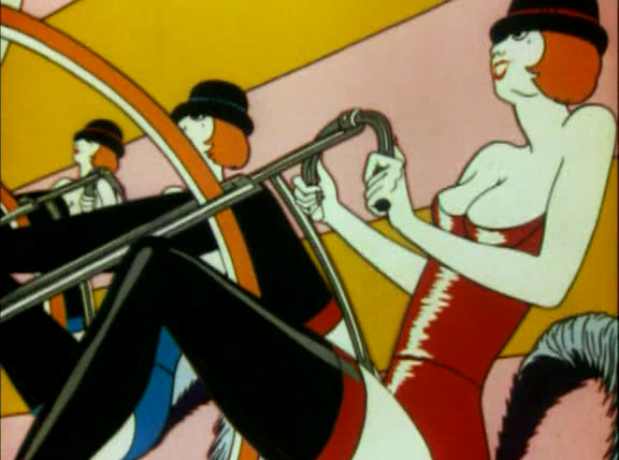 ‘Forward March Time!’ is a bold setting of a poem by soviet futurist poet Vladimir Mayakovsky (1892-1930).
The film illustrates the meandering poem with associative images of the 1905 revolution, the 1917 revolution, World War II and even a futuristic battle in space.
Using a combination of typical seventies designs (besides communist paintings) and rock music (besides an excerpt from Mahler’s fifth symphony), the film is both a markedly modern and interesting piece of soviet propaganda, if a bit too long. It shows Tarasov’s unique style, which he explored further in the much more lighthearted short ‘Contact‘.
Watch ‘Forward March, Time!’ yourself and tell me what you think:
‘Forward March, Time!’ is available on the DVD box set ‘Animated Soviet Propaganda’
Director: Grigori Lomidze
Release Date: 1959
Rating: ★★★
Review:
 Filmed in two colors, ‘Ali Baba and the Forty Thieves’ is a long puppet animation film from the Soviet Union.
The short takes half an hour to retell the famous story from One Thousand and One Arabian Nights quite faithfully. The film features the death of two characters, but the grim ending of the original story is lacking. Instead of being killed, the forty thieves are captured by the townspeople.
Interestingly, Ali Baba is not the real hero of the story, but rather his wife, a girl he bought on a slave market, unfortunately run by the very thieves he had robbed earlier. It’s this slave girl who decoys and fools the thieves to their own destruction.
The film uses a narrator who does all the voices, and a very lush score by composer Eduard Kolmanovsky. The film is quite slow and the puppet animation isn’t as sophisticated as in contemporary films by Jiří Trnka. The puppets have no facial expression whatsoever, and cannot move anything in their face, except for the gang leader, who can roll his one eye. Only occasionally their emotions become apparent. The best example of this may be the terror of Ali Baba’s neighbor when he realizes he’s trapped inside the thieves’ cave.
About the film’s director, Grigori Lomidze, little is known. He also directed the propaganda film ‘To You , Moscow‘ (1947), which combines live action and cel animation. Nothing points to a long experience in stop motion, and unfortunately, it shows. Nevertheless, ‘Ali Baba and the Forty Thieves’ is a charming film, succeeding in evoking the typical atmosphere of the Arabian Nights.
Watch ‘Ali Baba and the Forty Thieves’ yourself and tell me what you think:


 Dr. Grob's Animation Review