
You are currently browsing the category archive for the ‘★★★½’ category.
Directors: Norman McLaren & Evelyn Lambart
Release Date: 1960
Rating: ★★★½
Review:

‘Lines Vertical’ is one of the most extreme films Norman McLaren ever made.
Together with collaborator Evelyn Lambart he manages to make a film consisting of vertical lines only, made directly on film. The whole film consists of white vertical lines moving across the screen against monochrome backgrounds. The film starts with one line, then two, then three, and so on, until ca. twenty lines fill the screen in a constant ballet.
At one point the lines get a three-dimensional quality, resembling rotating columns. The movements of the lines follow Maurice Blackburn’s serene score, which is clearly inspired by Chinese classical music. It’s a testimony of the genius of both McLaren & Lambart that they can even pull off such a boring concept, and turn it into a successful film, even if it’s not the most engaging one.
Watch ‘Lines Vertical’ yourself and tell me what you think:
‘Lines Vertical’ is available on the DVD-box set ‘Norman McLaren – The Master’s Edition’
Director: Norman McLaren
Release Date: 1959
Rating: ★★★½
Review:
 In ‘Short and Suite’ a jazzy score for clarinet, piano and double bass by E. Rathburn is interpreted by dots, shapes and lines, scratched directly on film.
The film knows no narrative, and is highly abstract, but at one point one can clearly see flowers and even human shapes. The film consists of several episodes, following more or less frantic parts within the score. McLaren’s images are very well-timed to the music, and the shapes get extra dimensions by the shadows they cast on the black and monochrome backgrounds.
‘Short and Suite’ may not be among McLaren’s best, it’s still a nice example of his great art.
Watch ‘Short and Suite’ yourself and tell me what you think:
‘Short and Suite’ is available on the DVD-box set ‘Norman McLaren – The Master’s Edition’
Director: Paul J. Smith
Release Date: July 14, 1958
Stars: Woody Woodpecker
Rating: ★★★½
Review:
 ‘His Better Elf’ starts with Woody Woodpecker being poor, full of debts and living near a city dump.
Suddenly a four-leaf clove grows through the floor, which turns into a leprechaun woodpecker (a miniature green Woody) called O’Toole, who speaks in rhyme. First O’Toole demonstrates his powers, and then he grants Woody three wishes.
Woody’s first wish is, as expected, to become filthy rich. But O’Toole grants him the wish by placing him inside the National Bank, and soon a cop tries to arrest Woody for bank robbing. The rest of the cartoon is essentially a chase cartoon with the cop trying to catch Woody, and O’Toole sabotaging these attempts, using a lot of dynamite. In the end Woody uses his third wish to sent the little pest to hell.
‘His Better Elf’ is a genuine gag cartoon, but it’s a pity the wish concept isn’t used more, but instead taken over by a routine cartoon chase. There’s a shot featuring a moving background when Woody is caught by two policemen, a rare feat since the early 1930s.
Watch an excerpt from ‘His Better Elf’ yourself and tell me what you think:
This is Woody Woodpecker cartoon No. 85
To Woody Woodpecker’s debut film: Half Empty Saddles
To the next Woody Woodpecker cartoon: Everglade Raid
‘His Better Elf’ is available on the DVD-set ‘The Woody Woodpecker and Friends Classic Cartoon Collection Volume 2’
Director: Lew Keller
Release Date: February 27, 1958
Stars: Ham and Hattie
Rating: ★★★½
Review:
 ‘Sailing and Village Band’ is the second of four ‘Ham and Hattie’ cartoons, virtual video clips to two songs each.
‘Sailing’ is a very nice children’s song by Mel Leven on his ukelele. In this song he sing about sailing, and his lyrics are accompanied by images of little girl Hattie with a toy sail boat in a fountain in a park. This song is more narrative than ‘Trees’ was, and when Mel Leven sing about a sea monster, Hattie’s toy boat encounters a frog in the pool.
For the second song, ‘Village Band’ Ham changes himself into blue dog Roscoe, a tuba player in a very undignified village band in small, but very dignified village. Unlike any other Ham and Hattie episode this is actually a story, using a narrator. This is a typical UPA story of misfits and outcasts getting respect from their environment. Nevertheless, there’s an unwelcome sense of conformism present, for the beatnik-like band gets ‘dignified’ by wearing official costumes, emblem of their incorporation into the system…
Watch ‘Sailing and Village Band’ yourself and tell me what you think:
https://www.dailymotion.com/video/x1w22db
‘Sailing and Village Band’ is available on the DVD box set ‘UPA – The Jolly Frolics Collection’
Directors: Włodzimierz Haupe & Halina Bielińska
Release Date: 1958
Rating: ★★★½
Review:
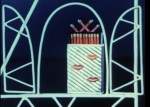
‘The Changing of the Guard’ is a stop motion film that tells a story with the simplest of means.
The background consists of highly graphical wiry outlines of buildings set in an empty stage. The ‘actors’ are matchboxes. We watch them marching, while one of them, a night guard, falls in love with a female matchbox in a window (the matchbox is recognizable as a woman, because of the three lips painted on its front). When the two meet at night, they catch flame, which devours the complete regiment. So, the next day the civilians put up a ‘no smoking’ sign.
Haupe’s and Bielińska’s stop motion is very primitive, yet effective, and their minimalist approach shows how little one needs to tell a communicating and resonating story. Admittedly, their story is not too interesting, verging on the brink of a farce, but the elegant designs and effective animation make it a short fun to watch.
Watch ‘Zmiana warty’ yourself and tell me what you think:
‘Zmiana warty’ is available on the DVD-set ‘Anthology of Polish Animated Film’
Directors: William Hanna & Joseph Barbera
Release Date: June 6, 1958
Stars: Tom & Jerry, Nibbles
Rating: ★★★½
Review:
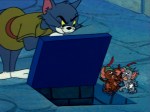 ‘Robin Hoodwinked’ is similar to Tom & Jerry’s four musketeer cartoons, but this time Jerry and Little Nibbles belong to Robin Hood’s merry men.
Alas! Poor Robin Hood has been locked inside the sheriff’s prison, so Jerry and Little Nibbles go to the rescue. Unfortunately, the prison is guarded by Tom. At one point Tom swallows the key, and Nibbles goes inside the sleeping Tom to retrieve it. This makes Tom getting the hiccups, and he swallows a jug of wine to stop them. Of course, Nibbles gets drunk, and at one point we watch him reappearing from Tom’s mouth, singing ‘The Bonnie Banks o’ Loch Lomond’. Unfortunately, the rest of the cartoon doesn’t build on this story idea, and all too soon Robin is rescued.
‘Robin Hoodwinked’ is not a bad cartoon, but rather routine and uninspired. Nibbles, who makes his twelfth and last screen appearance in this cartoon, speaks with an English accent in this short.
Watch ‘Robin Hoodwinked’ yourself and tell me what you think:
https://www.dailymotion.com/video/x3xzuvg
This is Tom & Jerry cartoon No. 113
To the previous Tom & Jerry cartoon: The Vanishing Duck
To the next Tom & Jerry cartoon: Tot Watchers
‘Robin Hoodwinked’ is available on the European DVD Box set ‘Tom and Jerry Collection’
Directors: William Hanna & Joseph Barbera
Release Date: January 3, 1958
Stars: Tom & Jerry, Little Quacker
Rating: ★★★½
Review:
 ‘Happy Go Ducky’ starts with the Easter bunny delivering an Easter egg to Tom & Jerry.
The two fight over the egg, which soon breaks, hatching into Little Quacker, which immediately goes swimming in whatever fluid containing device he sees, being it Tom’s milk bowl, a fish tank, a water tank or a bath. Tom & Jerry try to get rid of the little duck, even putting it back into the egg shell and sending it back to the Easter bunny, but to no avail. In the end, the whole room is flooded, and Tom and Jerry have to watch Little Quacker swimming around with his four duckling friends from the local public park pond.
‘Happy Go Ducky’ is remarkable for lack of conflict between Tom and Jerry. As soon as Little Quacker enters the scene, the two work together to get the intruder out. This hampers the comedy, which remains mild and friendly. Part of the humor stems from Little Quacker exclaiming ‘Happy Easter!’ enthusiastically every time he has found a place to swim. The best gag however is when Tom tries to shut a shower door, which Little Quacker has filled to the max with water.
Watch ‘Happy Go Ducky’ yourself and tell me what you think:
https://www.dailymotion.com/video/x3xxdrv
This is Tom & Jerry cartoon No. 110
To the previous Tom & Jerry cartoon: Tom’s Photo Finish
To the next Tom & Jerry cartoon: Royal Cat Nap
‘Happy Go Ducky’ is available on the European DVD Box set ‘Tom and Jerry Collection’
Director: Michael Lah
Release Date: February 7, 1958
Stars: Droopy, the Wolf
Rating: ★★★½
Review:
 In ‘Sheep Wrecked’ Droopy is a sheepherder, or more clearly, a sheep dog guarding his flock inside a fenced pasture against the laid-back Southern wolf character ( in his last screen appearance).
‘Sheep Wrecked’ arguably is the most inspired of Michael Lah’s six Droopy films. The animation is fine, and the gags plentiful. Among the wolf’s attempts are him dressing up like a stork and like Bo-Beep, a gag harking all the way back to the Silly Symphony ‘Three Little Wolves‘ (1936). Both Droopy and the wolf are in fine shape in this cartoon.
Unfortunately, the pace is rather slow, and the best features of this Cinemascope cartoon are Scott Bradley’s very inspired music and F. MonteAlegre’s beautiful backgrounds, with their minimal indications of settings on a bright orange canvas. Remarkably, this Homer Brightman-penned story involves a very slow guided missile, very similar to the one in the Woody Woodpecker cartoon ‘Misguided Missile‘. ‘Misguided Missile’ was penned by the very same writer, and only released eleven days earlier.
Watch ‘Sheep Wrecked’ yourself and tell me what you think:
https://www.dailymotion.com/video/x1y3cwt
‘Sheep Wrecked’ is available on the DVD-set ‘Tex Avery’s Droopy – The Complete Theatrical Collection’
Director: Paul J. Smith
Release Date: November 4, 1957
Stars: Woody Woodpecker, Windy & Breezy
Rating: ★★★½
Review:
 In Yellowstone Park a father bear shows his son how to get free food from the park visitors.
Father bear gets cake from an old couple, looking particularly miserably, and food from some youngsters playing ‘rock-‘n-roll’ (the tune the bear plays is more rock ‘n roll in name than in sound). The next customer is Woody Woodpecker, who for once isn’t short of food himself.
After making the bear perform some tricks, Woody gives the bear a sandwich and a bottle of ketchup, but when the greedy bear wants more, a gag routine starts, with Woody placing some food on ‘Old Faithful’ (a geyser), and the bear falling for it, no less than five times. This sequence is surprisingly fast-paced, making the comedy, which are essentially variations on one theme, work.
The little bear’s function in the plot is only to address the audience once in a while with an admiring ‘that’s my pop’, no matter what calamity befalls his father. In this respect he resembles Sylvester jr, who had made his debut eight years earlier in ‘Pop ‘Im Pop!’ (1950).
The bear pair was later christened ‘Windy & Breezy’ and starred four cartoons of their own, starting with ‘Salmon Yeggs‘ (1958).
Watch ‘Fodder and Son’ yourself and tell me what you think:
This is Woody Woodpecker cartoon No. 81
To the previous Woody Woodpecker cartoon: Dopey Dick and the Pink Whale
To the next Woody Woodpecker cartoon: Misguided Missile
‘Fodder and Son’ is available on the DVD-set ‘The Woody Woodpecker and Friends Classic Cartoon Collection Volume 2’
Directors: Stephen & Timothy Quay
Release Date: 1993
Rating: ★★★½
Review:
 The fourth and last Stille Nacht film returns to the music of His Name Is Alive, and the rabbit and doll from the second film.
The most disturbing image is that of the girl doll somehow bleeding. In another scene a death-like man tries to steal the rabbit’s egg, using string. The rabbit saves his egg by cutting the string with his teeth, and hides the egg in a glass on the ceiling. This is the most story-like part of the film, which looks beautiful, but is drenched in mystery, just like the other three Stille Nacht films.
Watch ‘Stille Nacht IV: Can’t Go Wrong Without You’ yourself and tell me what you think:
‘Stille Nacht IV: Can’t Go Wrong Without You’ is available on the DVD-set ‘The Brothers Quay – The Short Films 1979-2003’
Director: Faith Hubley
Release Date: 1990
Rating: ★★★½
Review:
 With Amazonia Faith Hubley returns to her favorite subject, mythology, telling three myths from this area.
The first is a creation myth in which the moon goddess creates life, but is envied by two other god-like creatures. Unfortunately, it’s far from clear what’s happening during this part.
Much clearer is the second part, which tells about a clever and hungry tortoise, who defeats a jaguar, a fox and a deer by outsmarting them, and then devouring them… This is a surprisingly funny sequence for a Faith Hubley film, whose style normally is more poetic than anything else.
The last myth is the only one to use a piece of dialogue: we hear Dizzy Gillespie say “One day, when there are no trees left, the heavens will fall and the people will be destroyed.” This part is clearly against deforestation, but also shows that nature will doubtless survive mankind.
Hubley’s magical animation style enhances the mythical atmosphere, as does Don Christensen’s music. The complete film is very beautiful and poetic.
‘Amazonia’ is available on the DVD ‘The Hubley Collection Volume 1’
Director: Milan Trenc
Release Date: 1990
Rating: ★★★½
Review:
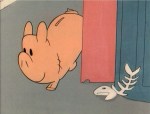 When a spoiled, rich brat is about to smash his piggy bank to pieces with a large hammer, the piggy bank flees. While the boy and his family are looking for him, the piggy bank has a good time at the fair.
This is a rather lightweight film, based on a story by Milan Milšić. Trenc uses a lot of different designs in this film, with the piggy bank itself being the most conventional. Like many other Zagreb films from this later period, the film is hampered by limited animation and an ugly electronic score, this time by Davon Rocco.
Watch ‘The Big Time’ yourself and tell me what you think:
‘The Big Time’ is available on the DVD ‘The Best of Zagreb Film: Be Careful What You Wish For and The Classic Collection’
Director: Krešimir Zimonić
Release Date: 1988
Rating: ★★★½
Review:
 ‘Butterflies’ is a film from the Zagreb Film studio, when the once famous studio was already in its decline.
‘Butterflies’ is about a young woman who imagines the different lives she can lead with some very different men. This film uses strong, angular 1980s designs and colors by co-writer Magda Dulčić, and has a rather stream-of-consciousness-like structure, with a lot of metamorphosis and designs that verge on the abstract. The animation ranges from very limited to full, and from serious to cartoony. Unfortunately, Igor Savin’s ugly electronic score and Dulčić designs make the film feel dated, and more a product of its time than a timeless classic.
‘Butterflies’ is available on the DVD ‘The Best of Zagreb Film: Be Careful What You Wish For and The Classic Collection’
Director: Émile Cohl
Release Date: 1911
Rating: ★★★½
Review:
 In this short comedy a man disapproves of the suitor of his daughter and consults a magician, who can extract a man’s history from a single hair.
The hair reveals that the suitor has spent some time in prison, so the man throws the suitor out, leaving it to the magician to ask the hand of the daughter. ”Le cheveu délateur’ is a rather silly film, full of broad comedy.
As may be expected, the hair section is done in animation. Unfortunately in this segment Cohl’s animation isn’t too interesting, showing mostly the suitor travelling, by train, by balloon, and by elephant. Cohl’s metamorphosis technique is only used sparingly, and never leads to strange associations like in his best films.
Watch ‘Le cheveu délateur’ yourself and tell me what you think:
‘Le cheveu délateur’ is available on the DVDs ‘Émile Cohl – L’agitateur aux mille images’
Director: Émile Cohl
Release Date: 1910
Rating: ★★★½
Review:
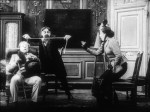 This short starts with a couple visiting a psychiatrist.
The woman exclaims that her husband is rather cuckoo, so the psychiatrist takes a look inside the husband’s head using a ‘cephaloscope’. As may be expected in an Émile Cohl film what the doctor sees is shown in animation: a series of weird images, tied by Émile Cohl’s trademark metamorphosis.
When the psychiatrist has seen enough, he drills a hole in the man’s skull and pulls out the crazy thoughts, which manifest themselves as more animation on a black screen, much in the vain of Cohl’s debut film ‘Fantasmagorie‘ (1908). Thus the man is saved and the film ends.
Cohl’s stream-of-consciousness way of animating works quite well for a film about craziness, and the framing story is amusing enough to keep the film interesting, even though it’s certainly not one of Cohl’s masterpieces.
Watch ‘Le retapeur de cervelles’ yourself and tell me what you think:
‘Le retapeur de cervelles’ is available on the DVDs ‘Émile Cohl – L’agitateur aux mille images’
Director: Émile Cohl
Release Date: 1910
Stars: Lucien Cazalis
Rating: ★★★
Review:
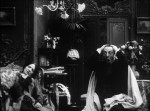 ‘Jobard a tué sa belle-mère’ is not an animation film, but one of ten comedy shorts Émile Cohl directed in a collaboration with actor Lucien Cazalis for Pathé.
The ten films all feature the character Jobard, played by Cazalis. It’s a pity that ‘Jobard a tué sa belle-mère’ appears to be the only one to have survived in some quality, because the film shows Cohl’s skills as a live action comedy director. Indeed, the film is a prime example of early French comedy film.
In this episode Jobard scares his mother-in-law to death. Literally. Or so he thinks. So he sets out to buy a wreath, which he loses immediately at a cafe. So he buys a circular bread instead, which he accidentally replaces with a tire. In the end he ends with a cushion, accidentally stolen from the police office.
Lucien Cazalis, who plays Jobard is quite a good comedian, and the film clearly shows that French comedy had a huge influence on American slapstick comedy. It’s a pity Lucien Cazalis has been completely forgotten, today, for he clearly deserves more recognition.
Watch ‘Jobard a tué sa belle-mère’ yourself and tell me what you think:
‘Jobard a tué sa belle-mère’ is available on the DVDs ‘Émile Cohl – L’agitateur aux mille images’
Director: Émile Cohl
Release Date: June 18, 1910
Rating: ★★★½
Review:
 ‘Le tout petit Faust’ is a retelling of Johann Wolfgang von Goethe’s Faust II using puppet animation.
This is arguably Émile Cohl’s best pure stop-motion film. Although the short is still only comprehensible if you know Goethe’s famous story, it greatly profits from elaborate sets and beautiful background art. There’s even some primitive evocation of emotion during the love scenes between Faust and Margarete. The devilish Mephisto fails to become scary, however, being just a doll just like the other dolls, but in different clothes.
Watch ‘Le tout petit Faust ‘ yourself and tell me what you think:
‘Le tout petit Faust ‘ is available on the DVDs ‘Émile Cohl – L’agitateur aux mille images’
Director: Émile Cohl
Release Date: 1909
Rating: ★★★½
Review:
 ‘Les locataires d’à-côté’ is a short comic film about an old couple who decide to drill a hole in the wall to spy on their younger neighbors.
However, the hole is immediately discovered by the young victims, and the young man wonders how he can punish the nosy neighbors. How he does it remains utterly unclear, but as soon as one of the neighbors takes a peak to the hole, the young neighbors’ room disappears, and makes place for some animation, mostly stop-motion, but also some pen animation, in which Cohl shows some pretty grotesque images.
The best part is when he applies his famous technique of metamorphosis to paper-cut forms. This is essentially replacement animation in a form never tried before, and rarely after. In a sense, this piece of animation anticipates George Pal’s groundbreaking replacement animation of the 1930s. Moreover, throughout his film, Cohl employs the split-screen technique, an absolute novelty. These facts alone make ‘Les locataires d’à-côté’ a great example of the astonishing creativity Émile Cohl showed in his films of 1908-1911.
In the end the couple fetch the house-keeper, but all he sees is the ordinary room, and he leaves the neighbors, stating they are crazy. Indeed, they seem to become crazy, in the end, and it’s the young couple who has the last laugh.
Watch ‘Les locataires d’à-côté’ yourself and tell me what you think:
‘Les locataires d’à-côté’ is available on the DVDs ‘Émile Cohl – L’agitateur aux mille images’
Director: Émile Cohl
Release Date: August 25, 1909
Rating: ★★★½
Review:
 ‘Porcelaines tendres’ is a tableau vivant film, like ‘L’éventail animé‘ and ‘Les couronnes‘, with people now pretending to be porcelain figures in crockery items.
Like two earlier shorts the film has a vague chronological order, and is very stylized and beautiful. Nevertheless, the film is less gripping than the former two films, and its frame more conventional, being akin to frames used in other contemporary French films. As in all of Cohl’s tableau vivant films, no animation is involved.
Watch ‘Porcelaines tendres’ yourself and tell me what you think:
‘Porcelaines tendres’ is available on the DVDs ‘Émile Cohl – L’agitateur aux mille images’
Director: J. Stuart Blackton
Release Date: April 6, 1906
Rating: ★★★½
Review:
 ‘Humorous Phases of Funny Faces’ is arguably the first drawn animation film. Like Blackton’s first film, ‘The Enchanted Drawing’ from 1900, the short combines the tradition of live sketching with that of trick filming to a novelty effect. Made for Thomas A. Edison, the film is an important step forward, however, because, unlike ‘The Enchanted Drawing’ there now is animated movement.
The film starts with a live action hand drawing the face of a man on a chalkboard. Next to the man a woman is drawn, now without the hand. The two faces alter, and at one point the man grows a cigar and a top hat. This ‘scene’ ends when the man’s smoke covers the whole woman, and the hand erases the drawing.
Next come two other faces. Little is happening here, so soon we cut to an old man with an umbrella. This part shows a little arm movement, done with cut-out. Blackton used the cut-out technique more extensively in the last shot, that of a clown, toying with his hat, a hoop and a poodle. The film ends with the hand erasing again. The whole experience lasts less than three minutes.
Overall, the image is pretty static, and it’s clear that the whole film is made pure for the novelty of its tricks. Of course, ‘Humorous Phases of Funny Faces’ is historically important, yet, it’s difficult to call this first hand-drawn animation film (and probably the first one to use cut-out) an instant classic, as apart from the movement hardly anything is happening, and only the smoke gag comes somewhere near being funny. Moreover, Blackton’s arm can be seen a few times, which hampers the trick.
Watch ‘Humorous Phases of Funny Faces’ yourself and tell me what you think:
‘Humorous Phases of Funny Faces’ is available on the DVD ‘Before Walt’


 Dr. Grob's Animation Review