You are currently browsing the category archive for the ‘★★★★★ ♕’ category.
Director: Jan Švankmajer
Release Date: 1971
Rating: ★★★★★ ♕
Review:
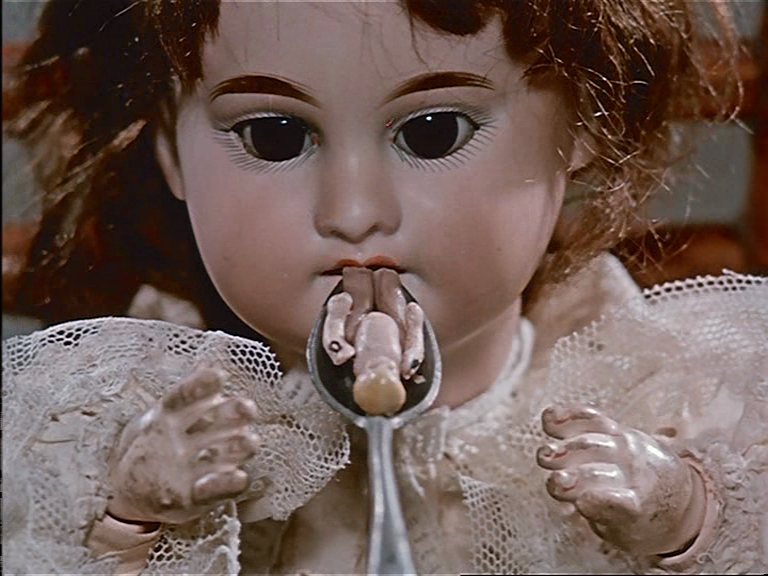 ‘Jabberwocky’ has little to do with the poem from Lewis Carroll’s ‘Through The Looking Glass’, although we hear it being recited by a little girl during the opening sequence.
The film it is Švankmajer’s surrealistic masterpiece on the loss of childhood, depicted by several episodes, which are separated by a box of bricks, a labyrinth and a black cat crushing the box of bricks.
During the episodes we are treated on extremely surrealistic images of very active inanimate objects in a child’s room. First we watch a boy’s suit growing a forest in his room, defying both time and authority (symbolized by the portrait in the room). Then we watch large cannibalistic dolls grinding, ironing and eating little dolls, a china baby in a cradle destroying two tin armies, a pocket knife performing acrobatic tricks until it makes an ill-fated fall and stabs itself, and finally, schoolbooks producing paper boats and planes, which fly out of the window, while the father’s portrait produces pictures of beautiful women.
This last episode shows the child’s changing interests. In the end the labyrinth is solved, the cat – the only living thing in the entire film – is caged, and the boy’s suit is replaced by an adult one. The boy is free from his parent, but the days of imagination are over, the fantasy is gone.
For this film Švankmajer makes excellent use of 19th century imagery (sailor suit, vintage dolls and toys) to create a completely unique world. It’s the film maker’s most typical film, partly expanding on ideas explored in ‘Historia Naturae, Suita‘ (1967), and showing his fascination with fantasy, cruelty and decay, which roam freely in the child’s self-contained room. The rather morbid behavior of the everyday objects is quite unsettling and it shows how a child’s fantasy can be both imaginative and cruel.
‘Jabberwocky’ is without doubt one of Švankmajer’s most powerful films. He would only top it eleven years later, with ‘Dimensions of a Dialogue‘ (1982). Švankmajer would explore the imagination of children further in the moving ‘Down to the Cellar‘ (1983), and in his unique adaptation of Lewis Carroll’s most famous work ‘Alice‘ (1987).
Watch ‘Jabberwocky’ yourself and tell me what you think:
‘Jabberwocky’ is available on the DVD ‘Jan Svankmajer – The Complete Short Films’
Directors: John Halas & Joy Batchelor
Release Date: January 31, 1954
Rating: ★★★★★ ♕
Review:
 Based on George Orwell’s famous fable (published only nine years before), Animal Farm is the first animated feature made in England, it’s one of Europe’s first feature films, and it’s undoubtedly among the masterpieces of feature animation.
The film falls into the tradition of Disney-style semi-realistic cel animation. However, it sets itself apart from the Disney tradition in its grim and political story, its lack of sentimentality and its open depiction of cruelty and violence. Moreover, the backgrounds are bold oil paintings, with visible brush strokes and darker colors than any Disney film had ever shown.
Nevertheless, the realistic and wonderful animation of the animals pays some depths to the Disney tradition (watch the Silly Symphony ‘Farmyard Symphony‘ for example), greatly helped by the presence of ex-Disney animator John Reed. The film even contains one sweet character for comical relief in a little duckling who tries to keep up with the other animals, echoing the turtle in ‘Snow White and the Seven Dwarfs’ (1937). However, when the story turns particularly grim, with the killing of the Trotsky-like pig Snowball by Napoleon’s dog henchmen, we do not see this cute character again.
The assassination of Snowball is the first of several alarming events in which the animals’ revolution is betrayed. The most disturbing of these is Boxer’s ride to a certain death. This scene is the emotional highlight of the film, and it creates strong feelings of outrage and alarm, still. The horror on the face of his friend Benjamin is very well captured, and moves to this day.
Using a voice over and evocative music by Hungarian composer Mátyás Seiber, the film retells Orwell’s story effectively, using only Orwell’s own words. Its only strong deviation from the book is its ending. Where Orwell’s novel ends with the Stalin-like pig Napoleon’s regime installed, the film ends with yet another revolution – some wishful thinking that in the real world never quite came true until the late 1980s, when encouraged by Gorbachev’s perestroika, the people all over Eastern Europe revolted against their communist oppressors.
‘Animal Farm’, which was released within a year after Stalin’s death, is still a moving portrait of the corrupting force of power. Even though its subject, the Soviet Union, has long been a state of the past, the forces depicted in this movie are still active. The world is not free of its Napoleons, yet…
Watch ‘Animal Farm’ yourself and tell me what you think:
Director: Raoul Servais
Release Date: 1979
Rating: ★★★★★ ♕
Review:
 A man rescues a harpy from a man who strangles her. He takes her home, but with disastrous results, because he soon discovers that the harpy eats all his food…
‘Harpya’ is a fantastic surreal film, which makes great use of a mixture of animation, live action and pixillation to create a totally unique atmosphere. The film is both funny and uncanny, and its story is Servais’s best since ‘Sirene’ (1968).
With ‘Harpya’ Raoul Servais made his most enduring work. It’s his all-time masterpiece, and a central film in his oeuvre, defining his mature style.
Watch ‘Harpya’ yourself and tell me what you think:
Director: René Laloux
Release Date: May 11, 1973
Rating: ★★★★★ ♕
Review:
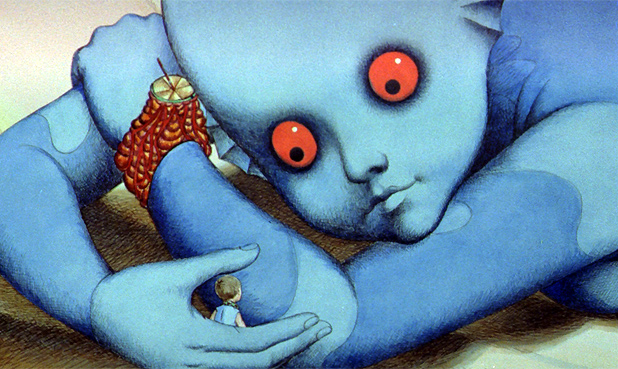
‘La planète sauvage’ is an old love of mine. I first watched it when I was ca. six or seven. It took me fifteen years before I learned which film I had actually watched, and it would take me another ten years before I could watch it again. However, all the time the film’s powerful images never left me.
‘La planète sauvage’ is a science-fiction feature, which tells about the life of humans (‘Oms’, which sounds like the french word for humans, ‘hommes’) on a strange planet occupied by story-block-high humanoid giants, called Draags. To them humans are no more than pets and pests. By accident, a pet Om, Terr (symbolically named after the French word for Earth, terre), learns the Draags’ knowledge and he leads his fellow humans into an uprising.
However, ‘La planète sauvage’ is not particularly famous for its straightforward and rather cliche plot. Its strength lies in its effective use of Roland Topor’s very surrealistic designs, which makes the depicted planet incomprehensible, foreign and scary. For example, the Draag’s behavior is so strange, that despite their humanoid form they feel very alien, indeed. The film’s original technique of combining drawn animation with cut-out adds to the surreal atmosphere. Even the space funk music accompanying the action sounds outlandish.
Even though the animation sometimes is rather stiff and at times even ridiculously poor, the graphic imaginary is so strong that these shortcomings never spoil the enjoyment of the film. On the contrary, the film’s totally unique and disturbing atmosphere and its philosophical questions about what makes man human make watching ‘La planète sauvage’ a very rewarding experience.
Together with Bruno Bozzetto’s ‘Allegro non troppo’ (1976) and Martin Rosen’s ‘Watership Down’ (1978) Laloux’s film must be counted among the most outstanding features of the seventies. René Laloux would make two other science fiction features, ‘Les maîtres du temps‘ (1981) and ‘Gandahar‘ (1988), but these do not reach the stunning originality of the visuals in this film.
Watch the trailer for ‘La Planète sauvage’:
Director: Chuck Jones
Release Date: July 25, 1953
Stars: Daffy Duck, Porky Pig, Marvin Martian
Rating: ★★★★★ ♕
Review:
 ‘Duck Dodgers in the 24½th Century’ is a spoof of the popular pulp magazine science fiction series Buck Rogers, which was made into a television series in 1950-1951. This makes this short one of the earliest theatrical cartoons parodying a television series.
Daffy “Duck Dodgers” and his sidekick “the eager young space cadet” Porky have to claim planet X for planet Earth. Unfortunately, Marvin Martian wants to claim the same planet for Mars. This starts a feud, which ends in both blowing up the entire planet.
Although the story of the cartoon is rather similar to the Bugs Bunny cartoon ‘Haredevil Hare‘ (1948), Daffy’s unique performance gives it an entirely different feel, leading to new and great gags. More than being a typical science fiction cartoon, this short can be regarded the second cartoon in a series which pairs Daffy as a misguided hero to Porky as a more sensible straight man (the first being ‘Drip-along Daffy‘ from 1951). ‘Duck Dodgers’ must be the highlight of the series, as well as a peak in both Daffy’s as Chuck Jones’s career.
Unhampered by conventions, Jones, his layout-man Maurice Noble and background painter Phil DeGuard went totally berserk with the science-fiction theme, creating wild and lushly colored backgrounds, which make ‘Duck Dodgers in the 24½th Century’ one of the most beautiful cartoons ever made at Warner Brothers.
Indeed, so great is its fame, it spawned sequels in 1980, 1996 and 2003. From 2003 to 2005 Cartoon Network even broadcasted a Duck Dodgers series.
Watch ‘Duck Dodgers in the 24½th Century’ yourself and tell me what you think:
http://www.220.ro/desene-animate/Looney-Tunes-Duck-Dodgers-In-The-24-5-Century/aTflTNIyAr/
This is Porky Pig cartoon no. 142
To the previous Porky Pig cartoon: Fool Coverage
To the next Porky Pig cartoon: Claws for Alarm
This is Daffy Duck cartoon No. 65
To the previous Daffy Duck cartoon: Muscle Tussle
To the next Daffy Duck cartoon: Duck! Rabbit! Duck!
‘Duck Dodgers in the 24½th Century’ is available on the Blu-Ray ‘Looney Tunes Platinum Collection: Volume 2’ and on the DVD-set ‘Looney Tunes Golden Collection Volume One’
Director: Chuck Jones
Release Date: February 28, 1953
Stars: Daffy Duck, Bugs Bunny (cameo)
Rating: ★★★★★ ♕
Review:
 One of the most self-aware animated cartoons ever made, ‘Duck Amuck’, more than any other cartoon, plays with the conventions of animation and with the frustrations of Daffy Duck.
This cartoon shows how good the character is, because even when drawn awkwardly, even without sound, and even when animated as a small speck in the distance, we know it’s Daffy. His struggles with the off-screen animator (who in the end turns out to be Bugs Bunny) form the zenith of his new frustrated personality, which had replaced his zany personality of the thirties and forties three years earlier. Furthermore he’s the sole character in the entire cartoon, but so strong is his unwilling performance that we become hardly aware of this fact.
The poor Daffy has to deal with disappearing and constantly changing backgrounds, with absent and inappropriate sounds, with deformations of his own body etc. In this cartoon he’s the victim of an omnipotent ‘cartoon god’ whom he cannot escape. In this sense ‘Duck Amuck’ questions the relationship between creator and creation and the responsibility of the creator to the things he created. This makes ‘Duck Amuck’ also one of the most philosophical cartoons ever made. And amazingly, it’s funny, too.
Watch ‘Duck Amuck’ yourself and tell me what you think:
http://www.dailymotion.com/video/x2ofats
This is Daffy Duck cartoon No. 63
To the previous Daffy Duck cartoon: Fool Coverage
To the next Daffy Duck cartoon: Muscle Tussle
‘Drip-along Daffy’ is available on the Blu-Ray ‘Looney Tunes Platinum Collection: Volume 2’ and on the DVD-set ‘Looney Tunes Golden Collection Volume One’
Director: Chuck Jones
Release Date: February 2, 1952
Stars: Marc Anthony
Rating: ★★★★★ ♕
Review:
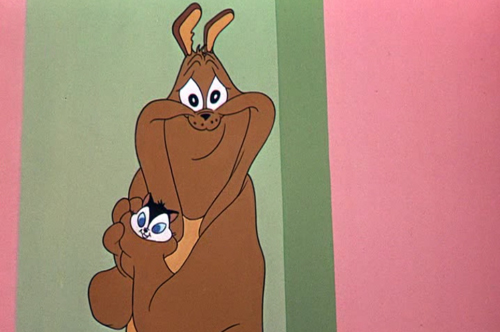 Among all the masterpieces of animation, this must be the most inconspicuous one: it’s a seemingly classical dog and cat story, involving quite some dull dialogue (provided by the dog’s mistress, of whom we only see her legs), and its looks are quite traditional, with unremarkable layouts and backgrounds.
Nevertheless, ‘Feed The Kitty’ is a real masterpiece, and its reputation is entirely due to the acting of its main character, the gentle bulldog Marc Anthony. His facial expressions are so wide ranging, so extreme and so heartfelt that ‘Feed the Kitty’ can almost be regarded as a study in depiction of emotion. Silent acting really reaches its peak here, and director Chuck Jones is without doubt at his all time best in this sweet little cartoon.
In ‘Feed the Kitty’ Marc Anthony adopts a sweet little kitten, but he’s not allowed to bring anything into the house. This leads to various gags with the dog trying to hide the little kitten from his mistress. However, the highlight of the cartoon is the sequence in which Marc Anthony thinks his darling pet is dead. His emotions are both hilarious and heartbreaking. Never before has the anxiety of having lost a dearly beloved been so convincingly put to the animated screen. At this point I often can’t keep my tears from running.
Indeed, this sequence is so popular among animators that it was almost exactly copied in ‘Monsters, Inc.‘ (2001) as a homage to the original. I’d say, if cartoons were shown at funerals (and why not?), ‘Feed the Kitty’ would be a perfect candidate.
Watch ‘Feed the Kitty’ yourself and tell me what you think:
http://www.dailymotion.com/video/xjw9ms_feed-the-kitty_shortfilms
‘Feed the Kitty’ is available on the DVD set ‘Looney Tunes Golden Collection, Vol. 1’
Directors: William Hanna & Joseph Barbera
Release Date: May 26,1951
Stars: Tom & Jerry, Mammy Two-Shoes, Meathead
Rating: ★★★★★ ♕
Review:
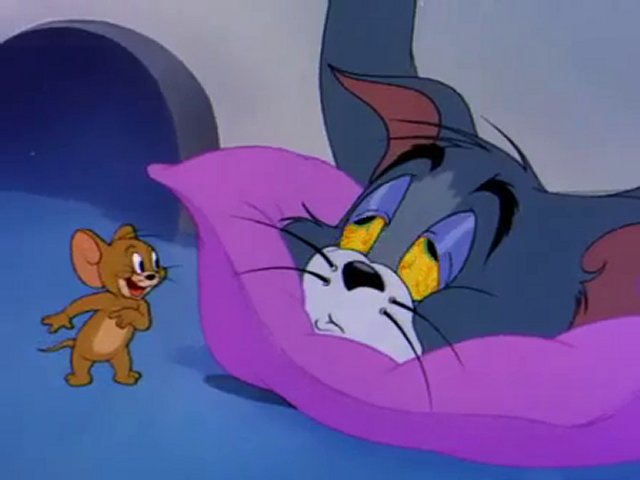 Tom has been hanging out all night with three other cats.
He comes home early in the morning, only to meet a very angry Mammy. The same night Jerry has plundered the kitchen, so Mammy orders Tom to stay awake to chase the mouse away. Not an easy task for the exhausted Tom. Especially when Jerry repeatedly makes him fall asleep. In the end Tom is thrown out, only to be picked up again by his friends for another long night out…
‘Sleepy Time Tom’ is a hilarious cartoon with great gags and wonderful animation involving Tom’s feeble attempts to stay awake. Together with ‘Daffy Duck Slept Here‘ from 1948, its’arguably the funniest cartoon about sleep ever, outdoing other great cartoons like the Woody Woodpecker cartoon ‘Coo-Coo Bird‘ (1947), the Donald Duck shorts ‘Early to Bed‘ (1941), ‘Fall out-Fall in’ (1944), ‘Sleepy Time Donald’ (1947), and ‘Drip Dippy Donald’ (1948), or the similar Pluto short ‘Cat Nap Pluto‘ (1948).
One may indeed consider ‘Sleepy Time Tom’ to be the last of the classic Tom & Jerry cartoons. Although other funny Tom & Jerry shorts would be made in the years to come, the average quality of the designs, animation and stories would only diminish during the rest of the fifties.
Watch ‘Sleepy Time Tom’ yourself and tell me what you think:
This is Tom & Jerry cartoon No. 58
To the previous Tom & Jerry cartoon: Jerry’s Cousin
To the next Tom & Jerry cartoon: His Mouse Friday
Directors: William Hanna & Joseph Barbera
Release Date: April 7, 1951
Stars: Tom & Jerry
Rating: ★★★★★ ♕
Review:
 In the great opening shot of ‘Jerry’s Cousin’ we see multiple cats being clobbered by what turns out to be a very muscular mouse.
This mouse happens to be Jerry’s cousin. He receives a letter in which Jerry asks ‘cousin muscles’ for help, having ‘serious trouble with Tom’. Muscles takes care of Tom alright, but only after he defeats the three ‘Dirty Job’ cats Tom called in, Tom surrenders. In the future, Jerry will be safe. His surprised smile at the end of the cartoon is priceless.
‘Jerry’s Cousin’ is one of the Tom & Jerry classics. It’s a great gag cartoon, its storytelling and timing are both perfect, and it makes clever use of the invincibility theme.
Watch ‘Jerry’s Cousin’ yourself and tell me what you think:
http://www.dailymotion.com/video/x2ekfzk_jerry-s-cousin-1951_shortfilms
This is Tom & Jerry cartoon No. 57
To the previous Tom & Jerry cartoon: Jerry and the Goldfish
To the next Tom & Jerry cartoon: Sleepy Time Tom
Director: Jack Kinney
Release Date: June 30, 1950
Stars: Goofy
Rating: ★★★★★ ♕
Review:
 In this cartoon a particularly civilized type of Goofy, an “average man” called Mr. Walker, changes into a Mr. Hyde-like wildman called Mr. Wheeler, once he sits behind the wheel of his car.
‘Motor mania’ is a quite disturbing film about road manners, it even becomes nightmarish when we watch cars bark at a helpless pedestrian. It is as moralistic as it is funny. And it remains somehow strikingly relevant today, making it an original classic within the Goofy series.
‘Motor Mania’ is the only Goofy cartoon in which our hero is depicted as an unsympathetic and even evil character. But by now Goofy had lost all his former persona. He had changed into a random citizen, so it works very well.
‘Motor Mania’ forms another step in the evolution of Goofy into the American everyman. By now Goofy had replaced Donald Duck as a representative of the American citizen. Donald Duck had been the average citizen in the 1940s, but at the end of the decade his role had been diminished, evolving into a straight man for the antics of Chip ‘n Dale, the little bee and such. Jack Kinney’s Goofy took over, cumulating in the typical 1950s everyman, George Geef, in ‘Cold War‘ from the next year.
Watch ‘Motor Mania’ yourself and tell me what you think:
This is Goofy cartoon No. 25
To the previous Goofy cartoon: Goofy Gymnastics
To the next Goofy cartoon: Hold That Pose
Director: Don Hertzfeldt
Release Date: August 24, 2012
Rating: ★★★★★ ♕
Review:
 ‘It’s such a Beautiful Day’ tells about Bill, a man with some kind of terminal disease, which affects his memory. The film uses an episodic, non-linear narrative, and at times feels as confused as the protagonist’s mind.
Hertzfeldt uses some unconventional ways to tell his story. He himself tells us the story in a dry, matter-of-factly, slightly worrying voice over, which makes the sometimes poignant episodes even more gripping. The images themselves are very simple: the people in the film are no more than stick figures. But because of Hertzfeldt’s perfect sense of timing, these simple images are richer than many more elaborately drawn animation films. The stick figure images are interchanged with 8mm-film-like live action fragments of details in streets, trees, the sea etc. Hertzfeldt’s basic screen is black, in which often more than one of his images is projected. This technique harks back to the silent era, and gives his film a timeless look.
Hertzfeldt uses all these techniques to tell a fragmented, associative narrative, which is rich in detailed observations on daily life. The scenes motivate the viewer to try to connect the presented information into an overall story. The scenes are often comical, even hilarious, with Bill watching a man with a leaf blower as a particular highlight. As often, however, the scenes are moving and very emotional. Throughout the feature the deterioration of Bill’s mind becomes clearly visible, and when he decides to take a walk around the block, the result is as funny as it is painful. The most beautiful part, however, is when Bill celebrates life, paying attention to details that normally go unnoticed. The film’s finale, too, is no less than glorious.
‘It’s such a Beautiful Day’ is a compilation of three short films released earlier: ‘Everything will be OK’ (2006), ‘I Am So Proud of You’ (2008), and ‘It’s Such a Beautiful Day’ (2012). To compile these into one feature is a very logical step. In fact, watching them together as one continuous story actually makes much more sense. The result is one of the most original feature films ever made, and also one of the most moving. An impressive effort by any standard, and especially when considering that this is a one-man-project.
Watch the trailer of ‘It’s Such a Beautiful Day’ and tell me what you think:
Director: Robert McKimson
Release Date: April 9, 1949
Stars: Bugs Bunny
Rating: ★★★★★ ♕
Review:
 To his nuisance Bugs Bunny discovers that rabbits (2 cts.) are less worth than foxes ($50) and bears ($75).
He mails himself to Washington, where the game commissioner (“I’m game”) explains to him that rabbits are harmless and therefore worthless for hunters. Bugs decides to be harmful to increase his value. And harmful indeed he gets!
A few of his hilarious actions include painting the obelisk at Washington like a barber’s pole, returning Manhattan to the Indians, cutting off Florida, and filling the grand canyon with sand. He manages to raise the prize on his head to a million dollars, but he ends in Alcatraz prison, too, wondering whether he has carried things too far…
‘Rebel Rabbit’ is full of the zany spirit of the early Warren Foster/Robert McKimson cartoons, and, together with ‘Easter Yeggs‘ (1947) and ‘Hillbilly Hare‘ from a year later, probably the best of all Robert McKimson Bugs Bunny cartoons.
This wonderfully zany cartoon features live army footage.
Watch an excerpt from ‘Rebel Rabbit’ yourself and tell me what you think:
This is Bugs Bunny cartoon No. 58
To the previous Bugs Bunny cartoon: Mississippi Hare
To the next Bugs Bunny cartoon: High Diving Hare
Director: Chuck Jones
Release Date: March 4, 1950
Stars: Daffy Duck, Elmer Fudd, Henery Hawk, Mama Bear, Porky Pig, Sylvester
Rating: ★★★★★ ♕
Review:
 ‘The Scarlet Pumpernickel’ starts with Daffy Duck being tired of comedy.
He proposes to one of the Warner Brothers (who remains off-screen) to make an Errol Flynn-like swashbuckler film based on ‘The Scarlet Pumpernickel by Daffy Dumas Duck’, with, of course, himself in the starring role. This leads to an all-star cartoon with roles for Porky Pig, Sylvester, Elmer Fudd (with Mel Blanc’s voice), Henery Hawk and Mama Bear. Never before were so many Warner Bros. cartoon stars seen in one short, and we had to wait until ‘Who Framed Roger Rabbit‘ (1988) to see the exercise repeated.
‘The Scarlet Pumpernickel’ is both an excellent parody on and a faithful homage to the Errol Flynn adventure films. But more importantly, this short is important in the evolution of Daffy Duck, for it marks the birth of Daffy’s final incarnation. In this film Daffy is more of a frustrated and misguided character than downright loony. This new role is still a bit out of Daffy’s element: at times his eyes and behavior are similar to that of Charlie Dog, especially in the opening scene. Nevertheless, in the following years the frustrated Daffy would completely replace the loony one.
‘The Scarlet Pumpernickel’ is also the first of Jones’s Daffy cartoons in which Daffy serves as a misguided hero, starting a great series of shorts, with highlights as ‘Drip-along Daffy‘ (1951) and ‘Duck Dodgers in the 24 ½ Century‘ (1953).
Watch ‘The Scarlet Pumpernickel’ yourself and tell me what you think:
http://www.220.ro/desene-animate/20-Daffy-Duck-Sylvester-The-Scarlet-Pumpernickel-1950/KJRkZjBcaE/
This is Porky Pig cartoon no. 131
To the previous Porky Pig cartoon: Boobs in the Woods
To the next Porky Pig cartoon: An Egg Scramble
This is Daffy Duck cartoon No. 51
To the previous Daffy Duck cartoon: Boobs in the Woods
To the next Daffy Duck cartoon: The Bitter Half
‘Boobs in the Woods’ is available on the DVD-set ‘Looney Tunes Golden Collection Volume One’
Directors: William Hanna & Joseph Barbera
Release Date: July 9, 1949
Stars: Tom & Jerry
Rating: ★★★★★ ♕
Review:
 When, during a typical chase, Tom is crushed by a falling piano, he unexpectedly dies…
His spirit goes up to heaven on a gigantic golden escalator. But he’s not allowed to go with the heavenly express, because of what he has done to Jerry. Nevertheless, he’s allowed one hour back on earth to persuade Jerry to sign a forgiveness certificate. If he doesn’t make it, it will be hell for him.
After loads of struggle and cheating Tom finally succeeds, but it is too late and Tom falls into hell. Fortunately it’s all a dream, and when he wakes up Tom rushes to Jerry’s home kissing and hugging the completely bewildered mouse.
‘Heavenly Puss’ is one of the all-time best Tom & Jerry cartoons. It draws completely on the two characters and their well-established love/hate-relationship. The silent acting is particularly superb and Tom’s feeble attempts to convince Jerry against a ticking deadline are both hilarious and chilling. His agony is heartfelt and his pantomimed pleas are moving.
‘Heavenly Puss’ may cover familiar grounds (comparable cartoons include Disney’s ‘Pluto’s Judgement Day‘ from 1935, and Paramount’s ‘A Self-Made Mongrel’ from 1945), it’s execution is both brilliant and original and a great example of both silent comedy and character animation.
Watch ‘Heavenly Puss’ yourself and tell me what you think:
https://www.dailymotion.com/video/x5vzdl1
This is Tom & Jerry cartoon No. 42
To the previous Tom & Jerry cartoon: Hatch Up Your Troubles
To the next Tom & Jerry cartoon: The Cat and the Mermouse
Director: Chuck Jones
Release Date: April 23, 1949
Stars: Claude Cat, Hubie and Bertie
Rating: ★★★★★ ♕
Review:
 Mouse Wreckers’ is one of Chuck Jones’s all time classic cartoons.
Hubie and Bertie have found a new home, which unfortunately is inhabited by a prize-winning mouse chasing cat, Claude (in his debut). But Hubie and Bertie succeed to chase the cat out of the house by turning him into a nervous wreck. Hubie and Bertie angle themselves through the chimney to evoke the cat’s doom. After several gags, ending with one using an upside down room, the cat, who never knew what was going on, flees the house in horror, leaving it for Hubie and Bertie to roast marshmellows at the fire.
‘Mouse Wreckers’ features some minor stars from the Chuck Jones vault, but its character comedy is brilliant nonetheless. The character animation of Claude Cat trying to deal with his supposed hallucinations is wonderfully well done, and his steady decline into madness is both hilarious and chilling to watch.
Fifteen years later Chuck Jones and Michael Maltese would reuse this story idea in their Tom and Jerry cartoon ‘The Year of the Mouse’ (1965).
Watch ‘Mouse Wreckers’ yourself and tell me what you think:
Director: Friz Freleng
Release Date: April 30, 1949
Stars: Bugs Bunny, Yosemite Sam
Rating: ★★★★★ ♕
Review:
 Bugs is presenting a vaudeville show in some western town.
Yosemite Sam especially visits his show to see the high diving Fearless Freep. Unfortunately, Freep is delayed by a storm and can’t come to perform. The disappointed Sam urges Bugs to take Freep’s place.
What follows is a masterful series of gags, which all end with Sam falling from the ridiculously high platform. At one point Freleng doesn’t even bother to point out how Bugs makes Sam take the plunge once again. As if it’s a natural law, Sam will fall anyway. Bugs, on the other hand, defies the law of the gravity. But you know, he tells us at the end, he never studied law…
Penned by storyman Tedd Pierce, this wonderfully hilarious cartoon takes a single idea from Freleng’s earlier ‘Stage Door Cartoon‘ (1944) and milks it brilliantly to a superb finale. Freleng’s timing rarely was so effective as in this cartoon, and it must rank among his all time best.
Watch ‘High Diving Hare’ yourself and tell me what you think:
http://www.dailymotion.com/video/x2bdtkf_bugs-bunny-ep-73-high-diving-hare_fun
‘High Diving Hare’ is available on the DVD set ‘Looney Tunes Golden Collection, Vol. 1’
This is Bugs Bunny cartoon No. 59
To the previous Bugs Bunny cartoon: Rebel Rabbit
To the next Bugs Bunny cartoon: Bowery Bugs
Director:Friz Freleng
Release Date: June 12, 1948
Stars: Bugs Bunny, Yosemite Sam
Rating: ★★★★★ ♕
Review:
 Bugs Bunny dares to resist Yosemite Sam in this Western entry, which is both delightfully classic and totally absurd.
For example, when Yosemite Sam exclaims that ‘The town is not big enough for the two of us’, Bugs responds by building an enormous block of skyscrapers in a few seconds! Its finale, too, is hilarious. When Bugs tries to board an unwilling Sam on a train leaving town, they discover this train’s going to Miami and is full of dames in bathing suits. Then they both want to board it! Needless to say our hero wins the day.
‘Bugs Bunny Rides Again’ is a brilliantly hilarious cartoon full of great and flexible animation, and undoubtedly one of Bugs Bunny’s finest entries. The short reuses some footage of a dancing Bugs from ‘Stage Door Cartoon‘ (1944).
Watch ‘Bugs Bunny Rides Again’ yourself and tell me what you think:
http://ulozto.net/live/xvYBg55/bugs-bunny-bugs-bunny-rides-again-1948-avi
This is Bugs Bunny cartoon No. 50
To the previous Bugs Bunny cartoon: Buccaneer Bunny
To the next Bugs Bunny cartoon: Haredevil Hare
Director: Jack Kinney
Release Date: September 21, 1945
Stars: Goofy
Rating: ★★★★★ ♕
Review:
 ‘Hockey Homicide’ is an account of a frantic ice hockey game between two teams, of which all players share names with Disney employees (while the referee is named after the cartoon’s director, Jack Kinney).
The cartoon is bursting with cartoon violence. For instance, there’s a hilarious running gag of two star players, Bertino and Ferguson, who, when they leave the penalty box, immediately start beating up each other, only to be send back into the penalty box again.
But the real treat of this fast and furious cartoon is its final sequence, when the crowd takes over and the cartoon runs totally haywire, even using non-related footage from ‘How to Play Football’ (1944), ‘How to Play Baseball‘ (1942), ‘Victory Through Air Power’ (1943) and Monstro the Whale from ‘Pinocchio‘ (1940), to add to the feeling of complete chaos.
‘Hockey Homicide’ must be the wildest, fastest and most violent cartoon Disney ever produced. Like earlier Goofy cartoons by Jack Kinney, it is clearly influenced by contemporary cartoons at Warner Bros. and MGM, and it has a genuine Tex Averyan spirit rarely seen at Dosmey outside the Goofy series.
With ‘Hockey Homicide’ the Goofy series reached its apex. More entertaining films were to follow, but none as wild and extreme as this one. After it Kinney was fully involved in feature films, only to return to the Goofy series again in 1949. By then the humor of Hollywood cartoons had toned down. In the meantime five Goofy cartoons were produced: four directed by Donald Duck-director Jack Hannah, and one by Clyde Geronimi.
Watch ‘Hockey Homicide’ yourself and tell me what you think:
This is Goofy cartoon No. 17
To the previous Goofy cartoon: Californy’er Bust
To the next Goofy cartoon: A Knight for a Day
Director: Clyde Geronimi
Release Date: January 15, 1943
Rating: ★★★★★ ♕
Review:
 Both propaganda shorts Disney released in January 1943, ‘Der Fuehrer’s Face‘ and ‘Education for Death’, were the most powerful propaganda the studio ever released. However, the two couldn’t be more different: while ‘Der Fuehrer’s Face’ is an outrageously funny satire, ‘Education for Death’ is, some funny scenes notwithstanding, the most unsettling short the studio ever released. Its general tone is black, grim and its purpose is to shock, not to entertain.
Based on a book by Gregor Ziemer, ‘Education for Death’ tells us how Hans, a typical German boy, is indoctrinated by the rulers of the Third Reich. The short is conceived in a quasi-documentary style. The narrator makes us believe that the scenes we’re watching, are happening right before our eyes, and unlike any other cartoon of the period, the Germans speak real German, which is translated by the narrator.
Moreover, most of the human designs are quite realistic, with Hans’s mother, animated by Milt Kahl, being the acme in human naturalism by the studio thus far. On the other hand, all scenes are heavily dramatized, using colors like red and black, vast shadows, and extreme camera angles, which depict every Nazi as a towering and threatening figure.
In the beginning we are still allowed to laugh at a ridiculous version of Sleeping Beauty, in which Hitler, dressed like a ‘handsome knight’ rescues a fat, Valkyrie-like Germany from an evil witch (said to be democracy). But after the school scene, the short turns decidedly black, with images of book burning, a bible being replaced by ‘Mein Kampf’ and Jesus by a Nazi sword. In the final scene, Hans has grown into a grim soldier, who, wearing chains, blinders and a muzzle, marches to his own death. No matter how blatant this propaganda short is, this is one of the most disturbing endings of an animated film ever put on screen.
Watch ‘Education for Death’ yourself and tell me what you think:
‘Education for Death’ is available on the DVD-set ‘Walt Disney Treasures: On the Frontlines’
Director: Jack King
Release Date: January 7, 1943
Stars: Donald Duck
Rating: ★★★★★ ♕
Review:
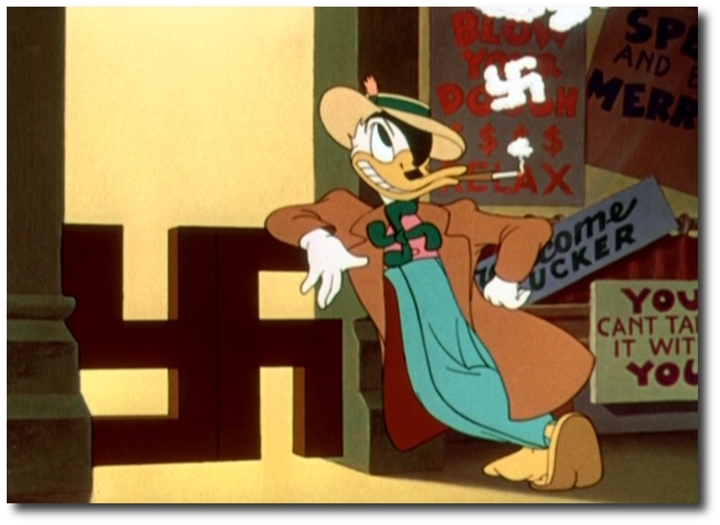 ‘The Spirit of ’43’ is the follow-up to ‘The New Spirit’ from the previous year. The second half is exactly the same, but the first half is even better than the first half of its predecessor, making a clever use of strong symbolic imaginary.
Donald just got paid and he’s divided between his two selves: the thrifty (a Scottish forerunner of Uncle Scrooge) and the spendthrift. These two characters struggle for Donald, in which they both fall down: the spendthrift into a tavern with a swastika-shaped swing-door and the thrifty into a wall, which, together with the stars his fall produces, resembles the American flag. This makes the decision for Donald easier, will he “spend for the axis or save for taxes”? He knocks his spendthrift side into the tavern, crushing the swastika door changing it into a V for victory. At this point the second half starts (see ‘The New Spirit‘ for a description of this part).
‘The Spirit of ’43’ is propaganda, and quite obviously so. But the film is both inventive and effective in its delivery of its message, and therefore surprisingly enjoyable.
Watch ‘The Spirit of ’43’ yourself and tell me what you think:


 Dr. Grob's Animation Review