
You are currently browsing the category archive for the ‘★★★★’ category.
Director: Jan Švankmajer
Release Date: 1965
Rating: ★★★★
Review:
 In ‘A Game with Stones’ (also known by its German title ‘Spiel mit Steinen’) an odd construction, consisting of a clock, a tap and a bucket, produces stones by the hour. These stones form patterns to the music of a music box until the bucket is emptied, dropping the stones on the floor.
The stones’ abstract patterns are indeed game-like, but they become more and more grim, ending in a destructive game, destroying the stones, and eventually, the bucket, leaving the machine useless. The game is over. It is Švankmajer’s genius that he’s able to give this fairly abstract film a heart and an unsettling, sad ending.
‘A Game with Stones’ is Švankmajer’s first film to use stop motion animation extensively. The fourth game contains faces made of numerous small pebbles, which anticipates similar heads in ‘Dimensions of Dialogue’ (1982), a film in which Švankmajer’s stop motion techniques reach a stunning apex.
Watch ‘A Game with Stones’ yourself and tell me what you think:
‘A Game with Stones’ is available on the DVD ‘Jan Svankmajer – The Complete Short Films’
Director: Friz Freleng
Release Date: December 18, 1964
Stars: The Pink Panther, The Little Guy
Rating: ★★★★
Review:
 In his very first own short The Pink Panther nags a painter by painting everything pink that the painter just has painted blue.
This is the Pink Panther’s first film, and it’s easily one of his best. Its simple idea is worked out perfectly into a tight plot (by John Dunn) with a grand finale. Its pantomime animation is effective and its sober design supporting.
Although he never got a name, the “little guy”, the white, big-nosed, mustached antagonist, who resembles both his creator, Friz Freleng, and Inspector Clouseau, is very important to the success of the series: he is easily the best designed opponent in the Pink Panther cartoons. Like the Pink Panther he’s monochrome, and a silent character, allowing the animators to make the best out of pantomime animation. Moreover, he could be staged in all kinds of functions and settings. Nevertheless, he kept a consistent character, being normally kind and gentle, but getting puzzled, then frustrated and often in the end, very angry with the Pink Panther’s antics.
Nevertheless, it took the makers a while to realize his potential, for though the little guy would return as a janitor in ‘We Give Pink Stamps’ (1965), he would only become a regular from ‘The Pink Blue Print‘ (1966) on, after twenty films with other, often talking, and always less wonderfully designed characters.
Watch ‘The Pink Think’ yourself and tell me what you think:
Director: Burt Gillett
Release Date: March 3, 1934
Stars: Mickey Mouse, Pluto
Rating: ★★★★
Review:
 Playful Pluto consists of several loose gags around Mickey and Pluto in a garden. It contains Mickey’s first encounter with a little whirlwind, which he manages better than his second one in ‘The Little Whirlwind’ from 1941.
But ‘Playful Pluto’ is most notable for the now famous flypaper sequence, in which Pluto gets caught in flypaper. This is an important scene in animation history, because it’s the first time Pluto is seen as a thinking character. Not only that, it is arguably the first believable animation of thought processes. This illusion of thought is achieved solely by pantomime animation.
The flypaper scene elevated its animator, Norm Ferguson, to the eternal hall of animation fame and it showed how laughs could originate in character animation alone. This sequence not only raised the standards of animation of Pluto, but of character animation in general. As to celebrate its success, this scene was remade in color for the Donald Duck short ‘Beach Picnic‘ (1939).
At the same time, this cartoon shows how character-based gags could slow down the pace. This was an unfortunate side-effect, for this high pace had been painstakingly achieved in the Mickey Mouse cartoons during the previous years.
Watch ‘Playful Pluto’ yourself and tell me what you think:
This is Mickey Mouse cartoon No. 65
To the previous Mickey Mouse cartoon: Camping Out
To the next Mickey Mouse cartoon: Gulliver Mickey
Director: Wilfred Jackson
Release Date: September 16, 1933
Rating: ★★★★
Review:

‘The Pied Piper’ is a vivid re-telling of the original fairy tale in operetta fashion.
Thus ‘The Pied Pier’, together with ‘King Neptune‘ (1932) and ‘Father Noah’s Ark‘ (1933), belongs to the operetta- like Silly Symphonies. In its score, composed by Leigh Harline, practically all dialogue is sung, making ‘The Pied Piper’ an animated mini-opera.
Its human designs are way more detailed and anatomically correct than in ‘King Neptune’ or ‘Father Noah’s Ark’, making these two films looking old-fashioned, already. Disney was advancing towards the later realism of ‘Snow White and the Seven Dwarfs’ (1937) with a lightning speed…
Unfortunately, at the same time, a sugary approach is unleashed, as well. For example, the rats are not drown, but caught in an imaginary cheese. Likewise, the children, who are depicted as virtual slaves in Hamelin, do not just disappear, but they’re lured into ‘Joyland’, where even the crippled get cured. So, in the end, practically no harm is done to anyone.
And so, like the contemporary ‘Lullaby Land‘, ‘The Pied Piper’ is a strange mixture of ever advancing animation and rather infantile material. A great deal of the remaining Silly Symphonies would share this mixture, and even Disney’s first features, like ‘Snow White and the Seven Dwarfs’ and ‘Bambi‘ (1942) are not immune to it.
The children designs used here would pop up in numerous sugary cartoons from the 1930s, including those from other studios. And, unfortunately, there would be a lot of them…
Watch ‘The Pied Piper’ yourself and tell me what you think:
This is Silly Symphony No. 39
To the previous Silly Symphony: Lullaby Land
To the next Silly Symphony: The Night before Christmas
Director: Wilfred Jackson
Release Date: July 11, 1932
Stars: Mickey Mouse, Minnie Mouse, Pete
Rating: ★★★★
Review:
 ‘Mickey in Arabia’ can be described as ‘Gallopin’ Gaucho‘ in Arabia.
In this short Mickey and Minnie are tourists visiting some mythical Arabian country on a camel. Here they meet Pete, who has both his legs here, and who apparently is some sort of sheik. Pete captures Minnie, which leads to an exciting finale, which consists of continuous series of gags.
Despite its all too familiar story outline, ‘Mickey in Arabia’ is a major step forward in the Mickey Mouse series. It places Mickey outside his familiar barnyard and performance settings, and sends him on an adventure abroad, similar to the ones Mickey was having in Floyd Gottfredson’s comic strip of the same time. Mickey is at his best as the little hero, and he excels here. Gottfredson himself sent Mickey to Arabia, too, but only two years later, at the end of 1934. His comic strip ‘The Sacred Jewel’ borrows a lot of images from this 1932 film.
The adventure notwithstanding, the Disney story men didn’t forget to fill the short with gags, making ‘Mickey in Arabia’ a fast paced and funny short. It also has a great score, which makes excellent use of Albert Ketèlbey’s ‘In a Persian Market’ to create an Arabian atmosphere.
With ‘Mickey in Arabia’, the studio had hit the jackpot storywise, and in the next two years Mickey would play the little hero more often, with delightful results. Indeed, already in the same year, ‘Mickey in Arabia’ would be topped by the even more excellent ‘Touchdown Mickey‘ and ‘The Klondike Kid‘.
Watch ‘Mickey in Arabia’ yourself and tell me what you think:
This is Mickey Mouse cartoon No. 43
To the previous Mickey Mouse cartoon: Musical Farmer
To the next Mickey Mouse cartoon: Mickey’s Nightmare
Director: Walt Disney
Release Date: May 10, 1930
Stars: Horace Horsecollar, Mickey Mouse, Minnie Mouse, Pete
Rating: ★★★★
Review:
 ‘The Cactus Kid’ can be summarized as ‘Gallopin’ Gaucho in Mexico’. Mickey visits a Mexican canteen where Minnie’s a waitress. They make music together until Pete enters and kidnaps Minnie.
When Mickey pulls her nose, we hear Minnie speaking Spanish. The Mexican atmosphere is further enhanced by the use of music from Emmanuel Chabrier’s España, although the chase scene is accompanied by Jacques Offenbach’s (French) can-can.
Pete’s seen with a peg leg for the first time in this cartoon, although he already had a peg leg in several Oswald the Lucky Rabbit cartoons. We also hear him really speak for the first time. Actually, there’s an unprecedented amount of dialogue in this cartoon. Nevertheless, Mickey’s lips still look awkward when he speaks. Fortunately, this problem would soon be solved in the following cartoons.
Horace Horsecollar is recognizable, too, with his characteristic yoke and bowler hat. But he’s still only a partly humanized horse, here, and Mickey rides him. Only in ‘The Shindig‘ from two months later Horace Horsecollar would be fully anthropomorphized.
‘The Cactus Kid’ happened to be the last cartoon Walt Disney directed himself until his unfortunate come-back with ‘The Golden Touch’ five years later. The film was parodied as ‘Galloping Romance’, the cartoon showed in ‘Mickey’s Gala Premier‘ from 1932.
Watch ‘The Cactus Kid’ yourself and tell me what you think:
This is Mickey Mouse cartoon No. 18
To the previous Mickey Mouse cartoon: The Barnyard Concert
To the next Mickey Mouse cartoon: The Fire Fighters
Director: Walt Disney
Release Date: March 6, 1930
Stars: Mickey Mouse
Rating: ★★★★
Review:
 This is a very aptly titled short: we only see Mickey, there are no other stars or characters.
Mickey is the sole performer in his fourth concert cartoon (after ‘The Opry House‘, ‘Mickey’s Follies‘ and ‘The Jazz Fool‘, all from 1929). This time he’s playing the violin, presenting his reading of the fifth Hungarian dance by Johannes Brahms, Träumerei by Robert Schumann (which makes him cry) and, as an encore, the finale from ‘Overture William Tell‘ by Gioachino Rossini.
The whole setting is such that we’ve got the feeling we’re part of the audience ourselves, and that the man with the mocking laugh is among us. Later, the Warner Bros. studio would expand upon this idea of cartoon figures and audience interplay.
‘Just Mickey’ contains some good facial expression animation of Mickey, besides some great shadow effects during his rendering of ‘Träumerei‘. Moreover, the hand movements in this short are remarkably convincing. It is an early showcase of Walt Disney’s ambition to improve the art of animation. Being the first Mickey Mouse cartoon after Ub Iwerks’s departure in January 1930, it shows the studio could do very well without him…
Watch ‘Just Mickey’ yourself and tell me what you think:
This is Mickey Mouse cartoon No. 16
To the previous Mickey Mouse cartoon: Wild Waves
To the next Mickey Mouse cartoon: The Barnyard Concert
Director: unknown
Release Date: February 15, 1926
Stars: Margie Gay (Alice), Julius
Rating: ★★★★
Review:
 Two dog catchers, a bear and a mouse, catch a whole school of dogs.
They also lure some dogs using a girl dog on a balcony. They all end in a prison-like sausage factory, which contains a death chamber. We see a dog actually walk in there (after having been salvaged by a dog priest). He comes out as a string of sausages… Luckily, detectives Alice (Margie Gay) and Julius free all remaining dogs.
This cartoon contains quite some flexible animation, especially of the bear emptying the school.
Watch ‘Alice’s Mysterious Mystery’ yourself and tell me what you think:
‘Alice’s Mysterious Mystery’ is available on the DVD ‘Walt Disney Treasures: Disney Rarities’
Director: Winsor McCay
Release Date: 1921
Rating: ★★★★
Review:
 After a period of unfinished projects, Winsor McCay completed a series of three related films in 1921, ‘Dreams of a Rarebit Fiend’.
These films are the animated counterparts of his comic strip of the same name, which run from 1904 to 1913. The films, like the comics, are about ordinary people having a bad dream. When they awake, they blame it on the food they’ve eaten.
The three animated Dreams of a Rarebit Fiend can be regarded as McCay’s most mature works. They’re not as revolutionary as ‘Gertie the Dinosaur‘ or ‘The Sinking of the Lusitania‘, but they display a total command of form and style, and they are flawless in their execution. It’s too bad, McCay didn’t complete any other film after these three, although he lived for another 13 years.
‘Bug Vaudeville’ is the first of the three ‘Dream of the Rarebit Fiend’ films. In this short, a man falls asleep against a tree and dreams he witnesses a bug vaudeville show. He watches the grasshopper and the ants performing acrobatics, a daddy longlegs (with beard and a a hat) dancing, a cockroach stunting on a bicycle, tumble bugs performing acrobatics, two potato bugs boxing and a butterfly on a horse-like black beetle. He awakes when he dreams that he’s been attacked by a giant spider.
‘Bug Vaudeville’ is an entertaining short, but in some respects it is the weakest of the three Dream of a Rarebit Fiend films. Its viewpoint is static: we see the same stage for the most part of the film, without any change of setting. The bugs are drawn relatively simple, and there’s no particularly outstanding animation involved, either of character or of effects. Highlight may be the cockroach on the bicycle, with its certain control of perspective.
Watch ‘Bug Vaudeville’ yourself and tell me what you think:
This is Winsor McCay’s eighth film
To Winsor McCay’s seventh, unfinished film: Flip’s Circus
To Winsor McCay’s ninhth film: The Pet
Director: Winsor McCay
Creation Date: ca. 1918-1921
Rating: ★★★★
Review:
 After completing four masterpieces, Winsor McCay produced three unfinished films, ‘The Centaurs’, ‘Gertie on Tour‘ and ‘Flip’s Circus‘ (all animated about ca. 1918-1921). ‘The Centaurs’ is the most interesting of the three.
This short film feels like a study. We see a female and a male centaur meeting each other, then we see the male centaur introduce his future wife to his parents, and then suddenly their baby jumps into the scene, frolicking around.
This film once again contains superb animation, rendering totally convincing centaurs. They indeed stand comparison to those of ‘Fantasia’, which were animated about twenty years later. In this short McCay also experiments with his creations moving behind his elaborate backgrounds, creating a great feel of depth.
Watch ‘The Centaurs’ yourself and tell me what you think:
This is Winsor McCay’s fifth film
To Winsor McCay’s fourth film: The Sinking of the Lusitania
To Winsor McCay’s sixth, unfinished film: Gertie on Tour
Director: Dave Fleischer
Release Date: March 2, 1934
Stars: Betty Boop, Koko the Clown
Rating: ★★★★½
Review:

‘Ha! Ha! Ha! was the last cartoon to feature Koko the Clown.
It opens with supposedly Max Fleischer’s hand drawing Betty Boop on a sheet of paper. When Max leaves the studio, Koko comes out of the inkwell for the very last time, and starts eating the candy bar Max had left on the table.
Almost immediately he develops a tootache, so Betty draws a dentist room to operate him, herself acting as the (most sexy) dentist. She first tries to pull Koko’s tooth, but when that doesn’t work, she tries laughing gas.
The laughing gas soon pervades everything, causing not only Koko and herself to laugh, but even the clock, the typewriter, and outside – in the real world – the mailbox, the cars and real people. Even a bridge and some graves join in.
This enjoyable and weird cartoon mixes animation, photographed backgrounds and live action to great results, and it forms a great finale to Koko’s long career, which had lasted fifteen years. Although Koko never had any great roles near Betty, he would be missed, for without Koko and Bimbo (who had his last screen appearance in ‘I Heard‘ from September 1933), Betty became a surprisingly inoffensive and boring character, and none of her remaining 62 films evoked the same fun as ‘Ha! Ha! Ha!’.
Watch ‘Ha! Ha! Ha!’ yourself and tell me what you think:
This is Betty Boop cartoon No. 26
To the previous Betty Boop cartoon: Red Hot Mamma
To the next Betty Boop cartoon: Betty in Blunderland
‘Ha! Ha! Ha!’ is available on the French DVD Box Set ‘Betty Boop Coffret Collector’
Director: Dave Fleischer
Release Date: September 1, 1933
Stars: Betty Boop, Bimbo, Koko The Clown
Rating: ★★★★
Review:
 Betty Boop works in a tavern near a coal mine, where Koko The Clown and Bimbo are working. The latter discovers some ghosts in the mine.
This short contains an excellent swinging jazz score by Don Redman and his orchestra, who are introduced in the beginning of the picture, playing in a zany cartoon decor. The music includes adapted versions of Don Redman’s hit songs ‘How am I doing?’ (1932) and ‘I Heard’ (1931).
‘I Heard’ was the last Fleischer cartoon to feature a great jazz score. Don Redman, and his predecessors Cab Calloway and Louis Armstrong, where soon replaced by Rubinoff and his orchestra playing sweet semi-classical music in ‘Morning Noon and Night‘ and ‘Parade of the Wooden Soldiers‘ (both late 1933). Even worse, the cartoon marked Bimbo’s last screen appearance. Being an animal he was no longer accepted as being Betty’s suitor in a Hays Code dominated Hollywood which shunned all eroticism and ‘unnatural sexual behavior’, including human-animal relationships.
After Bimbo, Betty would shortly date a human character named Fearless Freddie, but from 1935 on she remained a bachelor apparently with no interest in men whatsoever. In this cartoon, though, she’s still sexy, and she can briefly be seen in her underwear, after the elevator she and Bimbo had taken has crashed.
Thus, in many ways, one can regard ‘I Heard’ as the last of the classic Betty Boop cartoons. After this cartoon, the intoxicating mix of sex and surrealism was only seen once, in the compilation cartoon ‘Betty Boop’s Rise to Fame‘ (1934), a last tribute to Betty’s glory days.
Watch ‘I Heard’ yourself and tell me what you think:
This is Betty Boop cartoon No. 20
To the previous Betty Boop cartoon: The Old Man of the Mountain
To the next Betty Boop cartoon: Morning Noon and Night
‘I Heard’ is available on the French DVD Box Set ‘Betty Boop Coffret Collector’
Director: Wilfred Jackson
Release Date: March 28, 1936
Rating: ★★★★
Review:
 ‘Elmer Elephant’ is a beautiful cartoon. It’s full of cute animals, but despite its cuteness it never becomes cloying. Based on an idea by story artist Bianca Majolie, its storyline is very straightforward and really heartfelt, like the best of Disney’s works.
Elmer visits the birthday party of one of his jungle friends, the extremely cute girl tiger Tilly. He appears to be her favorite guest, but all the other animals (including some non-tropical foxes) mock him because of his trunk, singing “your nose is like a rubber hose”. Moreover they bully and taunt him and send him away.
Unhappy, Elmer wanders through the jungle, but then he encounters even stranger-looking animals: an old giraffe and three Jimmy Durante-like pelicans, who comfort him a little. Then, suddenly, there’s a fire in Tillie’s tree hut. Elmer comes to the rescue, and with help of his nose and of his new odd friends he saves Tillie from the anthropomorphized flames. Thus being the hero of the day he wins Tillie’s love, displayed by a kiss.
Elmer Elephant has the looks of a storybook. It’s beautifully animated, with lots of shadows, and it has well-designed characters. Especially the hippo, who has an absurdly low voice, is a wonderful character. It’s both surprising and a shame that no other cartoon has been made with these cute characters in their beautiful jungle forest, although Elmer and Tilly have a cameo appearance in ‘Toby Tortoise Returns‘.
Of course, the idea of a kind elephant being mocked for a handicap would later return in ‘Dumbo’ (1941), making ‘Elmer Elephant’ its immediate predecessor.
Watch ‘Elmer Elephant’ yourself and tell me what you think:
This is Silly Symphony No. 59
To the previous Silly Symphony: Broken Toys
To the next Silly Symphony: Three Little Wolves
Director: Graham Heid
Release Date: May 27, 1938
Rating: ★★★★
Review:
 ‘Wynken, Blynken and Nod’ is one of the last, and certainly one of the most spectacular Silly Symphonies ever made.
There is hardly any story: at the start of the cartoon we hear the poem being sung by a sugary soprano, then we watch Wynken, Blynken and Nod sailing the Milky Way and fishing ‘starfish’ and being at the mercy of some clouds.
The three babies are very alike, with Nod being the ‘Dopey’ of the three, and the humor is mild. But, boy, the looks of this cartoon! Like two other Silly Symphonies obsessed with babies and their bare behinds (‘Lullaby Land’ from 1933 and ‘Water Babies’ from 1935), ‘Wynken, Blynken and Nod’ is a showcase of Disney Animation. The cartoon features extraordinarily beautiful backgrounds, and literally bursts with effect animation, rendering astonishingly beautiful stars, comets, clouds and lightnings. The fantasy is enhanced by a wonderful score, which makes clever use of ‘Twinkle Twinkle Little Star’. All this gives one the feeling of watching a mini-Fantasia.
Certainly, no animated cartoon would ever show such lushness again. As such, in a sense ‘Wynken, Blynken and Nod’ forms the end and culmination of an era, which had started in the end of 1933, in which the Disney studio combined ever growing ambitions with childish and sugary material.
‘Wynken, Blynken and Nod’ was the only cartoon directed by Graham Heid. Remarkably little is known about this artist, who also contributed to ‘Pinocchio‘, ‘Fantasia’ and ‘Bambi‘. In fact, I can only find a birth date (November 14, 1909). This is rather surprising, for one can have worse seven minutes of fame than this delightful short. Luckily, animation historians Jerry Beck & Michael Barrier help us out on the Cartoon Research F.A.Q. page.
One trivial remark: ‘Wynken, Blynken and Nod’ is based on the 1889 published poem ‘Dutch Lullaby’ by Eugene Field. Indeed, the words Wynken and Blynken seem to suggest some Dutch origin, but there are no such verbs in the Dutch language, which would translate ‘to wink’ and ‘to blink’ as ‘knipogen’ and ‘knipperen’, respectively.
Watch ‘Wynken, Blynken and Nod’ yourself and tell me what you think:
This is Silly Symphony No. 70
To the previous Silly Symphony: Moth and the Flame
To the next Silly Symphony: Farmyard Symphony
Director: Wilfred Jackson
Release Date: July 13, 1935
Stars: Mickey Mouse, Pluto
Rating: ★★★★
Review:
 ‘Mickey’s Garden’ is Mickey’s second color cartoon (after ‘The Band Concert‘).
It’s also Pluto’s first: he passes the transition into color fluently, getting his typical orange color we’re all familiar with now.
Mickey and Pluto are in the garden trying to kill a number of insects eating Mickey’s crop. When Mickey accidentally sprays himself with bug poison he starts to hallucinate (the transition to the dreamworld is particularly psychedelic: everything, including the background becomes unsteady and wobbly). He dreams that all plants and bugs have grown. This leads to some imaginative scenes. The bugs are not very lifelike, though. The animators even make a weird mistake by giving a particularly evil-looking beetle eight legs instead of six.
Watch ‘Mickey’s Garden’ yourself and tell me what you think:
This is Mickey Mouse cartoon No. 76
To the previous Mickey Mouse cartoon: Mickey’s Kangaroo
To the next Mickey Mouse cartoon: Mickey’s Fire Brigade
Director: David Hand
Release Date: January 7, 1933
Stars: Mickey Mouse, Minnie Mouse, Pete ,Pluto
Rating: ★★★★
Review:
 ‘Building a building’ has a grand opening with its close-up of the anthropomorphized excavator.
This fast and gag-rich cartoon can be summarized as ‘Gallopin’ Gaucho‘ at a building site: Mickey is employed as an excavator machinist. When Minnie drops by selling box lunches, Mickey is so struck by love that he ruins the blueprints of foreman Peg Leg Pete three times. Pete is charmed by Minnie, too, and he tries to force her to a kiss. Of course, Mickey comes to the rescue, fleeing with Minnie and leaving Pete behind with the building in complete shambles. Pete just manages to fire Mickey, but Minnie immediately adds him to her business.
‘Building a Building’ reuses several story ideas from the early Oswald cartoon ‘Sky Scrappers‘ (1928). Both feature the hero being an excavator machinist, his love interest bringing box lunches, and Pete trying to abduct the girl. Even the excavator opening shot is a copy of the opening shot of ‘Sky Scrappers’. However, in five years both animation, timing and characterization have much improved. If ‘Sky Scrappers’ was a remarkable achievement for 1928, it was at times still crude. ‘Building a Building’ on the other hand has a refined quality that characterized the Mickey Mouse cartoons of 1933 and beyond.
There’s for example some remarkably flexible animation on Mickey when he rides the elevator. The animators have really put a sense of weight in his body, and exaggerated the effects of the sudden start and stop of the lift on it, with a lovely comic result. The musical score, too, is a delight from beginning to end, becoming particularly silly when Pete’s trousers change into a watering can. Indeed, with ‘Building A Building’ Mickey got his second Academy Award nomination, after ‘Mickey’s Orphans‘ (1931)
‘Building a Building’ is the first of a few 1933 Mickey Mouse cartoons that are introduced and partly played out in Song, following the Silly Symphonies ‘King Neptune‘ and ‘Santa’s Workshop‘ from 1932. Other examples from 1933 are ‘The Mad Doctor‘, ‘Ye Olden Days‘ and ‘The Mail Pilot‘.
Watch ‘Building a Building’ yourself and tell me what you think:
This is Mickey Mouse cartoon No. 51
To the previous Mickey Mouse cartoon: Mickey’s Good Deed
To the next Mickey Mouse cartoon: The Mad Doctor
Director: Walt Disney
Release Date: April 25, 1929
Stars: Mickey Mouse
Rating: ★★★★
Review:
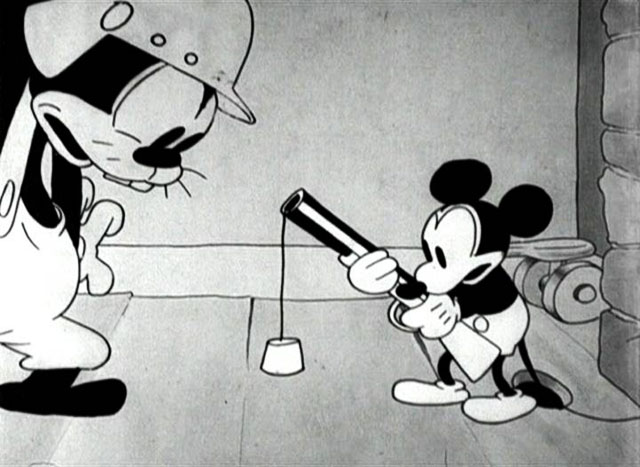 Mickey joins a barnyard army of mice (many of which are Mickey look-a-likes) against an invading army of cats.
We see him naked while he’s treated rather badly by a very rude officer. Mickey’s body is extraordinarily mechanical in this scene: the officer is able to stretch his neck and tongue endlessly, and can even take out Mickey’s heart.
In the next scene another officer shouts “company, forward march!”, making him the first character in a Disney cartoon that actually speaks. Up to this moment characters would only utter single syllable sounds and laughs. Only Minnie could express two syllables with her yoo-hoo, but that was it.
In spite of this step forward, ‘The Barnyard Battle’ remains, in effect, a silent cartoon. The way the inspecting officer asks Mickey to stick out his tongue is a perfect example. The highlight of silent acting, however, is given to Mickey, who, when confronted with a large and mean cat, gives a performance that matches Charlie Chaplin.
Mickey’s size is rather inconsistent in this cartoon. His never as small as in ‘When the Cat’s Away‘, but in some scenes he’s clearly much smaller than usual. The battle has more allusions to the American civil war than to World War I, making it a little more comfortable. Mickey finally defeats the cats by clobbering them with a hammer to Verdi’s anvil chorus from ‘Il Trovatore’. This is probably the first animated scene in which something totally unmusical is done musically. A great cartoon idea, which would be greatly expanded in many cartoons to come.
Watch ‘The Barnyard Battle’ yourself and tell me what you think:
This is Mickey Mouse cartoon No. 7
To the previous Mickey Mouse cartoon: When the Cat’s Away
To the next Mickey Mouse cartoon: The Plow Boy
Director: Friz Freleng
Release Date: November 11, 1946
Stars: Bugs Bunny
Rating: ★★★★
Review:
 A very deft Bugs Bunny plays Franz Liszt’s second Hungarian rhapsody on a piano. This classical piece was director Friz Freleng’s all-time favorite, and it appears in several of his films.
In ‘Rhapsody Rabbit’ it is played out full. The cartoon consists of spot gags and it has a small story about Bugs having problems with a mouse. This story element is not well-developed and dropped halfway the cartoon, only to return at the end.
The idea of a battle between the pianist and a mouse was perfected by Hanna & Barbera only five months later in their Tom & Jerry cartoon ‘The Cat Concerto‘, which has exactly the same subject, and which uses exactly the same music by Liszt. Unlike Freleng however, the duo swept the Oscar… There seems to be something fishy about this fact, which is analyzed in detail by Thad Komorowski in his excellent blogpost on the issue.
Compared to the latter cartoon, ‘Rhapsody Rabbit’ is less consistent, but more absurd. The gag in which the mouse makes Bugs play an infectious boogie-woogie may be the highlight of the film.
Watch ‘Rhapsody Rabbit’ yourself and tell me what you think:
http://www.220.ro/desene-animate/Rhapsody-Rabbit/RnRu8v7HIK/
This is Bugs Bunny cartoon No. 41
To the previous Bugs Bunny cartoon: The Big Snooze
To the next Bugs Bunny cartoon: Rabbit Transit
Director: Wilfred Jackson
Release Date: June 9, 1934
Stars: Donald Duck
Rating: ★★★★
Review:
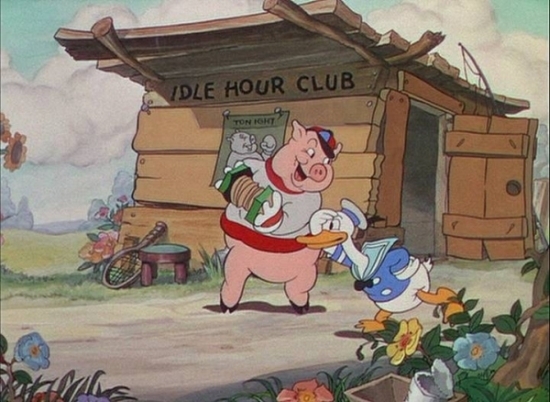 ‘The Wise Little Hen’ is a simple and quite moralistic Silly Symphony carried by a mediocre, yet all too memorable song. I guess it might have fallen into oblivion, were it not for Donald Duck.
In his first appearance Donald Duck is a real sailor, living on a boat and dancing the hornpipe. He’s a strong voice character from the start. When he joyfully shouts ‘oh boy, oh boy, oh boy!’ we all know it’s him, even though his looks are different.
Indeed, like Goofy’s voice, Donald Duck’s voice anticipated the character. When Walt Disney heard Clarence Nash use this particular voice, he really wanted something to do with it. According to animator Bill Cottrell, cited in ‘They Drew As They Pleased’, concept artist Albert Hurter was responsible for the duck’s looks. He gave Donald his trademark sailor suit, which he maintained to the present day.
Besides his typical voice and suit, Donald Duck displays two of his typical character traits: egotism and his tendency to trick others. However, he does not yet display his short temper: when ultimately foiled by the hen he’s not breaking down in anger, but joins Peter Pig in remorseful self-chastisement (a gag reused from an early Oswald the Lucky Rabbit cartoon called ‘Rival Romeos‘, 1928). But Donald would show his temper, in his next cartoon: ‘Orphan’s Benefit‘.
Besides Donald Duck this cartoon is interesting for an appetizing and startlingly realistic animation shot of butter melting on hot corn.
Watch ‘The Wise Little Hen’ yourself and tell me what you think:
This is Silly Symphony No. 45
To the previous Silly Symphony: The Big Bad Wolf
To the next Silly Symphony: The Flying Mouse
Director: Burt Gillett
Release Date: July 30, 1932
Stars: Pluto
Rating: ★★★★
Review:
 ‘Just Dogs’ opens with a dog pound, with several dogs howling to the tune of Vernon Dalhart’s 1924 hit ‘The Prisoner’s Song’.
Then a little black dog escapes, and helps Pluto and several other dogs escaping, too. Once outside the little dog repeatedly tries to gain Pluto’s sympathy, to no avail. Not even when it shares a large bone with Pluto. When an annoying little Pekingese warns the other dogs of the bone, trouble starts, but the little dog saves the day with the help of legion of fleas, while Pluto remains busy with an alarm clock. Only then he gains Pluto’s much wanted sympathy.
‘Just Dogs’ is not a particularly funny or beautiful short and its star, Pluto, is most of the time quite unsympathetic, but it does show the advancements in animation Disney was making at the time: we’re not watching ‘just dogs’, we’re watching several recognizable types of dogs, among them a very lifelike St. Bernard.
By now, the Disney animators didn’t need to stick to stereotyped ducks, pigs, cows, horses, or in this case, dogs, but were able to draw and animate real dogs, who looked like dogs, moved like dogs and behaved like dogs. This kind of naturalism is quite unprecedented in earlier films. ‘Just Dogs’ is still a mixed bag: some of the designs are still very primitive, especially during the escape scene, but there are some striking new designs here, not in the least, the small, optimistic black dog, who ‘s the real hero of the short.
The two main protagonists, Pluto and his clever comrade, are two distinct characters, which behave and move differently, a great advancement in character animation. Disney would develop both naturalism and character animation into perfection in the coming seven years.
Two years later the little dog would reappear as Pluto’s rival Terry in Floyd Gottfredson’s Mickey Mouse comics.
Watch ‘Just Dogs’ yourself and tell me what you think:
This is Silly Symphony No. 28
To the previous Silly Symphony: The Bears and the Bees
To the next Silly Symphony: Flowers and Trees


 Dr. Grob's Animation Review