
You are currently browsing the category archive for the ‘★★★’ category.
Director: Albert Barillé
Airing date: October 30?, 1982
Rating: ★★★
Review:
 ‘Du côte d’Andromède’ is the first episode of Il était une fois… l’espace in which Pierrot, his love Psi, and the little robot Metro are presented as a team.
Psi replaces Pierrot’s former co-pilot, Petit Gros, whose star would soon fade away. The trio’s routine inspection flight turns into a disaster when they crash into the planet Clarus, which orbits a dying star. In search of fresh air, our heroes meet a people called Terks, who are outcasts from Andromeda.
They also discover that the Terks are secretly armed by the evil constellation of Cassiopeia in order to invade Andromeda, making Clarus the third of four planets in the Andromeda Galaxy Cassiopeia is trying to use for an invasion. Naturally, the Terks aren’t fond of spies, and our heroes are about to get executed, when their friends from Omega come to the rescue.
Like ‘La planète verte‘, ‘Du côte d’Andromède’ shows Barillé’s love to show and explain political manipulations to children. This episode also introduces the vague, angel-like creature who visits Psi and tells her that evil will never win.
Watch ‘Du côté d’Andromède’ yourself and tell me what you think:
This is the 4th episode of ‘Il était une fois… l’espace’ (Once Upon a Time… Space)
To the 3rd episode: La planète verte (The Green Planet)
To the 5th episode: Les Cro-Magnons (The Cro-Magnons)
Director: Albert Barillé
Airing date: October 23?, 1982
Rating: ★★★
Review:
 Unlike the majority of the episodes of ‘Il était une fois… l’espace’, ‘La planète verte’ starts with politics: we witness a political conflict between Omega and Cassiopeia.
Like in ‘Les Sauriens‘, Cassiopeia tries to invade a green, primitive planet in the Andromeda section (something they would also try to do in the fifth episode). Only after more than eight minutes our heroes Pierrot and Petit Gros enter the stage. They check the planet, which turns out to be inhabited by intelligent plants, who have captured their invaders, including general Teigneux (The Pest) and ambassador Nabot (Dwarf) themselves.
This episode show us more of Cassiopeia than the two previous episodes. This society turns out to be very militaristic with Nazi-like characteristics. Because of Cassiopeia’s more prominent role, ‘La planète verte’ is more interesting than the previous two episodes, if not too exciting.
Watch ‘La planète verte’ yourself and tell me what you think:
This is the 3rd episode of ‘Il était une fois… l’espace’ (Once Upon a Time… Space)
To the 2nd episode: Les Sauriens (The Saurians)
To the 4th episode: Du côté d’Andromède (Towards Andromeda)
Director: Ward Kimball
Airing date: December 28, 1955
Stars: Walt Disney, Ward Kimball, Wernher von Braun
Rating: ★★★
Review:
 After ‘Man in Space‘ (1955), ‘Man and the Moon’ is the second of three Disneyland broadcasts documenting man’s plans to conquest space.
‘Man of the Moon’ deals with the conquest of the moon, and consists of four parts. The first, largely animated, tells about man’s fascination for the moon, depicting the moon in mythology, in literature, in folklore, in nursery rhymes and in song. This sequence is a highlight of ‘cartoon modern’ style, and is full of director Ward Kimball’s trademark zany humor. It’s also the highlight of the documentary, despite the studio’s efforts to evoke the first mission to the moon in the fourth part. The folklore section is the most bold part featuring a highly stylized man, but even better are the charming animated children’s drawings in the nursery rhyme section. The sequence ends hilariously with a silly tin pan alley song about the moon, in which the writers throw in every obvious rhyme word (June, swoon, spoon, honeymoon, and even Daniel Boone).
After 18 minutes of great animation, the live action sections start, beginning with the second part. This is the shortest of the four, and features Ward Kimball in real person, telling us facts about the moon. The third part is hosted by German rocket scientist Wernher von Braun, who tells about a possible mission to the moon. Surprisingly, Von Braun does not try to land on the moon, but merely wants to fly around it. His plans involve the assembly of a giant wheel-like space station before even one vessel is flown to the moon.
His plans are shown in the fourth part as an “on the spot account of the first expedition to the moon”. Unfortunately, this is not as exciting a finale it possibly was in 1955, despite the dramatic music and the inclusion of an emergency scene in which a small meteor hits one of the fuel tanks. Nevertheless, the special effects are quite good, showing the space station rotating, and smaller reparation vessel leaving the moon rocket. Especially, weightlessness within the moon rocket is shown quite convincingly.
In 1957 Disney even showed more ambitious space plans, in ‘Mars and Beyond’.
Watch ‘Man and the Moon’ yourself and tell me what you think:
Director: Friz Freleng
Release date: October 13, 1956
Stars: Sylvester, Elmer Fudd
Rating: ★★★
Review:
 ‘Yankee Dood It’ was the last of three propaganda cartoons Friz Freleng directed for the Alfred P. Sloan Foundation, following the earlier ‘By Word of Mouse‘ (1954) and ‘Heir-Conditioned‘ (1955).
This cartoon is an original take on the famous fable of the shoemaker and the elves. Elve company W is missing, and elven king (Elmer Fudd but smaller and wih pointed ears) is wondering where they are. They turn out to be still helping the old shoemaker.
In order to get the elves back, a little elf and the king tell the old shoemaker how companies work, thus telling the short’s propagandistic message. Unfortunately, the shoemaker’s exclamations of ‘Dear Jehosapath’ turn the elves into mice, much to delight of the cat Sylvester (who appears in all three of these shorts).
‘Yankee Dood It’ is a nice, if rather slow propaganda short that only sees advantages of the capitalistic system: lower prices and higher wages. Possible drawbacks like poverty, monopolization, unemployment and pollution are, of course, wisely left out.
Watch ‘Yankee Dood It’ yourself and tell me what you think:
Director: Friz Freleng
Release date: November 26, 1955
Stars: Sylvester, Elmer Fudd, Tweety (cameo)
Rating: ★★★
Review:
 ‘Heir-Conditioned’ was the second of three propaganda cartoons funded by the Alfred P. Sloan Foundation (the other two being ‘By Word of Mouse‘ from the previous year, and ‘Yankee Dood It‘ from the next year).
In this cartoon Sylvester has inherited a fortune, and all the alley cats try to persuade him to spend it. But Elmer, who’s Sylvester’s financial adviser, persuades Sylvester, and all the listening cats, to invest the money, in a lecture celebrating the capitalistic system, now focusing on the importance of investment. Sylvester remains pretty much the straight man in this cartoon, with most of the comic relief coming from the alley cats.
Watch ‘Heir-Conditioned’ yourself and tell me what you think:
Director: Friz Freleng
Release date: October 2, 1954
Stars: Sylvester
Rating: ★★★
Review:
 In the mid-fifties Friz Freleng directed three propaganda shorts celebrating the American capitalistic system. They were funded by the right wing Alfred P. Sloan Foundation and curiously, they all feature Sylvester the cat.
‘By Word of Mouse’ is the first of the three. In this cartoon we’re taken to the rather backward German town of “Knöckwurst-on-der-Rye”. Here mouse Hans tells his siblings about his trip to America. Cut to his memories: we watch him meeting his cousin Willie at the harbor. Willie takes the astounded Hans to a trip, showing the riches of the Americans. Because Hans doesn’t understand how this can be, Willie takes him to a university mouse, who lectures the two about mass production and mass consumption.
Comic relief is provided by Sylvester, who chases the three mice, interrupting the lectures. But he cannot hide the fact that, although being an ordinary Looney Tune, ‘By Word of Mouse’ is pretty informative, if rather propagandistic by single-mindedly glorifying the wonders of capitalism.
‘By Word of Mouse’ was followed by ‘Heir-Conditioned‘ (1955) and ‘Yankee Dood It‘ (1956), covering similar grounds.
Watch ‘By Word of Mouse’ yourself and tell me what you think:
Director: Chuck Jones
Release date: February 25, 1956
Stars: Bugs Bunny, Witch Hazel
Rating: ★★★
Review:
 ‘Broomstick Bunny’ was the second of three Bugs Bunny cartoons, featuring Witch Hazel, the others being ‘Bewitched Bunny’ (1954) and ‘A Witch’s Tangled Hare’ (1959).
‘Broomstick Bunny’ is a halloween cartoon, in which Bugs Bunny, wearing a witch mask, tries to get trick or treat from Witch Hazel.
Unfortunately, she sees in him a competitor in ugliness. In the end, she drinks her own beautifying potion, turning into a beautiful redhead girl, soon being chased by the genie from her magic mirror. Hazel’s girl image was allegedly modeled after her voice actress, June Foray.
Jones’s animation style becomes close to a mannerism here, with a practically obligatory way to depict Witch Hazel speeding away, leaving numerous hairpins in the air. The cartoon is saved by Ernie Nordli’s extreme layouts and Philip DeGuard’s more than fabulous backgrounds, which belong to the most beautiful of the cartoon modern age.
Watch ‘Broom-stick Bunny’ yourself and tell me what you think:
http://www.ulozto.net/live/x5US9Dz/bugs-bunny-broom-stick-bunny-1956-avi
This is Bugs Bunny cartoon No. 120
To the previous Bugs Bunny cartoon: Bugs’ Bonnets
To the next Bugs Bunny cartoon: Rabbitson Crusoe
Director: Tex Avery
Release date: June 6, 1955
Rating: ★★★
Review:
 In ‘Sh-h-h-h-h-h’ small, mustached Mr. Twiddle suffers from “trombonosis”.
He tries to calm down his nerves in an extraordinarily quiet hotel in the Swiss alps. But then some noisy neighbors drop in, who play the trombone and laugh all the time. In the end, they turn out to be Mr. Twiddle’s own doctor and nurse.
‘Sh-h-h-h-h-h’ was the last of only four cartoons Tex Avery directed at Walter Lantz. It is also the last theatrical cartoon he ever made. Unfortunately, it is not a great goodbye. Although excellently timed, ‘Sh-h-h-h-h-h’ is only a mildly amusing cartoon, which reuses many of Avery’s gag routines. It has some fatigued and sad feeling to it, as if Avery himself was tired of his own routines.
Having served his contract at Lantz, Avery left the studio on August 20th, 1954, only six months after he had started there. Avery founded his own company, Cascade Studios, with which he made several animated commercials for television. He kept this studio running until the late 1970s. After that he joined Hanna-Barbera, working on a few Saturday morning series until his death in August 1980.
After Avery had left Lantz, Alex Lovy took over his unit. Although the studio rarely hit Avery’s heights, Avery’s influence on the Lantz studio was strong, and kept being visible throughout the 1950s, leading to several inspired cartoons.
Watch ‘Sh-h-h-h-h-h’ yourself and tell me what you think:
Director: Tex Avery
Release date: February 14, 1955
Rating: ★★★
Review:
 ‘Crazy Mixed-up Pup’ was the second of four cartoon Tex Avery directed at the Walter Lantz studio. Unfortunately, it is not one of his best.
When a man and his dog are overrun by a car, mixed-up blood plasma results in mixing their behavior: the man starts to act dog-like, while the dog wins some human character traits. This is not a very exciting idea to start with, and Avery milks this premise to a nice finale, without ever getting really funny. Luckily, he would do much, much better with his next cartoon at Lantz, ‘The Legend of Rockabye Point‘ (1955).
The married couple, ‘Maggie and Sam’, were reused in three more cartoons in 1956-1957.
Watch ‘Crazy Mixed-up Pup’ yourself and tell me what you think:
Director: Dick Lundy
Release Date: March 25, 1949
Stars: Woody Woodpecker, Buzz Buzzard
Rating: ★★★
Review:
 Woody wants to go and buy a ‘drooler’s delight’ (a large sorbet), but Buzz Buzzard steals his quarter.
The rest of the cartoon consists of Woody and Buzz fighting for it, with mildly amusing results.
‘Drooler’s Delight’ was to be Dick Lundy’s last cartoon at Walter Lantz. After a squabble with his distributor, Universal, and a short fling with United Artists, Walter Lantz was forced to close down his studio in 1948, and Lundy was left on the street. In May 1950 he replaced Tex Avery at MGM, who had left for a sabbatical. At MGM Lundy directed one Droopy cartoon and revived the Barney Bear series.
Lantz meanwhile was able to reopen his studio in 1950. But because he had to watch his budgets more than ever, the quality of the cartoons would rarely match that of his 1940s output.
Watch ‘Drooler’s Delight’ yourself and tell me what you think:
https://www.dailymotion.com/video/xadkeu
This is Woody Woodpecker cartoon No. 31
To the previous Woody Woodpecker cartoon: Wild and Woody
To the next Woody Woodpecker cartoon: Puny Express
‘Drooler’s Delight’ is available on the DVD-set ‘The Woody Woodpecker and Friends Classic Cartoon Collection’
Director: Dick Lundy
Release Date: June 16, 1947
Stars: Wally Walrus
Rating: ★★★
Review:
 ‘Overture to William Tell’ was the second of three Musical Miniatures, a short-lived series similar to ‘Swing Symphonies’, but based on classical music instead of jazz.
In this one Wally Walrus stars in his very own cartoon as a conductor conducting an extraordinarily sleepy orchestra in a concert hall. The main gag involves a horsefly, which looks like a miniature horse with wings.
‘Overture to William Tell’ is better than the erratic ‘Musical Moments from Chopin‘, the first of the Musical Miniatures. But still it’s only moderately inspired, and pales when compared to that other concert cartoon using the same music by Gioachino Rossini, ‘The Band Concert‘ (1935).
Watch ‘Overture to William Tell’ yourself and tell me what you think:
Director: Jack Hannah
Release Date: August 22, 1947
Stars: Donald Duck, Bootle Beetle
Rating: ★★★
Review:
 In the postwar era Jack Hannah introduced three adversaries of Donald Duck: Bootle Beetle, Chip ‘n Dale*, and a little bee. Bootle Beetle, a little insect, was the first and surely the cutest of the lot.
In his first film Bootle Beetle, who resembles Jiminy Cricket a little, is introduced here as a rare species. In fact, we’re watching two Bootle Beetles, with the elderly one telling a younger one about his meeting with bug collector Donald Duck, who, in some scenes, is depicted as an enormous giant. These scenes with a humongous Donald are the highlights of a cute and gently cartoon, which is unfortunately low on gags.
Bootle Beetle would return in two 1949 Donald Duck cartoons, ‘Sea Salts‘ and ‘The Greener Yard‘. The little insect never became funny, and Hannah dropped him as Donald’s adversary after these three cartoons. His last role was as a narrator in ‘Morris, the Midget Moose‘ (1950).
Watch ‘Bootle Beetle’ yourself and tell me what you think:
This is Donald Duck cartoon No. 64
To the previous Donald Duck cartoon: Donald’s Dilemma
To the next Donald Duck cartoon: Wide Open Spaces
* Chip ‘n Dale actually made their debut in the war short ‘Private Pluto‘ (1943), directed by Clyde Geronimi, but it was Hannah who turned the two chipmunks into two different characters and made them opponents of Donald Duck.
Director: Paul Grimault
Release Date: 1946
Rating: ★★★
Review:

In this sweet little film, a boy-like minstrel and his misshapen dog disturb a nobleman in a castle.
The nobleman destroys the minstrel’s lute, whereupon a little bird gives the boy a magical flute, which makes alle people dance, including the evil nobleman and his birdlike soldiers.
This pantomime story is elaborately animated, but its designs belong more to the thirties than to the forties, and its story is hampered by uneven timing.
The idea of a flute making people dance was reused twelve years later by Belgian comic artist Peyo in his ‘La flûte à six schtroumpfs’ introducing his famous creations, the smurfs. This was also made into an animation film in 1976.
‘La flûte magique’ is available on the DVD ‘Le roi et l’oiseau’
Director: Robert McKimson
Release Date: April 12, 1947
Stars: Daffy Duck
Rating: ★★★
Review:
 Daffy Duck tricks a dog called Leopold with a ‘poisoned bone’ to let him stay at his house during the winter.
Unfortunately, the dog’s owner is an evil scientist (a caricature of Peter Lorre) who happens to be looking for a duck’s wishbone. This leads to a wild chase full of pretty weird gags and off-beat dialogue penned by Warren Foster.
‘Birth of a Nation’ is the second of two Warner Bros. cartoons featuring Peter Lorre as a mad scientist, the other being ‘Hair-Raising Hare’ from 1946. New voice artist Stan Freberg does an excellent job in mimicking and parodying Lorre’s typical voice.
Watch ‘Birth of a Notion’ yourself and tell me what you think:
This is Daffy Duck cartoon No. 36
To the previous Daffy Duck cartoon: The Great Piggy Bank Robbery
To the next Daffy Duck cartoon: Along Came Daffy
‘Birth of a Notion’ is available on the DVD-set ‘Looney Tunes Golden Collection Volume Six’
Director: Chuck Jones
Release Date: December 31, 1967
Rating: ★★★
Review:
 Even though not entirely successful, ‘The Bear That Wasn’t’ is a beautiful, highly stylized film, which uses some avant-garde techniques to tell its story, which makes it one of the most daring of the MGM cartoons, comparable to independent cartoons from the era.
Based on the children’s book by Jones’s former Warner Brothers colleague Frank Tashlin, ‘The Bear That Wasn’t’ tells the story of a bear who ends up in a factory after hibernation, and who’s told he’s not a bear, but “a silly man who needs a shave and who wears a fur coat” so many times, he comes to believe it himself.
Jones quite faithfully retells Tashlin’s simple, but deep story, but the cartoon is hampered by bad sound design, canned music and a theme song that never really develops. Moreover, it features a lot of smoking, which distracts the viewer from the main subject. Despite being billed as a producer Frank Tashlin was not involved in the film, at all, and he reportedly hated the film…
Watch ‘The Bear That Wasn’t’ yourself and tell me what you think:
Directors: Jill Culton, Roger Allers & Anthony Stacchi
Release Date: September 29, 2006
Rating: ★★★
Review:
 With ‘Open Season’ Sony Pictures joined the American computer animated feature pool, being the fourth major company to do so. And because in this world American animation films from the same year share the same features, ‘Open Season’ is about forest animals living near the civilized world, just like Dreamworks’s ‘Over The Hedge‘.
The story of ‘Open Season’ (a domesticated bear called Boog is left in the wild and tries to find his way back home) is fairly original (although similar to ‘Cars’), but like its setting, its execution is not. Like ‘Shrek’ (2001) and ‘Ice Age‘ (2002) it’s a buddy film full of fast-talking, wisecracking animals, with the sap deer Elliott (voiced by Ashton Kutcher) being all too similar to Donkey in ‘Shrek’.
Moreover, some scenes are rather formulaic, like the break-up scene after the waterfall ride (see also ‘Shrek’, ‘Monsters, Inc.‘), the ‘we-can-do-this-together-scene’ (see ‘A Bug’s Life’, ‘Robots‘), and the almost obligate near-death of Elliott in the end, which goes all the way back to Disney’s ‘The Jungle Book’ (1967).
The film’s designs are okay, and are more akin to Dreamworks and Blue Sky than to Pixar. The studio’s the animation is mostly of a high standard, if not inventive. The effect animation is adequate, with convincing lights, waters and smokes. Especially the furs look good, but the human hairs are very bad, and in one scene one can watch some very unrealistically animated bank notes flying around.
In the end, ‘Open Season’ is an entertaining film, but too standard to be a classic. Its foremost selling-point may be that it is one of those rare animated features in which the main protagonist (Boog) is voiced by an Afro-American (Martin Lawrence).
After this modest start Sony Animation would do better with its next feature, ‘Surf’s Up’ (2007), with its ‘documentary’ style. But the company really hit its stride with ‘Cloudy with a Chance of Meatballs’ (2009) with its overtly cartoony animation approach.
Meanwhile the reuse of formulaic story building blocks like the ones in ‘Open Season’ came to hamper more and more American computer animated features, with Disney’s ‘Planes’ (2013) as the ultimate low-point, as it consists of nothing but cliches…
Watch the tailer for ‘Open Season’ yourself and tell me what you think:
Director: Les Clark
Release Date: August 1, 1958
Rating: ★★★
Review:
 ‘Paul Bunyan’ belongs to a group of Disney specials that retell tall tales from the West, following ‘The Legend of Johnny Appleseed‘ and ‘Pecos Bill‘ from ‘Melody Time‘ (1948).
The short is told by three “eye witnesses”, who tell us about the great deeds of the mighty lumberjack Paul Bunyan, who was “63 axe handles high”, and his equally gigantic ox Babe. The best part describes how Bunyan and Babe have reshaped the American landscape: their footsteps turn into the land of 10,000 lakes (in Minnesota), and they themselves build landmarks like the Missouri River, Pikes Peak in Colorado, and the Grand Tetons and Yellowstone Falls in Wyoming.
Eyvind Earle supervised the color schemes, while Tom Oreb designed the characters, like they did for ‘Sleeping Beauty‘ (1959). Their designs are very bold and angular, and the background art, painted by Eyvind Earle and Walt Peregoy, is a delight to watch. Composer George Bruns composed a catchy theme song for the giant hero, which is sung several times throughout the short.
Unfortunately, the short is hampered by a remarkable slowness and a terrible lack of good gags, which make it at 17 minutes too long to remain entertaining. In the end ‘Paul Bunyan’ is more interesting for its looks than for its story.
‘Paul Bunyan’ was the only non-educational short directed by Disney veteran Les Clark, who had been with Disney since the birth of his own studio in 1928.
Watch ‘Paul Bunyan’ yourself and tell me what you think:
‘Paul Bunyan’ is available on the DVD ‘Walt Disney Treasures: Disney Rarities’
Director: Chuck Jones
Release Date: 1956
Stars: Ralph Phillips
Rating: ★★★
Review:
 ’90 Days of Wondering’ is a rather propagandistic advertising film to persuade ex-soldiers to reenlist.
Despite its rather questionable message, the film is beautifully designed and animated. Especially striking is its dazzling opening sequence in which we see a young man (an adult version of dreamer boy Ralph Phillips from ‘From A to Z-Z-Z-Z’ from 1954) being extremely happy to leave the army and rushing home. This opening sequence has a speed and gusto that recalls the Warner Brother shorts from the 1940s. It contrasts with the slow pace of the scenes following after, where the young man soon discovers he is out of tune with is hometown. Soon he is visited by two small characters explaining him why he should reenlist…
In 1957 ’90 Days of Wondering’ was followed by yet another propaganda film for the army called ‘Drafty, isn’t it?‘. It also stars the adult version of Ralph Phillips.
Watch ‘90 Days of Wondering’ yourself and tell me what you think:
Director: Robert McKimson
Release Date: July 7, 1956
Stars: Daffy Duck
Rating: ★★★
Review:
 ‘Stupor Duck’ is a spoof on the Fleischer’s Superman cartoons, a series that had ended 13 years before, and was earlier parodied by Chuck Jones in ‘Super Rabbit’ (1943), starring Bugs Bunny.
This time Daffy is “Stupor Duck”, who, overhearing a television program, seeks for the non-existent villain Aardvark Ratnick, seeing his deeds in everything. Daffy, for example, rescues a submarine from ‘sinking’. The best part of the cartoon is its opening sequence which perfectly parodies the Fleischer’s opening sequence. The rest of the cartoon is unfortunately hampered by mediocre timing.
Watch ‘Stupor Duck’ yourself and tell me what you think:
http://www.ebaumsworld.com/video/watch/82993447/
This is Daffy Duck cartoon No. 75
To the previous Daffy Duck cartoon: Rocket Squad
To the next Daffy Duck cartoon: A Star Is Bored
‘Stupor Duck’ is available on the DVD-set ‘Looney Tunes Golden Collection Volume Five’
Director: Jack Kinney
Release Date: February 24, 1956
Stars: Donald Duck, Chip ‘n Dale
Rating: ★★★
Review:
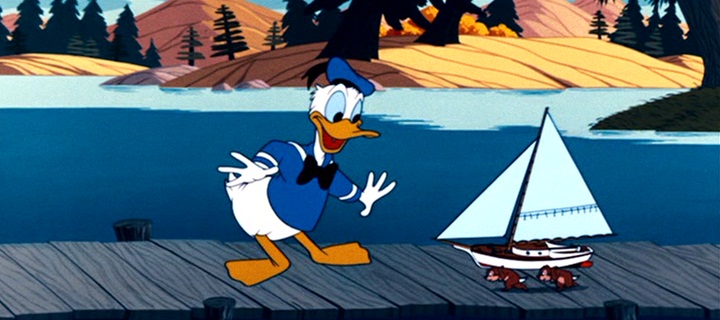 This Cinemascope cartoon is one of finals. It was the last screen appearance of Chip ‘n Dale, it was the last non-educational Donald Duck short and it was the last cartoon directed by Goofy director Jack Kinney, whose own Goofy series had stopped three years earlier.
The short features a quite ordinary battle between Chip ‘n Dale and Donald. This time the squirrels steal Donald’s miniature boat to sail to an island full of acorns. Highlights are Donald acting out a thunderstorm and Dale’s deadpan reactions to Donald’s attempts to persuade them into various boats.
By 1956 Jack Kinney, the greatest director of comedy the Disney studio had ever seen, had been out of favor for some time, and on March 13, 1958 he was fired. He continued animating during the dark ages of animation, in which animation was only seen in light of expenses. He worked on UPA’s first feature, ‘1001 Arabian Nights’ and on Popeye films for television, besides several small and often unfinished projects with his own animation company. In 1988 he wrote his highly entertaining and richly illustrated autobiography ‘Walt Disney and Assorted other Characters’. Jack Kinney passed away on February 9, 1992, 82 years old.
Watch ‘Chips Ahoy’ yourself and tell me what you think:
This is Donald Duck cartoon No. 114
To the previous Donald Duck cartoon: Up a Tree
To the next Donald Duck cartoon: How to Have an Accident in the Home


 Dr. Grob's Animation Review