You are currently browsing the category archive for the ‘★★★’ category.
Director: Phil Mulloy
Release Date: 1994
Rating: ★★★

‘The Invention of Writing (and Its Destruction)’ is the second of only three films in Phil Mulloy’s ‘The History of the World’-series, which apparently should have existed of 140 different shorts.
Like ‘The Discovery of Language‘ this is a film about sex. The short uses the same white characters as ‘The Discovery of Language’, and takes place in 2,000 years B.C. The short tells about a man who doesn’t manage to get sex, because he’s beaten again and again by other men.
Then the man uses his own penis as a pen, writing ‘The penis (pen is) mightier than the sword’. The invention of writing earns him a multitude of women to have sex with, but it won’t last.
Like ‘The Discovery of Language’ ‘The Invention of Writing (and Its Destruction)’ is essentially a silent film, with intertitles. Mulloy’s animation is simple and crude, and makes effective use of cut-out techniques. The result is a strange mix of sex, violence and absurd humor.
Watch ‘The Invention of Writing (and Its Destruction)’ yourself and tell me what you think:
‘The Invention of Writing (and Its Destruction)’ is available on the BFI DVD ‘Phil Mulloy – Extreme Animation’
Director: Phil Mulloy
Release Date: 1994
Rating: ★★★

‘The Discovery of Language’ is ‘episode 10’ of Phil Mulloy’s ‘The History of the World’, which in real life only consists of three films, of which this one is the first.
The film series uses Mulloy’s typical crude black and white style, enhanced by reds to depict blood. But unlike his other films, his characters are not black blots of inks, but white.
The short tells about a primitive tribe of women, 1,000,000 b.c. who discover letters in the soil, which together form the word ‘vagina’. As soon as they realize the meaning of the word they create their own Fall of Man, covering their crotches with skirts, and forbidding masturbation. Meanwhile, the men are on a similar quest to form the word ‘Penis’, but they are too stupid to fulfill the task.
The crude humor of this short is enhanced greatly by the effective soundtrack, featuring excellent music by Alex Balanescu.
Watch ‘The Discovery of Language’ yourself and tell me what you think:
‘The Discovery of Language’ is available on the BFI DVD ‘Phil Mulloy – Extreme Animation’
Director: Phil Mulloy
Release Date: 1993
Rating: ★★★

‘The Sound of Music’ is easily one of the more serious and more depressing films British animator Phil Mulloy created. The film is one misanthropic view on mankind.
The film stars Wolff, a saxophone player, who works as a window cleaner during daytime. The window cleaning part allows Mulloy to indulge in his misanthropic world view, as every room Wolff and his colleague watch from the outside is filled with scenes of violence, loneliness, despair and death.
But Wolff’s night job is even worse. He plays the saxophone at one charity diner, which turns out to be an orgy of indulgence for the rich and famous. When the cooks run out of meat, they empty the streets and hospitals to feed the do-gooders. These visions of cannibalism are as depressing as it can get in animation film. And yet, the end of this film holds some hope…
Mulloy’s crude drawing and animation style suits the black humor and extremely bleak world view fine. The film is devoid of dialogue, with Mulloy employing title cards as if it were a silent film. But the images are enhanced by screeching avant-garde music by Alex Balanescu, whose string quartet is enhanced with voice, saxophone and drums.
Watch an excerpt from ‘The Sound of Music’ yourself and tell me what you think:
https://www.philmulloy.tv/the-sound-of-music
‘The Sound of Music’ is available on the BFI DVD ‘Phil Mulloy – Extreme Animation’
Director: Isao Takahata
Release Date: July 16, 1994
Rating: ★★★

To start: this film is not about raccoons, but about raccoon dogs, which, despite their similarity, are only distantly related to raccoons, being more akin to foxes. The story tells about a population of raccoon dogs living on the Tama hills in Southwest Tokyo. The raccoon dogs see their own environment giving way rapidly to the ever growing metropolis, and decide to fight back in order to save their homes by reviving their old shape-shifting skills…
Apparently, the Japanese raccoon dog (Nyctereutes procyonoides viverrinus) or Tanuki, as the Japanese call him, has been a subject of a long folkloristic tradition. In this folklore the Tanuki has magical powers, being able to shape-shift, but he’s often too lazy, and too distracted to use them. Another peculiarity of this folklore is the focus on the raccoon dog’s testicles, which have magical powers themselves.
These character traits are clearly visible in ‘Pom Poko’: the raccoon dogs are depicted as carefree, fun-loving characters, their testicles are clearly visible, and used in some shape-shift transformations. For example, in one scene an elderly raccoon dog transforms his testicles into a giant carpet, in another a group of raccoon dogs use their inflated testicles as parachutes.
The shape-shifting scenes lead to some remarkable sequences, some of which are very close to pure horror, like a scene in which a cop meets all kinds of people without faces. This would have been a very frightening scene, indeed, if it were not depicted rather playfully, focusing on the police officer’s rather silly-looking panic, instead of the horror of the visions.
Most impressive of the shape-shifting sequences, and the undisputed highlight of the film, is the goblin parade. Here, too, some of the images are genuinely scary, but again, the depiction remains on the light side. For example, there’s a long scene with two men discussing the supernatural at a bar, completely oblivious of the mayhem behind them.
It’s interesting to compare ‘Pom Poko’ to other environmentalist film of the era, like ‘FernGully: The Last Rain Forest’ (1992). Compared to the earlier film, ‘Pom Poko’ is remarkably mature. There’s nothing of FernGully’s magical ‘healing power’, nor does the film need a supervillain. In ‘Pom Poko’ ordinary men, none of them intrinsically mean, form a threat enough to the little forest creatures.
Soon it becomes clear that the raccoon dogs cannot win, and we have to witness several tragic deaths of these critters. Some die in one desperate last fight, others disappear on a mythical ship to the netherworld, some blend in into human society, and still others keep on living in an urban environment, scavenging the suburbs.
In the end, the raccoon dogs must admit that man’s ability to transform the environment is much greater than their own shape-shifting abilities. Yet, this conclusion comes with a feeling of sadness of what’s been lost. Like many other Studio Ghibli films, there’s a longing to earlier times in this film, and especially the raccoon dogs’ last trick, reviving the landscape of old, is one of pure nostalgia.
‘Pom Poko’ is a mature film, but it’s not without its flaws. The film is told by using the weak voice over device, and it has a rather episodic nature, covering several years. Thus the story moves on a leisurely speed, not really building up to a grand finale. Moreover, there are a lot of characters in this film, and we don’t follow one in particular, thus scattering the viewer’s focus.
Another peculiarity is that the film uses three styles to depict the raccoon dogs: first, a very realistic one, which accounts for some very impressive naturalistic animation. Second, the most dominant one, in which the raccoon dogs are depicted as clothed anthropomorphic characters. And third, a highly simplified one, in which the raccoon dogs suddenly become flat comic book characters, especially when celebrating. To me, it’s completely unclear why this third style is even present, and during these scenes the animation is often crude and repetitive, relying on reused animation cycles.
What doesn’t help is that the film is very, very Japanese: the behavior and rites of the raccoon dogs are sometimes enigmatic, and there are a lot of Buddhist and Shintoist references that are completely lost on the Western viewer. In that respect it’s a surprise that foxes have the same character traits in Japanese folklore as in Western tradition: in ‘Pom Poko’ the foxes are sly tricksters, too.
‘Pom Poko’ may not be perfect, it still is a very interesting film on human-animal relationships, it provides a small window into Japanese folklore, and it certainly is a very humane and mature film, showing us that one doesn’t need villains for destruction, and that some very valuable things are getting lost in the march of progress.
Watch the trailer for ‘Pom Poko’ yourself and tell me what you think:
‘Pom Poko’ is available on DVD and Blu-Ray
Director: Henry Selick
Release Date: October 29, 1993
Rating: ★★★

Tim Burton’s ‘The Nightmare Before Christmas’ is an impressive film. Combining replacement techniques with puppets with complex armatures, computer-controlled camera movements, and a bit of drawn animation, Burton’s team takes the art of stop-motion to new heights.
Moreover, the film is surprisingly elaborate, and uses nineteen stages, 230 sets, sixty characters, and hundreds of puppets to tell its story. The opening scene alone is a tour-de-force of mind-blowing images, with too much happening to register it all.
The result is a stop motion film with the highest production values thus far, and simply bursting with stunning visuals. Together with Aardman’s ‘The Wrong Trousers’ from the same year the feature easily sets new standards for stop-motion.
So why don’t I give this film a five-star rating? The main reason is the songs. ‘The Nightmare Before Christmas’ was made at a time when American animation film practically equaled musical, but even so in this film soundtrack composer Elfman takes the musical idea to the max. There are no less than eleven songs within the 68 minutes the feature lasts, taking a staggering 43% of the screen time.
But Elfman is no Alan Menken, and all his songs are terribly meandering and forgettable, slowing down the action, with characters halting to express their emotions, like in a Baroque opera.
Low point arguably is Sally’s song, which could have been a moving expression of feelings, but turns out to be an all too short and completely aimless bit of music, lasting only 96 seconds. If one compares Elfman’s absent song-craft to the strong melodies of Menken’s ‘Beauty and the Beast’ (1991) or ‘Aladdin’ (1992), it becomes clear that Elfman’s efforts don’t add to the story, but drag it down, to a point that one screams to be freed from the omnipresent singing.
The film is typical Burton with its friendly take on horror, and Burton’s head animator Henry Selick rightly calls the film’s overall style a mix of “German expressionism and Dr. Seuss”. Selick and his team manage to make Burton’s pen and ink drawings come to life in believable puppets, despite the often very long limbs and unsteady balance of some of the characters.
With this animation effort Selick turned out to be a strong new voice in the animation field, and after ‘The Nightmare Before Christmas’ he continued to impress, first with ‘James and the Giant Peach’ (1996), then with ‘Coraline’ (2009), although his feature ‘Monkeybone’ (2001) was much less of a success.
Burton’s story is based on an original idea, but is not worked out too well. The idea of Holiday lands is a good one, but how does one return from Christmas land to Halloween land? And there is a focus problem: ‘The Nightmare Before Christmas’ follows two main characters, Jack Skellington and Sally, without choosing one as its principal character.
Jack is a bit of a problematical character anyhow: he’s king of his land, but remarkably bored, and he’s willing to take a huge risk to fill his own feelings of emptiness. Moreover, his selfish plans means a year without Halloween, not to mention the disastrous Christmas he makes. Jack does develop during the film, but his remorse and recovery come too quickly to be entirely convincing.
In the end, it’s Sally who turns out to be the most interesting character of the two: when we first watch her, she literally falls apart. She’s controlled and hold back by her maker, the possessive Dr. Finkelstein, and naturally very shy, but during the movie she becomes bolder and more venturous.
The film’s villain, The Bogeyman, is scary, but his role in Burton’s universe is obscure: why is he the only nightmarish character that is genuinely scary and unfriendly? I have no idea. A nice touch are the Cab Calloway influences on this character. He even literally quotes Calloway when saying “I’m doing the best I can” like Calloway did in the Betty Boop cartoon ‘The Old Man from the Mountain’ (1933).
The film’s story flaws would certainly be forgivable, given the film’s stunning visuals, if it were not for the songs. The biggest problem of ‘The Nightmare Before Christmas’ remains its unappealing soundtrack, reducing an otherwise fantastic film into a hardly tolerable one. An immense pity, for one remains wondering what the film could have been if it had not been the obligate and ugly musical it turned out to be.
Watch an excerpt from ‘The Nightmare Before Christmas’ yourself and tell me what you think:
‘The Nightmare Before Christmas’ is available on DVD and Blu-Ray
Director: Raymie Muzquiz
Stars: Duckman
Airing Date: April 16, 1994
Rating: ★★★

In this episode Duckman’s backward son Ajax is invited to attend a boarding school. After Duckman has visited Ajax’s present school, he sends his son off quickly.
Duckman’s visit to Ajax’s most atrocious school is a highlight. He e.g. gets beaten by caricatures of ‘Our Gang’. Better still is the montage sequence of Duckman and Ajax having some quality time during their last weekend together. Yet, the best line is for aunt Bernice, who tells Duckman when he drools over an attractive boarding school student: “You’re despicable! You’ve got kidney stones older than her!”.
‘Ride the High School’ introduces King Chicken as Duckman’s arch nemesis. King Chicken would never become a frequently recurring star, but he would return in eleven more episodes, including the very last one.
Watch ‘Ride the High School’ yourself and tell me what you think:
This is Duckman episode no. 6
To the previous Duckman episode: Gland of Opportunity
To the next Duckman episode: A Civil War
‘Ride the High School’ is available on the DVD-box ‘Duckman – The Complete Series’
Director: Dave Borthwick
Release Date: December 10, 1993
Rating: ★★★
 1993 was a great year for stop-motion animation: it saw the screening of the groundbreaking feature film ‘The Nightmare Before Christmas‘, as well as the Wallace & Gromit short ‘The Wrong Trousers‘, which also covered new grounds.
Much less well known is the stop-motion feature film ‘The Secret Adventures of Tom Thumb’, also released that year. Made by Dave Borthwick at the British Bolexbrothers studio the film is a much rougher affair than the smooth stop-motion efforts of Disney and Aardman. In fact, it stands firmly in a tradition of gritty and disturbing stop-motion films that via Jan Švankmajer harks all the way back to Władysław Starewicz.
To begin with the film takes place in a dark and disturbing world, where large insects crawl and violence roams. In this gloomy world a poor couple gives birth to a child the size of a small fetus, whom they call Tom Thumb (in one of ca. three lines of dialogue in the entire film).
But Tom soon is kidnapped and taken to a sinister laboratory populated by several chimeral creatures tortured by insane experiments. A two-legged lizard-like creature helps Tom escape. Outside Tom meets a human tribe his own size, who unfortunately kill his chimeral companion. Jack, the leader of the tribe and a master of weapons, takes Tom back to the laboratory, where they eventually apparently destroy the laboratory’s power…
Much of what’s happening in this film is rather incomprehensible, and the plot could do with some cleaning. For example, it remains utterly unclear why Tom is kidnapped, and what the origin of the little people is. Throughout Tom remains a silent and innocent character, not unlike Pinocchio or Dumbo, and he hardly acts.
In the end the film is more interesting because of its disturbing images and for its unique artwork than for its story. The creators made especially well use of pixillation (the animation of people), giving all actors a grotesque appearance and ditto movement.
The best scenes remain the ones inside the laboratory, where Tom sees some pathetic creatures. Especially the one in which one of the creatures asks Tom to shut down the power that sustains them, is a moving piece of animation.
The Secret Adventures of Tom Thumb’ may never get the classic status of a ‘The Nightmare Before Christmas’ or a ‘The Wrong Trousers’, it still is a film that shows the limitless power of animation in the hands of creators with a lot of imagination.
Watch ‘The Secret Adventures of Tom Thumb’ yourself and tell me what you think:
‘The Secret Adventures of Tom Thumb’ is available on DVD
‘
Directors: Herbert M. Dawley & Willis O’Brien
Release Date: November 17, 1918
Rating: ★★★
 This film was produced, acted and animated by Herbert M. Dawley and Willis O’Brien.
Dawley plays ‘Uncle Jack Holmes’, who tells two boys a story about how he camped out on slumber mountain and meets the ghost of Mad Dick there (played by O’Brien). The ghost tells Holmes to watch through a magic instrument, and the uncle suddenly sees prehistoric animals in the distance.
At this point the film is nine minutes away, and by O’Brien’s skillful animation we watch a Brontosaurus wandering, a Diatryma (a giant flightless bird, now Gastornis) catching a snake, two Triceratopses fighting, and a Tyrannosaurus killing one of the Triceratopses.
Especially the animation on the first Triceratops is well done, O’Brien even shows the creature breathing. Another nice detail is that of the Tyrannosaurus licking its lips. Most importantly, O’Brien doesn’t show the prehistoric creatures not as monsters but as convincingly living creatures. No wonder this master animation was asked to do the dinosaur animation for ‘The Lost World’ (1925), and for all kinds of creatures in ‘King Kong‘ (1933).
It’s a pity the film is rather lackluster (in the end it all appears to be a dream, and even the boys don’t really buy that trite ending), for the animation is certainly worth watching once.
Watch ‘The Ghost of Slumber Mountain’ yourself and tell me what you think:
‘The Ghost of Slumber Mountain’ is available on the Blu-Ray of ‘The Lost World’
Director: Émile Cohl
Release Date: 1918
Rating: ★★★
 ‘Les adventures des Pieds-Nickelés’ is a short series of animated cartoons that Émile Cohl made for Éclair.
The first episode hasn’t survived, and only parts of the fifth, but from the surviving episodes one can distill that this series is about three criminals: Ribouldingue, who has a beard, Croquignol, and Filochard, who wears an eyepatch. The three flee from an inspector and have all kinds of adventures in Paris.
Cohl’s sketchy drawing style looks like something of the 19th century, and his animation, mostly done in cut-out, is rather stiff and badly timed, with none of the movement being remotely natural. Yet, Cohl’s gags are impressive as they seem to be embryonic versions of common cartoon gags of the 1940s and 1950s. For example, in the second episode there’s a scene in which numerous policemen pop-up from everywhere.
The third episode is the most impressive in this respect: the short contains a scene in which the trio enters a subterranean and rather nightmarish chamber in which everything can happen, making this scene a direct forerunner of ‘Bimbo’s Initiation‘ from 1931. Later, when a part of a fence falls on the inspector, he breaks into several pieces, just like a Tex Avery character. The fourth episode features a policeman who, when hitting a wall, contracts into a flat disc, and later Filochard rolls up like a piece of paper.
The fifth episode is the most incomprehensible of the four surviving films, partly because of only parts of it have survived. The best gag of this episode is when Croquignol almost drowns, and when rescued spits out hundreds of liters of water, including some fishes, only to ask for a drink.
All these gags are way ahead of the humor of contemporary American cartoons, but combined with the archaic drawing style the end result is a strange mix, indeed.
Watch ‘Les adventures des Pieds-Nickelés’ yourself and tell me what you think:
‘Les exploits de Farfadet’ is available on the DVD-set ‘Émile Cohl – L’agitateur aux mille images’
Director: Wallace Carlson
Release Date: January 9, 1919
Stars: Us Fellers
Rating: ★★★
 Wallace Carlson (1894-1967) was a comic strip artist, who had a brief career as an animator from 1914 to 1921. Carlson joined the Bray studio in 1917, for which he created the ‘Us Fellers’ series. The series stars a boy character called Dreamy Dud, whom Carlson had conceived earlier.
Dud is a boy who breaks his bank (and unfortunately the one coin therein) to buy his girlfriend Mamie some ice cream. But instead he’s punished and sent to bed without supper. At night Dud sneaks out and first imagines how his mother gets filled with remorse, while he finds a treasure. But then the figments of his imagination turn into scary monsters, and he runs home, only to get spanked.
‘Dud Leaves Home’ is a well-told film, with great attention to the child’s world and imagination. The night scenes show some pretty background art. The animation, on the other hand, is rather stiff and robotic, especially when compared to Earl Hurd’s or Raoul Barré’s animation from the same era.
Carlson left animation in 1921 to concentrate on comic strips again, creating the highly successful comic strip series ‘The Nebbs’ in 1923.
Watch ‘Dud Leaves Home’ yourself and tell me what you think:
‘Dud Leaves Home’ is available on the DVD ‘Before Walt’
Directors: Charles Bowers & Raoul Barré
Release Date: March 2, 1919
Stars: Mutt and Jeff
Rating: ★★★
 In this short Mutt and Jeff are firemen. First they extinguish the ‘fire’ of a smoking policeman, then they rush to a real fire. Mutt has to rescue a girl (which turns out to be a vicious dog), while Jeff relaxes, eats some fried eggs and drinks some coffee. In order to escape from the dog Mutt jumps down, but his colleagues are too busy looking at a beautiful dame descending a ladder…
‘Fireman Save My Child’ is a pure gag cartoon, with the gags coming in fast an plenty. The film is pretty fast and funny for its age, but animator Dick Huemer uses some surprising tricks to cut short on animation, making Mutt and Jeff move across the room without movement, or firemen sprouting from beds using the vaguest inbetween drawings. Nevertheless, it’s nice to watch some animation by this later Disney legend.
‘Fireman Save My Child’ is available on the Blu-Ray-DVD-combo ‘Cartoon Roots’
Director: Leon Searl
Release Date: February 29, 1916
Stars: Krazy Kat
Rating: ★★★
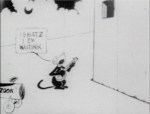 ‘Krazy Kat’ was the very first animal cartoon star featured in a cartoon series of her own.
‘Krazy Kat’, of course, was taken from George Herriman’s celebrated comic strip, which had started in 1913. The film series started three years later, and lasted until 1940. By then the character had become a far cry from Herriman’s creation.
But the earliest Krazy Kat cartoons still had a lot in common with George Herriman’s comic strip, on which they were based. ‘Krazy Kat Goes a-Wooing’, the fourth Krazy Kat cartoon, is a good example. This short animation film lasts only three minutes and seemingly re-tells one Sunday Page, using a lot of text balloons. Both the designs, backgrounds and characters are still in tune with Herriman’s creations.
Krazy Kat goes serenading her love Ignatz Mouse, but he rushes off to fetch some bricks to throw at her. Leon Searl’s drawings are appealing, but his animation is very stiff. For example, when we watch Krazy serenading, only two drawings are used.
Watch ‘Krazy Kat Goes a-Wooing’ yourself and tell me what you think:
‘Krazy Kat Goes a-Wooing’ is available on the DVD-set ‘Popeye the Sailor 1933-1938’
Director: George Vernon Stallings
Release Date: September 4, 1915
Stars: Colonel Heeza Liar
Rating: ★★★
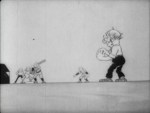 ‘Colonel Heeza Liar at the Bat’ is a Colonel Heeza Liar cartoon directed by George Vernon Stallings, who would later join Van Beuren and Disney.
Stallings’s approach to animation is very comic strip-like in this short: the scenes are very flat, and although the drawing and posing are very good, the animation is extremely limited and stiff, relying heavily on repeated drawings and on poses instead of movement.
In this short the colonel joins a ball game, winning it with ease, e.g. by pitching curve balls that defy all laws of nature, and by running a home-run three times in a row. The film uses titles in rhyme, but text balloons are reserved for the umpire only.
Watch ‘Colonel Heeza Liar at the Bat’ yourself and tell me what you think:
‘Colonel Heeza Liar at the Bat’ is available on the DVD-set ‘Popeye the Sailor 1933-1938’ and on the DVD ‘Before Walt’
Director: Émile Cohl
Release Date: 1916
Rating: ★★★
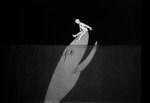 ‘Les exploits de Farfadet’ is a very short cut-out animation film, not even clocking two minutes.
In this short a man dreams he loses his hat at sea, drowns and gets swallowed by a huge fish.
The atmosphere of this film is very surreal and, indeed, dream-like, with a clear feel of unreality, and an illogical flow of events. The man speaks in text balloons , and in the end he blames his bad dream on rum, very much like Winsor McCay’s rarebit fiends.
Watch ‘Les exploits de Farfadet’ yourself and tell me what you think:
‘Les exploits de Farfadet’ is available on the DVD-set ‘Émile Cohl – L’agitateur aux mille images’
Directors: William Hanna & Joseph Barbera
Airing Date: April 7, 1961
Stars: The Flintstones
Rating: ★★★
 ‘Fred Flintstone: Before and After’ starts with a television studio in search of a ‘before man’ for their commercial for ‘Fat Off Reducing Method’.
B.J., the president of the company picks Fred from the street. An outrageously proud Fred invites all his friends to watch him on television, only to realize afterwards he was the ‘fat guy’, not the muscular after guy…
In a very unlikely follow up scene the studio offers Fred $1000 if he can reduce his weight with 25 pounds. It remains completely mysterious what the studio would gain with this bet. In any case, Fred sets out to eat less, only to discover that it’s much, much harder than he thought. So, he seeks help from ‘Food Anonymous’….
‘Fred Flintstone: Before and After’ suffers from a rather weak and implausible story, and rather repetitive scenes of Fred not dieting at all. For a while it seems that the $1000 reward doesn’t play any role, at all. Nevertheless, Fred’s wild looks when begging for a burger are priceless and belong to the best pieces of character animation on the whole show. However, the episode’s highlight is in the beginning, when Fred thinks he’s on camera, and goes berzerk.
‘Fred Flintstone: Before and After’ rounds up the first season of The Flintstones. Five seasons would follow, lasting until 1966. In the first season the series had shown to be an original mix of sitcom, slapstick comedy, sight gags and cartoon humor. Moreover, the series proved that cartoons could be prime time material, although that lesson would only get a real follow up when The Simpsons started airing in 1989.
Watch an excerpt from ‘Fred Flintstone: Before and After’ yourself and tell me what you think:
This is the 26th and final episode of Flintstones Season One
To the previous Flintstones episode: Rooms for Rent
‘Fred Flintstone: Before and After’ is available on the DVD-set ‘The Flintstones: The Complete First Season’
Directors: William Hanna & Joseph Barbera
Airing Date: March 10, 1961
Stars: The Flintstones
Rating: ★★★
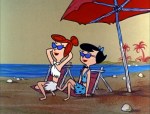 This episode starts with Fred complaining that none of his old pals ever writes him.
Promptly he gets a letter by old pal Smoothy, who runs a seaside hotel, so Fred gives old Smoothy a ring. Unfortunately, Smoothy just has had a major problem: all his staff has walked out of him, as Smoothy couldn’t pay them. So Smoothy invites Fred and his neighbors to come over and stay for free, only to make them work at his hotel with more than 200 guests coming to a convention. Of course, his plan doesn’t succeed.
‘The Long, Long Weekend’ is a rather badly scripted episode: Smoothy’s plan is laid out in advance; at no point his plan sounds feasible, and indeed it works for only a couple of minutes. A lot of screen time is wasted on Fred and Barney going swimming, fishing and skin diving – all without success. The fishing episode at least features a beautiful painting of Fred and Barney in a boat, silhouetted against an orange sky.
The episode is most important for introducing the Loyal Order of Water Buffaloes, the order Fred and Barney would join in the future.
Watch ‘The Long, Long Weekend’ yourself and tell me what you think:
https://www.dailymotion.com/video/x6pamff
This is Flintstones Season One Episode 23
To the previous Flintstones episode: The Tycoon
To the next Flintstones episode: In the Dough
‘The Long, Long Weekend’ is available on the DVD-set ‘The Flintstones: The Complete First Season’
Directors: William Hanna & Joseph Barbera
Airing Date: February 17, 1961
Stars: The Flintstones
Rating: ★★★
 The plot of this episode gets in motion when Wilma discovers an old love letter from Fred in a box full of memories. When Fred discovers his own poem in the drawer, he thinks it’s by somebody else, and suspects that Wilma has a secret lover.
What follows is a classic comedy of errors, also involving roller skates, a watch, and a private eye with a funny walk and the voice reminiscent of that of Tony Curtis as a millionaire in ‘Some Like It Hot’ (1959). Fred’s dramatic stances are priceless.
The episode is further uplifted by some amusing prehistory gags: a giant dinosaur from ‘Mastodon Motor Inc.’ full of cars on its back, a photo camera with a little bird drawing a picture in it, and a taxi you have to walk yourself. We also discover that Fred’s job, which already had been depicted in ‘The Snorkasaurus Hunter’, is being a “dino-operator”.
Watch ‘Love Letters on the Rocks’ yourself and tell me what you think:
https://www.dailymotion.com/video/x6ttnkr
This is Flintstones Season One Episode 21
To the previous Flintstones episode: The Hypnotist
To the next Flintstones episode: The Tycoon
‘Love Letters on the Rocks’ is available on the DVD-set ‘The Flintstones: The Complete First Season’
Directors: William Hanna & Joseph Barbera
Airing Date: January 27, 1961
Stars: The Flintstones
Rating: ★★★
 The story of this episode is set in when Fred gets angry about meat prices in a supermarket. So he decides to use his vacation to hunt the meat himself.
Thus the four neighbors are off with a trailer to the mountains where Fred and Barney try to clobber a ‘Snorkasaurus’ to death, while their wives experience all kinds of camping annoyances, like mosquitoes and ants. The Snorkasaurus turns out to be a wise-cracking, refined talking animal with a suave voice (according to Wikipedia imitating comedian Phil Sivers).
In the end the episode turns out to give us the origin of Dino, Fred and Wilma’s pet. This is a weird turn of events, as Dino has been seen before as a four-legged yelping dinosaur, behaving like a dog, not the two-legged suave and talkative animal as shown here. Indeed, this is this the only episode in which Dino talks.
‘The Snorkasaurus Hunters’ is the first episode to show Fred working as an excavator machinist at ‘Rockhead and Quarry’s Cave Construction Company’. In ‘Love Letters on the Rocks‘ Fred says he’s a ‘dino-operator’. Both his work and the supermarket lead to several prehistoric gags. The camping episode is particularly slapstick rich, and has surprisingly much in common with earlier Warner Bros. cartoons. For example, Barney chops an enormous redwood tree, which crashes on Fred’s car and trailer. Later, Barney goes fishing, but gets swallowed by a large fish himself. The best gag, however, is when the four dream what they could do with the money they save by hunting their meat themselves. Barney’s dream in particular is a delight.
Watch an excerpt from ‘The Snorkasaurus Hunter’ yourself and tell me what you think:
This is Flintstones Season One Episode 18
To the previous Flintstones episode: The Big Bank Robbery
To the next Flintstones episode: The Hot Piano
‘The Snorkasaurus Hunter’ is available on the DVD-set ‘The Flintstones: The Complete First Season’
Directors: William Hanna & Joseph Barbera
Airing Date: January 20, 1961
Stars: The Flintstones
Rating: ★★★
 This episode starts with two bank robbers (voiced by Mel Blanc and Stan Freberg) followed by a police car.
The robbers get rid of the loot, which lands on Fred’s head. When the wives convince Fred and Barney to return the money to the police, the boys are quickly seen as the robbers themselves. Fred and Barney flee into the wild Meanwhile, Wilma thinks of a rather unhealthy way to attract the real bank robbers, posing as sleazy gals (“Shirl” and “Myrt”) with too much dough on their hands. It remains a miracle that they only attract the original bank robbers to their house, and not the complete criminal scene of Bedrock with their act.
Anyway, in the end Fred accidentally knocks out the real crooks, earning the reward. But his bragging about it makes him all too vulnerable to blackmail, and in the end it’s the other three who spend all the money, leaving Fred only with his story as a conquering hero.
This episode features a gas station using a mastodon, but the best gag may be the police sketch, which is much more inspired than the tiring and completely superfluous scene in which Barney ends up in a pterodactyl nest. Moreover, this pterodactyl looks more like a bird than the real thing.
This is Flintstones Season One Episode 17
To the previous Flintstones episode: Arthur Quarry’s Dance Class
To the next Flintstones episode: The Snorkasaurus Hunter
‘The Big Bank Robbery’ is available on the DVD-set ‘The Flintstones: The Complete First Season’
Directors: William Hanna & Joseph Barbera
Airing Date: January 13, 1961
Stars: The Flintstones
Rating: ★★★
 Wilma gets four free tickets for a big charity dance, but Fred and Barney refuse to go.
It turns out they can’t dance, and they are too ashamed to tell this to their wives. Thus they join ‘Joe Rockhead’s Fire Department’, a scam for husbands who want to go out each night, so they can go out and take dance lessons at ‘Arthur Quarry’s Dance School’.
Like many other Flintstones episodes ‘Arthur Quarry Dance School’ leans heavily on Fred and Barney’s rather depressing tendency to keep things secret from their wives, but this time it’s all for the good, and this is one of the rare episodes with a happy ending, even though Barney and Fred still can hardly dance in the end.
Highlight of the episode is the scene in which Fred and Barney meet their dancing partners at the school, two beautiful young ladies. The prehistoric gag department is limited to the mailman who uses a small Ceratopsian as a mail cart, and the bird as a record player, which by now has become a staple gag.
Watch an excerpt from ‘Arthur Quarry’s Dance Class’ yourself and tell me what you think:
This is Flintstones Season One Episode 16
To the previous Flintstones episode: The Girl’s Night Out
To the next Flintstones episode: The Big Bank Robbery
‘Arthur Quarry’s Dance Class’ is available on the DVD-set ‘The Flintstones: The Complete First Season’


 Dr. Grob's Animation Review