
You are currently browsing the category archive for the ‘★★’ category.
Director: Dick Lundy
Release Date: July 12, 1942
Stars: Donald Duck
Rating: ★★
Review:
 In ‘Donald’s Garden’ Donald is a gardener, wearing a straw hat. We watch him having trouble with a water pump and with a gopher, which eats all his vegetables.
‘Donald’s Garden’ is a slow and boring cartoon. It’s hampered by particularly uninspired backgrounds, and it is one of the weaker entries in the Donald Duck series.
It has the same structure as ‘The Village Smithy‘ from earlier that year: it consists of only two situation gags: one with an inanimate object (the pump), and one with an animal (the gopher). Apparently, director Dick Lundy favored these types of gags, for they returned in ‘Donald’s Goldmine’, and in ‘Donald’s Tire Trouble‘, Lundy’s only successful cartoon in terms of situation comedy.
‘Donald’s Garden’ is the first Disney cartoon trying to be funny with gophers. But like the later Pluto shorts ‘Bone Bandit‘ (1948) and ‘Pluto and the Gopher‘ (1950), the studio doesn’t succeed. One may wonder whether gophers are funny, at all.
Watch ‘Donald’s Garden’ yourself and tell me what you think:
This is Donald Duck cartoon No. 33
To the previous Donald Duck cartoon: Donald Gets Drafted
To the next Donald Duck cartoon: Donald’s Gold Mine
Director: Abe Levitow
Release Date: June 30, 1966
Stars: Tom & Jerry
Rating: ★★
Review:
 In ‘Fillet Meow’ Tom is after a goldfish, who looks a little like Chloe from ‘Pinocchio‘ (1940). Of course Jerry tries to protect the cute little fish.
‘Fillet Meow’ was the third Tom & Jerry cartoon directed by Abe Levitow and by now quality standards had dropped almost to the level of the Gene Deitch Tom & Jerry shorts. The result is rather awful, and nowhere near the quality of the similar ‘Jerry and the Goldfish‘ (1951).
Watch ‘Fillet Meow’ yourself and tell me what you think:
http://onlineplayer.eu/Tom-and-Jerry/filet-meow-148.html
This is Tom & Jerry cartoon No. 149
To the previous Tom & Jerry cartoon: Love, Love My Mouse
To the next Tom & Jerry cartoon: Matinee Mouse
Director: Chuck Jones
Release Date: December 8, 1964
Stars: Tom & Jerry
Rating: ★★
Review:
 In ‘The Unshrinkable Jerry Mouse’ Tom is master of the house and Jerry is his slave. But then enters a cute young kitten. Tom gets jealous at the intruder and tries to get rid of it. But Jerry befriends the kitten and in the end the tables are turned.
One of the weaker entries in Chuck Jones’ Tom & Jerry series, ‘The Unshrinkable Jerry Mouse’ is a surprisingly unfunny cartoon, suffering from bad timing and ugly music.
Watch ‘The Unshrinkable Jerry Mouse’ yourself and tell me what you think:
https://www.dailymotion.com/video/x3ngu09
This is Tom & Jerry cartoon No. 133
To the previous Tom & Jerry cartoon: Snowbody Loves Me
To the next Tom & Jerry cartoon: Ah, Sweet Mouse Story of Life
Director: Gene Deitch
Release Date: November 1962
Stars: Tom & Jerry
Rating: ★★
Review:

In ‘Buddies Thicker than Water’ Jerry has it made, living in a luxury penthouse on the top of a huge skyscraper. Meanwhile Tom is freezing in the snow below.
Tom calls his former foe for help and Jerry is willing to take him in. But Tom double-crosses his savior and in return the mouse haunts Tom out of the house.
This cartoon has got one of the best and most straightforward stories of all Gene Deitch’s Tom & Jerry cartoons, which makes it stand out of the series. Unfortunately the short is very low on gags, and the animation and staging are very poor, as always in Gene Deitch’s Tom and Jerries. I guess the cartoon’s highlight is the modernly designed interior of the apartment.
Watch an excerpt from ‘Buddies Thicker than Water’ yourself and tell me what you think:
This is Tom & Jerry cartoon No. 126
To the previous Tom & Jerry cartoon: Sorry Safari
To the next Tom & Jerry cartoon: Carmen Get It
‘Buddies Thicker than Water’ is available on the DVD-set ‘Tom and Jerry – The Gene Deitch Collection’ and the European DVD-Box ‘Tom and Jerry Collection’
Director: Gene Deitch
Release Date: January, 1962
Stars: Tom & Jerry
Rating: ★★
Review:
 ‘High Steaks’ can be summarized as ‘Down and Outing‘ at a barbecue brawl.
The film reuses the fat man from ‘Down and outing’, and like in the former film, Tom tries to get rid of Jerry.
Despite some clever gags, this film suffers greatly from the terrible animation, music etc., problems typical of the Gene Deitch Tom & Jerry cartoons. This was the second of three cartoons featuring the unnamed fat man. He would return in ‘Sorry Safari‘, later that year.
Watch ‘High Steaks’ yourself and tell me what you think:
This is Tom & Jerry cartoon No. 118
To the previous Tom & Jerry cartoon: It’s Greek To Me-Ow!
To the next Tom & Jerry cartoon: Mouse into Space
Director: Gene Deitch
Release Date: October 26, 1961
Stars: Tom & Jerry
Rating: ★★
Review:
 In ‘Down and Outing’ Tom and Jerry join a fat man who goes fishing. During the cartoon Tom tries to get rid of Jerry, mostly on expense of the man.
‘Down And Outing’ is the second of thirteen Tom & Jerry films by Gene Deitch, and like in the first, ‘Switchin’ Kitten‘, a rather inspired story (by Larz Bourne) is ruined by bad design, bad timing, bad animation and bad sounds. The fat man would become Gene Deitch’s best attempt on a recurring character, returning in ‘High Steaks‘ and ‘Sorry Safari‘ (both from 1962).
Watch ‘Down and Outing’ yourself and tell me what you think:
This is Tom & Jerry cartoon No. 116
To the previous Tom & Jerry cartoon: Switchin’ Kitten
To the next Tom & Jerry cartoon: It’s Greek to Me-Ow!
Director: Burt Gillett
Release Date: June 6, 1931
Stars: Mickey Mouse, Minnie Mouse, Pete (cameo), Pluto
Rating: ★★
Review:
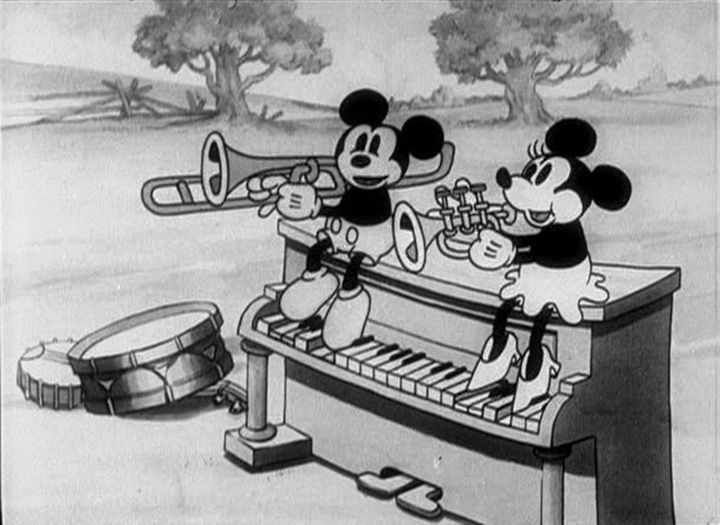 In ‘The Delivery Boy’ we watch Minnie doing the laundry in a pasture, singing the 1905 hit song ‘In the Shade of the Old Apple Tree’.
Mickey surprises her, and they dance the Charleston together to the background music. Mickey is so happy, he boxes a wasp’s nest. The wasp’s nest hits his donkey and his whole delivery, which consists of musical instruments, is spread over the pasture.
Undaunted, Mickey and Minnie start playing the piano, and all the farm animals join in, playing ‘The stars and stripes forever’. The cartoon ends when Pluto retrieves a burning dynamite stick and everything explodes. Nevertheless, Mickey is still able to finish playing John Philip Sousa’s famous march.
‘The Delivery Boy’ is as joyous as it is boring. After three years of song-and-dance routines one grows rather tired of it. Moreover, cartoons like ‘Traffic Troubles‘ and ‘The Moose Hunt‘ had proven that Mickey could do very well without them.
Pluto would cause havoc again in some of the succeeding films, like ‘Mickey Steps Out‘ (1931), ‘Mickey Cuts Up‘ (1931) and ‘The Grocery Boy‘ (1932). In these films the song-and-dance routine would give way to well-build gag-filled finales, of which the one in ‘The Delivery Boy’ is an embryonic version.
Watch ‘The Delivery Boy’ yourself and tell me what you think:
This is Mickey Mouse cartoon No. 29
To the previous Mickey Mouse cartoon: The Moose Hunt
To the next Mickey Mouse cartoon: Mickey Steps Out
Director: Wilfred Jackson
Release Date: March 27, 1931
Stars: Mickey Mouse
Rating: ★★
Review:
 Mickey is a castaway, stranding on a tropical island.
Luckily, a piano is washed ashore as well, so Mickey performs for the jungle animals inhabiting the island. Unfortunately, an obnoxious little tiger disturbs him, and a great ape wants to play the piano, too, wrecking the instrument.
‘The Castaway’ was a short made out of rest material, and it shows: Mickey’s looks are wildly inconsistent, there’s not even a hint of a story, and the whole film feels like a throwback to 1929. Nevertheless, this short contains nice effect animation of waves washing ashore. It also reuses some animation of dancing sea lions from ‘Wild Waves‘ (1929) and of a dancing ape from ‘Jungle Rhythm‘ (1929), the film with which ‘The Castaway’ has most in common, which is no advertisement. In fact, Walt Disney disliked the film, thinking it didn’t look like a Walt Disney picture. And indeed, it hardly does.
The gag in which a lion gets eaten by a crocodile was borrowed from a very early Mickey Mouse comic strip from February 1930, which incidentally was the last panel drawn by Ub Iwerks himself.
‘The Castaway’ is also noteworthy for being the first Disney short to feature music by Frank Churchill, who would score many Disney shorts, and who would become particularly famous for the hit song ‘Who’s Afraid of the Big Bad Wolf’ from ‘Three Little Pigs‘ (1933) and the songs in ‘Snow White and the Seven Dwarfs’ (1937).
Watch ‘The Castaway’ yourself and tell me what you think:
This is Mickey Mouse cartoon No. 27
To the previous Mickey Mouse cartoon: Traffic Troubles
To the next Mickey Mouse cartoon: The Moose Hunt
Director: Ub Iwerks
Release Date: June 26, 1930
Rating: ★★
Review:
 In ‘Arctic Antics’ the song-and-dance-routine, typical of the early Silly Symphonies, is carried out by polar bears, sea lions, penguins (whose habitat actually is the Antarctic), and a walrus. The latter is reused from the Mickey Mouse short ‘Wild Waves‘ from 1929.
‘Arctic Antics’ was the last cartoon Ub Iwerks directed before he left the studio to set up one of his own. It features a rather Mickey Mouse-like polar bear, but the most interesting aspect of this cartoon is the end, in which the marching penguins disappear behind an iceberg. This gives a novelty effect of depth. This search of effects of depth would eventually lead to the invention of the multiplane camera, seven years later.
Penguins were revisited five years later, in ‘Peculiar Penguins‘ (1935). By then they had lost the out-of-place bellybuttons they got in this cartoon.
Watch ‘Arctic Antics’ yourself and tell me what you think:
This is Silly Symphony No. 11
To the previous Silly Symphony: Frolicking Fish
To the next Silly Symphony: Midnight in a Toy Shop
Director: Burt Gillett
Release Date: May 23, 1930
Rating: ★★
Review:
 Frolicking fish indeed. Even oysters, starfish and a lobster join in the dance routines, oh so typical of early Silly Symphonies. Nevertheless, this cartoon ends with some kind of story, when an evil octopus follows a small fish, who gets rid of the villain by dropping an anchor on him.
There’s not much to enjoy in ‘Frolicking Fish’ despite its merry premise. However, like ‘Autumn‘ this cartoon contains early and to many rivaling studios undoubtedly ‘unnecessary’ effect animation, this time loads and loads of bubbles.
It has entered animation history, however, by featuring the first example of ‘overlapping action’ in animation. Overlapping action acknowledges that different (body) parts move with different speeds. So one part can already start moving, before another comes to an end, and animation cycles can overlap each other in imperfect ways. This opposed to the then normal type of animation, which was based on poses, which led to straightforward animation cycles. This new type of animation was developed by animator Norm Ferguson, who had been hired by Disney in August 1929. It was a milestone at that time, a piece of animation marveled at by Ferguson’s colleagues, including Walt Disney himself. It led to the development of full animation, which would slowly replace the ‘rubber hose animation’ of the early thirties.
Overlapping Action can be seen in the three fish dancing at 2:07. Compare it to the stiff stop-and-go movements of the fish musicians following this scene, and the difference may become clear.
From ‘Frolicking Fish’ on Norm Ferguson would become one of Disney’s greatest and most influential animators of the 1930s, and he was responsible for another breakthrough piece of animation: ‘Playful Pluto‘ (1934), the first convincing piece of animation of a character thinking. He was a great influence on future Nine Old Man John Lounsberry, whom he trained as an assistant animator. Unfortunately, Ferguson’s star diminished in the 1940s, and by the 1950s his style had become old-fashioned…
Watch ‘Frolicking Fish’ yourself and tell me what you think:
This is Silly Symphony No. 10
To the previous Silly Symphony: Night
To the next Silly Symphony: Arctic Antics
‘Frolicking Fish’ is available on the DVD-set ‘Walt Disney Treasures: More Silly Symphonies’
Director: Walt Disney
Release Date: April 18, 1930
Rating: ★★
Review:
 ‘Night’ is a typical ‘mood piece’ Silly Symphony, comparable with the season mini-series (Springtime, Summer, Autumn, and Winter). This time it’s night and we watch owls, moths, fireflies, mosquitoes and frogs moving to music.
As usual in the early Silly Symphonies, there’s practically no plot, but only a dance routine, and a rather dull one, too. Nevertheless, the short manages to evoke more ‘mood’ than the other early entries.
Especially the opening scene looks beautiful with its rippling reflection of the moon in the water, predating similar scenes in ‘Water Babies‘ (1935) and ‘The Old Mill‘ (1937). Indeed, ‘Night’ can be seen as an early forerunner of the latter cartoon, and it is interesting to compare them, and awe at the tremendous strides the Disney studio had made in the mere seven years between the two shorts.
According to David Gerstein in ‘Animation Art’ the dancing frog is the embryonic form of Flip the Frog, Ub Iwerks’s own star after he had left Disney January 1930. Apparently, Iwerks wanted to make a new star out of this frog, but this idea was turned down by Walt Disney. Indeed, this frog gets quite some screen time (the last three minutes of the cartoon), and has a girlfriend, who is a clear forerunner of Flip’s sweetheart in Flip’s second cartoon, ‘Puddle Pranks‘.
Watch ‘Night’ yourself and tell me what you think:
This is Silly Symphony No. 9
To the previous Silly Symphony: Cannibal Capers
To the next Silly Symphony: Frolicking Fish
Director: Frank Moser
Release date: July 25, 1920
Stars: Bud and Susie
Rating: ★★
Review:

‘Bud and Susie’ was an animation series created by Frank Moser that consisted of at least twenty cartoons and run from 1920 to 1921. ‘Down the Mississippi’ does little to advertise the series as something outstanding, when compared to contemporary series like Earl Hurd’s Bobby Bumps’ or Otto Messmer’s Felix the Cat.
Like, Ub Iwerks, Moser is known as a very fast animator. However, unlike Iwerks, Moser wasn’t either innovative or funny. It may be unfair to use such an early cartoon as ‘Down the Mississippi’ as an example, but the ‘Bud and Susie’ series was Moser’s own creation, so it could have been inspired. This is not the case.
In this film Bud, Susie and their cat read ‘Huckleberry Finn’. When the sandman puts Bud to sleep, he dreams he’s on a raft on the Mississippi with his sister and the cat. The cat catches an electric eel and Bud catches a crocodile. They camp at the river bank, where they’re about to be eaten by a bear, which looks like an oversized mouse. The print on the ‘Presenting Felix the Cat’ DVD unfortunately stops here.
‘Down the Mississippi’ is clearly rooted in the comic strip tradition, although there are only two text balloons. Like, Ub Iwerks, Moser is known as a very fast animator, in fact he famed himself as being the fastet animator in the world. However, unlike Iwerks, Moser wasn’t either innovative or funny. His animation is certainly very readable but crude, and the animal designs are anything but original. Most interesting are his animation of the waves and the background art of the camping site. Notice that the cat’s tail changes into a question mark at one point, a feature normally attributed to Felix the Cat.
Nothing is particularly outstanding in this cartoon, which isn’t funny either. Indeed, Art Babbitt was unimpressed with Moser’s art. As he relates to Charles Solomon in his book ‘Enchanted Drawings’: “Moser was a man devoid of humor. He worked very rapidly, but his work was crude and without feeling. Of course, everybody’s work was crude in those days, but he constantly told you he was the fastest animator in the world. I undiplomatically told him that was like being the fastest violinist in the world. You can play very fast, but you can’t play worth a damn!” (Enchanted Drawings – The History of Animation p. 95).
Frank Moser would later co-found Terrytoons with Paul Terry. The two were likely kindred spirits, more interested in efficiency than in art.
Watch ‘Down the Mississippi’ Yourself and tell me what you think:
‘Down the Mississippi’ is available on the DVD ‘Presenting Felix the Cat – The Otto Messmer Classics 1919-24’
Director: Winsor McCay
Production Date: ca. 1918-1921
Stars: Flip
Rating: ★★
Review:
 With ‘Flip’s Circus’ Winsor McCay returned to one of his stars from ‘Little Nemo in Slumberland’.
This is a short and unfinished film featuring Flip performing tricks in a circus, a.o. with a large hippo-like animal called Baby. The film does not have much of a story, and is undoubtedly the weakest of McCay’s surviving films, despite the high quality of the animation.
Watch ‘Flip’s Circus’ yourself and tell me what you think:
This is Winsor McCay’s seventh film
To Winsor McCay’s sixth, unfinished film: Gertie on Tour
To Winsor McCay’s eighth film: Bug Vaudeville
Director: Dick Rickard
Release Date: February 24, 1939
Stars: The Three Little Pigs
Rating: ★★
Review:
 ‘The Practical Pig’ was the fourth and last of the ‘Three Little Pigs’ cartoons*. It’s also arguably the least inspired one of the four.
Again, the two pigs flout the practical pig’s warnings. Again, the wolf dresses up (this time as a mermaid, and, surprisingly, it works), and again, his three little brats try to bake the two pigs alive. The complete cartoon feels routine, it’s as even the animators had lost the interest in the trio, and the result is a rather tiresome watch. The only new idea comes in the very end of the cartoon, when the rather goody-goody practical pig is punished by his own lie detector.
It’s no wonder that the three little pigs were dropped after this cartoon. Of course, the Silly Symphony series were about to stop, but the pigs had had their time, anyway.
Nevertheless, in 1963, they were revived for a special animated sequence for the Mexican live action feature ‘Cri Cri el grillo cantor’, which can be seen on Youtube: https://www.youtube.com/watch?v=xSkbZArXSXI.
Watch ‘The Practical Pig’ yourself and tell me what you think:
This is Silly Symphony No. 74
To the previous Silly Symphony: Mother Goose Goes Hollywood
To the next Silly Symphony: The Ugly Duckling
* Not counting ‘The Thrifty Pig’, which was a propaganda film made for the Canadian government and which used the opening music of this cartoon.
Director: Walt Disney
Release Date: May 9, 1929
Stars: Mickey Mouse, Minnie Mouse, Horace Horsecollar
Rating: ★★
Review:
 In this weak cartoon (Mickey’s seventh) Mickey and Minnie are farmers.
The most remarkable thing about this cartoon is that it marks the debut of Horace Horsecollar. One might say, it marks the debut of Clarabelle Cow, as well, but the early Mickey Mouse cartoons contain a little too many non-distinct cows to state that clearly, because this cow is not different from the others.
This cartoon is particularly important in the development of Minnie: she now has lost the bra-like circles on her body and she’s singing for the first time. Notice how the animation of the tongue is completely convincing. Although Minnie’s only singing “lalalala” (something she would do in many cartoons to follow), this is an important step in the animation of speech. This was something I guess Disney was eager to master. Indeed, in the next cartoon, ‘The Karnival Kid‘, there’s suddenly a lot of talking and singing.
‘The Plow Boy’ contains a scene where the background moves the wrong way making the cow walk backwards.
Watch ‘The Plow Boy’ yourself and tell me what you think:
This is Mickey Mouse cartoon No. 8
To the previous Mickey Mouse cartoon: The Barnyard Battle
To the next Mickey Mouse cartoon: The Karnival Kid
Director: Wilfred Jackson
Release Date: March 24, 1934
Rating: ★★
Review:
 ‘Cute Little Bunnies’ would have been a better title for this easter short, for the bunnies are very cute, not funny.
In fact, “Funny Little Bunnies’ is so cute it can only have been meant for children. It makes one wonder what movies it was supposed to support in the theaters (surely no grim gangster thriller!).
Because everybody copied Disney at that time, other studios were copying this ‘new cuteness’ as well. Especially 1934 saw an explosion of Silly Symphonies imitating series, combining the appeal of color with sugary tales. Former Disney associate Ub Iwerks was the first, releasing his first Comicolor cartoon on December 23, 1933. He was followed by Max Fleischer (Color Classics, August 1934), MGM (Happy Harmonies, September), Van Beuren (Rainbow Parade, September), Columbia (Color Rhapsodies, November), and Walter Lantz (Cartune Classics, December). This resulted in a spread of cute (and severely unfunny) cartoons in the mid-thirties.
One is therefore particularly thankful that in the late thirties Tex Avery restored nonsense, wackiness and absurdism in the animated cartoon. These qualities Disney sometimes seemed to have forgotten during his pursuit for greater naturalism and beauty.
Notice how, for example, ‘Funny Little Bunnies’ uses animation to tell a story that cannot be told in live action, but how it tries to tell this story in the most conventional, ‘live action-like’ way. Especially the opening shot of this short is stunning, with two bunnies hopping realistically and lots of birds and butterflies flying around.
Watch ‘Funny Little Bunnies’ yourself and tell me what you think:
This is Silly Symphony No. 43
To the previous Silly Symphony: The Grasshopper and the Ants
To the next Silly Symphony: The Big Bad Wolf


 Dr. Grob's Animation Review