
You are currently browsing the category archive for the ‘Stop motion films’ category.
Director: Peter Lord
Release Date: 1989
Rating: ★★½
Review:
 With ‘War Story’ the Aardman studio returned to their original lip-synch experiments with real dialogue.
This time they use an interview with one Bill Perry, an old man who tells his memories of his life in Bristol during World War II. Unlike the ‘Animated conversations’ series, however, there is room for goofy images exaggerating the tall tales of the voice over, which involve a slant house and lots of coal. The film’s images are very tongue-in-cheek, yet this film once again suffers from a bad soundtrack, and the old man’s mumblings are at times very difficult to follow, indeed.
The blending of real interviews with original and humorous images would be perfected in ‘Creature Comforts’ by Nick Park, who also animated on this film. In this sense ‘War Story’ is an important step towards Aardman’s mature style, which was to become less serious, and more cartoony, and consequently, more commercially successful.
Watch ‘War Story’ yourself and tell me what you think:
‘War Story’ is available on the DVD ‘Aardman Classics’
Director: Richard Goleszowski
Release Date: 1989
Rating: ★★★½
Review:
 ‘Ident’ is a surrealistic film about how we change our identity over the course of a day according to the people we meet.
The film uses highly original and very stylized designs, and jabbering dialogue to an alienating effect. Its claustrophobic labyrinth setting alone is unsettling. The film is not heavy-weighted, however, but keeps a light sense of humor. It also features a flat dog that was to become the direct ancestor of Rex the Runt.
Watch ‘Ident’ yourself and tell me what you think:
‘Ident’ is available on the DVD ‘Aardman Classics’
Director: ?
Release Date: 1987
Rating: ★★★★
Review:
 ‘My Baby Just Cares For Me’ was Aardman Studio’s second video clip, after ‘Sledgehammer’ for Peter Gabriel (1986).
‘My Baby Just Cares For Me’ is not quite as elaborate, however. It’s a sweet little video in mostly black and white. It’s set to Nina Simone’s 1958 recording of the song, which was reissued in 1987 after being used in a successful commercial for Chanel No.5.
The clip features cat characters, including a black female cat singer, and a white cat who’s in love with her. It also features some live action footage showing details of a piano, brushes on a snare drum, and a double bass.
The smoky nightclub atmosphere is captured very well, and the animation, joyful if a little crude, matches the song perfectly. The result is one of the most enjoyable little stop motion films of the 1980s.
Watch ‘My Baby Just Cares For Me’ yourself and tell me what you think:
‘My Baby Just Cares For Me’ is available on the DVD ‘Aardman Classics’
Director: Peter Lord & David Sproxton
Release Date: 1986
Rating: ★★
Review:
 ‘Babylon’ is an early Aardman film criticizing weapon trade. Unfortunately, despite its sympathetic message, it’s not a successful film.
In it we watch a meeting of weapon dealers. During this gathering one of the guests, a bald Russian-looking guy, is growing in statue to a gargantuan size until it explodes into a flood of blood, destroying all the other guests.
‘Babylon’ impresses with its many detailed human-like plasticine puppets, its virtuoso stop motion animation and its elaborate set. But it suffers from slowness, ugly sound design and a very bad soundtrack, involving an all too long speech by the chairman of the weapon dealers. The end result is too tiresome and too vague to impress.
Watch ‘Babylon’ yourself and tell me what you think:
‘Babylon’ is available on the DVD ‘Aardman Classics’
Director: Jan Švankmajer
Release Date: 1971
Rating: ★★★★★ ♕
Review:
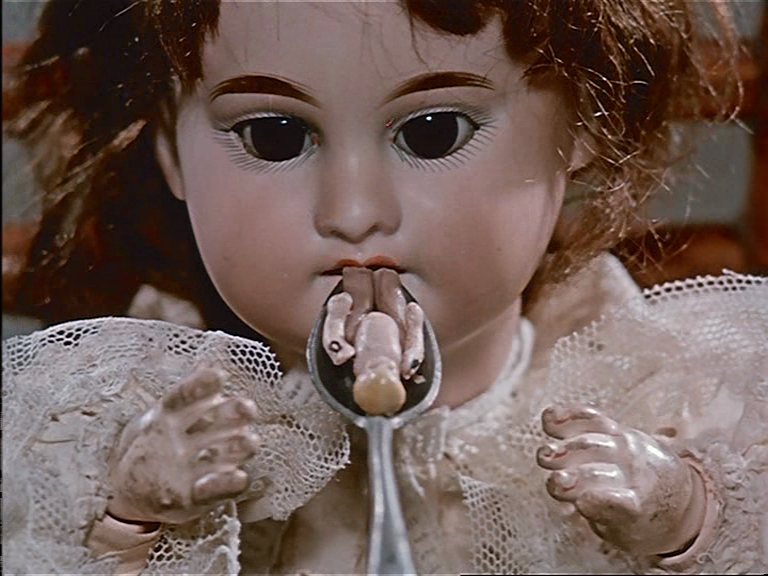 ‘Jabberwocky’ has little to do with the poem from Lewis Carroll’s ‘Through The Looking Glass’, although we hear it being recited by a little girl during the opening sequence.
The film it is Švankmajer’s surrealistic masterpiece on the loss of childhood, depicted by several episodes, which are separated by a box of bricks, a labyrinth and a black cat crushing the box of bricks.
During the episodes we are treated on extremely surrealistic images of very active inanimate objects in a child’s room. First we watch a boy’s suit growing a forest in his room, defying both time and authority (symbolized by the portrait in the room). Then we watch large cannibalistic dolls grinding, ironing and eating little dolls, a china baby in a cradle destroying two tin armies, a pocket knife performing acrobatic tricks until it makes an ill-fated fall and stabs itself, and finally, schoolbooks producing paper boats and planes, which fly out of the window, while the father’s portrait produces pictures of beautiful women.
This last episode shows the child’s changing interests. In the end the labyrinth is solved, the cat – the only living thing in the entire film – is caged, and the boy’s suit is replaced by an adult one. The boy is free from his parent, but the days of imagination are over, the fantasy is gone.
For this film Švankmajer makes excellent use of 19th century imagery (sailor suit, vintage dolls and toys) to create a completely unique world. It’s the film maker’s most typical film, partly expanding on ideas explored in ‘Historia Naturae, Suita‘ (1967), and showing his fascination with fantasy, cruelty and decay, which roam freely in the child’s self-contained room. The rather morbid behavior of the everyday objects is quite unsettling and it shows how a child’s fantasy can be both imaginative and cruel.
‘Jabberwocky’ is without doubt one of Švankmajer’s most powerful films. He would only top it eleven years later, with ‘Dimensions of a Dialogue‘ (1982). Švankmajer would explore the imagination of children further in the moving ‘Down to the Cellar‘ (1983), and in his unique adaptation of Lewis Carroll’s most famous work ‘Alice‘ (1987).
Watch ‘Jabberwocky’ yourself and tell me what you think:
‘Jabberwocky’ is available on the DVD ‘Jan Svankmajer – The Complete Short Films’
Director: Jan Švankmajer
Release Date: 1969
Rating: ★★
Review:
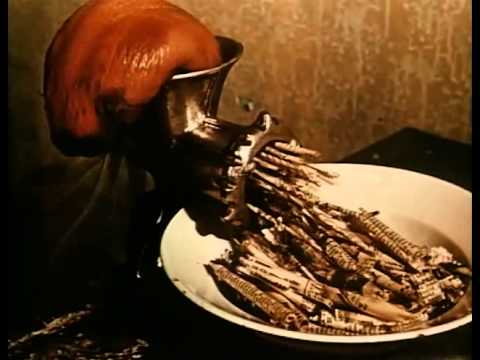 ‘A Quiet Week in the House’ is the last film in a series of four involving people facing surreal settings, which Švankmajer made in 1968-1969.
in this film a fugitive seeks shelter in an abandoned house. Every day he digs a hole in one of the doors of the corridor in which he sleeps. Every day he looks through the hole to watch weird surrealistic images of inanimate things behaving strangely. After a week he sets up a device to blow up all doors.
The live action footage is shot in black-and-white, and is accompanied by the sound of a camera. The surrealistic images, on the other hand, are shot in color and completely silent. Unfortunately, the film is too long, and it fails to be as impressive as related films like ‘The flat’ (1968) or ‘Jabberwocky‘ (1971), being neither completely disturbing nor very entertaining. ‘A Quiet Week in the House’ remains one of Švankmajer’s rare weak films.
Watch ‘A Quiet Week in the House’ yourself and tell me what you think:
http://www.dailymotion.com/video/xpfbvj_a-quiet-week-in-the-house-de-jan-svankmajer_shortfilms
‘A Quiet Week in the House’ is available on the DVD ‘Jan Svankmajer – The Complete Short Films’
Director: Jiří Trnka
Release Date: 1954
Rating: ★★★
Review:
 A young man on a motorcycle is on his way to his girl.
Along the way he stops at a bar, where a wedding is taking place. There he’s offered a drink, which he reluctantly accepts. However, one leads to another and he is quite intoxicated when leaving the bar. Driving at night he tries to speed against a car, a train and even a plane, but he finally crashes, never to see his girl.
This educational film warns us not to combine drinking with driving. In this respect the film is very dull and predictable, but Trnka’s illusion of speed and drunkenness is astonishing.
Watch ‘A Drop Too Much’ yourself and tell me what you think:
http://en.channel.pandora.tv/channel/video.ptv?ch_userid=noisypig&prgid=46485008&ref=rss
Director: Jiří Trnka
Release Date: 1949
Rating: ★★★
Review:
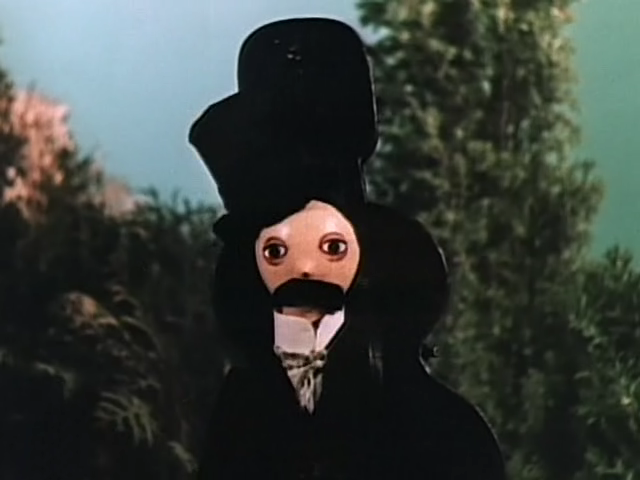 ‘Story of the Bass Cello’ is a re-telling of a classic story by Anton Chekhov.
The film tells about a bass player and a girl who both take a swim, but whose clothes are stolen. The bass player invites the lady to take place in his bass case, but when he’s after the possible thief, the case is picked up by his fellow instrumentalists and brought to the palace, where an astonished crowd discovers the naked lady inside.
‘Story of the Bass Cello’ is a mildly amusing and sweet film. It contains nice silent comedy. The short is a little bit slow, however, and not as good as Trnka’s more outrageous ‘The Song of the Prairie‘ from the same year.
Watch ‘Story of the Bass Cello’ yourself and tell me what you think:
http://veehd.com/video/4587175_Jiri-Trnka-Roman-s-Basou-Story-Of-The-Bass-Cello-1949
Director: Jiří Trnka
Release Date: 1949
Rating: ★★★★★
Review:
 With ‘The Song of the prairie’ Trnka’s both made a parody of and a homage to the classic Western.
The film uses all the cliches of the genre: a stagecoach, masked bandits, a damsel in distress, a hero with a white hat, a villain fancying the girl, and a climax on a cliff.
Trnka’s animation has much improved since ‘The Emperor’s Nightingale‘: the cinematography is excellent, and particularly the illusion of speed is astonishing. The film is wonderfully tongue-in-cheek and full of brilliant silent comedy, showing Trnka’s then unsurpassed mastery in stop-motion. ‘The Song of the Prairie’ is one of Trnka’s most enjoyable films, and deserves a more classic status.
Watch ‘The Song of the Prairie’ yourself and tell me what you think:
Director: Jiří Trnka
Release Date: April 15, 1949
Rating: ★★★
Review:
 ‘The Emperor’s Nightingale’ is Jiří Trnka’s second feature film (he made no less than six in total).
It tells the familiar story by Hans Christian Andersen from an original perspective: he frames the fairy tale by a live-action story about a lonely rich boy, who lives in a restricted environment. When the boy goes to bed, he dreams the fairy-tale, which stars some of his toys. Thus, after more than seven minutes, the animation kicks in.
In the boy’s dream, the Chinese emperor is a lonely little rich boy, restricted by rules, too, and the whole film seems a plea for freedom and against rules and restrictions, quite some message in communist Czechoslovakia. This theme is enhanced by the English narration, wonderfully voiced by Boris Karloff, which is a welcome addition to Trnka’s silent comedy. The whole film breathes a kind of surrealistic atmosphere and Trnka’s use of camera angles is astonishing, as is his sometimes very avant-garde montage.
Nevertheless, the pacing of the film is slow, its humor sparse and only mildly amusing, and the puppet animation still too stiff to allow elaborate character animation. Therefore, the film hasn’t aged very well, and although a tour-de- force, ‘The Emperor’s Nightingale’ falls short as a timeless masterpiece.
Watch ‘The Emperor’s Nightingale’ yourself and tell me what you think:
Director: Peter Lord & David Sproxton
Release Date: 1978
Rating: ★★
Review:
 ‘Confessions of a Foyer Girl’ is the second film in Aardman’s revolutionary ‘Animated Conversations’ series.
Like its predecessor, ‘Down & Out‘, the film uses recorded dialogue. This time we hear two foyer girls chatting in a cinema. The dialogue is hard to understand and the lip-synch is not as good as in ‘Down & out’. Moreover, the animation is associated with seemingly unrelated stock live action footage, which leads to a film, which is both experimental and vague. The result never quite works and the result must be called a failure.
‘Confessions of a Foyer Girl’ is available on the DVD ‘Aardman Classics’
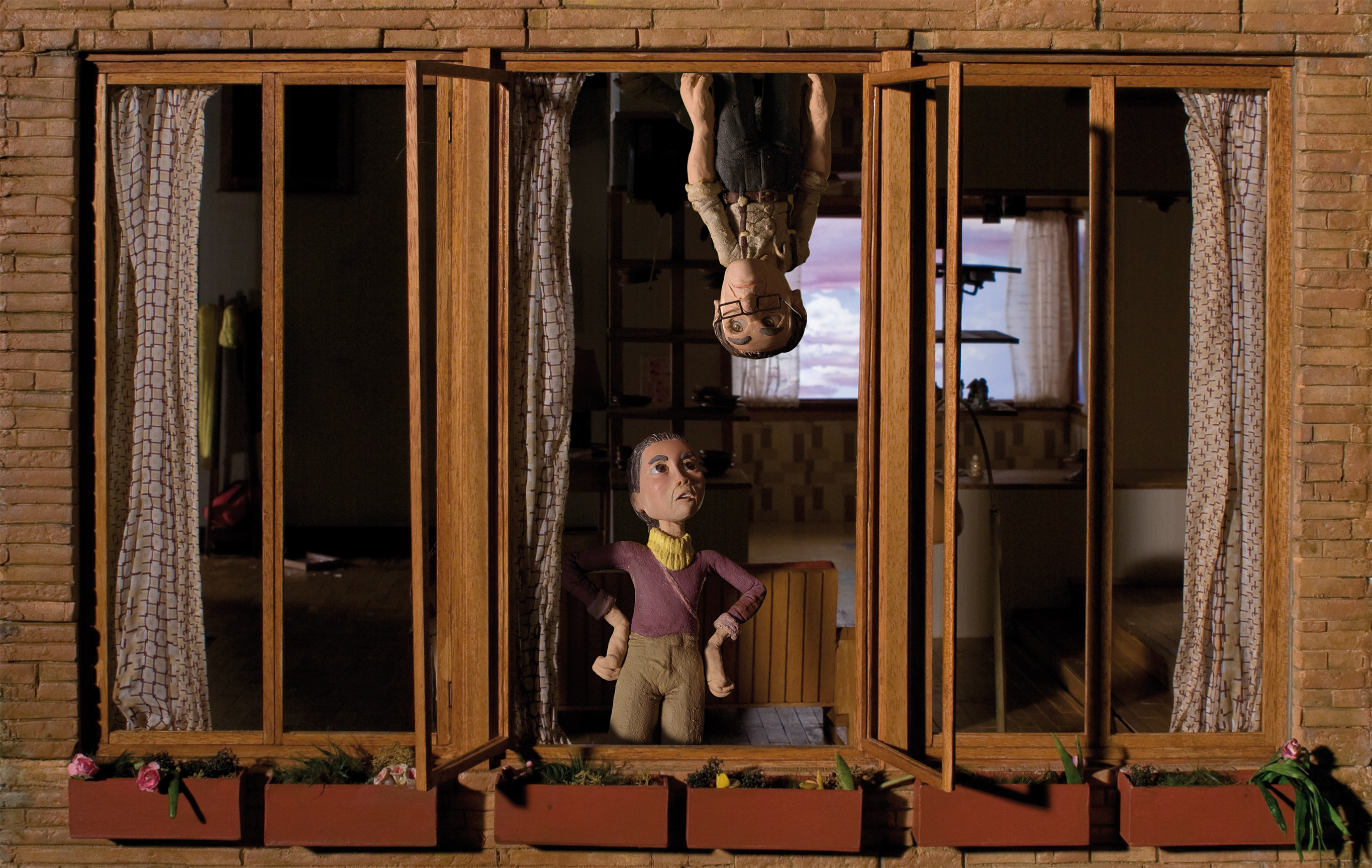
Still from ‘Head over Heels’
‘Head over Heels’ is a film directed by Timothy Reckart, and produced by Fodhla Cronin O’Reilly. It has won this prestigious Eruopean prize at the Cartoon Forum, held in Toulouse, France. Earlier, the film had been nominated for an Academy Award.
‘Head over Heels’ is a stop-motion film about a couple who have grown apart, even though they still live in the same house. In the film, one of them occupies the ceiling, the other the floor. This concept is a masterstroke, and the story is very well executed. The result is a moving picture, which is a well-deserved winner of the Cartoon d’Or 2013.
http://cartoon-media.com/cartoon-d-or/cartoon-d-or-2013/nominees.htm
Director: Peter Lord & David Sproxton
Release Date: 1978
Rating: ★★★★★
Review:
 ‘Down & out’ is the first film in Aardman’s ‘animated conversations’ series and the British studio’s first masterpiece.
The very idea of using dialogue from real life is revolutionary enough, but to use it for clay animation with lip-synch is a masterstroke. Moreover, the animation of the plasticine figures is startling: it lacks the exaggerations of normal animation, but uses small gestures and real movements, like scratching one’s nose or belly, instead. The animation continues realistically even when not supported by the soundtrack. The result is uncannily realistic, making the drama of an old, confused man asking for food and shelter, but being turned down at an Salvation army office, extra tragic.
With this film Aardman single-handedly invented the ‘animated documentary’, a genre which would lead to fantastic films like ‘Ryan’ and ‘Waltz with Bashir’ in the 2000s.
‘Down & Out’ is available on the DVD ‘Aardman Classics’
Director: Fernando Cortizo
Release Date: October 31, 2012
Rating: ★★★★½
Review:
 2012 was a good year for stop motion animation fans: no less than four stop motion features were released that year. In March we had Aardman’s ‘The Pirates! In an Adventure with Scientists!’, followed by Laika’s ‘ParaNorman’ in August and Disney’s ‘Frankenweenie’ in September. Least known among these was the last release, from October: ‘O Apóstolo’ from Spain.
Somehow, stop motion feature film makers seem to favor horror-inspired plots, and ‘O Apóstolo’ is no exception. However, unlike ‘ParaNorman’ or ‘Frankenweenie’, ‘O Apóstolo’ is not a lighthearted family film. Instead, it’s a dark gothic thriller, and it succeeds surprisingly well in maintaining a high level of suspense throughout most of the picture.
Both the film’s theme and setting are typical Spanish: the film is drenched in a catholic atmosphere, and it’s set in a remote village on the road to Santiago de Compostela, famous for its numerous pilgrims. We follow the thief Ramon, who has escaped from prison to turn to this village to collect a treasure his cell mate has hidden there.
We soon discover that there is something terribly wrong with the little village. Its inhabitants seem to lure innocent pilgrims, and try to keep them there. It remains long unknown why, keeping the suspense at a high level. And even when the obligatory explanation of the events comes, the makers present it elegantly: the explanation, despite being long and quite absurd, is beautifully done in 2D animation with quasi-medieval designs, accompanied by a song.
Luckily, the film also has its lighter moments, mostly in a subplot, involving a particularly unsympathetic archbishop, who goes on his way to invest the loss of pilgrims. It’s soon clear that the film makers have plotted a punishment for this haughty, selfish character.
Apart from the gripping plot, ‘O Apóstolo’ excels in gorgeous production values. The little village and its sinister forest surroundings are conceived with stunning detail. They are as rich as any life action background, and contribute highly to the dark and creepy atmosphere. The puppets are designed less originally than the other features mentioned above, but retain a certain realism, which makes it possible to relate to them, especially with the main protagonist, Ramon the thief. The sole exception is the priest, whose appearance is too absurd and too sinister to blend in. It’s a pity, because his dominant presence casts a shadow on the more underplayed (and underdesigned) other village characters, whose threat is much more subtle, and therefore more disturbing.
In all, ‘O Apóstolo’ easily draws you in. It is without doubt one of the most original and best animated films of 2012. It definitely deserves to be more well-known.
Watch the official trailer of ‘O Apóstolo’ and tell me what you think:
Director: Władysław Starewicz
Release Date: 1922
Rating: ★★★★★
Review:
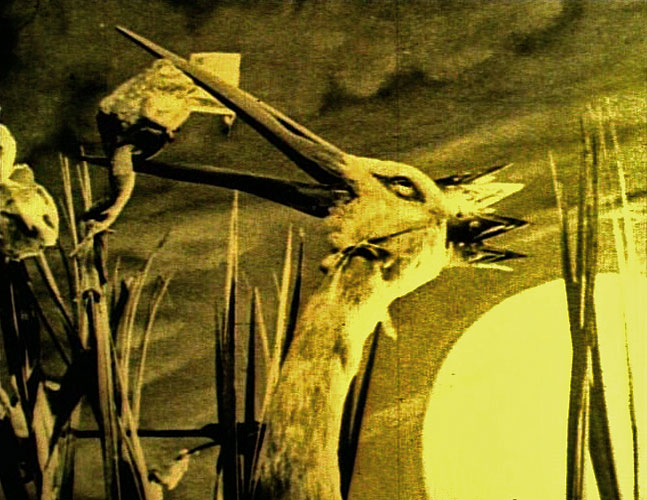 After the October revolution, Władysław Starewicz fled to France, where he continued to make stop motion films until his death in 1965. ‘The Frogs Who Wanted a King’ is the fourth film he made in France, and probably his most political.
The film is based on one of Aesop’s fables. Some frogs ask Jupiter for a king. Jupiter sends them one, but the king looks like a tree and does nothing at all. The frogs don’t like him, so Jupiter sends them a stork, who, naturally, eats the unfortunate amphibians.
The message may be that it’s better to have a dull government than one that kills you, a message Starewicz could certainly relate to, being forced to exile by the oppressing communist regime in Russia.
Once again, Starewicz’ animation is top notch. The film has a particularly fable-like character, taking place in its own, very convincing universe.
Watch ‘The Frogs Who Wanted a King’ yourself and tell me what you think:
Director: Władysław Starewicz
Release Date: 1913
Rating: ★★★½
Review:
 ‘The Insects’ Christmas’ is Starewicz’s next film after his masterpiece ‘The Cameraman’s Revenge‘.
Although the short uses insects again, it’s a whole different film, turning to the sweet subject of Christmas. It’s probably the first animated film about Christmas ever made.
The plot is surprisingly simple: Father Christmas climbs down a Christmas tree, awakes some insects and a frog, who are hibernating underground, and he invites them to a Christmas party. He gives them presents and they all go skiing and skating.
This film’s story cannot be compared to the mature plot of ‘The Cameraman’s revenge‘. It’s more like a child’s dream of Christmas. The film reuses puppets from ‘The Cameraman’s Revenge’ and others, and even though the animation is less engaging than in Starewicz’s earlier film, it is still of a stunning virtuosity, making the result still a delight to watch. Note, for example, the illusion of wind in the animation of Father Christmas’s coat.
Watch ‘The Insects’ Christmas’ yourself and tell me what you think:
‘The Insects’ Christmas’ is available on the DVD ‘The Cameraman’s Revenge & other Fantastic Tales’
Director: Władysław Starewicz
Release Date: November 9, 1912
Rating: ★★★★★ ♕
Review:
 ‘The Cameraman’s Revenge’ is one of the earliest animation films ever made, and a very early masterpiece (it predates ‘Gertie the Dinosaur‘ by two years). Surprisingly, it’s a film about adultery involving insects.
The plot of this stop motion film is as follows: Mr. Beetle commits adultery with a dragonfly, who is a dancer at a nightclub. Unbeknownst to him his secret behavior is filmed by a rival grasshopper who happens to be a cameraman. Meanwhile, Mrs. Beetle also commits adultery, with a beetle who is also a painter. But they’re discovered by Mr. Beetle on his arrival home. Mr. Beetle chases the painter out of his house. Nevertheless he forgives his wife and takes her to the cinema. However, the film that is shown reveals his infidelity, which creates a riot and the married couple ends in jail for destroying the movie box.
‘The Cameraman’s Revenge’ is an extraordinary film, and without doubt one of the first masterpieces of animation. Unlike Émile Cohl’s stop motion, Starewicz’s animation is stunning and very convincing. The insects are very lifelike, and move surprisingly realistically. The insects’ gestures are subtle, clearly evoking their emotions. For example, there’s a beautiful and very lifelike little scene of a beetle servant lighting the fireplace, animated without any hint of overacting. On the other hand, Mr. Beetle clearly is a brute, but we can also watch him in a seductive mood.
Throughout, Starewicz’s storytelling is economical and mature. The film’s subject is highly original for an animation film, even today. It’s almost unbelievable that such a modern film was made in Czarist Russia.
Watch ‘The Cameraman’s Revenge’ yourself and tell me what you think:
‘The Cameraman’s Revenge’ is available on the DVD ‘The Cameraman’s Revenge & other Fantastic Tales’
Director: Jan Švankmajer
Release Date: 1967
Rating: ★★★★★
Review:
 ‘Historia Naturae, Suita’ is an abstract, yet morbid and disturbing film.
It uses drawings, models, skeletons, stuffed and live animals, which change into each other and which perform morbid dances. Their antics are interspersed with a close up of a man eating meat.
We see molluscs (Aquatilia, foxtrot), insects (Hexapoda, bolero), fish (Pisces, blues), reptiles (Reptilia, tarantella), birds (Aves, tango), mammals (Mammalia, menuet), monkeys (Simiae, polka) and man (Homo, waltz), successively.
It shows us that we, men, are made from the same mortal matter as the rest of the animal kingdom, which in this film appear to us only as collectibles or food. This unsettling reminder is emphasized by the last shot, in which the human is replaced by a skull, eating…
The music is a perfect match to the surrealistic imagery, with its rather abstract, uncanny and atonal renderings of the dance forms mentioned.
Watch ‘Historia Naturae, Suita’ yourself and tell me what you think:
http://www.totalshortfilms.com/ver/pelicula/379
‘Historia Naturae, Suita’ is available on the DVD ‘Jan Svankmajer – The Complete Short Films’
Director: Jiří Trnka
Release Date: 1965
Rating: ★★★★★ ♕
Review:
 In a self-contained world, seemingly outside space and time, an harlequin lives happily in his home.
The harlequin is an artist, a ceramist and a sculptor, making pots for his beloved plant. Unfortunately, his domestic peace is disturbed by a giant gloved hand, which orders him to sculpt a statue of a hand. As the harlequin keeps refusing, the hand uses praise, money, indoctrination, brutal force and erotics to persuade the artist to do what he’s ordered.
In the end the harlequin is caught, his hands are attached to strings worked by the hand, and he has to sculpt a giant hand in a cage. But, after finishing his works, the artist escapes and returns to his beloved home. It sadly is his own beloved plant that kills him by falling on his head, while he’s barricading the entrances to his room. The hand gives the artist a state funeral, making him posthumously part of the system.
‘The Hand’ was Czech puppet animator Jiří Trnka’s last film, and it was to be his masterpiece. Instead of diving into classic tales, he made one of his own, resulting in a most personal film and one that stands as the classic animated tale on totalitarianism.
Trnka manages to tell his tale without any dialogue. Although the puppet of the harlequin knows only one expression, his emotions are well-felt through his animation. There’s no doubt he’s symbolic for artists working in totalitarian regimes in general. The glove is a masterstroke. In its facelessness it is as scary as it is symbolic for the invisible hand of totalitarian power. The result is an equally sad and disturbing film, which shows both Trnka’s genius and the power of animation in general.
It’s no small surprise that this highly symbolic film was forbidden in communist Czechoslovakia.
‘The Hand’s message is still topical, being symbolic for artists working in oppressive regimes all over the world.
Watch ‘The Hand’ yourself and tell me what you think:
‘The Hand’ is available on the DVD ‘The Puppet Films of Jiri Trnka’
Director: Jan Švankmajer
Release Date: 1965
Rating: ★★★★
Review:
 In ‘A Game with Stones’ (also known by its German title ‘Spiel mit Steinen’) an odd construction, consisting of a clock, a tap and a bucket, produces stones by the hour. These stones form patterns to the music of a music box until the bucket is emptied, dropping the stones on the floor.
The stones’ abstract patterns are indeed game-like, but they become more and more grim, ending in a destructive game, destroying the stones, and eventually, the bucket, leaving the machine useless. The game is over. It is Švankmajer’s genius that he’s able to give this fairly abstract film a heart and an unsettling, sad ending.
‘A Game with Stones’ is Švankmajer’s first film to use stop motion animation extensively. The fourth game contains faces made of numerous small pebbles, which anticipates similar heads in ‘Dimensions of Dialogue’ (1982), a film in which Švankmajer’s stop motion techniques reach a stunning apex.
Watch ‘A Game with Stones’ yourself and tell me what you think:
‘A Game with Stones’ is available on the DVD ‘Jan Svankmajer – The Complete Short Films’


 Dr. Grob's Animation Review