Director: Bob Hatchcock Airing Date: April 17, 1995 Stars: Duckman Rating: ★★★½ Review:
This episode starts with Aunt Bernice finding a crystal in her own backyard and taking the family to a new age fair to let it examine.
Against all odds it’s Duckman who gets the most spiritual journey of his life, when he talks to his late mother, who has reincarnated as a highly infectious germ. It turns out that Duckman was heavily neglected by his mother during his childhood, and in a flashback we see some rare footage of Duckman as a kid. Duckman’s mother explains her son that it’s all about karma, which prompts Duckman to better his life in his own unique way, by stuffing his kids full of bad food, by bribing their teachers, and by building a baseball field right on a railroad track.
Duckman’s encounter with his mother forms the heart of the episode, and this part is surprisingly sincere, despite the occasional joking, making this one of those welcome episodes exposing more of Duckman’s emotional side.
Watch ‘The Germ Turns’ yourself and tell me what you think:
Director: Paul Demeyer Airing Date: April 10, 1995 Stars: Duckman Rating: ★★★ Review:
‘America the Beautiful’ starts with a warning sign stating that “the following contains scene of heavy-handed and over-obvious allegories and is not recommended for small children and certain congressmen from the South”.
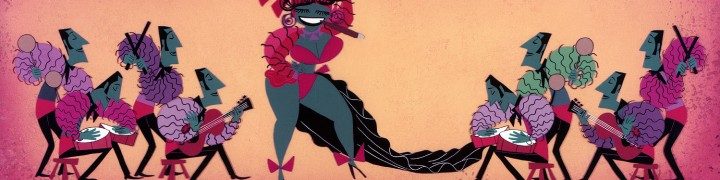
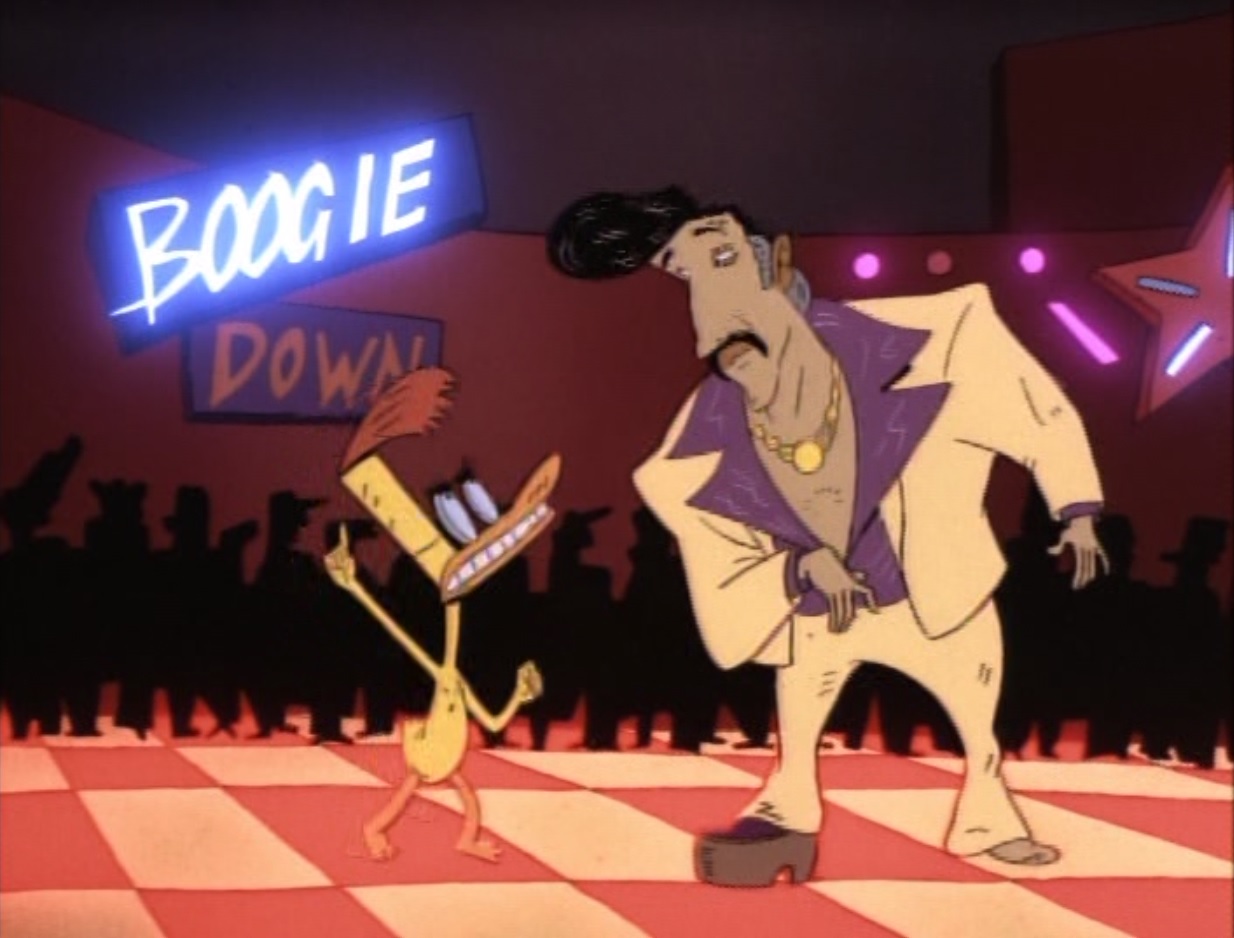
And indeed, this is an allegorical episode, with Duckman and Cornfed in search of America (who has taken form of a beautiful and noble woman) on behalf of some overtly cute little children. The quest takes them to a 1950s suburbia, a 1960s hippie university, a 1970s disco, and 1980s Wall Street. All the four have exploited America, giving nothing in return. Duckman finally finds America at a dump. The episode ends with a corny ‘We Are the World’-like song sung by all protagonists and the children called ‘We Are Here’.
The episode indeed suffers from heavy-handedness, and Duckman in particular, seems quite at loss here. The best part is when Duckman and Cornfed drive into the 1950s suburbia, which changes them from full color into black and white, prompting Cornfed to say “it appears they don’t allow people of color in this community“. Also remarkable, but much less functional is the beauty pageant-turning-into-a-big fight with which the episode opens.
Watch ‘America the Beautiful’ yourself and tell me what you think:
Director: Kevin Lima Release Date: April 7, 1995 Stars: Goofy, Max, Pete Rating: ★★★ Review:
‘A Goofy Movie’ arguably is the least known of Disney’s theatrical movies from the studio’s Renaissance period. The film is not even in its official canon of animated features. Maybe because it was Disney’s first animated theatrical feature based on a television series, in this case ‘Goof Troop’, which run from September to December 1992.
Now I’ve never seen an episode of this television series myself, but I comprehend that it does resolve around Goofy being a single father of his son, Maximilian (in short Max), and being neighbor to Pete, who is a single father of a son, too, Pete Junior or P.J. in short. ‘A Goofy Movie’ uses exactly this premise, focusing on the relationship between Goofy and his son, with Max being the undisputed main character of the movie.
Now, Goofy’s family life has always been odd, being the classic Disney character that changed the most during his career. And indeed, he has been seen having a son in a few of his classical cartoons, starting with ‘Fathers are People’ from 1951, but by that time Goofy had transformed into everyman George J. Geef, and this son clearly isn’t Max, as he’s called George Geef jr. In both ‘Goof Troop’ and ‘A Goofy Movie’ Goofy once again is his clumsy self, so he has evolved once more. Pete, too, has had a son in earlier entries, most notably in ‘Bellboy Donald’ from 1942. In ‘A Goofy Movie’ he’s not really the villain of the old days of old, but still a disruptive voice, not taking Goofy for full, and giving him ill advice.
Voice artist Bill Farmer reprises his role as Goofy from ‘Goof Troop’ and is an excellent successor to Pinto Colvig. Max is voiced by Jason Marsden, a different voice than in ‘Goof Troop’, in which he was voiced by a woman (Dana Hill). But this is understandable as the events in ‘A Goofy Movie’ take place several years after the ones in ‘Goof Troop’. Max’s singing voice is provided by Aaron Lohr.
Added to the mix, and apparently not present in ‘Goof Troop’, is Max’s love interest Roxanne, and the film starts with Max’s last day at school, on which he tries to impress Roxanne, in which he succeeds, and he manages to ask her on a date to a party. Unfortunately, his father, realizing he might be losing grip on his son, has planned a trip for two to some fishing lake, and Max invents a totally unconvincing lie of why he has to cancel the date, involving both Max’s and Roxanne’s pop idol Powerline (who, voiced by Tevin Campbell, sounds a little like Michael Jackson).
As said, the father-son relationship between Goofy and Max is the focal point of the cartoon, and as such the film is surprisingly realistic and down to earth, with Max being ashamed of his old-fashioned, awkward and clumsy father, and Goofy uncomprehending of Max’s interests as an independent teenager. However, the two learn to know and to respect each other on a rather forced road trip through America. In this respect, one can see ‘A Goofy Movie’ as a forerunner of ‘Finding Nemo’ (2003), which explores a similar theme.
The road trip, which takes place on Route 66, and which takes the two Goofs all through America, forms the main part of the film, and it’s surprising to note that this piece of Americana was animated in studios in Paris, France and Sydney, Australia. Unfortunately, ‘A Goofy Movie’ defies all realism in several scenes, hampering the heartfelt story with outlandish scenes, like the two Goofs encountering Bigfoot, falling off a cliff with their car, and escaping a waterfall in an all too improbable and inconsistent series of events.
Moreover, for a film starring Goofy there’s surprisingly little humor – it’s all not that goofy. Yet, the team has managed to keep Goofy’s optimistic and naive character, while adding some depth to the former simpleton, mostly his struggle in being a father to Max. Indeed, the film is at its best when keeping focus on the relationship between Goofy and Max. This focal point remains interesting despite the deviations from reality.
As a film of the early nineties, ‘A Goofy Movie’ is an obligate musical, and the movie knows three nice if forgettable songs by Carter Burwell, sung by Max, with Goofy joining in in two of them. They at least succeed in not being obnoxious.
The animation is of a very high quality, with considerable attention detail. There are some nice touches, like Max’s reflection in a window, or colors turning blue when Goofy gets sad.
In all, ‘A Goofy Movie’ is a nice little movie with a surprisingly mature theme. The film may not be a masterpiece, it’s of enough quality to be worth a watch.
Watch the trailer for ‘A Goofy Movie’ yourself and tell me what you think:
Director: Jeff McGrath Airing Date: April 3, 1995 Stars: Duckman Rating: ★★★½ Review:
‘Inherit the Judgement: The Dope’s Trial’ starts with Duckman and the family driving through the desert in a hot car in search of some idiotic bargain.
They crash into some hick town, which happens to be the home town of Ducman’s rival King Chicken (see ‘Ride the High School‘ and ‘Joking the Chicken‘ from the first season). By exclaiming that the egg came before the chicken Duckman gets imprisoned and is about to be hanged, but he manages to save himself on trial by making King Chicken revealing his own vile scheme.
The episode ends with Cornfed parodying Porky Pig, but the episode’s highlight is King Chicken’s ‘Down with Duckman Carnival’, which is full of crazy rides based on killing Duckman.
Watch ‘Inherit the Judgement: The Dope’s Trial’ yourself and tell me what you think:
Director: Van Partible Airing Date: March 26, 1995 Stars: Johnny Bravo Rating: ★★ Review:
Johnny Bravo was one of the striking characters of the cartoon renaissance happening at Cartoon Network. Together with Dexter’s Laboratory, Cow and Chicken, The Powerpuff Girls, and Courage the Cowardly Dog he was the flagship of the creativity at the network in the second half of the nineties.
Yet, this isn’t immediately visible in the very first short starring the character, aptly titled ‘Johnny Bravo’. This very first Johnny Bravo episode first aired as part of Cartoon Network’s ‘World Premiere Toons’ (later renamed ‘What a Cartoon’), and was re-shown later as the first part of three shorts forming the first Johnny Bravo episode broadcasted on July 7, 1997.
The episode firmly establishes Johnny Bravo as a character obsessed by his own body and presumable attractiveness to women, who don’t care about him in a bit. The short starts at a zoo where Johnny Bravo hopelessly tries to impress passing girls. When a gorilla has escaped he offers the female zookeeper to retrieve the animal.
The gorilla is a badly designed, purple talking beast that is one of the least funny characters to hit the television screen, especially when Partible tries to make him Bugs Bunny-like funny when talking to Johnny Bravo. This is a painful attempt at humor, indeed. Much better are Johnny Bravo’s attempts to show off and to attract women.
The animation overall is limited and very jerky, with especially Bravo jumping from pose to pose, an animation style that was remarkably fresh at the time. The hands mostly are mere paws until the fingers have to be drawn. This style unfortunately gives the character an ugly and cheap look. The color design, too, is far from interesting and arguably non-existent. In all, this debut cartoon hasn’t aged very well. Yet, the character would last four seasons, being on television between 1997 and 2004.
‘Johnny Bravo’ is available on the DVD-set ‘Johnny Bravo Season One: All 13 Episodes’
Director: John Eng Airing Date: March 25, 1995 Stars: Duckman Rating: ★★½ Review:
In this mediocre Duckman episode a guy named Milo, owner of a rehab clinic for the rich and famous, asks the help of Duckman to find out who wants to murder him.
Unfortunately, the man is killed even before Duckman can start the case. But Duckman isn’t focused anyway, and it’s up to Cornfed to solve the murder mystery, while Duckman gets ravingly mad in rehab.
Duckman behaves more cartoony than ever in this episode, and his hallucinatory ride in which he has visions of food and women forms the highlight of the cartoon. But he’s playing second base this time, for much screen-time is devoted to his assistant Cornfed at his most serious. There’s also some random violence by Duckman on his cutesy-wootsy assistants Fluffy and Uranus.
Watch ‘Days of Whining and Neurosis’ yourself and tell me what you think:
‘Married Alive’ start with Duckman’s house being in the baddest shape imaginable, with everything broken and undefined gore lying in heaps everywhere.
It turns out that aunt Bernice has been away, but when she returns, she’s not even mad, but sings Giacomo Puccini’s aria ‘O mio babbino caro‘, because she’s in love. During her holiday a billionaire and media magnate called Baron von Dillweed proposed to her to star the first infomercial-wedding ever. Duckman only starts to worry when Bernice reveals she’ll move to Switzerland and take the boys with her. At that point Duckman comes into action, and uses his dormant detective skills to unmask the baron in his own unique way.
This episode features a short reference to Indiana Jones, Cornfed doing karaoke, and Duckman grinding Fluffy and Uranus to rice, but the episode’s highlight must be aunt Bernice’s lovesick behavior.
Watch ‘Married Alive’ yourself and tell me what you think:
The second season of ‘Duckman: Private Dick/Family Man’ starts with a rather rambling episode in which Duckman tries to get famous by exploiting the sleazy reputation he got by pinching the butts of two sexy ladies on camera.
The set up of this episode is rather incomprehensible and involves the president visiting town, and three sexy but dumb ladies visiting Duckman’s office for no apparent reason. Also involved is a commercial fellow with shades, a ponytail and an annoying voice, making Duckman sign a contract to get him famous. Nothing is done with this devilish scheme, however.
Highlight of this otherwise disappointing episode is Duckman’s feature film on his life called “Pinch Me, Kiss Me Kill Me: The Duckman Story”. This part is acted out in live action, and includes over the top sexy women falling for the cool Duckman character as well as ridiculous dialogue full of sexual references, and even blatant advertising.
Watch ‘Papa Oom M.O.W. M.O.W.’ yourself and tell me what you think:
This is Duckman episode no. 14 To the previous Duckman episode: Joking the Chicken To the next Duckman episode: Married Alive
‘Papa Oom M.O.W. M.O.W.’ is available on the DVD-box ‘Duckman – The Complete Series’
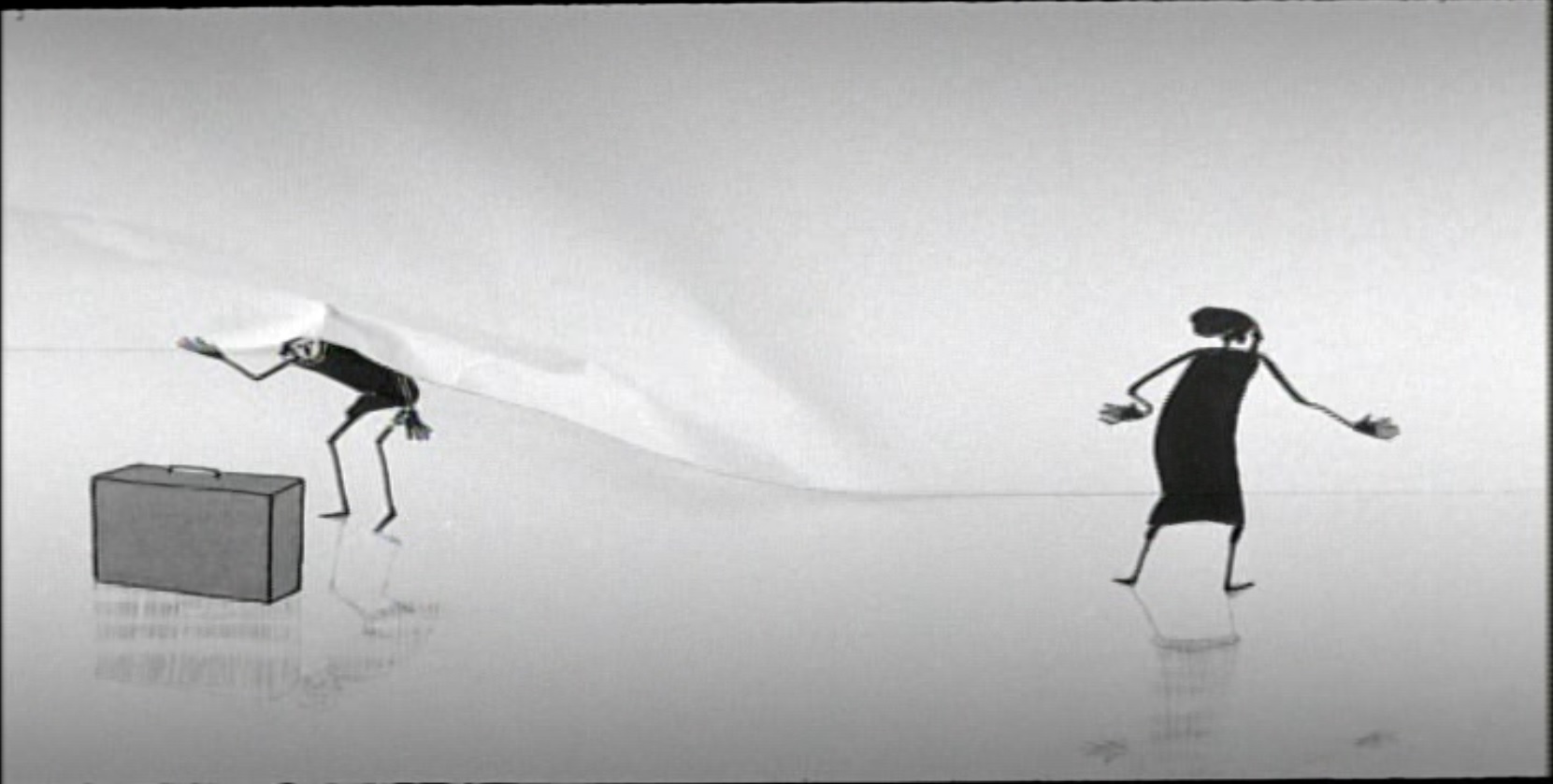
In ‘Passage’ a man and his servant, who carries a heavy suitcase, are crossing an empty space of snow and ice. The snow and ice provide a conflict between the two, even disrupting the integrity of the two men’s bodies.
Typically for Krumme even the background space isn’t what it seems to be, with the servant hiding behind the horizon line, and several pieces of paper wrinkling during the fight. This is inventive use of the medium of animation, indeed.
Unfortunately, one can hardly tell the two men apart, who are drawn and animated the same (one has a tall hat, but the two even exchange hats at one moment). Moreover there’s hardly any story, and the film appears to stop only because Krumme seemingly runs out of ideas.
Watch an excerpt from ‘Passage’ yourself and tell me what you think:
‘Passage ’ is available on the DVD ‘Spatial Pandemonium – Short Films by Raimund Krumme’ and on The Animation Show of Shows Box Set 9
Director: Jan Švankmajer Release Date: September 10, 1994 Rating: ★★★★★ ♕ Review:
‘Lekce Faust’ (literally ‘Lesson Faust’) is Jan Švankmajer’s second feature film. It contains much less animation than his first feature film ‘Něco z Alenky’ (Alice) from 1988 and can be considered his first live action movie.
However, this film is still much connected to his earlier work, mostly through the use of life-sized puppets, which goes all the way back to ‘Don Šajn’ (Don Juan) from 1969, and of advanced clay animation, which Švankmajer first used in ‘Možnosti dialogu’ (Dimensions of Dialogue) in 1982. Moreover, there’s little dialogue in the film, with the first lines only appearing after 15 minutes. Instead, the film relies heavily on stark imagery and exquisite sound design (there’s no musical soundtrack), just like in animation film. The English dub, by the way, is excellent, and there’s no need to find the original Czech version.
Švankmajer retells the story of Faust in his own unique way, with an inner logic that is unique to his brand of surrealism. For this Švankmajer uses texts from Johann Wolfgang von Goethe’s two Faust plays (1808 & 1832), as well as Christopher Marlowe’s play Doctor Faustus from 1592, enhanced with text traditions from Czech puppet theater productions based on the same legend. Even a part from Charles Gounod’s opera ‘Faust’ from 1859 is used in a scene that features four ballerinas and which is probably the least essential and least successful episode in the entire film.
Importantly, the film stars an unnamed everyman (played by the deadpan Petr Čepek in his last role before his death in 1994), who’s slowly lured into the devil’s clutches. By using the most common protagonist imaginable we’re given the opportunity to live the nightmare the man experiences ourselves. There’s a sense of ‘this could happen to anyone’, with which we enter the bizarre series of events.
The film starts with two characters handing out copies of a map with a red spot but no explanation to passers-by. Our man gets one, too, and has a short look at it, before he discards the piece of paper. Nevertheless, immediately strange omens pile up around him: he watches a doll’s head getting crushed between two doors, a black chicken flees his home apartment, and when he goes eating he finds an egg inside his bread. As soon as he opens the egg, the man seems to be lost, and the next day he goes exploring…
The film mostly takes place indoors, and like in ‘Alice’ there’s a genuinely claustrophobic feel to it, with a total lack of logic with which the different spaces are connected. This of course contributes to the nightmarish atmosphere that stays throughout the feature. Nevertheless, Švankmajer occasionally returns to outdoor scenes, sometimes very abruptly, with staged sets switching to scenes taking place in nature, parks or ruins, and vice versa. But sometimes more naturally, with the man reentering the streets of Prague a couple of times.
Yet our hero never stays out of the clutches of the devils for long, and all too soon his curiosity brings him back to the theater set where he more or less has to play his part. For a long while, the man takes the whole play for a joke. It certainly doesn’t help that the part of the good angel is played by a puppet as well, making the man’s only chance to repent by all means a rather silly occasion. Thus only too late the man realizes that the devil will indeed collect his soul.
As the film progresses, the man transforms more and more into the character of Faust, and he becomes more and more a puppet himself. Indeed, several important scenes, like the signing with the blood, take place in puppet form. While the man becomes a puppet more and more himself, the puppets around him seem to behave more and more freely. First they are only seen operated by anonymous stage hands. But later we watch a devil, who’s summoned by the Jester, walking in and out of the street by himself. Later still, we can clearly see a puppet of a queen breathing, making its stagy death all the more poignant.
Like the man himself, the viewer has a hard time following the surreal course of events, but the film nevertheless progresses slowly but steadily to its logical and macabre conclusion. The film ends with the cycle starting all over again: as the man flees the devil’s place in horror, another one enters. But the man cannot escape the devil’s clutches: if the devil may not be able to take him in his puppet form, he’ll do it in real life, on the streets of Prague…
Despite the dark subject matter, there’s room for some comedy. For example, when the burning wagon rides off stage, it’s followed by a fireman in a cartoon fashion. More comic relief comes from a Jester puppet, who speaks in rhyme, and whose lines clearly come from the puppet theater tradition. In a way the Jester is smarter than his master, being able to tame a devil without losing his soul to it. Scarier, but still amusing are a bum carrying a severed leg, and the two men from the first scene, who return several times, showing their playfully mischievous characters repeatedly, e.g. making the man pay for all their beers, and stealing snacks during intermission.
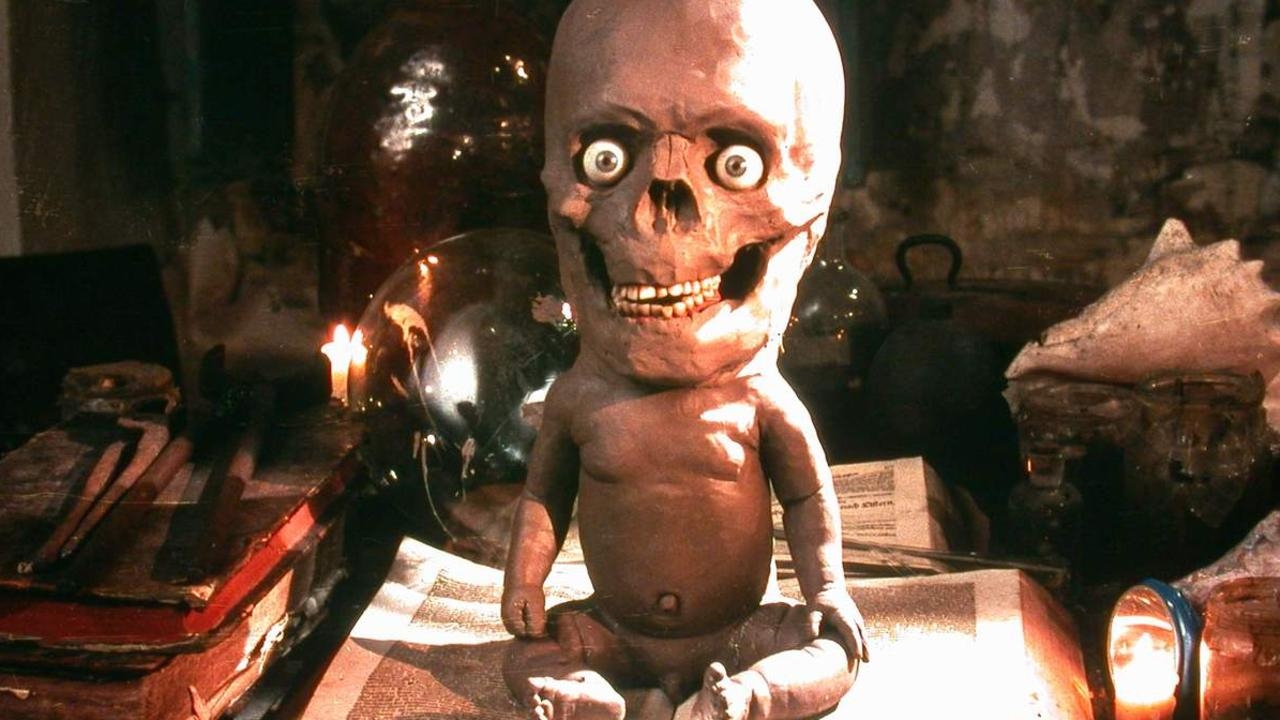
Animation reoccurs throughout the film, which nevertheless remains essentially a live action movie. For animation lovers highlight is a rather unsettling scene in which the man creates life, which quickly ages and transforms into a gruesome skull. This is done in Švankmajer’s characteristic virtuoso clay animation. A highlight of puppet animation is a short scene in which little devils molest and abuse little angels in order to make Faust sign his soul away.
The Best scene of the whole film, however, features little animation. This is when the man summons Mephistopheles. This scene is full of compelling images, with brooms dusting as if they were alive, drums playing themselves, crossbows appearing from pillars, and a burning wagon circling the summoner. During this scene the scenery changes from indoor to outdoor repeatedly, with the man finding himself in the woods, on top of a mountain and on a snowy plain.
Švankmajer tests the general viewer with his typical way of filming, using extreme close-ups, virtually no dialogue, fair use of puppetry and stiff old fashioned language during the staged parts. But viewers who stay are rewarded with a deeply layered film that will cling into the back of the mind for quite a while after viewing. To me ‘Lekce Faust’ is the best of his feature films, and together with ‘Jabberwocky’ (1971) and ‘Dimensions of Dialogue’ it forms the pinnacle of the Czech master’s art.
Watch the trailer for ‘Lekce Faust’ yourself and tell me what you think:
After the critically acclaimed ‘Words Words Words‘ (1991) Michaela Pavlátová returned with an even better film called ‘Repete’. This film explores daily routines, with a man walking a dog as a bridging elements.
The walking man repeatedly watches a beautiful woman passing by, a cyclist, and a hurried man looking at his watch. These street scenes are interspersed with scenes depicting three couples, all stuck in an unhealthy repetitive relationship. The first shows a woman feeding a man, who doesn’t even look at her, but keeps on reading the newspaper. The second depicts a man threatening to commit suicide the moment his love rejects him. And the third shows a couple about to have sex until a telephone calls the woman away, leaving the man waiting.
At one point the dog refuses to go on, and the repetition stops, allowing the couples to get mixed. It looks like the mingling of these people improves their relationships, but all too soon new repetitions set in…
Like ‘Words Words Words’ Repete is a great work of animated surrealism, making full use of the medium. Pavlátová uses a very crude and scribbly pastel technique, shifting perspectives and no dialogue. Her style is completely her own, and very engaging. No wonder Repete, too, swept many awards.
Watch ‘Repete’ yourself and tell me what you think:
‘Repete’ is available on the DVD ‘Desire & Sexuality – Animating the Unconscious Vol.2’
‘Words Words Words’ is set in a cafe, and explores different types of dialogue, like gossip, seduction, quarrel, pep talk, and talk of love.
The different ways of talking are depicted by colorful balloons that, contrary to the familiar text balloons in comic strips, are devoid of text. This leads to humorous and inventive images in the best surrealist tradition. The best sequence involves a couple falling in love, but then falling into discord. Luckily, the humble waiter saves the day. Running gag of the film is a little yellow dog, who secretly drinks from the visitors’ cups and glasses.
‘Words Words Words’ is a highly entertaining film, and was rightly nominated for an Academy Award.
Watch ‘Words Words Words’ yourself and tell me what you think:
‘Words Words Words’ is available on the DVD ‘Desire & Sexuality – Animating the Unconscious Vol.2’
Director: Lynn Smith Release Date: 1994 Rating: ★★½
‘Sandburg’s Arithmetic’ is a gentle if unremarkable children’s film which uses the poet Carl Sandburg’s reading of his own poem ‘Arithmetic’ as its basis.
Smith illustrates the poem with painted animation images of birds, children, numbers and a zebra, which all sprout from the text. The film has a happy atmosphere, greatly helped by the vivid colors and Zander Amy’s rustic, yet lively music. Smith’s strongest point in animation is her command of perspective, event though she’s no Georges Schwizgebel.
‘Sandburg’s Arithmetic’ is a charming little film, but no more than that. But then again, it doesn’t aim to.
Watch an excerpt from ‘Sandburg’s Arithmetic’ yourself and tell me what you think:
‘Sandburg’s Arithmetic’ is available on the The Animation Show of Shows DVD Box Set 6
Director: Michael Dudok de Wit Release Date: 1994 Rating: ★★★★½
Dutch master animator Michael Dudok de Wit came into presence with this short, made as an artist at residence at the renowned Folimage animation studio in France.
In this film Dudok de Wit already establishes his trademark command of light and shadow. The setting is a monastery bathing in Summer sunlight. In fact, all background artwork, done by Dudok de Wit himself, is gorgeous. The film has a very simple premise (a monk wants to catch a fish), uses no dialogue, and knows a simple character design and excellent comic timing. Yet, the film is not a gag film, but a rather poetic meditation on fanaticism.
The monk’s movements are echoed by Serge Besset’s excellent score, which uses variations on the tune of la folía, based on those by baroque composer Arcangelo Corelli. Music and movement are in perfect tune and form another layer of delight. Unfortunately, the film ends rather puzzling, and it’s a little as if Dudok de Wit couldn’t dream of a more proper ending to his otherwise delightful short.
Watch ‘The Monk and the Fish’ yourself and tell me what you think:
‘The Monk and the Fish’ is available on the The Animation Show of Shows DVD Box Set 3
Director: Phil Mulloy Release Date: 1994 Rating: ★★★
‘The Invention of Writing (and Its Destruction)’ is the second of only three films in Phil Mulloy’s ‘The History of the World’-series, which apparently should have existed of 140 different shorts.
Like ‘The Discovery of Language‘ this is a film about sex. The short uses the same white characters as ‘The Discovery of Language’, and takes place in 2,000 years B.C. The short tells about a man who doesn’t manage to get sex, because he’s beaten again and again by other men.
Then the man uses his own penis as a pen, writing ‘The penis (pen is) mightier than the sword’. The invention of writing earns him a multitude of women to have sex with, but it won’t last.
Like ‘The Discovery of Language’ ‘The Invention of Writing (and Its Destruction)’ is essentially a silent film, with intertitles. Mulloy’s animation is simple and crude, and makes effective use of cut-out techniques. The result is a strange mix of sex, violence and absurd humor.
Watch ‘The Invention of Writing (and Its Destruction)’ yourself and tell me what you think:
‘The Invention of Writing (and Its Destruction)’ is available on the BFI DVD ‘Phil Mulloy – Extreme Animation’
Director: Phil Mulloy Release Date: 1994 Rating: ★★★
‘The Discovery of Language’ is ‘episode 10’ of Phil Mulloy’s ‘The History of the World’, which in real life only consists of three films, of which this one is the first.
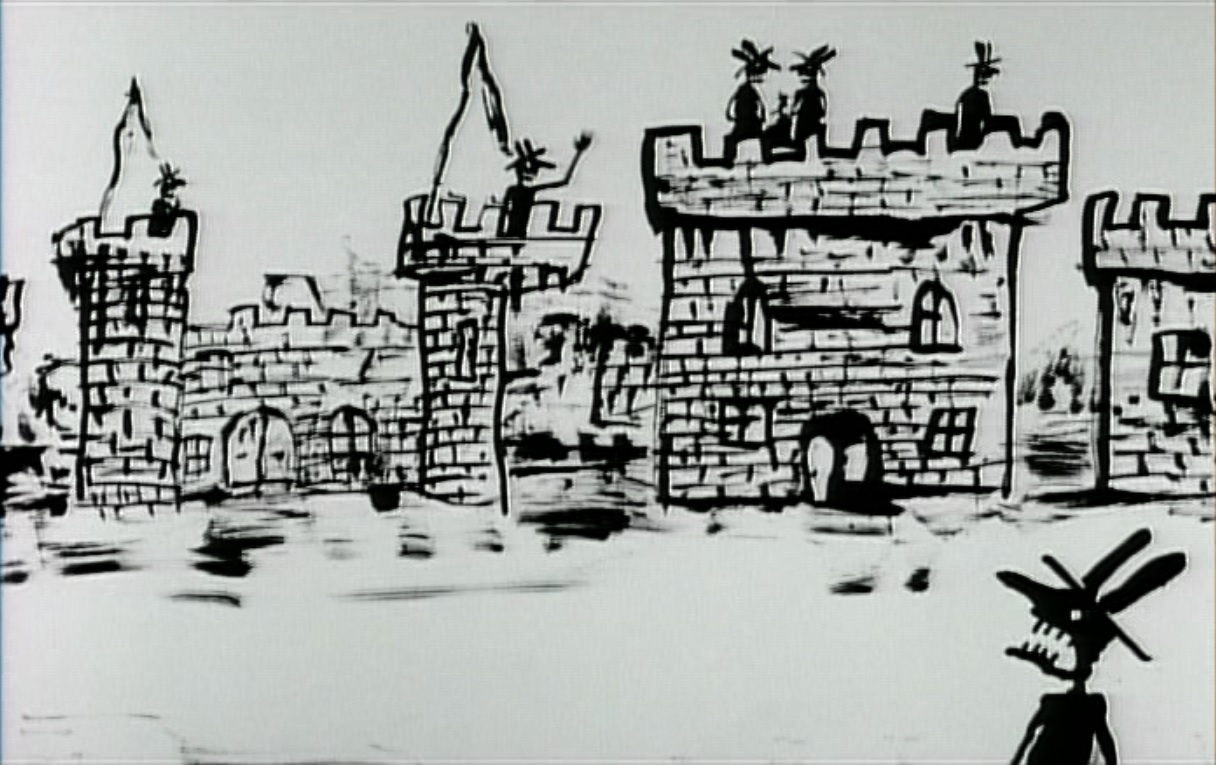
The film series uses Mulloy’s typical crude black and white style, enhanced by reds to depict blood. But unlike his other films, his characters are not black blots of inks, but white.
The short tells about a primitive tribe of women, 1,000,000 b.c. who discover letters in the soil, which together form the word ‘vagina’. As soon as they realize the meaning of the word they create their own Fall of Man, covering their crotches with skirts, and forbidding masturbation. Meanwhile, the men are on a similar quest to form the word ‘Penis’, but they are too stupid to fulfill the task.
The crude humor of this short is enhanced greatly by the effective soundtrack, featuring excellent music by Alex Balanescu.
Watch ‘The Discovery of Language’ yourself and tell me what you think:
‘The Discovery of Language’ is available on the BFI DVD ‘Phil Mulloy – Extreme Animation’
Director: Phil Mulloy Release Date: 1994 Rating: ★★
‘Thou Shalt Not Steal’ is the most critical of Mulloy’s ‘Ten Commandment’ films.
This short tells about Hank, an honest worker in ‘Joesville, at the wrong side of the Mississippi’. Hank works at a building site, and all his colleagues are stealing stuff (in a rather absurd sequence of images), but he won’t.
When crisis hits Joesville, Hank ends on the street, while all his colleagues mysteriously have built homes for themselves…
Director: Phil Mulloy Release Date: 1994 Rating: ★
‘Thou Shalt Not Commit Adultery’ is the fourth of Phil Mulloy’s ‘The Ten Commandments films’. This short tells about two astronauts, Tex an Mary Lou, who have feelings for each other, which they don’t express, because of their questionable marriages on earth.
This seems like a more critical episode than ‘Thou Shalt Not Kill‘, but Mulloy spoils it by an absurd postlude involving flies.
The black and white ink drawings are enriched by bright yellows and reds to depict flames of desire
‘Thou Shalt Not Commit Adultery’ is available on the BFI DVD ‘Phil Mulloy – Extreme Animation’
Director: Phil Mulloy Release Date: 1993 Rating: ★★★
‘The Sound of Music’ is easily one of the more serious and more depressing films British animator Phil Mulloy created. The film is one misanthropic view on mankind.
The film stars Wolff, a saxophone player, who works as a window cleaner during daytime. The window cleaning part allows Mulloy to indulge in his misanthropic world view, as every room Wolff and his colleague watch from the outside is filled with scenes of violence, loneliness, despair and death.
But Wolff’s night job is even worse. He plays the saxophone at one charity diner, which turns out to be an orgy of indulgence for the rich and famous. When the cooks run out of meat, they empty the streets and hospitals to feed the do-gooders. These visions of cannibalism are as depressing as it can get in animation film. And yet, the end of this film holds some hope…
Mulloy’s crude drawing and animation style suits the black humor and extremely bleak world view fine. The film is devoid of dialogue, with Mulloy employing title cards as if it were a silent film. But the images are enhanced by screeching avant-garde music by Alex Balanescu, whose string quartet is enhanced with voice, saxophone and drums.
Watch an excerpt from ‘The Sound of Music’ yourself and tell me what you think:
Director: Phil Mulloy Release Date: 1993 Rating: ★★
After his absurd series ‘Cowboys’ (1991), which dealt with Western cliches, and the two-part ‘history of the world’, mostly devoted to sex, British indie animator Phil Mulloy embarked on a series on the ten commandments.
All stories are typically silent comedies, using a voice over by Joel Cutrara to tell the story. Unfortunately, Mulloy stays far from Krzysztof Kieślowski’s critical view on the ancient biblical laws. It seems he only uses the commandments as templates to build rather absurd stories on. Most attractive is Mulloy’s rough style, using broad black ink strokes on a white Canvas, with the occasional blood reds. His animation is very limited, but effective.
‘Thou Shalt Not Kill’ is a typical example of the series. The short tells about one Uncle Josh from Arkansas, who loses his family rapidly, in Job-like fashion. A a reaction he commits suicide, flies to heaven, where he’s kicked into hell by God himself.
It’s as if Mulloy tells a joke, helped by visuals. In no way the series approaches the misanthropic criticisms of his contemporary film ‘The Sound of Music‘ (1993).
‘Thou Shalt Not Kill’ is available on the BFI DVD ‘Phil Mulloy – Extreme Animation’
Animation Backgrounds
A blog dedicated to background paintings from animation films. Kept until 2016.
Animation Scoop
Animation historian Jerry Beck’s animation film news blog.
Cartoon Brew
Topical blog on animation film, led by animation historian Amid Amidi.
Cartoon Modern
Amid Amidi’s blog on modern design cartoon art from the forties, fifties and sixties.
Cartoon Research
THE site on classic animation research, hosted by cartoon historian Jerry Beck.
Cartoons Theory
Frank Beef analyzes classic cartoons. Kept until 2020.
Century Film Project
Michael reviews films of 100 years old and older, roughly in chronological order.
Classic Cartoons
A similar blog featuring many stills and comic strips. Kept until 2012.
Comet over Hollywood
Jessica Pickens reviews classic Hollywood films, especially musicals.
Deja View
Top ex-Disney animator Andreas Deja’s own blog.
Disney History
Esteemed Disney historian Didier Ghez on the latest books on Disney history.
Feeling Animated
Paul Astell brings us thorough reviews of animated features.
Flickers in Time
Short and to the point reviews of classic films (lately mostly pre-code talkies) by an anonymous retired Foreign Service Officer from California







 Dr. Grob's Animation Review