Directors: William Hanna & Joseph Barbera
Release Date: December 6, 1941
Stars: Tom & Jerry
Rating: ★★★★½
Review:

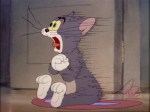
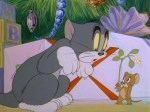
The Night Before Christmas © MGMAlready in their third cartoon Tom & Jerry were given their own Christmas special.

The short starts with the narrator reciting the first two lines from the early 19th century poem ‘A Visit from St. Nicholas’: “‘Twas the night before Christmas, when all thro’ the house not a creature was stirring, not even a mouse“.

Upon the last word we cut to Jerry who appears from his hole and goes exploring the Christmas setting. When Jerry mistakes Tom for a stuffed animal, a cartoon chase emerges, which is the more fun due to the Christmas setting. For example, we watch Tom inspecting a troop of wooden soldiers, and Jerry inviting Tom for a kiss under the mistletoe.

The chase ends when Jerry accidentally falls through the letter box outside in the snow. Relieved, Tom settles himself at the warm fire site, only to be plagued by remorse. Anxiously Tom rushes outside to retrieve a frozen Jerry from the snow. The cartoon ends with the broadest smile on Jerry possible.

‘The Night Before Christmas’ was only the duo’s third cartoon, but already Hanna and Barbera were able to play with the relationship between the cat and the mouse. Now they’re not only antagonists, they’re also friends, or at least ‘friendly enemies’, and their chase retains a playful attitude.

Jerry is animated outstandingly in this cartoon, and pulls several priceless faces, the last smile being a highlight among highlights. Tom’s finest moment is when he’s invited by Jerry for a kiss. The cat’s obstinate refusal turning into goodwill, followed by an embarrassed shyness is animation at its best.

Composer Scott Bradley provides a fantastically integrated score, weaving the Tom and Jerry themes with Jingle Bells to a great effect. In fact, one can listen to the score in its own right. The result is a cartoon of sheer delight, and ‘The Night Before Christmas’ easily is one of the best Christmas cartoons of all time.

Watch ‘The Night Before Christmas’ yourself and tell me what you think:

https://vimeo.com/114492513

This is Tom & Jerry cartoon No. 3
To the previous Tom & Jerry cartoon: The Midnight Snack
To the next Tom & Jerry cartoon: Fraidy Cat

‘The Night Before Christmas’ is available on the European DVD set ‘Tom and Jerry Collection’

Directors: William Hanna & Joseph Barbera
Release Date: July 19, 1941
Stars: Tom & Jerry, Mammy Two-Shoes
Rating: ★★★★
Review:

The Midnight Snack © MGMFollowing the success of ‘Puss Gets the Boot‘ it would take quite a while before the cat and mouse duo were given their own series. But one and a half year later ‘The Midnight Snack’ was released: Tom & Jerry’s very first official cartoon.

The duo was re-christened ‘Tom and Jerry’, which may have sounded right, as there had been a human cartoon duo before with that name (1931-1933). The looks of the cat and mouse were altered, too: Tom now has his characteristic black nose and thick black eyebrows, which make his facial expressions much stronger. Nevertheless, his features are still very complex. Jerry’s designs have remained the same, but he’s now animated much more consistently, rendering him less pudding-like.

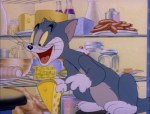
The story of ‘The Midnight Snack’ feels like a variation on ‘Puss Gets the Boot’. Tom catches Jerry stealing cheese from the fridge, only to make a buffet out of the fridge himself. When Mammy awakes, Tom frames Jerry, but in the end it’s he who gets punished by the angry maid. The cartoon violence is still rather mild in this cartoon, the most conspicuous gag being Jerry pricking the trapped Tom with a large carving fork.

Composer Scott Bradley juxtaposes separate themes for the cat and the mouse against each other in a rather complex continuous cartoon score. Bradley used this composition method in the duo’s first cartoons to a great effect. Later, the frantic cartoon action called for more disjointed and less integrated musical scores.

‘The Midnight Snack’ shows the cat and mouse’s great appeal and potential. Yet, in Charles Solomon’s book ‘Enchanted Drawings – The History of Animation’ Joe Barbera reveals that ‘The Midnight Snack’ almost became the last Tom & Jerry cartoon; apparently producer Fred Quimby was opposed to make any more of them, until he got a letter from Texas asking for more of “these delightful cat-and-mouse-cartoons”.

Watch ‘The Midnight Snack’ yourself and tell me what you think:

This is Tom & Jerry cartoon No. 2
To the previous Tom & Jerry cartoon: Puss Gets the Boot
To the next Tom & Jerry cartoon: The Night Before Christmas

‘The Midnight Snack’ is available on the European DVD set ‘Tom and Jerry Collection’

Directors: William Hanna & Joseph Barbera
Release Date: February 10, 1940
Stars: Tom & Jerry, Mammy Two-Shoes
Rating: ★★★★★
Review:

Puss gets the Boot © MGM

‘Puss Gets the Boot’ marks the first of three game-changing debut cartoons of 1940 (the other ones being ‘A Wild Hare‘ from July and ‘Knock Knock‘ from November), making the year a turning point in American studio animation. From now on cartoons were to be brassier, more energetic and more violent.

‘Puss Gets the Boot’ introduces that illustrious cat and mouse duo, Tom & Jerry. The cartoon was made by William Hanna and Joe Barbera under Rudolf Ising’s flag, and like ‘A Wild Hare’ only meant as a one-off cartoon. Indeed, Tom is called Jasper in this short, and Jerry remains unnamed.

Moreover, the two look quite different from their later incarnations. Not only is Tom drawn with outrageous detail, he also has a white nose and very modest eyebrows. Jerry’s physique is rather unstable, as if he were made of a sort of rather amorphous jelly.

Yet, the characters are well established, and the friendly antagonism between the two is set from the start, as is the prize-winning combination of silent comedy and high production values. Also present is the combination of cuteness and gag-rich cartoon violence that made the Tom & Jerry series unique.

‘Puss Gets the Boot’ also marks the debut of Mammy Two-Shoes, a black maid character whose face we were never to see (except for a few frames in ‘Saturday Evening Puss‘ from 1950). Mammy was borrowed from Disney, who had introduced exactly such a character in ‘Three Orphan Kittens‘ (1935). For present American audiences this character is problematical, as she clearly is a stereotype of a black maid. But I, as a European kid, always thought of her as the owner of the house, never realizing the discrepancy of the enormous mansion and the maid’s modest looks. In any case Mammy lasted until 1952, starring 18 Tom & Jerry cartoons in total.

In this very first Tom & Jerry short Mammy tells Jasper (Tom) that if he breaks one more thing, he goes out. So the still unnamed Jerry takes advantage of the situation, in a series of gags that culminate in a scene in which Tom tries to hold a ridiculously high pile of plates. The short features several gags that were pretty modern at the time, like Tom drawing a fake mouse hole entrance, and Jerry poking Tom’s eyes. Indeed, the idea was strong enough to be more or less revisited in ‘Mouse Cleaning‘ (1948), with even better results.

‘Puss Gets the Boot’ is a very well made cartoon. The silent comedy of the two characters is acted out perfectly and the action is timed very well. It’s still very funny, and it’s no wonder that the audiences asked for more cartoons from this cat and mouse duo. The short even was nominated for an Academy Award, but lost it to another MGM cartoon, the equally feline, yet much more saccharine ‘The Milky Way‘.

However, Tom and Jerry would quickly become MGM’s superstars, and they would win no less than seven Academy Awards, more than any other cartoon star. Indeed, Tom and Jerry arguably were the most successful cartoon stars of the 1940s and 1950s, starring 114 cartoons, and lasting until 1958, when MGM shut its animation department down. However, even that wouldn’t be the end of the cat and mouse duo, and even in the 21st century still films are made featuring these great characters.

Watch ‘Puss Gets the Boot’ yourself and tell me what you think:

This is Tom & Jerry cartoon No. 1
To the next Tom & Jerry cartoon: The Midnight Snack

‘Puss Gets the Boot’ is available on the European DVD set ‘Tom and Jerry Collection’

Director: Dave Fleischer
Release Date: April 11, 1941
Stars: Gabby
Rating: ★★½
Review:

Swing Cleaning © Max FleischerThe title ‘Swing Cleaning’ promises a cartoon full of big band music.

None of that. Instead, we have a Gabby cartoon, in which our read-headed hero volunteers to take control of the palace’s spring cleaning. Gabby soon meddles with everyone and everything, and manages to destroy a great deal, twice. In the end the other palace dwellers give him their tokens of gratitude, and clobber him with their brooms.

Compared to ‘Two for the Zoo‘ ‘Swing Cleaning’ is a much better cartoon, with its focus on Gabby’s destructive meddling. However, the short loses some screen time to unrelated gags, and one doesn’t feel for either Gabby or the other palace dwellers. In the end. Swing Cleaning’ remains a mediocre cartoon, still much rooted in the sugary 1930s era, and feeling dated when compared to contemporary cartoons from other studios.

Watch ‘Swing Cleaning’ yourself and tell me what you think:

‘Swing Cleaning’ is available on the Thunderbean DVD/Blu-Ray ‘Fleischer Classics featuring Gulliver’s Travels’

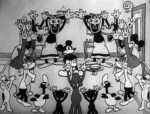
Mickey's Birthday Party (ending) © Walt DisneyHooray! Today it’s the day! Mickey turns ninety years young, and still counting!

Today it was ninety years ago Mickey was presented to the general audience in the Colony Theatre on Broadway, in the groundbreaking sound cartoon ‘Steamboat Willie‘. This short made Mickey a sensation almost over night, and during the 1930s Mickey was the biggest cartoon star of them all. Today, Mickey’s movie days are mostly over, but otherwise he’s clearly still alive and kicking.

So, take out your Mickey Mouse socks, your Mickey Mouse T-shirt, your Mickey Mouse ears, and spend this festive day watching some of Mickey’s best cartoons, like ‘Plane Crazy‘ (1928), ‘Barnyard Olympics‘ (1932), ‘The Mad Doctor‘ (1933) or ‘Mickey’s Fire Brigade‘ (1935), and learn more about them in my book ‘Mickey’s Movies – The Theatrical Films of Mickey Mouse‘.

For a complete list of Mickey Mouse shorts see here.


Director: Dave Fleischer
Release Date: February 21, 1941
Stars: Gabby
Rating:
Review:

Two for the Zoo © Max FleischerIn a search for more lasting characters, the Fleischer studio gave Gabby, the omnipresent watchman from ‘Gulliver’s Travels‘ (1940) his own series.

In 1940 and 1941 the studio made eight Gabby cartoons. Unfortunately, the series was not a success. The problem lies with the character itself. Even in ‘Gulliver’s Travels’ Gabby is hardly funny, and in ‘Two for the Zoo’, his fourth solo film, he only demonstrates that he was the most talkative character of his era, which is hardly an advertisement.

In this rather tiresome cartoon Gabby meets a porter who transports a ‘rubberneck Kango’ to the zoo inside a large crate. For unclear reasons Gabby volunteers to take the animal itself, taking a small fantasy creature out of the box, which looks like a kangaroo with a trunk and giraffe-like horns. What Gabby doesn’t realize is that he has only taken the cub, and that the mother Kango is still inside the crate. She soon follows the two, putting her cub inside her pouch. This leads to quite some confusion, and only in the end Gabby discovers that there were actually two animals all along.

Unfortunately, none of Gabby’s antics are remotely funny, and the gags are greatly hampered by Gabby’s constant jabbering. The best part is when the large Kango has the hiccups, and Gabby balances on a ladder on her head.

Watch ‘Two for the Zoo’ yourself and tell me what you think:

‘Two for the Zoo’ is available on the Thunderbean DVD/Blu-Ray ‘Fleischer Classics featuring Gulliver’s Travels’

Director: Norm Ferguson
Release Date: January 24, 1941
Stars: Pluto
Rating: ★★★
Review:

Pluto's Playmate © Walt Disney‘Pluto’s Playmate’ takes place at the beach.

Here Pluto meets a playful little seal, who repeatedly steals his red rubber ball. Pluto tries to get rid of the obtrusive intruder, but when the little seal rescues him from drowning, the two finally become friends.

‘Pluto’s Playmate’ introduces a story line that would be featured in no less than eight Pluto cartoons, and which lasted until 1949. In all these shorts Pluto meets a new strange animal, which he doesn’t like at first, but which he befriends in the end. An embryonic version of this trope could even been seen in Pluto’s very first solo effort, the Silly Symphony ‘Just Dogs‘ (1932). This rather limited story concept severely hampered the series, and is responsible for the rather questionable reputation of the Pluto shorts as being more cute than funny. Luckily, not even a third from the Pluto shorts from the 1940s use it, but it’s true that only when the studio abandoned this tiresome formula, Disney could make its best Pluto shorts, which it did in the last two years of the series.

‘Pluto’s Playmate’ is one of the first Disney cartoons to feature oil backgrounds. It also features some spectacular effect animation of the sea and its surf. ‘Pluto’s Playmate’ would be the only short directed by Norm Ferguson, the animator most responsible for the dog’s character and design. Pluto’s features are very flexible in this short, especially in the scenes featuring the angry little octopus.

The friendly little seal would return in ‘Rescue Dog‘ (1947) and ‘Mickey and the Seal‘ (1948), the former being very similar to ‘Pluto’s Playmate’ in story line.

Watch ‘Pluto’s Playmate’ yourself and tell me what you think:


This is Pluto cartoon No. 4
To the previous Pluto cartoon: Pantry Pirate
To the next Pluto cartoon: Pluto Junior

‘Pluto’s Playmate’ is available on the DVD set ‘The Complete Pluto Volume One’

Director: Jack Kinney
Release Date: June 28, 1940
Stars: Pluto, Butch
Rating: ★★★★
Review:

Bone Trouble © Walt DisneyPluto’s solo career had a slow start: after his first own cartoon, ‘Pluto’s Quin-puplets’ our favorite mutt had to wait three more years for a second cartoon.

Compared to this first, cute cartoon, ‘Bone Trouble’ is an altogether different short: it’s a real exponent of the chase cartoon era: when Pluto steals a bone from vicious neighbor dog Butch, a chase soon follows into a surprisingly empty carnival. Most of the gags originate in Pluto’s adventures in a hall of mirrors. This is a wonderful place, having mirrors that are able to reflect Pluto as an alligator, a camel, an ape, a kangaroo and a seal.

Unlike many of the later Pluto shorts, ‘Bone Trouble’ is a genuine gag cartoon, greatly helped by the carnival atmosphere, and an excellent musical score. The short introduces Butch the bulldog. Butch was not the first vicious bulldog on the animated screen (for example, there’s one in the Betty Boop cartoon ‘You’re Not Built That Way’ from 1936), but he is the prototype of all subsequent animated bulldogs, most notably Spike, who made his debut in the Tom & Jerry cartoon ‘Dog Trouble’ (1942). Why in cartoons Bulldogs were always portrayed as bullies, we’ll never know, as real bulldogs look hardly like their cartoon counterparts.

‘Bone Trouble’ is also noteworthy for being the cartoon in which Jack Kinney’s makes his direction debut. Kinney became the studio’s best gag director, which he showed in the Goofy series, which in 1940 became his own. Kinney directed only one other Pluto cartoon: ‘Cold Storage‘ from 1951, which is even better than ‘Bone Trouble’.

Butch, meanwhile, would return in five other Pluto cartoons, ‘T-Bone for Two‘ (1942), ‘Canine Casanova’ (1945), ‘Pluto’s Kid Brother‘ (1946), ‘Pluto’s Purchase’ (1948) and ‘Pluto’s Heart Throb‘ (1950).

Watch ‘Bone trouble’ yourself and tell me what you think:

https://www.dailymotion.com/video/x6ct3d8

This is Pluto cartoon No. 2
To the previous Pluto cartoon: Pluto’s Quin-Puplets
To the next Pluto cartoon: Pantry Pirate

‘Bone Trouble’ is available on the DVD set ‘The Complete Pluto Volume One’

Director: Bob Clampett
Release Date: November 1, 1941
Stars: Porky Pig
Rating: ★★★
Review:

Porky's Pooch © Warner Bros.In ‘Porky’s Pooch’ a dog tells his Scottish terrier friend how he managed to get a master.

This dog is a clear forerunner of Chuck Jones’s Charlie Dog, who would make his debut six years later in ‘Little Orphan Airedale’ (1947). Like Charlie Dog, this dog, called Rover, is an orphan, forcefully trying to make Porky Pig his master. Rover speaks in a similar way as Charlie, and even introduces the Charlie Dog lines “You ain’t got a dog, and I ain’t got a master’ and ‘and I’m affectionate, too’.

The dog also does a Carmen Miranda impression, most probably the first in an animated film, as the Brazilian actress had become famous only one year earlier, with ‘Down Argentine Way’ (1940). The short is also noteworthy for the use of real photographs as backgrounds, against which the characters read surprisingly well.

Watch ‘Porky’s Pooch’ yourself and tell me what you think:

This is Porky Pig cartoon no. 93
To the previous Porky Pig cartoon: Robinson Crusoe, jr.
To the next Porky Pig cartoon: Porky’s Midnight Matinee

‘Porky’s Pooch’ is available on the DVD sets ‘Looney Tunes Golden Collection Volume 5’ and ‘Porky Pig 101’

Director: Bob Clampett
Release Date: May 10, 1941
Rating: ★★
Review:

Farm Frolics © Warner Bros.‘Farm Frolics’ was the second Merrie Melodie directed by Bob Clampett.

In this cartoon Clampett follows Tex Avery with his own spot gag cartoon, this time on farm life, making it strangely similar to the Walter Lantz cartoon ‘Fair Today‘ from only three months earlier.

The Warner Bros.’ spot gag cartoons rarely belonged to the best of their repertoire, and ‘Farm Frolics’, too, is hardly funny. Even the running gag of this forgettable cartoon is trite, and fails to provide a welcome finale. Nevertheless, the animation is very fine. For example, there’s some surprisingly realistic animation on a horse. Thus even this weak short shows that by 1941 the Warner Bros. animators could do almost everything.

Watch ‘Farm Frolics’ yourself and tell me what you think:

‘Farm Frolics’ is available on the DVD set ‘Looney Tunes Golden Collection Volume 5’

Director: Bob Clampett
Release Date: October 12, 1940
Stars: Porky Pig
Rating: ★★½
Review:

Prehistoric Porky © Warner Bros.In ‘Prehistoric Porky’ Porky Pig follows the footsteps of Daffy Duck, who had started a prehistoric cartoon in ‘Daffy Duck and the Dinosaur‘.

Set rather extravagantly ‘one billion, trillion years b.c. (a long time ago)’ the short opens beautifully with several moving silhouettes of dinosaurs. Soon we cut to caveman Porky, who has a pet Brontosaur (erroneously with visible ears) called ‘Rover’. Porky reads in ‘Expire – the magazine for cavemen’, and discovers that his own bearskin is outdated. So he goes out to hunt for one. Unfortunately, he encounters a vicious sabertooth tiger…

Like almost all films set in the prehistory, ‘Prehistoric Porky’ cheerfully mixes all kinds of prehistoric periods together. Unfortunately, the short is rather low on gags, and has a trite ending. Moreover, most dinosaurs look like fantasy dragons, instead of the real thing. Yet, the sabertooth tiger is well animated, and it’s interesting to see Porky in a quasi-urban caveman setting, making the cartoon one of the forerunners of ‘The Flintstones’.

Watch a colorized version of ‘Prehistoric Porky’ yourself and tell me what you think:

https://www.dailymotion.com/video/x5w09t5

This is Porky Pig cartoon no. 78
To the previous Porky Pig cartoon: Calling Dr. Porky
To the next Porky Pig cartoon: The Sour Puss

‘Prehistoric Porky’ is available on the DVD sets ‘Looney Tunes Golden Collection Volume 5’ and ‘Porky Pig 101’


The Birthday Party © Walt DisneyIn two weeks Mickey Mouse will be ninety years young!

On November 18, it will be ninety years ago Mickey made his public debut in ‘Steamboat Willie‘, creating an enormous success and changing the course of animation forever. Today Mickey is as alive as ever, even if his heydays (ca. 1928-1935) lay way behind him. In those days Mickey without doubt was one of the biggest stars in Hollywood, and most of his films stem from this era. What would be better than spend some time watching a few of Mickey’s best films? Why not take a look at for example ‘Traffic Troubles‘, ‘Touchdown Mickey‘, ‘The Klondike Kid‘, ‘Mickey’s Gala Premier‘ or ‘The Band Concert‘. For a complete list of Mickey Mouse shorts see here.

Later Mickey settled done more, and on the silver screen he was eventually eclipsed by the likes of Donald Duck, Bugs Bunny and Tom & Jerry. Mickey retired from cinema in 1953, but today he’s still all over the place, e.g. in comic strips, on television, in merchandise, and as a host in Disney parks.

Read all about Mickey’s exciting cinematic career in my book ‘Mickey’s Movies – The Theatrical Films of Mickey Mouse‘.

Director: Walter Lantz
Release Date: February 24, 1941
Rating:  ★★
Review:

Fair Today © Walter Lantz‘Fair Today’ is a spot gag cartoon on a county fair.

The short uses a voice over in the tradition of Tex Avery’s Warner Bros. Spot gag cartoons, e.g. ‘Circus Today’ (1940), ‘Holiday Highlights’ (1940) and ‘Aviation Vacation‘ (1941). Indeed, three months later the Warner Bros. studio itself came with a similar cartoon called ‘Farm Frolics‘. The Warner Bros. connection is further enhanced by the presence of Mel Blanc as voice artist, and a ‘story’ by Warner Bros.-alumnus Ben Hardaway.

The Warner Bros.-influx does not lead to a funny cartoon, however. Even Avery’s spot gag cartoons were more than often rather tiresome, and Lantz’s ‘Fair Today’ is more miss than hit. The gags flow in at a high speed, but let’s face it: most of them are very corny, to say the least, and they include some very bad puns. The obligate running gag is give to an old lady in search of her little boy. The best gag is when the narrator says “let’s skip over to … ‘ and the camera hops accordingly through the scene.

Watch ‘Fair Today’ yourself and tell me what you think:

‘Fair Today’ is available on the DVD set ‘The Woody Woodpecker and Friends Classic Cartoon Collection Volume 2’

Director: Dave Fleischer
Release Date: April 4, 1941
Stars: Popeye
Rating:  ★★★★★
Review:

Flies Ain't Human © Max FleischerIn ‘Flies Ain’t Human’ Popeye tries to take a nap, but he’s bothered by some flies.

Popeye manages to blow the flies out of the window, but then one has stayed behind, giving the sailor a hard time, especially after the little insect has eaten spinach.

Like most 1941 Popeye cartoons, ‘Flies Ain’t Human’ is fast and gag rich. The turning around of the classic spinach story device is a great invention, and provides some excellent comedy, as Popeye becomes helpless against the surprisingly mighty little fly. In his final attempt to kill the tiny foe Popeye blows his own house to pieces, only to find multitudes of flies on his head in the end. The most delightful gag is when Popeye’s head gets stuck in a painting of a snowy landscape, and the fly takes some time to ski jump from his face into the painted snow.

The idea for the fly may have come from the bee troubling Donald Duck in ‘Window Cleaners‘ (1940). The cartoon itself at least looks forward to the cartoon ‘The Pink Tail Fly‘ (1965), in which a mosquito keeps the Pink Panther out of his sleep.

Watch ‘Flies Ain’t Human’ yourself and tell me what you think:

This Popeye film No. 94
To the previous Popeye film: Olive’s Sweepstake Ticket
To the next Popeye film: Popeye Meets Rip van Winkle

‘Flies Ain’t Human’ is available on the DVD set ‘Popeye the Sailor 1941-1943’

Director: Dave Fleischer
Release Date: February 7, 1941
Stars: Popeye, Poopdeck Pappy
Rating:  ★★★★★
Review:

Quiet! Pleeze © Max Fleischer‘Quiet! Pleeze’ opens with Poopdeck Pappy lying with a hangover in bed.

When his son comes in to wake him, Poopdeck Pappy pretends to be ill, and Popeye goes at lengths to give his poor old dad peace and quiet, e.g. giving a crying baby across the street a bottle, and stopping workmen from blowing up a huge hill. This part is very fast, and reuses footage from various Popeye shorts, but now in a very different light. Of course, all Popeye’s actions are to no avail, as in the end he finds his dad being the life of a party.

Like ‘Problem Pappy‘, ‘Quiet! Pleeze’ is a fast and gag-rich cartoon, which belongs to Popeye’s best. It’s clear that the character of Poopdeck Pappy brought some new life into the series, giving the otherwise goody-goody Popeye something to work with.

However, it seems that with this cartoon the new formula had reached its limits, for Poopdeck Pappy’s next two cartoons, ‘Child Psykolojiky‘ and ‘Pest Pilot‘ aren’t half as good.

Watch ‘Quiet! Pleeze’ yourself and tell me what you think:

https://www.dailymotion.com/video/x5v9jqv

This Popeye film No. 92
To the previous Popeye film: Problem Pappy
To the next Popeye film: Olive’s Sweepstake Ticket

‘Quiet! Pleeze’ is available on the DVD set ‘Popeye the Sailor 1941-1943’

Director: Dave Fleischer
Release Date: January 10, 1941
Stars: Popeye, Poopdeck Pappy
Rating:  ★★★★★
Review:

Problem Pappy © Max FleischerIn ‘Problem Pappy’ story man Ted Pierce (of later Warner Bros. fame) reuses part of the story idea from ‘With Poopdeck Pappy‘: Popeye wants to wake his dad, only to find the bed empty.

When Popeye starts looking for his father, he finds his mischievous old dad juggling on a pole on top of a tall building. Popeye’s attempts to retrieve his pop account for some delightful comedy on dizzying heights. T

he film is simply stuffed with great gags and original images, like Popeye using lightning bolts as Tarzan would use lianas. The staging in this cartoon is absolutely wonderful, and the animators make great use of a shot of the staircase of the tall building. In all, ‘Problem Pappy’ is one of the all time best Popeye cartoons, and completely in tune with the faster comedy style of the chase cartoon era.

Watch ‘Problem Pappy’ yourself and tell me what you think:

This Popeye film No. 91
To the previous Popeye film: Popeye Presents Eugene, the Jeep
To the next Popeye film: Quiet! Pleeze

‘Problem Pappy’ is available on the DVD set ‘Popeye the Sailor 1941-1943’

Director: Jack Kinney
Release Date: December 26, 1941
Stars: Goofy
Rating: ★★★½
Review:

The Art of Self Defense © Walt DisneyThe first five Goofy shorts all progressed the Goofy character, and none was like the previous one.

Goofy and Wilbur’ had made Goofy a solo star, ‘Goofy’s Glider’ introduced the pompous narrator John McLeish, ‘Baggage Buster’ rendered Goofy voiceless, and ‘How to Ride a Horse’ and ‘The Art of Skiing‘ put this all together into the archetypical sports cartoon.

Now, in ‘The Art of Self Defense’ another step was made: the duplication of Goofs. In the main body of the cartoon we still watch only one Goofy, but this is preceded by a historical overview of fighting, featuring several different goofs, even in caveman and hieroglyph form. Now Goofy could be anybody, and indeed, already in his next cartoon, ‘How to Play Baseball’ (1942) numerous Goofs flock the screen.

‘The Art of Self Defense’ is about boxing, and features Goofy being clobbered by his own shadow, and training endlessly, only to be knocked out in the ring within seconds. The very silly historical opening is the highlight of the cartoon, however, featuring great sound effects, and various depictions of time marching on. Also interesting is the boxing scene from the turn of the century, which figures very graphical quasi-etched background art.

Watch ‘The Art of Self Defense’ yourself and tell me what you think:

https://www.dailymotion.com/video/x39zdca

This is Goofy cartoon No. 5
To the previous Goofy cartoon: The Art of Skiing
To the next Goofy cartoon: How to Play Baseball

‘The Art of Self Defense’ is available on the DVD set ‘Walt Disney Treasures: The Complete Goofy’

Director: Jack Kinney
Release Date: November 14,1941
Stars: Goofy
Rating: ★★★★★
Review:

The Art of Skiing © Walt DisneyJack Kinney revolutionized the Goofy cartoon with the ‘How to Ride a Horse’ sequence in ‘The Reluctant Dragon’ from June 1941. The contrast between John McLeish’s all too sincere instructions, and Goofy’s original ways of acting them out, proved to be a highly successful one, and resulted in great comedy.

This concept was immediately put into action in the Goofy shorts, with ‘The Art of Skiing’ being the first example. This is Goofy’s first real sports cartoon, and it shows several aspects of skiing, like the slalom and the ski jump, all in Goofy’s own original fashion. The Alpine setting is enriched by yodels by Austrian alpine ski racer and professional yodeler Hannes Schroll (1909-1985), who’s also responsible for the very first Goofy yell, which is in fact a variation on his other yodels in the same short. The Goofy holler, as it came to be known, was an instant hit, and reappeared in several other Goofy cartoons, every time our beloved character made a great fall.

The Goofy holler even appeared outside the Goofy series, and can be heard in e.g. the Pluto shorts ‘Legend of Coyote Rock’ (1946) and ‘Food for Feudin’ (1950), and in the feature ‘Bedknobs and Broomsticks’.

‘The Art of Skiing’ also marks the first instance in which McLeish recites a poem. This story idea would be used to a great effect in ‘The Olympic Champ’ (1942). The best gags, however, involve Goofy trying to put on his trousers with his skis already attached, and Goofy trying to turn around with his skis. The endless string of predicaments story man Jack Cutting and the animators put the character in is both inventive and very funny.

Watch ‘The Art of Skiing’ yourself and tell me what you think:

This is Goofy cartoon No. 4
To the previous Goofy cartoon: Baggage Buster
To the next Goofy cartoon: The Art of Self Defense

‘The Art of Skiing’ is available on the DVD set ‘Walt Disney Treasures: The Complete Goofy’

Mickey's Movies cover artReader Geert on Goodreads about my book Mickey’s Movies: The Theatrical Films of Mickey Mouse:

“Who knew old Mickey Mouse cartoons could be such delight to watch? Animation historian Gijs Grob guides us through the wonderful world of every single Mickey Mouse film ever made.

His reviews are detailed and fun to read, with a clear focus on the history of Mickey and the Disney Studios. Note: it’s more of a reference book than it is non-fiction work you’d read from start to end. And there’s no pictures (a copyright issue, I’d imagine).

I recommend this book to everyone, not just animation geeks.”

Thank you, Geert!

You can buy the book on Amazon. There is both a paperback and a Kindle edition. I hope you’ll enjoy it! And if you’ve already grabbed a copy: 1) thanks! and 2) I’d love it if you could review the book on Amazon.

Director: Jack Kinney
Release Date: April 18,1941
Stars: Goofy
Rating: ★★★
Review:

Baggage Buster © Walt DisneyThe start of Goofy’s solo career was eventful, and all his five earliest solo cartoons can be regarded as key shorts in the evolution of the character.

‘Baggage Buster’ is a particularly transitional cartoon. The short was made after Pinto Colvig’s departure to the Max Fleischer studio in Miami, leaving Goofy voiceless. The result is that in ‘Baggage Buster’ Goofy has become a completely silent character, while by 1941 silent characters already had become a rare feat.

Of course, director Jack Kinney and his team would use this fact to their advantage in the great ‘how to’ cartoons, starting with ‘How to Ride a Horse’ sequence in ‘The Reluctant Dragon’ of two months later, but in ‘Baggage Buster’ Goofy still is his 1930s self. After ‘Baggage Buster’ Kinney never reverted to this version of the character, and he was only revived in a few Mickey Mouse shorts, and in the Goofy cartoons ‘Foul Hunting’ (1947, by Jack Hannah) and ‘The Big Wash’ (1948, by Clyde Geronimi). In these two cartoons, however, Goofy speaks again, leaving ‘Baggage Buster’ being the sole cartoon in which our character remains a strange mix of the 1930s Goof and the 1940s silent character.

Like Donald had been in his first solo cartoon, ‘Donald’s Ostrich’ (1937), Goofy is a station master at some remote train station. And where Donald had to deal with an all too hungry ostrich, Goofy struggles with a magician’s trunk. The trunk knows quite some tricks, and even defies gravity, giving Goofy a hard time. The most bizarre scene is when Goofy’s body largely disappears inside the magician’s hat, leaving him walking on his arms.

The cartoon ends with the trunk producing an endless stream of animals, and soon Goofy’s little station is flocked by e.g. a lion, an armadillo, a shark, a flying squirrel, a giraffe, a crocodile, a stork (carrying a baby), a seal, an elephant, an ant eater, and even a sperm whale and a dinosaur…

As is often the case with cartoons dealing with magic, however, the humor never reaches great heights, as the magic permits an ‘anything can happen’ mantra, which spoils the fun. It’s so much funnier when cartoon magic is applied without the ‘it’s magic’ excuse.

Goofy’s looks once again are more streamlined than before, but only with ‘How to Ride a Horse’ he would reach his new appearance, which would last until he was redesigned once again, for ‘Tennis Racquet’ in 1949.

Watch ‘Baggage Buster’ yourself and tell me what you think:

This is Goofy cartoon No. 3
To the previous Goofy cartoon: Goofy’s Glider
To the next Goofy cartoon: The Art of Skiing

‘Baggage Buster’ is available on the DVD set ‘Walt Disney Treasures: The Complete Goofy’


Enter your email address to follow this blog and receive notifications of new posts by email.

Join 915 other subscribers
Bookmark and Share

Categories