
Director: Ub Iwerks
Release Date: 1942
Rating: ★★½
Review:

Stop That Tank © Walt Disney‘Stop That Tank!’ was the first commission that resulted from the showing of the pilot instruction film ‘Four Methods of Flush Riveting‘. In that respect it was Disney’s very first commissioned animated instruction film.

The film was made for the Canadian army to show the working of the Boys MK-1 anti-tank rifle. Unlike ‘Four Methods of Flush Riveting’ it features full animation and humor, as well as live action sequences, to educate the soldiers. Most of the film consists of (very boring) instructions, but the film starts very nicely with the full animation sequence of a squad of rattling tanks led by a caricature of Adolf Hitler, jabbering in mock-German, being shot to hell by Tommies and their anti-tank-rifles. In hell we watch Hitler raging in distress. The devil explains to us that Hitler says that “against your anti-tank rifles he simply can’t win”.

During the instruction film which follows we still have four incidents of full animation: three involving a goofy soldier, who 1) tries to carry an anti-tank rifle on his own, 2) opens the magazine the wrong way and 3) goes to bed with his gun, the film’s last shot. The fourth incident is that of a cow being shot instead of a tank.

No doubt these four comic reliefs were very welcome during the otherwise extremely dry and boring instruction film. However, for contemporary audiences only the opening sequence remains of interest. Its strong and rather vicious propaganda was going to be echoed in a lot of cartoons during the war era.

Interestingly, this film was directed by Ub Iwerks, Disney’s old friend, who, after the end of his own animation studio adventure, had recently rejoined the Disney studio. Iwerks went to work at the technical department, and ‘Stop That Tank’ is the only film he directed during his second stay at Disney’s I know of.

Watch ‘Stop That Tank!’ yourself and tell me what you think:

Director: James Algar
Release Date: 1942
Rating: ★★½
Review:

Four Methods of Flush Riveting © Walt DisneyOf all milestones of Disney animation, ‘Four Methods of Flush Riveting’ is the most unassuming and certainly the most boring.

It was made in early 1941, thus before The United States had entered the war, for the Lockheed Aircraft Corporation, which was located nearby the Disney studio at Burbank. The film was “produced under the technical direction of the Lockheed Aircraft Cop.”, and without doubt very useful, but it was in fact a pilot film. As the title card states:

The following film uses a simplified technique developed by the Walt Disney studio to demonstrate the quickest and cheapest method whereby the animation medium can be applied to National Defense Training”.

Both 1940 features ‘Pinocchio‘ and ‘Fantasia’ had lost money, and Disney was looking for new opportunities to earn some. In World War I J.R. Bray had demonstrated that animation film could be used perfectly for training the troops, thus pioneering the educational animation film. Nevertheless, between World War I and World War II only few educational films were made.

Disney’s new technique is in fact limited animation. As such it is the mother of all animated instruction films up to the present day, but even more of limited animation as an art, which would be explored more and more during the 1950s and 1960s.

The immediate effect on the Disney studio was that it sprouted commissions for several instruction films, mostly for the army and the navy, starting with ‘Stop That Tank!‘ for the National Film Board of Canada.

During World War II the Disney studio produced no less than 200 different training films for the armed forces. Moreover, limited animation immediately entered propaganda shorts, like ‘The Thrifty Pig‘ (1941) and such, as well as features, like ‘The Three Caballeros‘ (1944).

The film itself is very dry, and as educational as it is dull. Its most interesting feature is the use of a structured blue monochrome background against which the clean, airbrushed objects read very well. The idea of using monochromes and structures in backgrounds was going to be of as much importance as limited animation to the more forward looking forces in the animation field, and the UPA studio, which sprouted from the 1941 Disney strike, in particular.

Watch ‘Four Methods of Flush Riveting’ yourself and tell me what you think:

Director: Isadore Sparber
Release Date: September 4, 1942
Stars: Popeye, Bluto, Olive Oyl
Rating:
Review:

Alona on the Sarong Seas © ParamountPopeye and Bluto are on a battle cruiser stationed somewhere in the South Seas.

There they meet a ‘princess Alona’ (Olive Oyl in a sarong). Her parrot warns the two suitors that if the princess get’s harmed, the volcano will erupt. In the end all turns out to be just a dream.

In this cartoon the comedy is mostly silent, and princess Alona doesn’t speak at all. Unfortunately, Jack Mercer’s jabbers are absent, too, and they are certainly missed. The result is the weakest Popeye cartoon in years.

Watch ‘Alona on the Sarong Seas’ yourself and tell me what you think:

This Popeye film No. 110
To the previous Popeye film: You’re a Sap, Mr. Jap
To the next Popeye film: A Hull of a Mess

Director: Dan Gordon
Release Date: August 7, 1942
Stars: Popeye
Rating: ★★
Review:

You're A Sap, Mr. Jap © Paramount‘You’re a Sap, Mr. Jap’ is the first Popeye short by the Famous studio, after Paramount had taken over business from the Fleischer Brothers.

This film is immediately the most vicious propaganda film in Popeye’s career, and one of the most extreme cartoons of the entire World War II era. In it Popeye encounters some vicious caricatures of Japanese who doublecross him while suggesting to want to make peace. Their small boat turns out to be on top of a giant battleship which Popeye defeats singlehandedly. The cowardly admiral then commits suicide by drinking nitroglycerin and eating firecrackers, destroying the whole ship.

‘You’re a sap, Mr. Jap’ is as propagandistic as it is ferocious. In the Fleischer’s  ‘Fleets of Stren’th’ from five months earlier, the enemy was still rather abstract, but in ‘You’re a sap, Mr. Jap’ the Japanese people themselves are attacked. The film was the first, but not the only one to feature extreme caricatures of Japanese, which in this cartoon are killed by the dozen. Later, cartoons like ‘Bugs Bunny Nips the Nips’ and ‘Commando Donald’ (both 1944) would follow suit.

These cartoons mark a clear difference between the two enemies: the Germans and the Japanese. While the Nazis were always portrayed as silly, the German people were almost never seen in cartoons, and when shown, they were regarded as victims of their leaders, like in ‘Education for Death‘ (1943). The Japanese, on the other hand, with their less visible regime, were treated as one and the same, from the military top to the average soldier. No doubt, a sizable dose of racism accompanied this view. And it’s views like this that resulted in the arrest and internment of American Japanese, something that also happened to Germans living in the United States, but on a much smaller scale…

In ‘You’re a sap, Mr. Jap’ the anti-Japanese sentiment results in a remarkably unfunny cartoon, and the short is more famous for its lack of politic correctness than for its humor.

Watch ‘You’re a Sap, Mr. Jap’ yourself and tell me what you think:

This Popeye film No. 109
To the previous Popeye film: Baby Wants a Bottleship
To the next Popeye film: Alona on the Sarong Seas

Director: Dave Fleischer
Release Date: July 3, 1942
Stars: Popeye, Olive Oyl, Li’l Swee’Pea
Rating: ★★★★½
Review:

Baby wants a Bottleship © Paramount‘Baby Wants a Bottleship’ opens with Olive visiting Popeye, whose battleship is stationed at the harbor.

Olive has brought li’l Swee’Pea with her. The baby wants to have a battleship en climbs aboard the cruiser. Popeye has a hard time catching him again.

The result is a cartoon of great comedy and excellent timing. The action includes a musical number in which Popeye is clobbered by a canon. Like in the previous Popeye cartoon, ‘Many Tanks’, Popeye’s design switches between old and new.

Watch ‘Baby wants a Bottleship’ yourself and tell me what you think:

This Popeye film No. 108
To the previous Popeye film: Many Tanks
To the next Popeye film: You’re a Sap, Mr. Jap

Director: Dave Fleischer
Release Date: May 15, 1942
Stars: Popeye, Bluto, Olive Oyl
Rating: ★★★
Review:

Many Tanks © ParamountIn this World War II cartoon Bluto is a soldier who tries to sneak away to date Olive Oyl.

When Popeye passes by Bluto tricks him into his army uniform. Popeye unwillingly has to join a tank squad, which leads to hilarious antics. Only when he has eaten some spinach Popeye directs his tank out of the camp straight to Bluto, who is wooing Olive.

Jack Mercer’s ad libbing during Popeye’s tank ride is fantastic and a highlight of the cartoon, as is the extremely flexible animation on Popeye’s tank. Popeye’s design changes back and forth from the old Fleischer design to the later, more streamlined Famous design, which makes its debut in this cartoon.

Watch ‘Many Tanks’ yourself and tell me what you think:

This Popeye film No. 107
To the previous Popeye film: Olive Oyl and Water Don’t Mix
To the next Popeye film: Baby Wants a Bottleship

Director: Clyde Geronimi
Release Date: August 14, 1942
Stars: Pluto, Butch
Rating: ★★½
Review:

T-Bone for Two © Walt Disney‘T-Bone for Two’ is one of those Clyde Geronimi directed Pluto shorts about bones (other examples are ‘The Sleep Walker‘ and ‘Pluto at the Zoo‘ from the same year). It’s also Pluto’s second attempt to get a bone from vicious bulldog Butch, after ‘Bone Trouble‘ from 1940.

This time Pluto gets the bone by making Butch think he has buried a gigantic bone somewhere else. The second half is devoted to Pluto’s problems with a car horn. The horn make him lose his bone to Butch again, but he regains it with it, too.

Despite some great comedy (Pluto’s fake steps to his supposed hiding place and Butch’s flight into the air), Clyde Geronimi’s interplay between Pluto and Butch is less successful than Jack Kinney’s was in ‘Bone Trouble’. The cartoon never becomes really funny, resulting in one of the weaker entries in the Pluto series.

Watch ‘T-Bone for Two’ yourself and tell me what you think:

This is Pluto cartoon No. 8
To the previous Pluto cartoon: The Sleep Walker
To the next Pluto cartoon: Pluto at the Zoo

Director: Clyde Geronimi
Release Date: July 3, 1942
Stars: Pluto
Rating: ★★½
Review:

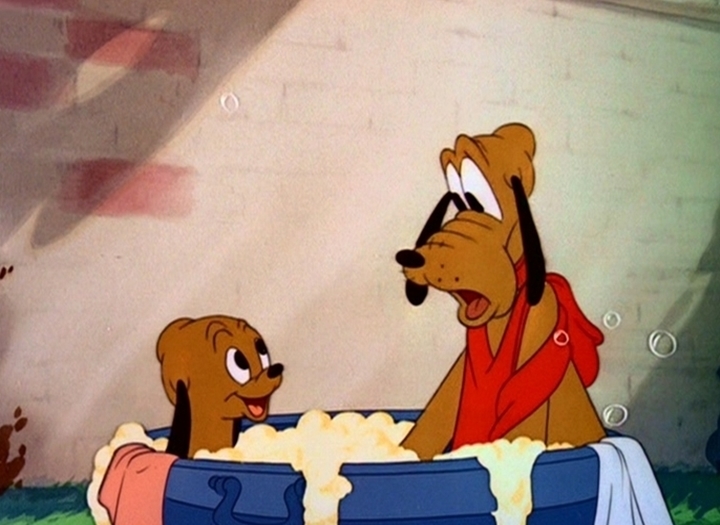
The Sleep Walker © Walt DisneyIn the first scene of this cartoon a female black dachshund tries to steal Pluto’s bone, but she fails.

Then, strangely enough, Pluto delivers her his bone in his sleep, but when he awakes he thinks she has stolen it. After some chasing, he finally destroys her home in his wrath, only to discover that she’s a mother of five pups. When it starts to rain, too, he repents and lends her his own house and collection of bones.

Director Clyde Geronimi favored food-themed Pluto cartoons, and this short is no exception. Unfortunately, the premise of Pluto sleepwalking  is very unlikely and the execution more aimed at sighs than at laughs. The result is yet another cute and rather unfunny Pluto entry. Its best feature is its music (unfortunately uncredited), which uses an effective muted trumpet during the chase scenes, and a weird melody for woodwinds during Pluto’s sleepwalking.

The female dachshund is an early forerunner of Pluto’s later love interest, Dinah, who would first appear in the 1945 cartoon ‘Canine Casanova’.

Watch ‘The Sleep Walker’ yourself and tell me what you think:
This is Pluto cartoon No. 7
To the previous Pluto cartoon: The Army Mascot
To the next Pluto cartoon: T-Bone for Two

Director: Clyde Geronimi
Release Date: February 28, 1942
Stars: Pluto
Rating: ★★
Review:

Pluto Junior © Walt DisneyIn this cartoon Pluto has only one son (instead of five as in ‘Pluto’s Quin-Puplets’ from 1937).

We watch this pup playing with a ball, a balloon, a caterpillar and a bird, which leads him into a distressful position on a clothes-line. Only then Pluto, who had been asleep all the time, comes into action. Pluto rescues his son and both fall into a wash-tub.

The best sequence of the cartoon involves Pluto’s antics on the clothes-line. It’s clear that he is a far funnier character than his son, which is only cute. Indeed, after this cartoon Pluto jr. was never seen again.

Watch ‘Pluto Junior’ yourself and tell me what you think:
This is Pluto cartoon No. 5
To the previous Pluto cartoon: Pluto’s Playmate
To the next Pluto cartoon: The Army Mascot

Director: Grigori Lomidze
Release Date: 1947
Rating: ★★★
Review:

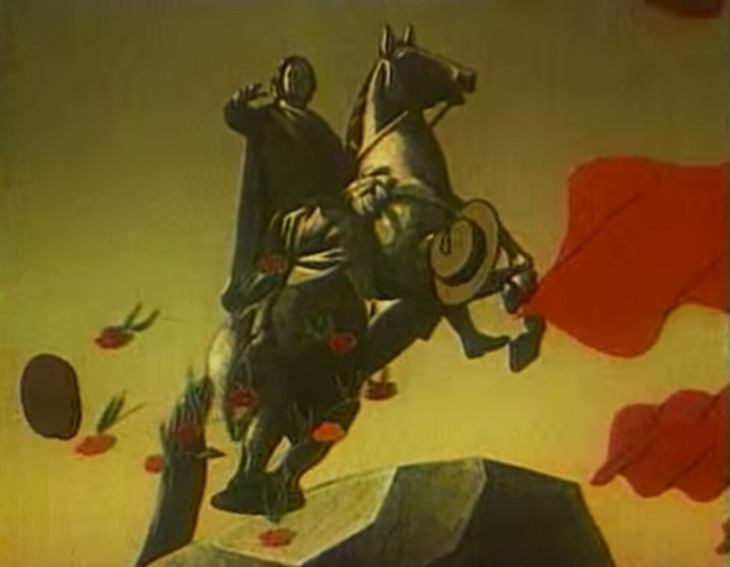
To You, Moscow © Soyuzmultfilm‘To You, Moscow’ is a long and slow Soviet propaganda film celebrating Moscow’s 800th birthday by depicting its turbulent history.

During the film we watch Moscow’s settlement, the victory of Ivan III over the Tartars (15th century), the revolt against Polish occupation (17th century), the defeat of Napoleon’s army in 1812, the 1905 revolution, the 1917 socialist revolution (‘led by Lenin and Stalin’) and the 1941 defeat of the fascist army to the present day.

The socialist revolution section leads to live-action footage of Moscow, a happy child, flowers, some buildings and street scenes and statues of Lenin and Stalin. The last section, the celebration, shows photographs of heroic inhabitants of the Soviet Union, and not only glorifies Moscow as “our youth, our glory”, “our dear mother” and “our birthday girl”, but also as a “glory to Stalin”.

The different sections are bridged by letters and postcards to comrade Stalin. The sections themselves focus on strives and battles, and are accompanied by alternately realistic and symbolic images. For example, the 1917 revolution is depicted by the czarist double-headed eagle struggling and falling to pieces, while the most impressive part may be that of 1812, with its realistic images of fire.

It may be clear that this film is propaganda at its worst. The film is saved from becoming totally unwatchable by the beautiful animation, the stark images, and the lively patriotic music.

Watch ‘To You, Moscow’ yourself and tell me what you think:

‘To You, Moscow’ is available on the DVD box set ‘Animated Soviet Propaganda’

Director: Alex Lovy
Release Date: July 27, 1942
Rating: ★★★
Review:

Juke Box Jamboree © Walter LantzIn the deserted ‘Zowie cafe’ a mouse is disturbed a jukebox playing latin music.

In his attempts to stop the machine, the mouse ends in a cocktail and gets drunk. He visions ‘spirits’ coming from the bottles who start a conga beat. A lobster does a Carmen Miranda act, blending Cuban and Brazilian styles, and singing in some kind of mock-Spanish. The mouse happily joins in, until he returns to his home to sleep.

The whole cartoon has a delirious atmosphere, and can be called ‘intoxicating’ without necessarily being really entertaining. The ghosts’ designs, with their red noses and bowler hats, are copied straight from the Mickey Mouse cartoon ‘Lonesome Ghosts’ (1938).

Watch ‘Juke Box Jamboree’ yourself and tell me what you think:

Director: Walter Lantz
Release Date: March 4, 1942
Rating: ★★★★
Review:

The Hams That Couldn't Be Cured © Walter LantzThis short has probably grimmest opening shot of all Hollywood cartoons: that of someone about to be hanged.

It turns out to be the wolf, who will be hanged for harassing the three little pigs. The wolf pleads innocent, however, and tells us “what really happened”. In his own story the wolf is a classical music teacher, loving peace and quiet (the most ridiculous illustration of this is the image of the wolf crocheting a bath tube out of a sheep). He’s visited by the three little pigs who play hot jazz, bullying the wolf, wrecking his instruments, and finally his house.

It’s a bit odd to associate such intoxicating jazz with random violence à la Clockwork Orange, but the result is an entertaining cartoon, although it is clearly tributary to the 1941 Warner Bros. cartoon ‘The Trial of Mr. Wolf’, which features a very similar story idea. Interestingly enough the director of that cartoon, Friz Freleng, would later also direct a cartoon about a wolf and three little pigs playing hot jazz, in ‘The Three Little Bops‘ (1957).

Watch ‘The Hams That Couldn’t Be Cured’ yourself and tell me what you think:

http://vk.com/video-20905395_162788911

Director: Friz Freleng
Release Date: May 23, 1942
Rating:
Review:

Light Fantastic © Warner Bros.From the early 1930s to the early 1940s Warner Bros. released several cartoons in which books, magazines etc. come to life. Of all these cartoons, ‘Lights Fantastic’ is probably the most extreme and the most dated.

It opens with a real life shot of Times Square in New York, and all sequences after that supposedly take place in neon billboards on this square. This results in little movement, a few gags on Chinese and no laughs.

Present day viewers like me don’t even have a clue how many of these billboards were based on real and familiar ones. I personally could only recognize Mr. Peanut (from Planters). No doubt most of the fun disappeared with the familiarity of the pictured advertising. However, I seriously doubt whether this cartoon has ever been a winner, for its few gags are lame, and don’t build up to a finale, at all.

Watch an excerpt from ‘Lights Fantastic’ yourself and tell me what you think:

Director: Bob Clampett
Release Date: April 11, 1942
Rating: ★★★★★ ♕
Review:

Horton Hatches the Egg © Warner Bros.

‘Horton Hatches The Egg’ is a unique film within Bob Clampett’s oeuvre, and indeed the complete Warner Bros. canon: it’s the studio’s only book adaptation, it lacks sex and violence, and there is nothing of the zany and extreme animation so typical of Clampett’s unit.

Instead, we’re treated on a surprisingly faithful adaptation of Dr. Seuss’s children’s book to the screen. The cartoon uses most of Dr. Seuss’s rhymes, with adding only a little dialogue of its own, which is easily identifiable because of the lack of rhyme. Dr. Seuss’s designs, too, are wonderfully transferred to the animated screen. Especially Horton and the other forest animals have a distinctive Dr. Seuss character.

The Warner Bros. team departs from Dr. Seuss’s drawings, however, in the human designs. The three hunters are rather bland in Dr. Seuss’s children’s book, but Clampett made them a very funny trio in the cartoon. Moreover, some of the wild Warner Brothers humor has crept into the cartoon, most typically two movie star references, which, unfortunately, date the film a little: Lazy Mayzie imitates Katharine Hepburn, and there’s a fish with Peter Lorre’s features, who, after seeing Horton on a ship, shoots itself, exclaiming “Now I’ve seen everything!”.

Today, a gag like this is regarded inappropriate for children, and it might be this gag that is responsible for the little screen time the cartoon gets today. This is very unfortunate, because this animated adaptation of a Dr. Seuss book is not only the first of all, it is also one of the best, being second only to Chuck Jones’s ‘How The Grinch Stole Christmas‘ from 1966.

Watch ‘Horton Hatches the Egg’ yourself and tell me what you think:

http://www.metatube.com/en/videos/195775/Horton-Hatches-the-Egg-Cartoon-1942/

Director: Dave Fleischer
Release Date: March 13, 1942
Stars: Popeye
Rating: ★★★
Review:

Fleets of Stren'th © Max Fleischer‘Fleets of Stren’th’ is the third in a series of cartoons in which Popeye has joined the American navy.

In this cartoon Popeye still is a lousy sailor, but when the battle cruiser is under attack, he once again shows what he’s able to do (see also ‘Blunder Below‘). This time the battle cruiser is attacked by a squad of Japanese dive bombers. It takes some time before Popeye is able to eat his spinach, but when he does, he turns into a plane himself, defeating the complete enemy fleet.

In this process we see only one pilot, the other planes are subtly dehumanized. In this way we’ll never think of the fate of the Japanese pilots, at all. This was a clever device used in many war propaganda films of the time.

Watch ‘Fleets of Stren’th’ yourself and tell me what you think:

This Popeye film No. 104
To the previous Popeye film: Blunder Below
To the next Popeye film: Pip-Eye, Pup-eye, Poop-eye and Peep-eye

Director: Dave Fleischer
Release Date: February 13, 1942
Stars: Popeye
Rating: ★★★★
Review:

Blunder Below © Max FleischerPopeye had joined the navy before the United States entered the war, in ‘The Mighty Navy‘ (November 1941), so in ‘Blunder Below’ he’s ready to fight the enemy, the first major cartoon star to do so on the movie screen.

In the first part of this cartoon Popeye tries to be a normal sailor, among Superman-like sailors, trying to learn gunning. He is no talent, however, blundering away and almost shooting down the captain by accident.

But when a submarine approaches, Popeye shows his real worth: he beats the submarine single-handedly, saving the battle cruiser. It’s this great combination of clumsiness and superhuman powers which make Popeye such an appealing character.

The approaching submarine is accompanied by the music of Franz Schubert’s Erlkönig, indicating a German origin. However, it soon turns out to be Japanese. The submarine is anthropomorphic itself and completely dehumanized, as if it were not manned by people at all. When in August 1942 Popeye changed hands from the Fleischers to Paramount, this would radically change…

Watch ‘Blunder Below’ yourself and tell me what you think:

This Popeye film No. 103
To the previous Popeye film: Kickin’ the Conga ‘Round
To the next Popeye film: Fleets of Stren’th

Director: Alex Lovy
Release Date: August 3, 1942
Rating: ★★★
Review:

Pigeon Patrol © Walter Lantz‘Pigeon Patrol’ is a typical war era cartoon. It tells about Homer Pigeon, a dopey little country pigeon, whose girl Daisy May is impressed by the USA carrier pigeons, who look like American army planes.

Rejected by Daisy May, Homer decides to volunteer, too, but he’s way too small. However when he encounters a crashed carrier, he rescues an important message from an ugly Japanese vulture, beating the enemy saying: “remember Pearl Harbor and Singapore!”. In the end we watch him being decorated and happily married to Daisy May.

‘Pigeon Patrol’ is not too funny, but very propagandistic. It seems to want to emphasize that every man can do his job for the country. The Japanese vulture belongs to the typical stereotyped caricatures of a Japanese in Hollywood cartoons, complete with a suggestion of general Tojo-like glasses.

Two years later, Warner Bros. would tell another tale about a pigeon called Homer in ‘Plane Daffy‘ (1944). Their Homer commits suicide in that film. Walter Lantz’s Homer Pigeon, however, would star one other cartoon, ‘Pigeon Holed’ from 1956.

Watch ‘Pigeon Patrol’ yourself and tell me what you think:

http://www.dailymotion.com/video/x1mnywl_clube-do-pica-pau-correio-aereo_music

Director: Walter Lantz
Release Date: April 13, 1942
Rating: ★★
Review:

Mother Goose on the Loose © Walter LantzMother Goose on the Loose’ stands in a long tradition of nursery rhyme cartoons, from the Felix the cat cartoon ‘Felix in Fairyland’ (1923) via the Silly Symphony ‘Mother Goose Melodies‘ (1931) and ‘Mother Goose Land‘ starring Betty Boop (1933), to Disney’s ‘Mother Goose Goes to Hollywood’ (1938) featuring caricatures of Hollywood stars.

Unfortunately, ‘Mother Goose on the Loose’ is weaker than any of these, hampered by a slow timing, corny gags and an obnoxious voice over. Even a jazzy tune, setting in after five boring minutes, cannot rescue the cartoon. Its only attraction is its obsession with dames, which are literally all over the cartoon. This makes ‘Mother Goose on the Loose’ a typical cartoon of the World War II era.

Director: Walter Lantz
Release Date: September 1, 1941
Rating: ★★★★
Review:

The Boogie Woogie Bugle Boy of Company B © Walter LantzBased on the 1941 hit song by the Andrews sisters, ‘The Boogie Woogie Bugle Boy of Company “B”‘ tells the story of a black trumpeter who gets drafted and has to blow the reveille, which he does in a swinging style, introducing the song.

The song itself is accompanied by various gags on blacks in the army. Even the Andrews Sisters themselves make a cameo, although they do not sing. Typical of the era, the blacks are pretty stereotyped, with huge lips, grammatically incorrect speech, and allusions to gambling. Two of them even die during the cartoon: one black after playing xylophone on some shells, while the other gets eaten by an alligator. So I can understand if some people find it hard to watch this cartoon today. Even so, the cartoon is less offensive than ‘Scrub Me Mama With a Boogie Beat‘ from six months earlier, from which the cartoon reuses some animation.

Indeed, the overall mood of the cartoon is cheerful and rather innocent, emphasizing the swinging mood. In fact, thanks to the catchy song and some flexible animation ‘The Boogie Woogie Bugle Boy of Company “B”‘ is one of the great jazz cartoons. It’s also one of the most enjoyable army cartoons of the era, of which it is probably the first. It’s at least one of the first American cartoon on conscription, which had come in effect in September 1940, as a reaction on the war in Europe. The cartoon thus predates cartoons like the Pluto short ‘The Army Mascot‘, ‘Donald Gets Drafted‘ featuring Donald Duck, and the Woody Woodpecker cartoon ‘Ace in the Hole’ (all from 1942).

Watch ‘The Boogie Woogie Bugle Boy of Company “B”’ yourself and tell me what you think:

‘The Boogie Woogie Bugle Boy of Company “B”’ is available on the DVD-set ‘The Woody Woodpecker and Friends Classic Cartoon Collection’

Director: Bob Clampett
Release Date: September 25, 1943
Stars: Bugs Bunny, Porky Pig, Elmer Fudd, Daffy Duck?
Rating: ★★★★★ ♕
Review:

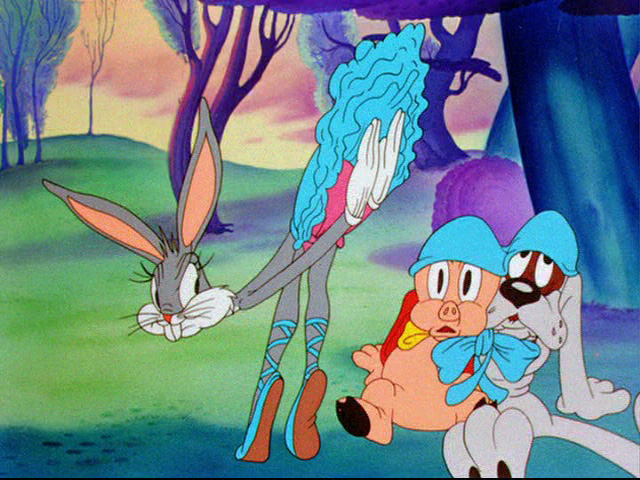
A Corny Concerto © Warner Bros.‘A Corny Concerto’ is a two part spoof on Disney’s most ambitious feature, ‘Fantasia’ (1940), using two waltzes by Johann Strauss jr.

The cartoon features a very Fantasia-like opening, with Elmer Fudd as a clear caricature of Deems Taylor. He announces ‘Tales from the Woods’, which tells about Porky Pig and a dog hunting Bugs Bunny. Porky fills the role of Elmer Fudd in this sequence, and it’s the only cartoon in we can watch him hunting Bugs Bunny. This first part is a classic Bugs Bunny routine, complete with death scene, but now timed to music and acted in pantomime. With its overt mix of high culture and silliness this part is a direct ancestor to Chuck Jones’s later ‘What’s Opera, Doc?‘ (1957).

The second part is a story on ‘The Blue Danube’. It opens with flowers dropping on water, just like in the Nutcracker Suite sequence in Fantasia. This part tells about a little black duck, an infant version of Daffy Duck, trying to join a family of swans, and finally saving them from a vulture by destroying him with TNT. As this story is some kind of inverse of ‘The Ugly Duckling‘ (another acclaimed Disney masterpiece), this could be considered to be a parody within a parody.

Apart from Elmer Fudd’s speeches, the cartoon is completely pantomimed, and full of the wild and zany animation so typical of Bob Clampett’s unit. The backgrounds are lush and colorful, and reminiscent of the the Pastoral Symphony sequence in the original Fantasia. Their designs become overtly ridiculous in ‘The Blue Danube’, with Greek columns placed randomly in the water.

The result is a highly original mix of style and nonsense, and a great testimony of what Leon Schlesinger’s studio could do on a limited budget. In all, the cartoon is an undisputed classic, and very enjoyable, even if you don’t know its topic of parody.

Watch ‘A Corny Concerto’ yourself and tell me what you think:
This is Bugs Bunny cartoon No. 19
To the previous Bugs Bunny cartoon: Wackiki Wabbit
To the next Bugs Bunny cartoon: Falling Hare

This is Porky Pig cartoon No. 102
To the previous Porky Pig cartoon: Porky’s Pig’s Feat
To the next Porky Pig cartoon: Tom Turk and Daffy

Enter your email address to follow this blog and receive notifications of new posts by email.

Join 905 other subscribers
Bookmark and Share

Categories