Director: Bob Clampett Release Date: October 3, 1942 Rating: ★★★★★ Review:
‘The Hep Cat’ was the first Looney Tune made in color. As the Merrie Melodies already were in color, this cartoon heralded a full color era for the Leon Schlesinger studio.
In ‘The Hep Cat’ the dog Rosebud (Willoughby but with another name) tries to catch a ‘hep cat’, a feline womanizer who, on his turn, tries to get a girl, a.o. by speaking with a deep french voice, anticipating the romancing skunk Pepe Le Pew by three years. Rosebud succeeds to seduce the jive cat by using a sexy kitten-like hand puppet. He looses the chase however, and in the last shot we can see the hep cat stroking the hand puppet, saying, with a Jerry Colonna voice ” I can dream, can’t I?”.
‘The Hep Cat’ does not have much of a story, but who cares? It’s an intoxicating and jazzy cartoon, and from the moment the Hep Cat starts singing ‘Java Jive’ with alternate lyrics, you’re lost. The short is fast and funny, full of uninhibited sex and violence gags and throughout the picture one keeps marveling at the extreme and amazingly flexible animation from Bob Clampett’s unit.
Watch ‘The Hep Cat’ yourself and tell me what you think:
Director: Friz Freleng Release Date: May 18, 1940 Stars: Daffy Duck, Porky Pig, Leon Schlesinger Rating: ★★★★★ ♕ Review:
‘You Ought to Be in Pictures’ is the very first cartoon to bridge two ideas of animation film figures being ‘real’.
First, the idea that cartoon figures can come alive from the drawing board into the real world, an idea that hauls all the way back to Max Fleischer’s first ‘Out of the Inkwell’ cartoons (1915). The second idea is that of cartoon figures being real Hollywood stars, explored in cartoons such as ‘Felix in Hollywood’ (1923), ‘Movie Mad‘ (1931), ‘Mickey’s Gala Premier‘ (1933) and especially ‘The Autograph Hound‘ (1939), with which ‘You Ought to Be in Pictures’ has most in common. ‘You Ought to Be in Pictures’ synthesizes these two ideas, making it a direct ancestor of ‘Who Framed Roger Rabbit‘ (1988).
‘You Ought to Be in Pictures’ was one of the first films director Friz Freleng made after his return from an ill-fortuned move to MGM, and as Jerry Beck points out in the audio commentary track, one can see this film somehow as autobiographical.
In any case, this short marks is Freleng’s first take on Daffy Duck, and he places him firmly as Porky’s rival. In this cartoon Daffy is not necessarily zany, like in Tex Avery’s and Bob Clampett’s cartoons, but overconfident and sneaky, with a tendency to show off; character treats that would be explored more from 1950 on, especially by Chuck Jones. However, by then the relation between Porky and Daffy would be changed completely.
In ‘You Ought to Be in Pictures’ Porky is still an innocent, cute and Boyish character. In the opening scene we watch him being drawn by animator Fred Jones on the drawing board. When all animators have rushed off to lunch (reused footage from a Leon Schlesinger Christmas Party film), Daffy, framed on the wall, addresses the Porky drawing. He convinces Porky to leave Leon Schlesinger’s studio to get a real job in the business of feature films. Leon Schlesinger lets Porky go, saying into the camera “he’ll be back!”. While Porky has a hard time in the neighboring live action studio, Daffy tries to get his plays at Warner Bros. But Porky returns and beats the hell out of the double-crosser.
‘You Ougt to Be in Pictures’ is a lovely cartoon. It mixes animation and live action, partly from other Warner Bros. features, to great effects. The scene in which Porky talks to Leon Schlesinger is very convincing, and Porky’s drive back no less than breathtaking. Besides Leon Schlesinger, the film stars writer Michael Maltese as a guard, animator Gerry Chiniquy as a director, and executive producer Henry Binder as a sound man. However, as the live action footage was shot silently, all are voiced by Mel Blanc, except for Leon Schlesinger who does his own voice.
Watch ‘You Ought to Be in Pictures’ yourself and tell me what you think:
This is Porky Pig cartoon No. 73
To the previous Porky Pig cartoon: Porky’s Poor Fish
To the next Porky Pig cartoon: The Chewin’ Bruin
This is Daffy Duck cartoon No. 9
To the previous Daffy Duck cartoon: Wise Quacks
To the next Daffy Duck cartoon: A Coy Decoy
‘You Ought To Be In Pictures’ is available on the DVD-sets ‘The Looney Tunes Golden Collection Volume Two’, ‘Porky Pig 101’, and the Blu-Ray ‘Looney Tunes Platinum Collection: Volume 2’
Director: Harold Mack Release Date: August 1, 1952 Rating: ★★★★★ Review:
By 1952 the Dutch Toonder studios had been producing animation films for ten years, and now they were ready to produce a ‘free film’, not commissioned, but out of their own ideas.
The first of these free films was ‘De gouden vis’ (The Golden Fish). It was Marten Toonder’s old wish to produce a free film, and the result is clearly a work of love. ‘De gouden vis’ is an astonishing achievement for the Dutch studio: all elements of animation film have matured in this film: its storytelling is original, its designs are gorgeous, the animation is excellent, the effects are convincing and its atmosphere is unique. The result is arguably one of the most beautiful films ever made in The Netherlands.
Based on a story by Marten Toonder’s brother, Jan Gerhard Toonder, the film tells about the Chinese prince Li Pai, who repeatedly asks an old wise fish how to live. The fish tells the prince that his eyes know the answer, but Li Pai misinterprets what he sees, and only in old age he discovers the truth…
The film has a genuinely Chinese atmosphere, thanks to designs by Pamela & Harold Mack and backgrounds by Cees van de Weert and Ling Nan Lung. The film hasn’t aged a bit, except for Nell Knoop’s Dutch narration, which has an unmistakable 1950s diction.
Unfortunately, ‘De gouden vis’, in spite of praise on several film festivals around the world, only returned a mere thousand guilders, while its production had costed about 40,000 guilders. So, during the rest of its existence, the Toonder studios produced only a handful of other ‘free films’, most notably ‘Moonglow’ (1955).
‘De gouden vis’ is available on the DVD inside the Dutch book ‘De Toonder Animatiefilms’
Director: John Hubley Release Date: March 27, 1952 Rating: ★★★★★ ♕ Review:
In a time when most Hollywood animation studios produced chase cartoons featuring anthropomorphized animals, UPA and director John Hubley come with a court drama about a murder…
That we have something different in our hands is underlined when during the opening titles we watch a choreographer being billed. Indeed, ‘Rooty Toot Toot’ is something different, and widely praized as one of the most beautiful cartoons ever produced.
Based on the traditional murder ballad ‘Frankie and Johnny’, it’s set in a court room. We come to know how the jealous girl Frankie shot her lover Johnny down, when she caught him with singer Nellie Bly. Then Frankie’s lawyer, Honest John, comes in with a rather different story…
‘Rooty Toot Toot’ is not a flawless cartoon. Phil Moore’s music is a rather unsuccessful marriage between musical and jump blues, lacking strong melodies. His score even threatens to wear the action down. One can only guess what the cartoon would have sound like in the hands of a more capable composer.
Moreover, Honest John’s account of the murder is a missed opportunity. It’s too silly and too cartoonish to be believed (the following bullets come right out of the chase cartoon). Indeed, the lawyer himself declares it to be fiction, making all claims of ‘Rooty Toot Toot’ being a sort of cartoon ‘Rashomon’ out of place and unfounded. In substance ‘Rooty Toot Toot’ is much more akin to that other great musical court cartoon, ‘Who Killed Cock Robin?‘ from 1935, which is also based on a traditional text.
No, the real attraction of ‘Rooty Toot Toot’ lies in it looks: practically every frame is a beautiful illustration in itself. The colors and designs, by Paul Julian, are elegant and stylish; simple, yet sophisticated. There’s a perfect harmony between characters and backgrounds, and the stark colors enhance both character and mood.
The animation, too, is superb. John Hubley didn’t think much of his colleague’s Bobe Cannon’s ideal of “drawings that moved”. Instead we watch moving characters, and it’s clear where the choreography comes in, for many characters move with a ballet-like elegance, especially Frankie and Honest John. The movement of the characters is often unreal (as in Nellie’s curling arms), but always delicate. It’s no surprise that the animation was done by the able hands of veteran animators like Art Babbitt and Grim Natwick. When the Jury declares Frankie not guilty, the cartoon bursts in a frenzy of bold design that has to be seen to be believed.
Even if ‘Rooty Toot Toot’ is not perfect, it’s a masterpiece nonetheless, and one of the best cartoons UPA ever produced.
Watch ‘Rooty Toot Toot’ yourself and tell me what you think:
In ‘The Oompahs’ a voice over tells a story about a family of musical instruments.
‘The Oompahs’ is one of UPA’s most avantgardistic cartoons. Its story and designs are by caricaturist T. Hee, who went for the extremes. The instruments are very basic paper cut outs, with very little animation on them. Mostly they just move across the screen. It’s almost unbelievable that such a modern cartoon could come from a Hollywood studio, at all.
The cartoon is the prime example of director Bobe Cannon’s wish to let the audience watch “drawings that moved”. Even if the founding idea of humanized musical instruments is the same as in Disney’s ‘Music Land‘ (1936), ‘The Oompahs’ is aesthetically miles away from the earlier cartoon.
Like some other UPA cartoons ‘The Oompahs’ tells about a young character with a free spirit. Young Orville, a trumpet, wants to play and improvize freely with his friends (some other instruments), in a game that is depicted by a baseball match, and which sounds like a dixieland band. But Oompah Pa doesn’t approve and makes young Orville practice boring tunes. Then young Orville loses all spirit, gets sick, and only his friends can revive him.
This message of letting creative energy run free must have appealed a lot to its makers, for creative freedom was the raison d’être of the whole studio.
Watch ‘The Oompahs’ yourself and tell me what you think:
‘The Wonder Gloves’ is one of the more extreme films by the UPA studio: the characters have an extraordinarily thick outline, and Paul Julian’s backgrounds are minimal and very graphic, indeed, using photographic material to indicate textures.
Moreover, the animation is limited, sometimes no more than several poses without movement inbetween. Lou Maury’s music, too, is strikingly modern, more reminiscent of contemporary French music than of classic cartoon music.
In the cartoon Uncle George tells his nephew how he found yellow wonder boxing gloves with which he became a star boxer. The framing story uses dialogue, but Uncle George’s story is told in pantomime.
Unfortunately, the story is less interesting than the designs of the cartoon. At points the limited animation hampers a fluent telling instead of enhancing it.
Watch ‘The Wonder Gloves’ yourself and tell me what you think:
‘Georgie and the Dragon’ is one of those UPA shorts about young people trying to break free, a topic the studio favored (see also ‘Gerald McBoing Boing’ from 1951) and ‘The Oompahs‘ from 1952).
‘Georgie and the Dragon’ is set in Scotland, and tells about the lonesome boy Georgie. His father forbids him to bring pets in the house, but little Georgie befriends a little dragon. When he takes it home it grows larger every minute. Nevertheless Georgie manages to hide the dragon from his parents, even if the dragon’s fire repeatedly damages his father and his surroundings.
‘Georgie and the Dragon’ is a gentle story, but the film is hampered by the tiresome Scottish dialogue and all too present angular backgrounds by Bill Hurtz, against which the fluently animated characters don’t read well.
Watch ‘Georgie and the Dragon’ yourself and tell me what you think:
Directors: Nathan Greno & Byron Howard Release Date: November 24, 2010 Rating: ★★★★½ Review:
With ‘Tangled’ the Walt Disney studio arguably released their first really successful computer animated feature.
Despite the modern techniques with which it has been made, ‘Entangled’ really looks back, even more than the hand-drawn ‘Princess and the Frog’ from one year earlier. First, it’s a musical in the vain of ‘The Little Mermaid’ (1989) and ‘Beauty and the Beast’ (1991), and indeed the songs are by same composer, Alan Menken. Second, it’s based on a classic fairy-tale (Rapunzel), placing it in a tradition looking all the way back to ‘Snow White and the Seven Dwarfs’ (1937) and ‘Cinderella‘ (1950). And third, there’s even an animal sidekick, the chameleon Pascal, something we hadn’t seen since ‘Mulan’ (1998).
Like in all these films the main protagonist is a young female yearning for love. With Ariel from ‘The Little Mermaid’, Rapunzel is the most overtly adolescent of the lot. She displays many behaviors of teenagers: not only is she torn apart between loyalty to her ‘mother’ and the longing for freedom, she also displays the naive and intoxicating excitement typical of her age. It seems like ‘Tangled’ was clearly marketed for this age group.
However, the studio changed the film’s name from ‘Rapunzel’ to ‘Tangled’ to attract other people than teenage girls, and rightly so, for the film has more to offer. However, it’s not necessarily to be found in the male protagonist, Flynn Rider. Flynn is a somewhat cliche overconfident macho, who discovers his softer side, and he is more of interest to young girls than to young men, who may have difficulties relating to him. In fact, I dare say they will more relate to Rapunzel herself.
No, it’s found in a well-told story, in which both the evil witch and Rapunzel’s hair gain new dimensions. Apart from its magical power, it is amazing what Rapunzel can do with her hair. It clearly defines her as a strong, independent and creative character: not submissive and to be won, but active, and with a will of her own.
The story knows plenty of fun, action and romance, but also allows for some deep emotional moments. For example, there is a short scene in which we see Rapunzel’s grieving father, and his emotion is played so well, it breaks your heart. Alan Menken’s songs aren’t the greatest, and can sometimes be missed, but the ‘I have a dream’ sequence in the tavern is acted out with so much bravado, it’s a great fun to watch.
I doubt whether ‘Tangled’ will become a modern classic like e.g. Pixar’s ‘Wall-E’ (2008), ‘Up’ (2009) or Disney’s later ‘Frozen’ (2013), but it seriously showed that the Disney studio still was able to make good animated features, even computer animated ones. That alone was a relief after a series of seriously bad (‘Chicken Little’, 2005), forgettable (‘Meet the Robinsons’, 2007) and average (‘Bolt’, 2008) films.
Watch the trailer for ‘Tangled’ yourself and tell me what you think:
Director: Dick Lundy Release Date: September 27, 1952 Stars: Droopy, The Wolf Rating: ★ Review:
In 1950 Tex Avery left MGM for a sabbatical, most probably due to overwork. Dick Lundy was hired to replace him, and the first cartoon he directed at MGM was ‘Caballero Droopy’.
This short’ is strangely reminiscent of the cartoons of Lundy’s former employer, Walter Lantz, with which it shares a lesser quality: both the designs and the animation are sub-par. It’s really as if this cartoon was made at Walter Lantz instead of at MGM.
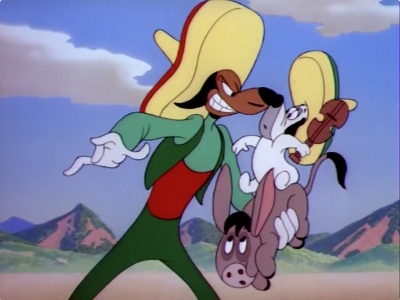
For ‘Caballero Droopy’ Lundy revived the wolf, gave him a mustache and placed him into a Mexican setting, in which he tries to outdo Droopy in serenading the phlegmatic dog’s girl. The cartoon is full of Tex Averyanisms, but due to its low production quality it never takes off.
‘Caballero Droopy’ remained the only Droopy cartoon Lundy directed. He moved on to the ailing Barney Bear series, before he had to leave MGM on Tex Avery’s return in October 1951.
Watch ‘Caballero Droopy’ yourself and tell me what you think:
Droopy is a butler in a mansion who invites his incredibly strong brother Drippy to join him at work.
The pair is told to let nobody into the house while the master’s away, but Droopy brings in his old pal, the tramp Spike. What follows is a series of confusion gags, in which Spike is pampered by Droopy and clobbered by Drippy.
The comedy is less inventive than in earlier Droopy shorts, and ‘Droopy’s Double Trouble’ is arguably Avery’s weakest Droopy cartoon. Spike is in no sense the funny, mean cheater he was in earlier cartoons, like ‘The Chump Champ’ (1950) and ‘Droopy’s Good Deed’ (1951). He speaks with a strange, Irish(?) accent and is only a meek and unfunny victim of the confusion gags.
Watch ‘Droopy’s Double Trouble’ yourself and tell me what you think:
Directors: Clyde Geronimi, Wilfred Jackson & Hamilton Luske Release Date: July 26, 1951 Rating: ★★★½ Review:
Of all the classic Walt Disney features, ‘Alice in Wonderland’ had the longest and most troublesome history.
Lewis Carroll’s book had intrigued Walt Disney for years. It had inspired the Alice cartoons, if only in name, and already in 1933 the first ideas appeared to turn the literary classic into an animated feature, starring Mary Pickford as Alice – being Disney’s first feature idea ever. Unfortunately, the idea was dropped because in 1933 Paramount released their version of the classic tale.
More serious work on Alice started in 1939/1940 when illustrator David Hall made numerous, exceptionally beautiful concept drawings. After the failures of ‘Pinocchio‘ and ‘Fantasia’ (both 1940) at the box office, these ideas were shelved, and virtually nothing of Hall’s ideas entered the final film. At one point even novelist Aldous Huxley cooperated, turning in a literary script in 1945, which the Disney studio found useless. Only in 1949 real work on the film began, resulting in Disney’s second feature of the 1950s, after the successful ‘Cinderella‘.
The final film unfortunately was poorly received when it was finally released in 1951. It performed rather badly at the box office, losing the studio almost a million dollars, practically evaporating the profits that ‘Cinderella’ had made the previous year. The film was critisized even by its own animators. Marc Davis said the film “gave us nothing to work it” and called it a “cold film”. Frank Thomas and Ollie Johnston hardly mention the film in their elaborate book ‘The Illusion of Life’. In ‘The Disney Villain’ they reveal why: they felt they “had failed to find the intriguing combination of fantasy, satire and whimsy that made the original book popular”. Even Walt Disney himself denounced the film, saying it lacked heart.
However, ‘Alice in Wonderland’ has aged suprisingly well. In fact, it has turned out to be one of the best adaptations of the book to the screen, its only serious rivals being Jan Švankmajer’s disturbing stop motion film from 1987, and a NBC production from 1999. Certainly not Disney’s feature from 2010, which, although visually stunning, owes very little to the original story.
The film’s most overt weakness, its episodic character (which, of course, it shares with the original book), is also its strong point: none of the Disney story cliches are apparent, and there’s a welcome lack of sentimentality to the film. In fact, the film’s low point is reached when the studio does try to squeak sentimentality into the story: in the Tulgey Wood scene, an invention of the story department and not found in the original book, Alice has enough of nonsense, wants to go home and feels lost. She sings the feature’s weakest and most forgettable song with a sobbing voice, with some fantasy birds sympathizing with her in stereotypical Disney fashion. Despite the inventive bird designs, this scene is wide of the mark.
Luckily, it is one of only two weak scenes (the other one being the flower scene, squeaked in from ‘Through the Looking Glass’) amidst the wonderful series of utter nonsense, which evoke the zany spirit of the book very well. The film is literally stuffed with great characters, most of them voiced by well-known British and American actors: the white rabbit (Bill Thompson, the voice of Droopy), the dodo, Tweedledee and Tweedledum (Pat O’Malley), the caterpillar (Richard Haydn), The Cheshire Cat (Disney favorite Sterling Holloway), The Mad Hatter and the Marc Hare (Ed Wynn & Jerry Colonna), the Queen of Hearts (Verna Felton), and the little king. Eleven year old Kathryn Belmont is a perfect Alice: pleasantly normal, and a little pedantic, just like the one in the book.
Of all Nine Old Men, the Disney animators who worked on the film, Ward Kimball in particular seems in his element, as Lewis Carroll’s work has much in common with his own zany type of humor. Kimball supervised animation on Tweedledee and Tweedledum, the Walrus and the Carpenter, the Mad Tea Party and the Cheshire Cat, and all characters are delightfully loony.
However, the film’s strongest point may be in its design, which is nothing like Sir John Tenniel. In contrast to his gloomy black-and-white engravings, styling artists Mary Blair, John Hench, Claude Coats and Ken Anderson present a vibrant world of colors. The stylized backgrounds are superb with their angular designs and highly original color combinations, evoking a perfect dream world. It’s these designs that give the movie unity. They are matched by the looniest animation within any Disney feature, all bringing the zany Lewis Carroll perfectly to life. Both the animation and the countless visual gags complement the textual madness of the original book. Moreover, the film is surprisingly speedy, and still enjoyable for a 21st century audience.
‘Alice in Wonderland’ may not be Disney’s best or most successful feature, it’s a very pleasant ride through a colorful world, and more of a timeless classic than anyone would have imagined in 1951.
Watch ‘Alice in Wonderland’ yourself and tell me what you think:
Director: Jack Kinney Release Date: October 21, 1951 Stars: Goofy Rating: ★★★★ Review:
This third cartoon of the Mr. Geef-series starts with our hero announcing to his colleagues that he has become a father.
We quickly move to several years later, when his son has become a hyper-active and extremely playful young boy, who troubles his father a lot. Like the other George Geef cartoons the humor of the cartoon stems mostly from its recognisability. Fathers can connect immediately to Mr. Geef’s problems with his son.
Although it’s not brought with great bravado, ‘Fathers are People’ is a milestone within the Disney catalog: for the first time a Disney star becomes a parent. Although it may be debatable whether Mr. Geef really is Goofy, the son is his, he’s not some nephew or whatever, like Huey, Dewey and Louie are. This is a very rare happening in the complete cartoon universe. True, Oswald became a father in ‘Poor Papa’ (1927), but this was a pilot film, and Oswald wasn’t a star, yet. And indeed, Pete was the first Disney cartoon character shown to be a father, having a son in ‘Bellboy Donald‘, 1942, but that cartoon didn’t celebrate a birth.
Anyway, George Geef jr. would return the next year in ‘Father’s Lion’. But in ‘A Goofy Movie’ (1995) Goofy had a very different and older son called Max, so maybe George Geef and Goofy weren’t one and the same, after all…
Watch ‘Fathers are People’ yourself and tell me what you think:
Director: Jack Kinney Release Date: June 29, 1951 Stars: Goofy Rating: ★★★★ Review:
Several of the Goofy cartoons of the 1950s cover everyday problems like driving and smoking, and, in ‘Tomorrow We Diet!’, dieting. These subjects remain remarkably topical, which makes them enjoyable to watch today.
‘Tomorrow We Diet’ features a particular fat type of Goofy with a weird faint voice. This fat Goofy is encouraged to diet by his rather independent mirror image. This unfortunately leads to hallucinations of food and to sleep-walking. When he finally gives in to his hunger he discovers that ‘the man in the mirror’ has eaten everything.
The highlights of the cartoon are a number of fatness gags, and the nightmarish hallucination sequence with its continuous voices saying “eat!”
Watch ‘Tomorrow We Diet!’ yourself and tell me what you think:
This is Goofy cartoon No. 30
To the previous Goofy cartoon: Cold War
To the next Goofy cartoon: Get Rich Quick
Director: Jack Kinney Release Date: April 27, 1951 Stars: Goofy Rating: ★★★ Review:
‘Cold War’ introduces a new name for the Goofy character as the average American, as he had already been portrayed in ‘Goofy Gymnastics‘ (1949) and ‘Hold That Pose‘ (1950).
From now on our hero is known as Mr. George G. Geef, who has a characterless, average voice and who is married to a human wife, of whom we only see her arms and legs. Despite these departures, ‘Cold War’ stills uses the voice over from the sports cartoons, putting the cartoon firmly back into a great tradition. Nevertheless, George G. Geef has little to do with the original Goofy from ‘On Ice‘ (1935), and it’s almost inconceivable that it’s still the same character.
As George Geef Goofy would deal with the troubles of the average American man, like diets, children, and cigarettes. And so, in this first entry of the ‘George Geef’ series within the Goofy series, Mr. Geef catches a cold at work, and is nursed to the max by his over-caring wife…
Watch ‘Cold War’ yourself and tell me what you think:
Director: Jack Kinney Release Date: March 23, 1951 Stars: Goofy Rating: ★★ Review:
In ‘Home Made Home’ Goofy tries to build his own house.
‘Home Made Home’ features the updated design of Goofy, introduced in ‘Tennis Racquet‘ (1949). Nevertheless, this cartoon has an old-fashioned feel to it. Like the sports cartoons from the 1940s, it uses a pompous narrator, and Goofy’s original voice. Moreover, the cartoon consists of three elongated situation gags in a style we had not seen since the 1930s. In the first Goofy is trapped in a blueprint, in the second he has to deal with a glass panel with a will of his own, recalling the piano from ‘Moving Day‘ (1937), and in the third he has to battle a snake-like paint-gun.
The gags are clever at times. Nevertheless, this short is rather slow and unfunny and only a shadow of the 1930s cartoons, the style of which it seems to try to evoke.
Watch ‘Home Made Home’ yourself and tell me what you think:
This is Goofy cartoon No. 28
To the previous Goofy cartoon: Lion Down
To the next Goofy cartoon: Cold War
Director: Walter Lantz Release Date: October 29, 1951 Stars: Woody Woodpecker, Wally Walrus Rating: ★★★½ Review:
‘The Woody Woodpecker Polka’ is one of several cartoons in which Woody Woodpecker tries to get some food.
In this cartoon Woody Woodpecker tries to enter a barn dance, but only for the food that is served there. The usher, Wally Walrus, doesn’t let him in however, for Woody can’t pay the one dollar entrance fee. Luckily, ladies are free of admission, so Woody dresses like one and makes Wally accompany him to the dance floor. What follows is a dancing scene in which Woody tries to eat as much food as he can, a story idea the studio borrowed from Walt Disney’s ‘The Legend of Sleepy Hollow‘ (1949).
The dancing scene is enhanced by the intoxicating title song, sung by the Starlighters, and for a change Clarence Wheeler’s music is inspired during this sequence.
Watch ‘The Woody Woodpecker Polka’ yourself and tell me what you think:
This is Woody Woodpecker cartoon No. 37
To Woody Woodpecker’s debut film: Redwood Sap
To the next Woody Woodpecker cartoon: Destination Meatball
‘The Woody Woodpecker Polka’ is available on the DVS-set ‘The Woody Woodpecker and Friends Classic Cartoon Collection’
Director: Walter Lantz Release Date: October 10, 1951 Stars: Woody Woodpecker Rating: ★★★★ Review:
‘Redwood Sap’ is the fable of the grasshopper and the ants disguised as a Woody Woodpecker cartoon.
Woody Woodpecker plays the role of the grasshopper, being extremely lazy, and stealing food from his neighbors: two beavers, a squirrel and a nest of ants. In the opening shot we watch him reading a book called “work and how to avoid it” by Hans Doolittle, and later we learn that Woody’s motto is “Why worry about tomorrow, I’m gone the day after”.
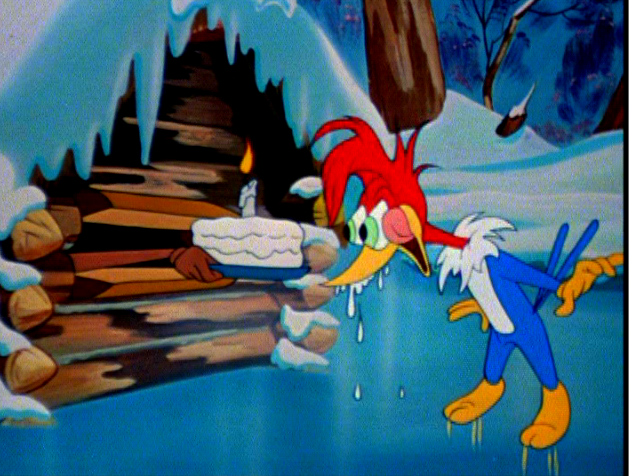
Then winter arrives, and Woody even refuses to join the birds flying South. However, confronted with an empty stomach and an empty cupboard Woody is forced to beg his neighbors for food. They however punish him for their maltreatment. So, when spring arrives they find him trapped inside an ice cube. However, when the animals take pity on Woody and revive him, they soon experience the woodpecker hasn’t learned a bit…
‘Redwood Sap’ is not a gag cartoon like contemporary Woody Woodpecker shorts. With its fable-like story it looks back to cartoons of the 1930s. However, in its speed, its animation and in its dubious moral, it’s clearly a product of its own time. ‘Redwood Sap’ shows the inventiveness of the Walter Lantz studio, who could turn out original cartoons even on a small budget.
Watch ‘Redwood Sap’ yourself and tell me what you think:
This is Woody Woodpecker cartoon No. 36
To the previous Woody Woodpecker cartoon: Sling Shot 6 ⅞
To the next Woody Woodpecker cartoon: The Woody Woodpecker Polka
‘Redwood Sap’ is available on the DVD-set ‘The Woody Woodpecker and Friends Classic Cartoon Collection’
Director: Walter Lantz Release Date: July 23, 1951 Stars: Woody Woodpecker, Buzz Buzzard, Wally Walrus Rating: ★★★ Review:
In ‘Sling Shot 6 ⅞’ Woody Woodpecker enters a shooting contest in a Western town.
Woody wins time after time using his slingshot. His main rival is Buzz Buzzard, who ‘plays’ an evil, but extraordinarily dumb Indian who fails to understand the slingshot’s mechanism. When Buzz steals the prize money, Woody destroys the villain with an H-bomb, a nuclear weapon that would be tested the following year.
Despite the animation being surprisingly good at times, ‘Sling Shot 6 ⅞’ is a rather mediocre cartoon, but it is noteworthy for being the first Woody Woodpecker short to feature both Buzz Buzzard and Wally Walrus, who appears as a sheriff.
Watch ‘Sling Shot 6 ⅞’ yourself and tell me what you think:
This is Woody Woodpecker cartoon No. 32
To the previous Woody Woodpecker cartoon: Wicket Wacky
To the next Woody Woodpecker cartoon: Redwood Sap
‘Sling Shot 6 ⅞’ is available on the DVD-set ‘The Woody Woodpecker and Friends Classic Cartoon Collection’
Director: Walter Lantz Release Date: May 28, 1951 Stars: Woody Woodpecker Rating: ★★½ Review:
‘Wicket Wacky’ opens with Woody Woodpecker playing croquet, disturbing a gopher by doing so.
‘Wicket Wacky’ features the first original story since Lantz’s reopening of his studio in 1950, and it’s way less successful than the leftovers from the 1940s: ‘Puny Express‘ and ‘Sleep Happy’.
The comedy doesn’t work, because it remains unclear whose side we should be on: both Woody and the gopher behave rather unsympathetically. Moreover, Woody remains a totally blank character in this cartoon, showing practically no emotions whatsoever.
‘Wicket Wacky’ only seems to show that gophers are poor comedy material, something we knew from other weak cartoons like the Donald Duck short ‘Donald’s Garden‘ (1942) and the Pluto shorts ‘Bone Bandit‘ (1948) and ‘Pluto and the Gopher‘ (1950).
Watch ‘Wicket Wacky’ yourself and tell me what you think:
This is Woody Woodpecker cartoon No. 34
To the previous Woody Woodpecker cartoon: Sleep Happy
To the next Woody Woodpecker cartoon: Sling Shot
‘The Screwdriver’ is available on the DVD-set ‘The Woody Woodpecker and Friends Classic Cartoon Collection’
Director: Walter Lantz Release Date: January 22, 1951 Stars: Woody Woodpecker, Buzz Buzzard Rating: ★★★★★ Review:
After a squabble with his distributor Universal, and a short fling with United Artists, Walter Lantz was forced to close down his studio in 1948.
Only when Lantz and Universal came to terms again in 1950 Lantz could restart again, with a strongly reduced staff. For example, there was no story department, so the first new cartoon in two years, ‘Puny Express’, was based on storyboards Bugs Hardaway and Heck Allen had left behind in 1948. Worse, Woody Woodpecker was left voiceless.
Lantz himself picked up directing, something he hadn’t done in nine years. The studio owner directed eleven cartoons before Don Patterson took over in 1952. All these cartoons feature Woody Woodpecker; Andy Panda was not revived. Woody himself was redesigned, his looks made simplier and more appealing. It’s this new cute design which remains the best known to viewers today.
Woody’s voicelessness turned out to be a blessing in disguise. In contrast to the dialogue-driven cartoons of rival studios the 1951/1952 Woody Woodpecker shorts feature excellent silent comedy and situation gags, competing with the best of the Pink Panther, who would enter the scene only in 1964.
‘Puny Express’ is a western in which Woody volunteers to deliver the mail, despite the fact that Buzz Buzzard has killed no less than 125 mailmen. What follows is a gag-rich wild chase, full of fast and flexible animation. The humor is overtly Tex Averyan: at one point Woody’s little horse gets a flat hoof, and the cartoon cites the empty road gag from Tex Avery’s own western ‘Wild and Woolfy‘ from 1945.
The cartoon’s only weakness is its music by Clarence Wheeler, which is surprisingly out of tune with the short’s zany character, evoking a mellower 1930s feel.
Watch ‘Puny Express’ yourself and tell me what you think:
This is Woody Woodpecker cartoon No. 32
To the previous Woody Woodpecker cartoon: Drooler’s Delight
To the next Woody Woodpecker cartoon: Sleep Happy
‘Puny Express’ is available on the DVD-set ‘The Woody Woodpecker and Friends Classic Cartoon Collection’
Animation Backgrounds
A blog dedicated to background paintings from animation films. Kept until 2016.
Animation Scoop
Animation historian Jerry Beck’s animation film news blog.
Cartoon Brew
Topical blog on animation film, led by animation historian Amid Amidi.
Cartoon Modern
Amid Amidi’s blog on modern design cartoon art from the forties, fifties and sixties.
Cartoon Research
THE site on classic animation research, hosted by cartoon historian Jerry Beck.
Cartoons Theory
Frank Beef analyzes classic cartoons. Kept until 2020.
Century Film Project
Michael reviews films of 100 years old and older, roughly in chronological order.
Classic Cartoons
A similar blog featuring many stills and comic strips. Kept until 2012.
Comet over Hollywood
Jessica Pickens reviews classic Hollywood films, especially musicals.
Deja View
Top ex-Disney animator Andreas Deja’s own blog.
Disney History
Esteemed Disney historian Didier Ghez on the latest books on Disney history.
Feeling Animated
Paul Astell brings us thorough reviews of animated features.
Flickers in Time
Short and to the point reviews of classic films (lately mostly pre-code talkies) by an anonymous retired Foreign Service Officer from California
 ‘The Hep Cat’ was the first Looney Tune made in color. As the Merrie Melodies already were in color, this cartoon heralded a full color era for the Leon Schlesinger studio.