Director: Charles Nichols
Release Date: September 21, 1951
Stars: Pluto, Milton
Rating: ★★★★½
Review:

Cold Turkey © Walt Disney‘Cold Turkey’ was the very last Pluto cartoon, although Pluto would return in Mickey Mouse’s last three cartoons (1952/1953).

The short couples Pluto to Milton, the zany cat who had been introduced in ‘Puss-Cafe‘ the previous year, only to star in three cartoons.

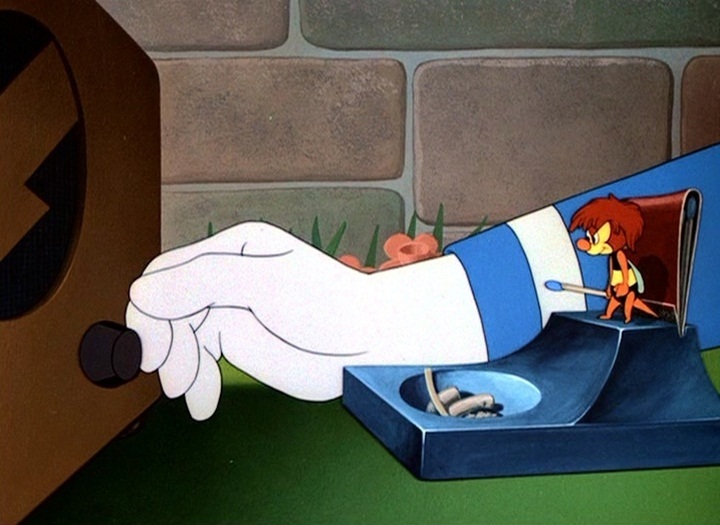
‘Cold Turkey’ opens with some live action footage on a television set featuring a wrestling match. Pluto and Milton sleep right through it, only to awake at an add for hot turkey. The pair first tries to get the turkey out of the television set, then try to find it in the kitchen. When they discover one in the fridge, the companionship turns into rivalry.

‘Cold Turkey’ is less funny than either ‘Puss-Cafe’ or ‘Plutopia‘, the other two cartoons featuring Milton, but it’s still an enjoyable short. The best part may be the pedal bin scene. It’s sad to see the Pluto series ending when its makers had finally made it into a funny one, with its last eleven cartoons being among the best of the entire series.

Watch ‘Cold Turkey’ yourself and tell me what you think:

This is Pluto’s 43rd and last cartoon
To the previous Pluto cartoon: Plutopia

‘Cold Turkey’ has been released on the Walt Disney Treasures DVD-set ‘The Complete Pluto Volume Two’

Director: Charles Nichols
Release Date: May 18, 1951
Stars: Mickey Mouse, Pluto, Milton
Rating: ★★★★★
Review:

Plutopia © Walt DisneyIn ‘Plutopia’ Mickey and Pluto reach a cabin in the mountains called Utopia.

The place turns out to be dog-unfriendly however: Pluto has to stay outside and even worse, has to be muzzled. Frustrated, Pluto falls asleep. He dreams he’s in Plutopia where Milton (one of the cats from ‘Puss-Cafe‘, and here the cabin’s cat) is his willing servant, serving him food every time Pluto bites him in his tail.

The dream sequence is a delight to watch: its backgrounds consists of no more than changing monochromes featuring ‘scribbled’ outlines of doors, stairs e.g. With this sequence Pluto enters the ‘cartoon modern’ era. Unfortunately, it would be his only cartoon featuring such modern designs.

‘Plutopia’ is the last of only three Pluto cartoons featuring Mickey Mouse (the other two being ‘Pluto’s Purchase’ from 1948 and ‘Pueblo Pluto‘ from 1949). Normally cartoons featuring Mickey would appear under his own name. Indeed, after ‘Plutopia’ the Pluto series had only one entry left, but Pluto would return in Mickey’s last four cartoons.

Remarkably, ‘Plutopia’ features animation by two of the greatest animators of Mickey and Pluto in the 1930s: Fred Moore and Norm Ferguson. Both animators had been eclipsed by Disney’s Nine Old Men, and ‘Plutopia’ is one of the last films they worked on before their premature deaths in 1952 and 1957, respectively.

Watch ‘Plutopia’ yourself and tell me what you think:

This is Pluto cartoon No. 42
To the previous Pluto cartoon: Cold Storage
To the next Pluto cartoon: Cold Turkey

Director: Jack Kinney
Release Date: February 9, 1951
Stars: Pluto
Rating: ★★★★★
Review:

Cold Storage © Walt DisneyCold Storage is the second of only two Pluto cartoons directed by Jack Kinney, the other being ‘Bone Trouble‘ from 1940.

Jack Kinney was Disney’s best gag cartoon director, and ‘Cold Storage’ is no exception. The story is set in wintertime. A freezing stork seeks shelter in Pluto’s dog house. When an equally cold Pluto returns home, a battle for the dog house begins.

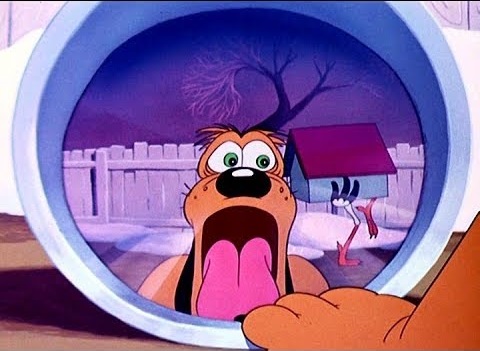
Highlight of the film is when Pluto discovers his doghouse is moving and flying. Pluto’s facial expressions are priceless in this section. However, throughout the picture the animation of Pluto is expressive and flexible, full of great facial expressions and extreme poses. The interplay between the two characters is excellent and accounts for many gags.  In the end the already zany cartoon turns absurd, when winter suddenly gives way to a hot summer day…

Watch ‘Cold Storage’ yourself and tell me what you think:

This is Pluto cartoon No. 41
To the previous Pluto cartoon: Camp Dog
To the next Pluto cartoon: Plutopia

Director: Charles Nichols
Release Date: August 11, 1950
Stars: Pluto, Chip ‘n’ Dale
Rating: ★★★★★
Review:

Food for Feudin' © Walt DisneyFood for Feudin’ is the third of four cartoons coupling Chip ‘n’ Dale to Pluto. It’s also the only Chip ‘n’ Dale cartoon directed by Charles Nichols.

Nichols handles the characters of the two chipmunks very well. Their interplay is better than in many Donald Duck cartoons and a delight to watch. In the opening scene Dale even mocks Donald’s anger dance, and later we hear his version of the Goofy yell.

The story is set in autumn, in a park. Pluto tries to store his bone in Chip ‘n’ Dale’s nut tree. The result is that all Chip ‘n’ Dale’s nuts end up in Pluto’s dog house. In order to get them out they hide themselves in two gloves. This idea leads to some wonderfully comedy.

In all ‘Food for Feudin’ is a delightful cartoon, and one of Chip ‘n’ Dale’s best.

Watch ‘Food for Feudin’’ yourself and tell me what you think:

This is Pluto cartoon No. 39
To the previous Pluto cartoon: Pests of the West
To the next Pluto cartoon: Camp Dog

Director: Charles Nichols
Release Date: July 21, 1950
Stars: Pluto, Bent-Tail & Bent-Tail junior
Rating: ★★★★½
Review:

Pests of the West © Walt Disney‘Pests of the West’ is the second of three cartoons featuring the coyote Bent-Tail and his dopey son.

In ‘Sheep Dog‘ (1949) they’d tried to steal sheep; this time the hungry duo is after the chickens. Pluto is only the straight man in a cartoon, which is devoted to the delightful interplay between father and son.

Although not as classic as ‘The Legend of Coyote Rock’, ‘Pests of the West’ is a funny cartoon. The short is packed with gags, some being quite Tex Averyan, like the son hanging in mid air until his father knocks him down. However, its highlight is the great scene in which Pluto and Bent-Tail fight for a chicken. The wonderful and jazzy soundtrack enhances all the fun. It was composed by Paul Smith, who had been an arranger for Disney since the late 1930s, and would become a noteworthy composer on the studio’s True-Life Adventures.

Watch ‘Pests of the West’ yourself and tell me what you think:

This is Pluto cartoon No. 38
To the previous Pluto cartoon: Puss-Cafe
To the next Pluto cartoon: Food for Feudin’

Director: Jack Hannah
Release Date: October 13, 1950
Stars: Donald Duck, the bee
Rating: ★★★
Review:

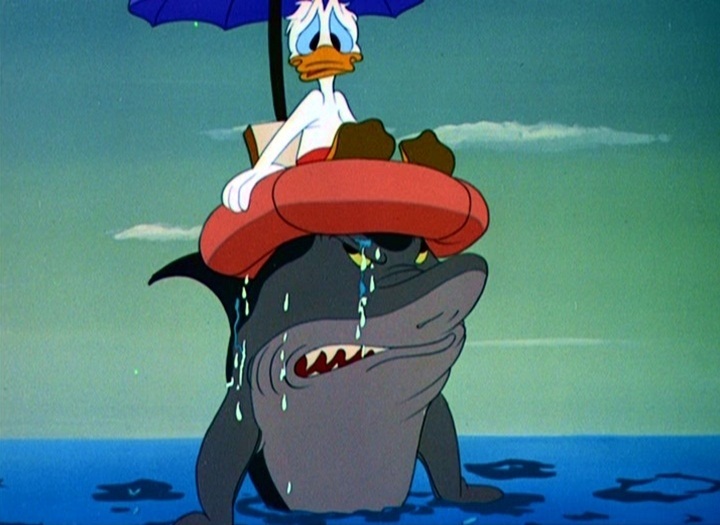
Bee at the Beach © Walt DisneyThe bee and Donald compete for an empty spot on the beach in an exceptionally violent cartoon.

This short contains some good gags, but because both characters behave very unsympathetically, it is not too enjoyable. The bee, for instance, deliberately feeds Donald to a shoal of hungry sharks, which our poor hero can hardly escape. Even worse, the cartoon ends with Donald swimming into the horizon, with the sharks following after.

The sharks’ design go all the way back to ‘Peculiar Penguins‘ (1934).

Watch ‘Bee at the Beach’ yourself and tell me what you think:

This is Donald Duck cartoon No. 87
To the previous Donald Duck cartoon: Hook, Lion and Sinker
To the next Donald Duck cartoon: Out on a Limb

Director: Jack Hannah
Release Date: September 1, 1950
Stars: Donald Duck, the mountain lion
Rating: ★★★★
Review:

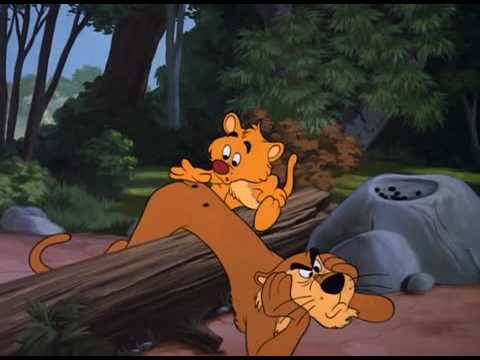
Hook, Lion and Sinker © Walt DisneyIn ‘Hook, Lion and Sinker’ the mountain lion from ‘Lion Around’ from eight months earlier returns.

The big cat now has a son, not unlike Bent-Tail in the Pluto short ‘Sheep Dog‘ from 1949. The comedy between father Lion and son is excellent, even though it’s less funny than that of the two coyotes, as the mountain lion’s son is clearly smarter than Bent-Tail jr.

Nevertheless, ‘Hook, Lion and Sinker’ is the best of the four films featuring the mountain lion. Donald is only the straight man, with all the comedy restricted to the wonderful interplay between father and son. The two mountain lions are after Donald’s newly caught fish, but unfortunately, Donald has a gun, and he is all too glad to shoot the duo with hail…

Watch ‘Hook, Lion and Sinker’ yourself and tell me what you think:

This is Donald Duck cartoon No. 86
To the previous Donald Duck cartoon: Trailer Horn
To the next Donald Duck cartoon: Bee at the Beach

Director: Robert McKimson
Release Date: December 13, 1949
Stars: Goofy Gophers
Rating: ★★★
Review:

A Ham in a Role © Warner Bros.Robert McKimson reuses the Goofy Gophers from the Art Davis cartoons ‘Goofy Gophers’ (1947) and ‘Two Gophers from Texas’ (1948) to play them against an anonymous dog who wants to be a Shakespearean actor.

The dog finds the gophers in his house, where they start to nag him for no reason. The humor comes from the Shakespeare quotes and the apt practical jokes the Gophers play on the dog, echoing his lines. However, it’s the opening scene that is the most remarkable part of the film: directly after the opening titles we watch the dog being hit by a pie, only to get the ‘That’s All Folks’ caption immediately after it. Then we watch the dog leaving ‘the stage’, cartoons and broad comedy in general to follow his Shakespearean dreams. This scene anticipates a similar scene in ‘Who Framed Roger Rabbit‘ (1988).

It’s a pity that the rest of the cartoon doesn’t live up to this great opening, and that McKimson didn’t use a more familiar or appealing character than this dog, which ultimately fails to impress.

Robert McKimson would return to the Gophers only once, in 1958, with ‘Gopher Broke’.

Watch an excerpt from ‘A Ham in a Role’ yourself and tell me what you think:

‘A Ham in a Role’ is available on the DVD-set ‘Looney Tunes Golden Collection Volume Six’

Director: Robert McKimson
Release Date: November 19, 1949
Stars: Sylvester, Hippety Hopper
Rating: ★★
Review:

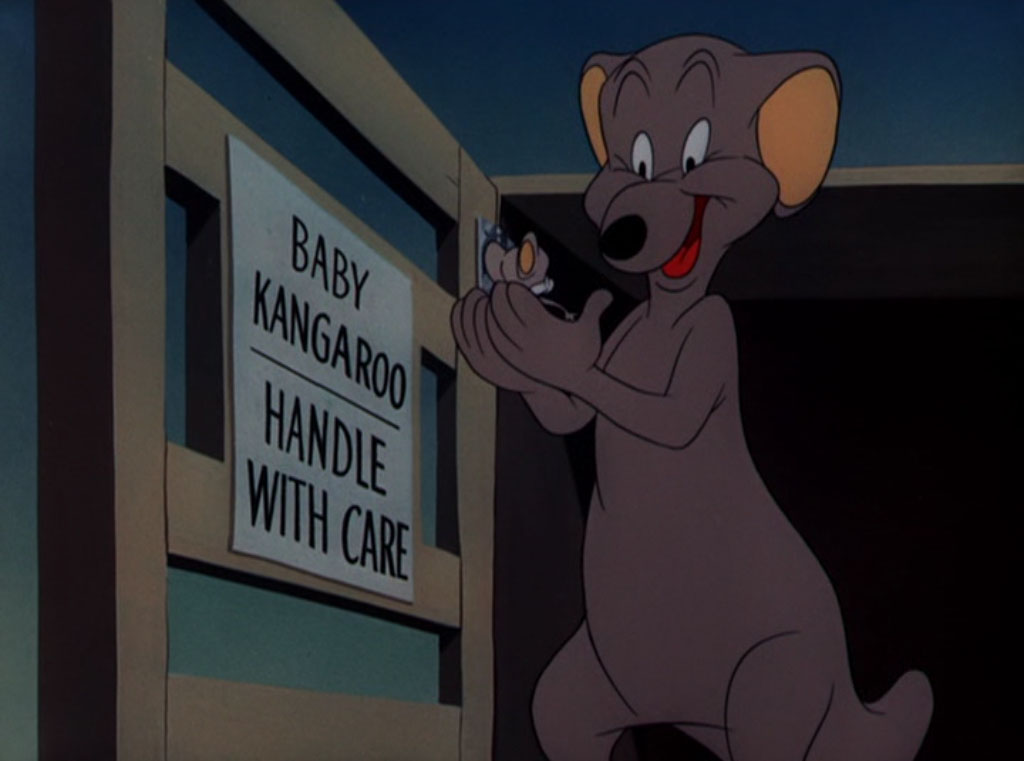
Hippety Hopper © Warner Bros‘Hippety Hopper’ introduces the kangaroo of the same name, and its only function during its entire career: being mistaken for a mouse.

The cartoon starts gloomily enough, with a misty harbor scene, where a mouse is trying to commit suicide. He’s rescued by Hippety Hopper, however, and together they face the mouse’s terror: Sylvester the cat. The mouse makes Sylvester think he can grow tall, and lets Hippety Hopper beat him out of the house. The best comedy comes from a bulldog who keeps pushing Sylvester back inside.

Hippety Hopper himself is a silent character with a friendly smile and absolutely no personality. He’s easily the least funny recurring star in the Warner Brothers cartoon catalog before the 1960s. Even in this first cartoon his appearance is tiresome. Nevertheless, he would star in twelve other cartoons, lasting even till 1964. The mouse, on the other hand, would disappear after this cartoon. No wonder: he’s designed and animated rather uglily.

Watch ‘Hippety Hopper’ yourself and tell me what you think:

http://www.dailymotion.com/video/x7b04w_merrie-melodies-hippity-hopper-1949_shortfilms

Director: Chuck Jones
Release Date: August 13, 1949
Stars: Charlie Dog, Porky Pig
Rating: ★★★★
Review:

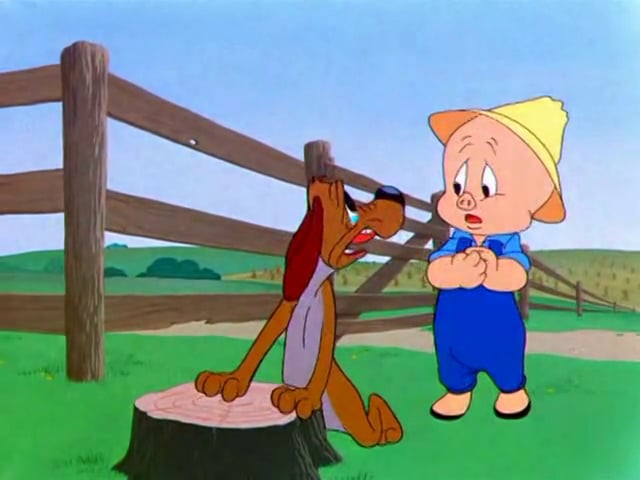
Often an Orphan © Warner Bros.‘Often an Orphan’ is the third of four cartoons featuring Chuck Jones’s minor cartoon star Charlie Dog.

Of the quartet, this short is probably the best. Left alone at the roadside, Charlie Dog tries to become Porky Pig’s dog again, who now is a farmer in the countryside. At no point Porky is willing to take him in, despite some great acting by the deceitful mutt: highlight of the film is his playing of a weak, sick, nervous wreck, ruined by the terrors of the big city. This is arguably Charlie Dog’s all time best moment. The cartoon ends at the roadside, again, but now it’s Porky who gets left behind.

Watch ‘Often an Orphan’ yourself and tell me what you think:

This is Porky Pig cartoon no. 127
To the previous Porky Pig cartoon: Curtain Raizor
To the next Porky Pig cartoon: Dough for the Do-Do

Director: Jack Hannah
Release Date: March 24, 1950
Stars: Donald Duck, Chip ‘n’ Dale, Daisy Duck, cameos by Goofy, Mickey Mouse and Minnie Mouse
Rating: ★★★
Review:

Crazy over Daisy © Walt DisneyDespite its name and title song ‘Crazy over Daisy’ is a surprisingly typical Donald Duck vs. Chip ‘n’ Dale cartoon.

In fact, it hardly features Daisy, at all. And when Daisy finally does show up, she takes the chipmunks in, leaving Donald outside. Yet, we do see Donald being crazy over Daisy, cycling to her on his velocipede… Yes, you read this right: Donald is riding a velocipede, because this cartoon is set in the 1890s. Its opening scene even feels like a copy of the opening scene of the 1941 Mickey Mouse cartoon ‘The Nifty Nineties’, complete with cameos of Goofy, and Mickey and Minnie (in the same car as they drove in the earlier cartoon).

Apart from the typical bicycle, it’s unclear why this cartoon is set in this period. The interplay between Donald and the two chipmunks could have taken place in any era. The most interesting fact about ‘Crazy over Daisy’ is that it contains an animated background scene, rarely seen since the early 1930s.

Watch ‘Crazy over Daisy’ yourself and tell me what you think:

This is Donald Duck cartoon No. 84
To the previous Donald Duck cartoon: Lion Around
To the next Donald Duck cartoon: Trailer Horn

Director: Jack Hannah
Release Date: January 20, 1950
Stars: Donald Duck, Huey, Dewey and Louie, the mountain lion
Rating: ★★★
Review:

Lion Around © Walt DisneyIn ‘Lion Around’ Huey, Dewey and Louie use a remarkably lifelike mountain lion costume to fool Donald in order to steal a pie. Unfortunately, Donald discovers the deceit, and then, off course, a real mountain lion shows up.

This story line was already formulaic by 1950, and it doesn’t lead to anything particularly funny. In fact, the highlight is the nephews’ costume itself, with its remarkable ability to stretch. This is some funny animation, unmatched by that of the ‘real’ mountain lion. Nevertheless, the real one would return later that year in ‘Hook, Lion and Sinker‘, and in two Goofy shorts: ‘Lion Down‘ (1951) and ‘Father’s Lion’ (1952).

Watch ‘Lion Around’ yourself and tell me what you think:

This is Donald Duck cartoon No. 83
To the previous Donald Duck cartoon: Toy Tinkers
To the next Donald Duck cartoon: Crazy Over Daisy

Director: Jack Hannah
Release Date: December 16, 1949
Stars: Donald Duck, Chip ‘n’ Dale
Rating: ★★★
Review:

Toy Tinkers © Walt DisneyIn 1949 Donald Duck had to deal with three small adversaries: Bootle Beetle, the bee and Chip ‘n Dale. Of the three, Chip ‘n Dale were by far the funniest – and it’s no wonder they have become famous where the two insects have not.

‘Toy Tinkers’ is particularly inspired, using Christmas toys as props for a chase inside Donald’s living room, leading to an open war that is far removed from the Christmas spirit. Highlight, however, is the excellent animation of Dale impersonating a gentleman with a top hat and a cane.

Watch ‘Toy Tinkers’ yourself and tell me what you think:

This is Donald Duck cartoon No. 82
To the previous Donald Duck cartoon: Slide, Donald, Slide
To the next Donald Duck cartoon: Lion Around

Director: Jack Hannah
Release Date: November 25, 1949
Stars: Donald Duck, The Bee
Rating: ★★
Review:

Slide, Donald, Slide © Walt DisneyAfter his move into the Donald Duck series three months earlier in ‘Honey Harvester’, the bee returns. This time as a classical music lover competing with Donald over the radio.

While the bee wants to listen to classical music, Donald wants to listen to a world series baseball match.

The most inspired gags involve Donald and the bee reenacting the match in Donald’s garden. But the bee is hardly a funnier character than Bootle Beetle, and the cartoon never comes off: the violence remains restrained, the bee remains cute. Donald is reduced to a simply annoying character, a bully who is rightly ‘sent to the showers’.

Watch ‘Slide, Donald, Slide’ yourself and tell me what you think:

This is Donald Duck cartoon No. 81
To the previous Donald Duck cartoon: The Greener Yard
To the next Donald Duck cartoon: Toy Tinkers

Director: Jack Hannah
Release Date: October 14, 1949
Stars: Donald Duck,  Bootle Beetle
Rating:
Review:

The Greener Yard © Walt Disney‘The Greener Yard’ is the third cartoon starring the annoyingly unfunny Bootle Beetle.

In this short there are in fact two Bootle Beetles: an older one and his son, who doesn’t like to eat beans and who longs for greener pastures. But the older Bootle Beetle tells him how the grass always looks greener at the other side, but isn’t. He apparently has learned this lesson in Donald’s garden, where is given a hard time by Donald, his chickens and two bluebirds.

‘The Greener Yard’ is slow, boring and moralistic, and forms a low point in Donald Duck’s canon. Luckily, it was the last Donald Duck short to feature this boring insect. Nevertheless, the elderly Bootle Beetle and his younger counterpart would return to the screen one last time, in ‘Morris, the Midget Moose‘ (1950).

Watch ‘The Greener Yard’ yourself and tell me what you think:

This is Donald Duck cartoon No. 80
To the previous Donald Duck cartoon: All in a Nutshell
To the next Donald Duck cartoon: Slide, Donald, Slide

Director: Tex Avery
Release Date: April 9, 1949
Stars: Droopy, the Wolf, Lina Romay
Rating: ★★★★★ ♕
Review:

Señor Droopy © MGM‘Señor Droopy’ is one of Tex Avery’s most classic cartoons and arguably the best bullfight cartoon of all time, another candidate being Chuck Jones’s ‘Bully for Bugs’ from 1953.

‘Señor Droopy’ is set in Mexico and features the wolf as an overconfident champion bullfighter and Droopy as his measly challenger. Both are in love with Mexican film star/singer Lina Romay, but it’s of course Droopy who wins her: the last scene shows live action footage of this forgotten film star petting our happy hero.

But it’s of course not the story that makes the short so memorable. It’s the gags, and they come in fast and plenty. The film is stuffed with Avery’s own weird logics and cosmic laws, which lead to many a hilarious situation. The best example of Avery’s unique logic may be the following gag: when the bull has vanished between two wooden doors, the wolf closes them together, then another time, but this time vertically, reducing their size by two. He continues doing so until the large doors have been reduced to a tiny cube. He then casually throws the cube behind him, which quickly unfolds to the size of the original doors, which open to reveal a stairway to a cellar, from which the bull rushes back into the arena. Seeing is believing.

‘Señor Droopy’ is not entirely flawless: the wolf’s transformation from über-confident to panic-stricken is not really convincing, and Avery reuses the road gag from ‘Wild and Woolfy‘ (1945), which makes less sense inside the arena. But who cares! The interplay between the wolf, the bull and Droopy is delightful throughout, and even a minor character like the Mexican announcer is animated with gusto.

Watch ‘Señor Droopy’ yourself and tell me what you think:

http://www.veoh.com/watch/v202445Gjy2WGzy?h1=Senor+Droopy+-+Droopy

Director: Jack Hannah
Release Date: June 3, 1949
Stars: Donald Duck,  Chip ‘n’ Dale
Rating: ★★★
Review:

Winter Storage © Walt DisneyIt’s 7 October, and Chip and Dale are storing acorns for the winter. Because they don’t get enough, they steal them from Donald Duck, who, as a forest ranger, has a sackful to plant new oak trees with.

‘Winter Storage’ was Chip and Dale’s fourth film, and only the second in their mature form. In this cartoon they are even better developed than in their previous entry, ‘Three for Breakfast’ (1948), and watching the interplay between the two chipmunks is a sheer delight. Donald’s role, on the other hand, is modest, and only comes alive in the finale, in a very nice fake ice hockey scene.

Watch ‘Winter Storage’ yourself and tell me what you think:

This is Donald Duck cartoon No. 77
To the previous Donald Duck cartoon: Sea Salts
To the next Donald Duck cartoon: Honey Harvester

Director: Jack Hannah
Release Date: April 8, 1949
Stars: Donald Duck, Bootle Beetle
Rating:
Review:

Sea Salts © Walt DisneyBootle Beetle, introduced in ‘Bootle Beetle‘ from 1947, returns to tell us about his relationship with ‘the captain’, and old seafaring version of Donald Duck. He relates how he and ‘the captain’ were shipwrecked and stranded on a desert island.

Bootle Beetle never was a funny character, and this cartoon, too, suffers: Bootle beetle is simply too cute. Moreover, his relationship to Donald is never explained, nor the fact why Donald is suddenly a captain. To make things worse, the cartoon is painstakingly slow. For example, it contains a very long gag on a coconut, unfavorably reminiscent of the overlong gags of the earliest character animation-based cartoons of the mid-1930’s, like ‘Mickey Plays Papa‘ (1934) or ‘Moving Day‘ (1936).

Watch ‘Sea Salts’ yourself and tell me what you think:

This is Donald Duck cartoon No. 76
To the previous Donald Duck cartoon: Donald’s Happy Birthday
To the next Donald Duck cartoon: Winter Storage

Director: Mikhail Kamenetsky
Release Date: 1984
Rating: ★★
Review:

Wolf and Calf © SoyuzmultfilmMikhail Kamenetsky (1924-2006) was a director of numerous puppet films made between 1965 to 1995, almost all featuring animals.

In his ‘Wolf and Calf’ an old wolf steals a calf to eat, but he starts to like it and raises it like his own son. In the end, when a hungry bear, a vixen and a boar try to steal his loot, he is saved by the calf itself, which has turned into a strong bull.

‘Wolf and Calf’ is a fable-like children’s film with an old-fashioned look. The designs of the protagonists look like they have come from a 1950’s toy shop. Kamenetsky’s puppet animation is elaborate, and actually quite good, if erratic, but the film suffers from an excess of dialogue, which not always seems to correspond with the animated characters themselves.

Moreover, the film’s world is rather inconsistent, stretching its believability: the wolf, like all other animals, is highly anthropomorphic and even lives in a house, alongside humans, who are afraid of him nonetheless. The calf, on the other hand, remains on all fours, and stays an animal, even though it is able to speak.

Watch ‘Wolf and Calf’ yourself and tell me what you think:


Director: Ideya Garanina
Release Date: 1981
Rating: ★★½
Review:

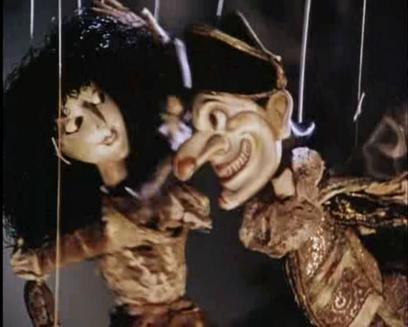
Cabaret © SoyuzmultfilmBased on plays by Federico García Lorca, Cabaret (a better translation would be ‘farce’) is a puppet animation film, using puppets in a puppet theater.

The film is something of a musical and tells about the love between Donna Rosita and Don Cristobál. The music, by world famous composer Sofia Gubaidulina is odd and rather unconvincing in its avant-garde version of the musical genre.

The film falls into two parts: the first part looks most like an ordinary puppet play: it’s fast, hectic, humorous, and even vulgar, with a strong sense of eroticism. Halfway the film, however, the mood changes drastically. Don Cristobál gets rid of his strings and tears off his grotesque mask to reveal a more noble face. With that the film enters the second part, a dreamlike, lyrical one. Unfortunately, the narrative gets lost in this part, and in the end the film suffers from its length, from its meandering music and beautiful, but vague imagery.

‘Cabaret’ was Garanina’s Fourth film, and her third after she had joined Soyuzmultfilm in 1976. In 1988 Garanina and Gubaidulina would work together again on “The Cat That Walked by Itself”, a feature film based on Rudyard Kipling’s ‘Just So Stories’. Unfortunately she came to a tragic end, as she was murdered in her own house in 2010.

Watch ‘Cabaret’ yourself and tell me what you think:

http://www.dailymotion.com/video/x27btal_08-ideya-garanina-1981-cabaret_shortfilms

Enter your email address to follow this blog and receive notifications of new posts by email.

Join 918 other subscribers
Bookmark and Share

Categories