Director: Jack Kinney Release date: October 15, 1954 Rating: ★★ Review:
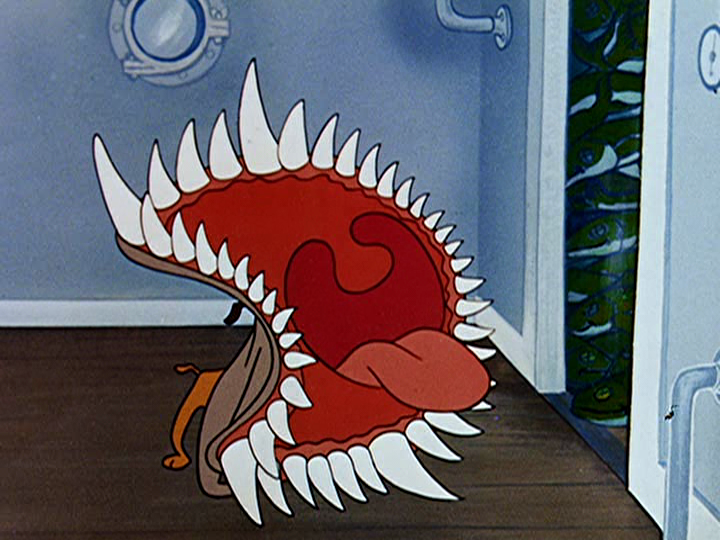
In this narrated short a lion deliberately gets himself caught to scare the people in New York. Unfortunately, he’s all but unnoticed there.
‘Social Lion’ was the last of three ‘special cartoons’ Jack Kinney directed in 1954, after his own Goofy series had stopped. It is, unfortunately, not a very successful cartoon. Its narration is trite, its timing poor and its animation, by veteran Norm Ferguson, heterogeneous: the full animation of the lion is awkwardly out of contact with the highly stylized animation of the humans.
Unfortunately, ‘Social Lion’ would be the great animator’s last statement. the Disney studio fired Ferguson in July 1953. He died four years later of a heart-attack, at the premature age of 45.
The cartoon reuses the weird safari song from Kinney’s earlier, way more successful short ‘African Diary’ (1945).
Watch ‘Social Lion’ yourself and tell me what you think:
‘Social Lion’ is available on the DVD ‘Walt Disney Treasures: Disney Rarities’
Director: Jack Kinney Release date: May 21, 1954 Rating: ★★★★ Review:
After his own Goofy series had stopped in 1953, Jack Kinney directed six other shorts at the Walt Disney Studio.
‘Pigs is Pigs’ is probably the best of the lot. It’s a story in rhyme and song about a railway station employee who does everything by the rules. At one day he has a dispute with a Scotchman about whether guinea pigs are pigs or not. The guinea pigs remain at the station until the bureaucrats of his company have found out the answer. Unfortunately, the animals multiply by the hour, soon filling the complete station.
The designs and animation of this short are highly stylized, making ‘Pigs is Pigs’ a prime example of ‘cartoon modern’, despite its 1905 setting. The scenes at the railway company are the best, ruthlessly parodying the aimless ways of bureaucracy.
Watch ‘Pigs is Pigs’ yourself and tell me what you think:
‘Pig is Pigs’ is available on the DVD ‘Walt Disney Treasures: Disney Rarities’
In ‘Sh-h-h-h-h-h’ small, mustached Mr. Twiddle suffers from “trombonosis”.
He tries to calm down his nerves in an extraordinarily quiet hotel in the Swiss alps. But then some noisy neighbors drop in, who play the trombone and laugh all the time. In the end, they turn out to be Mr. Twiddle’s own doctor and nurse.
‘Sh-h-h-h-h-h’ was the last of only four cartoons Tex Avery directed at Walter Lantz. It is also the last theatrical cartoon he ever made. Unfortunately, it is not a great goodbye. Although excellently timed, ‘Sh-h-h-h-h-h’ is only a mildly amusing cartoon, which reuses many of Avery’s gag routines. It has some fatigued and sad feeling to it, as if Avery himself was tired of his own routines.
Having served his contract at Lantz, Avery left the studio on August 20th, 1954, only six months after he had started there. Avery founded his own company, Cascade Studios, with which he made several animated commercials for television. He kept this studio running until the late 1970s. After that he joined Hanna-Barbera, working on a few Saturday morning series until his death in August 1980.
After Avery had left Lantz, Alex Lovy took over his unit. Although the studio rarely hit Avery’s heights, Avery’s influence on the Lantz studio was strong, and kept being visible throughout the 1950s, leading to several inspired cartoons.
Watch ‘Sh-h-h-h-h-h’ yourself and tell me what you think:
In ‘The Legend of Rockabye Point’ a polar bear tries to steal blue finned tuna from a ship which is guarded by a vicious bulldog.
However, he’s hindered by Chilly Willy, who does anything to awaken the bulldog. The polar bear repeatedly tries to save his skin by singing the bulldog back to sleep. In the end, it has become a habit, and we watch the old-aged polar bear singing his old friend to sleep in his arms.
Penned by Michael Maltese, this cartoon shares some ideas with ‘Deputy Droopy’ (which was made earlier, but only released six months later), but the result is fresh and original. ‘The Legend of Rockabye Point’ was the third of four cartoons Tex Avery made at Walter Lantz’s studio, and without doubt it is the best of the lot. Avery’s timing is, as always, excellent, and the gags come fast and funny. In fact, the cartoon is one of Tex Avery’s all time best, and it stands as Avery’s last masterpiece.
Watch ‘The Legend of Rockabye Point’ yourself and tell me what you think:
‘Crazy Mixed-up Pup’ was the second of four cartoon Tex Avery directed at the Walter Lantz studio. Unfortunately, it is not one of his best.
When a man and his dog are overrun by a car, mixed-up blood plasma results in mixing their behavior: the man starts to act dog-like, while the dog wins some human character traits. This is not a very exciting idea to start with, and Avery milks this premise to a nice finale, without ever getting really funny. Luckily, he would do much, much better with his next cartoon at Lantz, ‘The Legend of Rockabye Point‘ (1955).
The married couple, ‘Maggie and Sam’, were reused in three more cartoons in 1956-1957.
Watch ‘Crazy Mixed-up Pup’ yourself and tell me what you think:
In 1954 Tex Avery left MGM to return to his first employer in the animation field, Walter Lantz, at whose studio he had been an animator in the early 1930s.
I’m Cold’ was the first of a mere four cartoons Tex Avery made at Walter Lantz’s studio. In this cartoon he sets his teeth on a character introduced in 1953 called Chilly Willy, a cute little penguin.
Like Pablo the cold-blooded penguin from ‘Three Caballeros‘ (1944), Chilly Willy finds it too cold in Antarctica. Avery, however, uses this premise with much funnier results. In an attempt to get warm, Chilly Willy sneaks into a fur coat store, guarded by a phlegmatic dog who shares a Daws Butler voice with the laid-back wolf from Tex Avery’s ‘Three Little Pups‘ from 1953. This phlegmatic dog was reused in at least four more Chilly Willy cartoons.
Avery is in excellent form here, delivering a perfectly timed cartoon. ‘I’m Cold’ demonstrates how genius can overcome small budgets and limited (animation) talent. Even Clarence Wheeler’s music sounds more inspired and certainly funnier than normal. Of course, the product was much cruder than Avery’s films at MGM had been, but at the same time it was much better than any earlier Lantz film from the 1950s. And, Avery’s second film featuring Chilly Willy, ‘The Legend of Rockabye Point‘ (1955) would even be better…
Watch ‘I’m Cold’ yourself and tell me what you think:
Directors: Clyde Geronimi, Wilfred Jackson & Hamilton Luske Release Date: June 16, 1955 Rating: ★★★★★ Review:
‘Lady and the Tramp’ is a mild and friendly film based both on story ideas by Joe Grant that went as far back as 1939, and a short story by novelist Ward Greene. It tells the story of Lady, an upper class female Cocker Spaniel living around the turn of the century.
Lady’s life of luxury seems to be threatened by the coming of a baby, but it is the babysitter, aunt Sarah, who’s her real nemesis. The cat-loving old lady quickly has Lady muzzled, and it’s up to the tramp to rescue her. They spend a night out together, but in the morning, while they’re chasing chickens “together”, Lady gets caught and ends in the city dogpound. There she discovers that the tramp is quite a ladies’ man. It seems their short-lived relationship is over, but then the tramp helps her catching a rat that has sneaked into the house and into the baby’s room…
‘Lady and the Tramp’ was the first animated feature in Cinemascope. The film uses the new technique to great effects, with the action carefully laid out to the broad screen. Its backgrounds are very beautiful, and remarkably lush or, when necessary, highly dramatic. Only in the love scene they become somewhat stylized, showing a Mary Blair influence otherwise absent from the film.
The high quality animation is a delight to watch and stands out in an age of stylized and limited animation, something the 1950s more and more became to be. Like the animals in ‘Bambi‘ (1942), the dogs have a look and feel of real animals, while, at the same time, being full characters one can relate to, with a complete range of human expressions. Even the minor characters, like the dogs in the dogpound, are perfectly animated in that respect. The voices help in this dualism, often being a combination of human and dog-like sounds.
The humans, on the other hand, are hardly seen, and only the strongly caricatured ones, Aunt Sarah, Tony and Joe, have something of a character. It is telling that the most famous and probably most romantic kiss in animation history can be seen in this movie and is a kiss between two dogs. In this scene Lady and the tramp share a meal of spaghetti, accompanied by romantic music by the two Italian restaurant owners. This scene, animated by Frank Thomas, is the undisputed highlight of the film. Honorable mention goes to the very lifelike fight between the tramp and a large rat, a strongly dramatic scene animated by Wolfgang Reitherman, which can compete with the fighting scene in ‘Bambi’ in its impact.
Watch the dining scene from ‘Lady and the Tramp’ yourself and tell me what you think:
Director: Ward Kimball Airing Date: March 9, 1955 Stars: Walt Disney, Ward Kimball, Wernher von Braun Rating: ★★★★ Review:
‘Man in Space’ is a Disneyland special about man’s conquest of space, which, two years before the launching of Sputnik, was still a dream at that time.
The documentary includes information about rockets, weightlessness and concludes with an exciting account of man’s first space travel, based on the designs by rocket engineer Wernher von Braun. Von Braun is one of three German scientists featured in the program, the others being Willy Ley and Heinz Haber, demonstrating the enormous influence of German scientists on American science. Ley had fled Nazi Germany in 1935, but Haber stayed there till the end of the war, and Von Braun was even responsible for the deadly V2 rocket, a technical tour-de-force, but also the Nazi regime’s most fearful weapon.
‘Man in Space’ is shortly introduced by Walt Disney himself, quickly giving the presentation to director Ward Kimball, who remains the main host of the program. Kimball is clearly in his element here. His own wacky cartoon animation style is featured in a short history of man’s attempts to enter space, and in Haber’s accounts of ‘space medicine’. Indeed, he later called the space series, of which ‘Man in Space’ is the first entry, the creative high point of his career.
Throughout the movie, the use of animation is sparse, however, and the animation itself very limited. Nevertheless, its use is very effective, especially in the visionary concluding part, with its typical fifties science fiction designs.
‘Man in Space’ would be followed by ‘Man and the Moon‘ (1955) and ‘Mars and Beyond’ (1957), taking ideas on space travel even further.
Watch ‘Man in Space’ yourself and tell me what you think:
Director: Chuck Jones Release date: August 8, 1955 Stars: Porky Pig, Sylvester Rating: ★★★★ Review:
‘Jumpin’ Jupiter’ was the last of three cartoons in which director Chuck Jones employed Porky Pig, and Sylvester as his frightened cat.
This time they’re camping out when they’re visited by a bird-like alien. The alien takes their complete camping site to outer space. As in the former cartoons, Porky remains completely unaware of what’s happening, while Sylvester sees it all, much to his horror. In the end we see them drive off into the horizon on a strange, strange planet.
‘Jumpin’ Jupiter’ is a beautiful and well animated cartoon, and arguably the most enjoyable of the Porky-Sylvester pairings. The action is helped by Carl Stalling’s particularly inspired music, which matches the science fiction setting perfectly.
Watch ‘Jumpin’ Jupiter’ yourself and tell me what you think:
During a chase Sylvester falls down and ceases to be.
He goes straight to hell, where a bulldog-like devil tells him he can return to earth because he has still eight lives left. Unfortunately, back on earth Sylvester loses his lives fast, especially during a chase at a carnival.
‘Satan’s Waitin’ shows some similarities to the Tom & Jerry cartoon ‘Heavenly Puss‘ (1949), including bulldog devils and a heavenly escalator. Nevertheless, it’s one of the most original and most inspired of the Tweety and Sylvester cartoons, on par with the celebrated ‘Birds Anonymous’ from 1957.
Watch ‘Satan’s Waitin’’ yourself and tell me what you think:
Director: Jack Hannah Release Date: January 14, 1955 Stars: Donald Duck Rating: ★★★★ Review:
In ‘No Hunting’ Donald is encouraged by an off-screen narrator and by the spirit of his grandfather to join the hunting season.
This leads to a great satirical cartoon, ridiculing hunting and hunters. It even contains a parody on ‘Bambi‘!
‘No hunting’ feels like a Goofy short featuring Donald. Like in the Goofy shorts, most of the humor comes from the contrast between the narrator’s lines and what is shown on the screen. It’s a very enjoyable Cinemascope cartoon, which deserves to be more widely known.
Watch ‘No Hunting’ yourself and tell me what you think:
This is Donald Duck cartoon No. 110
To the previous Donald Duck cartoon: Grand Canyonscope
To the next Donald Duck cartoon: Bearly Asleep
Director: Charles Nichols Release Date: December 23, 1954 Stars: Donald Duck, the Park Ranger Rating: ★★★★★ Review:
By 1954 Donald Duck was Walt Disney’s only cartoon star to survive as, Mickey, Pluto and Goofy all had retired in 1953.
Following Tom & Jerry, who had entered the large screen one month earlier, he was to enjoy the last stage of his cinema career in Cinemascope, being the only Disney cartoon star to do so.
‘Grand Canyonscope’ is the first of Donald’s Cinemascope cartoons, and it uses the new technique to great effects. Donald is an annoying tourist in the Grand Canyon, repeatedly bothering the park ranger from ‘Grin and Bear it‘. The action makes excellent use of the wide screen, and the Grand Canyon is portrayed in beautiful scenic backgrounds, which are the real stars of this extraordinarily beautiful Donald Duck cartoon.
Watch ‘Grand Canyonscope’ yourself and tell me what you think:
This is Donald Duck cartoon No. 109
To the previous Donald Duck cartoon: The Flying Squirrel
To the next Donald Duck cartoon: No Hunting
Director: Don Patterson Release Date: November 20, 1954 Stars: Woody Woodpecker Rating: ★ Review:
In ‘Convict Concerto’ Woody Woodpecker is a piano tuner, who’s ordered by a gangster to play the piano continuously, while he hides inside the piano.
Consequently, during the rest of the cartoon we hear Woody play the Hungarian Rhapsody by Franz Liszt. This is the only interesting aspect of this cartoon…
‘Convict Concerto’ was the last of fifteen cartoons Don Patterson directed for Walter Lantz during 1952-1954. None of his cartoons were interesting enough to become classics, with ‘Convict Concerto’ being particularly bad. So he is all but forgotten now. He was replaced by Tex Avery, who, in contrast, was already an animation classic at the time.
Watch ‘Convict Concerto’ yourself and tell me what you think:
This is Woody Woodpecker cartoon No. 57
To the previous Woody Woodpecker cartoon: Fine Feathered Frenzy
To the next Woody Woodpecker cartoon: Helter Shelter
‘Convict Concerto’ is available on the DVD-set ‘The Woody Woodpecker and Friends Classic Cartoon Collection Volume 2’
Director: Jack Hannah Release Date: August 13, 1954 Stars: Donald Duck, Humphrey the Bear Rating: ★★★★ Review:
‘Grin and Bear it’ was the second of six cartoons featuring the nervous bear Humphrey, Disney’s last cartoon star to hit the cinema screen.
It also introduces the fidgety park ranger, voiced by Bill Thompson (more commonly known as the voice of Droopy and Mr. Smee in ‘Peter Pan’, 1953). The park ranger would star in five cartoons. In this short he orders the bears to mix with the tourists, something they gladly do, because this means getting fed. Humphrey, however, is stuck to Donald, who doesn’t share a crumb with the bear. This leads to Humphrey making more and more desperate attempts to obtain food.
Donald is hardly anything more than a straight man in this short. But it’s an entertaining film, nonetheless, featuring beautiful backgrounds.
Watch ‘Grin and Bear it’ yourself and tell me what you think:
This is Donald Duck cartoon No. 107
To the previous Donald Duck cartoon: Dragon Around
To the next Donald Duck cartoon: The Flying Squirrel
Director: Jack Kinney Release Date: March 5, 1954 Stars: Donald Duck, Daisy Duck, Huey, Dewey and Louie Rating: ★★★★ Review:
In this strange and original cartoon Donald is a bachelor in San Francisco during the 1920s, who falls in love with Daisy, but who flees from the prospect of marriage, after having a horrible nightmare.
Like Mickey in ‘Mickey’s Nightmare‘ (1932), Donald has a rather distorted view of married life. While Mickey was haunted by hundreds of little kids, Donald’s fear is virtual slavery.
This short is narrated by an eloquent voice over (reminiscent of Donald’s dream voice in the cartoon of the same name from 1948), supposedly Donald’s ‘written’ voice. Most of the gags originate in the contrast between what’s being said and what the viewer sees.
‘Donald’s Diary’ is a very atypical Donald Duck cartoon. Maybe because it was not directed by his regular director Jack Hannah, but by Jack Kinney, whose own Goofy series had stopped the previous year. The short uses strong and beautiful 1950s backgrounds, more angular animation, and a very different design of Daisy. Moreover, Huey, Dewey and Louie are not Donald’s nephews here, but Daisy’s little brothers.
‘Donald’s Diary’ was the fourth of five Donald Duck cartoons Jack Kinney directed. In it he reused some animation from his first Donald Duck cartoon, ‘Der Fuehrer’s Face‘ from 1943.
Watch ‘Donald’s Diary’ yourself and tell me what you think:
This is Donald Duck cartoon No. 105
To the previous Donald Duck cartoon: Spare the Rod
To the next Donald Duck cartoon: Dragon Around
Director: Tex Avery Release Date: December 26, 1953 Stars: Droopy, The Wolf Rating: ★★★★★ Review:
‘The Three Little Pups’ starts as a pastiche of the Disney classic ‘Three Little Pigs‘ (1933) with dogs instead of pigs, and the wolf being a dogcatcher.
However it changes into a typical Avery-cartoon as soon as the wolf has failed to blow the smart little pup’s dog house down. He then goes completely berserk on trying to break the house down only to freeze and say into the camera in a remarkably laid-back Southern voice, provided by Daws Butler: “Well, that’s a well-built dog house, man”.
This is clearly a completely different wolf than we had seen before in Tex Avery’s cartoons. Instead of having wild takes, his reactions to his humiliations are absurdly stolid. All through the picture, he remains completely calm, and several times we can hear him whistling the civil war tune ‘Kingdom Coming’, accompanied by the barest minimum of percussion. This would become his signature song in his reappearances in the Tex Avery one-shot ‘Billy Boy’ (1954), and in two of Michael Lah’s Droopy cartoons: ‘Sheep Wrecked‘ (1958) and ‘Blackboard Jumble’ (1957), which reuses some animation from ‘The Three Little Pups’.
Incidentally, the wolf is not the first animated character to whistle this tune. Twenty years earlier, Pooch the Pup already whistled it in the Walter Lantz cartoon ‘King Klunk‘ (1933). Avery worked at Lantz at the time – is it possible he remembered the tune from this cartoon?
The phlegmatic Southern Wolf is by all means a hilarious character to watch, and he plays surprisingly well against the equally deadpan Droopy. Add lots of gags, Tex Avery’s superb timing and spot on music by Scott Bradley, and we have a fine cartoon of excellent comedy. ‘Meow, man!’
Note the anti-television gags in this short. Tex Avery would make more of those in ‘Drag-along Droopy’ (1954). During the 1950s television made things difficult indeed for theatrical cartoons. Less and less visits were paid to the cinemas, and so studios were forced to cut down their costs. This process ultimately led to the demise of the theatrical cartoon, and to the decline of American studio animation in general, which reached an all-time low in the 1970s, only to be revived again at the end of the 1980s.
Watch ‘The Three Little Pups’ yourself and tell me what you think:
‘The Three Little Pups’ is available on the DVD-set ‘Tex Avery’s Droopy – The Complete Theatrical Collection’ and on the French DVD-box ‘Tex Avery’
Director: Paul J. Smith Release Date: February 15, 1954 Stars: Sugarfoot Rating: ★ Review:
In their search for new characters the Lantz Studio introduced yet another character after launching Maw and Paw in 1953. Their new star, Sugarfoot the horse, was even less successful than the barnyard couple.
In his debut cartoon Sugarfoot is expelled from his farm for wrecking his replacement, a tractor. He soon finds a job at the movies as a double for a star horse, earning enough money for his boss to buy a new tractor.
Sugarfoot was an interesting character for the 1950s, because he did not speak. Nevertheless, he was so remarkably unfunny, he lasted only two cartoons, the other one being ‘Hay Rube’ from the same year. It remains an almost unbelievable fact that this terribly unfunny cartoon was penned by the great Michael Maltese.
Watch ‘A Horse’s Tale’ yourself and tell me what you think:
Director: Paul J. Smith Release Date: August 10, 1953 Stars: Maw and Paw Rating: ★ Review:
In the early 1950s Lantz seemed to be in search of new characters for his cartoons.
This cartoon introduces Maw and Paw, two poor, phlegmatic farmers with hundreds of kids and one pig, who’s introduced as being the most intelligent of the lot. In an almost plotless story the pig wins a sports car. This leads to a lot of gags, without getting any funny. The cartoon even seem to look back all the way to the early 1930s with its barnyard setting and its abundance of repetitive animation.
Maw and Paw were no strong characters, and their series stopped two years later after only four films.
Director: Dick Lundy Release Date: March 25, 1949 Stars: Woody Woodpecker, Buzz Buzzard Rating: ★★★ Review:
Woody wants to go and buy a ‘drooler’s delight’ (a large sorbet), but Buzz Buzzard steals his quarter.
The rest of the cartoon consists of Woody and Buzz fighting for it, with mildly amusing results.
‘Drooler’s Delight’ was to be Dick Lundy’s last cartoon at Walter Lantz. After a squabble with his distributor, Universal, and a short fling with United Artists, Walter Lantz was forced to close down his studio in 1948, and Lundy was left on the street. In May 1950 he replaced Tex Avery at MGM, who had left for a sabbatical. At MGM Lundy directed one Droopy cartoon and revived the Barney Bear series.
Lantz meanwhile was able to reopen his studio in 1950. But because he had to watch his budgets more than ever, the quality of the cartoons would rarely match that of his 1940s output.
Watch ‘Drooler’s Delight’ yourself and tell me what you think:
Director: Dick Lundy Release Date: August 27, 1948 Stars: Woody Woodpecker, Buzz Buzzard Rating: ★★★★½ Review:
‘Wet Blanket Policy’ uses exactly the same idea as Dick Lundy’s last Donald Duck short, ‘Flying Jalopy‘ (1943).
The cartoon even uses the same adversary in Buzz Buzzard, a swindler who makes Woody sign an insurance contract that will give Buzz a $10,000 when Woody dies (in the original Donald Duck cartoon the character was called Ben Buzzard).This leads to a fast and very murderous chase sequence full of nonsense.
Penned by Warner Bros. alumnus Ben Hardaway and Heck Allen, who had collaborated with Tex Avery at MGM, ‘Wet Blanket Policy’ is one of Woody’s wildest cartoons. Unfortunately, it’s also the first in which Woody’s proportions start to waver. At one point he’s particularly tiny. This unsteady sizing of Woody would become a particular problem of the cartoons of the 1950s. Buzz Buzzard, however, proved to be a strong adversary for Woody, and became Woody’s antagonist in many of the following Woody Woodpecker cartoons.
Watch ‘Wet Blanket Policy’ yourself and tell me what you think:
This is Woody Woodpecker cartoon No. 29 To the previous Woody Woodpecker cartoon: Wacky-Bye Baby To the next Woody Woodpecker cartoon: Wild and Woody
‘Wet Blanket Policy’ is available on the DVD-set ‘The Woody Woodpecker and Friends Classic Cartoon Collection’
Animation Backgrounds
A blog dedicated to background paintings from animation films. Kept until 2016.
Animation Scoop
Animation historian Jerry Beck’s animation film news blog.
Cartoon Brew
Topical blog on animation film, led by animation historian Amid Amidi.
Cartoon Modern
Amid Amidi’s blog on modern design cartoon art from the forties, fifties and sixties.
Cartoon Research
THE site on classic animation research, hosted by cartoon historian Jerry Beck.
Cartoons Theory
Frank Beef analyzes classic cartoons. Kept until 2020.
Century Film Project
Michael reviews films of 100 years old and older, roughly in chronological order.
Classic Cartoons
A similar blog featuring many stills and comic strips. Kept until 2012.
Comet over Hollywood
Jessica Pickens reviews classic Hollywood films, especially musicals.
Deja View
Top ex-Disney animator Andreas Deja’s own blog.
Disney History
Esteemed Disney historian Didier Ghez on the latest books on Disney history.
Feeling Animated
Paul Astell brings us thorough reviews of animated features.
Flickers in Time
Short and to the point reviews of classic films (lately mostly pre-code talkies) by an anonymous retired Foreign Service Officer from California

 In this narrated short a lion deliberately gets himself caught to scare the people in New York. Unfortunately, he’s all but unnoticed there.



 Dr. Grob's Animation Review