‘Playthings’ is a film on fighting. The film knows only monochrome yellow and red backgrounds and silhouetted, abstracted human figures and weapons.
The film starts with some designs based on ancient cave paintings. We watch a group of human figures hunt a deer. When one is killed, another group of more tangram-like humans, arrives, and the fighting starts, with more and more advanced weaponry, like cannons, machine guns, tanks, bomber planes. As can be expected, in the end everybody is killed by a giant, probably nuclear explosion. The message of ‘Playthings’ is crystal clear, but the short is too one-dimensional to make a lasting impression.
Watch ‘Playthings’ yourself and tell me what you think:
‘Playthings’ is available on the DVD-set ‘Anthology of Polish Animated Film’
In ‘Labirynt’ a man flies into a seemingly abandoned city, only to find it to be a dangerous place, terrorized by strange creatures and machines, alike.
This is one of those rare animation films from Eastern Europe depicting what it’s like to live in an oppressive communist state. The film is highly surreal, featuring strange creatures, often mixes of animal and human parts, but I am still surprised the film got past the censors. For example, at one moment the man is captured by a bearded machine-man and thoroughly examined. At one key scene we watch is thoughts roaming freely inside his head, only to get barred by a strange contraption. The end, too, in which the man tries to escape the paranoid city is telling enough.
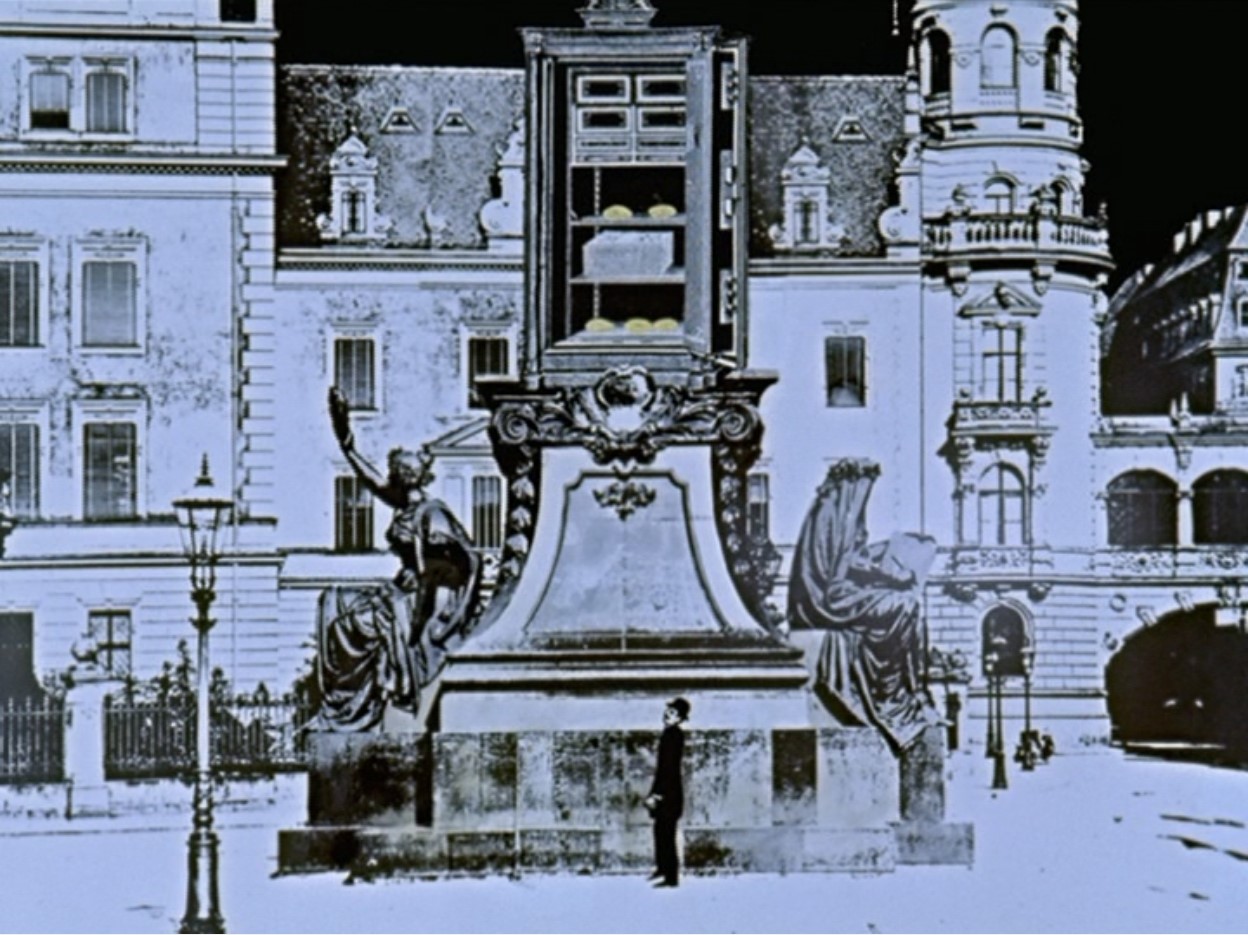
Jan Lenica’s world is based on partly colored old photographs and engravings. His animation is emblematic, but at one point we surely feel the man’s fear, as he tries to flee from his oppressors. The surrealist atmosphere is enhanced by Jan Radlicz’s sound design and by Włodzimierz Kotoński’s score.
Watch ‘Labirynt’ yourself and tell me what you think:
‘Labirynt’ is available on the DVD-set ‘Anthology of Polish Animated Film’
Director:Chuck Jones Release date: November 30, 1963 Stars: Bugs Bunny Rating: ★ Review:
‘Transylvania 6-5000’ is one of those late Warner Bros. Cartoons, which are equally beautiful to look at as they are boring to watch.
In this short Bugs Bunny wanted to travel to Pittsburgh, Pennsylvania, only to end up in Transylvania, where he encounters a vampire with the name Count Bloodcount.
The cartoon is very talkative, and features an annoying female two-headed bird. Worse are the central gags, which are all constructed around the words Abacadabra, which turn the count into a vampire, and ‘hocus pocus’, which turn him back to a human form, again. These sequences suffer from a lack of inner logic and sloppy timing, and are hardly as funny as intended. Bill Lava’s canned music doesn’t help, either.
Despite its gorgeous settings, one cannot conclude but that the Warner Bros. studio ran out of inspiration and of ideas quickly in the early 1960s, contributing to its own shutdown after only one other cartoon, ‘Señorella and the Glass Huarache‘ (which, incidentally, is more fun than this jaded Bugs Bunny cartoon). And yet, already in 1964 Warner Bros. cartoons appeared again, now produced by the DePatie-Freleng cartoon studio of Pink Panther fame. And thus four more Bugs Bunny cartoon were released in 1964, before the character was retired.
Watch ‘Transylvania 6-5000’ yourself and tell me what you think:
This is Bugs Bunny cartoon No. 164 To the previous Bugs Bunny cartoon: Mad as a Mars Hare To the next Bugs Bunny cartoon: Dumb Patrol
‘Transylvania 6-5000’ is available on the DVD-box ‘Looney Tunes Golden Collection Volume Five’
Director:Chuck Jones Release date: May 20, 1961 Stars: Bugs Bunny, Daffy Duck Rating: ★★ Review:
By the early 1960s the classic age of animated cartoons was clearly over. ‘The Abominable Snow Rabbit’ clearly shows the insipid state of affairs. Although both animation and background art are still top notch, and a delight to watch, the gags are uninspired and stale, and never reach the heights from similar films of the early 1950s.
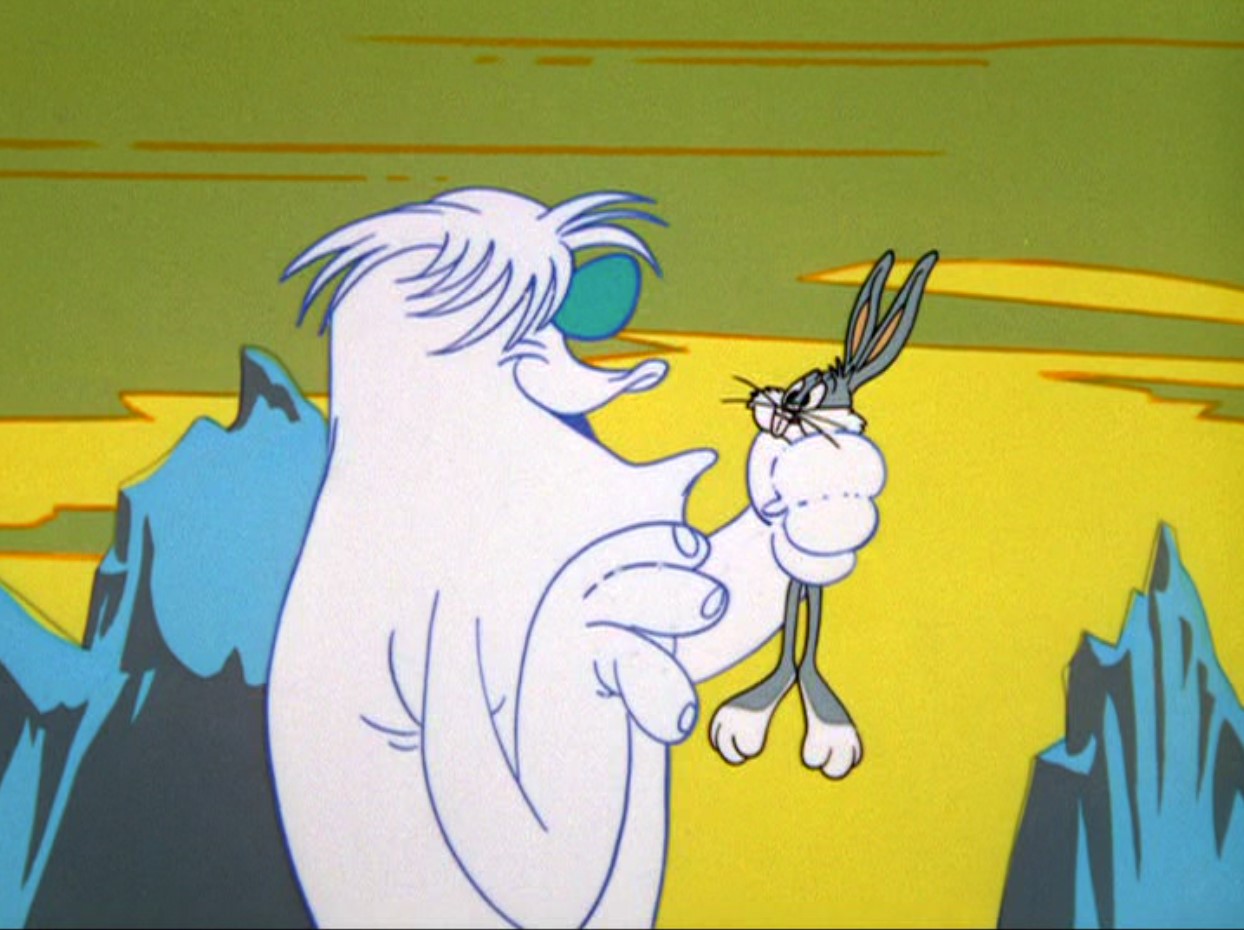
In this cartoon Bugs and Daffy both travel underground, apparently on their way to Palm Springs, only to end up in the Himalayas, where they encounter a very cartoony and blue-nosed abominable Snowman. The Snowman is a late addition to a plethora of characters based on Lon Cheney’s depiction of Lenny in ‘Of Mice and Men’ from 1939, without adding anything. Apart from the jaded gags, the cartoon suffers from a large amount of dialogue, rendering the cartoon almost like the “illustrated radio” Chuck Jones detested in contemporary television animation.
Watch ‘The Abominable Snow Rabbit’ yourself and tell me what you think:
Director:Denis Do Release date: June 11, 2018 Rating: ★★★½ Review:
‘Funan’ is a film by Denis Do, a French film maker of Cambodian descent, and the film is partly based on the memories of his own mother.
‘Funan’ means ‘the new people’ in the Khmer language, and this is an apt description of the radical ideology of the Khmer Rouge, an extreme communist movement that took power in Cambodia from 1975 to 1979, only to plunge the nation in one of the severest mass killings in human history, with the ultimate goal to rise as a ‘new nation’ of autarkic, non-intellectual people.
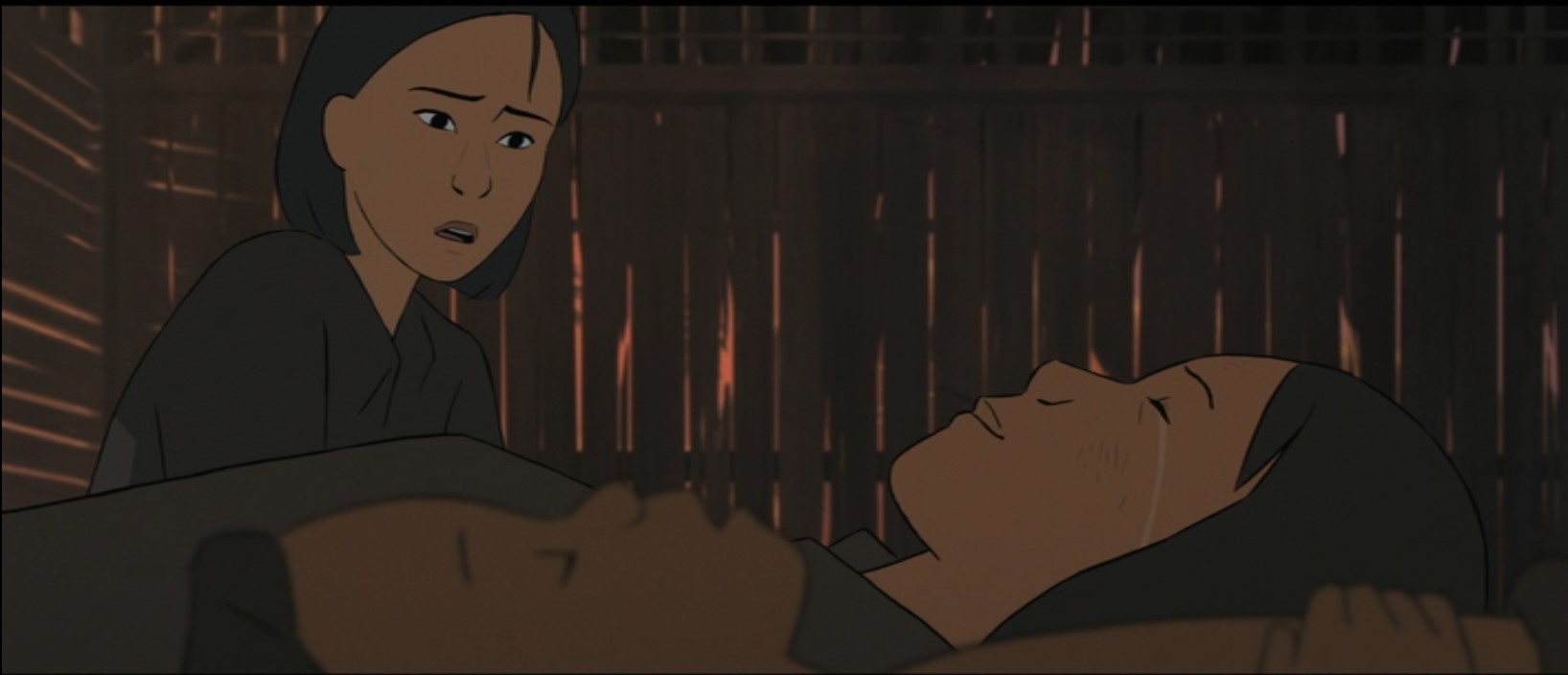
‘Funan’ thus tells about Cambodia’s darkest years, and does so by following one family from Phnom Penh, which almost immediately falls apart, and which succumbs one by one to various aspects of the terror, be it brutal murder, forced labor, famine or rape. We especially follow a couple, Chou and Khuon, and their son Sovanh, who gets separated from his parents near the start of the film.
Luckily, the film eschews gross images, keeping the watch tolerable, but strangely enough, this also means one feels the hardship and sorrow less than one should. The film’s rather episodic nature certainly doesn’t help, and one has a little trouble relating to these people, perhaps because they aren’t introduced very well (the happy bliss of pre-Khmer rouge existence is shown all too shortly), and because the film is told in a plethora of very short scenes, instead of a few well-chosen longer ones. Especially Sovanh’s story is too fragmentary to follow, and his experiences are only hinted at, although it’s clear that the young boy sees a lot of cruelty and death.
The 2D animation is fair, with the human character designs rooted in the French ligne claire tradition, while the background is painted and lineless. Both coloring and lighting are clearly digitally done, and to be frank, rather uninteresting.
I suspect the film could be more daring and more idiosyncratic in its designs and storytelling, especially when compared to Elsa Duhamel’s similar, but far more interesting short ‘Bach-Hong’, which tells of the coming of the communists to Saigon, Vietnam. Duhamel cleverly sticks to a single story, illustrating the regime’s cruelty by one, ostensibly minor detail in the nation’s history.
Do, on the other hand, seems to want to tell everything, and indeed he succeeds in painting a picture of these black years, but I suspect he had better chosen less scenes, and less characters, for now, unfortunately, the film remains at an emotional distance, and that can hardly be the film maker’s purpose. Yet, I am glad personal films like this are being made, for films like ‘Funan’ save tragedies like that of Cambodia from oblivion, and remind us that peace and safety aren’t guaranteed, at all.
Watch the trailer for ‘Funan’ yourself and tell me what you think:
Director:Mamoru Hosoda Release date: May 16, 2018 Rating: ★★★ Review:
‘Mirai’ was the third feature film Mamoru Hosoda made for his own studio, Studio Chizu. Hosoda favors rather episodic films about growing up, and ‘Mirai’ is no exception, although the film takes place in a much smaller time frame than ‘Wolf Children’ or ‘The Boy and the Beast’.
Main protagonist of the film is ca. four-year-old boy Kun, who lives in a design house in Yokohama (the town is depicted regularly during the film in swooping bird-eye’s view shots), but more importantly, who gets a baby sister, the Mirai from the title. Mirai also means future, and in fact, the Japanese title is ‘Mirai no Mirai’, or ‘Mirai from the future’. Indeed, Kun meets an older version of his younger sister from the future, as well as some other characters, while he struggles to adapt to the new situation he finds himself in.
Because with the coming of little Mirai a lot changes for the young boy: his parents have less attention for him, focusing more on the new baby, they’re more often tired and crabby, and they struggle with combining working and caring, now there are two children around. Needless to say, Kun has a hard time getting adjusted, and even gets jealous of his innocent baby sister.
The film focuses on some key scenes, in which Kun experiences a setback, at least in his own mind, and then something magical happens in the little courtyard of his house. First the little boy first meets a humanized form of the family dog, and then his younger sister in older form (there’s more, but I won’t spoil it here).
Unfortunately, Hosoda doesn’t stick to the boy-sister relationship, and at some point, the magic scenes also help Kun overcome his fears. Moreover, a four-year-old is a difficult and questionable protagonist of a film that wants to show the hero’s progress. After all, he is just a little boy. It’s little surprising that Hosoda spends considerable time on Kun’s parents, and their development during this crucial part of their lives. And, indeed, to be frank, Hosoda’s honest depiction of the hardships of young parenthood and of raising one’s own children is much more interesting than Kun’s ‘development’ of character.
Main attraction of the film are the five magical scenes, with the first two showing some broad comedy, as the man-dog and Mirai from the future roam around the house. The third and fourth start to feel obligatory, even though the fourth has a nice nostalgic feel to it. But with the fifth, Hosoda goes completely overboard, and one wonders why these nightmarish scenes, taking the film to a altogether other atmosphere, were even necessary. In fact, this finale, in which Hosoda wants to tell us something about family ties, is too overtly self-explanatory and spoils a film that wasn’t perfect to start with.
In fact, ‘Mirai’ drags a little, being mostly confined to the small space of Kun’s house and with Kun’s development of character as an important, but very weak story device. The film’s episodic nature doesn’t really help, spreading the story thin, a problem that also invades ‘Wolf Children’ and ‘The Boy and the Beast’. I wish Hosoda was able to keep his use of time as tight as his use of space in this movie. ‘Mirai’ is not a failure, the film is too original for that, but it’s arguably Hosoda’s weakest feature film so far, never reaching the emotional heights of either ‘Wolf Children’, ‘The Boy and the Beast’ or even his debut film, ‘The Girl Who Leapt Through Time’ from 2006.
Watch the trailer for ‘Mirai’ yourself and tell me what you think:
Director:Mari Okada Release date: February 24, 2018 Rating: ★★★ Review:
The Japanese animation industry apparently is so rich that new interesting films can pop up seemingly out of nowhere. For example, ‘Maquia: When the Promised Flower Blooms’ (from now on ‘Maquia’) is made by the P.A. Works studio, which since its founding in 2000 focused on television series, and which only made four feature films, the first being based on a video game, the second made for television, the third for training purposes, and the fourth based on a television series.
So, their fifth feature film to be a completely original story, not based on a video game, television series or even a manga, comes as a surprise. It seems that ‘Maquia’ was the pet project by its director Mari Okada, who wrote the story herself. Okada, apparently is somewhat of a modern legend as she has written for over fifty television series since 2001, and is called by Wikipedia “one of the most prolific writers currently working in the anime industry”. She’s one of the brains behind ‘Anohana: The Flower We Saw That Day’ (2011), one of only two anime television series I have watched, and it comes to no surprise to me that the ‘Maquia’s’ story style has something in common with that series. Both series and film have a strong focus on human drama, with emotions reigning uncontrolled, and tears flowing frequently. In fact, despite the high fantasy setting, ‘Maquia’ has a strong element of melodrama, and the rather forced emotions, so different from the more restrained style in studio Ghibli, or the films by Yasujirō Ozu for that matter, actually made it harder for me to relate with these people.
‘Maquia’ is a fantasy film, set in a rather Middle Earth-like world, and starts with the depiction of a society of near-immortals called Lorphs, whose surroundings are particularly like the depictions of elven kingdoms in Peter Jackson’s adaptation of The Lord of the Rings. These Lorphs write their memories by weaving cloths and live far away from more mortal men. One of these, a young girl called Maquia (from which the English film title takes its name) rather out of nowhere complaints she is so alone. Shortly after this scene of distress the eternal city is attacked by an army of men, and Maquia soon finds herself in the outside world, where she adopts a baby, whose mother is killed.
From then on, the film takes an episodic nature, showing us various stages of the mother-son relationship until the son, whom Maquia calls Ariel, has matured, while his mother, in contrast, has retained the same teen appearance she had in the beginning.
The film apparently tries to say something about how to love is to lose and to let go, how to find beauty in the short lives we have, and how relationships form the most important part of life, but the film’s messages get deluded in a rather complex story, in which we do not only follow Maquia, but also her childhood friend Leilia, who is forced to become a queen by her abductors, the captain who destroyed the Lorph city in the first place and one Lang, a boy/man with whom Maquia spent her first years in the mortal world. The bigger story, and all its subplots are far less interesting than Maquia’s relationship to her adopted son, and both prolong and distract the film unnecessarily.
Apart from being unfocused and very, very emotional, ‘Maquia’ is also hampered by an overblown score by Kenji Kawai, all too forcefully guiding the viewer in which emotion to feel. Even worse, are the rather lazy and utterly generic human designs, which nowhere transcend your average anime television series. The animation, too, is fair, but not outstanding. There’s also a small dose of computer animation that is used sparingly and effectively. No, the film’s highlights are not the story, music, character designs or the animation, but the background art and the lighting, which are both no less than magnificent, and which both give ‘Maquia’ a splendor that make the film a delight to watch, even when the characters and events themselves don’t.
I like ‘Maquia’ being an original story, and its theme of what it means to be (im)mortal is interesting, but the film is too long, too episodic, too meandering and too dramatic to entertain, and I am pretty sure in the end I will not remember either the film’s story or its characters, but the beautiful background art and superb lighting, which the make the film a standout, after all.
Watch the trailer for ‘Maquia: When the Promised Flower Blooms’ yourself and tell me what you think:
‘Maquia: When the Promised Flower Blooms’ is avaiable on Blu-Ray and DVD
Director:Jan Švankmajer Release date: January 26, 2018 Rating: ★★ Review:
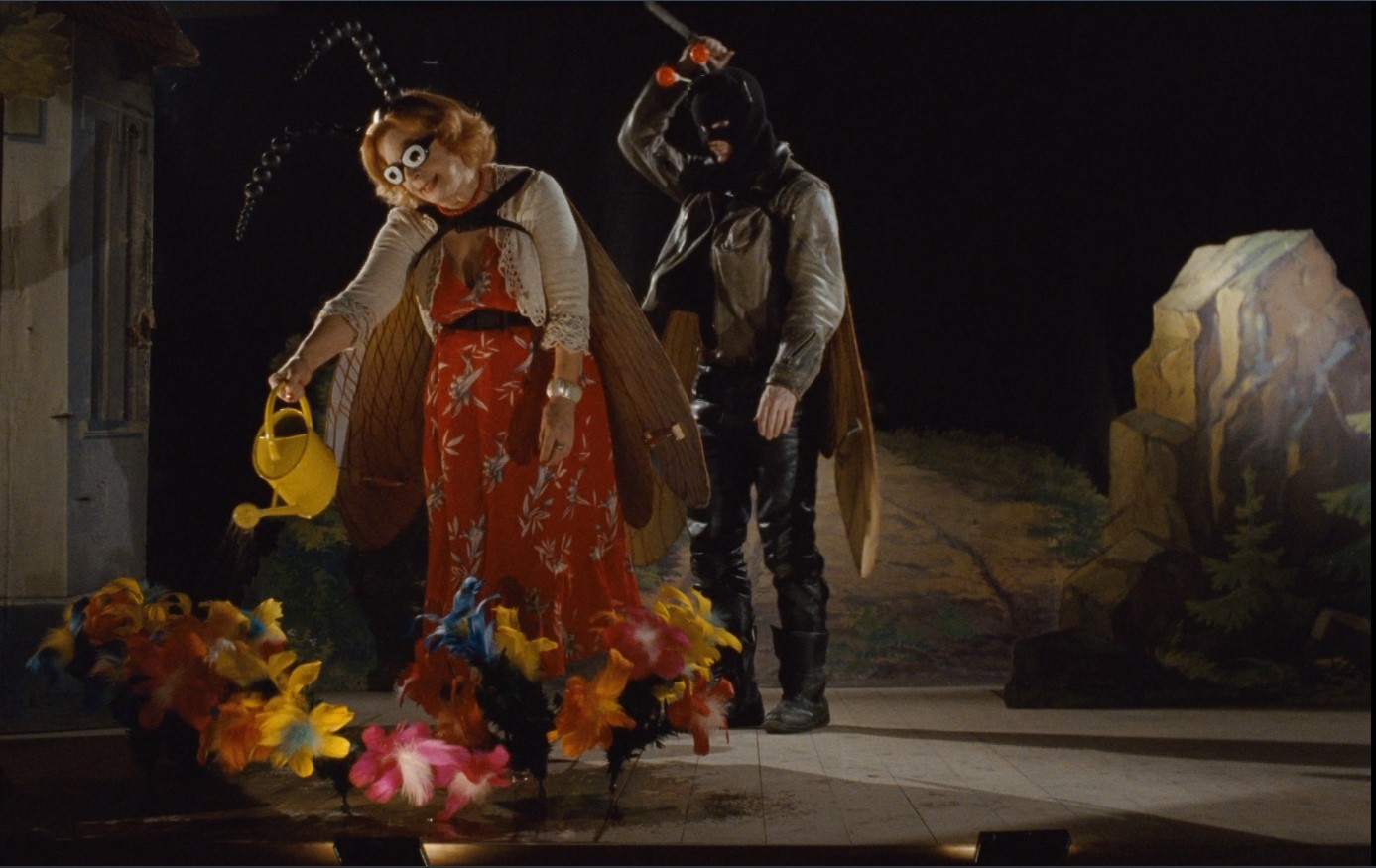
‘Insect’ is Jan Švankmajer’s last film. Even though at the time of writing the Czech master of surrealist cinema is still alive, he announced this film as such. It sure was a difficult film to make, as even crowdfunding was needed to finish the movie.
Unfortunately, the film is not a grand finale to Švankmajer’s glorious oeuvre. Sure, the film’s main story is interesting enough and shows all elements of the Czech director’s idiosyncratic style: surrealist events, morbid humor, extreme close-ups, claustrophobic spaces, a preoccupation with food, and even a splash of stop-motion and cut-out animation, rarely seen since the 1980’s.
In this story an amateur company rehearses the 1921 play ‘Pictures from the Insects’ Life’ by the Čapek brothers. Only part of the troupe is present, and the film features only six characters, who are cramped into a dark, poorly lit space, which give the film an eerie feeling the actors are trapped like insects themselves. Four actors are bullied by an overt ambitious director, while the sixth sleeps through most of the rehearsal. While the inapt actors act out a few scenes from the play, strange events start happening, like insects appearing everywhere, and a dummy coming to life, and several of the actors don’t live through the end of the rehearsing.
This story shows a strong unity of time and space, and is told by Švankmajer with gusto, while his actors delight in portraying the clumsy actors, one even worse on the stage than the other. The actor’s antics are often accompanied by the beginning of Bedřich Smetana’s overture to ‘The Bartered Bride’ (1866), the lively sounds of which contrast heavily with the bad acting on the stage. The sound design, too, is excellent, with its well-chosen unpleasant sounds, as of crawling insects.
However, apparently this main story wasn’t enough material to fill a complete feature length film, and thus the action is constantly interrupted by behind-the-scene footage, showing how the film was made, as well as the real actors telling about their dreams. These scenes often reveal the tricks involved in the film making, and thus spoil the fun of the surrealist main story. But more importantly, they greatly disrupt the main narrative, and the viewer is constantly thrown in and out of the story, which makes the film a frustrating watch, indeed. This choice of adding an extra layer to the film actually makes it a weaker product than it could have been, and although it’s nice to watch Jan Švankmajer at work, it makes the film a sad farewell to his illustrious career.
Watch the trailer for ‘Insect’ yourself and tell me what you think:
Director:Wes Anderson Release date: February 15, 2018 Rating: ★★★★★ Review:
The 21st century saw a few live action directors and film makers crossing over to animation, often with original films that were welcome deviations from the standard family fare of Pixar, Dreamworks, Sony, Illumination and the like. One of these directors was Wes Anderson, whose live action films already have a very distinct flavor, let alone his animation work.
In 2009 Wes Anderson brought us ‘Fantastic Mr. Fox’, his own quirky take of the classic children’s book by Roald Dahl, adding some ‘The Royal Tenenbaums’-like flavor to it. It seemed a one off, like all other animation adventures by live action directors, but in 2018 Wes Anderson surprised everyone by making yet another animation movie, this time with a completely original story of his own.
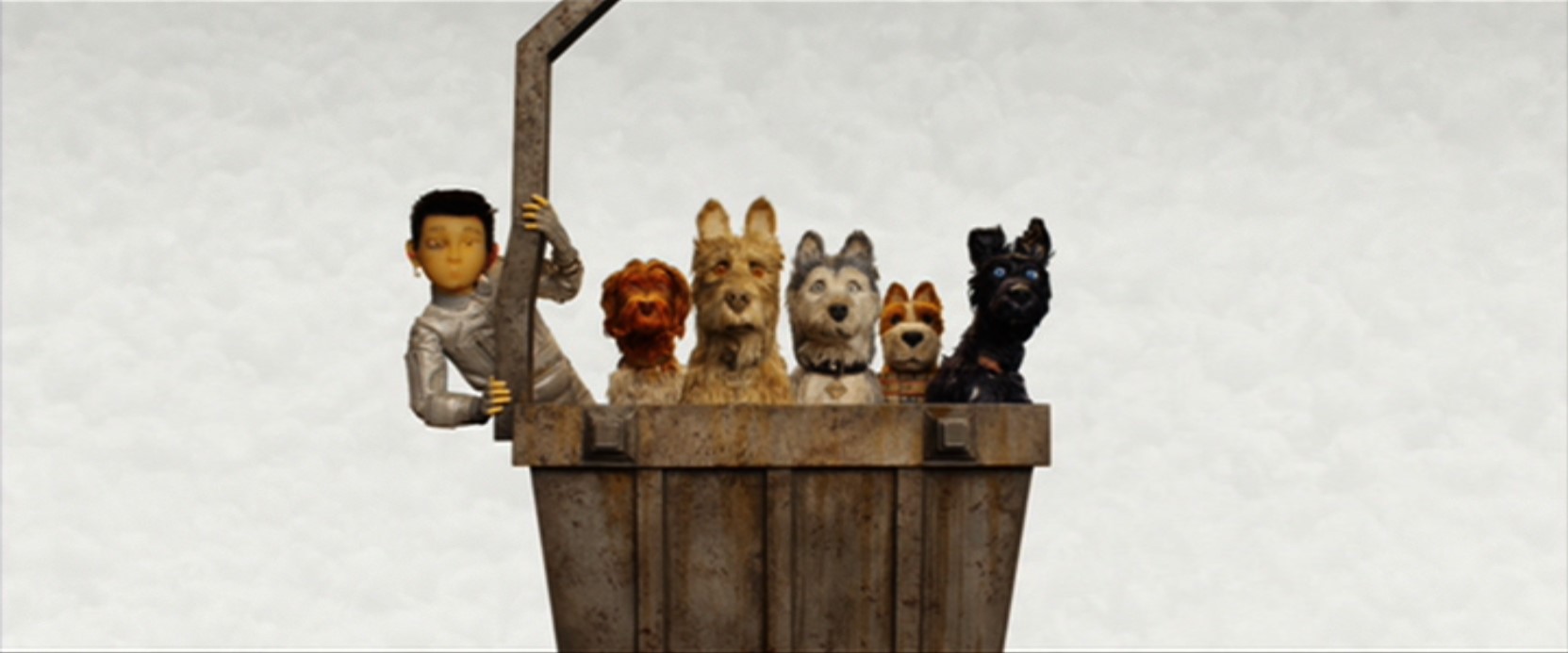
‘Isle of Dogs’ is a sort of fantasy-dystopia film set in Japan. Surprisingly, much of the dialogue is in Japanese, and not always translated, adding to the film’s idiosyncrasy. The film tells about the cat-loving Kobayashi clan who wants to get rid of all the dogs. When a Kobayashi mayor gets into power in the fictive town of Megasaki, he banishes all dogs to a garbage dump island…
The film knows quite a lot human characters, but uses mostly a dog-viewpoint and is even narrated by a dog (voiced by Courtney B. Vance). The film focuses on a stray dog called Chief, whose life changes when a young boy arrives on the island, looking for his own former pet, Spots.
Where all other film makers would make the boy and the dogs be able to talk with each other, Anderson keeps their languages strictly separated, with the dogs not getting a thing the boy says, and vice versa. As the boy speaks Japanese, we, the audience, too, cannot always follow what the boy tries to say – a bold move.
The dog communication is all in English, and Anderson makes use of a lot of familiar names to voice his animated creatures, like Edward Norton, Jeff Goldblum, Bill Murray and Scarlett Johansson, just to name a few. Even Yoko Ono has a small role as a scientist of the same name.
Like ‘Fantastic Mr. Fox’ ‘Isle of Dogs’ is a stop motion film, and a very virtuoso one, too. The animation, directed by Mark Waring, is superb throughout and there are crowd scenes with tens to hundreds of puppets, and both dog and human characters are very intricately designed. Like in Anderson’s first animated film, all animals have a rather scruffy look, giving the film a very individual look. There are some typical quirks in the animation, like dogs sneezing at random moments. I also like Anderson’s use of cartoony fight clouds. As far as I know he’s the first to use those in a stop-motion film.
As with his other films Anderson employs a very typical use of the camera, often showing symmetrical images, and sometimes using close ups in a rather Spaghetti Western-like fashion. There’s also a little 2D animation to depict events on television. The background art, too, is unique. Apart from elaborate sets, the film uses rather flat background art, with a typical cut-out look. The quasi-Japanese score by Alexandre Desplat, an Anderson favorite, adds to the film’s unique atmosphere.
The film’s story says something about populism, and how misleading information can lead to unjust decisions, but the film is too silly to emphasize this point. Likewise, the film’s heart lies with Chief, but much more interesting than his development are the dry dialogues, and the running gag of one dog hearing a rumor the others never heard of. In fact, apart from the film’s looks, the dialogues form the film’s main attraction, as they are often very funny.
Unfortunately, the film’s finale is not the best part, and the defeat of the villains a little too easy, but otherwise ‘Isle of Dogs’ is a real treat, and with its unique style a very welcome diversion from the often run-of-the-mill fare of American studio animation.
Watch the trailer for ‘Isle of Dogs’ yourself and tell me what you think:
Director:Nick Park Release date: January 20, 2018 Rating: ★★ Review:
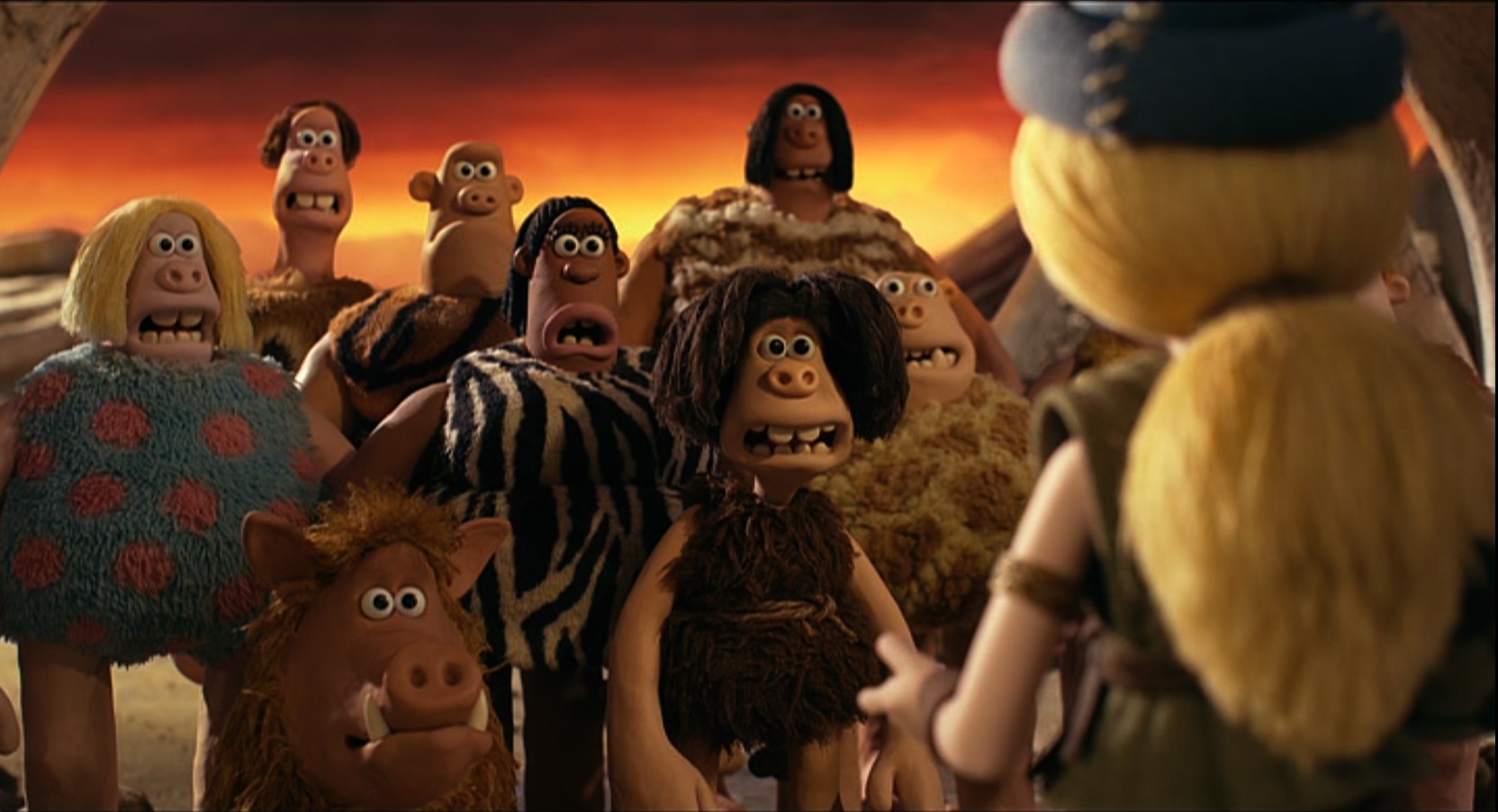
In ‘Early Man’ some cavemen have to play a soccer match to save their village from oblivion.‘Early Man’ was Aardman’s seventh feature film, and the fifth using the studio’s trademark Claymation, but when compared to the wonderful movies ‘Wallace & Gromit: The Curse of the Were-Rabbit’ (2005) or ‘Shaun the Sheep Movie’ (2015) ‘Early Man’ is frustratingly lackluster.
Sure, the film is wonderfully made, and clearly with a lot of love, and has the charm of fingerprints being visible on the clay puppets. Moreover, by now, the Aardman studio clearly makes its animation style look easy. Then there are the typical Aardman quirks, like the way replays are shown, or some funny side remarks, the best of which is “Sliced bread? That’s the best thing since… well, ever!”. I particularly liked the idea of the message bird, which not only repeats all that is said to him, but all the accompanying actions, as well. These little touches at times made me laugh out loud.
Unfortunately, the story is not half as good: it’s one long sum of cliches, never venturing into new or surprising story ideas, making the film surprisingly dull. Especially, the football match ticks all the familiar boxes of the sports film, and there are team effort scenes and unconventional training scheme scenes as we had seen already a thousand times, most recently in ‘Kung Fu Panda 3’ (2016) and ‘Cars 3’ (2017), which were both also frustrating affairs story-wise. The characters, too, are in no sense original, and feel emblematical, instead of rounded. Even the main hero Dug is appallingly onedimensional.
As said, ‘Early Man’ especially follows the sports film trope of the underdog winning against all odds but it does so in the laziest way. For example, at one point Goona makes clear to the cavemen that they may have a chance because they can be a team while their opponents are just a bunch of individuals. Now, there’s a chance to make the cavemen’s win believable. And what is done with this idea? Absolutely nothing. As soon as the real match starts, the so-called big difference between the behavior of the star players and the cavemen team on the field disappears. It’s disheartening to watch this saving element being left unused.
The world-building, too, leaves a lot to be desired. ‘Early Man’ doesn’t really play in the stone age, or the bronze age, or whatever. It is set in some fantasy sword-and-sorcery world with bare rocks and active volcanoes. Even the time period of the prologue makes no sense, set in the non-existing ‘Neo-Pleistocene’ and showing us cavemen living next to dinosaurs (in a nice little nod to Willis O’Brien, although the two creatures were apparently called Ray and Harry after that other great stop motion monster animator, Ray Harryhausen).
By the time the main story starts, the dinosaurs have disappeared, but some Flintstones-like gags remain, like little crocodiles as clothespins and a beetle as an electric razor. But then the studio adds some creatures that in no world make any sense whatsoever, like a giant woodlouse, a giant spider, a giant duck with teeth and some giant caterpillars. With these the film makers lost all consistency and believability of a world that was rather shaky to start with.
For example, the only green spot in this world is where ages ago a meteorite struck, but it’s in this world the cavemen live. How the other people survived in the highly hostile environment of the rest of the planet remains an utter mystery. It doesn’t help that most of this world is rendered in the ugliest and laziest computer animation, which contrasts greatly with the fine Claymation.
It seems the film makers too much wanted to make a football (soccer) movie, and got blind for the film’s flaws, which are instantly recognizable to any viewer. Instead, they should have thought things over, both about their story and their world, because the final film is a formulaic drag, and, not surprisingly, became a box office bomb.
Watch the trailer for ‘Early Man’ yourself and tell me what you think:
Director:Sarah Smith Release date: November 11, 2011 Rating: ★★½ Review:
After making ‘Flushed Away’ (2006) in cooperation with Dreamworks, the British animation studio Aardman made another computer animated film, this time in cooperation with Sony, as part of a three year contract with the American production company. Upon its release ‘Arthur Christmas’ was a box office success, but since then it has rather went into oblivion, and I can see why, because the film unfortunately is a flawed one.
In the world of ‘Arthur Christmas’ Father Christmas is not an eternal figure, but a dynasty, with Santa Clauses succeeding each other in time. The film tells about Arthur, whose father is the current Santa Claus, but whose mission are much controlled by his son, Arthur’s elder brother Steve, with military precision. In contrast, Arthur is clumsy, cowardly, afraid of heights and thus totally useless to the Santa Claus clan. Or is he? When, despite all military precision, one present is not delivered, Arthur comes into action.
I’ve once read an article in which someone from Aardman complained that ‘Arthur Christmas’ was not even nominated for an Academy Award, blaming it on the fact that their film was overlooked because it was a holiday film. But the truth is, ‘Arthur Christmas’ is just not that good.
The film’s characters aren’t that sympathetic. The current Santa is as incapable, as he is irresponsible. His son Steve is more ambitious than he is caring, and Arthur may have his heart in the right place, he stumbles through most of the film, which is rather tiring to watch. The finale, in which all elder Santa Clauses realize Arthur’s worth, feels forced and obligatory, and one hardly believes Arthur’s clumsy days are now over.
But the film’s biggest problem is its lack of originality. The film lacks the quirky charm of the British studio’s stop motion work (there are some nice touches here and there, like a wobbly toy on Grandsanta’s sleigh, but these are rare). And despite the British voice cast and mostly European setting, the film feels very, very American. Plot-wise the film ticks all familiar boxes, without straining from tried paths.
Moreover, the designs are erratic and inconsistent: the humans are all cartoony, but the reindeer have realistic designs, and the film features some pretty ugly lions. In fact, the film is utterly unrecognizable as an Aardman product, the only feature film in their catalogue being so generic and bland in its looks.
Luckily, ‘Arthur Christmas’ would be Aardman’s last computer animated movie. With their next project the studio returned to more familiar and much more satisfying waters with ‘The Pirates! In an Adventure with Scientists!’ (2012).
Watch the trailer for ‘Arthur Christmas’ yourself and tell me what you think:
‘Arthur Christmas’ is available on Blu-Ray and DVD
Director:Nina Paley Release date: February 11, 2008 Rating: ★★★★★ Review:
Unlike the European and Japanese animation field, the American animation studio system is unkind to author films. Walt Disney’s ‘Lilo & Stitch’ (Chris Sanders, 2002) probably comes closest, apart from several feature films based on animated television series. Thankfully, some individual artists have filled this gap, most notably Bill Plympton, releasing no less than seven features. Other notable artists are Don Hertzfeldt (‘It’s Such a Beautiful Day’ from 2012), and Nina Paley. Amazingly, all these artists mostly work totally alone, which makes their accomplishments even more stunning.
Nina Paley ‘Sita Sings the Blues’ for example, is written, directed and produced by Paley alone, which took her five to six years, and which could only be finished with help from crowd-funding, being one of the first animated projects to use this type of fund raising.
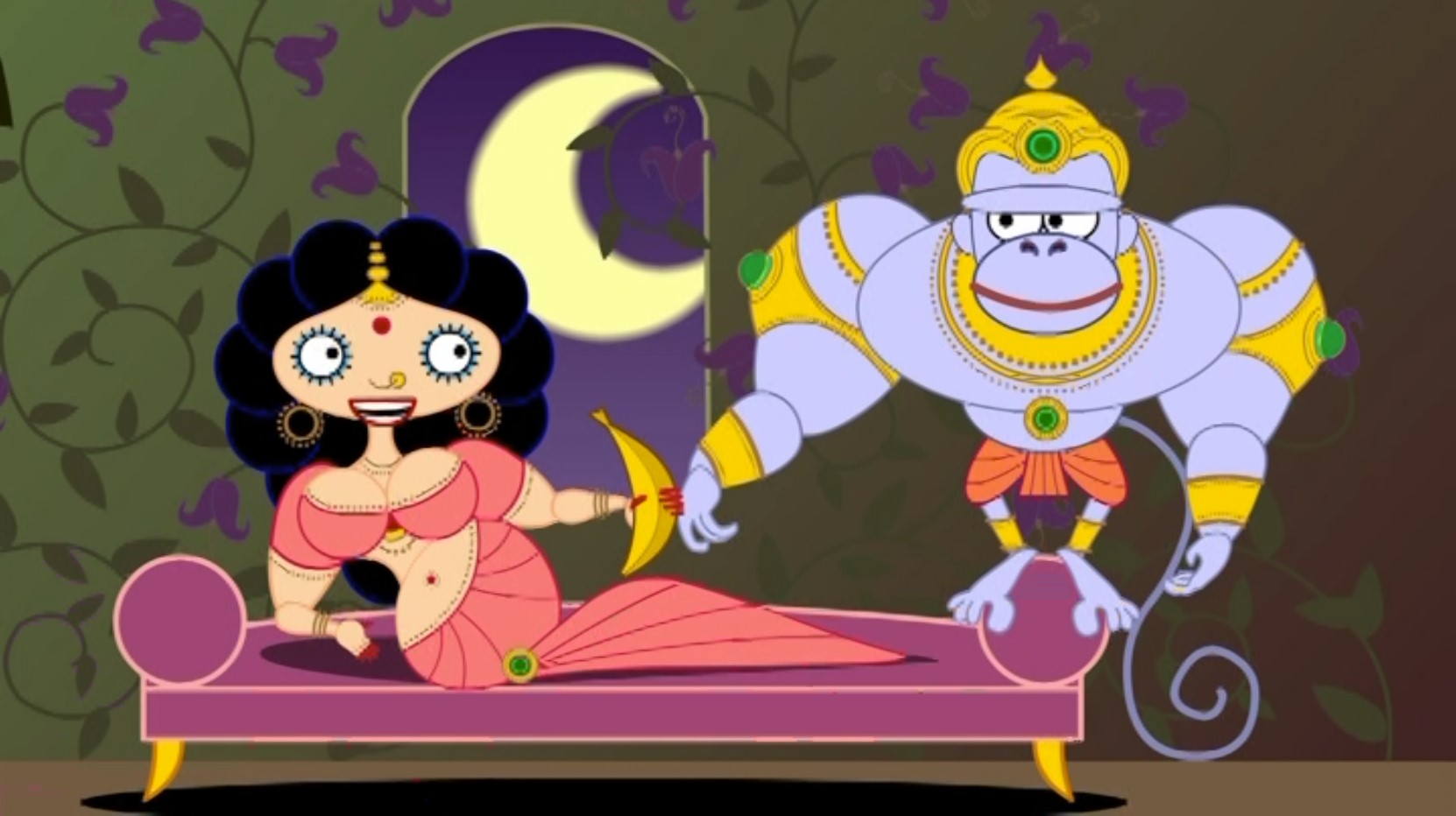
‘Sita Sings the Blues’ retells the Indian epic ‘The Ramayana’, but it’s also a personal film, in which Paley links her own situation to that of Sita, the perfect wife to the hero Rama. The most incongruous element are the eleven songs by 1920s jazz singer Annette Hanshaw, an artist sadly almost forgotten, whom Paley had discovered prior to the film making. The linking of these sweet and gentle tin pan alley songs to the Ramayana is as odd as it is effective, and the pairing certainly contributes to the uniqueness of the film.
The film uses several different animation styles: Nina Paley’s own personal story is told in a traditional scribbly animation style, with sets based on photographic material. These parts are the least attractive of the lot, even though Paley shows to be a very able animator in this classic cartoon style. The Ramayana is retold by three Indians (Aseem Chhabra, Bhavana Nagulapally and Manish Acharya) who are depicted as traditional shadow puppets of Hanuman, Sita, and Rama, respectively. The story they are telling together is shown in tongue-in-cheek cut-out animation.
The ‘official’ story is also told in cut-out animation, using very attractive recreations of traditional Indian paintings. But the best parts to look at are the songs, which are done in a most attractive cartoon modern design. In these song parts Paley reuses a lot of animation cycles, but actually she makes excellent use of the flash medium, and she makes the most of her limited animation.
Apart from these five alternating styles, there’s also a short sequence using rotoscope and a much more pop-art influenced videoclip-like filming style. All these are apparently done in Macromedia flash.
As said, ‘Sita Sings the Blues’ retells the Ramayana, reducing the huge epic to its barest elements. For example, Lakshmana is hardly mentioned, and the monkey king Sugriva not at all. Moreover, unlike the traditional poem, the focus is on Sita, not Rama, and Paley highlights the questionable parts from the original poem (one at the end of the Yuddha Kanda, and another in the Uttara Kanda), in which Rama treats Sita very unfairly indeed, just like Paley’s own partner does in real life. This makes ‘Sita Sings the Blues’ a feminist film, which sheds a welcome critical light on the traditional depiction and treatment of women, then and now.
As the story is told by three people, who remember the story differently and interpret it in different ways, this leads to some very funny moments. But Paley adds some humor, too, in the ‘official’ story part, for example when the female rakshasa (a sort of demon) Shurpanakha tells her brother Ravana about the beauty of Sita, comparing all her body parts with lotuses.
As said, the Annette Hanshaw songs boast the most attractive designs, and like traditional opera arias, they shed an emotional light on the events. However, Paley cleverly propels the story forward even during these sequences. Yet, as the songs are featured in their entirety, typically lasting ca. 3 minutes, they also drag the film down. As there are eleven of them, one tends to grow a little weary of them as the film progresses. Nevertheless, ‘Sita Sings the Blues’ does a great job in restoring interest in this almost forgotten singer. Unfortunately, the Hanshaw songs were not free from copyright, causing Paley a lot of trouble, and eventually causing her to release the film completely free from copyright.
The Annette Hanshaw songs are juxtaposed to some Indian pop music, mostly by artist Masaladosa. Particularly strong is the angry song which follows the scene in which Paley gets dumped by email. The complete soundtrack is as attractive as the film’s visual designs, and the two complement each other very well.
In all, ‘Sita Sings the Blues’ is not without its flaws, but as it is made by a single woman, it’s no less than a tour-de-force, and the result is a very interesting personal film, which makes one think. Moreover, the film shows the great power and endless possibilities of animation, and single-handedly puts Paley into the pantheon of the medium’s greats. In 2018 Paley made yet another feature called ‘Seder-Masochism’, which unfortunately has attracted much less attention.
Watch the trailer for ‘Sita Sings the Blues’ yourself and tell me what you think:
The South Park television series was only midway in its third season when its first (and only!) theatrical feature film was released. Thus, the film contains many of the quirks so typical of the earliest seasons but long since forgotten, like Kenny’s obligatory death, Kyle performing the act of ‘kick the baby’ with his little brother Ike or Stan compulsory vomiting on meeting Wendy.
Also prominent are characters that years ago have disappeared from the sitcom like Chef and Mr. Hat. Moreover, Cartman’s personality as a complete and pretty evil ass is not yet defined here, and although he’s already a jerk, he’s just one of the gang here.
The animation, too, retains much more of its cut-out origins than later seasons, although in the feature film the all too primitive animation is juxtaposed to a swirling 3D computer animation, especially in the hell scenes, which gives the film extra grandeur, but which would become more of a style element in later seasons of the series.
The South Park series always was at its best in social commentary, and it that respect, ‘South Park: Bigger, Longer & Uncut’ delivers big time. The film painfully clearly shows America’s obsession to prevent their children to experience anything subversive, except gun violence (incidentally by now the major death cause of American youth). It’s best not to reveal the plot, but it’s enough to know that when the kids go see the new Philip and Terrance movie ‘Asses on Fire’, things quickly go out of hand.
The film also introduces the idea that Terrance and Philip are Canadian, and that all Canadians have disjointed heads and square hands, so the difference between the designs of the main characters and that of their favorite television show turns out not be one of style, but one of ‘nature’. This ridiculous idea is played out well, and was continued in the television series, too.
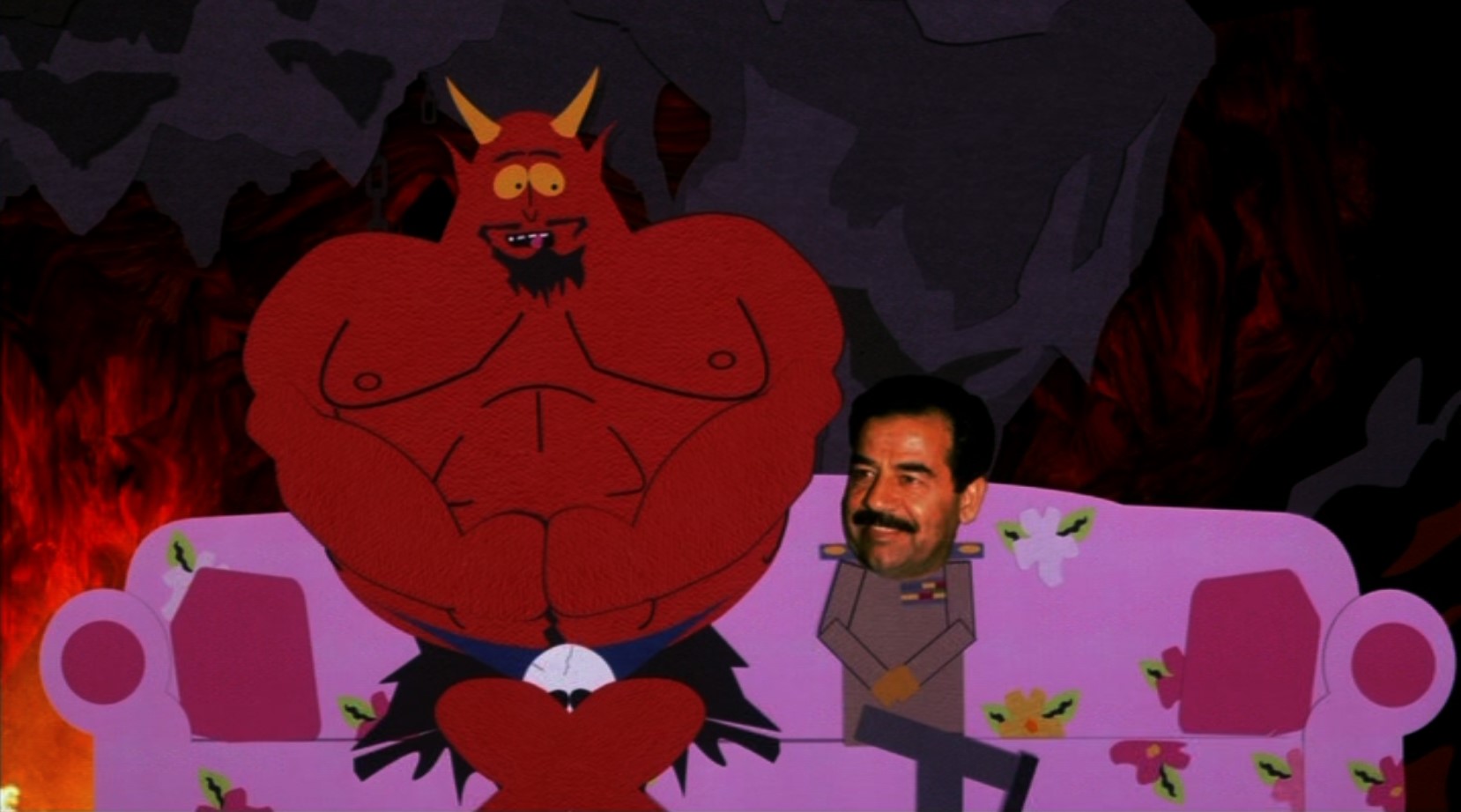
Kenny dies, of course, but for the first time we see what happens to him after his death, and quite a bit of the action takes place in hell, where Satan and Saddam Hussein get involved in the plot. Now, the Iraqi dictator was very much alive back then, and the film is a testimony of the US’ frustration they didn’t remove the villain from the office in the first Gulf War (1990-1991).
Because of Hussein Iraq was included in George Bush jr.’s nonsensical ‘Axis of evil’ (together with its arch enemy Iran), which ultimately lead to the misguided and very questionable invasion of Iraq in 2003. In ‘South Park: Bigger, Longer & Uncut’ Saddam Hussein is shown as being even more evil than Satan himself, dominating the prince of darkness in a toxic relationship. Of course, the inclusion of Saddam Hussein ages the film more than necessary, as do other references to real people, like Brian Boitano (whom I as a non-American had never heard of).
Yet, the biggest surprise of ‘South Park: Bigger, Longer & Uncut’ is not its high level of satire, nor its excellent plot, nor the introduction of elements that would become more familiar later on in the series. No, the biggest surprise of the film is that it is in fact, a musical, and a very good one at that, too. The film literally bursts with songs (there are fourteen of them), all ranging from good to excellent.
It seems Trey Parker knew exactly how to write a musical song: yes, practically all his songs are parodies of musical tropes, but his own creatures have such beautiful and memorable melodies they perfectly stand on their own. Absolutely top are ‘What would Brian Boitano do?’ and Satan’s Jesus Christ Superstar-like ‘Up there’. And then there’s a great musical moment when the Les misérables-like song ‘La résistance’ suddenly gets intermixed by four other songs, including a new one sung by soldiers, and the outstanding ‘Blame Canada’. This latter song, which was introduced much earlier in the film, is the undisputed highlight of the feature and was nominated for an academy award for best original song (which it unjustly lost to the bland ‘You’ll Be in My Heart’ Phil Collins composed for Disney’s ‘Tarzan’).
In fact, ‘South Park: Bigger, Longer & Uncut’ is so good at being a musical that it can easily be counted among the best animated musicals ever. Main composer Trey Parker, at least got on a new career as a musical writer. No, there were no other South Park movies to come, but not only did more and more songs creep into the South Park series itself, but Parker made another musical with the bizarre puppet movie ‘Team America: World Police’ (2004) and even hit Broadway with the stage musical ‘The Book of Mormon’ (2011).
In all, South Park: Bigger, Longer & Uncut’ is great satire, it’s a great musical, and it’s a great proof that feature films based on television series could (and should) be an improvement on the original series.
Watch the trailer for ‘South Park: Bigger, Longer & Uncut’ yourself and tell me what you think:
‘South Park: Bigger, Longer & Uncut’ is available on Blu-Ray and DVD
Director: Norman McLaren Release date: 1972 Rating: ★★ Review:
In the final stages of his career Norman McLaren apparently got interested in ballet, for three of his final films (‘Pas de deux’, ‘Ballet Adagio’ and ‘Narcissus’) are on the movements of ballet dancers.
‘Ballet Adagio’ is the most straightforward of the three: it is a documentary recording of a two and a half minute pas de deux, danced by David and Anna Marie Holmes, played on a quarter speed and set to the faux-Albinoni adagio in G minor by Remo Giazotto.
There’s no trickery, let alone animation involved – it’s just the two dancers on an empty stage doing their thing. Due to the slow motion one gets ample opportunity to watch the sheer virtuosity of the two dancers, the sometimes almost impossible stunts of the two, and their muscle movements. But, as there’s nothing else going on, the result is as fascinating as it is boring. It doesn’t really matter, for the film’s intentions were purely educational, giving ballet students an opportunity to study movement.
Watch ‘Ballet Adagio’ yourself and tell me what you think:
‘Ballet Adagio’ is available on the DVD Box ‘Norman McLaren – The Master’s Edition’
Director: Henry Selick Date: 1977 Rating: ★★★ Review:
Compared to the earlier ‘Tube Tales‘ ‘Phases’ much better shows what Henry Selick was capable of.
This film was made at CalArts and in it Selick shows great command of motion, convincingly animating a human walk cycle, a big cat and a horse, all also in stunning perspective. But even more, the film itself is nice to look at with its poetic metamorphosis of red paints on a black canvas.
Watch ‘Phases’ yourself and tell me what you think:
‘Phases’ is available on the DVD ‘Giants’ First Steps’
Director: John Musker Release date: 1977 Rating: ★★ Review:
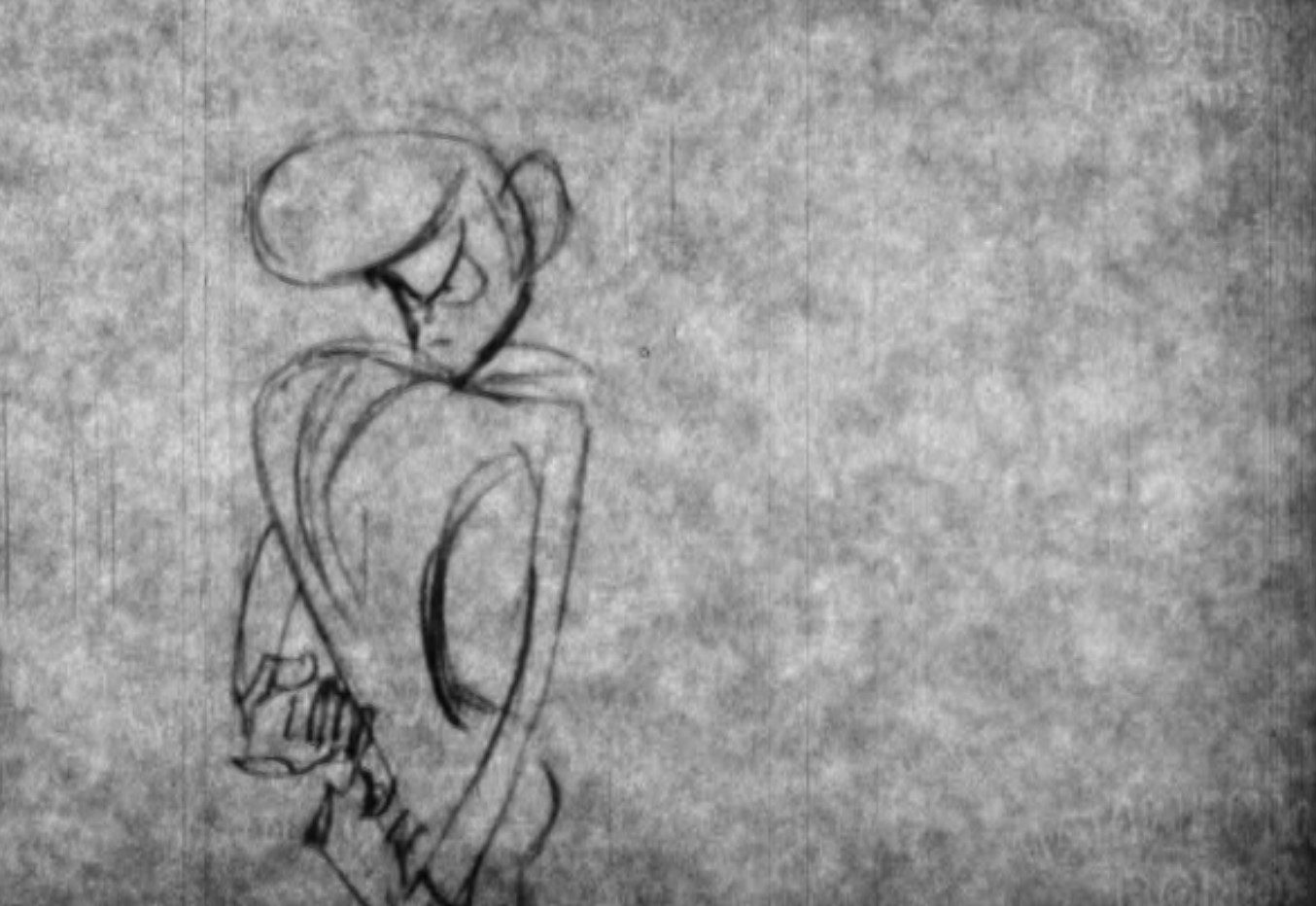
‘Little Darlin” is a short animation film that apparently never transcended the pencil test phase. Made by John Musker (of later e.g. ‘The Little Mermaid, ‘Aladdin’ and ‘Moana’ fame) at CalArts, the film immediately shows Musker’s great talent as an animator. All classic animation techniques can be found in this short film, and all are done with the virtuosity of a great talent.
Unfortunately, the film’s designs and story are much less appealing, and the overacting of all three protagonists is tiresome, not funny.
‘Little Darlin” is available on the DVD ‘Giants’ First Steps’
Director: Henry Selick Date: 1975 Rating: ★ Review:
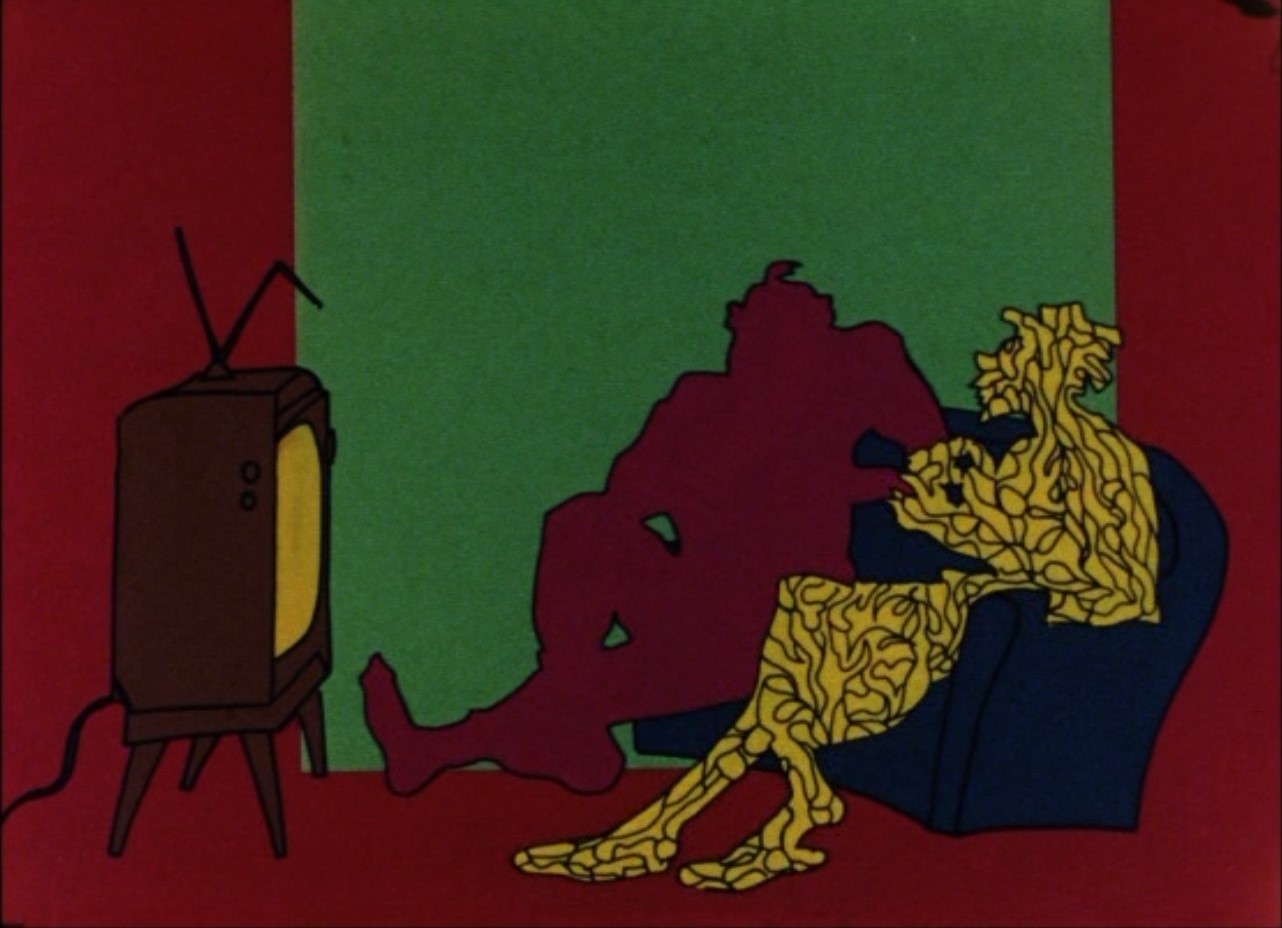
Made by Henry Selick (of later ‘James and the Giant Peach‘ and ‘Coraline’ fame’) at Syracuse University ‘Tube Tales’ is a rather experimental short about the influence of television.
The film features a couple watching a television set, which vomits numerous adverts out on the two. The most idiotic is one on welding. Selick’s designs are angular, and pretty ugly, and with its mere three minutes the short overstays its welcome big time.
Watch ‘Tube Tales’ yourself and tell me what you think:
‘Tube Tales’ is available on the DVD ‘Giants’ First Steps’
Director: Eric Goldberg Date: 1974 Rating: ★★★ Review:
‘Good Old Fashioned Cartoon Violence’ is another gag cartoon made by top animator Eric Goldberg when he was still in his teens.
In this black and white cartoon a cartoon figure watches a Tom & Jerry like violent cartoon on television. Immediately after that, cartoon violence starts happening to him, too. It only ends when the poor guy shoots his creator (a nice self caricature of Goldberg).
This is not really a funny or good cartoon, but Eric Goldberg’s talent is unmistakable.
‘Good Old Fashioned Cartoon Violence’ is available on the DVD ‘Giants’ First Steps’
Director: Eric Goldberg Date: 1973 Rating: ★★★ Review:
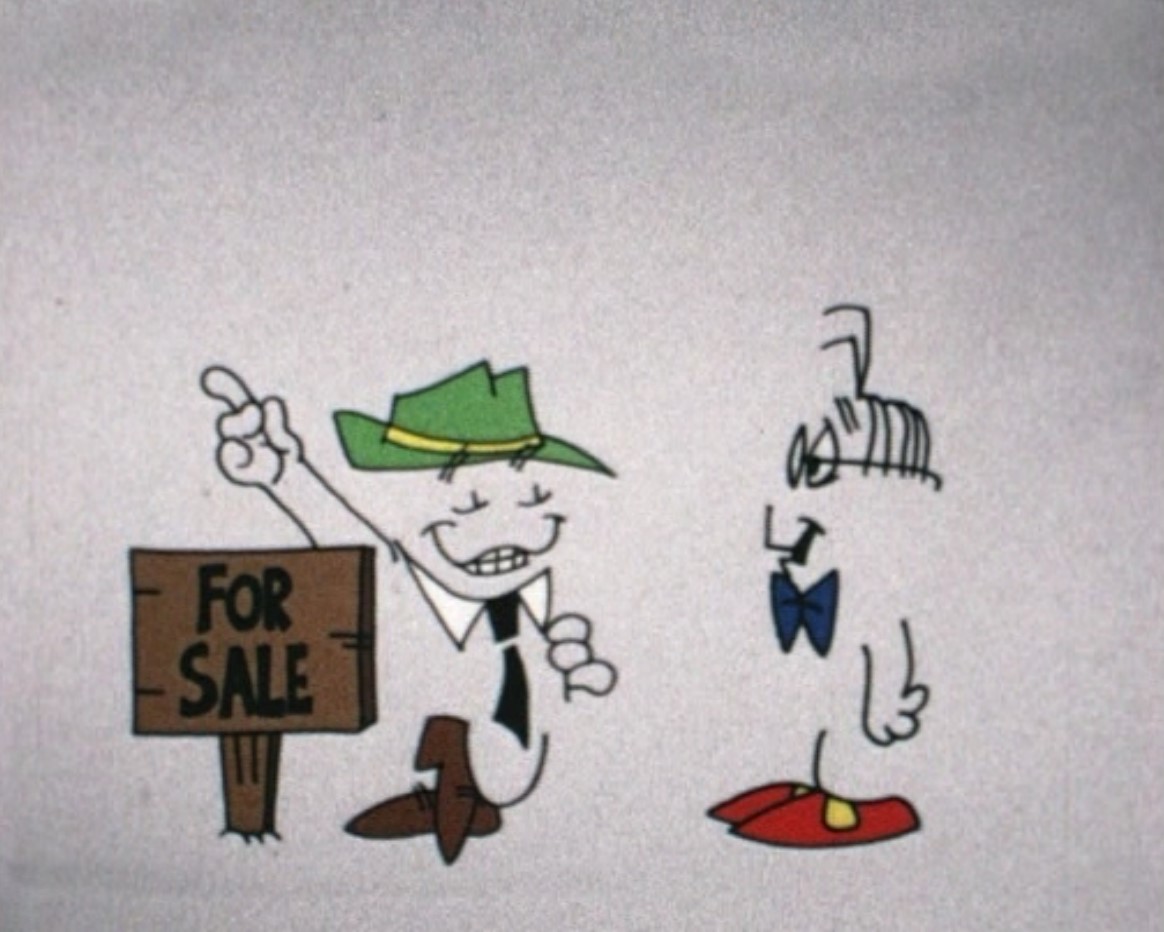
Legendary animator Eric Goldberg made this film when he was only 17 or 18. ‘For Sale’ is a short gag cartoon in which a man pursuits a background which can change into every scenery by snapping one’s fingers.
The main characters are designed with interesting open lines, and Goldberg already demonstrates his skills as an animator. Even the timing is rather good.
‘For Sale’ is available on the DVD ‘Giants’ First Steps’
Director: Ron Clements Date: 1972 Rating: ★★ Review:
Ron Clements, of later e.g. ‘The Little Mermaid’, ‘Aladdin’ and ‘Moana’ fame, turns out to be influenced by cheap television animation in his early short ‘Shades of Sherlock Holmes’.
His cartoon features generic designs, limited animation, a lot of dialogue and a rather Scooby Doo-like plot. Absolutely nothing in this short indicates a great talent, and the film is as generic as it is boring. The bad sound mixing doesn’t help either. Luckily, Clements turned out fine, and became one of the most famous directors in feature animation.
‘Shades of Sherlock Holmes’ is available on the DVD ‘Giants’ First Steps’
Animation Backgrounds
A blog dedicated to background paintings from animation films. Kept until 2016.
Animation Scoop
Animation historian Jerry Beck’s animation film news blog.
Cartoon Brew
Topical blog on animation film, led by animation historian Amid Amidi.
Cartoon Modern
Amid Amidi’s blog on modern design cartoon art from the forties, fifties and sixties.
Cartoon Research
THE site on classic animation research, hosted by cartoon historian Jerry Beck.
Cartoons Theory
Frank Beef analyzes classic cartoons. Kept until 2020.
Century Film Project
Michael reviews films of 100 years old and older, roughly in chronological order.
Classic Cartoons
A similar blog featuring many stills and comic strips. Kept until 2012.
Comet over Hollywood
Jessica Pickens reviews classic Hollywood films, especially musicals.
Deja View
Top ex-Disney animator Andreas Deja’s own blog.
Disney History
Esteemed Disney historian Didier Ghez on the latest books on Disney history.
Feeling Animated
Paul Astell brings us thorough reviews of animated features.
Flickers in Time
Short and to the point reviews of classic films (lately mostly pre-code talkies) by an anonymous retired Foreign Service Officer from California










 Dr. Grob's Animation Review