Director: Nick Park Date: 1978 Rating: ★★★ Review:
The interesting aspect of the DVD ‘Giants’ First Steps’ is that it shows well known animators and animation directors were not always that good. They had to start somewhere, and their early films show where they already succeeded and where they faltered.
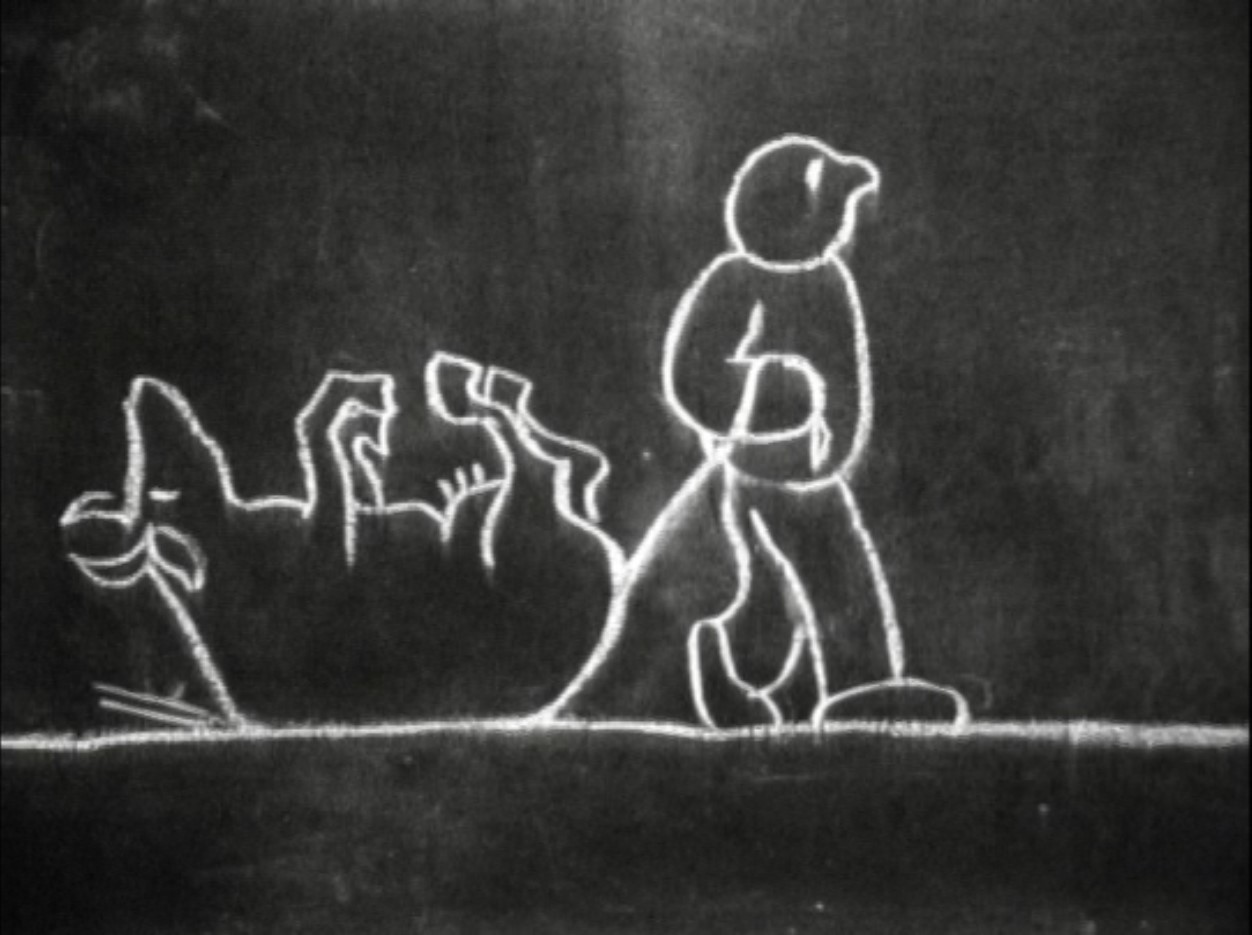
With the charcoal animation of ‘Jack and the Beanstalk’ (made at the Sheffield Art School) Nick Park returns to the very origin of animation, with its earliest films using a blackboard. Nick Park retells the classic fairy tale in an original, stream of consciousness-like manner, with a lot of metamorphosis and weird sound effects.
Even though Park’s animation is crude, the film is pleasantly odd and original throughout. For example, Jack shoots a cow from the sky, and puts in a vending machine to obtain his magic bean, which turns out to be huge. My favorite part is a little guy talking gibberish into a microphone before the titles appear.
Park, of course, would later become world famous with his ‘Creature Comforts’ and Wallace and Gromit films, made at Aardman.
‘Jack and the Beanstalk’ is available on the DVD ‘Giants’ First Steps’
Director: John Lounsberry Release date: December 20, 1974 Stars: Winnie the Pooh, Piglet, Tigger, Rabbit, Kanga, Roo & Christopher Robinson Rating: ★★★★ Review:
The third of the Winnie the Pooh-featurettes is based on chapter seven and four from ‘The House at the Pooh Corner’ and both stories are centered around Tigger.
Now Tigger was from the start a wonderful character, superbly animated, and he shines again in his second appearance after ‘Winnie the Pooh and the Blustery Day’ from 1968. In both stories Tigger’s main adversary is the serious and rather sour Rabbit, who, too, is greatly animated, and the enormous difference in movement and expressions between the two characters is a great testimony of what character animation is all about, and of the extraordinary art of the nine old men.
As the two stories are very simple and straightforward, it’s best not to say much else about them, but in the second one Pooh himself is at his best when he discovers some mysterious tracks in the snow. There’s again a little playing with the book setting, even if it’s less than in the previous featurette.
The result is another delightful little film that will appeal to youngsters and adults, alike.
‘Winnie the Pooh and Tigger Too’ was planned as the last of the Winnie the Pooh featurettes, and in 1977 all three were combined into a feature (which had been Walt’s original plan, anyway) called ‘The Many Adventures of Winnie the Pooh’, which adds one last and moving little scene to end it all. Nevertheless, 1983 saw another Winnie the Pooh short ‘Winnie the Pooh and a Day for Eeyore’.
And even that was not the end of the Disney-Pooh-adventure, as in 1988 the television series ‘The New Adventures of Winnie the Pooh’ started, followed by a few television specials and several straight to video features. And of course, in more recent times, the Winnie the Pooh franchise has gotten an update with films like ‘The Tigger Movie’ (2000) and ‘Piglet’s Big Movie’ (2003). One would almost blame the Disney company for milking the Pooh franchise too much, especially when getting far away from the source material, but then the company surprised us with the absolutely delightful ‘Winnie the Pooh‘ from 2011.
Watch an excerpt from ‘Winnie the Pooh and Tigger Too’ yourself and tell me what you think:
‘Winnie the Pooh and Tigger Too’ is available on Blu-Ray and DVD as part of ‘The Many Adventures of Winnie the Pooh’
Director: Paul Driessen Release date: 1975 Rating: ★★★ Review:
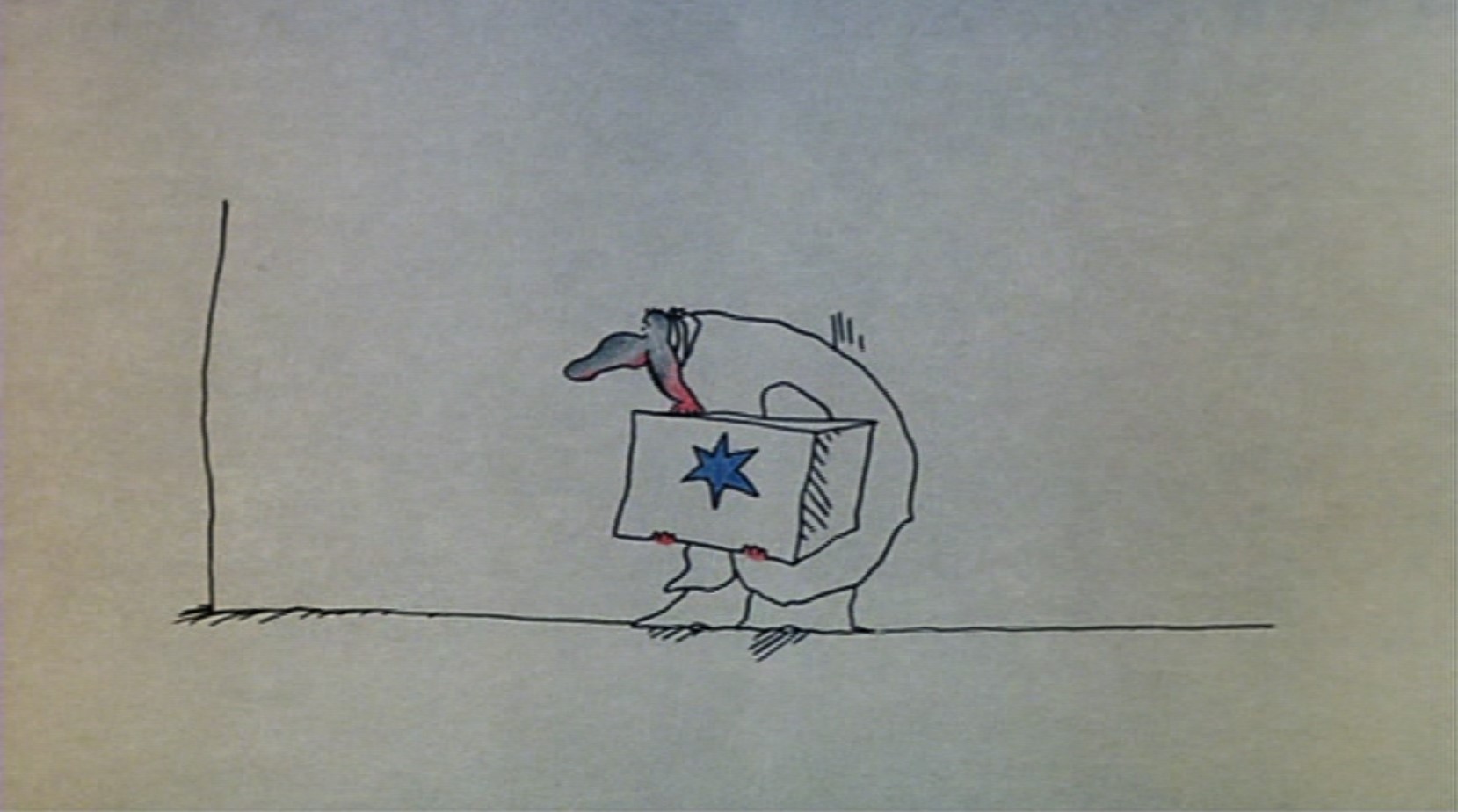
‘An Old Box’ is Paul Driessen’s own variation on the Hans Christian Andersen fairy tale ‘The Little Match Girl’.
In his own film a poor man paints an old box in order to entertain people, but he is at the wrong corner of the town, and nobody passes by, while a short distance away a county fair takes place.
In this short Driessen introduces his idiosyncratic way of showing background art only when necessary. Thus lines indicating backgrounds appear from and dissolve into nothingness as we progress from scene to scene.
Likewise, Driessen’s color use is very limited, emphasizing the most important elements. Only in the very end the animator bursts into a fantastical multi-colored perspective animation before returning to the prevailing depressing grays of the rest of the short.
Watch ‘An Old Box’ yourself and tell me what you think:
‘An Old Box’ is available on the DVD ‘Des histoires pas comme les autres’
Director: Paul Driessen Release date: 1974 Rating: ★★★ Review:
‘Cat’s Cradle’ is an early film by Dutch animator Paul Driessen for the National Film Board of Canada.
This is one of Driessen’s most enigmatic films, in which the images seem to flow in a stream-of-consciousness-like fashion, bridged by a string spun by tiny spider. Somehow the tale, if there is one, has a retrograde character, but it’s hard to make head or tail of Driessen’s narrative in this short.
The background art again is very limited and made of monochromes, and Driessen’s typical morbid humor is very present. For example, the spider is handled by a man, who in turn turns out to hang at a gallows pole.
Watch ‘Cat’s Cradle’ yourself and tell me what you think:
‘Cat’s Cradle’ is available on the DVD ‘Des histoires pas comme les autres’
Director: Paul Driessen Release date: 1972 Rating: ★★★½ Review:
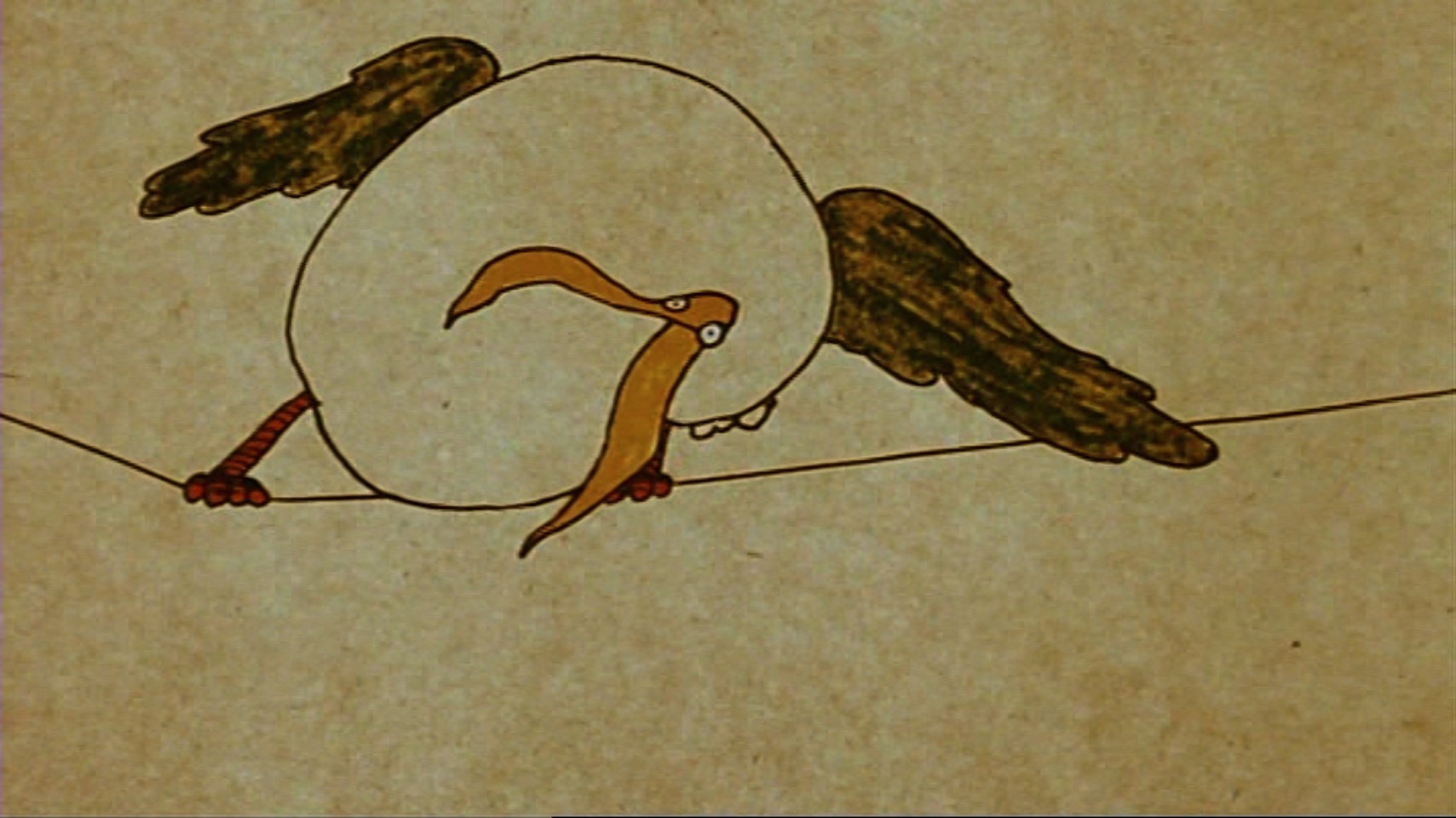
‘Air!’ was the first animated short Dutch animator Paul Driesen made for the National Film Board of Canada. In this very short film (it only takes two minutes) everything and everyone is gasping for air. Only at the very end we experience why.
Driessen makes the most of the barest background art: a monochrome background with a single horizontal line, which in each scene depicts something else. This is an early short by the Dutch master, but the film already showcases Driessen’s idiosyncratic animation style and morbid sense of humor.
Director: Ralph Bakshi Release date: August 8, 1973 Rating: ★★ Review:
Ralph Bakshi arrived on the scene when American classic studio animation was in steady decline, reaching its low point in the 1970s and early 1980s. In this dry period, Bakshi tried to reinject classic animation with new energy, most notably by ripping it of its association with children. Now, in the golden age animation never had been solely associated with children, but due to the advent of the Saturday-morning cartoon in the mid-1960s American animation more and more became something just for kids.
Bakshi, on the other hand, saw the full potential of the medium, and enriched the animation world with several animated features aimed at adult audiences, thus bypassing the middle ground of the family film, which was Disney’s monopoly at the time, anyway. Thus, Bakshi is sometimes seen as the savior of animation during the medium’s dark ages, but I find it hard to subscribe to that opinion, and that’s because his films are sadly just not good.
Now, I will not talk about the abysmal ‘The Lord of the Rings’ (1977), which is a disgrace to the medium, but even ‘Heavy Traffic’, his supposed masterpiece, fails on several key features.
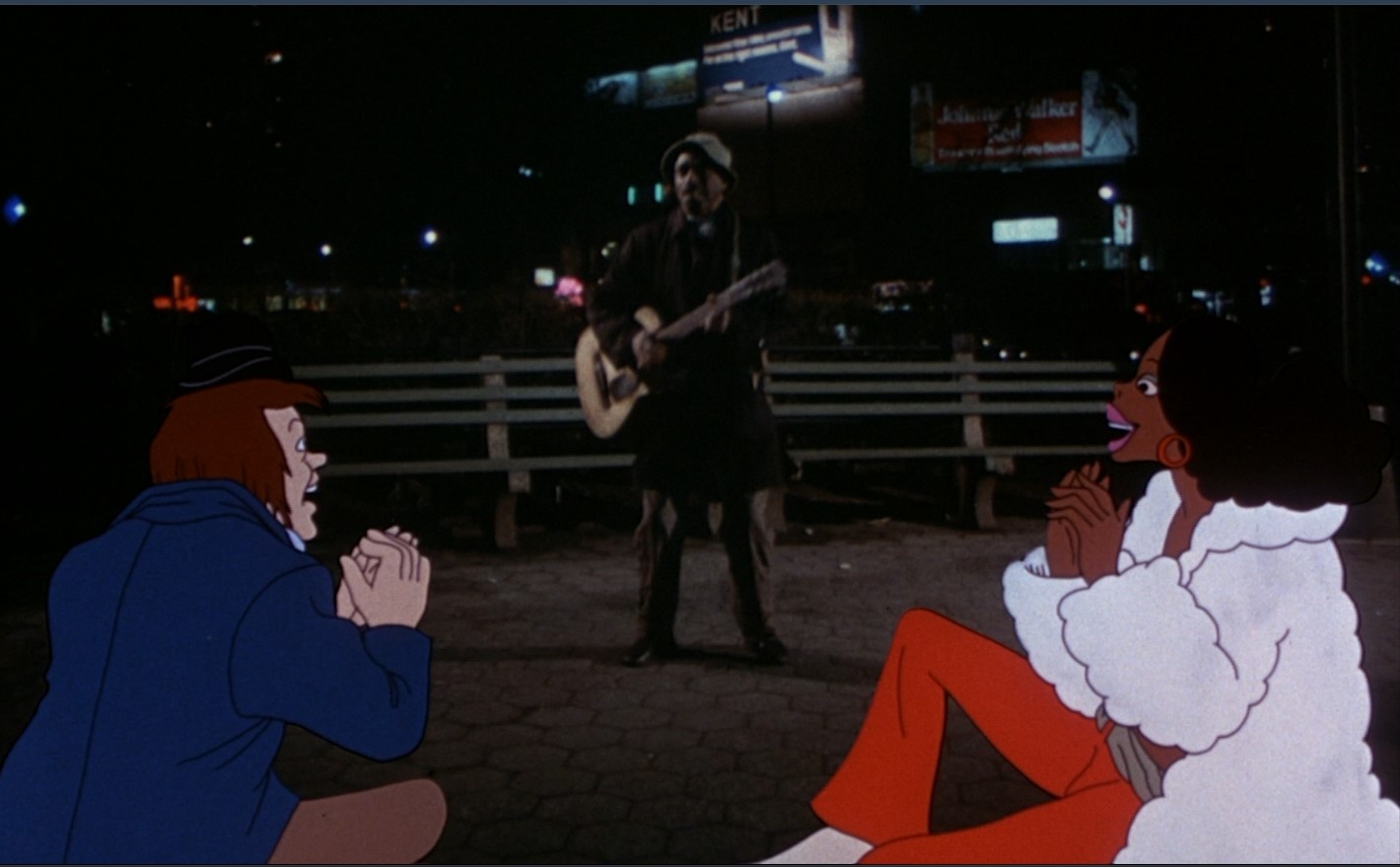
‘Heavy Traffic’ was written by Bakshi himself and has strong autobiographical elements. Set in New York the feature film tells of Michael Corleone, a young and aspiring underground cartoonist, who stills live with his quarreling parents (a Jewish mother and an Italian father), and who dates a black girl called Carole.
The film uses a voice over and the images of a pinball machine as bridging elements, but this cannot hide the fact that the film is a loose bag of scenes, and hardly goes anywhere. Sure, the film is depressing and draws a dark picture of the Big Apple, but its fourteen scenes have little to do with each other and are more about atmosphere than storytelling.
It certainly doesn’t help that none of the characters are remotely sympathetic. Even Michael himself, our supposed hero, is more of a self-centered jerk than anything else. For example, the comics he shows a publisher, wouldn’t interest anyone with a sane mind.
Worse, ‘Heavy Traffic’ falls for the misguided idea that making a film for an adult audience means it must contain sex and violence. ‘Heavy Traffic’ was not the first film to fall into this trap, and certainly not the last one (the unappealing ‘Sausage Party’ from 2016 comes to mind), but Bakshi clearly indulges in both, not only in this film, but also in ‘Fritz the Cat’ from the year before, ‘Wizards’ (1977) and ‘Cool World’ (1992), to name a few, which, to me, only proofs his immaturity. In ‘Heavy Traffic’, for example, bare breasts pop up from everywhere, with little other purpose than arousing the male audience.
Bakshi’s character designs are a mixed bag, sometimes reminiscent of the work of Mort Walker, as in the design of Michael’s father, at other times very cartoony, and reminiscent of DePatie-Freleng (e.g. the gay drag queen Snowflake), at other times quasi-realistic (Carole). Especially ill-conceived is Michael himself, whose quasi-realistic design is as mediocre as it is unappealing.
The background art too is a strange mix of drawings and photographs to a gritty effect. There are even some real live action footage elements from old films, like ‘Red Dust’ (1932) and ‘The Gang’s All Here’ (1943). In the end, the characters change into their live action counterparts, and suddenly one asks himself why this gritty film was not filmed in live action in the first place, as Bakshi’s animation adds surprisingly little.
Now, ‘Heavy Traffic’’s animator list features such illustrious names like Tom Ray, Carlo Vinci, Irv Spence, Manny Gould and Dave Tendlar, and it’s admirable that Bakshi kept these animation greats at work, but I doubt how many people watch ‘Heavy Traffic’ for its beautiful animation, for there’s hardly any. There’s manic animation, there’s outrageous animation, there’s fair animation, and there’s a lot of rotoscoping, but I’d prefer ‘Robin Hood’ from the same year anytime, even if that is the poorest of all classic Disney features.
For a supposed masterpiece, ‘Heavy Traffic’ feels like a sad affair, wasting a lot of animation talent on an egotistical document too heavy-handed for its own good, a film that is as depressing as it is boring and unappealing.
No, to me, Bakshi was more like the wrong guy at the right time: he could not save animation, for he lacked both the talent and the vision to do so. His films never transcend the dark ages, but are firmly rooted in them, and because of Bakshi’s limited view on what an adult film can be, the whole concept never really took off in the United States. This is an infinite pity, for this is one of the reasons we still must deal with the narrowminded view of animation being equal to family entertainment, today.
Watch the theatrical trailer for ‘Heavy Traffic yourself and tell me what you think:
Directors: André Leduc & Bernard Longpré Release date: 1974 Rating: ★ Review:
Monsieur Pointu is a clown played by Paul Cormier, who also provides the short’s fiddle soundtrack. The clown tries to play the fiddle, but this turns out harder than it seems.
‘Monsieur Pointu’ consists of general clown routines, exaggerated and augmented by animation. André Leduc’s and Bernard Longpré’s pixilation animation is quite impressive, although the black screen also helps with all the tricks.
Unfortunately, their command of pixilation is much better than their comic timing, and literally none of the antics is funny. In fact, the action is very tiresome, and with its twelve minutes the short overstays its welcome extensively, especially if you don’t like clowns anyway, like me.
Watch ‘Monsieur Pointu’ yourself and tell me what you think:
‘Monsieur Pointu’ is available on the DVD ‘Best of the Best – Especially for Kids!’
‘The Owl Who Married a Goose: An Eskimo Legend’ was the first film acclaimed animator Caroline Leaf made for the National Film Board of Canada.
Done entirely in sand animation (in fact, Caroline Leaf was one of the very first animations to explore this technique for an entire film) the short tells about an owl, who marries a goose, but cannot follow her life style, with disastrous results. The legend is told and sung by real inuit, who also provide the goose’s and owl’s voices. As their Inuktitut language remains untranslated, one is lost in what is said, but luckily Leaf’s charming animation tells it all.
With its simple designs, effective animation and original soundtrack ‘The Owl Who Married a Goose: An Eskimo Legend’ created quite a stir, and the film surely is one of the most Canadian the NFB ever made. After this film Leaf set off to a great career as one of the most interesting of independent animation film makers, creating such intriguing masterpieces like ‘The Street’ (1976) and ‘Two Sisters’ (1990).
Watch ‘The Owl Who Married a Goose: An Eskimo Legend’ yourself and tell me what you think:
‘The Owl Who Married a Goose: An Eskimo Legend’ is available on the DVD ‘Best of the Best – Especially for Kids!’
Director: Michael Mills Release date: 1971 Rating: ★★½ Review:
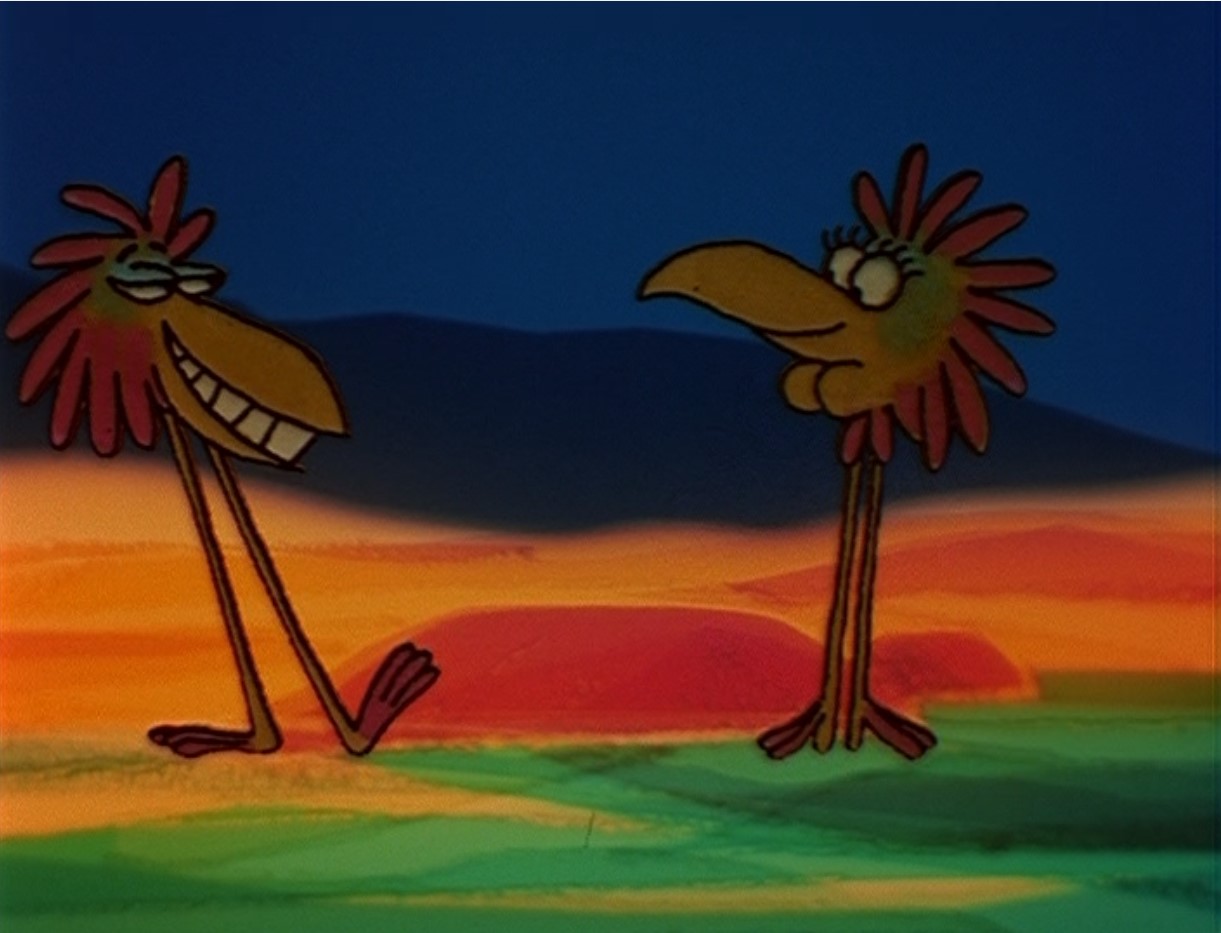
‘Evolution’ is Michael Mills’ cartoony take on the biological concept. The short features several fantasy creatures, starting with single cells in a pond (which all look like eye balls).
Mills depicts the origin of sex, the struggle of life, and the colonization of land, but none of his images are remotely serious, and most scenes consist of short gags. Unfortunately, the short is not too funny, and feels a little empty, ending quite abruptly and disappointingly.
Five years later Bruno Bozzetto did a much better job when depicting the same subject in his Boléro section of ‘Allegro non troppo’ (1976)
Watch ‘Evolution’ yourself and tell me what you think:
‘Evolution’ is available on the DVD ‘Best of the Best – Especially for Kids!’
In ‘Banquet’ a bunch of waiters and chefs are preparing a huge banquet for a large number of guests. But when the guests arrive, the banquet turns out to be very different than expected.
‘Banquet’ has a mixed design: the waiters and chefs are rather classic cartoony figures, while the meals and the guests are collages partly made out of photo material.
Jan Skorża’s cut-out animation is fair, if not outstanding, and the whole film is a little too empty to be memorable. I guess the Polish film makers were less in their game when trying an attempt at humor.
Watch ‘Banquet’ yourself and tell me what you think:
‘Banquet’ is available on the DVD-set ‘Anthology of Polish Animated Film’
In ‘Soup’ avant-garde film maker Zbigniew Rybczyński shows his fondness of repetitive use of live action material to create startling new images.
Rybczyński would perfect this technique in 1980 with the Academy Award winning short ‘Tango’, but ‘Soup’ already is intriguing and hard to describe. Rybczyński has tinted his source material in stark, contrasting colors, with reds, greens, yellows and blues really popping out of the screen.
The images show the daily routines of a married couple, until it is suggested that the man dies in a train crash. At that point the film burns down. The daily routines are strangely juxtaposed to each other, and there are some very odd touches, like a fork taking a bite out of cheek.
The alienating effect is greatly enhanced by the soundtrack. For sound designer Mieczysław Janik and composer Eugeniusz Rudnik have provided a highly disturbing score full of ordinary sounds amplified to a grotesque effect. For example, when the man brushes his teeth, this rather sounds like a fork scratching on a plate.
I don’t think ‘Soup’ is for everyone, but this intriguing film shows both Rybczyński’s unique approach to film making and the sheer creativity that Communist Poland was in the graphic arts in the 1960s and 1970s.
Watch ‘Soup’ yourself and tell me what you think:
‘Soup’ is available on the DVD-set ‘Anthology of Polish Animated Film’
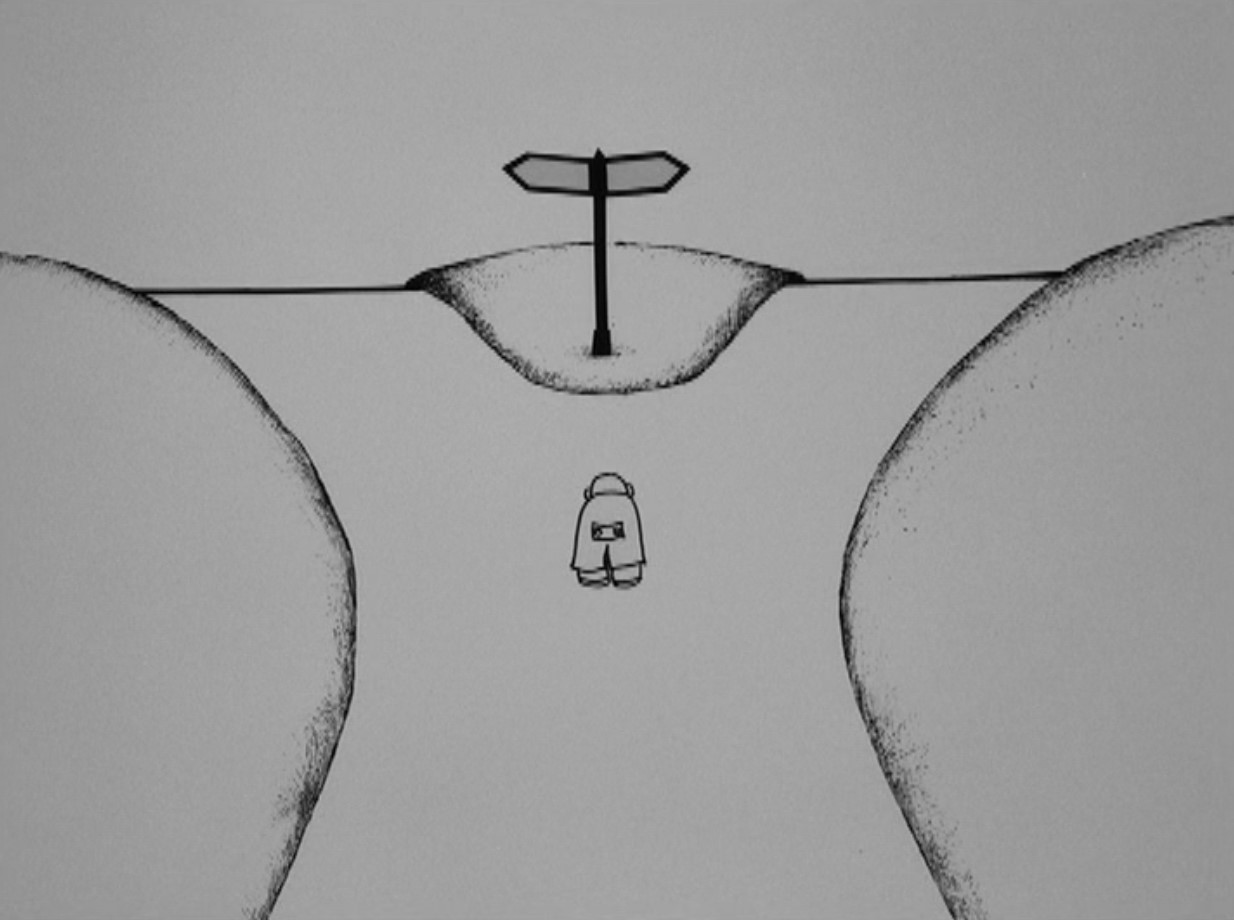
‘The Road’ is a simple little black and white film about a man walking a road, but then he faces a fork in the road.
According to IMDb this is a parable on how choices have consequences, and I can see something in that. Nevertheless the film may be a little too simple, making its message rather vague and puzzling. For example, we only see the man from the back, and only the second choice he has is clearly motivated, with help from a text balloon. Nevertheless, ‘The Road’ is a charming example of the experimental approach to animation in Poland.
Watch ‘The Road’ yourself and tell me what you think:
‘The Road’ is available on the DVD-set ‘Anthology of Polish Animated Film’
Director: Lee Mishkin Release date: November 8, 1974 Rating: ★★★★½ Review:
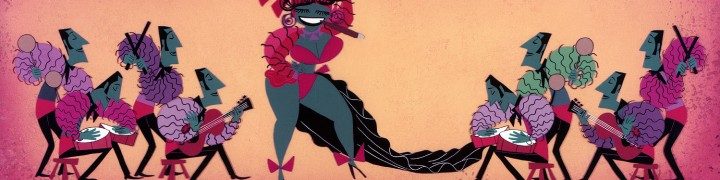
This short video clip is an all favorite of mine, perfectly illustrating Roger Glover’s rather hippie-like hit song from his concept album for children ‘The Butterfly Ball and the Grasshopper’s Feast’, which in turn is based on a poem with the same title.
Both the original poem, the record were designed by Alan Aldridge, and so is Halas & Batchelor’s animation film, with charming results. Harold Whitaker has turned these images into charming animation very well, and Lee Mishkin does a good job transferring the lyrics to faithful, if often surprising images.
Young Ronnie James Dio’s voice is given to a minstrel frog, who walks to the Butterfly Ball itself, together with a number of a masked animals. Three drunken salamanders provide some comic relief, as does a fat toad at the ball itself. The slightly surreal images are a delight throughout and the clip is over before you know it. I wish the whole record was transferred into animation this way.
Watch ‘Butterfly Ball (Love Is All)’ yourself and tell me what you think:
‘Butterfly Ball (Love Is All)’ is available on the Blu-Ray ‘The Halas & Batchelor Short Film Collection’
The twelfth Peanuts special was another holiday special, this time celebrating Easter. As with all Peanuts specials the story evolves at a leisurely speed, this time mixing ca. three stories into very short cross-cutting scenes.
The first and most entertaining story is about Peppermint Patty trying to teach Marcie how to paint eggs, but this goes haywire, because Marcie has absolutely no clue on how to prepare the eggs. The second story is about Snoopy buying a birdhouse for Woodstock, who initially shivers in the cold rain. Then there’s a story arc in which Linus tells the gospel of the Easter Bunny, just like he did on the Great Pumpkin.
Several scenes take place in a department store, and some of them are charming, if totally independent of the main story material, like Peppermint Patty, Marcie and Snoopy dancing to some Christmas-themed music boxes. This gives the episode a rather disjointed, almost improvisatory feel.
Vince Guaraldi’s soundtrack is great throughout, giving Snoopy and Woodstock an especially groovy soul-jazz theme, while the Easter Beagle is accompanied by a jazzy version of Beethoven’s seventh symphony.
Watch ‘It’s the Easter Beagle, Charlie Brown’ yourself and tell me what you think:
It’s the Easter Beagle, Charlie Brown’ is available on the DVD-set ‘Peanuts 1970’s Collection Vol. 1’
‘It’s a Mystery, Charlie Brown’ is the first Peanuts special not to be directed by Bill Melendez. Instead, Phil Roman takes the director’s seat, after co-directing the previous episode, ‘A Charlie Brown Thanksgiving‘ with Melendez.
There’s little wrong with Roman’s directing, except for an odd staging here and there, but ‘It’s a Mystery, Charlie Brown’ is one of the weakest of the Peanuts episodes. Its story is incredibly straightforward, and lacks the little drama of the other episodes. This is mostly because the story is concentrated on Woodstock and Snoopy, instead of the children.
The episode starts with Woodstock trying to build a nest, and it’s this nest that drives the plot. The best parts of the episode deal with the power of imagination: Woodstock almost drowning in the bird bath and Woodstock riding an imaginary elevator. Also great is Snoopy as Woodstock’s attorney, issuing letters full of nonsensical Latin.
But the running gag in which Woodstock gets repeatedly wet falls rather flat, and one senses that more could have been made out of it. Also, the episode’s closing feels rather forced. In fact, the best aspect of the episode is its groovy soul-jazz music, which is a delight throughout the episode.
Watch ‘It’s a Mystery, Charlie Brown’ yourself and tell me what you think:
‘It’s a Mystery, Charlie Brown’ is available on the DVD-set ‘Peanuts 1970’s Collection Vol. 1’
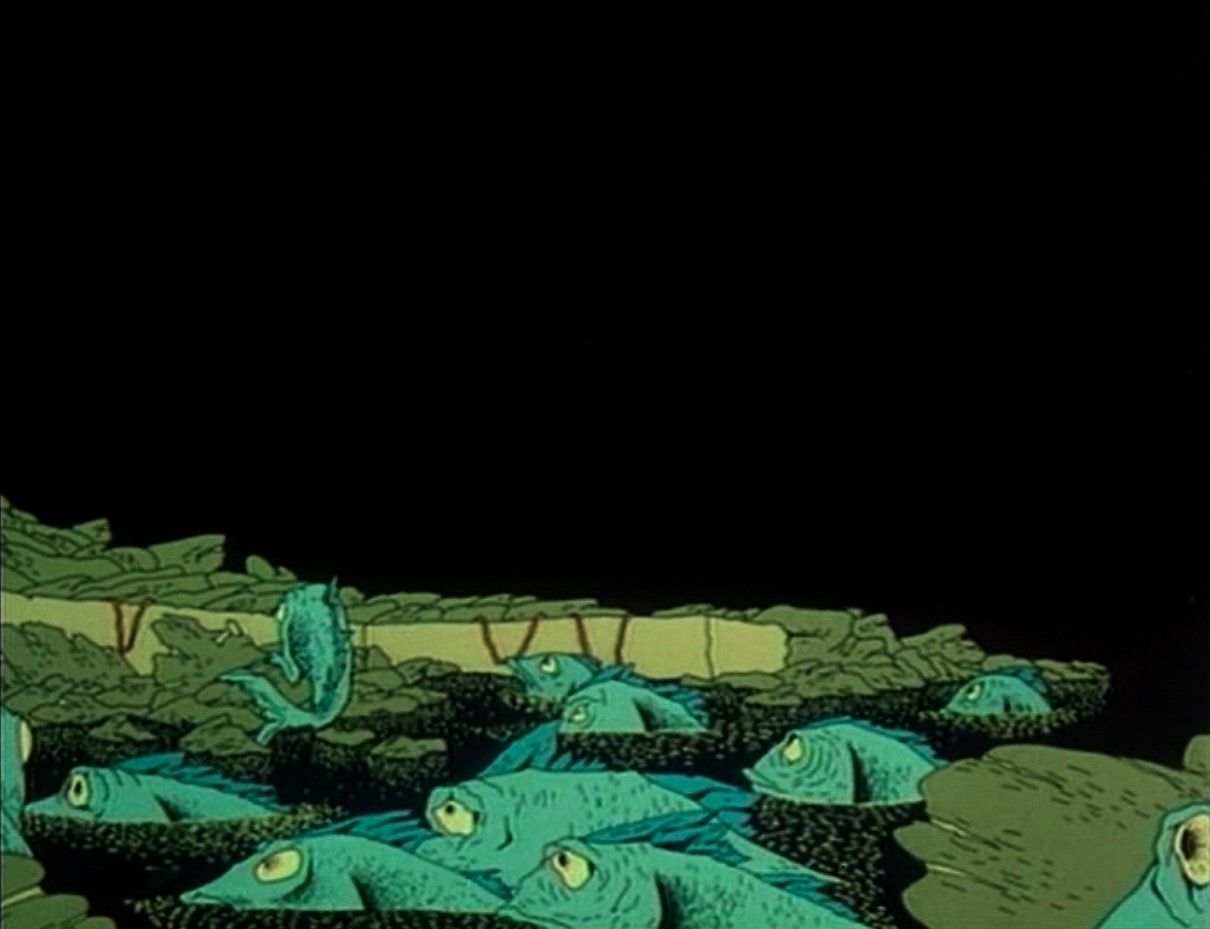
This dark and surreal film starts with fishing villagers saying goodbye to their men who go out fishing on the sea. But when they’re gone, the fish suddenly come to the shore…
‘Fisheye’ is animated very well and knows a sickly color palette with its pale yellows, greens and blues on a black canvas. There’s some great moving perspective animation of the fishing village. The film contains a grim atmosphere, but in the end is too one-dimensional to make a lasting impression. The abrupt and inconclusive ending doesn’t help.
Watch ‘Fisheye’ yourself and tell me what you think:
‘Fisheye’ is available on the DVD ‘The Best of Zagreb Film: Be Careful What You Wish For and The Classic Collection’
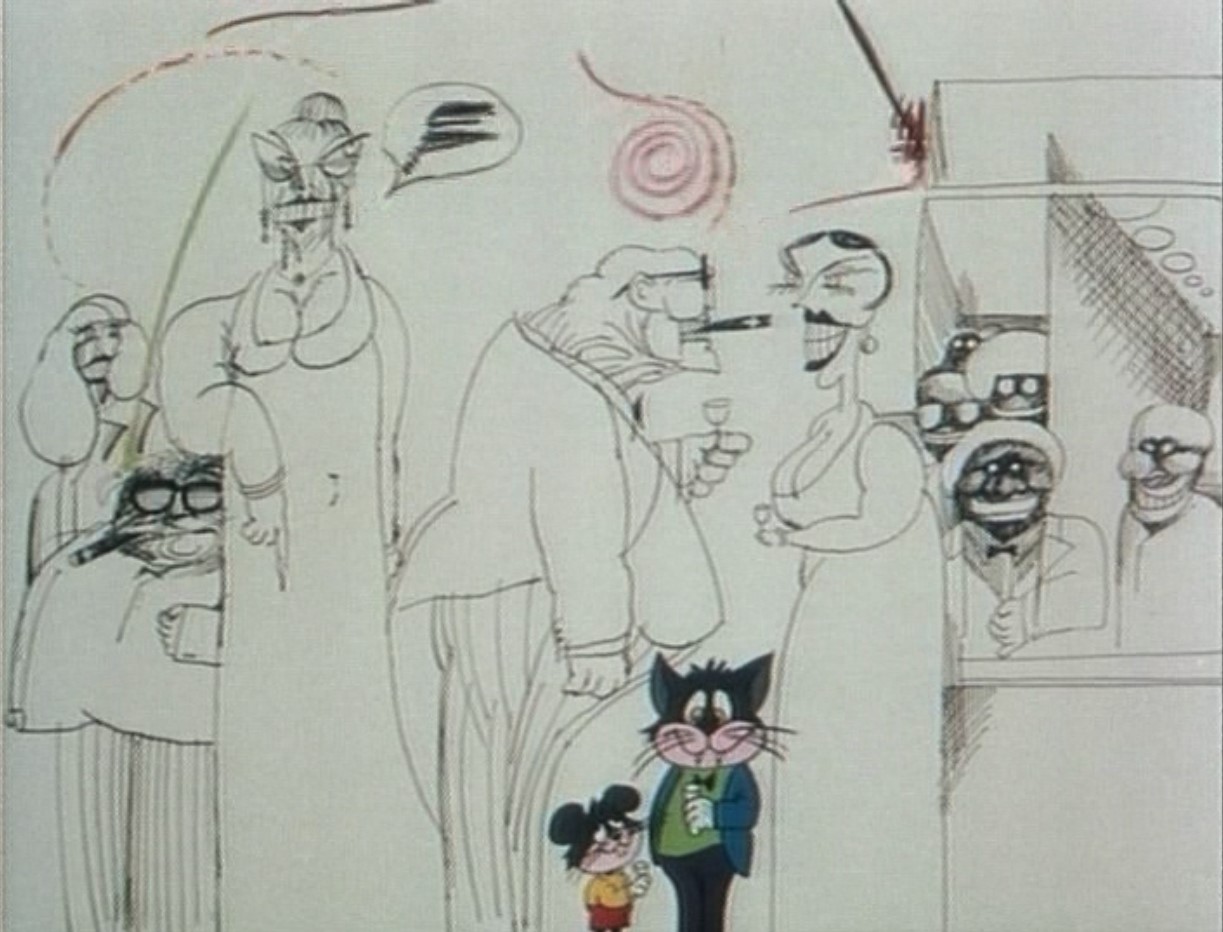
This animated short is very akin to the later ‘Satiemania’ by Zdenko Gašparović. The film features drawings and paintings on a white canvas, which change and morph in a stream-of-consciousness-like fashion.
The short starts with rather Saul Steinberg-like images of a man walking, while changing into all kinds of forms, figurative and abstract. The man then changes into a driver, while all the metamorphosis continues. This part contains some spectacular perspective and moving background animation.
The films then shifts to a party scene, in which a very cartoony mouse and cat form a running gag. From this point the film seems to say something about modern life and modern Western commercialism. As the film progresses, the images get more and more agitated, as if depicting the stressful life in the modern city. The film ends with another walking figure, showing a lonely man on an island inside.
‘Diary’ is a tour de force of imagination, and the images never cease to amaze. Nevertheless, the film’s purpose remains puzzling and leaves the viewer with more questions than answers.
Watch ‘Diary’ yourself and tell me what you think:
‘Diary’ is available on the DVD ‘The Best of Zagreb Film: Be Careful What You Wish For and The Classic Collection’
This is another very short gag cartoon from the Zagreb studio. In this short a man and a woman haggle for paid sex, or are they?
This cartoon features a monochrome ochre background, cartoonish designs, and dialogue in gibberish and loud nos. The single gag unfortunately is too lame for words.
‘Okay!’ is released on the DVD ‘The Best of Zagreb Film: Be Careful What You Wish For and The Classic Collection’
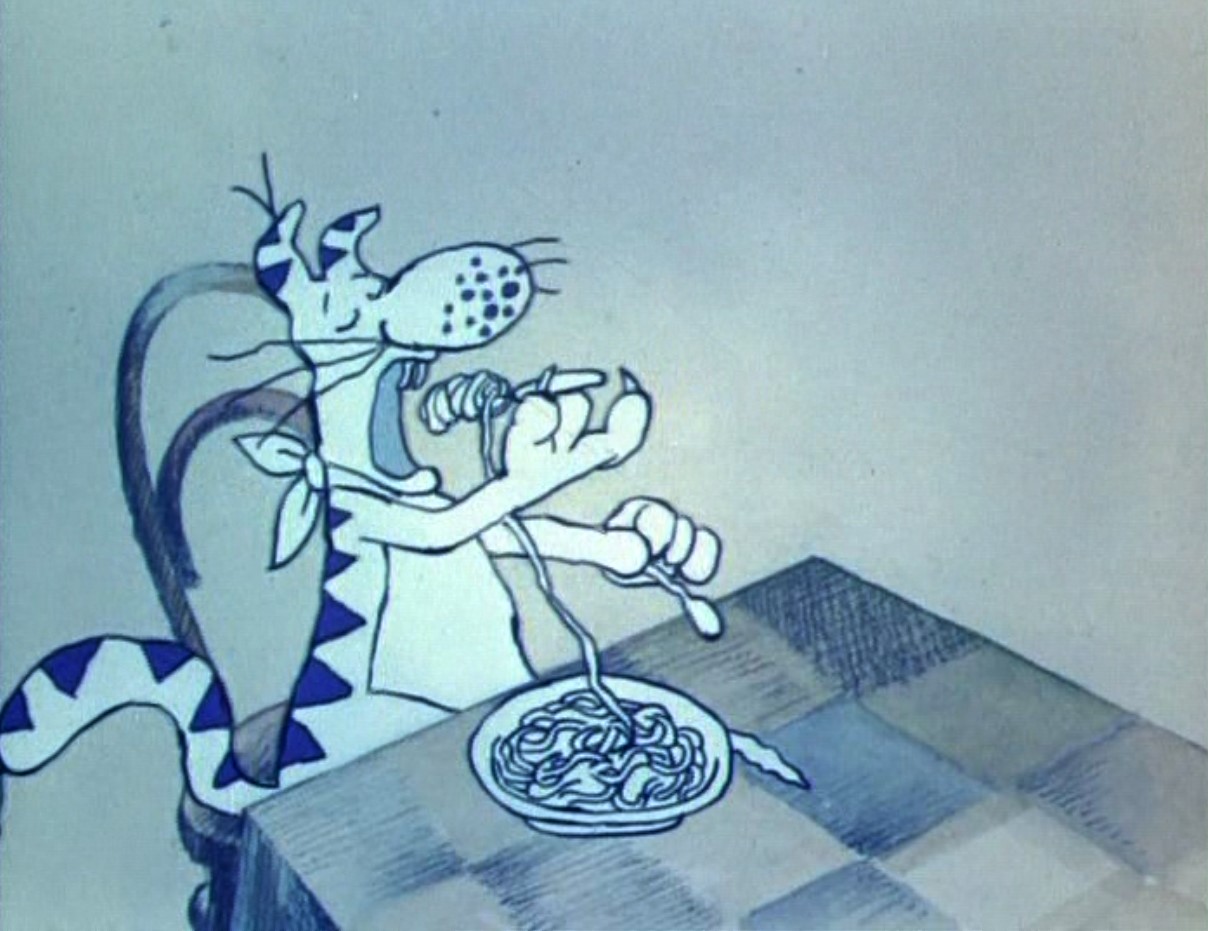
These are three very short episodes of the Maxicat series, which consisted of 24 episodes in total. These feature a very cartoony cat with a big nose experiencing Pink Panther-like adventures on a grey, featureless canvas.
In the first Maxicat finds a magical hat, in the second he eats spaghetti, and in the last he finds a flying broom. All three are short and classic gag cartoons with the dialogue-less action being accompanied by very jolly music. As these three episodes prove, Maxicat is an enjoyable series from the very creative Zagreb Film Studio from Yugoslavia.
Watch some Maxicat episodes yourself and tell me what you think:
These Maxicat episodes are available on the DVD ‘The Best of Zagreb Film: Be Careful What You Wish For and The Classic Collection’
Animation Backgrounds
A blog dedicated to background paintings from animation films. Kept until 2016.
Animation Scoop
Animation historian Jerry Beck’s animation film news blog.
Cartoon Brew
Topical blog on animation film, led by animation historian Amid Amidi.
Cartoon Modern
Amid Amidi’s blog on modern design cartoon art from the forties, fifties and sixties.
Cartoon Research
THE site on classic animation research, hosted by cartoon historian Jerry Beck.
Cartoons Theory
Frank Beef analyzes classic cartoons. Kept until 2020.
Century Film Project
Michael reviews films of 100 years old and older, roughly in chronological order.
Classic Cartoons
A similar blog featuring many stills and comic strips. Kept until 2012.
Comet over Hollywood
Jessica Pickens reviews classic Hollywood films, especially musicals.
Deja View
Top ex-Disney animator Andreas Deja’s own blog.
Disney History
Esteemed Disney historian Didier Ghez on the latest books on Disney history.
Feeling Animated
Paul Astell brings us thorough reviews of animated features.
Flickers in Time
Short and to the point reviews of classic films (lately mostly pre-code talkies) by an anonymous retired Foreign Service Officer from California











 Dr. Grob's Animation Review