Director: Unknown Release Date: November 14, 1927 Stars: Oswald the Lucky Rabbit, Peg Leg Pete Rating: ★★★½ Review:
Oswald joins a plane race from New York to Paris (inspired by Charles Lindbergh’s flight on May 20-21 that year).
Oswald is introduced as the dark horse and enters the race disguised as a pantomime horse. One of his competitors is an early version of Peg Leg Pete. Pete is the obvious villain, gluing Oswald’s plane to the ground with chewing gum. Luckily, Oswald manages to make a new, rather improbable plane out of a dachshund and two balloons.
Meanwhile, Pete misleads all the other competitors by turning an absurdly high direction indicator. Somehow, Oswald isn’t misled and he and Pete compete to be the first. Pete shoots Oswald out of the air, but it’s Oswald who wins the day. What became of the falling dachshund, however, we’ll never know… [UPDATE: Thanks to David Gerstein we do know: see his comment for the cartoon’s lost end gag]
‘The Ocean Hop’ is a clear forerunner of ‘Plane Crazy‘ (1928), Mickey Mouse’s debut cartoon. Both were inspired by Charles Lindbergh’s historical transatlantic flight. Oswald’s cartoon is not as consistent as Mickey’s, however, and features less spectacular scenes. In one way the differences between the two cartoons show that Walt Disney and Ub Iwerks were constantly improving themselves even at this early stage of their careers.
Watch ‘The Ocean Hop’ yourself and tell me what you think:
This is Oswald the Lucky Rabbit cartoon No. 6
To the previous Oswald the Lucky Rabbit cartoon: All Wet
To the next surviving Oswald the Lucky Rabbit cartoon: Empty Socks
Director: Unknown Release Date: October 31, 1927 Stars: Oswald the Lucky Rabbit Rating:★★★★ Review:
In his fifth film Oswald is a hot dog vendor at the beach.
At one point his girlfriend drops by, only to give him the cold shoulder, so Oswald pretends to be a lifeguard. The girl in turn pretends to drown, but then she really get suck into the ocean by a giant fish. Oswald comes to the rescue and earns a passionate kiss.
Although this film still contains some stiff animation and designs from the early 1920s (for example the dog customer), most of the animation is very flexible and lively, especially that of Oswald and the sea. Many of the hot dog gags were reused in the Mickey short ‘The Karnival Kid‘ (1929).
Watch ‘All Wet’ yourself and tell me what you think:
This is Oswald the Lucky Rabbit cartoon No. 5
To the previous Oswald the Lucky Rabbit cartoon: Great Guns
To the next Oswald the Lucky Rabbit cartoon: The Ocean Hop
Director: Unknown Release Date: October 17, 1927 Stars: Oswald the Lucky Rabbit Rating: ★★★ Review:
War has broken out. This leads to a surprisingly cheerful crowd of people happily volunteering to be a soldier. As if The Great War had never happened.
Oswald volunteers too, after a long goodbye to his girlfriend. In the trenches, he’s still kissing her portrait, until it is bombed by a mouse. This leads to an air battle between Oswald and the little rodent, which ends with Oswald beating up the mice, until he’s confronted by an angry officer. Oswald and the officer get into a bombing duel, in which Oswald uses an elephant, which explodes. In the end even Oswald himself is literally blown to pieces, but he’s revived by his girlfriend who’s a red cross nurse.
The depiction of war in this cartoon is surprisingly positive, and there are a lot of gags. Real danger is never felt, but the cartoon does feature some startling images of huge cannons swooping into the camera. Four years later Hugh Harman, who did some of the animation, would reuse elements of ‘Great Guns’ in his own World War I film ‘Bosko the Doughboy‘ (1931).
Watch ‘Great Guns’ yourself and tell me what you think:
This is Oswald the Lucky Rabbit cartoon No. 4
To the previous Oswald the Lucky Rabbit cartoon: The Mechanical Cow
To the next Oswald the Lucky Rabbit cartoon: All Wet
Director: Unknown Release Date: October 3, 1927 Stars: Oswald the Lucky Rabbit Rating: ★★★ Review:
In his fifth film Oswald has a mechanical cow to deliver milk with.
When his girlfriend gets kidnapped by a mob of gangsters, the cow helps him to rescue her. The gangsters come to a surprisingly cruel end, when they fall off a cliff and are eaten by sharks.
The cow behaves anything but mechanical. On the contrary, it is very rubbery, and even lazy and sleepy in the first scene, and its animation is not different from that of any of the other characters.
Watch ‘The Mechanical Cow’ yourself and tell me what you think:
This is Oswald the Lucky Rabbit cartoon No. 3
To the previous Oswald the Lucky Rabbit cartoon: Oh, Teacher
To the next Oswald the Lucky Rabbit cartoon: Great Guns
Directors: various Release Date: June 3, 2003 Rating: ★★½ Review:
The enormous success of ‘The Matrix’ (1999) not only spawned two sequels, but also a direct-to-video release with several animation films, expanding the film’s theme and providing some background history.
‘The Animatrix’ is an American/Japanese/South Korean co-production and consists of nine parts, produced by four different animation film studios (Square, Studio 4°C, Madhouse Studios and DNA). The nine parts differ a lot in style, content and quality, and the end result is pretty uneven to say the least. However, for fans of ‘The Matrix’ it contains very welcome background material to The Matrix universe.
1. Final Flight of the Osiris Director: Andy Jones Rating: ★★★½
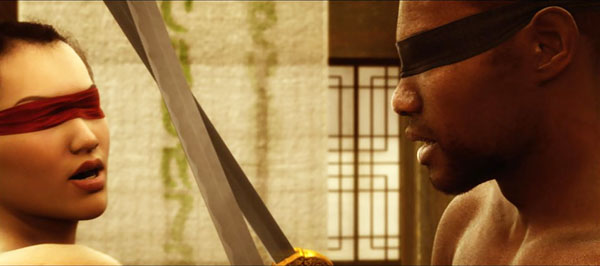
The first of the nine segments of The Animatrix is the most straightforward. It’s a dark action episode that tells what happened to the Osiris, a human vessel that shortly appears in ‘The Matrix’. The Square Studio, then already famous for the groundbreaking animation in ‘Final Fantasy: The Spirits Within’ (2001), tops itself with for 2003 ultra-realistic computer animation, with human characters of a then unsurpassed realism. Especially its opening sequence, an erotic martial arts fight, is impressive and made many viewers doubt whether it was real or not they were looking at.
2. & 3. The second Renaissance Director: Mahiro Maeda
★★★½
Made by Studio 4°C and brought in two episodes, The Second Renaissance tells us what happened before the Matrix in an American anime-style. It uses a robotic female voice-over to tell us about a robotic revolution and a human-robot-war which ends in defeat for the human population, which is then used as an energy source for the robots. These episodes are the most satisfying as an addition to The Matrix trilogy.
4. Kid’s Story
Director: Shinichirô Watanabe Rating: ★
‘Kid’s Story’ is the first of four episodes dealing with people who discover the matrix. This episode is about a teenager who doubts reality and who wakes up in the real world. The episode uses a very realistic, yet graphic style that is very American and rather ugly. Especially the animation (by Studio 4°C) is slow, unsightly and unsteady, making it one of the most unappealing parts of ‘The Animatrix’ to watch.
5. Program Director: Yoshiaki Kawajiri Rating: ★★
‘Program’ is another weak entry in ‘The Animatrix’. Animated by Madhouse Studios and drawn in a rather American comics/anime-style and using sharp shades, it tells about a treacherous character trying to persuade a girl to join him in a Japanese samurai setting (the program the two are in). The whole episode is rather melodramatic and forgettable.
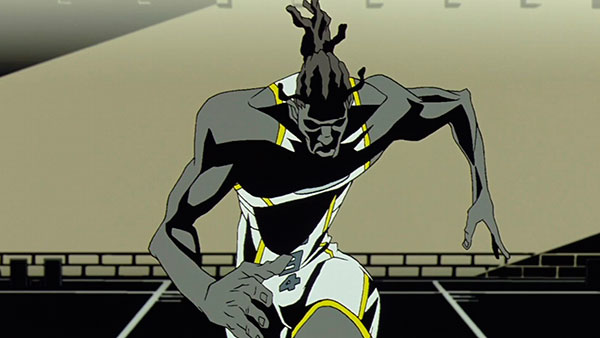
6. World Record Director: Takeshi Koike Rating: ★
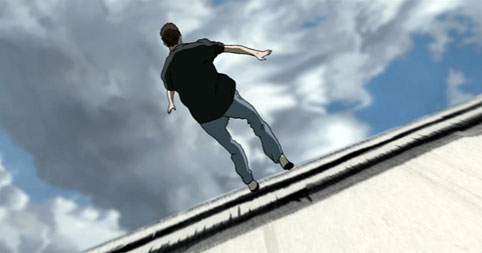
By far the most unappealing of all episodes of ‘The Animatrix’, ‘World Record’, by Madhouse studios, is drawn in a a gruesomely ugly comics design to tell the story of an athlete who discovers the matrix and who has to pay for it.
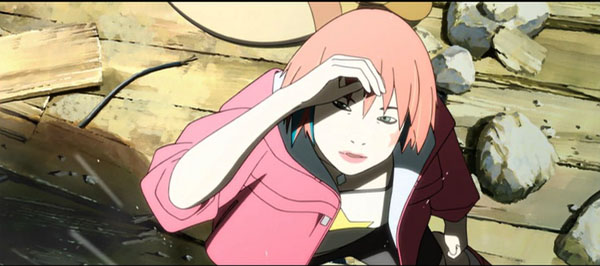
7. Beyond Director: Kôji Morimoto Rating:★★★★
Studio 4°C’s ‘Beyond’ is the third of four Animatrix episodes about people who discover the matrix, and it is easily the best of the lot. Set in Japan, it tells about a young woman, who is looking for her cat Yuki, and who’s led by some kids to a house where the ‘program’ has gone haywire, resulting in some wonderful surreal effects (like objects defying gravity). Unlike the rest, the episode has a lighthearted feel to it, which is enhanced by its appealing graphic anime design and its excellent animation, which makes clever use of 3D-effects. More than in any other part of the Animatrix one has the feeling that this episode is about real people in a real environment. The short is another showcase for Morimoto’s great direction skills, which he had already shown with the ‘Magnetic Rose’ sequence in the compilation feature ‘Memories‘ (1995).
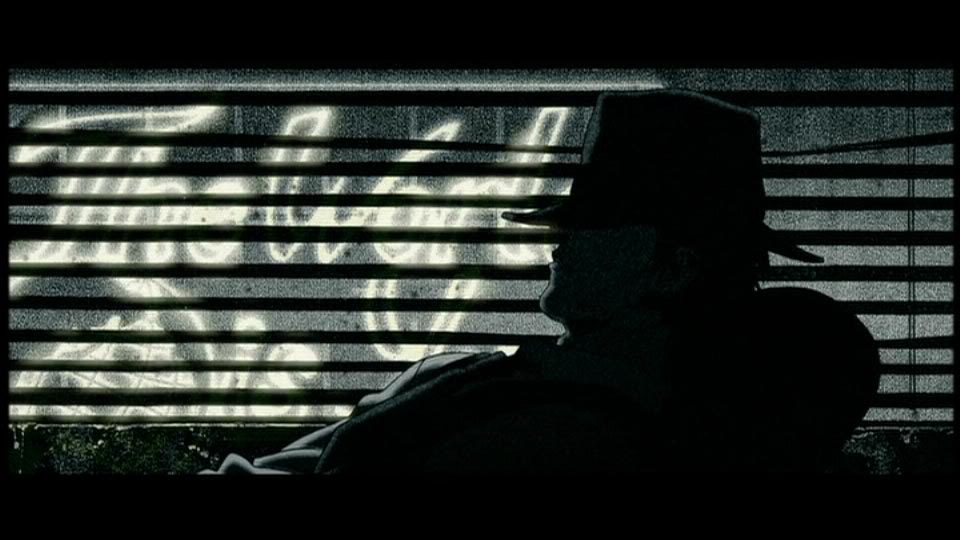
8. A Detective Story Director: Shinichirô Watanabe Rating: ★
‘A Detective Story’ is the fourth and last episode about people who discover the matrix. This episode is about a private detective and it uses all film noir cliches, including a very trite voice over. The nice black and white backgrounds evoke a forties atmosphere, even though the story is about hackers and chat rooms. But they cannot hide Studio 4°C’s very limited animation or the corny story, making ‘A Detective Story’ one of the weakest episodes of this package film.
9. Matriculated
Director: Peter Chung Rating: ★★★★
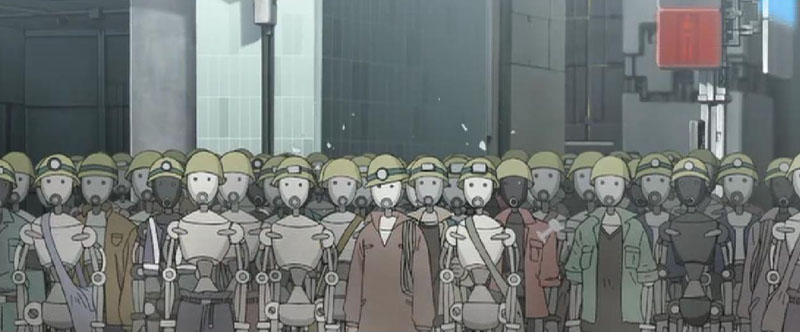
Penned and directed by Æon Flux-director Peter Chung and produced by the Korean DNA studio, ‘Matriculated’ is the most philosophical of the nine episodes of ‘The animatrix’. The story is set in the ‘real’ world. It deals with humans who try to make robots defending them by making them dream. Although its angular human designs are once again quite unattractive, this episode’s clever story makes it one of the highlights of ‘The Animatrix’.
Watch the trailer for ‘The Animatrix’ yourself and tell me what you think:
Seven years after ‘Akira‘, Katsuhiro Otomo returned to the animated screen with ‘Memories’, a package film, which impresses, but fails to reach the heights of ‘Akira’. Indeed, the film is much, much less well known than either Otomo’s previous film, or ‘Ghost in the Shell‘, which was the anime hit of 1995.
Based on his own short stories, ‘Memories’ consists of three unrelated parts: ‘Magnetic Rose’, ‘Stink Bomb’ and ‘Cannon Fodder’, which are discussed separately below.
Magnetic Rose
Director: Kōji Morimoto Rating: ★★★★★
‘Magnetic Rose’ starts the Memories trilogy, and it’s arguably the feature’s most satisfying episode. Animated by Morimoto’s own Studio 4°C, it is the only part that clearly deals with memories.
In this episode a rescuing squad of space garbage collectors is ensnared in the memories of a long deceased opera singer, who still seems alive in her remote satellite home in space, blurring the boundaries of reality. This accounts for an exciting story, greatly enhanced by Yoko Kanno’s superb soundtrack, in which she mixes an eerie choir, ambient guitar work and dark electronic with bites of Giacomo Puccini (the famous aria ‘un bel di vedremo’ and the finale from ‘Madame Butterfly’, an opera set in Japan, and a small soundbite from ‘Turandot’, which is set in China). Also featured is a stage set from Puccini’s ‘Tosca’, in which the opera singer, as Tosca, stabs Heinz, one of the rescuers.
Even though the science fiction setting with its touches of horror is typical anime, the underlying drama is very mature and quite unique. This episode’s screenplay was penned by future director Satoshi Kon. Kon certainly established himself with this screenplay, and he would further explore the theme of memory and loss in ‘Millennium Actress’ (2001), and the blurring of reality and fantasy in both that film and ‘Paprika’ (2006) with even more spectacular results. Director Kōji Morimoto, meanwhile, would prove his worth as a director in ‘Beyond’, the best episode of ‘The Animatrix‘ (2003).
In ‘Magnetic Rose’ the characters are from all over the world, and this is one of the few anime, in which the Japanese character looks distinctively Asian compared to the European characters.
Stink Bomb
Director: Tensai Okamura Rating: ★★★
Penned by Katsuhiro Otomo, but directed by Tensai Okamura, and animated by the Madhouse animation studio, ‘Stink Bomb’ feels like a comical interlude between the two more serious outer episodes. The story is set in present day Japan and features a very stupid, but surprisingly indestructible protagonist who turns into a nonsensical weapon of mass destruction. The story is simple: Nobue Tanake, our ‘hero’, works in a biochemical laboratory. To cure his cold one of his colleagues suggests he takes a sample of the new medicine they’ve developed at the lab. But Tanake accidentally swallows the wrong pills, which turn him into a lethal weapon, sweating poisonous gasses that kill everything in sight. Although he remains unaware of this, he becomes the cause of the annihilation of Japan.
This story is rather silly – there’s a lot of broad comic acting, and it even ends with a kind of punch-line. And yet, the episode manages to be unnerving at the same time; the short has some disturbing undertones, with the fear of mass destruction weapons and corrupt governments played out well. The unsettling atmosphere is greatly enhanced by Jun Miayke’s score, in which he uses nervous free jazz saxophones to a great effect.
Otomo himself directed the last and most beautiful sequence of Memories. This episode once again is animated by Studio 4°C, but has a distinctive graphic style that doesn’t resemble any other anime. Especially the background art and character design are highly original. But even more startling is the fact that the film is ‘shot’ in one long camera take (with a little bit of smuggling, but very impressive nonetheless). The cinematography is outstanding, and uses a little bit of computer animation. One moving shot of a colonel ascending on a platform is a great piece of character animation. Nevertheless, the boys’ own dream of becoming a colonel himself, done in charming children’s drawings, may be the highlight of the entire film.
‘Cannon Fodder’ deals with an alternative, distinctively European world, where a totalitarian military regime enters every aspect of life. It’s a kind of steam punk, vaguely based on images of the first world war, with its giant cannons, gas masks, and pompous generals. We’re following one day in the life of a single family. They live in a city were all work and school is directed to a war with a mysterious city, which remains unseen throughout the movie. This war is fought entirely by using cannons, fired at the distant enemy.
Despite the caricatured humans, the atmosphere is hardly comical, but dark and disturbing. The unseen foe reminds one of ‘1984’, and one wonders whether the enemy is real – but then, in the end, the air alarm kicks in. ‘Cannon Fodder’ is more a film of concept than of drama, and thus less engaging than ‘Magnetic Rose’. Still, because of its unique style, and strict control of cinematography, ‘Cannon Fodder’ is a small masterpiece.
Watch the trailer for ‘Memories’ yourself and tell me what you think:
After several very fine films, like ‘My Neighbor Totoro‘ (1988) and ‘Princess Mononoke’ (1997), Miyazaki tops himself with his masterpiece ‘Spirited Away’. This film single-handedly places him among the greatest masters of animation of all time.
The film depicts a strange and inexplicable, yet surprisingly complete fantasy world, with a conviction and originality that has rarely been seen since Lewis Carroll’s ‘Alice in Wonderland’. At the same time, unlike several of Miyazaki’s earlier films, one feels that ‘Spirited away’ could only have been made in Japan. Its setting of a public bath, with its numerous gods and demi-gods, is totally Japanese.
Yet, its story about coming of age is universal as is its appeal. The little girl Chihiro (or Sen, as she’s called during most of the film) is the greatest of Miyazaki’s heroines. Like Kiki in ‘Kiki’s Delivery Service’ (1989), she matures during the film, but the fears and terrors she has to conquer are far more alarming than Kiki’s, and her growth is way more convincing. Not only has she to prove herself, she has to regain her name, and most importantly, she has to rescue her parents, who have been transformed into pigs in a particularly horrifying scene. At one scene we see her stricken with traumatic stress. In another we watch her breaking down. Despite some exaggerations (a flood of tears, for example), these scenes are so surprisingly real, they startle the viewer who’s used to the formalized emotions of many commercial animation films, whether Japanese or Western.
However, the character animation of Chihiro is outstanding throughout the film: she is a true girl and not an adult in disguise, and her emotions feel genuine and seem deeply rooted in observation of real human behavior. We identify immediately with her, and she’s strong enough a character to make her extraordinary journey in that strange, mysterious and dreamlike world believable.
Typical for Miyazaki, even in this hostile world our young heroine is not without friends, and even the most unpleasant characters (Yubaba and Without Face) are not without their weaknesses or positive character traits. On the other hand, even the good can look fearsome and unpleasant, as Yaku does in his dragon form. Also typical for Miyazaki is his depiction of children at work (see ‘Laputa – Castle in the Sky‘ (1986) and ‘Kiki’s Delivery Service’). On the other hand, his recurring theme of man versus nature is less apparent in this film, although it does appear in the form of a polluted river god.
In all, ‘Spirited Away’ is a rich film of pure delight and will enchant everyone everywhere in the world.
Watch the trailer for ‘Spirited Away’ yourself and tell me what you think:
Director: Te Wei Release Date: 1988 Rating: ★★★★★ ♕ Review:
After a hiatus of 25 years, China’s pioneering star animator Te Wei returns with this powerful and serene film, which is probably the most Chinese film ever made.
‘Feeling from Mountain and Water’* tells about an old master passing of the Guqin, a Chinese zither, and most revered of all Chinese classical instruments. Feeling his time has come, the old master passes his art on to a musical boyish fisherman. In the end we watch the boy playing an ode to his master and to nature on the guqin, which is now his.
The designs of this short are extremely beautiful, the watercolor backgrounds are on the verge of the abstract, and the animation is delicate and sophisticated. The film knows no dialogue, and much of the story is more suggested than shown.
Te Wei must have felt close to the film’s subject, as he himself was already in his seventies when he made this. Meanwhile, a younger gang of Chinese animators had taken inspiration from his films from the 1960s in what must have been a Chinese animation renaissance since the devastation of the cultural revolution.
‘Feeling from Mountain and Water’ is a very beautiful and meditative film on nature, music and life, and to me the masterpiece of Chinese animation.
Watch ‘Feeling from Mountain and Water’ yourself and tell me what you think:
‘Feeling from Mountain and Water’ is available on the French DVD ‘Impression de montagne et d’eau’
* this film is also known by its French title: impression de montagne et d’eau
Set in the early post-war period, ‘My Neighbor Totoro’ is the sister film to ‘Grave of the Fireflies‘, released on the same date as a double bill.
The film is a way more lighthearted affair than ‘Grave of the Fireflies’, however. With ‘My Neighbor Totoro’ Miyazaki definitely entered the children’s world, which he had already explored a little in ‘Laputa: Castle in the Sky‘ (1986). But where the latter film firmly puts the children into an adult world, in ‘My Neighbor Totoro’ Miyazaki explores the children’s world itself.
The film focuses on two little girls: ca. eight year old Satsuki and her sister, four year old Mei. They move with their father to an old ramshackle house in the countryside to be near the hospital where their ill mother is staying. In a giant camphor tree next to this new home Mei and Satsuki meet the Totoros, three forest spirits: a tiny one, a small one and a huge one. When Mei gets lost, the giant Totoro and a cat bus help Satsuki to find her.
‘My Neighbor Totoro’ is a delightful film for children and their parents. There’s no conflict or villain whatsoever, and even when there seems to be drama, when the two children think their mother may be dying, there’s really little to worry about. But like in ‘E.T.’ (1982) we share the children’s point of view, in which there really is a problem. ‘My Neighbor Totoro’ draws us convincingly and irresistibly into this magical world of children. The film knows no dull moments, and is full of wonderful scenes, the best being Satsuki, Mei and the giant Totoro waiting for the bus in the pouring rain. Its strong focus and perfect execution makes ‘My Neighbor Totoro’ arguably the best of all Studio Ghibli films.
At any rate ‘My Neighbor Totoro’ is a gem even among Miyazaki’s films, which are of a constant high quality throughout. He must have felt so himself, for it’s the large Totoro which gave the Ghibli Studio their studio icon.
Watch the trailer for ‘My Neighbor Totoro’ yourself and tell me what you think:
Based on the semi-autobiographical novel by Akiyuki Nosaka, ‘Grave of the Fireflies’ is a strong, emotional and immensely sad film. It kicks in right away, when we hear Seita say “September 12, 1945. That was the night I died”.
What follows is Seita’s story: this boy, about fourteen, first loses his mother in the fire raid of Kobe, which destroys the wooden town completely. Then he and his little sister Setsuko try to live at their aunt’s place, but the initially kind woman grows increasingly hostile to them. So Seita decides to find his own living space for him and his sister in an abandoned shelter, first trying to get food by buying it, then by stealing. Unfortunately, Setsuko sickens from malnutrition, and while he finally has a real meal for her, she dies. Seita manages to build her funeral, but although not shown, the film suggests Setsuko’s death has broken his will, leading to his own death as depicted in the first scene.
The rather straightforward story is told with several flashbacks and flash-forwards and with a unique focus on details of everyday life, which really makes the two children come to life. The realism of ‘Grave of the Fireflies’ is unprecedented, the animation of Setsuko in particular being very lifelike, despite a less fluent animation technique. Never before has such a realistic and endearing child entered the animated screen.
The film’s subject matter, which confronts the Japanese viewer with the lowest point in their recent history, is daring and so is its execution, with its concise focus on human suffering, instead of heroism or action. The film makes the viewer really feel the impact of war on innocent civilians: the agony of shortages, hunger and despair, while the rest of the war remains at the background. Takahata focuses on Seita’s love for his little sister, and his struggle to shield her from the effects of war. Seita is a sympathetic character, but not without flaws. His struggle to survive and to nurture his sister is heroic, but his decision to leave his aunt is also iinduced by pride, and it’s partly his own stubbornness that prevents him from reconciling with his aunt, which may have prevented Setsuko’s death. It’s hard to blame him, though, for he’s a child himself, after all.
‘Grave of the Fireflies’ is one of the most serious animation features ever made, dealing with war and death. It’s also very sad, bringing tears to the eyes of almost every viewer. Like ‘Animal Farm‘ (1954), ‘Le planète sauvage‘ (1973) or ‘Watership Down’ (1978), ‘Grave of the Fireflies’ is one of the few truly serious animation features, expanding the medium’s subject matter, and it’s a cinematic masterpiece by any standard.
‘Grave of the Fireflies’ was released as a double bill with ‘My Neighbour Totoro‘, which is equally classic, but very different in tone, indeed.
Watch the trailer for ‘Grave of the Fireflies’ yourself and tell me what you think:
In 2019, 31 years after World War III, which destroyed the old town completely, Neo-Tokyo is even bigger and more urbanized than the old one. And more violent, too. The city is constantly on the brink of anarchy.
We follow Kaneda and Tetsuo, two members of a rough motorbike gang. When Tetsuo is hospitalized and taken away from his friend, Kaneda tries to retrieve him, while getting involved with a girl, who’s a revolutionary and whose troupe is after Tetsuo, too. Tetsuo, meanwhile, discovers he’s getting immense powers. Tetsuo suffers from an inferiority complex, and he realizes it’s payback time. He sets out to seek the mystical Akira, destroying most of Neo-Tokyo along the way. But in the end his powers take control of him, and while he and Akira merge to form a new universe in a very 2001 A Space Odyssey-like ending, Kaneda and his girlfriend Kei can look to a new future in a partly destroyed Neo-Tokyo.
If this plot line may sound a little hard to follow – it is, and I left quite some subplots out of it, too. ‘Akira’ is a violent and action-loaded science fiction film. Its plot may be vague and all too complex, the violent images never cease to impress. The film’s depiction of apocalyptic destruction, its speed, its wide range of characters, and its use of extreme camera angles are unprecedented in any animation film, and sometimes the grandness of the film’s scale is staggering. Some of the scenes are very complicated, with many people animated within one frame. And the story, too, seems to aim to encompass everything within the feature’s 124 minutes. Not surprising, considering that the film is based on a manga story six fat volumes thick.
Although Anime had known earlier masterpieces, it’s ‘Akira’, which set new standards in its home country. Moreover, it’s this film, which put the Japanese animation feature film industry firmly on the map in Western countries, which thus far practically had known the country’s television series, only. Thus, for most Westerners Japanese animation was synonymous to cheap animation, and the use of ridiculously large eyes. However, ‘Akira’ showed the Western world that Japan was perfectly capable of producing films of a high quality and stunning originality. Japanese animation has only grown in popularity since Akira’s release, and has become a major inspiration for many Western films and television series, animated or not.
Watch the trailer for ‘Akira’ yourself and tell me what you think:
Drawing inspiration from Jonathan Swift’s ‘Gulliver’s Travels’, ‘Laputa, Castle in the Sky’ takes Miyazaki’s love for flying machines to the max, introducing a humongous flying island.
Its story is set in a parallel world, which has a genuinely late 19th century European feel, but where flying machines are very common. The strange machines imagined for the film are both wonderful and convincing.
We follow the two orphan children Pazu, a poor mine worker, and Sheeta, who falls from the sky carrying a mysterious amulet, which reveals that she’s a Laputan princess. Followed by the Dola clan, a gang of pirates led by an old pink-haired woman, and by the military led by the enigmatic gentleman Muska, the children seek out to find the flying island.
Unlike other films by Miyazaki, ‘Laputa’ knows a real villain, the ruthless prince Muska. While the children admire Laputa for its nature, and while the pirates and the soldiers are only after its treasures, Muska seeks the island’s destructive possibilities to obtain world power. On the way, the film moves to a grander and grander scale, with a finale on the floating island that shows us dazzling heights, and which doesn’t eschew many killings, making ‘Laputa: Castle in the Sky’ Miyazaki’s most violent movie.
‘Laputa: Castle in the Sky’ is Studio Ghibli’s very first feature film. It’s akin to the earlier ‘Nausicaä of the Valley of Wind‘ (which predates the studio’s foundation) in its focus on the importance of love and nature and its aversion to short-minded people only interested in power and destruction. Despite its violent finale, ‘Laputa’ is more overtly a film for children than ‘Nausicaä’. Its focus stays with the rather naive children, and it contains more humor, especially in the depiction of the pirates, who are almost used as a comic relief only.
In any sense, ‘Laputa’ is a powerful film: its depiction of an original made-up world is convincing, its animation is outstanding, and its message complex and far from black and white. It once again shows the mastery of Miyazaki and the Ghibli studio.
Watch the trailer for ‘Laputa: Castle in the Sky’ yourself and tell me what you think:
Director: Hu Jinqing Release Date: 1985 Rating: ★★ Review:
‘The Straw Man’* is yet another example of China’s typical preoccupation with nature, water and fishermen.
Based on an ancient proverb (which one could translate into ‘it’s dogged as does it’), this film tells about a fisherman who is disturbed by two pelicans and who disguises himself as a scarecrow to catch the two birds.
The cut-out animation of the birds is very naturalistic, yet the backgrounds, based on paintings from the Tang dynasty, are are very graphical. Unfortunately, compared to the stunning animation of the animals, the animation of the fisherman is very crude and primitive, and the film suffers a little from a slow pace and all too present music.
Watch ‘The Straw Man’ yourself and tell me what you think:
‘The Straw Man’ is available on the French DVD ‘Impression de montagne et d’eau’
* this film is also known by its French title: ‘l’épouvantail’
Director: Hu Jinqing Release Date: 1983 Rating: ★★½ Review:
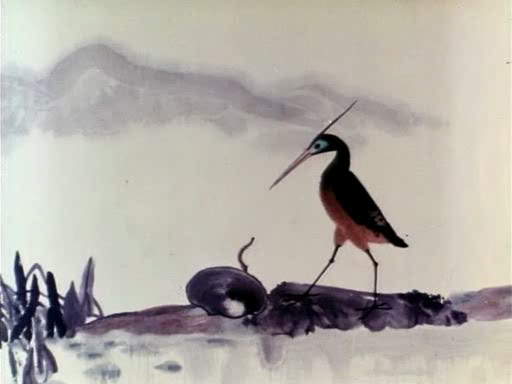
‘The Snipe and the Clam’* is one of many Chinese films based on ancient tales.
And like many other Chines films it has a look based on ancient Chinese paintings, it’s set in nature, and it deals with a fisherman.
In this film, a fisherman, a kingfisher and a snipe try to open a giant clam. When the snipe gets stuck, it’s the fisherman who wins the day. The film is based on an ancient Chinese proverb, which can be translated into “two dogs fight for a bone, and a third one runs away with it”.
In ”The Snipe and the Clam’ Hu Jinqing excels in gorgeous watercolor backgrounds, beautiful designs, great silent acting and remarkably naturalistic cut out-animation of the animals. In comparison, the animation of the fisherman is simple and rather crude. The film unfolds at an unhurried, almost meditative speed, which can make it difficult to enjoy.
Watch ‘The Snipe and the Clam’ yourself and tell me what you think:
‘The Snipe and the Clam’ is available on the French DVD ‘Impression de montagne et d’eau’
* this film is also known as ‘Snipe-Clam Grapple’, and by its French title: ‘l’aigrette et j’huitre’
Although the titles say ‘based on the graphic novel’, the manga of the same name was actually created to be able to make the picture.
Based on his own original story, ‘Nausicaä of the Valley of Wind’ is Miyazaki’s first mature film. It’s already a typical Miyazaki film, with its strong environmental message, strong female characters, the absence of clear villains, and the setting of an alien, yet totally convincing world.
The film tells of Nausicaä, princess of a small medieval-like state in a green valley, which is threatened not only by the strange, hostile and poisonous insect world nearby, but also by other human states, especially the militaristic state of Tolmekia. The humans are more preoccupied with destruction than with comprehension. Because of this shortsighted and drastic behavior, the humans almost destroy their entire environment. It is Nausicaä, with her unique understanding of animals and her pacifistic nature, who saves the day.
‘Nausicaä of the Valley of Wind’ is an epic science fiction film, made on a grand scale, with layered characters, beautiful designs, and excellent animation. Its production led to the foundation of the Ghibli studios, which high quality standards it already meets. In no sense it feels like a first-born or a dated film. Even though it’s from 1984, it is remarkably fresh and its message still viable. In other words, ‘Nausicaä of the Valley of Wind’ is the first of a long series of Ghibli studio classics.
Miyazaki would revisit the theme of a sick and angered nature in the similar and equally impressive ‘Princess Mononoke’ (1997). Once again it’s a princess who saves the day…
Watch the trailer for ‘Nausicaä of the Valley of Wind’ yourself and tell me what you think:
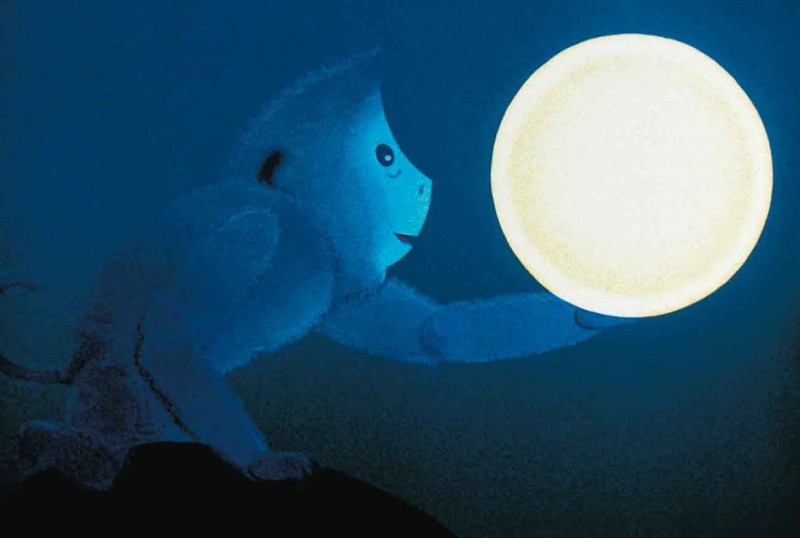
‘Monkeys Fish the Moon’* tells about a troupe of monkeys who try to catch the moon.
When they finally succeed to catch its reflection in a bowl, they drop it, only to discover that the moon still is in the sky.
‘The Monkeys who tried to catch the moon’ is, like many other Chinese films, based on an ancient fable. And, like many others it uses silent acting to tell its story. Nevertheless, the film is also a little atypical. Its elegant designs are not inspired by ancient painting, but more akin to Lotte Reiniger’s films. Moreover, the movements are not really naturalistic and the film doesn’t use Chinese music. Instead we have a lush and colorful forest world accompanied by rich film music. The cut-out models of the monkeys are soft and subtle in design, and there’s a striking use of light.
The result is one of the most beautiful Chinese animation films ever made.
Watch ‘Monkeys Fish the Moon’ yourself and tell me what you think:
‘Monkeys Fish the Moon’ is available on the French DVD ‘Impression de montagne et d’eau’
* this film is also known by its French title: ‘les singes qui veulent attraper la lune’
After ‘Persepolis’ (2007) ‘Jasmine’ is the second animation film about the Iranian revolution of 1979.
In his strongly autobiographical film Ughetto rediscovers his love relationship with Jasmine, a young woman from Iran, whom he visited during the turmoils of 1978/1979, and whom he left behind, to return to France, alone.
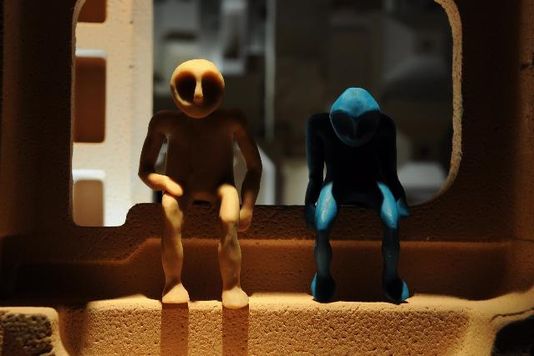
Ughetto doesn’t spare himself, and realizes leaving her was a big mistake on his part. To tell his story he uses love letters from the time, 8mm film images he shot during the Iran revolution and clay animation. He also shows the clay animation process, his elaborate sets made from styrofoam packaging material and collections of clay figures.
Unfortunately, Ughetto’s clay animation is very limited. His plasticine figures are devoid of any facial expression, and they all look the same. The only difference between the Alain and Jasmine puppets is their color (caramel vs. blue – reflecting the color of her eyes). There’s only a limited amount of animation, and little of it is expressive.
Because of this, the film relies heavily on the voice overs, Alain telling his story, a woman reading Jasmine’s love letters. Without the soundtrack the film becomes utterly incomprehensible. Only at one point in the film, the animation images leave a strong impression themselves: when the oppressive forces of the new Islamic regime strike down and kill the former revolutionaries. This is shown by giant floating turbans suddenly falling down and crushing discussing people.
‘Jasmine’ is an intimate, very personal and honest film, and the story of the Iranian revolution and its effects on the everyday lives of people remains moving. But ‘Jasmine’ is no ‘Persepolis’ and in the end falls short as an animation film. It could easily have been a live action film, a documentary, or even a novel, instead.
Watch the trailer for ‘Jasmine’ and tell me what you think:
It seems that with their growing economies the BRIC countries enter a new creative era, in which costly projects like animated features are now possible. Especially Brazil is a surprising new country from which unique and distinct animation films sprout.
In 2013 the Holland Animation Film Festival had shown the ambitious ‘Uma História de Amor e Fúria‘, this year it’s the charming film ‘O menino e o mundo’ (The Boy and the World). Surprisingly, given the extremely different animation styles, the two features have more in common than one would expect.
According to its director Âle Abreu* the idea of ‘O menino e o mundo’ was conceived when the little boy character suddenly appeared in his notes when studying Latin American protest music of the last hundred years. The film tells about this little boy growing up in the countryside, near the jungle, who goes to seek his father, who has left for the city to work. On his trip he discovers the real world that is Brazil, far from his idyllic place in the hills. He meets cotton pickers, people in the cotton industry, and even discovers how cotton is shipped to some futuristic cities (vaguely resembling the US) to be made into clothes, which are shipped back to Brazil to be sold at ridiculous prices.
I say Brazil, but Abreu insists that this story is the story of practically every Latin American country, or even every third world country emerging from a dark dictatorial past and now getting caught up in the World Economy. Indeed, the film’s world may be one great fantasy, with vehicles like animals, towns like mountains, and great futuristic cities in the sky. Yet, what happens in this world is instantly recognizable to people all over the world,
Meanwhile, the film clearly shows the grand effects of the global economy on the lives of ordinary and poor people. Without reservation Abreu shows us cotton pickers being fired because they are old and sick, workers working ridiculously long hours in hot industries to produce cotton, only to be replaced by a machine in the end. We watch poor people living in favelas (slums), while advertisements on the streets and on television produce images of a happy life they’ll never be able to reach. We watch people who demand more freedom being oppressed by military police, in a particular powerful sequence in which a colorful bird of freedom is crushed by a black bird of oppression, etc.
It’s this focus on social injustice that ‘O menino e o mundo’ shares with ‘Uma História de Amor e Fúria’. Unlike the latter film, however, Abreu’s film never becomes too heavy-handed, because we keep on seeing this world through the eyes of a child. To achieve this, Abreu uses a wonderfully naive style resembling children’s drawings and pastel crayons. All images are drenched in imagination and wonder, even those of the city and the oppressive forces, whose tanks look like large elephants. When the boy approaches the city, more and more magazine clippings are added to the colorful images. Abreu says he wanted to tell a tale about freedom, so he wanted to have freedom during the making of this film, too. He says: “A director should listen to the voice of his film, and listen to where the film wants to go“.
The result is an absolutely gorgeously looking film, simply bursting in color and fantasy. The animation, too, is superb, especially when considering that most of it was done in Photoshop. According to Abreu the drawings were then printed, filmed, and imported in After Effects for compositing. Moreover, the whole film was made with a very small crew. Nevertheless, the makers have reached a high quality by any standards.
To tell his story Abreu uses no dialogue. Yes, we hear people speak, but in a language that is constructed of Portuguese words spoken out backwards. Indeed, the voice actors had to act and sing in this backward language. However, in no way comprehensible dialogue is missed, for Abreu is perfectly capable of storytelling by images alone. Added to the mix is the cheerful score by Ruben Feffer and Gustavo Kurlat, which is a perfect match to the colorful images. According to Abreu, even the sounds of nature are made by musical means, like hand claps for rain.
‘O menino e o mundo’ is a magical film of sheer delight, deserving to be shown everywhere in the world. And unlike American films, it doesn’t shun the big questions our world needs to answer. For this bravery alone, it deserves a large audience.
Watch the trailer for ‘O menino e o mundo’ and tell me what you think:
* Quotations from Abreu are taken from his introduction and Q&A at the screening of his film at the Holland Animation Film Festival, March 20, 2014.
‘Betty’s Blues’ is Vandenitte’s ode to the country blues, and its origins in the South of the United States.
The film is a frame story, with two distinct styles. The framing story is told in stop-motion. We watch a young black blues singer perform in a small and empty bar near a metro line (we hear the cars rattling by from time to time). The singer tells his audience the story of Betty’s Blues. Enter the drawn animation.
The story itself is about a blues singer who loses his girl to the K.K.K. and becomes blind himself. In return for his blindness he receives the gift to make everybody dance to his guitar playing. When he meets the K.K.K. again, his revenge is sweet. The film ends with the audience shocked with horror by this rather violent story.
Both Vandenitte’s stop-motion and 2D animation are of a high quality. His stop-motion puppets have a delightfully gritty texture, and Vandenitte’s animation of guitar playing is wonderfully convincing. In the 2D sequences Vandenitte makes use of a technique simulating wood carving, combined with bold and evocative coloring, sometimes mimicking the color palette of that great cinematic ode to the musical South, ‘O Brother Where Art Thou’. The result is a gorgeous film, if a little shallow in the end.
Watch the teaser for ‘Betty’s Blues’ yourself and tell me what you think:
Director: Sabrina Peña Young Release Date: October 5, 2013 Rating: ★ Review:
‘Libertaria: The Virtual Opera’ must be one of the most unwatchable animated features ever made.
This science fiction film is utterly pretentious, using heavy texts to tell a dystopian story about some post-apocalyptic America. The film makes use of some interesting split-screen techniques, but is hampered by erratic storytelling and the most primitive computer animation techniques. The animation of the characters is appallingly poor and amateurish, and the designs hideously ugly. The emotions of the songs are not mirrored in the images, at all. Even the cheapest video game looks better than this.
This combination of dead serious pretentiousness and extremely poor execution make the film a nightmare to watch. Its best aspect is its music, because that, at least, has some quality. Indeed, Sabrina Peña Young is a composer, not an animator, and it remains puzzling why she wanted to make this film in the first place.
Cobbler, stick to your last!
[UPDATE: Sabrina Peña Young reacted to this blog post to explain why she made this film. Please read her response below]
Watch ‘Libertaria: The Virtual Opera’ yourself and tell me what you think:
Animation Backgrounds
A blog dedicated to background paintings from animation films. Kept until 2016.
Animation Scoop
Animation historian Jerry Beck’s animation film news blog.
Cartoon Brew
Topical blog on animation film, led by animation historian Amid Amidi.
Cartoon Modern
Amid Amidi’s blog on modern design cartoon art from the forties, fifties and sixties.
Cartoon Research
THE site on classic animation research, hosted by cartoon historian Jerry Beck.
Cartoons Theory
Frank Beef analyzes classic cartoons. Kept until 2020.
Century Film Project
Michael reviews films of 100 years old and older, roughly in chronological order.
Classic Cartoons
A similar blog featuring many stills and comic strips. Kept until 2012.
Comet over Hollywood
Jessica Pickens reviews classic Hollywood films, especially musicals.
Deja View
Top ex-Disney animator Andreas Deja’s own blog.
Disney History
Esteemed Disney historian Didier Ghez on the latest books on Disney history.
Feeling Animated
Paul Astell brings us thorough reviews of animated features.
Flickers in Time
Short and to the point reviews of classic films (lately mostly pre-code talkies) by an anonymous retired Foreign Service Officer from California

 Oswald joins a plane race from New York to Paris (inspired by Charles Lindbergh’s flight on May 20-21 that year).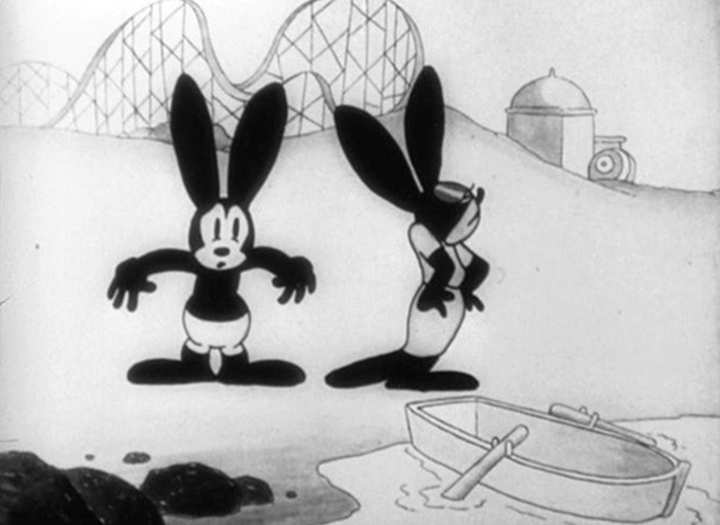









 Dr. Grob's Animation Review