Director: Charles Nichols Release Date:February 2, 1947 Stars: Pluto, Butch, The Little Turtle
Rating: ★★★ Review:
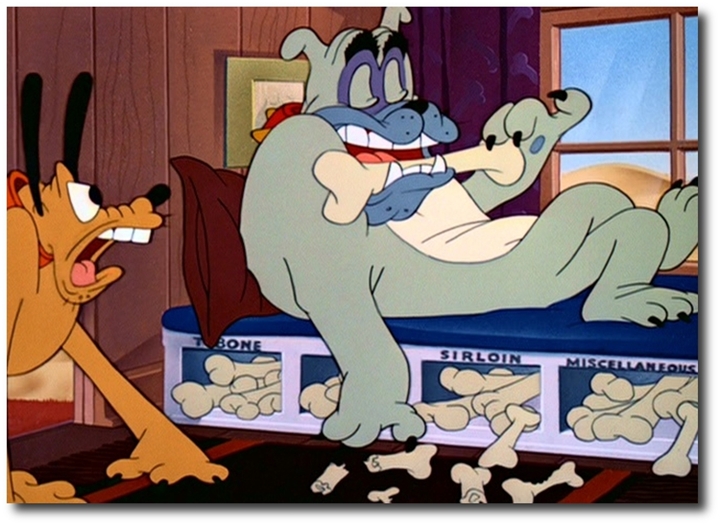
In ‘Pluto’s Housewarming’ Pluto’s got a new and very fancy home at the beach, but even before he moves in, it’s occupied by the little turtle from ‘Canine Patrol‘ (1945).
Pluto manages to dispose of the little fellow, but then bulldog Butch squats his house. Butch chases Pluto away, but he himself is chased away by the little turtle. In return, Pluto allows the little fellow to live in his mansion, too.
‘Pluto’s Housewarming’ is one of those numerous Pluto cartoons from the forties in which Pluto befriends a little animal, which he doesn’t like at first. The addition of Butch, however, brings in a new dimension. Nevertheless, this is cartoon is still rather cute than funny.
The little turtle would reappear in the equally cute and unfunny ‘Pluto’s Surprise Package‘ from 1949.
Watch ‘Pluto’s Housewarming’ yourself and tell me what you think:
This is Pluto cartoon No. 20
To the previous Pluto cartoon: The Purloined Pup
To the next Pluto cartoon: Rescue Dog
Director: Jack Hannah Release Date: June 7, 1946 Stars: Mickey Mouse, Pluto, Chip and Dale Rating: ★★★½ Review:
‘Squatter’s Rights’ is director Jack Hannah’s first of many cartoons starring Chip and Dale, who were introduced by Clyde Geronimi in ‘Private Pluto‘ in 1943. The two chipmunks are still interchangeable here. They would get real personalities in their next cartoon ‘Chip an’ Dale‘ (1947).
In this cartoon Chip and Dale live in a winter cottage, which is visited by Mickey and Pluto. Pluto soon discovers the jabbering duo, but Mickey never does. In the end Chip and Dale make Pluto and Mickey think Pluto’s been shot. In the final shot we can see Mickey running into the distance, carrying Pluto to a hospital, and leaving the cottage to the two little chipmunks.
‘Squatter’s ‘Rights’ is the first of only eight post-war Mickey Mouse cartoons. Mickey had had a short renaissance under director Riley Thompson in the early 1940s, but by 1946 he was once again reduced to a side character, at best co-starring with Pluto. ‘Squatter’s Rights’ is typical, with most of the screen time devoted to Pluto, Chip and Dale.
Jack Hannah would direct only one other Mickey Mouse cartoon: ‘Pluto’s Christmas Tree‘ (1952), which also features Chip ‘n Dale. Hannah’s appointed character was Donald Duck, whom he led through the last stage of his cinematic career. In this he would develop Chip n’ Dale into Donald Duck’s main adversaries.
Watch ‘Squatter’s Rights’ yourself and tell me what you think:
Director: Charles Nichols Release Date: May 10, 1946 Stars: Pluto, Dinah Rating: ★★★★ Review:
‘In Dutch’ is one of those rare cartoons set in Holland.
In ‘in Dutch’ Pluto is a milk-bringing dog in a very awkward, almost fairy tale-like picture of The Netherlands. He and his love, Dinah the dachshund, accidentally ring the alarm bell in their love play, and they get expelled from the village.
However, our couple saves the day, when Dinah stops a leak in the dyke and Pluto warns the villagers, albeit in an unorthodox way. This story idea is a nice take on the children’s book ‘Hans Brinker, or the Silver Skates’ (1865) by Mary Mapes Dodge. The result is a charming little story in an exotic setting.
Like Mapes Dodge, the animators had probably never visited The Netherlands themselves, for the country is erroneously depicted as surrounded by a huge dyke, behind which the sea is splashing. Further couleur locale is provided by numerous windmills, tulips and wooden shoes. The people in the cartoon speak with a weird accent, which is supposed to sound like Dutch, but which is more reminiscent of German.
Nevertheless, it’s hard to blame the makers for the cliches, for even the George Pal’s cartoon about Holland, ‘Tulips Shall Grow’ (1942), is crowded with windmills, tulips and wooden shoes. And George Pal had lived in The Netherlands for several years…
Watch ‘In Dutch’ yourself and tell me what you think:
This is Pluto cartoon No. 18
To the previous Pluto cartoon: Pluto’s Kid Brother
To the next Pluto cartoon: The Purloined Pup
Director: Charles Nichols Release Date: April 12, 1946 Stars: Pluto, Butch
Rating: ★★★½ Review:
Pluto’s family life has been treated mysteriously in his films.
Mostly, he is on his own, but in ‘Pluto’s Quin-Puplet’s (1937) he had five children, and in ‘Pluto Junior‘ (1942) only one. In ‘Pluto’s kid Brother’, without any explanation, Pluto suddenly has a smaller brother.
The little brat is full of mischief, causing trouble with a rooster, a mean red cat and even teaming up with Butch the Bulldog to get some sausages from the butcher’s shop. But Butch is not the type to share, and in the end Pluto has to save his brother, while Butch is caught by the dog catcher. However, there’s not too much moral to this story, for Pluto, too, fancies the loot: the sausages his little brother has stolen.
‘Pluto’s Kid Brother’ uses the same story idea as the 1936 Betty Boop cartoon ‘You’re Not Build That Way’ starring Pudgy, but with better results. ‘Pluto’s Kid Brother’ is a great improvement on ‘You’re Not Build That Way’: it’s better animated, less cloying, and more entertaining. The result is a nice cartoon, if by no means among Pluto’s best. It remains unknown whether the makers even knew the Betty Boop cartoon, at all.
The red alley cat would reappear in the Figaro cartoon ‘Bath Day’, six months later. Pluto’s little brother, on the other hand, would disappear again into nothingness, never to return to the screen.
Watch ‘Pluto’s Kid Brother’ yourself and tell me what you think:
This is Pluto cartoon No. 17
To the previous Pluto cartoon: Canine Patrol
To the next Pluto cartoon: In Dutch
In ‘Back Alley Oproar’ a sleepy Elmer Fudd is kept awake by Sylvester’s singing in his back alley.
Sylvester turns out to be a rather talented alley cat. His performance is quite infectious, and includes the famous Largo al factotum aria from Gioachino Rossini’s ‘Il barbiero di Seviglia’, Liszt’s second Hungarian Rhapsody (which he performs by stamping with heavy boots on the staircase), “You Never Know Where You’re Goin’ Till You Get There” and “Moonlight Bay”.
At last, Elmer tries to blow Sylvester to smithereens, but they are both killed, and on his way to heaven, Elmer is disturbed by Sylvester’s nine lives singing the Sextet from Gaetano Donizetti’s ‘Lucia di Lammermoor’.
‘Back Alley Oproar’ is one of director Friz Freleng’s cartoons in which he spreads his own love for music. He does so in a very entertaining way.
The cartoon was the first of only four Elmer Fudd-Sylvester pairings. Only Freleng coupled these two characters, although they did co-star in Chuck Jones’ ensemble film ‘The Scarlet Pumpernickel‘ (1950).
Watch an excerpt from ‘Back Alley Oproar’ yourself and tell me what you think:
Director: Bob Clampett Release Date: January 5, 1946 Stars: Daffy Duck
Rating: ★★★★ Review:
‘Book Revue’ is the last of the book-covers-come-to life cartoons, a series started by Harman and Ising in 1932, with ‘Three’s a Crowd’.
These cartoons, in which the book titles provide the gags, were mostly plotless, relying on puns and sight gags. ‘Book Revue’ is no exception, but it has the most swinging take on the formula one can wish for.
Set in ‘ye olden book shoppe’, ‘Book Revue’ contains caricatures of some famous (white) jazzmen of the era: Harry James, Frank Sinatra, Tommy Dorsey, Benny Goodman and Gene Krupa. There’s a scene resembling ‘The Swooner Crooner’ (1944), and foreshadowing ‘Little ‘Tinker’ (1948), in which several female characters swoon as soon as Sinatra starts singing. There’s a strong sense of sex here, as in an earlier scene involving ‘Indian strip’, affecting male characters. This places ‘Book Revue’ at the end of the World War II cartoon trends, for these allusions to sex would soon be discarded.
At a certain point Daffy Duck (jumping from a Merrie Melodies and Looney Tunes magazine cover) dresses himself as Danny Kaye (with a blonde wig). He interrupts the swing music to tell about a nonsensical tale of some Russian youth and a girl called Cucaracha. In this sequence Daffy imitates the Russian accent Kaye sometimes would explore. When ‘singing’ cucaracha the background suddenly changes into a startling monochrome red.
This absurd sequence is followed by Daffy singing ‘Carolina in the Morning’. Daffy immediately exchanges the song for some superb scat singing to warn Red Riding Hood for the Wolf. These two sequences form a highlight in Daffy’s career, and a real tour de force from voice actor Mel Blanc. The ‘story’, if there is any, involves Daffy being followed by the wolf from Red Riding Hood. In line with the book-covers-come-to-life tradition several personas from book covers come to help to get rid of the villain, sending the wolf to Dante’s inferno.
The animation of Daffy is extremely flexible in this cartoon, especially when animated by Rod Scribner and Manny Gould, who really push the limits here. At one point Daffy even converts into one big eye – probably the most extreme deformation of a major cartoon star ever put to screen.
‘Book Revue’ makes no sense at all, but it is a cartoon full of sheer joy, and a crowning achievement of the book series.
Watch an excerpt from ‘Book Revue’ yourself and tell me what you think:
This is Daffy Duck cartoon No. 31
To the previous Daffy Duck cartoon: Nasty Quacks
To the next Daffy Duck cartoon: Baby Bottleneck
‘Book Revue’ is available on the DVD-set ‘Looney Tunes Golden Collection Volume Two’ and on the Blu-Ray-set ‘Looney Tunes Platinum Collection: Volume 2’
In ‘Stage Door Cartoon’, the forest scene, in which Elmer is “fishing’ for a certain rabbit”, is soon replaced by an urban environment, where Bugs flees into a stage door. From then on, the action takes place in the theater.
The numerous gags involve a great tap dance by Bugs, a spectacular dive by Elmer from a ridiculously high ladder into an “ordinary glass of water” and Elmer watching a Bugs Bunny cartoon. ‘Stage Door Cartoon’ does not make any sense, but it’s full of gags, resulting in one of the funniest of all Bugs Bunny cartoons.
‘Stage Door Cartoon’ also features a Southern Sheriff who looks and sounds like an early version of Yosemite Sam, a Friz Freleng character who would make his debut only four months later.
Watch ‘Stage Door Cartoon’ yourself and tell me what you think:
Director: Dan Gordon Release Date: April 26, 1943 Stars: Superman
Rating: ★★★★★ Review:
The Superman cartoon ‘Jungle Drums’ blends the war theme with the adventure setting of ‘The Mummy Strikes‘.
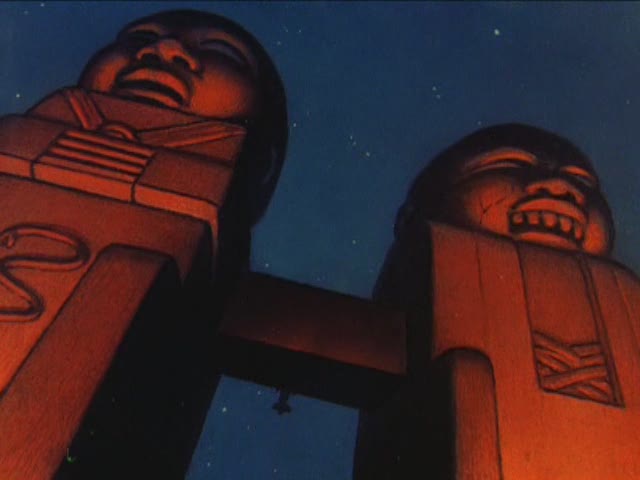
This time the setting is a vague African island, populated by scary natives who are under control of some mysterious Nazis. They shoot an American plane out of the sky, which contains Lois and some secrets concerning the American fleet. While the natives try to burn Lois, Clark Kent/Superman only arrives just in time to save her.
Superman beats the Nazis, while Lois warns the US Air Force against Nazi submarines threatening the fleet. The last shot is that of an angered Hitler listening to the radio how his plans were frustrated.
Although this short, like most Superman cartoons, contains a weak and badly built story, it stands out for its great shots of scary natives, with their original camera angles, stark color designs and large shadows. The end result is arguably Superman’s best film.
Watch ‘Jungle Drums’ yourself and tell me what you think:
This is Superman film No. 15
To the previous Superman film: The Mummy Strikes
To the next Superman film: Underground World
With ‘The Mummy Strikes’ the Superman series entered the realm of the adventure movie, albeit with rather unsuccessful results.
One doctor Jordan is mysteriously killed in the museum and Clark Kent is invited to investigate the murder. Lois follows him secretly. After a very lengthy explanation, four gigantic mummies come to life, but Superman defeats them in an all too short battle. This finale is not in proportion to the boring explanation scene preceding it.
In all, ‘The Mummy Strikes’ is one of the weaker entries in the Superman series, because of this ill-constructed story. Luckily, Superman’s next adventure, ‘Jungle Drums‘, would be much better.
Watch ‘The Mummy Strikes’ yourself and tell me what you think:
This is Superman film No. 14
To the previous Superman film: Destruction, Inc.
To the next Superman film: Jungle Drums
‘Destruction Inc’ was Superman’s third war cartoon, after ‘Japoteurs‘ and ‘Eleventh Hour‘ from earlier that year. Like ‘Japoteurs’ it features saboteurs on American soil, a paranoid idea, well-fed by government propaganda.
This time the danger comes from the inside: some American gangster saboteurs threaten a munition plant. Lois discovers them at a factory, but she’s captured and put inside a torpedo. Luckily Superman is in the neighborhood, not as Clark Kent, but as an elderly general. However, he only arrives just in time to rescue Lois from a certain death in a short that belongs to Superman’s more entertaining films.
‘Destruction, Inc’ opens with a shot of someone being murdered. Such a shot would open the next film, ‘The Mummy Strikes‘, too.
Watch ‘Destruction, Inc.’ yourself and tell me what you think:
Director: Dan Gordon Release Date: November 20, 1942 Stars: Superman
Rating: ★★★ Review:
‘Eleventh Hour’ is Superman’s second war cartoon, after ‘Japoteurs‘ from earlier that year. It’s one of the earliest World War II cartoons dealing with Japan.
In this short Superman himself is the saboteur, destroying ships, bridges, airports and tanks in Yokohama, Japan. The furious Japanese capture Lois, who stays with Clark Kent in Japan, and threaten Superman to execute her if he doesn’t stop his sabotage.
Superman reads this ultimatum all but too late and he’s only just in time to rescue Lois from the firing squad. Lois returns home, but Clark Kent stays behind, implying that Superman keeps on doing his sabotage work, a message that must have been comforting to the home-front.
The story of this cartoon is quite original, if not very well-constructed. Unfortunately, by now Superman has been reduced to an expressionless figure, making him a boring character to watch.
Watch ‘Eleventh Hour’ yourself and tell me what you think:
This is Superman film No. 12
To the previous Superman film: Showdown
To the next Superman film: Destruction, Inc.
In an original twist to the Superman formula, a sneaky fake Superman steals jewelry for his gangster boss.
Meanwhile Lois and Clark have to report an opera performance. Luckily, the fake superman is there, too, pickpocketing the attendants. Superman captures his look-alike and his boss.
‘Showdown’ clearly has the most original story line of all superman cartoons, and this makes the short arguably the best entry of the series. At least the cartoon contains the funniest line in the series, when Lois makes Clark Kent the sarcastic remark “fine Superman you‘d make”.
Watch ‘Showdown’ yourself and tell me what you think:
This is Superman film No. 11
To the previous Superman film: Japoteurs
To the next Superman film: Eleventh Hour
Director: Dave Fleischer Release Date: August 26, 1942 Stars: Superman
Rating: ★★★ Review:
In ‘Terror on the Midway’ Lois is reviewing something as mundane as a circus, when a small monkey accidentally releases a titanic gruesome gorilla.
The gorilla follows her, while Superman’s busy putting other animals back into their cages. He rescues Lois and captures the gorilla, but it remains unclear how he stops the fire that has started, too.
‘Terror in the Midway’ is one of those fortunate Superman shorts without a villain (see also ‘The Arctic Giant’ and ‘Volcano‘ from the same year). However, it also shows Fleischer’s ambivalent realism: it contains some generic Fleischer thirties children designs, which by 1942 really look old-fashioned, but there are also some rare close-ups of Lois and Superman, which add to the drama. The staging, too, is superb, with some spectacular shots.
The gorilla looks like a typical King Kong-like monster, despite the fact that its model sheet was partly based on rotoscoped movements of real gorillas. Apparently, Bambi-like naturalism was wasted on the Fleischers animators.
gorilla modelsheet from ‘Terror on the midway’
Unfortunately, ‘Terror on the Midway’ would be the last Superman cartoon made by the Fleischer studios, before Paramount stole their crew to form their own Famous Studios. Indeed, it was the very last film the Fleischer brothers made together, ending an era that had begun 27 years earlier.
Watch ‘Terror on the Midway’ yourself and tell me what you think:
This is Superman film No. 9
To the previous Superman film: Volcano
To the next Superman film: Japoteurs
Director: Dave Fleischer Release Date: July 17, 1942 Stars: Superman
Rating: ★★★ Review:
In the aptly titled short ‘Volcano’, a dormant volcano is starting to erupt again on the island of Monokoa.
Daily Planet reporters Lois and Clarke are present, but Lois steals Clark’s press pass to work alone. She sneaks away to visit the volcano by herself, but when she’s up on the volcano, it suddenly erupts. Superman saves her and the village below by redirecting the lava to the other side.
Together with ‘The Arctic Giant’ and ‘Terror on the Midway‘, ‘Volcano’ is noteworthy for featuring no villain, let alone an evil scientist. Moreover, this Superman short probably contains the most spectacular effect animation within the series in its terrifying depiction of floating lava.
Watch ‘Volcano’ yourself and tell me what you think:
In the seventh Superman short New York is threatened by – whattaya know? – an evil scientist. But this evil scientist is more original than all the others before him: he is of Native American origin and he claims Manhattan for his own people.
Nonetheless, like all other evil scientists before him, he has a machine. His ridiculous machine causes earthquakes by using electricity. Oddly enough, the scientist first makes his threats at the Daily Planet. And when he returns to his secret hideout, Lois, of course, follows him. In his laboratory below sea level the scientist makes Lois watch the destruction of the city.
Luckily, Superman saves Manhattan by destroying the machine. However, he’s only able to rescue Lois because the scientist tells him that she’s still down in his laboratory, which is rapidly filling with water…
In any case the result is yet another routine entry.
Watch ‘Electric Earthquake’ yourself and tell me what you think:
This is Superman film No. 7
To the previous Superman film: The Magnetic Telescope
To the next Superman film: Volcano
Director: Dave Fleischer Release Date: April 24, 1942 Stars: Superman
Rating: ★★ Review:
In ‘The Magnetic Telescope’, the sixth entry in the Superman series, yet another evil scientist attracts ‘flaming comets’ with a ridiculously looking magnetic telescope.
As one comet has destroyed part of the city, the police tries to stop the villain from hauling in another one. But their attempts make the professor lose control over the comet, and while destruction is at hand, Lois phones the Daily Planet from the laboratory. When her call ends in a scream, Clark Kent rushes… er… takes a cab to the laboratory. Only when the cab is stopped by one of the comet’s offshoots, he changes into Superman and flies up there…
Superman, of course, saves the day. He first tries to stop the comet itself (which falls remarkably slowly), but surprisingly, this is too much for him, and his antics produce more offshoots, which destroy bridges and such. So, in a bright moment he restores power to the magnetic telescope, telling Lois to put the machine on ‘reverse’… (how Superman came to know how the telescope works, we’ll never know…).
The whole story is amazingly ridiculous, especially because the story is told in the most sincere fashion. It shows the Fleischer studio’s discomfort with realism all too clearly.
The all too powerful comet is a minor surprise within the formulaic Superman series. But ‘The Magnetic Telescope’ has two other deviations from the story formula: in this entry Clark Kent doesn’t say his usual ” this looks like a job for Superman”,’ and Lois manages to kiss Superman, who, unfortunately turns out to be Clark Kent, after all…
Watch ‘The Magnetic Telescope’ yourself and tell me what you think:
Director: Dave Fleischer Release Date: March 26, 1942 Stars: Superman
Rating:★★ Review:
Although it’s only the fifth Superman cartoon, ‘The Bulleteers’ already feels so formulaic, it’s depressing.
Like in Superman’s first two cartoons some evil scientists with some crazy machine threaten the city, Lois gets into trouble, superman saves her and Clark Kent discusses her story in the newspaper with her. This time the novelty is that we’re watching three villains.
The evil trio has invented a ‘bullet car’ (part car, part plane, part rocket), with which they destroy the police headquarters and a power-plant by flying through it. Lois foolishly climbs aboard the car, but Superman drags her and the villains out of it in flight.
The spectacular angular staging and effective lighting in this cartoon cannot hide the fact that with ‘The Bulleteers’ the series had reached an inspirational low point story-wise. Later in 1942, the war became a major theme in the Superman series, which fortunately led to more inspired story ideas.
Watch ‘The Bulleteers’ yourself and tell me what you think:
This is Superman film No. 5
To the previous Superman film: The Arctic Giant
To the next Superman film: The Magnetic Telescope
Director: Dave Fleischer Release Date: November 21, 1941 Stars: Superman
Rating: ★★★½ Review:
‘The Mechanical Monsters’ was Superman’s second cartoon, and it is almost a copy of the first one.
Again, there’s an evil scientist, this time a jewel thief, who robs jewelry using huge flying robots. Again, Lois gets herself into trouble by her curiosity and, again, after Superman has saved the day, Lois and Clark discuss Lois’s article in the newspaper.
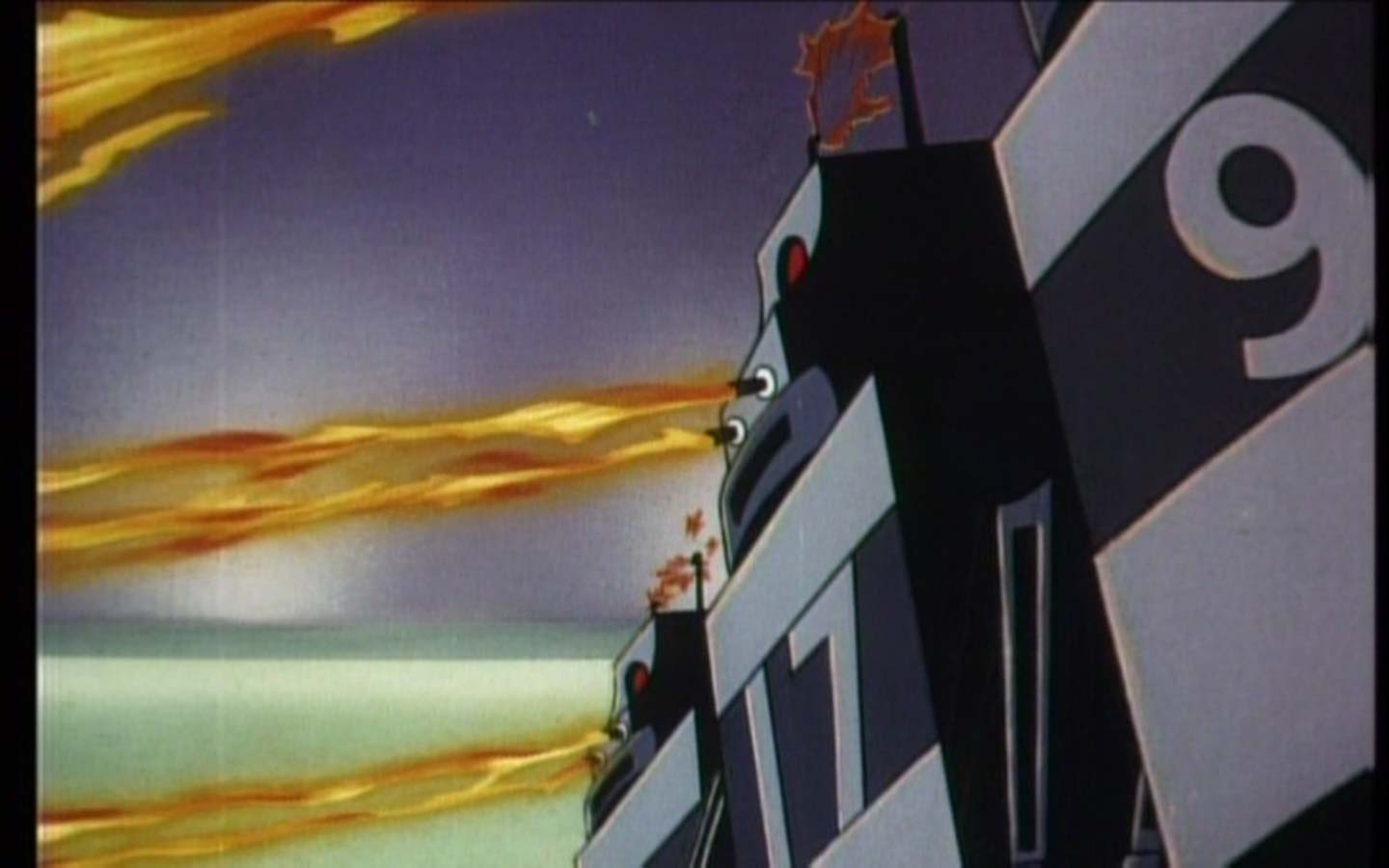
This copying of a formulaic story format is the main weakness of the Superman series, and it’s saddening to see it already happening in the second cartoon. Luckily, the execution of the formula is better than in the first cartoon. This evil scientist is drawn more realistically, and the sidekick has gone. The elaborate intro has been shortened into a few seconds, leaving more room for the story. Moreover, watching Superman knocking down giant robots is more enjoyable than watching him defeating a ray.
Watch ‘The Mechanical Monsters’ yourself and tell me what you think:
This is Superman film No. 2
To the previous Superman film: Superman
To the next Superman film: Billion Dollar Limited
Director: Dave Fleischer Release Date: September 26, 1941 Stars: Superman
Rating: ★★★ Review:
‘Superman’ is the first Superman cartoon, the very first cartoon series to feature realistic characters, and the Fleischer Studio’s most ambitious cartoon series.
Superman, of course, was based on the comic strip hero who made his debut in 1938. For his screen debut, the studio made a long introduction of the character, which lasts almost two minutes.
After this intro a very simple story develops, which contains many elements to be reused in later Superman cartoons, becoming a routine all too soon:
1) an evil scientist
2) something big to beat (in this cartoon a deadly ray, which Superman ridiculously punches away)
3) Lois getting intro trouble due to her curiosity, and
4) an ending with Lois and Clarke reading a newspaper article written by Lois Lane.
Despite elaborate shadows and special effects, this first realistic theatrical cartoon (not counting the works by Winsor McCay) hasn’t aged very well. The scientist is still half cartoony, and he has an animal sidekick, which mimics his moves.
The rest of the characters are drawn realistically, but also stiff and expressionless. They look forward to the wooden realistic cartoons of the TV era. The character was very popular, however, and inspired a couple of parodies, most notably the Bugs Bunny cartoon ‘Super Rabbit’ (1943). It’s ironic that after Popeye the Fleischer again had to rely on a character created elsewhere to achieve success. Unfortunately, this meant they couldn’t exploit Superman’s popularity as much as they could have with a character of their own.
Superman would star in seventeen cartoons, all from 1941-1943, nine by the Fleischer Studios, and eight by its successor, Famous studios. In 1943 the series was dropped because it was too costly to produce.
Watch ‘Superman’ yourself and tell me what you think:
Both propaganda shorts Disney released in January 1943, ‘Der Fuehrer’s Face‘ and ‘Education for Death’, were the most powerful propaganda the studio ever released. However, the two couldn’t be more different: while ‘Der Fuehrer’s Face’ is an outrageously funny satire, ‘Education for Death’ is, some funny scenes notwithstanding, the most unsettling short the studio ever released. Its general tone is black, grim and its purpose is to shock, not to entertain.
Based on a book by Gregor Ziemer, ‘Education for Death’ tells us how Hans, a typical German boy, is indoctrinated by the rulers of the Third Reich. The short is conceived in a quasi-documentary style. The narrator makes us believe that the scenes we’re watching, are happening right before our eyes, and unlike any other cartoon of the period, the Germans speak real German, which is translated by the narrator.
Moreover, most of the human designs are quite realistic, with Hans’s mother, animated by Milt Kahl, being the acme in human naturalism by the studio thus far. On the other hand, all scenes are heavily dramatized, using colors like red and black, vast shadows, and extreme camera angles, which depict every Nazi as a towering and threatening figure.
In the beginning we are still allowed to laugh at a ridiculous version of Sleeping Beauty, in which Hitler, dressed like a ‘handsome knight’ rescues a fat, Valkyrie-like Germany from an evil witch (said to be democracy). But after the school scene, the short turns decidedly black, with images of book burning, a bible being replaced by ‘Mein Kampf’ and Jesus by a Nazi sword. In the final scene, Hans has grown into a grim soldier, who, wearing chains, blinders and a muzzle, marches to his own death. No matter how blatant this propaganda short is, this is one of the most disturbing endings of an animated film ever put on screen.
Watch ‘Education for Death’ yourself and tell me what you think:
‘Education for Death’ is available on the DVD-set ‘Walt Disney Treasures: On the Frontlines’
Animation Backgrounds
A blog dedicated to background paintings from animation films. Kept until 2016.
Animation Scoop
Animation historian Jerry Beck’s animation film news blog.
Cartoon Brew
Topical blog on animation film, led by animation historian Amid Amidi.
Cartoon Modern
Amid Amidi’s blog on modern design cartoon art from the forties, fifties and sixties.
Cartoon Research
THE site on classic animation research, hosted by cartoon historian Jerry Beck.
Cartoons Theory
Frank Beef analyzes classic cartoons. Kept until 2020.
Century Film Project
Michael reviews films of 100 years old and older, roughly in chronological order.
Classic Cartoons
A similar blog featuring many stills and comic strips. Kept until 2012.
Comet over Hollywood
Jessica Pickens reviews classic Hollywood films, especially musicals.
Deja View
Top ex-Disney animator Andreas Deja’s own blog.
Disney History
Esteemed Disney historian Didier Ghez on the latest books on Disney history.
Feeling Animated
Paul Astell brings us thorough reviews of animated features.
Flickers in Time
Short and to the point reviews of classic films (lately mostly pre-code talkies) by an anonymous retired Foreign Service Officer from California

 In ‘Pluto’s Housewarming’ Pluto’s got a new and very fancy home at the beach, but even before he moves in, it’s occupied by the little turtle from ‘Canine Patrol‘ (1945).








 Dr. Grob's Animation Review