Director: Clyde Geronimi
Release Date: May 22, 1942
Stars: Pluto
Rating: ★★★
Review:

The Army Mascot © Walt Disney‘The Army Mascot’ is the first of two World War Two cartoons starring Pluto (the other one being ‘Private Pluto‘ from 1943).

Pluto never gets really involved in the war, though, he only joins the army. He was the second Disney character to do so, following Donald Duck, who had been drafted only three weeks earlier, in ‘Donald Gets Drafted‘.

However, Pluto’s reasons to join the army are doubtful, to say the least: only when he sees the enormous portions of meat an army mascot gets, he wants to be one, too. He tries to replace “Gunther Goat”, mascot of the Yoo-hoo Division, but all he gets is cans. In his second attempt he tries to chew tobacco like Gunther can, to impress the soldiers. But Gunther makes Pluto swallow the whole piece, making him sick. This sequence is the highlight of the cartoon, as Pluto’s sickness is animated in the most ridiculous way.

Gunther then tries to finish his rival off by bumping Pluto into the munition depot, but it’s Gunther himself who bumps into the depot, which explodes, blasting the wicked goat up into the air, where he’s caught by a plane and carried away into the distance. Now Pluto takes Gunther’s place, and gets his steak after all.

‘The Army Mascot’ is a rather odd cartoon, where both main characters show unpleasant behavior: Pluto envy and trickery and Gunther haughtiness and wrath. Thus, ‘The Army Mascot’, although war-themed, can hardly be called a patriotic film.

Watch ‘The Army Mascot’ yourself and tell me what you think:

This is Pluto cartoon No. 6
To the previous Pluto cartoon: Pluto Junior
To the next Pluto cartoon: The Sleep Walker
Director: Władysław Starewicz
Release Date: 1922
Rating: ★★★★★
Review:

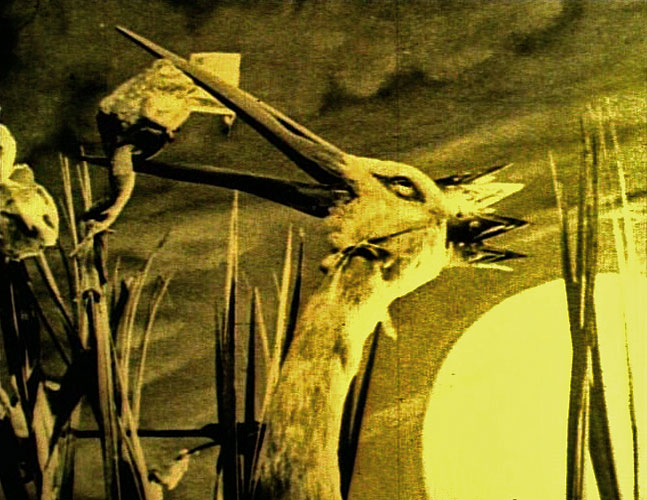
The Frogs Who Wanted a King © Ladislav StarewiczAfter the October revolution, Władysław Starewicz fled to France, where he continued to make stop motion films until his death in 1965. ‘The Frogs Who Wanted a King’ is the fourth film he made in France, and probably his most political.

The film is based on one of Aesop’s fables. Some frogs ask Jupiter for a king. Jupiter sends them one, but the king looks like a tree and does nothing at all. The frogs don’t like him, so Jupiter sends them a stork, who, naturally, eats the unfortunate amphibians.

The message may be that it’s better to have a dull government than one that kills you, a message Starewicz could certainly relate to, being forced to exile by the oppressing communist regime in Russia.

Once again, Starewicz’ animation is top notch. The film has a particularly fable-like character, taking place in its own, very convincing universe.

Watch ‘The Frogs Who Wanted a King’ yourself and tell me what you think:

Director: Władysław Starewicz
Release Date: 1913
Rating: ★★★½
Review:

The Insects' Christmas © Ladislav Starewicz‘The Insects’ Christmas’ is Starewicz’s next film after his masterpiece ‘The Cameraman’s Revenge‘.

Although the short uses insects again, it’s a whole different film, turning to the sweet subject of Christmas. It’s probably the first animated film about Christmas ever made.

The plot is surprisingly simple: Father Christmas climbs down a Christmas tree, awakes some insects and a frog, who are hibernating underground, and he invites them to a Christmas party. He gives them presents and they all go skiing and skating.

This film’s story cannot be compared to the mature plot of ‘The Cameraman’s revenge‘. It’s more like a child’s dream of Christmas. The film reuses puppets from ‘The Cameraman’s Revenge’ and others, and even though the animation is less engaging than in Starewicz’s earlier film, it is still of a stunning virtuosity, making the result still a delight to watch. Note, for example, the illusion of wind in the animation of Father Christmas’s coat.

Watch ‘The Insects’ Christmas’ yourself and tell me what you think:

‘The Insects’ Christmas’ is available on the DVD ‘The Cameraman’s Revenge & other Fantastic Tales’

Director: Władysław Starewicz
Release Date: November 9, 1912
Rating: ★★★★★ ♕
Review:

The Cameraman's Revenge © Ladislaw Starewicz‘The Cameraman’s Revenge’ is one of the earliest animation films ever made, and a very early masterpiece (it predates ‘Gertie the Dinosaur‘ by two years). Surprisingly, it’s a film about adultery involving insects.

The plot of this stop motion film is as follows: Mr. Beetle commits adultery with a dragonfly, who is a dancer at a nightclub. Unbeknownst to him his secret behavior is filmed by a rival grasshopper who happens to be a cameraman. Meanwhile, Mrs. Beetle also commits adultery, with a beetle who is also a painter. But they’re discovered by Mr. Beetle on his arrival home. Mr. Beetle chases the painter out of his house. Nevertheless he forgives his wife and takes her to the cinema. However, the film that is shown reveals his infidelity, which creates a riot and the married couple ends in jail for destroying the movie box.

‘The Cameraman’s Revenge’ is an extraordinary film, and without doubt one of the first masterpieces of animation. Unlike Émile Cohl’s stop motion, Starewicz’s animation is stunning and very convincing. The insects are very lifelike, and move surprisingly realistically. The insects’ gestures are subtle, clearly evoking their emotions. For example, there’s a beautiful and very lifelike little scene of a beetle servant lighting the fireplace, animated without any hint of overacting. On the other hand, Mr. Beetle clearly is a brute, but we can also watch him in a seductive mood.

Throughout, Starewicz’s storytelling is economical and mature. The film’s subject is highly original for an animation film, even today. It’s almost unbelievable that such a modern film was made in Czarist Russia.

Watch ‘The Cameraman’s Revenge’ yourself and tell me what you think:

‘The Cameraman’s Revenge’ is available on the DVD ‘The Cameraman’s Revenge & other Fantastic Tales’

Director: Vyacheslav Kotyonochkin
Release Date: 1967
Rating: ★★★
Review:

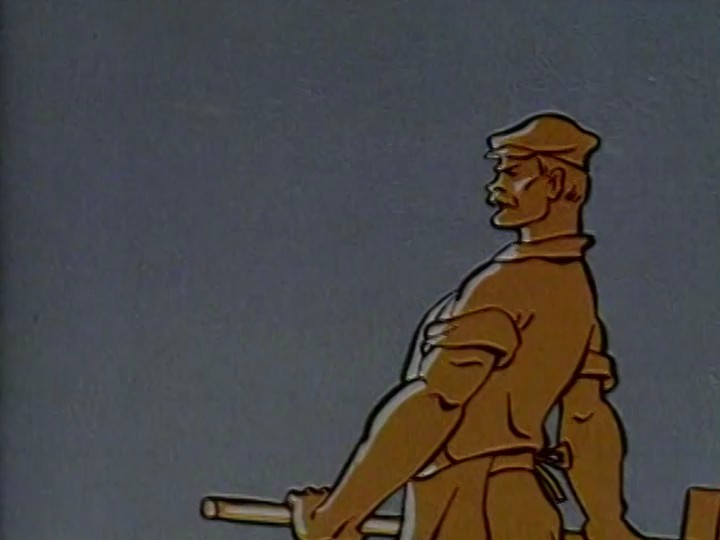
Prophets and Lessons © Soyuzmultfilm‘Prophets and Lessons’ is a Soviet propaganda film. It tells us how every time the Western world predicted the Soviet Union to fail, but that these predictions never came true.

Its chapters are all conceived in the same order: first we see animated capitalist predict something, then we see a giant Soviet blacksmith strike his mighty hammer and finally we see live action footage of the Soviet Union’s successes.

The separate chapters are the Soviet revolution, the civil war, the five year plans, the Second World War, the reconstruction after the war and the Soviet space program. The action is silent, and the imagery rather outdated (more like that of the 1920s than of the 1960s).

‘Prophets and Lessons’  is one of the most obviously propagandistic animation films ever made in the Soviet Union. Its overtly propagandistic message, its repetitive character, and its outdated symbolism make it rather tiresome to watch.

Surprisingly, two years later, the director of this humorless film, Vyacheslav Kotyonochkin, would launch a successful series of comic cartoons, called ‘Ну, Погоди!’ (‘Just Wait!’), featuring a very cartoony wolf.

Watch ‘Prophets and Lessons’ yourself and tell me what you think:

‘Prophets and Lessons’ is available on the DVD box set ‘Animated Soviet Propaganda’

Director: Vitold Bordzilovsky
Release Date: 1966
Rating: ★★★½
Review:

Proud Little Ship © Soyuzmultfilm‘Proud Little Ship’ is a Soviet propaganda film, which is clearly directed to children.

Three little boys make a small red ship as a copy of the famous cruiser ‘The Aurora’. This little ship sails the seas and is greeted with enthusiasm among all the people of the world.

There are some mean militarists who try to destroy the little ship, but they do not succeed. These militarists are drawn extremely silly, while the rest of the people are drawn rather realistically and appear as noble and gentle. Nevertheless, these drawing styles blend surprisingly well. Moreover the design and choreography of movement is often gorgeous.

All the action is silent, while the story is told by a narrator, who provides the clearest propagandistic message of the film: “the proud little ship sailed as a messenger of a happy life, which, as spring after winter, would certainly come to all people”.

Although ‘Proud Little Ship’ is overtly propagandistic, it’s also an enjoyable and beautiful film. One almost forgets that the message is not concerning world peace, but the ‘glorious’ communist revolution…

Watch ‘Proud Little Ship’ yourself and tell me what you think:

‘Proud Little Ship’ is available on the DVD box set ‘Animated Soviet Propaganda’

Director: Gerry Chiniquy
Release Date: June 13, 1967
Stars: The Pink Panther
Rating: ★
Review:

Jet Pink © DePatie-FrelengIn ‘Jet Pink’ the Pink Panther enters a secret airport and climbs in test jet X13, which immediately goes astray.

This cartoon marks former Warner Brothers animator Gerry Chiniquy’s debut as a director. Unfortunately, it’s far from an overnight success: ‘Jet Pink’ is inconsistent, and rather unfunny.

The cartoon reuses the ‘count to ten and pull string’ gag from ‘Goofy’s Glider‘ (1940), but its execution is terrible when compared to the original.

Watch ‘Jet Pink’ yourself and tell me what you think:

Director: Hawley Pratt
Release Date: May 18, 1967
Stars: The Pink Panther, The Little Guy
Rating: ★★★
Review:

In the Pink © DePatie-FrelengIn ‘In The Pink’, weirdly enough, the Pink Panther is getting fat. So, our pink hero tries his luck at the gym, where he hinders the little guy a great deal.

‘In the Pink’ is an average Pink Panther cartoon, consisting of blackout gags, the most bizarre one being a chicken hatching a punching ball. The opening sequence reuses animation from ‘Pink Panic’ from earlier that year.

Watch ‘In the Pink’ yourself and tell me what you think:

Director: Hawley Pratt
Release Date: May 17, 1967
Stars: The Pink Panther, The Little Guy
Rating: ★★★★★
Review:

Pink of the Litter © DePatie-FrelengIn ‘Pink of the Litter’, the Pink Panther is punished for littering by the little guy, who, in this cartoon, stars as a cop, a judge, a ranger, a fireman and a mayor. The Pink Panther has to clean ‘Litterburg’ from its rubbish. His methods include ‘instant shrink’ and making a giant paper plane out of the litter.

This is an original cartoon with a great story using blackout gags, building up to a great finale. The very idea of the little guy appearing in different functions is brilliant. In short, ‘Pink of the Litter’ is easily one of the best Pink Panther cartoons.

Watch ‘Pink of the Litter’ yourself and tell me what you think:

Director: Chuck Jones
Airing Date: December 18, 1966
Rating: ★★★★★
Review:

How The Grinch Stole Christmas © MGM‘How The Grinch Stole Christmas’ is a wonderful Christmas cartoon. The Christmas of a little town called the Whoville is threatened by a green character called the Grinch, who disapproves of Christmas, and particularly the noise involved. He decides to ‘steal’ Christmas from the little creatures, but then he discovers that Christmas is not restricted to objects.

This special, lasting 26 minutes, is one of Chuck Jones’s productions for MGM television. It’s a very faithful and beautiful reading of the classic Dr. Seuss children’s book, keeping Dr. Seuss’s rhymes and faithfully reproducing its designs, but extending those by long and beautiful silent comedy scenes and Jones’s wonderful facial expressions, to even better results.

Especially the Grinch himself is a wonderfully expressive character. In him Jones’ mastery of facial expression reaches its apex. Particularly amazing is the scene in which the Grinch thinks up his evil plan, making his face curl with wickedness.

The story is told by Boris Karloff’s grim voice, and it contains two songs: a rather annoying Christmas song sung by the Whos and an odd song describing the meanness of the Grinch. While we hear this song, we see the Grinch steal every Christmas item in Whoville.

All in all, it’s a classic. It’s arguably the best Dr. Seuss adaptation ever, and certainly one of the best Christmas cartoons ever made. It’s certainly better than the rather annoying live action remake from 2000.

Watch ‘How The Grinch Stole Christmas’ yourself and tell me what you think:

https://myspace.com/171601491/video/how-the-grinch-stole-christmas/47941731

Director: Hawley Pratt
Release Date: April 26, 1967
Stars: The Pink Panther, The Little Guy
Rating: ★★★★
Review:

Pink Posies © DePatie-Freleng‘Pink Posies’ could be summarized as ‘The Pink Phink‘ set in a garden: this time the little guy is a gardener planting yellow flowers, while the Pink Panther replaces them for pink ones.

Most of the gags are variations on those in ‘The Pink Phink’, which make this cartoon a very enjoyable one, even though it’s not very original. The designs of this cartoon are also attractive, the very stylized trees in the background in particular.

Watch ‘Pink Posies’ yourself and tell me what you think:

https://www.dailymotion.com/video/x36nrng


‘Pink Posies’ is available on the DVD Box set ‘The Pink Panther Cartoon Collection’

Director: Abe Levitow
Release Date: August 4, 1966
Stars: Tom & Jerry
Rating: ★
Review:

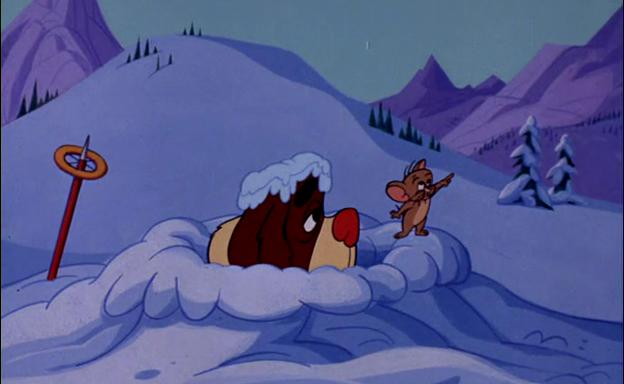
A-Tom-inable Snowman © MGM ‘The A-Tom-inable Snowman’ is as abominable as the snowman’s supposed to be: it’s painfully bad and unfunny.

The cartoon has nothing to do with yetis, however. It is set in the alps and involves a helpful St. Bernard. The only surprise is that the titles roll in after 1’22.

Watch ‘The A-Tom-inable Snowman’ yourself and tell me what you think:

This is Tom & Jerry cartoon No. 151
To the previous Tom & Jerry cartoon: Matinee Mouse
To the next Tom & Jerry cartoon: Catty Cornered

Director: Tom Ray
Release Date: July 14, 1966
Stars: Tom & Jerry
Rating: ★
Review:

Matinee Mouse © MGMIn ‘Matinee Mouse’ Tom and Jerry make peace and go watch their own cartoons together in a cinema. Of course, the truce doesn’t last long.

‘Matinee Mouse’ is a compilation cartoon, and a very cheap and terrible one, too. It uses footage of the classic Hanna/Barbera entries, but these are set to new sound effects and new music by Don Elliott. The gruesome result is easily one of the worst Tom and Jerry cartoons ever. Its director, Tom Ray (1919-2010), directed only one other Tom & Jerry cartoon, ‘Shutter Bugged Cat‘ (1967). That one is also a compilation cartoon, and arguably just as terrible.

Watch ‘Matinee Mouse’ yourself and tell me what you think:

This is Tom & Jerry cartoon No. 150
To the previous Tom & Jerry cartoon: Fillet Meow
To the next Tom & Jerry cartoon: A-Tom-inable Snowman

Director: Abe Levitow
Release Date: May 5, 1966
Stars: Tom & Jerry
Rating: ★★½
Review:

Puss 'n' Boats © MGMIn ‘Puss ‘n’ Boats’ Tom is a coastal guard trying to stop Jerry from entering a ship full of cheese. Surprisingly, this is a continuing story containing no black-out gags.

Unfortunately, the designs and animation are both weak, as is the music by first-timer Carl Brandt. The cartoon does contain some clever ideas, but they never get funny.

Watch ‘Puss ‘n’ Boats’ yourself and tell me what you think:

http://tune.pk/video/23936/Tom-And-Jerry-Puss-N-Boats-Episode-147

This is Tom & Jerry cartoon No. 148
To the previous Tom & Jerry cartoon: Love, Love My Mouse
To the next Tom & Jerry cartoon: Fillet Meow

Director: Abe Levitow
Release Date: June 30, 1966
Stars: Tom & Jerry
Rating: ★★
Review:

Fillet Meow © MGMIn ‘Fillet Meow’ Tom is after a goldfish, who looks a little like Chloe from ‘Pinocchio‘ (1940). Of course Jerry tries to protect the cute little fish.

‘Fillet Meow’ was the third Tom & Jerry cartoon directed by Abe Levitow and by now quality standards had dropped almost to the level of the Gene Deitch Tom & Jerry shorts. The result is rather awful, and nowhere near the quality of the similar ‘Jerry and the Goldfish‘ (1951).

Watch ‘Fillet Meow’ yourself and tell me what you think:

http://onlineplayer.eu/Tom-and-Jerry/filet-meow-148.html

This is Tom & Jerry cartoon No. 149
To the previous Tom & Jerry cartoon: Love, Love My Mouse
To the next Tom & Jerry cartoon: Matinee Mouse

Director: Chuck Jones & Ben Washam
Release Date: April 28, 1966
Stars: Tom & Jerry
Rating: ★★★
Review:

Love, Love My Mouse © MGMTom gives Jerry to his beloved, but she takes pity on the poor little mouse and protects him against Tom.

Jerry takes advantage of the situation, however, never stopping at putting the blame on Tom. Then, in the end, the puss’s love changes into hunger…

This is a very Chuck Jonesy cartoon, with loads of his wonderful trademark elegant designs and strong facial expressions. These solely make this cartoon one of the better entries in the series.

Watch ‘Love, Love My Mouse’ yourself and tell me what you think:

This is Tom & Jerry cartoon No. 147
To the previous Tom & Jerry cartoon: Jerry-Go-Round
To the next Tom & Jerry cartoon: Puss ‘n’ Boats

Director: Abe Levitow
Release Date: March 3, 1966
Stars: Tom & Jerry
Rating: ★
Review:

Jerry-Go-Round © MGM ‘Jerry-Go-Round’ is staged at a circus: Jerry helps a circus elephant, who in turn protects Jerry from Tom.

This rather dull and unfunny cartoon marks the debut of animator Abe Levitow as a Tom & Jerry director. It is not a success. Levitow was an experienced director: in 1959 he had directed several Warner Brothers cartoons, and at UPA he had directed Mr. Magoo television specials, and the studio’s second feature, Gay-Purree (1962). Yet, this experience is hard to detect in ‘Jerry Go-Round’: both the designs, the timing and the animation are inferior to those in the cartoons directed by Chuck Jones himself.

Watch ‘Jerry-Go-Round’ yourself and tell me what you think:

This is Tom & Jerry cartoon No. 146
To the previous Tom & Jerry cartoon: Jerry, Jerry Quite Contrary
To the next Tom & Jerry cartoon: Love, Love My Mouse

Director: Hawley Pratt
Release Date: December 23, 1966
Stars: The Pink Panther, The Little Guy
Rating: ★★★
Review:

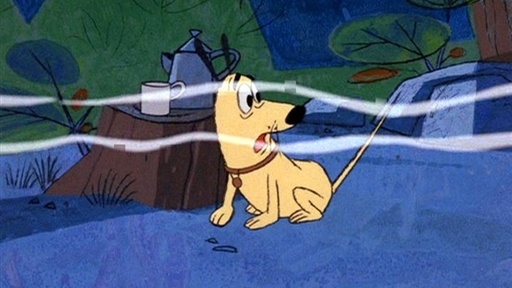
Rock-A-Bye Pinky © DePatie-FrelengIn ‘Rock-a-bye Pinky’ the little guy is camping out, but his snoring troubles the Pink Panther, who’s sleeping in the tree above.

The Pink Panther tries to get rid of the little guy, but it is the little guy’s dog who gets the blame. When finally man and dog discover that the Pink Panther is the real cause of their trouble, they chase him out of the park into the distance.

‘Rock-A-Bye Pinky’ is one of the better Pink Panther cartoons: it has a good story and some great gags. The dog would reappear in ‘Pink Paradise’, the following year.

Watch ‘Rock-A-Bye Pinky’ yourself and tell me what you think:

Director: Jan Švankmajer
Release Date: 1967
Rating: ★★★★★
Review:

Historia Naturae, Suita © Jan Svankmajer‘Historia Naturae, Suita’ is an abstract, yet morbid and disturbing film.

It uses drawings, models, skeletons, stuffed and live animals, which change into each other and which perform morbid dances. Their antics are interspersed with a close up of a man eating meat.

We see molluscs (Aquatilia, foxtrot), insects (Hexapoda, bolero), fish (Pisces, blues), reptiles (Reptilia, tarantella), birds (Aves, tango), mammals (Mammalia, menuet), monkeys (Simiae, polka) and man (Homo, waltz), successively.

It shows us that we, men, are made from the same mortal matter as the rest of the animal kingdom, which in this film appear to us only as collectibles or food. This unsettling reminder is emphasized by the last shot, in which the human is replaced by a skull, eating…

The music is a perfect match to the surrealistic imagery, with its rather abstract, uncanny and atonal renderings of the dance forms mentioned.

Watch ‘Historia Naturae, Suita’ yourself and tell me what you think:

http://www.totalshortfilms.com/ver/pelicula/379

‘Historia Naturae, Suita’ is available on the DVD ‘Jan Svankmajer – The Complete Short Films’

Director: Jan Švankmajer
Release Date: 1966
Rating: ★★★★★
Review:

Et Cetera © Jan SvankmajerIn ‘Et Cetera’ three faceless human figures demonstrate repetitive and aimless actions.

The first shows how to fly with wings, only to reach his own starting point. The second transforms himself into the animal he’s training using a whip, and the third keeps on drawing houses he cannot enter or leave.

Unlike most of Jan Švankmajer’s films, ‘Et Cetera’ uses 2d animation. It’s a clever and somehow saddening film: although the three little stories are extremely simple, they seem to tell something about the condition humaine. ‘Et Cetera’ uses great electronic music, which adds to the surrealistic atmosphere.

Watch ‘Et Cetera’ yourself and tell me what you think:

‘Et Cetera’ is available on the DVD ‘Jan Svankmajer – The Complete Short Films’

Enter your email address to follow this blog and receive notifications of new posts by email.

Join 918 other subscribers
Bookmark and Share

Categories