Directors: Aleksandr Ivanov & I. Vano Release Date: 1941 Rating: ★★★½ Review:
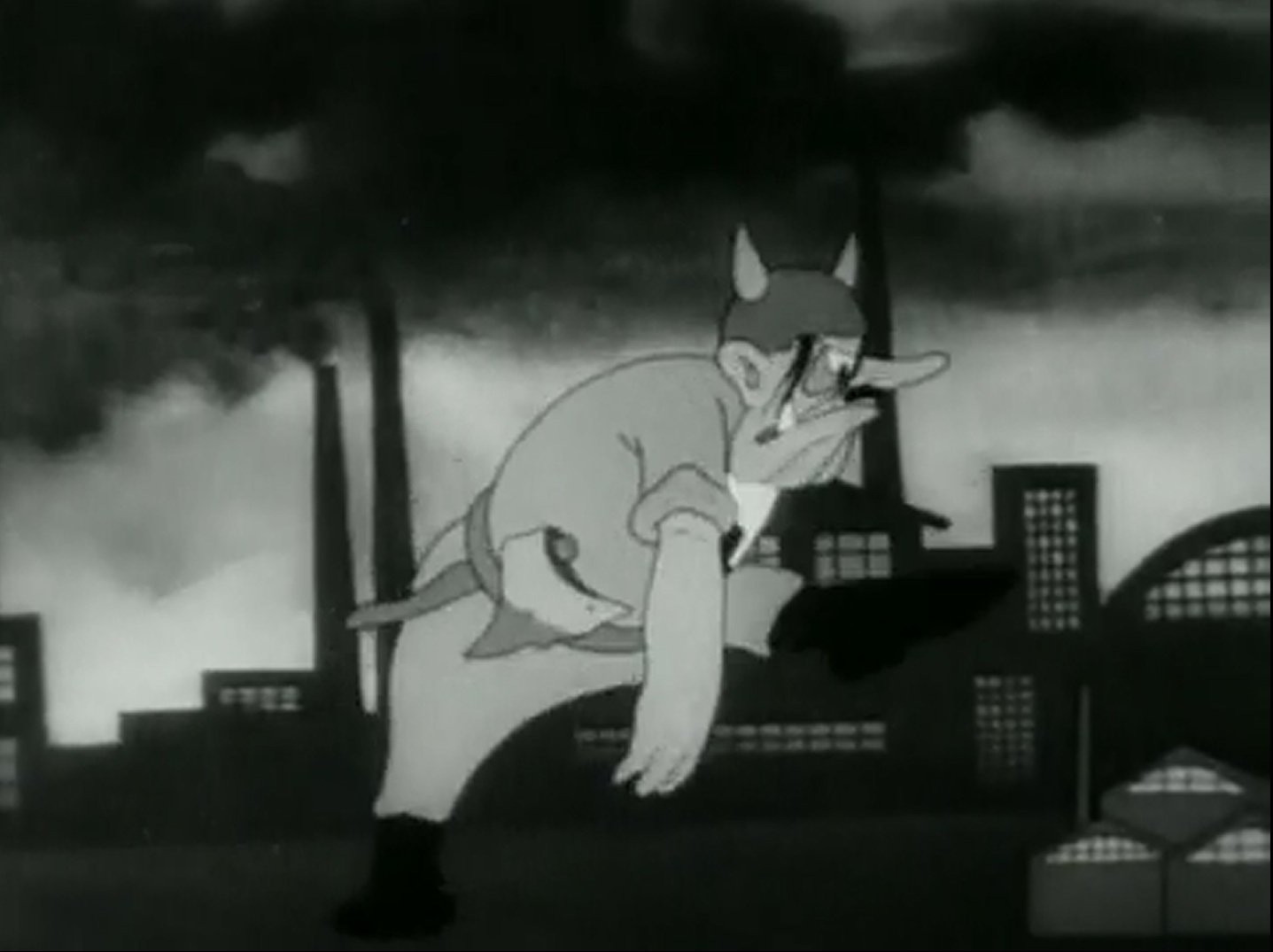
Like ‘4 Newsreels‘, ‘Fascist Boots on our Homeland’ is a so-called ‘political poster’, a short propaganda film that knows no competition in its vicious imagery.
In ‘Fascist Boots on our Homeland’ a horrific fascist pig marches on, trembling several European countries until he gets beaten by the Red Army. The film also contains a very patriotic song and rather associative imagery, including that of Russian soldiers riding horseback, a heroic image from the Russian civil war (1917-1923).
It’s interesting to compare the Soviet images of Nazis with that of American propaganda films from the same era. Whereas in American propaganda, like ‘Der Fuehrer’s Face‘ fascist leaders were caricatured and ridiculed, in the Soviet Union they were depicted as monsters and swines. The whole difference may be that the Soviet Union was invaded, while the United States were not.
Indeed, the US were less kind to the Japanese, who did stain American soil: they were all portrayed as silly, but treacherous Untermenschen, whom one could easily kill without remorse (e.g. in ‘Bugs Bunny nips the Nips’ from 1944 and the Popeye film ‘You’re a sap, Mr. Jap‘ from 1942).
Watch ‘Fascist Boots on our Homeland’ yourself and tell me what you think:
‘Fascist Boots on our Homeland’ is available on the DVD box set ‘Animated Soviet Propaganda’
Directors: Valentina Brumberg, Zinaida Brumberg, Aleksandr Ivanov, Olga Khodataeva and Ivan Ivanov-Vano Release Date: 1941 Rating: ★★★ Review:
The Soviet propaganda film ‘4 Newsreels’ consists of four so-called ‘political posters’, which are as blatant as propaganda can get.
The first, ‘What Hitler wants’, shows us an extremely ugly and vicious caricature of Hitler marching towards the Soviet Union until he is pierced by the Soviet bayonet.
In the second, ‘Beat the fascist pirates’, sea serpent-like German submarines are defeated by the Soviet fleet.
The third, ‘Strike the Enemy on the front and at home’, is typical for the paranoid society Stalinist Russia was, warning against treacherous fascist spies, foreign agents and saboteurs: “Be vigilant! Remember, our enemy is cunning!”.
The fourth, ‘A mighty handshake’, tells us about the union between England and the Soviet Union against Nazi Germany, showing two mighty giant soldiers shaking hands and crushing a tiny rat-like Hitler in doing so.
Obviously, Germany’s invasion of the Soviet Union left no room for subtleties.
‘4 Newsreels’ was directed by five veterans of animated Soviet propaganda. All had made animated films since the 1920s. Of the five, Ivan Ivanov-Vano (1900-1987) would become the most successful, directing animated films up to the 1970s. Luckily, he and Olga Khodataeva would be able to show a gentler side in numerous animated fairy tale films for children.
Watch ‘4 Newsreels’ yourself and tell me what you think:
‘4 Newsreels’ is available on the DVD box set ‘Animated Soviet Propaganda’
Director: Charles Nichols Release Date: June 23, 1944 Stars: Pluto Rating: ★★★★ Review:
An updated version of Pan from ‘Fantasia’ (1940), now wearing a boiler hat, creates spring.
Pluto enjoys it for a while, e.g. discovering a caterpillar who transforms into a very sexy butterfly. The butterfly is designed as a miniature pin-up girl, who dances to a conga beat. After this encounter, Pluto juggles with a wasps’ nest, angering the wasps who sting him in the form of a Lockheed Lightning and a V2 rocket. These two sequences make ‘Springtime for Pluto’ a typical war era cartoon, even though it’s not about war, at all.
After Pluto gets stung, he’s caught in the rain, and even in a hailstorm. In the end he’s not enjoying spring anymore, and angrily he chases Pan into the distance.
‘Springtime for Pluto’ is the first cartoon directed by Charles Nichols, who would direct all Pluto and Mickey cartoons (save one) from now on until their retirement in 1953. Nichols is famous for his mild-mannered humor, but his debut consists of very enjoyable utter nonsense from the beginning to the end. It’s full of the exuberant spirit of the war time era.
Even the oil backgrounds, painted by Lenard Kester (1917-1997), have more vivid colors than before. These are flatter than in most Disney films, and during the butterfly sequence one can even see the paper texture. They form an early example of a more graphic style of backgrounds within a Disney film, and look forward to the fifties. Perhaps Kester had been inspired by similar experiments by Chuck Jones’ unit at Warner Brothers (e.g. ‘The Dover Boys‘ from 1942). In any case, the result contributes to the surreal atmosphere of the film.
Kester has been credited for backgrounds of only one other Disney cartoon, ‘How To Play Football’ from a few months later. In this short the backgrounds are effective, but unremarkable. Had he been toned down by the studio? Fact is that Kester soon moved on to devote his life to oil painting…
Watch ‘Springtime for Pluto’ yourself and tell me what you think:
This is Pluto cartoon No. 11
To the previous Pluto cartoon: Private Pluto
To the next Pluto cartoon: First Aiders
Director: Clyde Geronimi Release Date: April 2, 1943 Stars: Pluto, Chip ‘n Dale Rating: ★★★★ Review:
Pluto has joined the army, and wearing a helmet, he has to protect “the pillbox” (a canon) against saboteurs.
These appear to be two little chipmunks who use the canon to crack acorns. Pluto tries to fight them, but the two critters defeat him in an unexpected ending.
‘Private Pluto’ is the second of two World War II-themed Pluto cartoons (the first being ‘The Army Mascot‘ from 1942). It was also to be the last Pluto cartoon directed by Clyde Geronimi, who promoted to sequence director in Disney’s feature films. Geronimi was succeeded by Charles Nichols, who seemed to be more comfortable with the character and who would direct every Pluto cartoon save one from then on.
‘Private Pluto’ is an important cartoon, because it introduces those famous chipmunks, Chip ‘n Dale. They’re not named yet, nor are they two different characters here, but their mischievous behavior and their hardly comprehensible jabbering are already present, and they’re certainly instantly likeable.
‘Private Pluto’ is interesting in its own right, for it shows the line of coastal defense the United States had placed at the Pacific Coast in the years preceding the war. After the attack on Pearl Harbor it had been placed on high alert (thus Pluto’s job), but luckily there was no need ever to use it.
Watch ‘Private Pluto’ yourself and tell me what you think:
Surprisingly, in this film Pluto is not Mickey’s dog, but owned by an Afro-American lady, who seems to be the exact copy of Tom & Jerry’s Mammy Two-Shoes, who made her debut in February of that year. However, it was the Disney studio itself who had introduced the Mammy character in ‘Three Orphan Kittens‘ (1935).
In ‘Pantry Pirate’ Mammy puts Pluto outside, but he sneaks into the kitchen trying to steal her roast beef. Hindered by an ironing-board, several tea cups and a bucket of soapy water, he doesn’t succeed, but he does escape Mammy’s wrath by quickly returning to his dog house, pretending to be asleep. Here the cartoon abruptly ends.
‘Pantry Pirate’ is the first of seven Pluto cartoons directed by Clyde Geronimi. It’s also one of his best, with gags leading to more gags in excellent pantomimed and physical situation comedy. This cartoon contains some remarkably flexible animation of Pluto, especially during the ironing-board scene. Pluto’s design, however, seems to be stubbier than usual. The Mammy character would return in ‘Figaro and Cleo‘ (1943).
Watch ‘Pantry Pirate’ yourself and tell me what you think:
This is Pluto cartoon No. 3
To the previous Pluto cartoon: Bone Trouble
To the next Pluto cartoon: Pluto’s Playmate
Director: David Hand Release Date: August 13, 1942 Rating: ★★★★★ ♕ Review:
Although it was released after ‘Dumbo‘, ‘Bambi’ is essentially Disney’s fourth feature, and it was also the last in which the studio really pushed the envelope.
‘Bambi’ had been long in the making, with initial work already starting in 1937. In fact, it was initially planned as Disney’s second feature, but soon pushed back in favor of ‘Pinocchio’.
After having made such great and diverse efforts as ‘Snow White’, ‘Pinocchio‘ and ‘Fantasia’, Disney set the stakes even higher in Bambi, reaching a zenith in naturalism. But the film is way more than that: it’s a symphony of nature, utterly romantic in its depiction of forest life. It’s also a coming of age story and a depiction of the circle of life.
‘Bambi’ is full of great scenes, starting with the stunning opening scene, a long and complicated shot, which shows the vastness and depth of the forest using a multiplane camera, and which leads us straight into the story, when we come to follow friend owl in his flight.
The storytelling is very lean, it uses little dialogue and it consists of only a few distinct parts, which all concentrate on Bambi’s experiences. Most of the story is told by images and music only, and there are three pure mood pieces very reminiscent of a Silly Symphony like ‘The Old Mill‘ (1937) and parts of ‘Fantasia’: the April Shower sequence, the autumn sequence and Bambi’s love scene. In these sequences especially, it’s clear that atmosphere prevails above character development, and the studio indulges in beautiful imagery that is still impressive and enchanting today.
The film can be divided into eight sections (the titles are all mine):
1) Birth: which also introduces the lovable little rabbit Thumper;
2) Discovery of the world: including the introduction of the little skunk Flower and a rain scene, set to the beautiful song ‘April shower’;
3) The meadow: where both danger and other deer are introduced, including Bambi’s father and his later love interest, Feline;
4) Autumn: a short transitional mood piece;
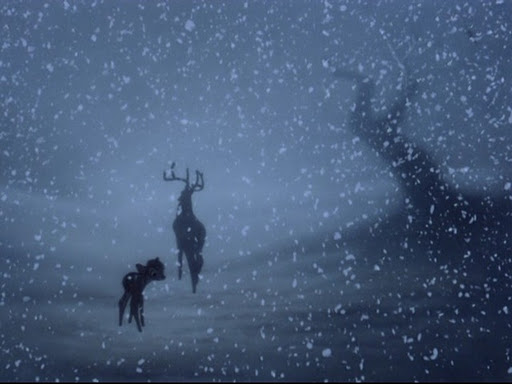
5) Winter: which includes the famous skating scene, inspired by Pluto’s difficulties on ice in ‘On ice‘ (1935) and which ends with that harrowing, yet off screen death of Bambi’s mother;
6) Spring: where all our characters have become adolescents and discover the power of love;
7) Man: where man, who never is seen on screen, but whose threatening presence is so much more felt, once again brings danger into the forest, shooting animals (including Bambi) and causing a forest fire, which leads to great dramatic and apocalyptic shots of the burning forest;
and finally
8) Birth again: in which the cycle is completed.
The first five sections take almost two-thirds of the film and are responsible for Bambi’s reputation of being a childish film full of cute animals. This may be partly true, but is does no justice to the complete film, for the last three sections, starting with the death of Bambi’s mother (which essentially ends his childhood) are more artistic, more expressionistic and more dramatic. These scenes belong to the most powerful animated images ever brought to the screen.
But throughout the complete picture the artwork is stunning: the backgrounds, based on designs by Tyrus Wong, are lush and suggestive, the use of color is very clever and often amazing, and the music, which is very important to the narrative and which uses off-screen songs to evoke moods, is rich and effective. Indeed, Bambi’s soundtrack, by composers Frank Churchill and Edward Plumb, ranks among the best scores of any animation film. Backgrounds, design, color, music – all these make the film a mood piece of an astonishing quality.
The animation itself, too, is a highlight. It was supervised by four of the later so-called ‘nine old men’: Eric Larson, Milt Kahl, Frank Thomas and Ollie Johnston, and it’s the first testimony of their legendary status. The animation is amazingly well-done both in its naturalism as in its sense of character. It ranks from pure naturalism in Bambi’s mother exploring the meadow and Bambi preparing to fight to pure character animation. A highlight of the latter is Bambi having to say hello to Feline. Bambi’s behavior in this scene is perfect that of a young bashful boy.
The only deviation from believability is during the Twitterpated sequence: Eric Larson’s animation on friend Owl is zany and cartoony, as is the animation of the lovestruck Flower. The whole sequence is a little bit ridiculous, and out of place with the rest of the film. Luckily as soon as Bambi falls in love with Feline, the last part starts, which in its drama, powerful imagery and stunning effects is the undisputed highlight of the whole movie.
Bambi never ceases to amaze: it is simply beautiful.
Watch the skating scene from ‘Bambi’ yourself and tell me what you think:
With ‘Pluto at the zoo’ director Clyde Geronimi delivers his most successful Pluto short.
In this short Pluto carries a tiny bone when he discovers a huge bone at the Lion’s cave. He decides to steal it, but this causes him lots of trouble with the lion, a kangaroo, a gorilla and several crocodiles.
Pluto’s pantomime is wonderful in this cartoon, and, unlike most of the previous entries directed by Geronimi, there’s an absence of sentimentality, which is nicely replaced by absurdism, with the simply hilarious gorilla sequence as a highlight within the whole series.
Watch ‘Pluto at the Zoo’ yourself and tell me what you think:
This is Pluto cartoon No. 9
To the previous Pluto cartoon: T-Bone for Two
To the next Pluto cartoon: Private Pluto
‘The Army Mascot’ is the first of two World War Two cartoons starring Pluto (the other one being ‘Private Pluto‘ from 1943).
Pluto never gets really involved in the war, though, he only joins the army. He was the second Disney character to do so, following Donald Duck, who had been drafted only three weeks earlier, in ‘Donald Gets Drafted‘.
However, Pluto’s reasons to join the army are doubtful, to say the least: only when he sees the enormous portions of meat an army mascot gets, he wants to be one, too. He tries to replace “Gunther Goat”, mascot of the Yoo-hoo Division, but all he gets is cans. In his second attempt he tries to chew tobacco like Gunther can, to impress the soldiers. But Gunther makes Pluto swallow the whole piece, making him sick. This sequence is the highlight of the cartoon, as Pluto’s sickness is animated in the most ridiculous way.
Gunther then tries to finish his rival off by bumping Pluto into the munition depot, but it’s Gunther himself who bumps into the depot, which explodes, blasting the wicked goat up into the air, where he’s caught by a plane and carried away into the distance. Now Pluto takes Gunther’s place, and gets his steak after all.
‘The Army Mascot’ is a rather odd cartoon, where both main characters show unpleasant behavior: Pluto envy and trickery and Gunther haughtiness and wrath. Thus, ‘The Army Mascot’, although war-themed, can hardly be called a patriotic film.
Watch ‘The Army Mascot’ yourself and tell me what you think:
This is Pluto cartoon No. 6
To the previous Pluto cartoon: Pluto Junior
To the next Pluto cartoon: The Sleep Walker
Director: Władysław Starewicz Release Date: 1922 Rating: ★★★★★ Review:
After the October revolution, Władysław Starewicz fled to France, where he continued to make stop motion films until his death in 1965. ‘The Frogs Who Wanted a King’ is the fourth film he made in France, and probably his most political.
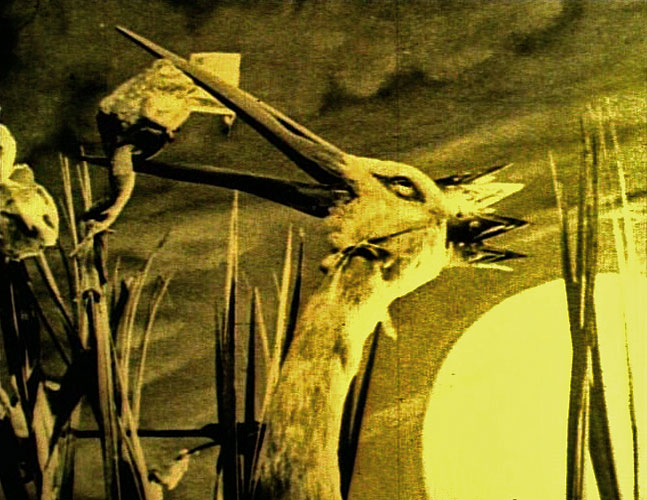
The film is based on one of Aesop’s fables. Some frogs ask Jupiter for a king. Jupiter sends them one, but the king looks like a tree and does nothing at all. The frogs don’t like him, so Jupiter sends them a stork, who, naturally, eats the unfortunate amphibians.
The message may be that it’s better to have a dull government than one that kills you, a message Starewicz could certainly relate to, being forced to exile by the oppressing communist regime in Russia.
Once again, Starewicz’ animation is top notch. The film has a particularly fable-like character, taking place in its own, very convincing universe.
Watch ‘The Frogs Who Wanted a King’ yourself and tell me what you think:
Director: Władysław Starewicz Release Date: 1913 Rating: ★★★½ Review:
‘The Insects’ Christmas’ is Starewicz’s next film after his masterpiece ‘The Cameraman’s Revenge‘.
Although the short uses insects again, it’s a whole different film, turning to the sweet subject of Christmas. It’s probably the first animated film about Christmas ever made.
The plot is surprisingly simple: Father Christmas climbs down a Christmas tree, awakes some insects and a frog, who are hibernating underground, and he invites them to a Christmas party. He gives them presents and they all go skiing and skating.
This film’s story cannot be compared to the mature plot of ‘The Cameraman’s revenge‘. It’s more like a child’s dream of Christmas. The film reuses puppets from ‘The Cameraman’s Revenge’ and others, and even though the animation is less engaging than in Starewicz’s earlier film, it is still of a stunning virtuosity, making the result still a delight to watch. Note, for example, the illusion of wind in the animation of Father Christmas’s coat.
Watch ‘The Insects’ Christmas’ yourself and tell me what you think:
‘The Insects’ Christmas’ is available on the DVD ‘The Cameraman’s Revenge & other Fantastic Tales’
Director: Władysław Starewicz Release Date: November 9, 1912 Rating: ★★★★★ ♕ Review:
‘The Cameraman’s Revenge’ is one of the earliest animation films ever made, and a very early masterpiece (it predates ‘Gertie the Dinosaur‘ by two years). Surprisingly, it’s a film about adultery involving insects.
The plot of this stop motion film is as follows: Mr. Beetle commits adultery with a dragonfly, who is a dancer at a nightclub. Unbeknownst to him his secret behavior is filmed by a rival grasshopper who happens to be a cameraman. Meanwhile, Mrs. Beetle also commits adultery, with a beetle who is also a painter. But they’re discovered by Mr. Beetle on his arrival home. Mr. Beetle chases the painter out of his house. Nevertheless he forgives his wife and takes her to the cinema. However, the film that is shown reveals his infidelity, which creates a riot and the married couple ends in jail for destroying the movie box.
‘The Cameraman’s Revenge’ is an extraordinary film, and without doubt one of the first masterpieces of animation. Unlike Émile Cohl’s stop motion, Starewicz’s animation is stunning and very convincing. The insects are very lifelike, and move surprisingly realistically. The insects’ gestures are subtle, clearly evoking their emotions. For example, there’s a beautiful and very lifelike little scene of a beetle servant lighting the fireplace, animated without any hint of overacting. On the other hand, Mr. Beetle clearly is a brute, but we can also watch him in a seductive mood.
Throughout, Starewicz’s storytelling is economical and mature. The film’s subject is highly original for an animation film, even today. It’s almost unbelievable that such a modern film was made in Czarist Russia.
Watch ‘The Cameraman’s Revenge’ yourself and tell me what you think:
‘The Cameraman’s Revenge’ is available on the DVD ‘The Cameraman’s Revenge & other Fantastic Tales’
‘Prophets and Lessons’ is a Soviet propaganda film. It tells us how every time the Western world predicted the Soviet Union to fail, but that these predictions never came true.
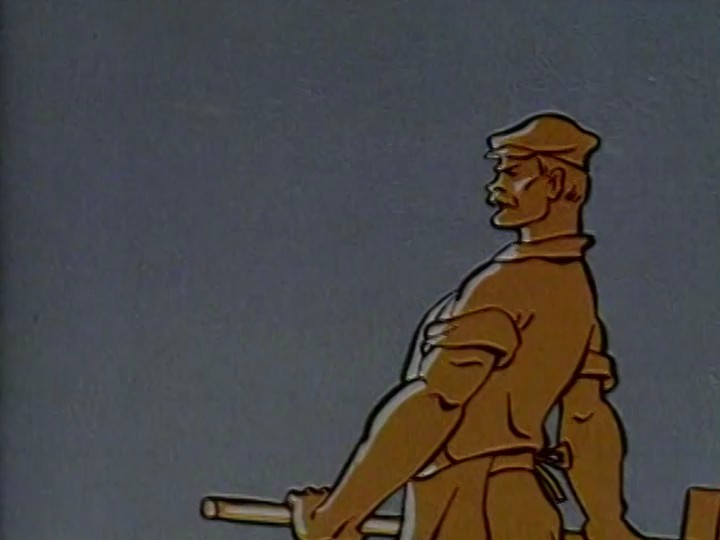
Its chapters are all conceived in the same order: first we see animated capitalist predict something, then we see a giant Soviet blacksmith strike his mighty hammer and finally we see live action footage of the Soviet Union’s successes.
The separate chapters are the Soviet revolution, the civil war, the five year plans, the Second World War, the reconstruction after the war and the Soviet space program. The action is silent, and the imagery rather outdated (more like that of the 1920s than of the 1960s).
‘Prophets and Lessons’ is one of the most obviously propagandistic animation films ever made in the Soviet Union. Its overtly propagandistic message, its repetitive character, and its outdated symbolism make it rather tiresome to watch.
Surprisingly, two years later, the director of this humorless film, Vyacheslav Kotyonochkin, would launch a successful series of comic cartoons, called ‘Ну, Погоди!’ (‘Just Wait!’), featuring a very cartoony wolf.
Watch ‘Prophets and Lessons’ yourself and tell me what you think:
‘Prophets and Lessons’ is available on the DVD box set ‘Animated Soviet Propaganda’
‘Proud Little Ship’ is a Soviet propaganda film, which is clearly directed to children.
Three little boys make a small red ship as a copy of the famous cruiser ‘The Aurora’. This little ship sails the seas and is greeted with enthusiasm among all the people of the world.
There are some mean militarists who try to destroy the little ship, but they do not succeed. These militarists are drawn extremely silly, while the rest of the people are drawn rather realistically and appear as noble and gentle. Nevertheless, these drawing styles blend surprisingly well. Moreover the design and choreography of movement is often gorgeous.
All the action is silent, while the story is told by a narrator, who provides the clearest propagandistic message of the film: “the proud little ship sailed as a messenger of a happy life, which, as spring after winter, would certainly come to all people”.
Although ‘Proud Little Ship’ is overtly propagandistic, it’s also an enjoyable and beautiful film. One almost forgets that the message is not concerning world peace, but the ‘glorious’ communist revolution…
Watch ‘Proud Little Ship’ yourself and tell me what you think:
‘Proud Little Ship’ is available on the DVD box set ‘Animated Soviet Propaganda’
Director: Gerry Chiniquy Release Date: June 13, 1967 Stars: The Pink Panther Rating: ★ Review:
In ‘Jet Pink’ the Pink Panther enters a secret airport and climbs in test jet X13, which immediately goes astray.
This cartoon marks former Warner Brothers animator Gerry Chiniquy’s debut as a director. Unfortunately, it’s far from an overnight success: ‘Jet Pink’ is inconsistent, and rather unfunny.
The cartoon reuses the ‘count to ten and pull string’ gag from ‘Goofy’s Glider‘ (1940), but its execution is terrible when compared to the original.
Watch ‘Jet Pink’ yourself and tell me what you think:
Director: Hawley Pratt Release Date: May 18, 1967 Stars: The Pink Panther, The Little Guy Rating: ★★★ Review:
In ‘In The Pink’, weirdly enough, the Pink Panther is getting fat. So, our pink hero tries his luck at the gym, where he hinders the little guy a great deal.
‘In the Pink’ is an average Pink Panther cartoon, consisting of blackout gags, the most bizarre one being a chicken hatching a punching ball. The opening sequence reuses animation from ‘Pink Panic’ from earlier that year.
Watch ‘In the Pink’ yourself and tell me what you think:
Director: Hawley Pratt Release Date: May 17, 1967 Stars: The Pink Panther, The Little Guy Rating: ★★★★★ Review:
In ‘Pink of the Litter’, the Pink Panther is punished for littering by the little guy, who, in this cartoon, stars as a cop, a judge, a ranger, a fireman and a mayor. The Pink Panther has to clean ‘Litterburg’ from its rubbish. His methods include ‘instant shrink’ and making a giant paper plane out of the litter.
This is an original cartoon with a great story using blackout gags, building up to a great finale. The very idea of the little guy appearing in different functions is brilliant. In short, ‘Pink of the Litter’ is easily one of the best Pink Panther cartoons.
Watch ‘Pink of the Litter’ yourself and tell me what you think:
Director: Chuck Jones Airing Date: December 18, 1966 Rating: ★★★★★ Review:
‘How The Grinch Stole Christmas’ is a wonderful Christmas cartoon. The Christmas of a little town called the Whoville is threatened by a green character called the Grinch, who disapproves of Christmas, and particularly the noise involved. He decides to ‘steal’ Christmas from the little creatures, but then he discovers that Christmas is not restricted to objects.
This special, lasting 26 minutes, is one of Chuck Jones’s productions for MGM television. It’s a very faithful and beautiful reading of the classic Dr. Seuss children’s book, keeping Dr. Seuss’s rhymes and faithfully reproducing its designs, but extending those by long and beautiful silent comedy scenes and Jones’s wonderful facial expressions, to even better results.
Especially the Grinch himself is a wonderfully expressive character. In him Jones’ mastery of facial expression reaches its apex. Particularly amazing is the scene in which the Grinch thinks up his evil plan, making his face curl with wickedness.
The story is told by Boris Karloff’s grim voice, and it contains two songs: a rather annoying Christmas song sung by the Whos and an odd song describing the meanness of the Grinch. While we hear this song, we see the Grinch steal every Christmas item in Whoville.
All in all, it’s a classic. It’s arguably the best Dr. Seuss adaptation ever, and certainly one of the best Christmas cartoons ever made. It’s certainly better than the rather annoying live action remake from 2000.
Watch ‘How The Grinch Stole Christmas’ yourself and tell me what you think:
Director: Hawley Pratt Release Date: April 26, 1967 Stars: The Pink Panther, The Little Guy Rating: ★★★★ Review:
‘Pink Posies’ could be summarized as ‘The Pink Phink‘ set in a garden: this time the little guy is a gardener planting yellow flowers, while the Pink Panther replaces them for pink ones.
Most of the gags are variations on those in ‘The Pink Phink’, which make this cartoon a very enjoyable one, even though it’s not very original. The designs of this cartoon are also attractive, the very stylized trees in the background in particular.
Watch ‘Pink Posies’ yourself and tell me what you think:
Director: Abe Levitow Release Date: August 4, 1966 Stars: Tom & Jerry Rating: ★ Review:
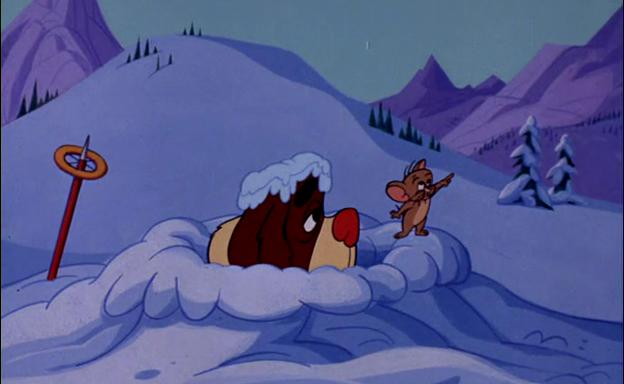
‘The A-Tom-inable Snowman’ is as abominable as the snowman’s supposed to be: it’s painfully bad and unfunny.
The cartoon has nothing to do with yetis, however. It is set in the alps and involves a helpful St. Bernard. The only surprise is that the titles roll in after 1’22.
Watch ‘The A-Tom-inable Snowman’ yourself and tell me what you think:
This is Tom & Jerry cartoon No. 151
To the previous Tom & Jerry cartoon: Matinee Mouse
To the next Tom & Jerry cartoon: Catty Cornered
Director: Tom Ray Release Date: July 14, 1966 Stars: Tom & Jerry Rating: ★ Review:
In ‘Matinee Mouse’ Tom and Jerry make peace and go watch their own cartoons together in a cinema. Of course, the truce doesn’t last long.
‘Matinee Mouse’ is a compilation cartoon, and a very cheap and terrible one, too. It uses footage of the classic Hanna/Barbera entries, but these are set to new sound effects and new music by Don Elliott. The gruesome result is easily one of the worst Tom and Jerry cartoons ever. Its director, Tom Ray (1919-2010), directed only one other Tom & Jerry cartoon, ‘Shutter Bugged Cat‘ (1967). That one is also a compilation cartoon, and arguably just as terrible.
Watch ‘Matinee Mouse’ yourself and tell me what you think:
This is Tom & Jerry cartoon No. 150
To the previous Tom & Jerry cartoon: Fillet Meow
To the next Tom & Jerry cartoon: A-Tom-inable Snowman
Animation Backgrounds
A blog dedicated to background paintings from animation films. Kept until 2016.
Animation Scoop
Animation historian Jerry Beck’s animation film news blog.
Cartoon Brew
Topical blog on animation film, led by animation historian Amid Amidi.
Cartoon Modern
Amid Amidi’s blog on modern design cartoon art from the forties, fifties and sixties.
Cartoon Research
THE site on classic animation research, hosted by cartoon historian Jerry Beck.
Cartoons Theory
Frank Beef analyzes classic cartoons. Kept until 2020.
Century Film Project
Michael reviews films of 100 years old and older, roughly in chronological order.
Classic Cartoons
A similar blog featuring many stills and comic strips. Kept until 2012.
Comet over Hollywood
Jessica Pickens reviews classic Hollywood films, especially musicals.
Deja View
Top ex-Disney animator Andreas Deja’s own blog.
Disney History
Esteemed Disney historian Didier Ghez on the latest books on Disney history.
Feeling Animated
Paul Astell brings us thorough reviews of animated features.
Flickers in Time
Short and to the point reviews of classic films (lately mostly pre-code talkies) by an anonymous retired Foreign Service Officer from California

 Like ‘4 Newsreels‘, ‘Fascist Boots on our Homeland’ is a so-called ‘political poster’, a short propaganda film that knows no competition in its vicious imagery.