
You are currently browsing the tag archive for the ‘future’ tag.
Director: Mamoru Hosoda
Release date: May 16, 2018
Rating: ★★★
Review:

‘Mirai’ was the third feature film Mamoru Hosoda made for his own studio, Studio Chizu. Hosoda favors rather episodic films about growing up, and ‘Mirai’ is no exception, although the film takes place in a much smaller time frame than ‘Wolf Children’ or ‘The Boy and the Beast’.
Main protagonist of the film is ca. four-year-old boy Kun, who lives in a design house in Yokohama (the town is depicted regularly during the film in swooping bird-eye’s view shots), but more importantly, who gets a baby sister, the Mirai from the title. Mirai also means future, and in fact, the Japanese title is ‘Mirai no Mirai’, or ‘Mirai from the future’. Indeed, Kun meets an older version of his younger sister from the future, as well as some other characters, while he struggles to adapt to the new situation he finds himself in.
Because with the coming of little Mirai a lot changes for the young boy: his parents have less attention for him, focusing more on the new baby, they’re more often tired and crabby, and they struggle with combining working and caring, now there are two children around. Needless to say, Kun has a hard time getting adjusted, and even gets jealous of his innocent baby sister.
The film focuses on some key scenes, in which Kun experiences a setback, at least in his own mind, and then something magical happens in the little courtyard of his house. First the little boy first meets a humanized form of the family dog, and then his younger sister in older form (there’s more, but I won’t spoil it here).
Unfortunately, Hosoda doesn’t stick to the boy-sister relationship, and at some point, the magic scenes also help Kun overcome his fears. Moreover, a four-year-old is a difficult and questionable protagonist of a film that wants to show the hero’s progress. After all, he is just a little boy. It’s little surprising that Hosoda spends considerable time on Kun’s parents, and their development during this crucial part of their lives. And, indeed, to be frank, Hosoda’s honest depiction of the hardships of young parenthood and of raising one’s own children is much more interesting than Kun’s ‘development’ of character.
Main attraction of the film are the five magical scenes, with the first two showing some broad comedy, as the man-dog and Mirai from the future roam around the house. The third and fourth start to feel obligatory, even though the fourth has a nice nostalgic feel to it. But with the fifth, Hosoda goes completely overboard, and one wonders why these nightmarish scenes, taking the film to a altogether other atmosphere, were even necessary. In fact, this finale, in which Hosoda wants to tell us something about family ties, is too overtly self-explanatory and spoils a film that wasn’t perfect to start with.
In fact, ‘Mirai’ drags a little, being mostly confined to the small space of Kun’s house and with Kun’s development of character as an important, but very weak story device. The film’s episodic nature doesn’t really help, spreading the story thin, a problem that also invades ‘Wolf Children’ and ‘The Boy and the Beast’. I wish Hosoda was able to keep his use of time as tight as his use of space in this movie. ‘Mirai’ is not a failure, the film is too original for that, but it’s arguably Hosoda’s weakest feature film so far, never reaching the emotional heights of either ‘Wolf Children’, ‘The Boy and the Beast’ or even his debut film, ‘The Girl Who Leapt Through Time’ from 2006.
Watch the trailer for ‘Mirai’ yourself and tell me what you think:
‘Mirai’ is available on Blu-Ray and DVD
Director: Peter Avanzino
Airing Date: April 13, 1996
Stars: Duckman
Rating: ★★★★★
Review:
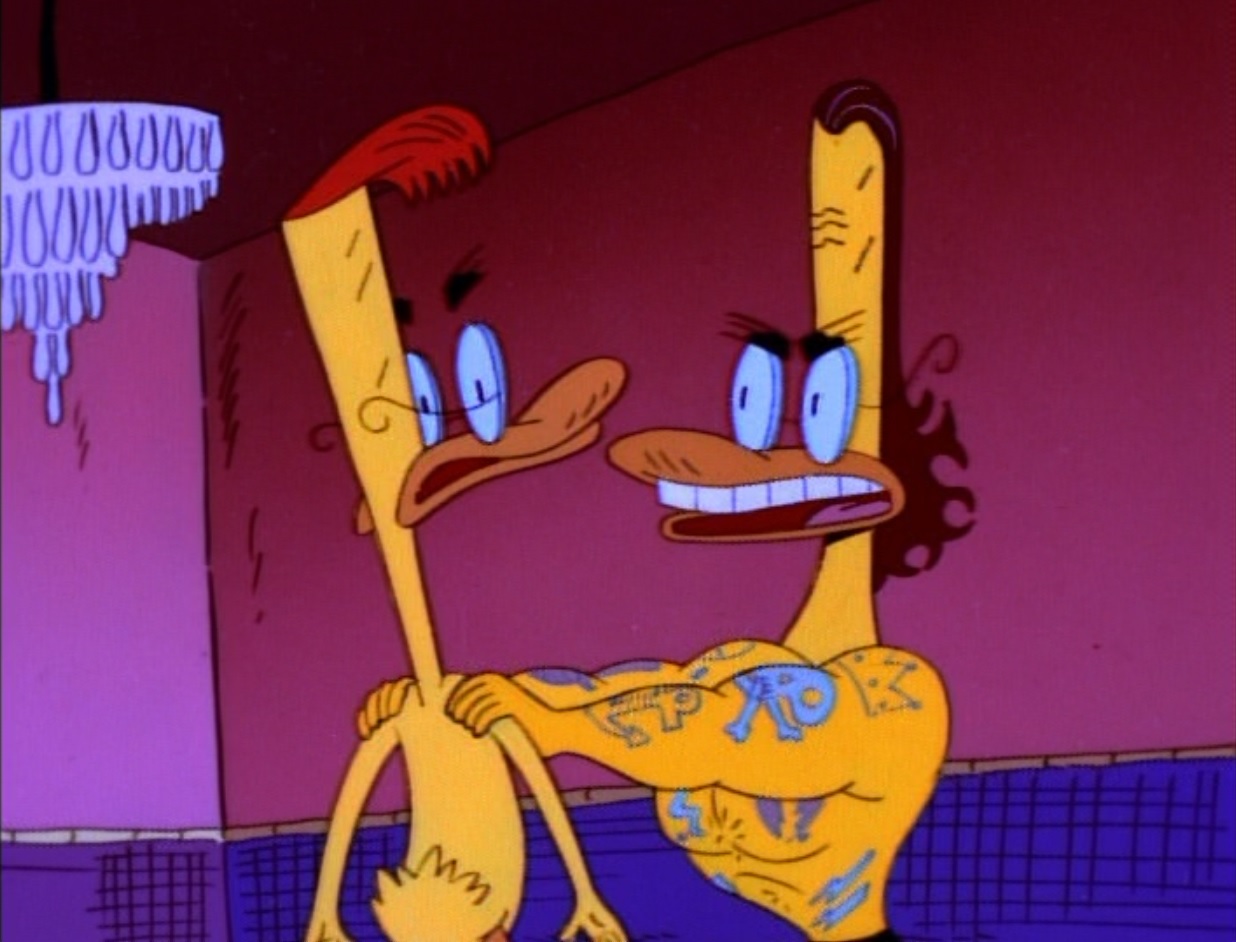
This episode starts with a simple promise by Duckman to attend the recital by the tuba-playing Mambo and Charles. But then Ajax accidentally creates a hole in the space-time continuum, which allows Duckman to gets a visit from his future self who tells him what will happen if he does go to the recital…
Before soon we’re right in the middle of a surprisingly sophisticated, even complicated episode on destiny and the consequences of one’s actions, involving multiple future selfs of Duckman, one even more outlandish than the other. At one point their appearances creates a scene of mayhem that’s got to be seen to be believed.
In short, ‘The Once and Future Duck’ is one of the best written and best directed of all Duckman episodes, relying less on wise-cracking asides, and more on the development of the inner logic of its own absurdist premises. The result is as profoundly philosophical as it is hilariously zany.
Watch ‘The Once and Future Duck’ yourself and tell me what you think:
This is Duckman episode no. 34
To the previous Duckman episode: Pig Amok
To the next Duckman episode: The One with Lisa Kudrow in a Small Role
‘The Once and Future Duck’ is available on the DVD-box ‘Duckman – The Complete Series’
Director: Don Hertzfeldt
Release Date: March 31, 2015
Rating: ★★★★★
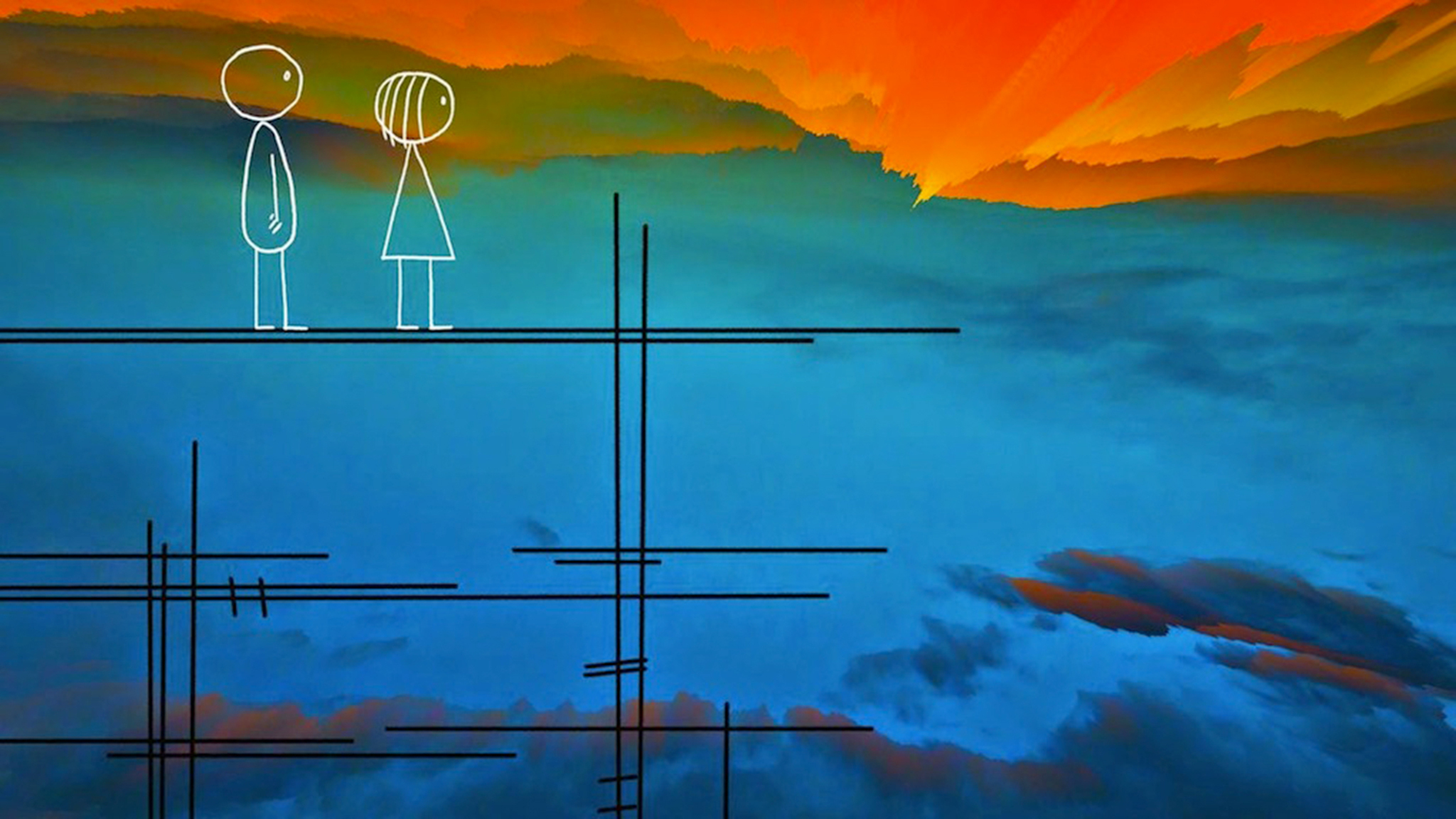
In ‘World of Tomorrow’ independent film maker Don Hertzfeldt greatly expands his simple stick-man style with colorful computer graphics to tell a harrowing tale of the future.
The sixteen minute-short stars a ca. 3 year old girl called Emily, lovely voiced by real youngster Winona Mae. When the phone rings, this turns out to be a call from the future, from a third generation clone of herself, voiced by Julia Pott, who uses the same flat way of speaking as Hertzfeldt himself did in his masterpiece ‘It’s Such a Beautiful Day‘. The clone sketches a rather bleak future, in which all the new and mind-blowing technology does nothing to exterminate man’s existential loneliness and anguish.
The film is part wonder part absurdist humor and part tragedy, and shares the important message with ‘It’s Such a Beautiful Day’ to celebrate life. As the clone says: “Now is the envy of all the dead“. Among the highlights are a museum of memories, death-fearing robots writing poetry, and an alien talking gibberish. The film relies heavily on the dialogue, but never ceases to show amazing images, and the sound design is fantastic, with little Winona Mae probably ad-libbing part of the dialogue. As a distant cousin of ‘2001: A Space Odyssey’ (1968), ‘World of Tomorrow’ has a soundtrack that features two romantic pieces of classical music: a waltz from ‘Die Rosenkavalier’ by Richard Strauss, and a romance by Reinhold Glière.
‘World of Tomorrow’ may be less compelling than the incomparable ‘It’s Such a Beautiful Day”, it’s absolutely a wonderful testimony of Don Hertzfeldt’s idiosyncratic art. Moreover, despite its short length the film is a great little piece of science fiction, comparable in scope and depth with much more well-known live action feature films like the aforementioned ‘2001: A Space Odyssey’ (1968), ‘Moon’ (2009), ‘Interstellar'(2014), and ‘Arrival’ (2016).
The film was followed by two sequels in 2017 en 2020, which unfortunately I haven’t seen, yet.
Watch the trailer for ‘World of Tomorrow’ yourself and tell me what you think:
‘World of Tomorrow’ is available on the Blu-Ray ‘It’s Such a Beautiful Day’
Director: Teizô Katô
Release Date: October 22, 1932
Rating: ★
Review:
 Surprisingly, the story of ‘The Plane Cabby’s Lucky Day’ takes place in the far future of 1980. By then the animals have inherited the earth, as people have taken the skies. Thus the film first takes place in an urban landscape of endless skyscrapers.
Unfortunately, the aimless story of a young flying cab driver soon hits more traditional settings, when the cab driver crashes on an island with talking animals etc. Moreover, Cabby’s behavior is shown to be very traditional, as he takes good care of his mother and helps a wounded bird. The story’s moral is that charity is a good investment.
Director-animator Teizo Kato was a newcomer in Japanese animation and it shows. His animation is incredibly primitive, and akin to American studio films from the 1910s. His animation lacks all hints of weight or personality, and is tiresome to watch. The long and boring story doesn’t help either, resulting in one of the worst products of early Japanese animated cinema.
Watch ‘The Plane Cabby’s Lucky Day’ yourself and tell me what you think:
http://cy.cyworld.com/home/22635133/post/4C403230C5957824B7388401
‘The Plane Cabby’s Lucky Day’ is available on the DVD-box set ‘Japanese Anime Classic Collection’
Director: Albert Barillé
Airing date: January 29?, 1983
Rating: ★★★
Review:
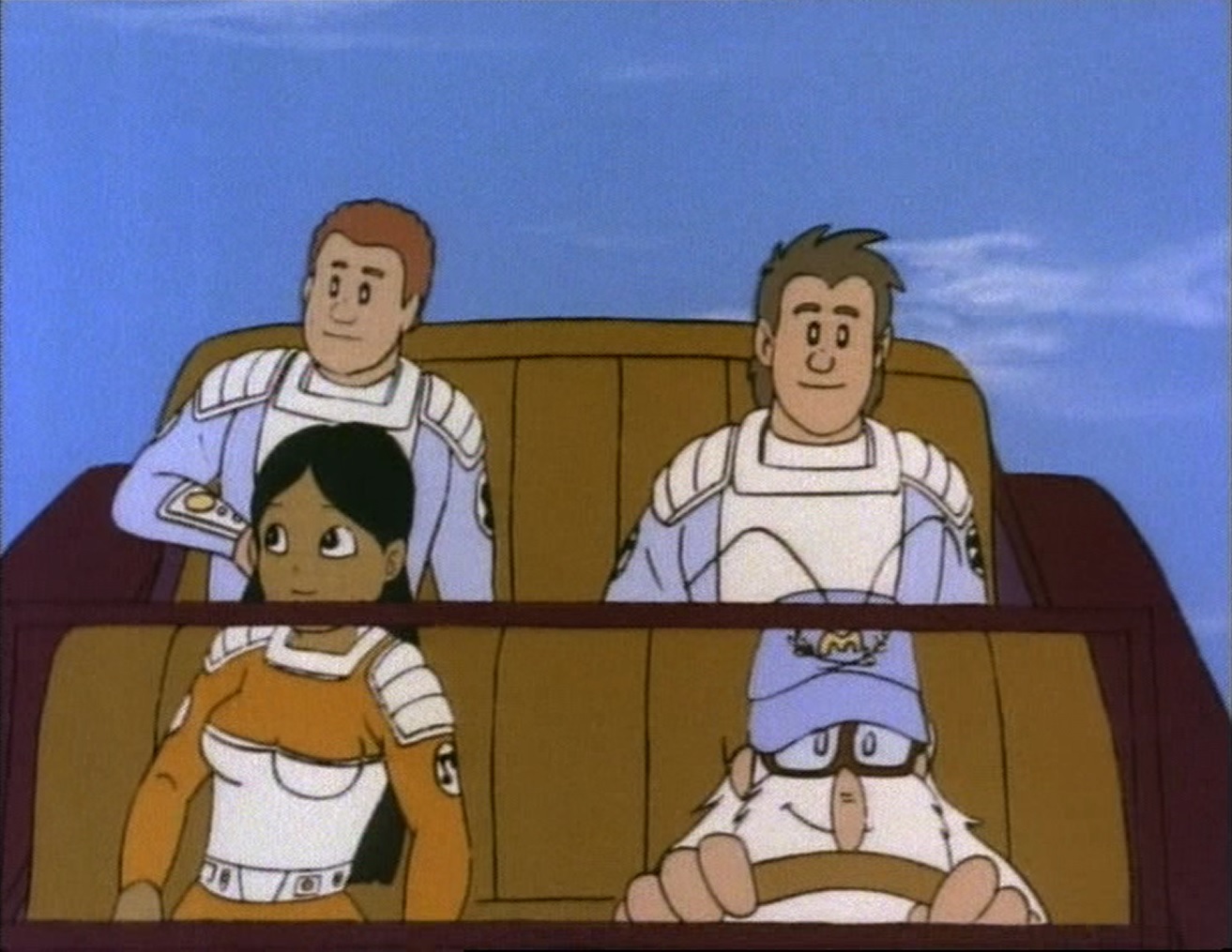 Because they have saved earth from an impending doom in ‘L’imparable menace‘, Pierrot, Psi and Petit Gros are allowed to go on holiday on earth, where they’re received as heroes.
On earth, Maestro’s ancestor (from ‘Le long voyage‘) is their guide, and he takes our heroes to the countryside. Here he tells our heroes the history of earth from the 21st century onward. Barillé’s vision of the earth’s future contains some rather somber views on genetics, war, informatics and the climate.
In the second half of this episode, the old Maestro takes Pierrot and Petit Gros into space, showing a solar ring, a cemetery of spaceships, and even an amusement park called ‘Barillé’s Land’.
Because of its holiday theme, this short moves at a leisurely speed, and it is rather boring compared to the two episodes preceding it. However, even in this relaxed episode, there’s some conflict, when our heroes encounter a saboteur from Cassiopeia.
Inconsistent design have always tortured the Il était une fois… series. And in this episode, in certain scenes the drawings of our heroes are no less than terrible.
Watch ‘Terre!’ yourself and tell me what you think:
This is the 17th episode of ‘Il était une fois… l’espace’ (Once Upon a Time… Space)
To the 16th episode: L’imparable menace (The Unstoppable Menace)
To the 18th episode: L’Atlantide (Atlantis)


 Dr. Grob's Animation Review