
You are currently browsing the tag archive for the ‘life’ tag.
Director: Pete Docter
Release date: October 11, 2020
Rating: ★★★★★
Review:
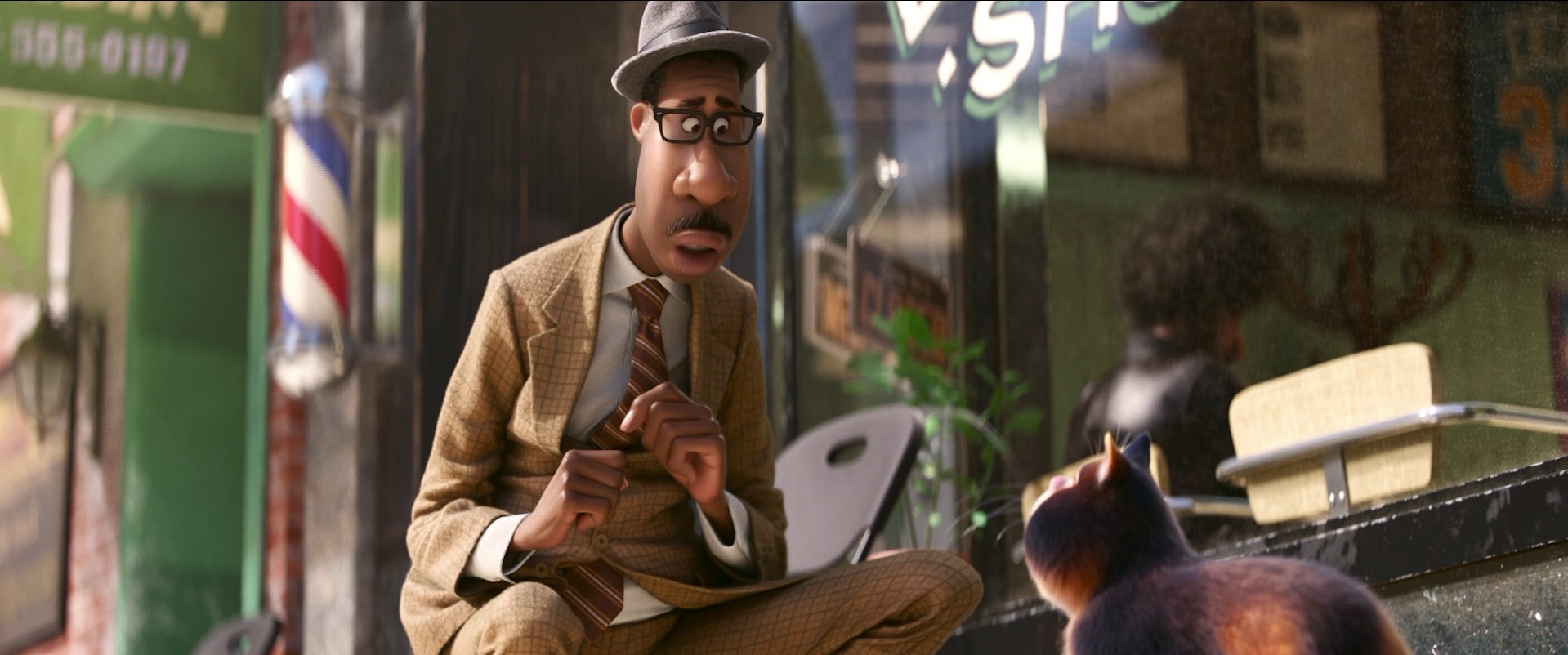
From the 2010s on Pixar’s output became very erratic. Excellent films became rarer, and too much of their output was just okay or even subpar. That said, the studio’s summits were still higher than anything in American studio animation around it, as ‘Soul’ for example proves.
What sets Pixar apart from all other American animation studios is its will to tackle more profound life questions, and not just the tired ‘importance of family’ trope that floods Disney films or the ‘believe in yourself’ message that has become the stale message of almost any American animation film around. No, ‘Soul’ ticks nothing less than the question of what it means to be alive and does so in a surprisingly subtle way, never laying the moral too thick.
‘Soul’ tells about Joe Gardner (a wonderful Jamie Foxx), an aspiring jazz pianist in New York, who finds himself teaching jazz to untalented school children and still depending on his mother, while he still longs for a breakthrough, despite being past his prime. Then opportunity knocks…
‘Soul’ is one of those extremely rare animation films starring African American people, and like the great predecessor in this respect, ‘The Princess and the Frog’ (2009), we see the black protagonist change into another shape for quite a while, because for a substantial part of the movie we watch ‘Joe Gardner’ wander ‘the great before’ in his spirit form. One almost starts to wonder if the American studios don’t dare to make their audiences watch black characters for too long. But luckily, we quite quickly return to New York and to its black community. I love how the film is about blacks without being about being black. The film also stars a very strong (and not totally sympathetic) female star saxophone player called Dorothea Williams, and jazz indeed plays an important part in the feature, even if the film isn’t about jazz, or music, at all.
For in ‘the great before’ Joe meets ‘22’, a soul terrified of life, and dodging being born for centuries. ‘22’ (greatly voiced by Tina Fey) simply refuses being born, and she isn’t able either, because she hasn’t found her spark, yet. It’s up to Joe to find it with her, otherwise he’ll never return to Earth.
The before-life scenes belong to the great world building sequences of any fantasy film. The new souls, for example, are guided by weird two-dimensional beings, all called ‘Jerry’, who look like they’ve walked away from a Picasso painting. There’s nothing of ‘this world is actually like contemporary America’, like that of ‘Monsters, Inc.’, ‘Cars’ or ‘Onward’. Even the colorful afterlife in ‘Coco’ looks rather mundane compared to this place, with its clear 1950s cartoon modern designs and strange surroundings.
‘Soul’ knows a wonderful plot with many surprise turns and unexpected twists and certainly entertains to the very end. The only very weak spot is Joe’s all too easy return to the other world in the end. This return was clearly needed for the plot, but the sequence feels forced and fails to convince, unfortunately breaking the suspense of disbelief. Nonetheless, the film certainly shows what it means to be alive, and there are sequences of great beauty and deep emotion, given to us in subtle doses and understated character animation. In all, ‘Soul’ belongs to the best animation film can offer, and it is arguably the first animated masterpiece of the new decade.
Watch the trailer for ‘Soul’ yourself and tell me what you think:
‘Soul’ is available on Blu-Ray and DVD
Director: Mari Okada
Release date: February 24, 2018
Rating: ★★★
Review:

The Japanese animation industry apparently is so rich that new interesting films can pop up seemingly out of nowhere. For example, ‘Maquia: When the Promised Flower Blooms’ (from now on ‘Maquia’) is made by the P.A. Works studio, which since its founding in 2000 focused on television series, and which only made four feature films, the first being based on a video game, the second made for television, the third for training purposes, and the fourth based on a television series.
So, their fifth feature film to be a completely original story, not based on a video game, television series or even a manga, comes as a surprise. It seems that ‘Maquia’ was the pet project by its director Mari Okada, who wrote the story herself. Okada, apparently is somewhat of a modern legend as she has written for over fifty television series since 2001, and is called by Wikipedia “one of the most prolific writers currently working in the anime industry”. She’s one of the brains behind ‘Anohana: The Flower We Saw That Day’ (2011), one of only two anime television series I have watched, and it comes to no surprise to me that the ‘Maquia’s’ story style has something in common with that series. Both series and film have a strong focus on human drama, with emotions reigning uncontrolled, and tears flowing frequently. In fact, despite the high fantasy setting, ‘Maquia’ has a strong element of melodrama, and the rather forced emotions, so different from the more restrained style in studio Ghibli, or the films by Yasujirō Ozu for that matter, actually made it harder for me to relate with these people.
‘Maquia’ is a fantasy film, set in a rather Middle Earth-like world, and starts with the depiction of a society of near-immortals called Lorphs, whose surroundings are particularly like the depictions of elven kingdoms in Peter Jackson’s adaptation of The Lord of the Rings. These Lorphs write their memories by weaving cloths and live far away from more mortal men. One of these, a young girl called Maquia (from which the English film title takes its name) rather out of nowhere complaints she is so alone. Shortly after this scene of distress the eternal city is attacked by an army of men, and Maquia soon finds herself in the outside world, where she adopts a baby, whose mother is killed.
From then on, the film takes an episodic nature, showing us various stages of the mother-son relationship until the son, whom Maquia calls Ariel, has matured, while his mother, in contrast, has retained the same teen appearance she had in the beginning.
The film apparently tries to say something about how to love is to lose and to let go, how to find beauty in the short lives we have, and how relationships form the most important part of life, but the film’s messages get deluded in a rather complex story, in which we do not only follow Maquia, but also her childhood friend Leilia, who is forced to become a queen by her abductors, the captain who destroyed the Lorph city in the first place and one Lang, a boy/man with whom Maquia spent her first years in the mortal world. The bigger story, and all its subplots are far less interesting than Maquia’s relationship to her adopted son, and both prolong and distract the film unnecessarily.
Apart from being unfocused and very, very emotional, ‘Maquia’ is also hampered by an overblown score by Kenji Kawai, all too forcefully guiding the viewer in which emotion to feel. Even worse, are the rather lazy and utterly generic human designs, which nowhere transcend your average anime television series. The animation, too, is fair, but not outstanding. There’s also a small dose of computer animation that is used sparingly and effectively. No, the film’s highlights are not the story, music, character designs or the animation, but the background art and the lighting, which are both no less than magnificent, and which both give ‘Maquia’ a splendor that make the film a delight to watch, even when the characters and events themselves don’t.
I like ‘Maquia’ being an original story, and its theme of what it means to be (im)mortal is interesting, but the film is too long, too episodic, too meandering and too dramatic to entertain, and I am pretty sure in the end I will not remember either the film’s story or its characters, but the beautiful background art and superb lighting, which the make the film a standout, after all.
Watch the trailer for ‘Maquia: When the Promised Flower Blooms’ yourself and tell me what you think:
‘Maquia: When the Promised Flower Blooms’ is avaiable on Blu-Ray and DVD
Director: Zbginiew Rybczyński
Release date: 1974
Rating: ★★★
Review:

In ‘Soup’ avant-garde film maker Zbigniew Rybczyński shows his fondness of repetitive use of live action material to create startling new images.
Rybczyński would perfect this technique in 1980 with the Academy Award winning short ‘Tango’, but ‘Soup’ already is intriguing and hard to describe. Rybczyński has tinted his source material in stark, contrasting colors, with reds, greens, yellows and blues really popping out of the screen.
The images show the daily routines of a married couple, until it is suggested that the man dies in a train crash. At that point the film burns down. The daily routines are strangely juxtaposed to each other, and there are some very odd touches, like a fork taking a bite out of cheek.
The alienating effect is greatly enhanced by the soundtrack. For sound designer Mieczysław Janik and composer Eugeniusz Rudnik have provided a highly disturbing score full of ordinary sounds amplified to a grotesque effect. For example, when the man brushes his teeth, this rather sounds like a fork scratching on a plate.
I don’t think ‘Soup’ is for everyone, but this intriguing film shows both Rybczyński’s unique approach to film making and the sheer creativity that Communist Poland was in the graphic arts in the 1960s and 1970s.
Watch ‘Soup’ yourself and tell me what you think:
‘Soup’ is available on the DVD-set ‘Anthology of Polish Animated Film’
Director: Michèle Lemieux
Release Date: February 15, 2012
Rating: ★★★★½
Review:
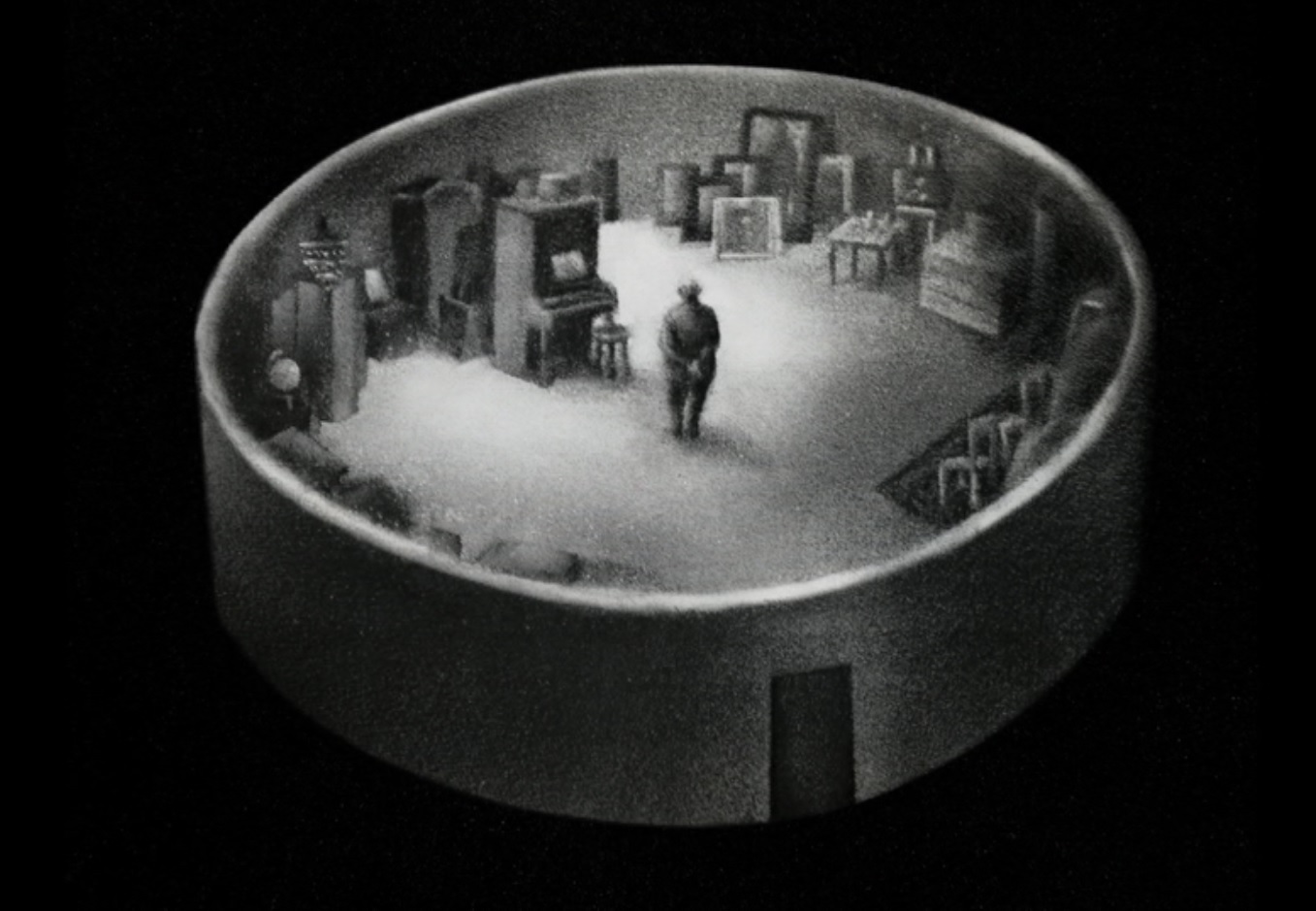
One of the most original devices for animation is the pinscreen, deviced by Alexandre Alexeïeff and his wife Claire Parker in the 1930s. Already in 1933 Alexeïeff himself demonstrated the power of this instrument with ‘Une nuit sur le mont chauve‘. However, it almost seemed that the use of machine would die with the great master.
Luckily, Canadian animator Jacques Drouin has continued this tradition, and passed it on to Michèle Lemieux. With its soft black and white images the pinscreen is especially fit for poetical images, and Lemieux’s film certainly is very lyrical. The film is subtitled ‘four meditations on space and time’, and consists of four parts, only bridged by the short’s protagonist, a piano playing man, living in a round chamber.
There’s no traditional story and no dialogue, and little music (which can only be heard during one episode and the finale). But the images are very absorbing, and the sound design is superb. The first episode, in which the man watches some strange phenomenons in the sky, is most intriguing, as is the second episode, which makes great use of metamorphosis. The third, however, is rather static, and relies a little too much on the music to evoke mood. Most disturbing is the fourth chapter, ‘The return of Nothingness’, in which a flying object sucks all objects in the man’s room away from him.
Lemieux ends her beautiful, if rather puzzling film with the pinscreen itself, and she cleverly uses the device to depict the man’s transfiguration. In all, Lemieux proves a very capable animator on this intriguing device, and one hopes she’ll make more animation films this way.
Watch an excerpt from ‘Here and the Great Elsewhere’ yourself and tell me what you think:
‘Here and the Great Elsewhere’ is available on The Animation Show of Shows DVD Box Set 8
Director: Bruno Bozzetto
Release Date: 1967
Rating: ★★★★
Review:
 The title of this cartoon can be translated as ‘life in a tin can’ and this is an apt title.
In this cartoon Bozzetto reduces a man’s whole life to several minutes. The main character’s life takes place in and between depressingly tall grey buildings. He is only allowed brief episodes of sheer joy: during is boyhood, when he falls in love, and when he becomes a father. These short episodes are depicted by colorful pictures of nature, accompanied by lyric music.
‘Una vita in scatola’ must be Bozzetto’s most perfectly timed cartoon, and it is his first real masterpiece.
Watch ‘Una vita in scatola’ yourself and tell me what you think:


 Dr. Grob's Animation Review