
You are currently browsing the tag archive for the ‘science fiction’ tag.
Director: Ben Washam
Release date: August 25, 1967
Stars: Tom & Jerry
Rating: ★
Review:
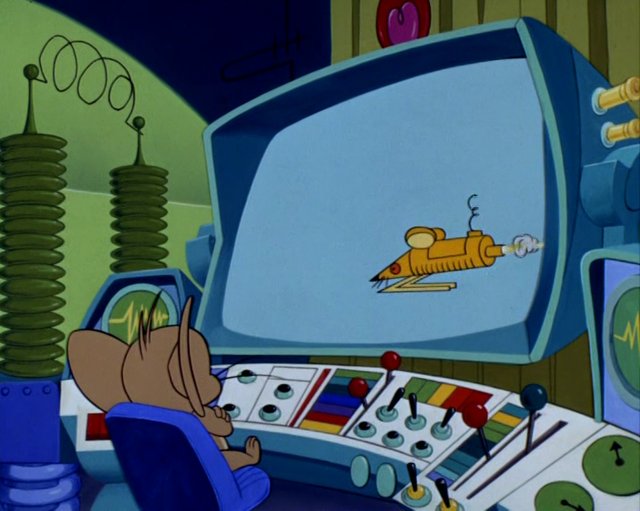 ‘Advance and Be Mechanized’ is the third of three science fiction cartoons starring Tom & Jerry, released in 1967, the others being ‘O Solar Meow‘ and ‘Guided Mouse-ille‘.
In their third science fiction short Jerry’s stealing cheese from a ‘cheese mine’ protected by police officer Tom. Both use the robots from ‘Guided Mouse-ille’ to fight each other. The film uses a whole scene twice and reuses a complete scene from ‘Guided Mouse-ille’, adding to a very cheap feel.
The end is particularly depressing when the two robots turn Tom & Jerry themselves into mindless robots… They could hardly be further removed from their glory days than in this cartoon.
Watch ‘Advance and Be Mechanized’ yourself and tell me what you think:
This is Tom & Jerry cartoon No. 161
To the previous Tom & Jerry cartoon: Shutter Bugged Cat
To the next Tom & Jerry cartoon: Purr-Chance to Dream
Director: Abe Levitow
Release date: March 10, 1967
Stars: Tom & Jerry
Rating: ★
Review:
 After ‘O-Solar-Meow‘ Tom and Jerry immediately return to the science fiction setting in ‘Guided Mouse-ille’.
The time is 2565 AD and again, Tom and Jerry fight each other with modern technology, including the robot cat from ‘O Solar Meow’. In the end, our heroes are inexplicably blown to the prehistory, where they continue their chase.
Written by story man John Dunn (as was O-Solar-Meow), ‘Guided Mouse-ille’ is a very bad and terribly unfunny cartoon. Luckily, Tom & Jerry’s next short would be much more fun…
Watch ‘Guided Mouse-ille’ yourself and tell me what you think:
This is Tom & Jerry cartoon No. 155
To the previous Tom & Jerry cartoon: O-Solar-Meow
To the next Tom & Jerry cartoon: Rock ‘n’ Rodent
Director: Abe Levitow
Release date: February 24, 1967
Stars: Tom & Jerry
Rating: ★★
Review:
 In a cartoon that looks forward to ‘2001 A Space Odyssey’ (which would be released the following year), Tom and Jerry inhabit a roulette-like space station.
Here they fight each other using modern technology, including a robot cat. In the end, Tom manages to shoot Jerry to the moon, but luckily for Jerry, it turns out to be made out of cheese.
This cartoon contains nice settings and some original ideas, but none of them are executed well, resulting in yet another mediocre Tom and Jerry cartoon produced by Chuck Jones. Tom & Jerry’s next cartoon, ‘Guided Mouse-ille‘, also has a science fiction setting. Interestingly, both these shorts were penned by story man John Dunn.
Watch ‘O-Solar-Meow’ yourself and tell me what you think:
http://www.dailymotion.com/video/x47z0hx
This is Tom & Jerry cartoon No. 154
To the previous Tom & Jerry cartoon: Cat and Dupli-cat
To the next Tom & Jerry cartoon: Guided Mouse-ille
Director: Ward Kimball
Airing date: December 28, 1955
Stars: Walt Disney, Ward Kimball, Wernher von Braun
Rating: ★★★
Review:
 After ‘Man in Space‘ (1955), ‘Man and the Moon’ is the second of three Disneyland broadcasts documenting man’s plans to conquest space.
‘Man of the Moon’ deals with the conquest of the moon, and consists of four parts. The first, largely animated, tells about man’s fascination for the moon, depicting the moon in mythology, in literature, in folklore, in nursery rhymes and in song. This sequence is a highlight of ‘cartoon modern’ style, and is full of director Ward Kimball’s trademark zany humor. It’s also the highlight of the documentary, despite the studio’s efforts to evoke the first mission to the moon in the fourth part. The folklore section is the most bold part featuring a highly stylized man, but even better are the charming animated children’s drawings in the nursery rhyme section. The sequence ends hilariously with a silly tin pan alley song about the moon, in which the writers throw in every obvious rhyme word (June, swoon, spoon, honeymoon, and even Daniel Boone).
After 18 minutes of great animation, the live action sections start, beginning with the second part. This is the shortest of the four, and features Ward Kimball in real person, telling us facts about the moon. The third part is hosted by German rocket scientist Wernher von Braun, who tells about a possible mission to the moon. Surprisingly, Von Braun does not try to land on the moon, but merely wants to fly around it. His plans involve the assembly of a giant wheel-like space station before even one vessel is flown to the moon.
His plans are shown in the fourth part as an “on the spot account of the first expedition to the moon”. Unfortunately, this is not as exciting a finale it possibly was in 1955, despite the dramatic music and the inclusion of an emergency scene in which a small meteor hits one of the fuel tanks. Nevertheless, the special effects are quite good, showing the space station rotating, and smaller reparation vessel leaving the moon rocket. Especially, weightlessness within the moon rocket is shown quite convincingly.
In 1957 Disney even showed more ambitious space plans, in ‘Mars and Beyond’.
Watch ‘Man and the Moon’ yourself and tell me what you think:
Director: Ward Kimball
Airing Date: March 9, 1955
Stars: Walt Disney, Ward Kimball, Wernher von Braun
Rating: ★★★★
Review:
 ‘Man in Space’ is a Disneyland special about man’s conquest of space, which, two years before the launching of Sputnik, was still a dream at that time.
The documentary includes information about rockets, weightlessness and concludes with an exciting account of man’s first space travel, based on the designs by rocket engineer Wernher von Braun. Von Braun is one of three German scientists featured in the program, the others being Willy Ley and Heinz Haber, demonstrating the enormous influence of German scientists on American science. Ley had fled Nazi Germany in 1935, but Haber stayed there till the end of the war, and Von Braun was even responsible for the deadly V2 rocket, a technical tour-de-force, but also the Nazi regime’s most fearful weapon.
‘Man in Space’ is shortly introduced by Walt Disney himself, quickly giving the presentation to director Ward Kimball, who remains the main host of the program. Kimball is clearly in his element here. His own wacky cartoon animation style is featured in a short history of man’s attempts to enter space, and in Haber’s accounts of ‘space medicine’. Indeed, he later called the space series, of which ‘Man in Space’ is the first entry, the creative high point of his career.
Throughout the movie, the use of animation is sparse, however, and the animation itself very limited. Nevertheless, its use is very effective, especially in the visionary concluding part, with its typical fifties science fiction designs.
‘Man in Space’ would be followed by ‘Man and the Moon‘ (1955) and ‘Mars and Beyond’ (1957), taking ideas on space travel even further.
Watch ‘Man in Space’ yourself and tell me what you think:
Director: Chuck Jones
Release date: August 8, 1955
Stars: Porky Pig, Sylvester
Rating: ★★★★
Review:
 ‘Jumpin’ Jupiter’ was the last of three cartoons in which director Chuck Jones employed Porky Pig, and Sylvester as his frightened cat.
This time they’re camping out when they’re visited by a bird-like alien. The alien takes their complete camping site to outer space. As in the former cartoons, Porky remains completely unaware of what’s happening, while Sylvester sees it all, much to his horror. In the end we see them drive off into the horizon on a strange, strange planet.
‘Jumpin’ Jupiter’ is a beautiful and well animated cartoon, and arguably the most enjoyable of the Porky-Sylvester pairings. The action is helped by Carl Stalling’s particularly inspired music, which matches the science fiction setting perfectly.
Watch ‘Jumpin’ Jupiter’ yourself and tell me what you think:
https://www.dailymotion.com/video/xk2yb4_porky-pig-jumpin-jupiter_tv
This is Porky Pig cartoon no. 145
To the previous Porky Pig cartoon: My Little Duckaroo
To the next Porky Pig cartoon: Dime to Retire
Director: Juan Antin
Release Date: October 3, 2002
Rating: ★★★
Review:
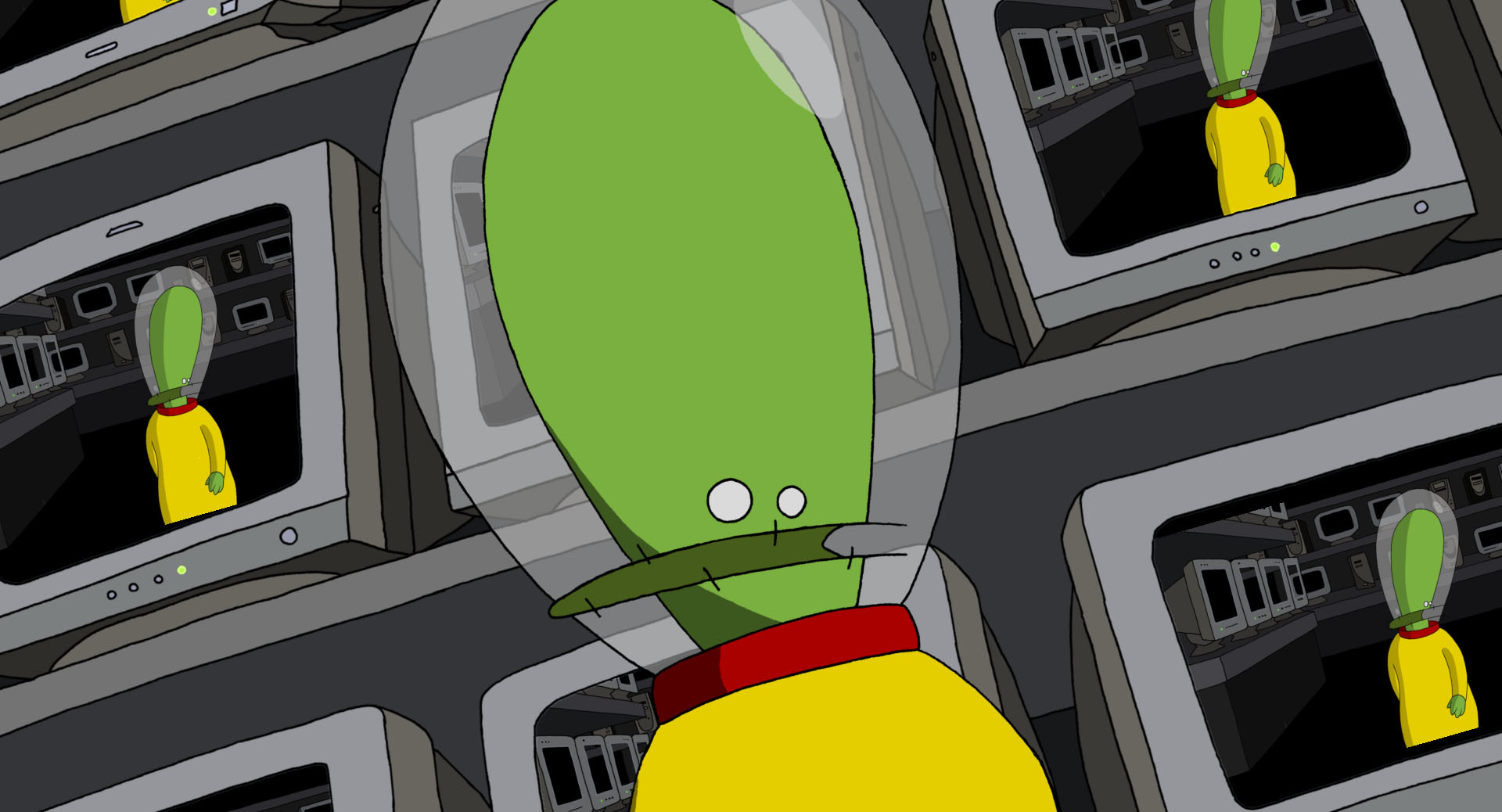 ‘Mercano el Marciano’ is a curious feature film from Argentine about an ugly little Martian who gets stranded in the evil city of Buenos Aires, where he ends up living in the sewer.
Here he builds a virtual Mars to play in for himself on the internet, but soon it is discovered and exploited by businessmen. Together with a nerdy boy and a trio of alternatives Mercano takes revenge. This leads to a silly musical finale.
The film uses original designs and is nicely animated. Unfortunately, it is also hampered by slow timing, poor gags, graphic violence, ugly colors and bad sound design. The result is an original, yet mediocre film, which is not too surprising, when one considers the film was made with a budget of only $250,000 (for comparison: a contemporary Hollywood production like ‘Monsters, Inc’ cost $115 million).
‘Mercano el Marciano’ seems to be an early example of an international movement in animation film, which favors urban settings, violence and rather adult material (e.g. ‘The District!’ (2004) from Hungary, and ‘George the Hedgehog’ (2011) from Poland).
Watch ‘Mercano el Marciano’ yourself and tell me what you think:
Directors: various
Release Date: June 3, 2003
Rating: ★★½
Review:
The enormous success of ‘The Matrix’ (1999) not only spawned two sequels, but also a direct-to-video release with several animation films, expanding the film’s theme and providing some background history.
‘The Animatrix’ is an American/Japanese/South Korean co-production and consists of nine parts, produced by four different animation film studios (Square, Studio 4°C, Madhouse Studios and DNA). The nine parts differ a lot in style, content and quality, and the end result is pretty uneven to say the least. However, for fans of ‘The Matrix’ it contains very welcome background material to The Matrix universe.
 1. Final Flight of the Osiris
Director: Andy Jones
Rating: ★★★½
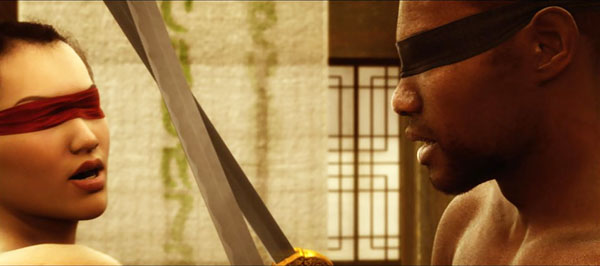
The first of the nine segments of The Animatrix is the most straightforward. It’s a dark action episode that tells what happened to the Osiris, a human vessel that shortly appears in ‘The Matrix’. The Square Studio, then already famous for the groundbreaking animation in ‘Final Fantasy: The Spirits Within’ (2001), tops itself with for 2003 ultra-realistic computer animation, with human characters of a then unsurpassed realism. Especially its opening sequence, an erotic martial arts fight, is impressive and made many viewers doubt whether it was real or not they were looking at.
 2. & 3. The second Renaissance
Director: Mahiro Maeda
★★★½
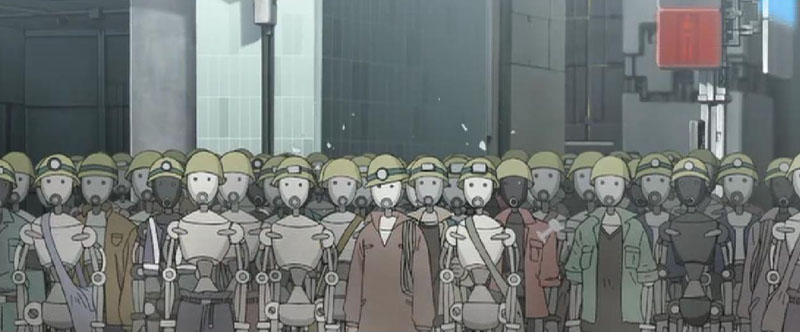
Made by Studio 4°C and brought in two episodes, The Second Renaissance tells us what happened before the Matrix in an American anime-style. It uses a robotic female voice-over to tell us about a robotic revolution and a human-robot-war which ends in defeat for the human population, which is then used as an energy source for the robots. These episodes are the most satisfying as an addition to The Matrix trilogy.
 4. Kid’s Story
Director: Shinichirô Watanabe
Rating: ★
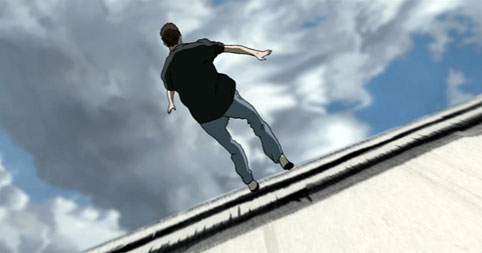
‘Kid’s Story’ is the first of four episodes dealing with people who discover the matrix. This episode is about a teenager who doubts reality and who wakes up in the real world. The episode uses a very realistic, yet graphic style that is very American and rather ugly. Especially the animation (by Studio 4°C) is slow, unsightly and unsteady, making it one of the most unappealing parts of ‘The Animatrix’ to watch.
 5. Program
Director: Yoshiaki Kawajiri
Rating: ★★
‘Program’ is another weak entry in ‘The Animatrix’. Animated by Madhouse Studios and drawn in a rather American comics/anime-style and using sharp shades, it tells about a treacherous character trying to persuade a girl to join him in a Japanese samurai setting (the program the two are in). The whole episode is rather melodramatic and forgettable.
 6. World Record
Director: Takeshi Koike
Rating: ★
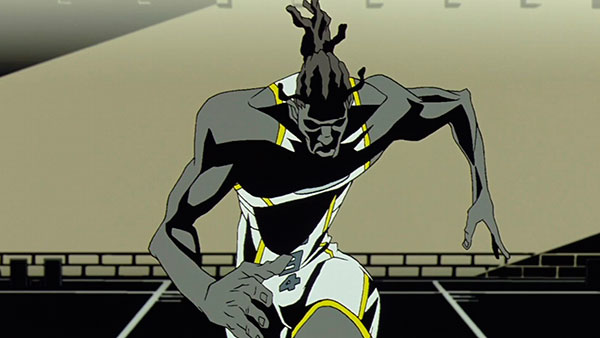
By far the most unappealing of all episodes of ‘The Animatrix’, ‘World Record’, by Madhouse studios, is drawn in a a gruesomely ugly comics design to tell the story of an athlete who discovers the matrix and who has to pay for it.
 7. Beyond
Director: Kôji Morimoto
Rating:★★★★
Studio 4°C’s ‘Beyond’ is the third of four Animatrix episodes about people who discover the matrix, and it is easily the best of the lot. Set in Japan, it tells about a young woman, who is looking for her cat Yuki, and who’s led by some kids to a house where the ‘program’ has gone haywire, resulting in some wonderful surreal effects (like objects defying gravity). Unlike the rest, the episode has a lighthearted feel to it, which is enhanced by its appealing graphic anime design and its excellent animation, which makes clever use of 3D-effects. More than in any other part of the Animatrix one has the feeling that this episode is about real people in a real environment. The short is another showcase for Morimoto’s great direction skills, which he had already shown with the ‘Magnetic Rose’ sequence in the compilation feature ‘Memories‘ (1995).
 8. A Detective Story
Director: Shinichirô Watanabe
Rating: ★
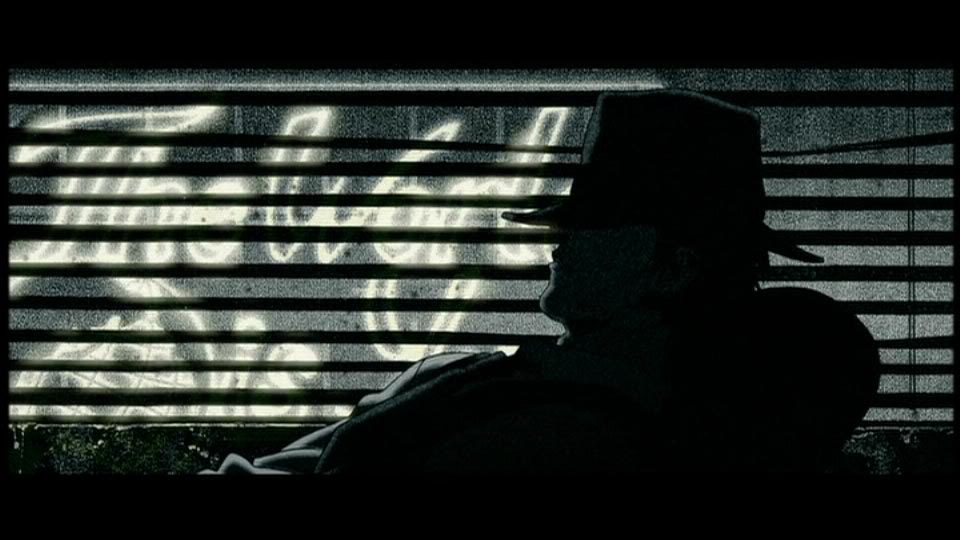
‘A Detective Story’ is the fourth and last episode about people who discover the matrix. This episode is about a private detective and it uses all film noir cliches, including a very trite voice over. The nice black and white backgrounds evoke a forties atmosphere, even though the story is about hackers and chat rooms. But they cannot hide Studio 4°C’s very limited animation or the corny story, making ‘A Detective Story’ one of the weakest episodes of this package film.
 9. Matriculated
Director: Peter Chung
Rating: ★★★★
Penned and directed by Æon Flux-director Peter Chung and produced by the Korean DNA studio, ‘Matriculated’ is the most philosophical of the nine episodes of ‘The animatrix’. The story is set in the ‘real’ world. It deals with humans who try to make robots defending them by making them dream. Although its angular human designs are once again quite unattractive, this episode’s clever story makes it one of the highlights of ‘The Animatrix’.
Watch the trailer for ‘The Animatrix’ yourself and tell me what you think:
Director: Kōji Morimoto, Tensai Okamura & Katsuhiro Otomo
Release Date: December 23, 1995
Rating: ★★★★
Review:
Seven years after ‘Akira‘, Katsuhiro Otomo returned to the animated screen with ‘Memories’, a package film, which impresses, but fails to reach the heights of ‘Akira’. Indeed, the film is much, much less well known than either Otomo’s previous film, or ‘Ghost in the Shell‘, which was the anime hit of 1995.
Based on his own short stories, ‘Memories’ consists of three unrelated parts: ‘Magnetic Rose’, ‘Stink Bomb’ and ‘Cannon Fodder’, which are discussed separately below.
 Magnetic Rose
Director: Kōji Morimoto
Rating: ★★★★★
‘Magnetic Rose’ starts the Memories trilogy, and it’s arguably the feature’s most satisfying episode. Animated by Morimoto’s own Studio 4°C, it is the only part that clearly deals with memories.
In this episode a rescuing squad of space garbage collectors is ensnared in the memories of a long deceased opera singer, who still seems alive in her remote satellite home in space, blurring the boundaries of reality. This accounts for an exciting story, greatly enhanced by Yoko Kanno’s superb soundtrack, in which she mixes an eerie choir, ambient guitar work and dark electronic with bites of Giacomo Puccini (the famous aria ‘un bel di vedremo’ and the finale from ‘Madame Butterfly’, an opera set in Japan, and a small soundbite from ‘Turandot’, which is set in China). Also featured is a stage set from Puccini’s ‘Tosca’, in which the opera singer, as Tosca, stabs Heinz, one of the rescuers.
Even though the science fiction setting with its touches of horror is typical anime, the underlying drama is very mature and quite unique. This episode’s screenplay was penned by future director Satoshi Kon. Kon certainly established himself with this screenplay, and he would further explore the theme of memory and loss in ‘Millennium Actress’ (2001), and the blurring of reality and fantasy in both that film and ‘Paprika’ (2006) with even more spectacular results. Director Kōji Morimoto, meanwhile, would prove his worth as a director in ‘Beyond’, the best episode of ‘The Animatrix‘ (2003).
In ‘Magnetic Rose’ the characters are from all over the world, and this is one of the few anime, in which the Japanese character looks distinctively Asian compared to the European characters.
 Stink Bomb
Director: Tensai Okamura
Rating: ★★★
Penned by Katsuhiro Otomo, but directed by Tensai Okamura, and animated by the Madhouse animation studio, ‘Stink Bomb’ feels like a comical interlude between the two more serious outer episodes. The story is set in present day Japan and features a very stupid, but surprisingly indestructible protagonist who turns into a nonsensical weapon of mass destruction. The story is simple: Nobue Tanake, our ‘hero’, works in a biochemical laboratory. To cure his cold one of his colleagues suggests he takes a sample of the new medicine they’ve developed at the lab. But Tanake accidentally swallows the wrong pills, which turn him into a lethal weapon, sweating poisonous gasses that kill everything in sight. Although he remains unaware of this, he becomes the cause of the annihilation of Japan.
This story is rather silly – there’s a lot of broad comic acting, and it even ends with a kind of punch-line. And yet, the episode manages to be unnerving at the same time; the short has some disturbing undertones, with the fear of mass destruction weapons and corrupt governments played out well. The unsettling atmosphere is greatly enhanced by Jun Miayke’s score, in which he uses nervous free jazz saxophones to a great effect.
 Cannon Fodder
Director: Katsuhiro Otomo
Rating: ★★★★½
Otomo himself directed the last and most beautiful sequence of Memories. This episode once again is animated by Studio 4°C, but has a distinctive graphic style that doesn’t resemble any other anime. Especially the background art and character design are highly original. But even more startling is the fact that the film is ‘shot’ in one long camera take (with a little bit of smuggling, but very impressive nonetheless). The cinematography is outstanding, and uses a little bit of computer animation. One moving shot of a colonel ascending on a platform is a great piece of character animation. Nevertheless, the boys’ own dream of becoming a colonel himself, done in charming children’s drawings, may be the highlight of the entire film.
‘Cannon Fodder’ deals with an alternative, distinctively European world, where a totalitarian military regime enters every aspect of life. It’s a kind of steam punk, vaguely based on images of the first world war, with its giant cannons, gas masks, and pompous generals. We’re following one day in the life of a single family. They live in a city were all work and school is directed to a war with a mysterious city, which remains unseen throughout the movie. This war is fought entirely by using cannons, fired at the distant enemy.
Despite the caricatured humans, the atmosphere is hardly comical, but dark and disturbing. The unseen foe reminds one of ‘1984’, and one wonders whether the enemy is real – but then, in the end, the air alarm kicks in. ‘Cannon Fodder’ is more a film of concept than of drama, and thus less engaging than ‘Magnetic Rose’. Still, because of its unique style, and strict control of cinematography, ‘Cannon Fodder’ is a small masterpiece.
Watch the trailer for ‘Memories’ yourself and tell me what you think:
‘Memories’ is available on DVD and Blu-Ray
Director: Katsuhiro Otomo
Release Date: July 16, 1988
Rating: ★★★★★ ♕
Review:
 In 2019, 31 years after World War III, which destroyed the old town completely, Neo-Tokyo is even bigger and more urbanized than the old one. And more violent, too. The city is constantly on the brink of anarchy.
We follow Kaneda and Tetsuo, two members of a rough motorbike gang. When Tetsuo is hospitalized and taken away from his friend, Kaneda tries to retrieve him, while getting involved with a girl, who’s a revolutionary and whose troupe is after Tetsuo, too. Tetsuo, meanwhile, discovers he’s getting immense powers. Tetsuo suffers from an inferiority complex, and he realizes it’s payback time. He sets out to seek the mystical Akira, destroying most of Neo-Tokyo along the way. But in the end his powers take control of him, and while he and Akira merge to form a new universe in a very 2001 A Space Odyssey-like ending, Kaneda and his girlfriend Kei can look to a new future in a partly destroyed Neo-Tokyo.
If this plot line may sound a little hard to follow – it is, and I left quite some subplots out of it, too. ‘Akira’ is a violent and action-loaded science fiction film. Its plot may be vague and all too complex, the violent images never cease to impress. The film’s depiction of apocalyptic destruction, its speed, its wide range of characters, and its use of extreme camera angles are unprecedented in any animation film, and sometimes the grandness of the film’s scale is staggering. Some of the scenes are very complicated, with many people animated within one frame. And the story, too, seems to aim to encompass everything within the feature’s 124 minutes. Not surprising, considering that the film is based on a manga story six fat volumes thick.
Although Anime had known earlier masterpieces, it’s ‘Akira’, which set new standards in its home country. Moreover, it’s this film, which put the Japanese animation feature film industry firmly on the map in Western countries, which thus far practically had known the country’s television series, only. Thus, for most Westerners Japanese animation was synonymous to cheap animation, and the use of ridiculously large eyes. However, ‘Akira’ showed the Western world that Japan was perfectly capable of producing films of a high quality and stunning originality. Japanese animation has only grown in popularity since Akira’s release, and has become a major inspiration for many Western films and television series, animated or not.
Watch the trailer for ‘Akira’ yourself and tell me what you think:
‘Akira’ is available on DVD and Blu-Ray
Director: Hayao Miyazaki
Release Date: March 11, 1984
Rating: ★★★★★
Review:
 Although the titles say ‘based on the graphic novel’, the manga of the same name was actually created to be able to make the picture.
Based on his own original story, ‘Nausicaä of the Valley of Wind’ is Miyazaki’s first mature film. It’s already a typical Miyazaki film, with its strong environmental message, strong female characters, the absence of clear villains, and the setting of an alien, yet totally convincing world.
The film tells of Nausicaä, princess of a small medieval-like state in a green valley, which is threatened not only by the strange, hostile and poisonous insect world nearby, but also by other human states, especially the militaristic state of Tolmekia. The humans are more preoccupied with destruction than with comprehension. Because of this shortsighted and drastic behavior, the humans almost destroy their entire environment. It is Nausicaä, with her unique understanding of animals and her pacifistic nature, who saves the day.
‘Nausicaä of the Valley of Wind’ is an epic science fiction film, made on a grand scale, with layered characters, beautiful designs, and excellent animation. Its production led to the foundation of the Ghibli studios, which high quality standards it already meets. In no sense it feels like a first-born or a dated film. Even though it’s from 1984, it is remarkably fresh and its message still viable. In other words, ‘Nausicaä of the Valley of Wind’ is the first of a long series of Ghibli studio classics.
Miyazaki would revisit the theme of a sick and angered nature in the similar and equally impressive ‘Princess Mononoke’ (1997). Once again it’s a princess who saves the day…
Watch the trailer for ‘Nausicaä of the Valley of Wind’ yourself and tell me what you think:
Director: Sabrina Peña Young
Release Date: October 5, 2013
Rating: ★
Review:
 ‘Libertaria: The Virtual Opera’ must be one of the most unwatchable animated features ever made.
This science fiction film is utterly pretentious, using heavy texts to tell a dystopian story about some post-apocalyptic America. The film makes use of some interesting split-screen techniques, but is hampered by erratic storytelling and the most primitive computer animation techniques. The animation of the characters is appallingly poor and amateurish, and the designs hideously ugly. The emotions of the songs are not mirrored in the images, at all. Even the cheapest video game looks better than this.
This combination of dead serious pretentiousness and extremely poor execution make the film a nightmare to watch. Its best aspect is its music, because that, at least, has some quality. Indeed, Sabrina Peña Young is a composer, not an animator, and it remains puzzling why she wanted to make this film in the first place.
Cobbler, stick to your last!
[UPDATE: Sabrina Peña Young reacted to this blog post to explain why she made this film. Please read her response below]
Watch ‘Libertaria: The Virtual Opera’ yourself and tell me what you think:
Director: René Laloux
Release Date: 1988
Rating: ★★★★½
Review:
 ‘La Prisonnière’ is a short, rather surrealistic science fiction film about two children.
They visit an extraterrestrial monastery and witness a rescue of a prisoner by naked women who step out of a stranded whale.
The film looks like an animated version of designer Caza’s source comic, Équinoxe (which can be found here), and contains only a limited amount of animation. In his designs Caza’s style is very reminiscent of that of his fellow french comic artist Moebius.
‘La prisonnière’ seems like an etude for Laloux’s and Caza’s much bigger project, the feature film ‘Gandahar‘ (1988). The atmosphere of the short is poetic, if completely incomprehensible.
Watch ‘La Prisonnière’ yourself and tell me what you think:
‘La Prisonnière’ is available on the DVD ‘Gandahar’
Director: René Laloux
Release Date: May 11, 1973
Rating: ★★★★★ ♕
Review:
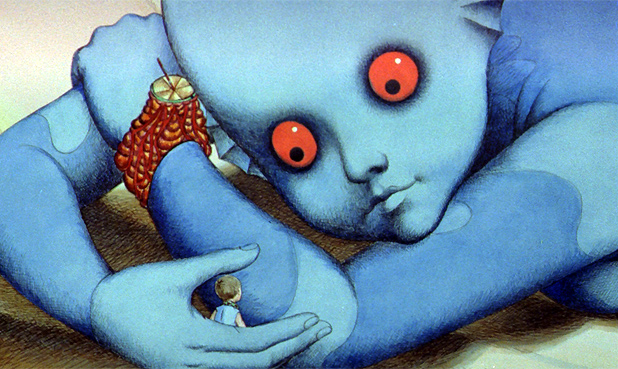
‘La planète sauvage’ is an old love of mine. I first watched it when I was ca. six or seven. It took me fifteen years before I learned which film I had actually watched, and it would take me another ten years before I could watch it again. However, all the time the film’s powerful images never left me.
‘La planète sauvage’ is a science-fiction feature, which tells about the life of humans (‘Oms’, which sounds like the french word for humans, ‘hommes’) on a strange planet occupied by story-block-high humanoid giants, called Draags. To them humans are no more than pets and pests. By accident, a pet Om, Terr (symbolically named after the French word for Earth, terre), learns the Draags’ knowledge and he leads his fellow humans into an uprising.
However, ‘La planète sauvage’ is not particularly famous for its straightforward and rather cliche plot. Its strength lies in its effective use of Roland Topor’s very surrealistic designs, which makes the depicted planet incomprehensible, foreign and scary. For example, the Draag’s behavior is so strange, that despite their humanoid form they feel very alien, indeed. The film’s original technique of combining drawn animation with cut-out adds to the surreal atmosphere. Even the space funk music accompanying the action sounds outlandish.
Even though the animation sometimes is rather stiff and at times even ridiculously poor, the graphic imaginary is so strong that these shortcomings never spoil the enjoyment of the film. On the contrary, the film’s totally unique and disturbing atmosphere and its philosophical questions about what makes man human make watching ‘La planète sauvage’ a very rewarding experience.
Together with Bruno Bozzetto’s ‘Allegro non troppo’ (1976) and Martin Rosen’s ‘Watership Down’ (1978) Laloux’s film must be counted among the most outstanding features of the seventies. René Laloux would make two other science fiction features, ‘Les maîtres du temps‘ (1981) and ‘Gandahar‘ (1988), but these do not reach the stunning originality of the visuals in this film.
Watch the trailer for ‘La Planète sauvage’:
Director: Chuck Jones
Release Date: July 25, 1953
Stars: Daffy Duck, Porky Pig, Marvin Martian
Rating: ★★★★★ ♕
Review:
 ‘Duck Dodgers in the 24½th Century’ is a spoof of the popular pulp magazine science fiction series Buck Rogers, which was made into a television series in 1950-1951. This makes this short one of the earliest theatrical cartoons parodying a television series.
Daffy “Duck Dodgers” and his sidekick “the eager young space cadet” Porky have to claim planet X for planet Earth. Unfortunately, Marvin Martian wants to claim the same planet for Mars. This starts a feud, which ends in both blowing up the entire planet.
Although the story of the cartoon is rather similar to the Bugs Bunny cartoon ‘Haredevil Hare‘ (1948), Daffy’s unique performance gives it an entirely different feel, leading to new and great gags. More than being a typical science fiction cartoon, this short can be regarded the second cartoon in a series which pairs Daffy as a misguided hero to Porky as a more sensible straight man (the first being ‘Drip-along Daffy‘ from 1951). ‘Duck Dodgers’ must be the highlight of the series, as well as a peak in both Daffy’s as Chuck Jones’s career.
Unhampered by conventions, Jones, his layout-man Maurice Noble and background painter Phil DeGuard went totally berserk with the science-fiction theme, creating wild and lushly colored backgrounds, which make ‘Duck Dodgers in the 24½th Century’ one of the most beautiful cartoons ever made at Warner Brothers.
Indeed, so great is its fame, it spawned sequels in 1980, 1996 and 2003. From 2003 to 2005 Cartoon Network even broadcasted a Duck Dodgers series.
Watch ‘Duck Dodgers in the 24½th Century’ yourself and tell me what you think:
http://www.220.ro/desene-animate/Looney-Tunes-Duck-Dodgers-In-The-24-5-Century/aTflTNIyAr/
This is Porky Pig cartoon no. 142
To the previous Porky Pig cartoon: Fool Coverage
To the next Porky Pig cartoon: Claws for Alarm
This is Daffy Duck cartoon No. 65
To the previous Daffy Duck cartoon: Muscle Tussle
To the next Daffy Duck cartoon: Duck! Rabbit! Duck!
‘Duck Dodgers in the 24½th Century’ is available on the Blu-Ray ‘Looney Tunes Platinum Collection: Volume 2’ and on the DVD-set ‘Looney Tunes Golden Collection Volume One’
Director: Luiz Bolognesi
Release Date: April 5, 2013
Rating: ★★
Review:
 ‘Uma História de Amor e Fúria’ (Rio 2096: a Story of Love and Fury) is a a rather depressing film from Brazil, showing three violent episodes in Brazilian history, plus one in the future.
Main protagonist is the Tupinambá Indian Abeguar, who is granted the possibility of flight and immortality, reincarnating as a bird. Through his eternal love interest Janaína he can reincarnate back into a human form, which he does three times during the film.
This framing story binds the four separate episodes, which take place in 1556, the 1820s, 1968-1980 and 2096. The first episode shows us his Tupinambá self, and how his tribe gets slaughtered and enslaved by Portuguese colonists. In the second episode Abeguar reincarnates as a poor farmer joining a troop of enraged farmers and escaped slaves during Brazil’s war of independence. In the third episode he’s a teacher fighting the military dictatorship, and in the last episode, taking place in the future, he fights in a war over scarce water.
‘Uma História de Amor e Fúria’ shows Brazil’s troubled history. Throughout the picture life is showed through the eyes of the underdog. Abeguar sarcastically observes that his oppressors get statues, while the oppressed remain anonymous.
‘Uma História de Amor e Fúria’ is an accomplished work: the animation is fairly good, if a little mechanical, the backgrounds are gorgeous, and the production values pretty high. The film clearly aims at a more adult audience, not eschewing nudity or graphic violence.
The film is hampered, however, by rather ugly designs: the humans look like those from Disney’s Pocahontas (1995), but with even more angular designs. The animation of emotions is crude and stereotypical. But more important: the film is totally devoid of humor. It is dark and heavy throughout, without any light moments. This gives the film a propagandistic gravity, which becomes tiresome in the end.
Watch the official trailer of ‘Uma História de Amor e Fúria’ and tell me what you think:
Director: Chuck Jones
Release Date: July 24, 1948
Stars: Bugs Bunny, Marvin the Martian
Rating: ★★★★
Review:
 ‘Haredevil Hare’ Bugs opens with two headlines of the ‘Daily Snooze’: ‘Scientist to Launch First Rocket to the Moon’ and ‘Heroic Rabbit Volunteers to Be First Passenger’.
Cut to Bugs Bunny ‘volunteering’ (he’s literally dragged towards the spaceship by two men). Bugs changes his mind however, when he notices the supply of carrots dumped into the rocket. And so he’s off to the moon.
Bugs has a hard landing on the moon, which destroys his vesssel and leaves him in shock. But just when he’s adjusted to the fact that he’s alone on the moon, Bugs encounters Marvin the Martian (in his first screen appearance) and his green, talking Martian dog, who is designed like a green version of Charlie Dog and who speaks with the dumb voice of Junior Bear, provided by voice actor Stan Freberg.
The two Martians are on the first Mars-Moon expedition and want to blow up the Earth. But it’s Bugs who blows up the two and accidentally half the moon, too. In the end we see the three hanging on the left piece of the moon with bugs screaming to the control room: “Get me outa here!”.
‘Haredevil Hare’ is one of the first science fiction-themed films that flooded the post-war era. It even predates the first post-war live action features set in outer space, ‘Rocketship X-M’ and ‘Destination Moon’ by two years. In the 1950s outer space would become a popular film setting. Indeed, Chuck Jones himself would revisit outer space several times in his cartoons, most notably in ‘Jumpin’ Jupiter‘ (1955), ‘Rocket Squad’ (1956), and the greatest of all science fiction cartoons, ‘Duck Dodgers in the 24½th Century‘ (1953).
The latter cartoon also features Marvin the Martian, who would reappear in three more Bugs Bunny cartoons: ‘The Hasty Hare’ (1951), ‘Hare-Way to the Stars’ (1958) and ‘Mad as a Mars Hare’ (1963). Of all cartoon villains, Marvin the Martian is the most extraordinary. He’s as gentle, polite and mild-mannered as he is destructive. Although he would never become a major star, he’s still popular today.
Apart from introducing Marvin, ‘Haredevil Hare’ is a notable cartoon because of some nice and weird animation by Ben Washam of Bugs being a nervous wreck after his voyage to the moon: we watch him changing from one bizarre pose into the other, almost without any animation in between. The scenes inside the rocket scene are reminiscent of Bob Clampett’s ‘Falling Hare’ (1943).
Watch ‘Haredevil Hare’ yourself and tell me what you think:
http://www.supercartoons.net/cartoon/661/haredevil-hare.html
‘Haredevil Hare’ is available on the DVD set ‘Looney Tunes Golden Collection, Vol. 1’
This is Bugs Bunny cartoon No. 51
To the previous Bugs Bunny cartoon: Bugs Bunny Rides Again
To the next Bugs Bunny cartoon: Hot Cross Bunny
Director: Winsor McCay
Release Date: 1921
Rating: ★★★½
Review:
 ‘The Flying House’ is the last of the three ‘Dream of a rarebit fiend’ films Winsor McCay completed in 1921.
In this short the classic rarebit makes a woman dream that her man has made a flying machine out of their house. With their flying house they fly to the moon, where they’re almost swatted by a giant. When they run out of gas they circle in empty space until they’re hit by a rocket, and both fall down. At this point, of course, the woman awakes.
Compared to the other two Rarebit Fiend films, ‘Bug Vaudeville‘ and ‘The Pet‘, this cartoon uses a lot of dialogue, both in balloons and in title cards. Moreover, there’s a lot of reverse and repeated animation – thus not all movements are too convincing. Although the story does not quite delivers what it promises, it contains a few good gags. And, as always, both McCay’s drawing style and command of perspective are top notch. Especially the shots of the house flying are very impressive.
Yet the film’s most stunning sequence is when the house leaves earth to fly to the moon. In one convincingly realistic shot we see the earth rotating, the moon appearing behind it and growing larger, while the house flies towards us, orbiting the earth. This is by all means a spectacular piece of animation, especially because it was done 37 years before the space age. McCay clearly and understandably was proud of this sequence, and so he announces it with a title card.
Unfortunately, ‘The Flying House’ was to be Winsor McCay’s last completed film. His legacy is formidable, and he undoubtedly belongs to the best and most imaginative animators/animation directors of all time.
Watch ‘The Flying House’ yourself and tell me what you think:
This is Winsor McCay’s tenth and last film
To Winsor McCay’s ninth film: The Pet


 Dr. Grob's Animation Review