You are currently browsing the tag archive for the ‘surrealism’ tag.
Director: Dave Fleischer
Release Date: January 5, 1934
Stars: Betty Boop, Fearless Freddie
Rating: ★★★★½
Review:
 Betty is the star in a melodrama with an evil landlord and a classic hero.
Arguably the first Betty Boop cartoon with a clear plot, ‘She Wronged Him Right’ marks the debut of Fearless Freddie, who seems to be designed as Betty’s new suitor (Bimbo, being an animal, was no longer accepted in a Hollywood dominated by the puritan Hays Code). His stay would be short, however, because very soon Betty would lose interest in men altogether, taking the Code even further.
Only nine months later the formula of this cartoon was repeated with less successful results in ‘Betty Boop’s Prize Show’. ‘She Wronged Him Right’ still contains some wonderful metamorphosis gags and some inanimate objects speaking or suddenly growing hands, preserving some of Fleischer’s famous surrealism.
The very idea of Betty performing in a melodrama may have been borrowed from Disney, who had released the comparable ‘Mickey’s Mellerdrammer‘ in 1933.
Watch ‘She Wronged Him Right’ yourself and tell me what you think:
This is Betty Boop cartoon No. 24
To the previous Betty Boop cartoon: Parade of the Wooden Soldiers
To the next Betty Boop cartoon: Red Hot Mamma
‘She Wronged Him Right’ is available on the French DVD Box Set ‘Betty Boop Coffret Collector’
Director: David Hand
Release Date: January 21, 1933
Stars: Mickey Mouse, Pluto
Rating: ★★★★★
Review:
 ‘The Mad Doctor’ is Mickey’s third horror cartoon and easily his best (the other two are ‘The Haunted House’ from 1929 and ‘The Gorilla Mystery’ from 1930).
The plot is simple: it’s night, the weather is foul and Pluto is kidnapped by an evil scientist called Dr. XXX, who takes him into his laboratory, which is reminiscent of that of Frankenstein in James Whales’ film of the same name, 1931. Mickey follows Pluto’s tracks into a creepy castle, entering it in a scene which reuses some footage of ‘Egyptian Melodies‘ from 1931. Inside the castle he has to deal with several skeletons, including a ridiculous hybrid of a skeleton and a spider. Soon, he’s captured, too, and about to be killed by a chainsaw. Fortunately, it turns out to be all just a dream…
Besides the horror, this cartoon also features elaborate designs and loads of special effects. Especially beautiful is its shadowing on the characters. It also has a strong musical element, as the mad scientist sings all his lines. Some of the gags are quite surreal and reminiscent of the Fleischer style, like a lock locking itself or the scientist cutting off Pluto’s shadow. The cartoon also features a gag with many doors in one doorpost. This gag would be reused and improved by Tex Avery in ‘The Northwest Hounded Police’ from 1946.
Watch ‘The Mad Doctor’ yourself and tell me what you think:
This is Mickey Mouse cartoon No. 52
To the previous Mickey Mouse cartoon: Building a Building
To the next Mickey Mouse cartoon: Mickey’s Pal Pluto
Director: Walt Disney
Release Date: March 15, 1929
Stars: Mickey Mouse, Minnie Mouse, Pete
Rating: ★★★★½
Review:
 In ‘The Barn Dance’, Mickey Mouse’s fourth cartoon, Pete’s rivaling Mickey for the love of Minnie.
The first scene of this cartoon draws its inspiration from the Oswald cartoon ‘Rival Romeos‘, released only eight months earlier. Pete and Mickey both come to Minnie’s house to court her. Pete has the advantage of having a car above Mickey’s chariot, and like Donna Duck would do nine years later in ‘Don Donald‘ (1937), Minnie (wearing a bra, like she did in ‘Gallopin’ Gaucho‘) falls for it. Luckily, the car falls apart even before they’ve taken a ride, so Mickey and Minnie ride together to a barn dance hall.
Unfortunately, Mickey can’t dance: his shoes grow bigger every step, stepping on Minnie’s leg all the time. So after the dance Minnie’s leg is a long mess. She then ties it in a knot and cuts off the excess! These two gags belong to a surreal type typical of the silent era, which Disney would soon abandon.
After Mickey’s failure as a dancer, Minnie only wants to dance with Pete. Mickey solves the problem with help from a balloon, but Pete wrecks Mickey’s plan, regaining Minnie and leaving Mickey crying on the floor. This is a rather odd ending of a marvelous cartoon, which is still firmly rooted in the silent era with its surreal gags, limited use of sound and absence of dialogue.
‘The Barn Dance’ is far less known than the three Mickey Mouse cartoons preceding it, but with its clear storytelling, funny gags and strong acting it’s still a delightful cartoon to watch.
Watch ‘The Barn Dance’ yourself and tell me what you think:
This is Mickey Mouse cartoon No. 4
To the previous Mickey Mouse cartoon: Steamboat Willie
To the next Mickey Mouse cartoon: The Opry House
Director: Wilfred Jackson
Release Date: August 19, 1933
Rating: ★★★★½
Review:
 In ‘Lullaby Land’ a baby is lulled to sleep by his mother, singing ‘rock-a-bye baby’. The song takes the baby and his stuffed dog to Lullaby Land, a wonderfully surreal land made of plaids, rattles etc.
There the baby encounters a parade of baby objects, and a forbidden garden, full of sharp things, like knives and scissors. Despite the warnings of the female choir in the soundtrack, the baby enters. He destroys all watches from a watch tree with a hammer, and plays with matches. The smoke evokes three bogey men, which scare the baby away. Finally, the baby meets the Sandman, who puts the baby asleep to the tune of Johannes Brahms’s lullaby.
With cartoons like ‘Lullaby Land’ Disney set new standards for animation that are still thrilling today. Don’t get me wrong, the cartoon is rather patronizing and sugary cute, especially through the soundtrack. But this is compensated by wonderful surrealistic images, beautiful artwork and superb animation. And, hey, this way of warning against sharp things and matches just may work with small children.
Lullaby Land itself is a highly original fantasy world, and especially its first images are stunningly beautiful. The dance of the bogey men contains some striking use of color that anticipates similar surreal images in ‘Dumbo‘ (1941). Moreover, it is the first example of totally unrealistic color use in animated cartoons, and therefore a milestone.
Unfortunately, the cartoon also marks a trend of childishness creeping into the animation world, not only at Disney’s, but at all other studios, as well. For example, ‘Lullaby Land’ is the first of a whole series of Silly Symphonies obsessed with little babies, and their bare behinds in particular, with ‘Wynken, Blynken and Nod‘ from 1938 being the last example.
Anyway, ‘Lullaby Land’ left all competitors far behind. Later, both Walter Lantz (‘Candy Land’, 1934) and Max Fleischer (‘Somewhere in Dreamland‘, 1936) tried to copy the concept with far less convincing results.
Watch ‘Lullaby Land’ yourself and tell me what you think:
This is Silly Symphony No. 38
To the previous Silly Symphony: Old King Cole
To the next Silly Symphony: The Pied Piper
Director: Norm Ferguson
Release Date: December 21, 1944
Stars: Donald Duck, Joe Carioca, Panchito, The Aracuan Bird
Rating: ★★★
Review:
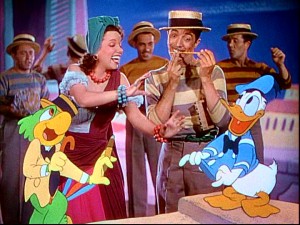 Donald stars in his first and only very own feature film.
In the opening scene he receives a large package full of presents. When he opens these presents, they lead him to the mild story of Pablo the cold-blooded penguin (narrated by the melancholy voice of Disney-favorite Sterling Holloway), and to the childish story of ‘Gauchito and his flying donkey Burrito’, before it reintroduces Joe Carioca from ‘Saludos Amigos‘ (1942). Joe takes Donald to Baía, where they dance the samba with Aurora Miranda, nicely blending animation with live action, something that occurs throughout the picture.
Another package introduces the Mexican rooster Panchito. Together the trio sings the intoxicating theme song, wonderfully animated by Ward Kimball, who regarded the scene as his best work. Panchito takes Donald and Joe on a magic serape ride over Mexico, visiting Mexico City, Veracruz en Acapulco Beach, where Donald plays blind man’s buff with a bunch of girls in bathing suits. Actually, Donald keeps hunting girls like a hungry wolf throughout the picture.
‘The Three Caballeros’ was the second of two ‘Good neighbor policy’ features, focusing on South America, and the second of six compilation features Disney made until returning to real features with ‘Cinderella‘ in 1950. When compared to ‘Saludos Amigos’, ‘The Three Caballeros’ is brighter, bolder and more nonsensical. It is noteworthy for its bold color design and for its beautiful color book artwork by Mary Blair, which in its modernity looks forward to the 1950s (especially in the opening titles, during the train ride and in the Mexican Christmas episode).
It is most interesting however, because of its zany surrealism, which invades many scenes with associative images, where metamorphosis and abstraction run haywire, not even sparing Donald himself. In this respect ‘The Three Caballeros’ is the boldest feature Disney ever made.
However, its lack of story, its strong touristic content, its outdated live action imagery, its sentimental songs and the two childish stories at the beginning of the feature all harm the picture. Thus watching the movie feels like being on a colorful journey full of beautiful images that nevertheless turns out to be unsatisfactory in the end.
Watch the title song from ‘The Three Caballeros’ below:
‘The Three Caballeros’ is available on DVD
Director: Jack Kinney
Release Date: January 1, 1943
Stars: Donald Duck
Rating: ★★★★★ ♕
Review:
 In ‘Der Fuehrer’s Face’ Donald is apparently a citizen of ‘Nutziland’, a fascist country where even trees and clouds are swastika-shaped.
Donald is awoken by a silly march band singing the sarcastic title song (penned by Disney composer Oliver Wallace and sung with gusto by Spike Jones). Then he has breakfast that consists of only one coffee bean, ‘aroma de bacon & eggs’ and a slice of wooden bread. All too soon he has to work at the assembly line, making shells and saluting to images of Adolf Hitler.
In the end, it appears that it was all just a dream, and Donald, in his Stars and Striped-colored room, sighs, embracing a golden copy of the statue of liberty: “Am I glad to be a citizen of the United States of America”. This closing scene is rather corny and the satire of the film misses some points: most of the (German) citizens of Nazi Germany were not poor and did not have to work like slaves, as is suggested here. Instead, the Nazis used forced labor forces from their occupied territories.
Nevertheless, ‘Der Fuehrer’s Face’ was both artistically and commercially the most successful of the Disney war time propaganda films. It even won an academy award for being the best animated short of 1943. It’s so successful, because, unlike most other propaganda shorts, it’s outrageously funny: its satire is so zany, its depiction of ‘Nutzi land’ so wacky, and the scene at the assembly line so out-to-lunch, that one cannot stop laughing. When Donald goes mad, these segments are even topped by a brightly colored, rather avantgardistic and very surrealistic stream-of-consciousness-like scene, which resembles similar dream sequences in ‘Dumbo‘ (1941) and ‘The three Caballeros‘ (1944).
This short was not directed by any of the two regular Donald Duck directors of the time, Dick Lundy and Jack King, who both preferred a more unassuming type of humor, but by Jack Kinney, who is most famous for directing Goofy, and who was undoubtedly the wackiest of the Disney directors, of which this film certainly is proof.
Watch ‘Der Fuehrer’s Face’ yourself and tell me what you think:
This is Donald Duck cartoon No. 38
To the previous Donald Duck cartoon: Bellboy Donald
To the next Donald Duck cartoon: Donald’s Tire Trouble


 Dr. Grob's Animation Review