
You are currently browsing the tag archive for the ‘women’ tag.
Director: Nina Paley
Release date: February 11, 2008
Rating: ★★★★★
Review:
Unlike the European and Japanese animation field, the American animation studio system is unkind to author films. Walt Disney’s ‘Lilo & Stitch’ (Chris Sanders, 2002) probably comes closest, apart from several feature films based on animated television series. Thankfully, some individual artists have filled this gap, most notably Bill Plympton, releasing no less than seven features. Other notable artists are Don Hertzfeldt (‘It’s Such a Beautiful Day’ from 2012), and Nina Paley. Amazingly, all these artists mostly work totally alone, which makes their accomplishments even more stunning.
Nina Paley ‘Sita Sings the Blues’ for example, is written, directed and produced by Paley alone, which took her five to six years, and which could only be finished with help from crowd-funding, being one of the first animated projects to use this type of fund raising.
‘Sita Sings the Blues’ retells the Indian epic ‘The Ramayana’, but it’s also a personal film, in which Paley links her own situation to that of Sita, the perfect wife to the hero Rama. The most incongruous element are the eleven songs by 1920s jazz singer Annette Hanshaw, an artist sadly almost forgotten, whom Paley had discovered prior to the film making. The linking of these sweet and gentle tin pan alley songs to the Ramayana is as odd as it is effective, and the pairing certainly contributes to the uniqueness of the film.
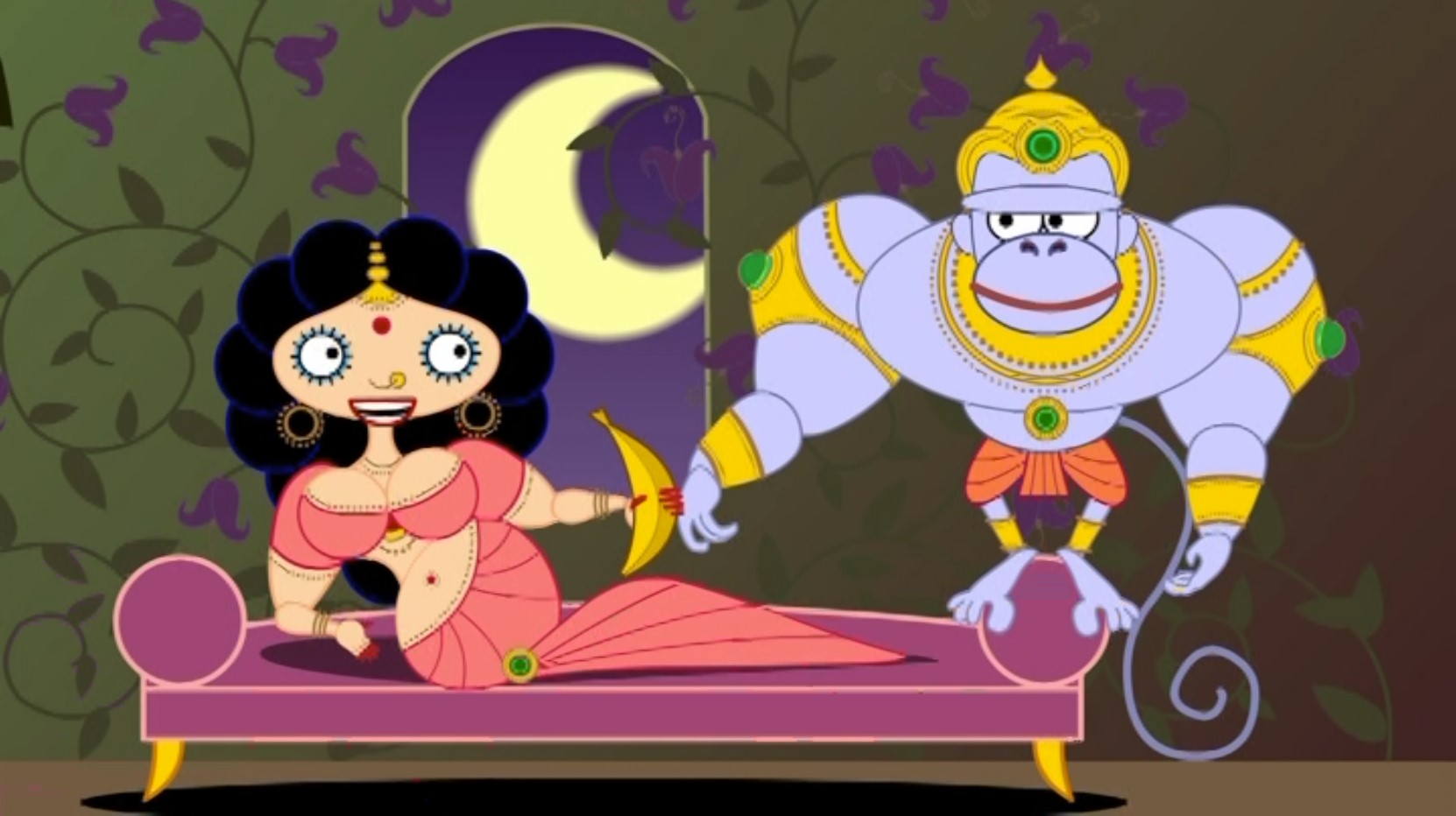
The film uses several different animation styles: Nina Paley’s own personal story is told in a traditional scribbly animation style, with sets based on photographic material. These parts are the least attractive of the lot, even though Paley shows to be a very able animator in this classic cartoon style. The Ramayana is retold by three Indians (Aseem Chhabra, Bhavana Nagulapally and Manish Acharya) who are depicted as traditional shadow puppets of Hanuman, Sita, and Rama, respectively. The story they are telling together is shown in tongue-in-cheek cut-out animation.
The ‘official’ story is also told in cut-out animation, using very attractive recreations of traditional Indian paintings. But the best parts to look at are the songs, which are done in a most attractive cartoon modern design. In these song parts Paley reuses a lot of animation cycles, but actually she makes excellent use of the flash medium, and she makes the most of her limited animation.
Apart from these five alternating styles, there’s also a short sequence using rotoscope and a much more pop-art influenced videoclip-like filming style. All these are apparently done in Macromedia flash.
As said, ‘Sita Sings the Blues’ retells the Ramayana, reducing the huge epic to its barest elements. For example, Lakshmana is hardly mentioned, and the monkey king Sugriva not at all. Moreover, unlike the traditional poem, the focus is on Sita, not Rama, and Paley highlights the questionable parts from the original poem (one at the end of the Yuddha Kanda, and another in the Uttara Kanda), in which Rama treats Sita very unfairly indeed, just like Paley’s own partner does in real life. This makes ‘Sita Sings the Blues’ a feminist film, which sheds a welcome critical light on the traditional depiction and treatment of women, then and now.
As the story is told by three people, who remember the story differently and interpret it in different ways, this leads to some very funny moments. But Paley adds some humor, too, in the ‘official’ story part, for example when the female rakshasa (a sort of demon) Shurpanakha tells her brother Ravana about the beauty of Sita, comparing all her body parts with lotuses.
As said, the Annette Hanshaw songs boast the most attractive designs, and like traditional opera arias, they shed an emotional light on the events. However, Paley cleverly propels the story forward even during these sequences. Yet, as the songs are featured in their entirety, typically lasting ca. 3 minutes, they also drag the film down. As there are eleven of them, one tends to grow a little weary of them as the film progresses. Nevertheless, ‘Sita Sings the Blues’ does a great job in restoring interest in this almost forgotten singer. Unfortunately, the Hanshaw songs were not free from copyright, causing Paley a lot of trouble, and eventually causing her to release the film completely free from copyright.
The Annette Hanshaw songs are juxtaposed to some Indian pop music, mostly by artist Masaladosa. Particularly strong is the angry song which follows the scene in which Paley gets dumped by email. The complete soundtrack is as attractive as the film’s visual designs, and the two complement each other very well.
In all, ‘Sita Sings the Blues’ is not without its flaws, but as it is made by a single woman, it’s no less than a tour-de-force, and the result is a very interesting personal film, which makes one think. Moreover, the film shows the great power and endless possibilities of animation, and single-handedly puts Paley into the pantheon of the medium’s greats. In 2018 Paley made yet another feature called ‘Seder-Masochism’, which unfortunately has attracted much less attention.
Watch the trailer for ‘Sita Sings the Blues’ yourself and tell me what you think:
‘Sita Sings the Blues’ is available on DVD
Director: Nora Twomey
Release date: September 8, 2017
Rating: ★★★★★
Review:

2017 was a good year for the animated feature film: Warner Bros., Dreamworks and the French Polivari and Panique studios gave us great laughs with ‘The Lego Batman Movie’, ‘Captain Underpants: The First Epic Movie’, and ‘ Le grand méchant renard et autres contes…’ (The Big Bad Fox and Other Tales), respectively; Pixar amazed us with the magnificent ‘Coco’, and the Japanese Science Saru studio made quite an impression with the mind-blowing film‘Night Is Short, Walk on Girl’.
However, the most important and most moving animated feature film was the Irish-Canadian-Luxembourgian co-production ‘The Breadwinner’. This was the third feature by the Irish Cartoon Saloon studio, which can be regarded as the most welcome and most original studio additions to the animated feature field of the 21st century, thus far. The Breadwinner’ shares with their previous two films, ‘The Secret of Kells’ (2009) and ‘The ‘Song of the Sea’ (2014) a very charming traditional animation style, and a surprisingly graphic overall design, although the latter is rather toned down in ‘The Breadwinner‘ when compared to the earlier two movies. But unlike the other two, ‘The Breadwinner’ completely lacks the Irish flavor, being set in, of all places, Afghanistan.
Based on the book by Deborah Ellis from 2000 ‘The Breadwinner’ is set in Kabul, the unfortunate country’s capital during the first Islamic Emirate of Afghanistan (better known as the Taliban regime, 1996-2001). By the time the film was made, this extremely oppressive regime was a ghost of the past, at least in Kabul (the Taliban never fully disappeared from the country), but sadly, since August 2021 this misogynist, backward movement is in full charge of the country, once again.
‘The Breadwinner’ makes no mistake how hard it is to live in such a violent, insecure country, where arbitrariness prevails, and where women have no rights, at all, whatsoever. The film follows the eleven-year-old Afghan girl Parvana, who lives with her disabled father, her mother, elder sister Soraya, and a baby brother called Zaki in a tiny house in Kabul. When the father gets arrested and thrown into a prison far outside town, the family quickly get into way more problems than they already had: as women cannot do anything outside without a man, their means to even obtain food completely come to a standstill. At this point Parvana takes an important decision to save her family’s life…
‘The Breadwinner’ is a very believable story, much more subtle than almost anything coming out of the United States. For example, the Afghan people are portrayed as real people, with a rich an ancient culture. Added to the sense of authenticity is the use of Afghan voices (except for the brabbling Zaki), while Mychael and Jeff Danna’s score clearly borrows from the Afghan musical tradition. Thus, the film’s Afghanistan is a convincing one, not a caricature seen through Western eyes. Moreover, although the film makes no mistake about the oppressive and misogynist nature of the Taliban regime, there are many shades of gray between the heroes and villains. Even the villain that causes Parvana’s family’s demise is shown in one last shot as not only evil, but insecure and afraid, too. Moreover, Parvana remains a relatable character, throughout. Despite her courage and adult responsibility, she remains a child, and is shown delighting in childish behavior, especially with her friend Shauzia.
Contrasted with Parvana’s dire circumstances are the images of a story she tells her beloved (her first audience is her baby brother, but she also tells the tale to others, and others even blend in, altering the direction of the story while doing so. These images are rendered in the most colorful, storybook illustration-like, faux cut-out animation, and tell about a boy who goes on a quest to retrieve his village’s seeds from an evil elephant king. This fantastical tale is picked up several times during the movie, and often reflects the events depicted in real life. Especially in the finale, in which the two seem to come together, this dual story telling comes to a harrowing conclusion.
As said, the film’s design is less graphic than that of Cartoon Saloon’s Celtic features. The background art is semi-realistic, with depressing greys, browns and yellows depicting the seemingly treeless town of Kabul. The character design is more graphic, with especially Zaki being an echo of the character designs from the earlier films. Noteworthy is the background art of a rather surreal scene in which Parvana and Shauzia are seen in a field full of abandoned tanks. The traditional animation is a delight, not only the very moving animation of the main characters, but also the cartoony quasi-cut-out animation of Parvana’s story. There’s only a little computer animation present, mostly for crowd scenes.
In all, ‘The Breadwinner’ is one of the best, most adult and most moving animation films to come out of any animation studio, and should be considered a modern classic.
According to director Nora Twomey ‘The Breadwinner’ may be set in Afghanistan but tells a universal story of all children growing up in oppressive countries, everywhere. Yet, we are still waiting for the animated depictions of their stories, while Afghanistan has been the subject of no less than three other animated feature films since then: ‘The Swallows of Kabul’ from 2019 and ‘My Sunny Maad’ and ‘Flee’ from 2021. Surely, the people of say North Korea, Syria, Eritrea, the Central African Republic, or Yemen deserve better.
Watch the trailer for ‘The Breadwinner’ yourself and tell me what you think:
‘The Breadwinner’ is available on Blu-Ray and DVD
Director: Michèle Cournoyer
Release Date: 1996
Rating: ★★★★
Review:
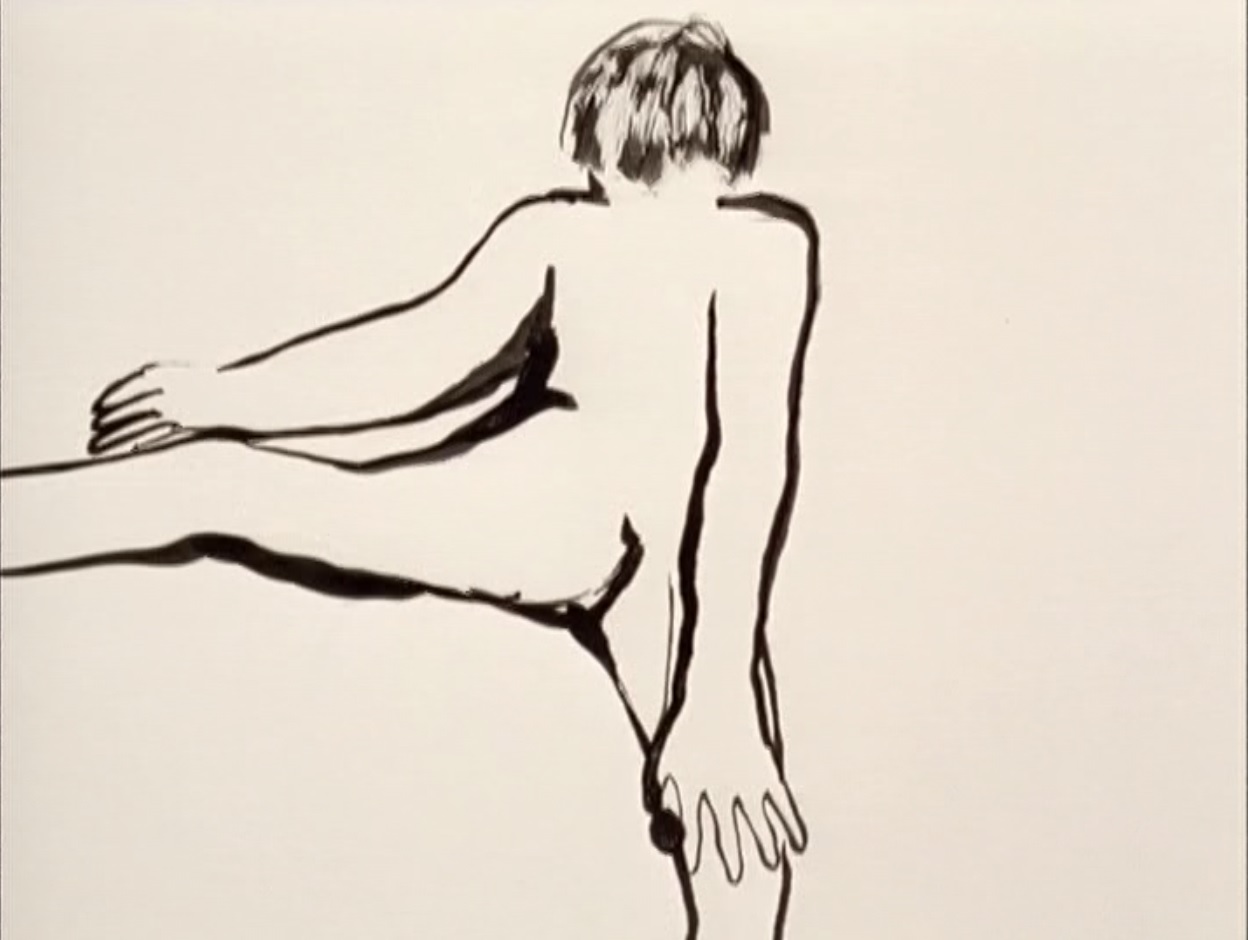
‘Le chapeau’ is a nonlinear, stream-of-consciousness-like film of flowing pen drawings morphing into each other on a white empty canvas, using the hat as a recurring motive.
The film is very associative, but it clearly says something about the male gaze and how it reduces women to mere objects of desire. The images show e.g. a female dancer dancing nude for a male audience, and images of sex. Most disturbing are the images in which the adult woman suddenly changes into a little girl and back, suggesting child abuse.
Cournoyer’s animation is flowing, her pen drawings are rough and sketchy, and her use of metamorphosis is mesmerizing. The result is a powerful, if rather uncomfortable short.
Watch ‘Le chapeau’ yourself and tell me what you think:
‘How Wings Are Attached to the Backs of Angels’ is available on the DVD ‘Desire & Sexuality – Animating the Unconscious Vol.2’
Directors: William Hanna & Joseph Barbera
Airing Date: March 17, 1961
Stars: The Flintstones
Rating: ★★½
 Wilma and Betty enter a baking contest with their recipe for an upside down bubble cake.
Fred ain’t too enthusiastic, until he hears of the prize money of $10,000. Indeed, Betty and Wilma get to the finals. But they get the measles, and cannot leave home. Enter Fred’s lunatic plan to take their place, impersonating Mrs. Rubble and Flintstone.
Following Betty’s and Wilma’s recipe, Fred and Barney even manage to win, but as Barney had used flour brand B instead of the sponsor’s Tastry Pastry flour, they never get the $10,000. Even worse, their plan only backfires on them, with the wives blackmailing them to tell their friends of their temporary womanhood.
‘In the Dough’ is a rather run of the mill episode, with the most inspired gag being a throwaway gag at the start of the show: Wilma packing Fred’s enormous lunch box. Moreover, this is another episode unwillingly revealing the plight of 1960s housewives: they pack their husbands’ lunchboxes, and only by using blackmail they can make their husbands doing the dishes…
‘In the Dough’ is available on the DVD-set ‘The Flintstones: The Complete First Season’
Director: Émile Cohl
Release Date: 1909
Rating: ★★½
Review:
 ‘Les chapeaux des belles dames’ is one of Émile Cohl’s tableau films.
Whereas Cohl’s other tableau films from 1909, like ‘L’éventail animé‘ and ‘Les couronnes‘ consisted of elaborate tableaux vivants, ‘Les chapeaux des belles dames’ is much simpler. The film only shows several ladies wearing hats from different ages. Within a vignette we watch the bustes of the ladies circling around, showing the hats from all sides. Thus we watch hats from 1400 to 1825, with emphasis on the 15th and 18th century (strangely enough the 17th century is skipped altogether).
The whole film may be insightful, the short is remarkably static, and only entertaining because of the sometimes extraordinary hats. It doesn’t help that the surviving copy is badly damaged, rendering some of the images more or less invisible.
Watch ‘Les chapeaux des belles dames’ yourself and tell me what you think:
‘Les chapeaux des belles dames’ is available on the DVDs ‘Émile Cohl – L’agitateur aux mille images’
Director: Émile Cohl
Release Date: June 12, 1909
Rating: ★★★★
Review:
 Despite its title ‘L’éventail animé’ is not an animated film, but the first of several films by Émile Cohl consisting of tableaux vivants. I’m including the film in this blog because it’s interesting to watch Émile Cohl’s very diverse oeuvre as a whole.
‘L’éventail animé’ shows ladies and their fans throughout the ages, e.g. Eve, Sappho, Cleopatra, empress Messalina, Aude (a character in ‘Chanson de Roland’), and a modern woman. The action is set in a fan-shaped frame, and the tableaux are remarkably beautiful and stylized. On the DVD the film is greatly enhanced by a lovely score using guitar and harp.
Watch ‘L’éventail animé’ yourself and tell me what you think:
‘L’éventail animé’ is available on the DVDs ‘Émile Cohl – L’agitateur aux mille images’


 Dr. Grob's Animation Review