
You are currently browsing the category archive for the ‘France’ category.
Director: Rémi Chayé
Release date: June 28, 2020
Rating: ★★★★★
Review:
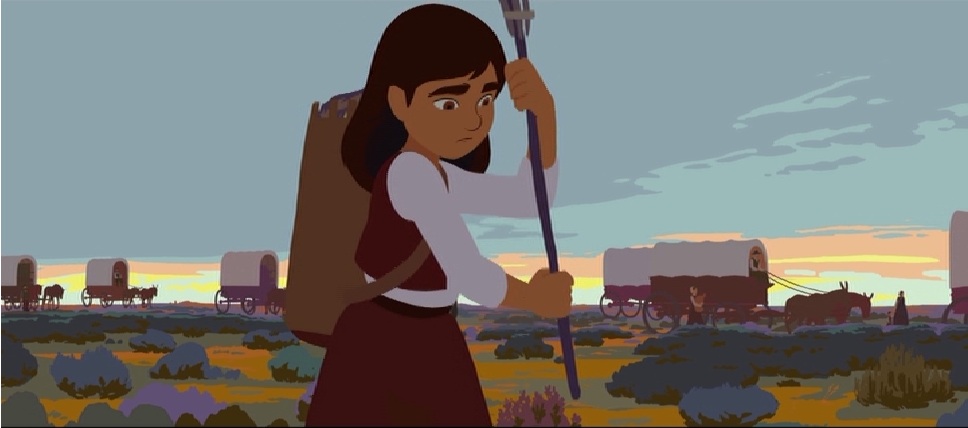
In 2015 Rémi Chayé surprised the animation world with his strong feature film ‘Tout en haut du monde’ (Long Way North), but his second feature, ‘Calamity, une enfance de Martha Jane Cannary’ arguably is even better.
Like the previous film ‘Calamity’ excels in an absolutely gorgeous digital background art, showing the prairies and mountains of the West in a plethora of colors, making each frame a delight to watch. But of course, this isn’t enough to sustain a feature film, and I am glad I can say that the story is also very good.
Like ‘Tout en haut du monde’ ‘Calamity’ stars a strong young female protagonist, and even more than in the previous film, ‘Calamity’ deals with the oppressive gender roles women were forced into, even if it didn’t suit their characters, ambitions and talents, at all. The film, of course, is based on real life enfant terrible Calamity Jane (1852-1903), but only vaguely so, and the film is called ‘A childhood’ and not ‘THE Childhood’, because the events depicted are mostly fictional and do not correspond to what we know about the historical Martha Jane Can(n)ary.
Nevertheless, with this film Chayé succeeds in making a subtle yet strong feminist statement. In fact, ‘Calamity’ is one of two strong European animation films from 2020 showing the historical plight of women, and how a masculine society kept them down for ages, for ‘Wolfwalkers’ by Cartoon Saloon tackles the same issues.
In the film we follow young Martha Jane (ca. 12-14 years old, I guess) accompanying her father and her two younger siblings on a caravan to Oregon. Her rather clumsy father is quite an outcast in the caravan, and Martha Jane is frequently mocked by Ethan, the son of the caravan’s leader, Mr. Abraham. When Martha Jane’s father breaks his ribs and must lay down in the wagon, and when goods get stolen from the caravan there’s an opportunity for Martha to break out of her role as an obedient girl, which she does with gusto, defying all counterforces she meets.
During the film Martha Jane poses as a boy called Marcus for a long time, and the only implausibility is when she gets chained to a real boy called Jonas. How she manages to maintain her disguise during these days baffles me. Otherwise, this is a strong coming of age film, which shows that women can be the equals of men, if they’re only allowed to.
Apart from gorgeous background art, the film includes appealing character designs, an effective, often surprisingly Japanese-like animation style and appropriate music. The result is one of the best feature films of 2020, on the same level as the more famous ‘Soul’ and ‘Wolfwalkers’.
Watch the trailer for ‘Calamity, a Childhood of Martha Jane Cannary’ yourself and tell me what you think:
‘Calamity, une enfance de Martha Jane Cannary (Calamity, a Childhood of Martha Jane Cannary)’ is available on Blu-Ray and DVD
Director: Walerian Borowczyk
Release date: December 1963
Rating: ★★★★★ ♕
Review:
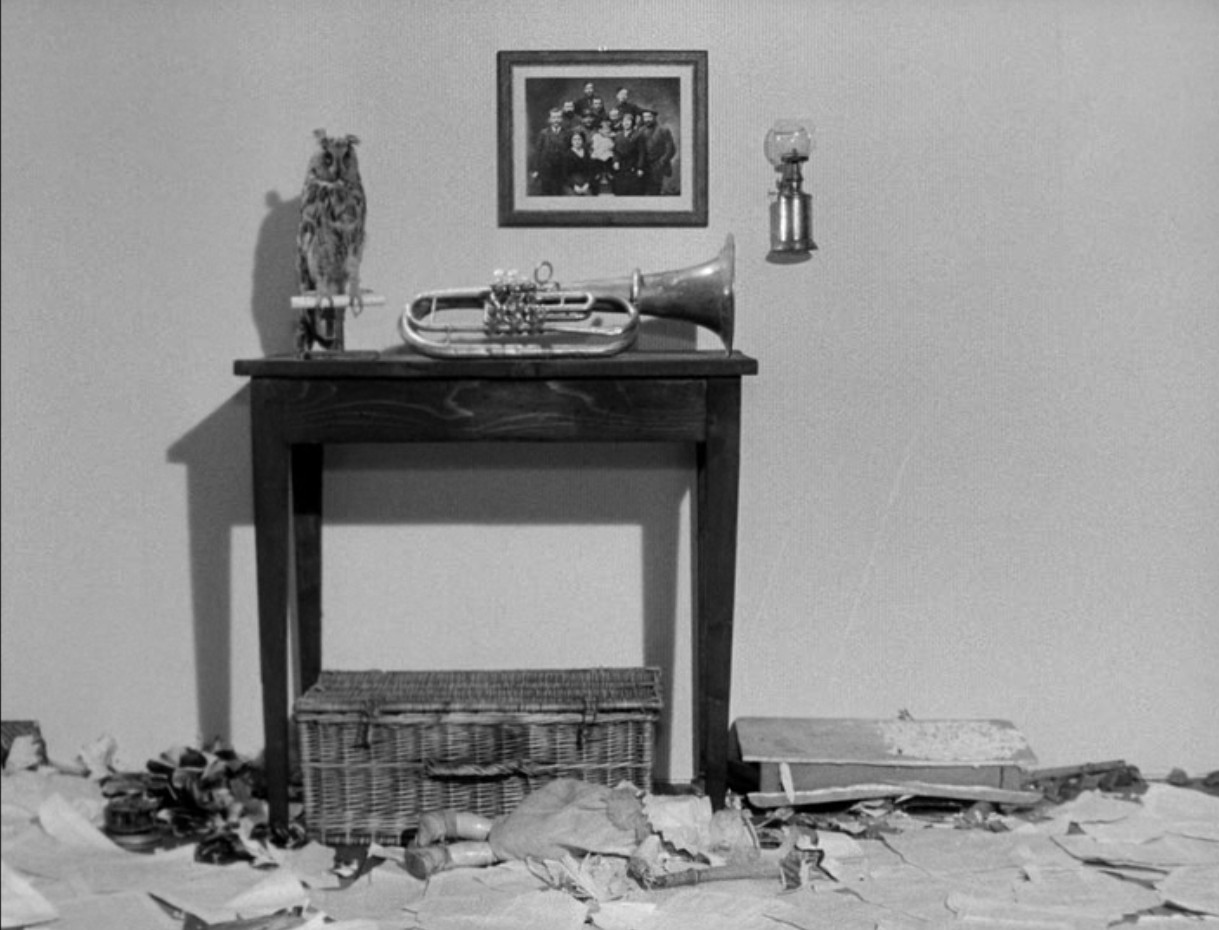
‘Renaissance’ must be counted among Walerian Borowczyk’s best and most powerful works. Instead of the silliness of ‘Les Astronautes‘ and ‘Encyclopédie de Grand-Maman‘, ‘Renaissance’ is a powerful stop-motion film on destruction.
The short starts bleak enough with the scene of a completely destroyed chamber. But then the objects in the room start to reassemble themselves…
Borowczyk’s command of stop-motion and reverse film making is astonishing, and although the tricks used are as old as cinema itself, these are used to an impressive effect, greatly enhanced by the soundtrack with all its crystal clear sounds. The whole surreal atmosphere looks forward to Jan Švankmajer’s stop-motion works, as does the morbid atmosphere.
Watch ‘Renaissance’ yourself and tell me what you think:
‘Renaissance’ is available on the Blu-Ray/DVD set ‘Walerian Borowczyk: Short Films and Animation’
Director: Walerian Borowczyk
Release date: June 1963
Rating: ★★★★
Review:
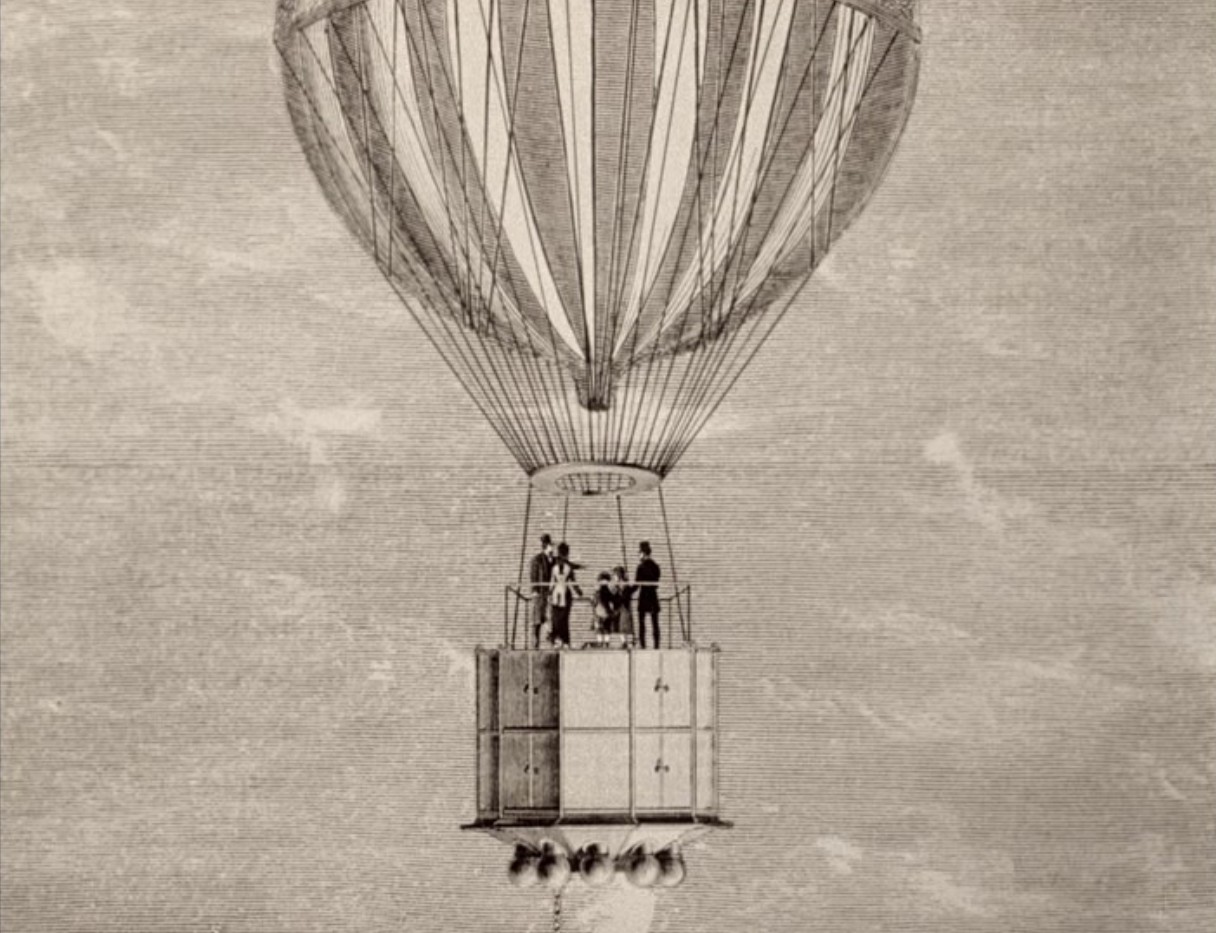
With ‘Encyclopédie de Grand-Maman’ Borowczyk continues the silly surrealism of ‘Les Astronautes‘ from 1959. Although we are promised 13 volumes, we only watch three words from the Encyclopédie: A is for automobiles, B for Balloons and C for Chemin de fer (Railways).
The film uses 19th century engravings to a great effect, especially the car race in ‘Automobiles’ is as inventive as it is entertaining. Borowczyk makes clever use of his source material, and the animation is greatly helped by the stark sound effects. These aspects make ‘Encyclopédie de Grand-Maman’ a fun film, if not more than that.
Watch ‘Encyclopédie de Grand-Maman en 13 Volumes’ yourself and tell me what you think:
‘Encyclopédie de Grand-Maman en 13 Volumes’ is available on the Blu-Ray/DVD set ‘Walerian Borowczyk: Short Films and Animation’
Director: Walerian Borowczyk
Release date: 1962
Rating: ★★
Review:
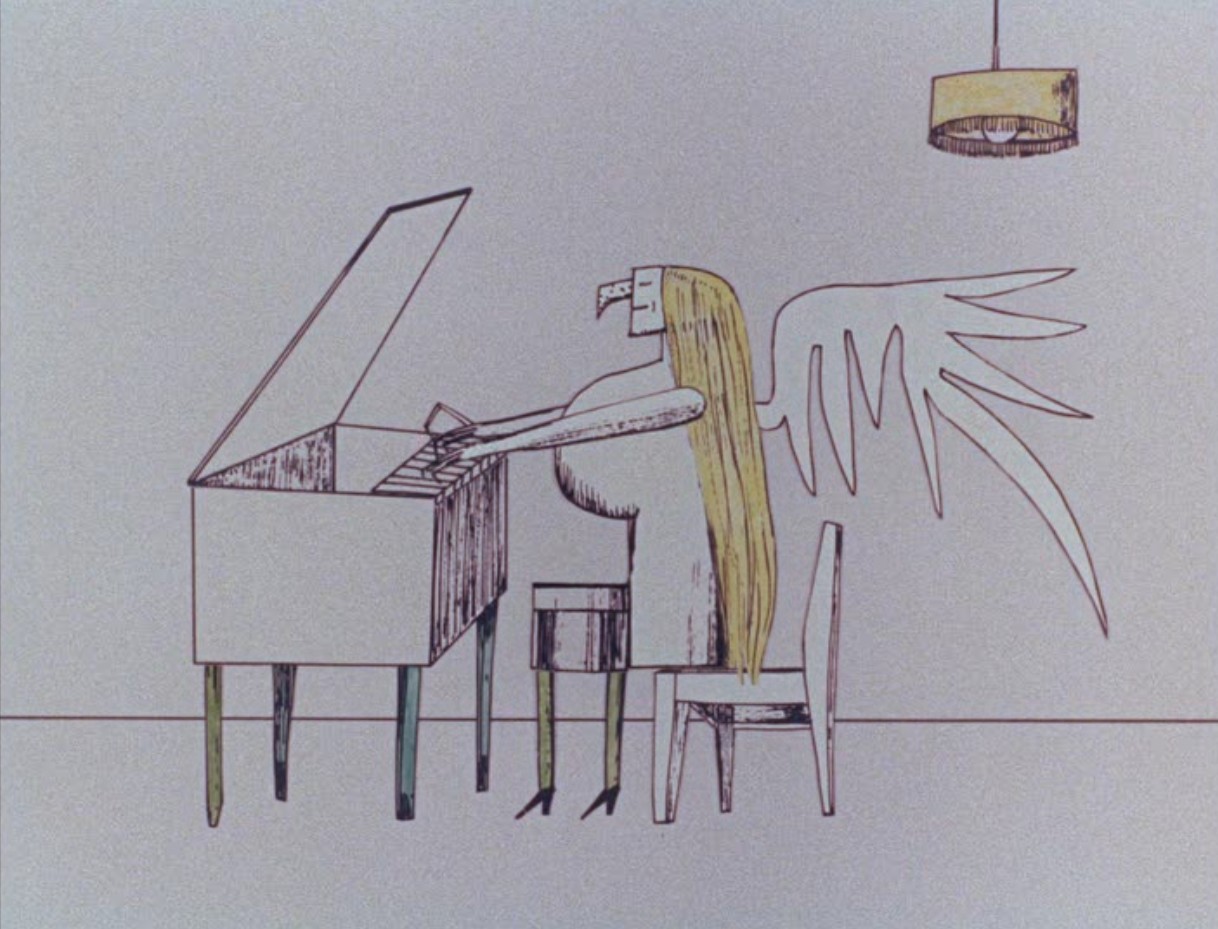
‘Concert’ stars Monsieur and Madame Kabal from the later feature film ‘Théâtre de Monsieur & Madame Kabal’ from 1967. This couple, a short man who constantly drinks and a grotesque tall woman with a hooked nose, are known for their domestic violence, and ‘Concert’ is no exception. When Madame Kabal catches Monsieur Kabal snoring through her piano recital her revenge is severe.
Unfortunately, Borowczyk’s cut-out animation is crude and emblematic, and even the violence is rather abstract. Even worse, a lot of time is wasted on less interesting scenes. Moreover, Monsieur and Madame Kabal are neither interesting or appealing characters and Borowcyk does nothing to establish their relationship. Thus, it doesn’t interest the viewer at all what happens to them on the screen, a problem that also haunts Borowczyk’s feature animation film.
Luckily, the next year Borowczyk would prove he could do much better with ‘Encyclopédie de Grand-Maman en 13 Volumes ‘ and especially the dark stop-motion short ‘Renaissance‘.
Watch ‘Concert’ yourself and tell me what you think:
‘Concert’ is available on the Blu-Ray/DVD set ‘Walerian Borowczyk: Short Films and Animation’
Director: Walerian Borowczyk
Release date: 1959
Rating: ★★★
Review:
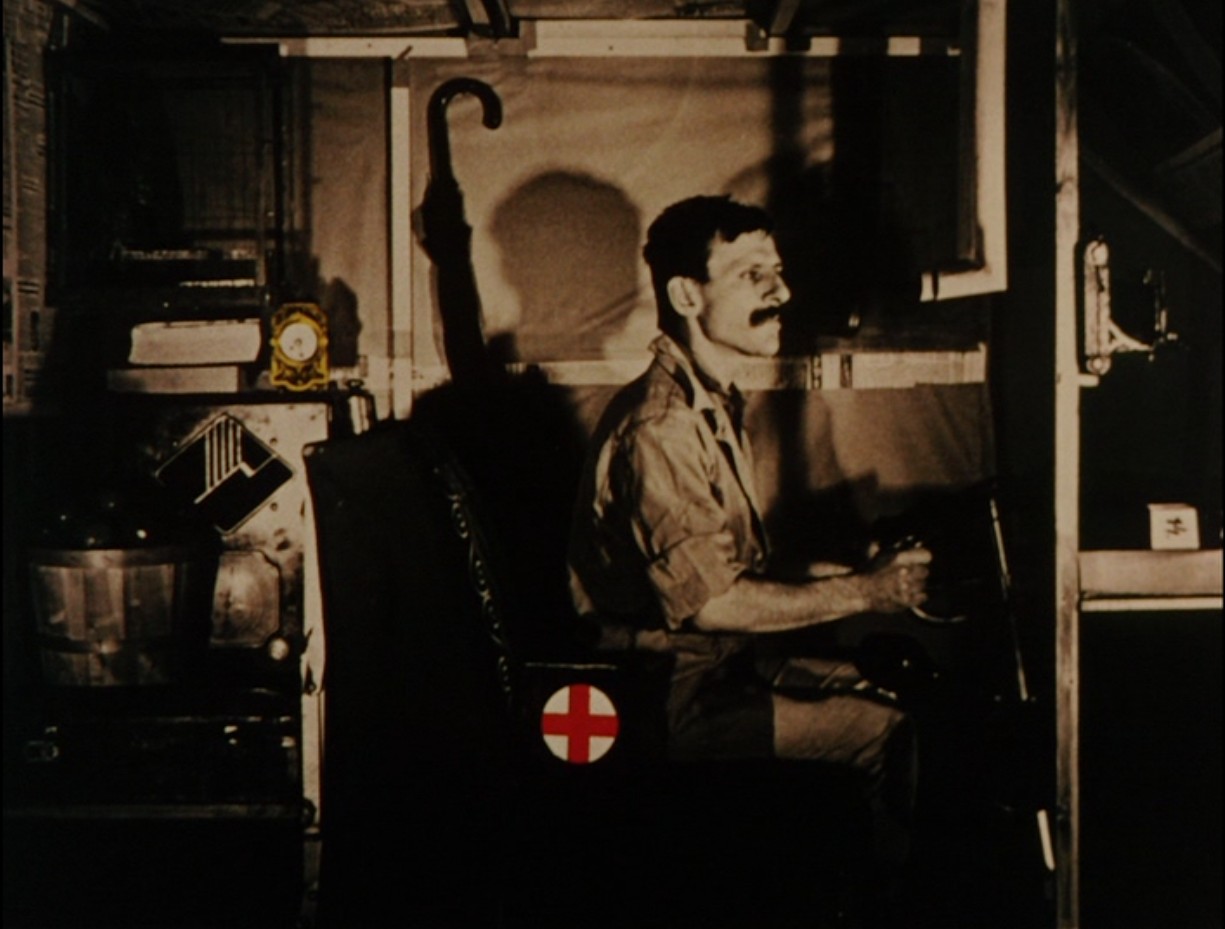
‘Les Astronautes’ was the first film the Polish film maker Walerian Borowczyk made in France. In this short a mustached inventor with a pipe builds his own spaceship.
This film is as surreal as it is silly and it consist of several hardly related gags. For example, the first thing the man does with his spaceship is spying on a woman dressing. Throughout, Borowczyk combines pixilation and cut-out animation of hand-colored photographs to a great effect. The surreal atmosphere is enhanced by Andrzej Markowski’s electronic score and sounds.
‘Les Astronautes’ may be of little substance, it’s an entertaining film, nonetheless.
Watch ‘Les Astronautes’ yourself and tell me what you think:
‘Les Astronautes’ is available on the Blu-Ray/DVD set ‘Walerian Borowczyk: Short Films and Animation’
Director: Michel Ocelot
Release date: June 11, 2018
Rating: ★★★
Review:

Michel Ocelot belongs to the great author-directors of animated feature films, bringing us such gems as ‘Kirikou et la Sorcière’ (1998), ‘Azur & Asmar’ (2006) and ‘Les Contes de la nuit’ (2011). But somehow, his latest movie, ‘Dilili à Paris’ from 2018 has escaped international attention.
The most obvious reason for this is that ‘Dilili à Paris’ is first and foremost an ode to Paris of 1900-1901*. It’s thus an utterly French film, simply crowded by famous people, many of which actively play a role in the story. I counted 26 painters, actors, dancers, authors, composers, and scientists, not counting a multitude of more in the background. Luckily, this doesn’t mean that film is a nationalistic one, for Ocelot includes a lot of foreigners in his pantheon of greats, e.g. Polish scientist Marie Curie, Romanian sculptor Constantin Brâncuși, Venezuelan composer Reynaldo Hahn, future British king Edward VII and Brazilian aviation pioneer Alberto Santos-Dumont.
In fact, by centering the film on these great minds in science and art, the film is also an ode to the fantasy and free thought of people. At the same time, the film is a firm statement against narrowmindedness, xenophobia, and oppression. Which brings us to the third theme of the film, which is a strong feminist one. In fact, apart from Dilili’s friend, the Parisian boy Orel, all main players are women, including soprano Emma Calvé (voiced by Natalie Dessay), stage actress Sarah Bernhardt, the aforementioned Marie Curie, and the feminist Louise Michel. Together with these women and many of the other famed people, Dilili and Orel unravel a secret plot in which the mysterious ‘male-masters’ kidnap little girls. Their anti-feminist scheme turns out to be one of nightmarish proportions. It’s clear that to Ocelot one should not underestimate, let alone oppress any human being, whether based on age, sex, color, nationality or whatever. A message that cannot be reinstated enough.
Dilili herself is an original heroine, a tiny Kanak girl from New Caledonia, who speaks French fluently, but who’s only brought to Paris to reenact her lifestyle in the jungle at the Exposition Universelle, a world exhibition that run from April 14 to November 12, 1900. When touring through Paris Dilili is dressed like a prize doll, and she also provides the film running gag, because to every person she meets she repeats the utterly polite sentence of ‘je suis heureuse de vous rencontrer’ (I am delighted to meet you). Of course, she experiences racism during her Parisian journeys, but this is not the film’s main theme.
Paris meanwhile comes to life in the extremely intricate background art, which is clearly based on photo material of contemporary Paris. The computer animation unfortunately is less impressive, and at times downright stiff. Especially Orel is poorly animated. When he makes friends with Dilili his moves and facial expressions are so terribly rigid, it doesn’t transcend puppet theater. The ending, too, leaves much to be desired, as the film’s finale is partly told during the end titles.
In the end the film is a little bit too crowded by famous people and certainly too poorly animated to be a masterpiece, but the mystery plot is a fine one, and the film’s message an important one. Above all ‘Dilili à Paris’ is a fine children’s film that deserves to be seen at least once.
Watch the trailer for ‘Dilili à Paris’ yourself and tell me what you think:
‘Dilili à Paris’ is available on Blu-Ray and DVD
* In fact, we can date the time period of the film pretty well, as Pablo Picasso first set foot in Paris in September 1900, and Edward VII became king on January 22, 1901, thus the events must be placed between September 1900 and January 1901.
Director: Denis Do
Release date: June 11, 2018
Rating: ★★★½
Review:
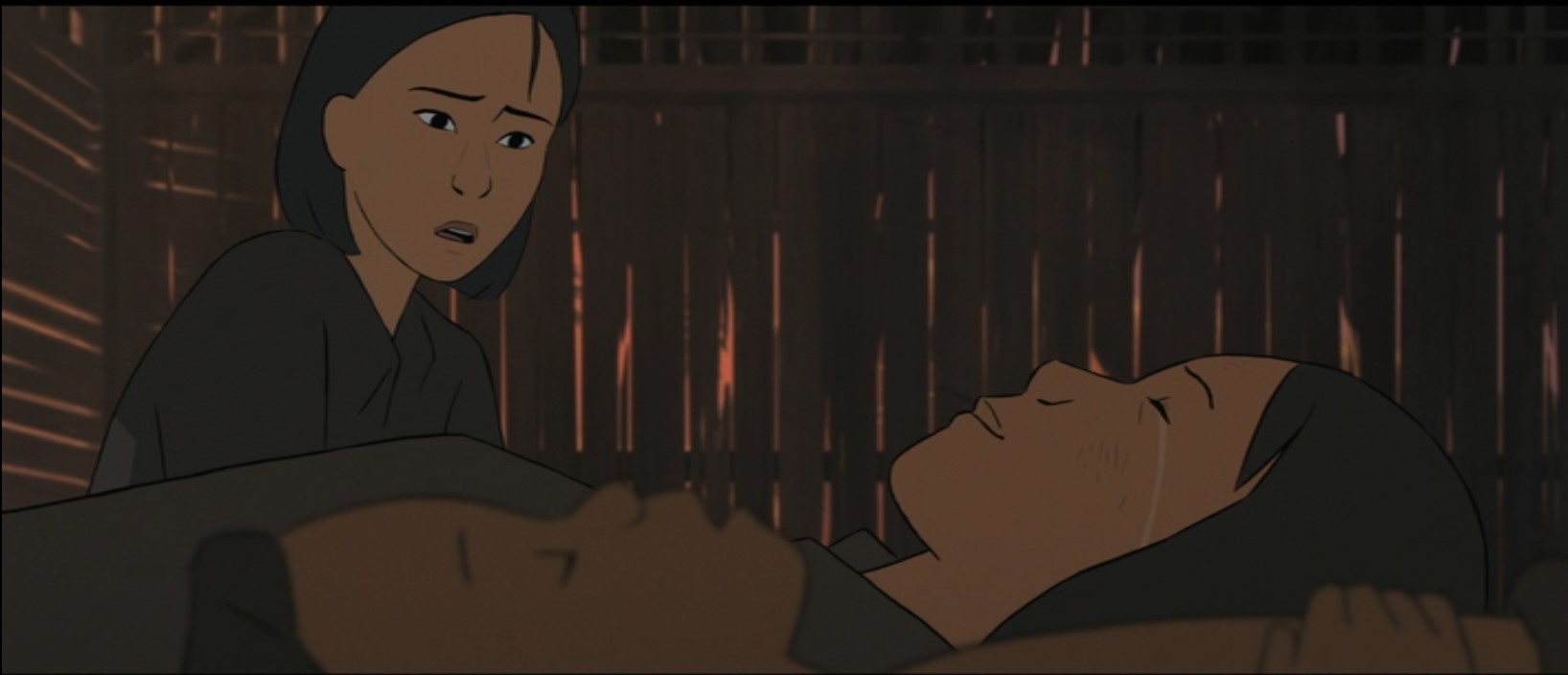
‘Funan’ is a film by Denis Do, a French film maker of Cambodian descent, and the film is partly based on the memories of his own mother.
‘Funan’ means ‘the new people’ in the Khmer language, and this is an apt description of the radical ideology of the Khmer Rouge, an extreme communist movement that took power in Cambodia from 1975 to 1979, only to plunge the nation in one of the severest mass killings in human history, with the ultimate goal to rise as a ‘new nation’ of autarkic, non-intellectual people.
‘Funan’ thus tells about Cambodia’s darkest years, and does so by following one family from Phnom Penh, which almost immediately falls apart, and which succumbs one by one to various aspects of the terror, be it brutal murder, forced labor, famine or rape. We especially follow a couple, Chou and Khuon, and their son Sovanh, who gets separated from his parents near the start of the film.
Luckily, the film eschews gross images, keeping the watch tolerable, but strangely enough, this also means one feels the hardship and sorrow less than one should. The film’s rather episodic nature certainly doesn’t help, and one has a little trouble relating to these people, perhaps because they aren’t introduced very well (the happy bliss of pre-Khmer rouge existence is shown all too shortly), and because the film is told in a plethora of very short scenes, instead of a few well-chosen longer ones. Especially Sovanh’s story is too fragmentary to follow, and his experiences are only hinted at, although it’s clear that the young boy sees a lot of cruelty and death.
The 2D animation is fair, with the human character designs rooted in the French ligne claire tradition, while the background is painted and lineless. Both coloring and lighting are clearly digitally done, and to be frank, rather uninteresting.
I suspect the film could be more daring and more idiosyncratic in its designs and storytelling, especially when compared to Elsa Duhamel’s similar, but far more interesting short ‘Bach-Hong’, which tells of the coming of the communists to Saigon, Vietnam. Duhamel cleverly sticks to a single story, illustrating the regime’s cruelty by one, ostensibly minor detail in the nation’s history.
Do, on the other hand, seems to want to tell everything, and indeed he succeeds in painting a picture of these black years, but I suspect he had better chosen less scenes, and less characters, for now, unfortunately, the film remains at an emotional distance, and that can hardly be the film maker’s purpose. Yet, I am glad personal films like this are being made, for films like ‘Funan’ save tragedies like that of Cambodia from oblivion, and remind us that peace and safety aren’t guaranteed, at all.
Watch the trailer for ‘Funan’ yourself and tell me what you think:
‘Funan’ is available on Blu-Ray and DVD
Directors: Patrick Imbert & Benjamin Renner
Release date: June 15, 2017
Rating: ★★★★★
Review:
One of the more pleasant developments of the 21st century was the coming of animated feature films, the whole purpose of which was to make people laugh. One could say this trend started off with the successful ‘South Park, Bigger, Longer & Uncut’ (1999), and like that film these films were mostly off-shoots from series (‘The Simpsons Movie’ and the Spongebob Squarepants movies from 2004, 2015 and 2021) or offshoots from other films (‘Minions’ from 2015, ‘The Lego Batman Movie’ from 2017).
But occasionally, a film comes to you, which is both very funny, and totally original, even if it’s based on an earlier comic strip, like the Franco-Belgian feature ‘Le grand méchant renard et autres contes…’. The film is co-directed by Benjamin Renner, one of the producers of the attractive, if flawed ‘Ernest et Célèstine’ from 2012, and the original author of the comic strip, ‘Le grand méchant renard et autres contes…’. . Both comic strip and movie aim for the laughs, and are highly successful at it, too.
The film is advertised as a children’s film, and it certainly is fit for all ages, but don’t let this fool you. There’s nothing childish about this film. Instead, we get high quality cartoon comedy, perfectly animated and perfectly timed.
Based on three separate stories, ‘Le grand méchant renard et autres contes…’ is an anthology film, bridged by the idea of a play performed by the main characters. As soon as the first tale starts, the backdrop changes into the scenery in which all three stories take place: a farm in the countryside.
In the first film a stork talks a pig, a duck, and a rabbit into delivering a baby for him to his parents. Unfortunately, the baby must be delivered in faraway Avignon, and sadly for the pig both the duck and the rabbit are as incapable as they are optimistic. This tale is chockfull of cartoon slapstick, as the duck and the rabbit keep on thinking more and more outlandish schemes to deliver the baby, while the pig desperately tries to keep the little one safe.
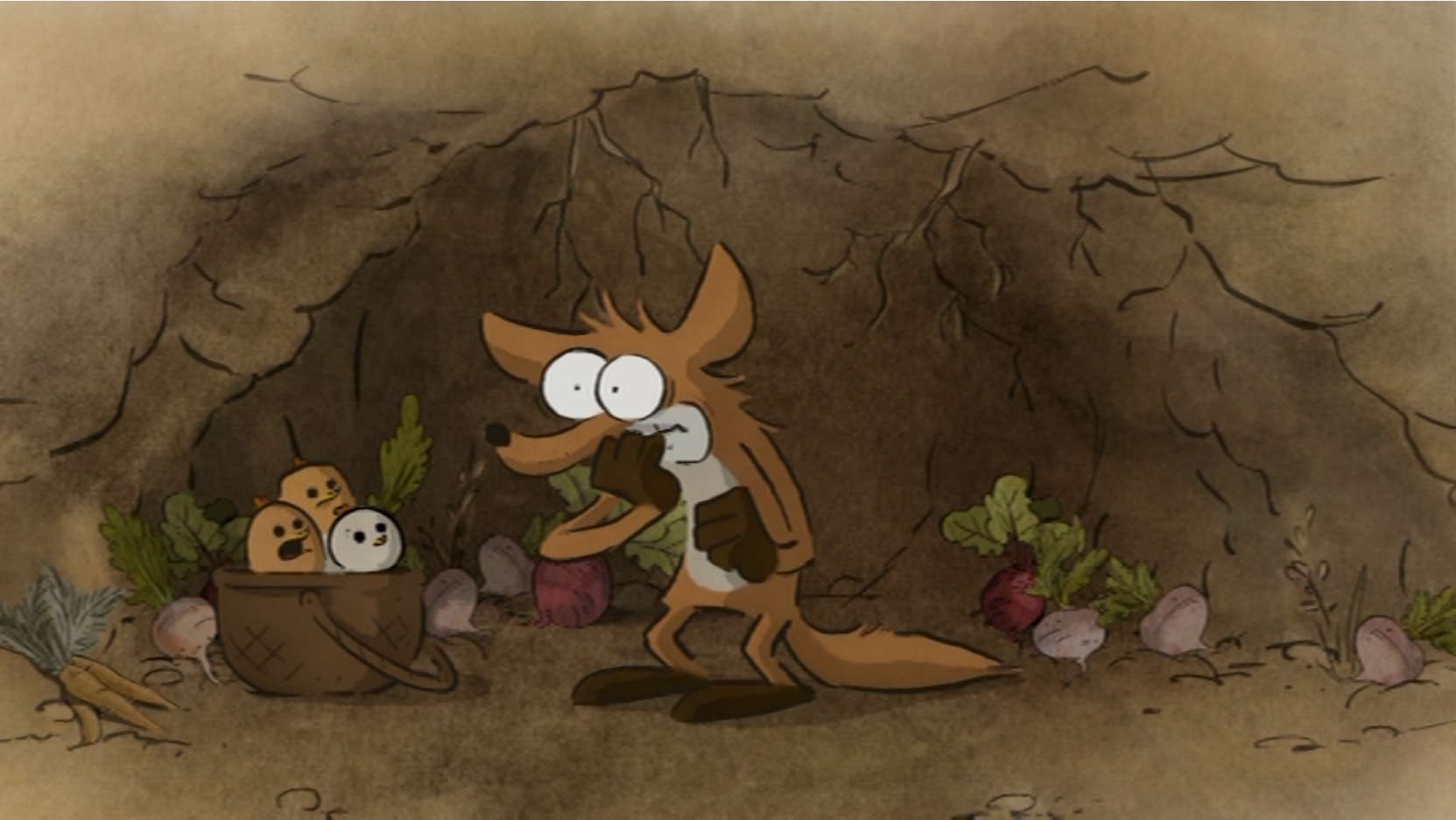
The next story is a little cuter and involves a totally inept fox who teams up with a lazy and selfish wolf. The wolf talks the fox into stealing some eggs to raise them into fat chickens, but of course the fox grows attached to the little ones. Nevertheless, this tale, too, moves and shifts into surprising directions, and is less straightforward than this summary.
The third and final story is a genuine Christmas story, which sees the happy return of the pig, duck, and rabbit trio of the first part. This time, duck and rabbit think they’ve killed Father Christmas, and make resolutions to deliver the presents themselves… General mayhem is ensured.
The film uses a very charming drawing style, which like the earlier ‘Ernest et Célèstine’ consists of watercolor backgrounds and fake watercolor-coloring of characters, open lines and appealing character designs, which more or less fit in a long and diverse Franco-Belgian cartoon style tradition. The film is continuously pleasant to look at, and the attractive score, by Robert Marcel Lepage, adds to the film’s charm, as well. Scored for a small ensemble, Lepage makes excellent use of some familiar themes, like the morning theme from Giachino Rossini’s Overture ‘William Tell’, the wolf theme from Sergei Prokofiev’s ‘Peter and the Wolf’, and in the last story, ‘Jingle Bells’.
In all, ‘Le grand méchant renard et autres contes…’ once again shows that France is one of the most interesting animation film-producing countries around. Recommended to all.
Watch the trailer for Le grand méchant renard et autres contes… (The Big Bad Fox and Other Tales) yourself and tell me what you think:
Le grand méchant renard et autres contes… (The Big Bad Fox and Other Tales) is available on Blu-Ray and DVD
Director: Bibo Bergeron
Release date: October 12, 2011
Rating: ★★★½
Review:

‘Un monstre à Paris’ is a charming and friendly French computer animation film by Bibo Bergeron who not only directed the film, but also wrote both the story and the screenplay.
The film is set in Paris in the winter of 1910 when the river Seine caused an enormous flood in the French capital. During this winter small and timid projectionist Émile and brassy, irresponsible delivery driver and inventor Raoul create a monster by accident. But cabaret singer Lucille discovers that this monster has surprising talents. Meanwhile, arrogant, and ambitious police commissioner Victor Maynott has his own plans with both Lucille, the monster, and the Great Flood. There’s also a proboscis monkey called Charles, who talks with reference cards, an idea that also occurs in Aardman’s ‘The Pirates! In an Adventure with Scientists!’ from a year later.
‘Un monstre à Paris’ knows quite a number of characters and has arguably three main protagonists. But Bergeron plays out his story surprisingly well, giving ample time and background stories to all three of them, even if the one of Raoul and Lucille only arrives during the end titles. The film is very talkative, but not too much so, and has its focus and heart firm in place. The action and drama are further ornamented with several little gags, which never ask too much attention. The best gag may be when Maynott’s balloon starts to lose helium.
In fact, Bergeron envisioned the city of Paris as the film’s main character, and indeed, the movie uses wonderful images of the great city, not only in computer animation, but also by classic matte paintings. Bergeron’s Paris, realized by Sébastian Piquet, is crooked, asymmetrical, and rather ramshackle character, which is always pleasant to look at. In addition, in several scenes the metropolis is clouded in mist, which give the backgrounds and settings an extra poetical atmosphere. Moreover, Bergeron’s Paris is a very, very familiar Paris, also to people who’ve never been there: the film takes mostly place in Montmartre, with the finale taking place on the Eiffel tower, both locations well-known to almost everyone.
Christophe Lourdelet’s character designs are a bit of a mixed bag: the male characters are all firmly rooted in the Franco-Belgian comic tradition, especially Raoul and inspector Pâté. The women Lucille and Maud (Émile’s love interest) on the other hand, have more generic 3D computer animation designs, with all too large eyes and all too slender bodies. The monster is well-designed, being both large and overpowering and delicate and friendly. He looks best when given an Aristide Bruant-like hat and shawl. In that respect the later zoot suit is way off for a film set in 1910.
The animation, directed by Fabrice Joubert, is fair, but not outstanding, and although the film makers are very proud of the dance scenes, the dance moves herein come over as stiff and unnatural. Worse are Lucille’s performances of the song ‘La Seine’. It seems the film makers didn’t know what to do with her long slender arms, which are all over the place. Compare the animation of Lucille with Preston Blair’s animation of Red in e.g., ‘Red Hot Riding Hood’ (1943) and the difference between an approximation of natural movement and natural song and dance animation becomes clear. The effect animation, on the other hand is fine: the water, the clouds and the mist all look very fine.
The songs are quite out of tune with the otherwise faithful 1910 setting, being all too modern and typical products of 2011, not 1910. Composer M (Matthieu Chedid) also provides the monster’s voice, singing in a very high voice, apparently to accentuate the creature’s innocent, childish and fragile nature. Lucille is lovely voiced by Belgian singer Vanessa Paradis of Eurovision Song Contest fame, and her rendering of ‘La Seine’ is very pleasant, even if the song doesn’t sound like a French cabaret song of the 1910s, at all.
In all, ‘Un monstre à Paris’ is not perfect, but certainly well-told and entertaining. The film may be more conventional than contemporary French films like ‘Une vie de chat’ (2010), ‘Le tableau’ (2011) or ‘Ernest & Célestine’ (2012), it still shows the extraordinary rich breeding ground of animation that France has been in the 21st century thus far.
Watch the trailer for ‘A Monster in Paris’ yourself and tell me what you think:
‘A Monster in Paris’ is available on Blu-Ray and DVD
Directors: Joann Sfarr & Antoine Delesvaux
Release date: June 1, 2011
Rating: ★★½
Review:

‘Le chat du Rabbin’ is the film version of the comic strip series of the same name, which comprises eleven volumes thus far. At the time the film was made there were five albums, and the film retells the contents of volume one, two and five very faithfully, with a lot of panels and dialogue being transformed directly from comic strip drawings to film scenes.
Perhaps this is no wonder, as the comic’s author Joann Sfar co-directed the film. He must have had an important vote in the production, because the film flawlessly transcends Sfar’s idiosyncratic drawings to the animated screen.
‘Le chat du rabbin’ is set in Algiers, the capital of Algeria, when it was still a French colony. It’s a little hard to date the time setting of the film, but because carbon dating is mentioned and because of the presence of jazz guitarist Django Reinhardt this limits the time period between 1947 and 1953. In Algiers, the French, Jews, and Muslims all live together harmoniously, and we follow a rabbi of the Sephardic community, and his cat, who turns into a talking creature after swallowing a parrot.
It’s the cat who is the narrator of the film, and we see the events often through his eyes, although, unfortunately, this isn’t maintained consequently. The scenes with the talking cat, mostly recreating the first book, are the film’s best, for the cat turns out to be a skeptic and he asks his master philosophical and theological questions, which are all valid, but drive the poor rabbi mad.
Unfortunately, not only the cat, but the whole movie is rather talkative, and far too dialogue rich, a problem all too common in all French cinema. But this is not the movie’s main problem. No, regrettably, the film also shares the many story problems of the original comic books. Sfar seems to have started his comic book series without a plan, and the volumes are highly different in tone and content. Story ideas are introduced and dropped, and there’s a frustrating lack of focus.
The same accounts for the film. For example, halfway the cat loses his speech again, and with the film immediately loses its main attraction. Even worse, the most interesting character of both the comic books and the film is Zlabya, the rabbi’s daughter, but she lacks a story arc, and is rarely seen, especially during the second half of the film, which focuses on the contents of volume five, in which the attention shifts to a far less interesting character of Russian origin in search of a mythical city of Jews somewhere in Ethiopia. With this part we also leave Algiers and all hope of a consistent story. I actually find the Russian’s quest utterly boring, and I wish the film makers dared to stay in Algiers and tell more about Zlabya. What certainly doesn’t help is an irritating and incomprehensible encounter with famous comic book character Tintin, who turns out to be a complete dork in this film.
The film’s designs are delightful, transferring Sfar’s sketchy comic book’s drawings very well, and applying very attractive color schemes, which evoke the subtropical, Mediterranean, and North African settings excellently. Especially the background art is gorgeous. Although heavily hatched, and thus very graphical, the animation reads very well against those background drawings, and it’s nice to see such a consistency of style from animated drawings to background art. There are even some very attractive Van Gogh influences visible in some of the night scenes.Olivier Davaud’s music, too, attributes to the Arabian atmosphere, with its quasi-Arabic style elements.
The animation, on the other hand, is not always that good. For example, when Zlabya plays the piano, the animation and the music aren’t in tune, at all. The animation is at its best when deviating from realism, as in the cat’s dream. In this dream sequence a bolder style is explored, with a lot of metamorphosis, absent from the rest of the film. The finale, too, explores a bolder style, just like the comic book does in these scenes, and I guess with this Sfar tries to tell us by then we’ve abandoned reality and entered the realm of tall tales. These scenes are certainly interesting to look at, but as said before, by then I at least had lost all interest already.
In all, ‘Le chat du Rabbin’ is a visually very attractive film, showing what traditional animation still can do in terms of original styling, but its rambling tale and its lack of focus make the film a frustrating watch. But to be honest, when reading the original comic strips one will experience the same frustration, thus the original source material is to blame. One wishes Sfar was as good a story teller as a visual artist, but let’s face it, he isn’t.
Watch the trailer for ‘Le chat du Rabbin’ yourself and tell me what you think:
‘Le chat du Rabbin’ is available on Blu-Ray and DVD
Director: Michel Ocelot
Release Date: February 13, 2011
Rating: ★★★½
Review:

This is a review of the 2011 film, not to be confused with the television series from 1992, which explores a similar style.
After two Kirikou movies (1998, 2005) and the praised ‘Azur & Asmar’ (2006) French director Michel Ocelot returned to the silhouette style he had explored in ‘Les trois inventeurs’ (1979) and in ‘Les contes da la nuit’ (1992) in particular. The result was a series of ten episodes for Canal+ called ‘Dragons et princesses’. These were aired in 2010, and more or less compiled in the feature film ‘Les contes de la nuit’ from the next year. This film compiles five of the ten stories from ‘Dragons et princesses’ and adds an extra one, called ‘La Fille-biche et le fils de l’architecte’ (The Young Doe and the Architect’s Son).
All stories are original, conceived by Ocelot himself, including the dialogue. Yet, their style is firmly rooted in ancient storytelling and fairytales. Thus, the heroes are pretty emblematic, a given that is emphasized by the bridging ‘story’. In these bridging episodes an old man teams up with two children to invent the stories. The children then act them out, while the old man does some background research on architecture and clothing and such. The two youngsters are then dressed by robot arms, and the tale can begin.
And so, each tale stars the same two children, and almost of them are about love. To be fair, these bridging parts make very little sense, and after the sixth story we don’t even return to this setting.
Much more interesting are the stories themselves. Set in different times and places, they have a surprising universal character and really feel as a homage to classic storytelling, a form of narrative other modern animation film makers seem to have lost. In fact, Ocelot’s most obvious inspiration is Lotte Reiniger (1899-1981), who also told classic tales in silhouette animation. Ocelot truly is her artistic successor, even though he trades the scissors and cut-out animation for 2D computer graphics.
As all stories are told in silhouette, the story depends greatly on body language and dialogue. It’s a little unfortunate then that the 2D computer animation is often rather stiff and unconvincing. At times the heroes’ faces are seen from the front, showing their eyes, but not their mouths, which makes one depend on the dialogue even more.
The stories themselves nevertheless are entertaining. The first, ‘the night of the werewolf’ takes place at the Burgundian court of the 15th century and tells about two rival sisters. The third, ‘The Chosen One of the Golden City’ takes place in Mexico in the 16th century and tells about a conquistador visiting a city of gold. This story knows some very stylized background art. The fourth, ‘Tom-Tom Boy’ is set in West Africa and takes us back to the world of ‘Kirikou et la sorcière’ (1998), with its bare breasted women. The fifth, ‘The Boy Who Never Lied’ is set in medieval Tibet, and certainly the most tragic of the collection. The mountainous background art in this story has the most 3D-feel to it of the whole lot. The final story, ‘The Young Doe and the Architect’s Son’ returns to France. Set in the 13th century it features very detailed gothic background art and a short piece of 3D computer animation.
The best story, however, is the second, ‘TJ and the Beauty Unknowing’. This story starts in the Caribbean, but soon the hero enters the land of the death, in which he must fulfill three tasks to save his life. This story makes great use of the tropes of ancient fairy tales, without following the classic love story tropes of the other entries.
Watch the trailer for ‘Tales of the Night’ yourself and tell me what you think:
Les Contes de la nuit (Tales of the Night) is available on DVD
Directors: Alain Gagnol & Jean-Loup Felicioli
Release Date: 1996
Rating: ★★★★½
Review:
The cinematic duo of Alain Gagnol and Jean-Loup Felicioli belong to France’s most interesting animation film makers.
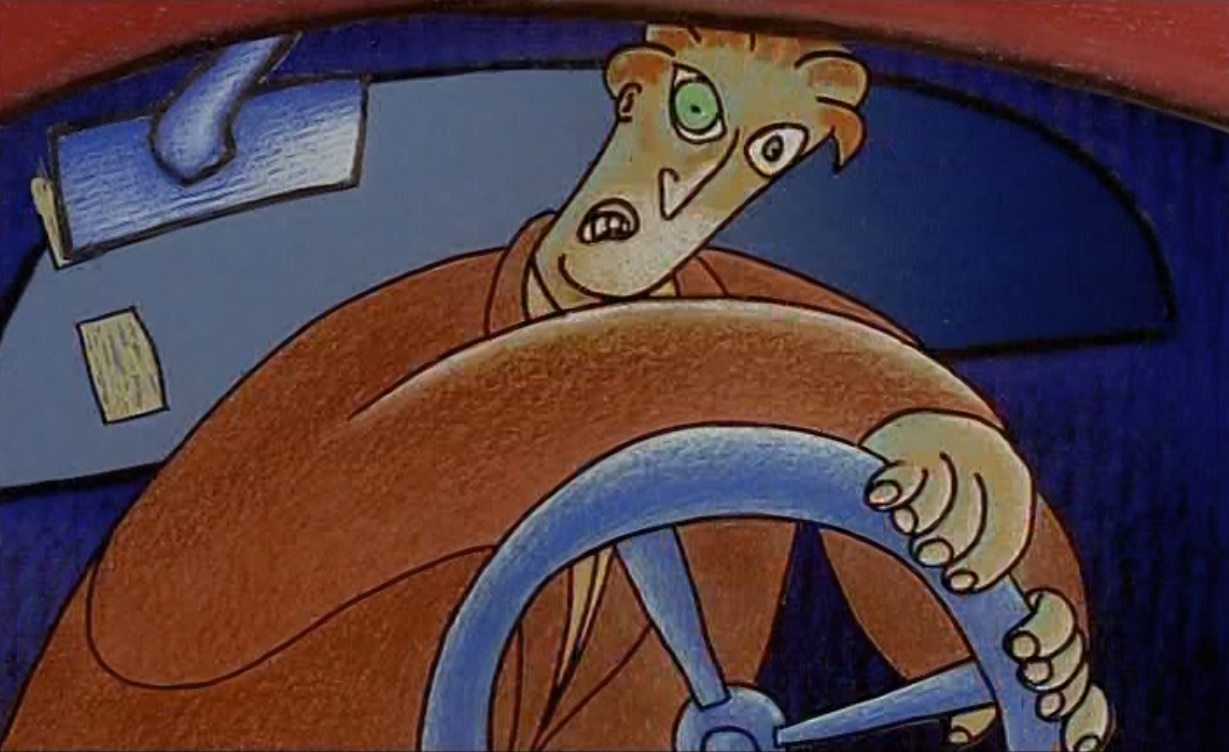
In the 2010s the two came to prominence with the equally idiosyncratic as entertaining animated feature films ‘Une vie de chat’ (A Cat in Paris, 2010) and ‘Phantom Boy‘ (2015). But even way back in 1996 they made an impression at animation festivals with ‘L’égoïste’ (The Egotist), a very short film about a man only loving himself. When the man falls in love with a woman, it’s because she resembles himself. All’s well until…
‘L’égoïste’ was made at the Folimage studio, which would be associated with Gagnol and Felicioli from then on. While Gagnol provided the scenario and the animation, Felicoli was responsible for the graphic design, which is a charming and very colorful type of expressionism. Both characters and background art is heavily distorted, with houses and furniture being skewed and crooked. The animation is relatively sparse but effective.
The film uses a narrator, being the voice of the egotist and unfortunately all too present music by Serge Besset. As the music hardly comments on the images this is the weakest aspect of a film that otherwise impresses because of its original visual style and very lean story telling.
‘L’égoïste’ is available on the DVD ‘Pris de Court – 14 films courts de Alain Gagnol & Jean-Loup Felicioli’ which features English soundtracks
Director: Michel Ocelot
Release Date: October 3, 2012
Rating: ★★½
Review:

‘Kirikou et les hommes et les femmes’ is the third movie about Kirikou, the brave little infant who lives in some West-African village and who battles the evil witch Karaba.
Like the second movie, ‘Kirikou et les bêtes sauvages’ (2005), but unlike the first movie, the feature consists of five stories, all lasting ca. a quarter of an hour. These stories clearly assume that one is already familiar with the main story, as told in the masterful ‘Kirikou et la Sorcière’ from 1998. They are told by Kirikou’s grandfather, and all take place in Kirikou’s little village or its direct surroundings.
The first story is mainly comical and tells about Kirikou’s mother taking in the stout woman, who’s rather ungrateful, and snores, too. In the second story the old man of the village has disappeared and Kirikou tricks Karaba’s all-seeing fetish on the roof to look for him. The third and fourth story make unwelcome and rather unconvincing leaves from the fairy tale setting of Kirikou’s first film, and suddenly place Kirikou’s village in the real world.
The third story is an all too obvious tale about racism and acceptance, while the fourth is a homage to the art of storytelling. The main problem with this episode is that storytelling itself is rather unfit for cinema, and thus this episode only makes the viewer long for an encounter with a real griot telling you the story of Sundiata Keita, the founder of the Mali empire. The fifth and last story is one about the power of music, in which Kirikou and his friends learn to play some instruments. In this episode Kirikou’s mother turns out to be an excellent flute player meeting gender inequality, as she’s not allowed to play because she is a woman.
All these stories end with the village rejoicing and dancing to the same melody, celebrating Kirikou’s cleverness. Unfortunately, none of these stories is very engaging and certainly not one of these stories comes near the narrative power of ‘Kirikou et la Sorcière’. Much more, by placing Kirikou’s village into the real world, the setting loses a lot of its magic, and in fact it makes Karaba’s presence suddenly absurd. In the end, the film feels superfluous and unnecessary, even unwelcome, spoiling the enchantment of the first film.
What certainly doesn’t help is the switch from traditional animation to 3D computer animation. The film uses a quite unique way of placing 2D designs on 3D characters (a very similar method was developed independently for ‘Couleur de peau: miel’). And, indeed, the makers have succeeded in keeping the ligne claire of the original designs, but nevertheless the 3D animation feels rather poor and remarkably stiff, never coming near the charm of the original hand drawn animation.
Much better than either the animation or the stories themselves are Ocelot’s hand-painted backgrounds, which retain the strange atmosphere of ‘Kirikou et la Sorcière’. Thibault Agyeman’s score is also a delight and makes clever use of traditional African instruments like the kora and balafon.
‘Kirikou et les hommes et les femmes’ is not a bad film, the stories themselves are told well enough. But let’s face it: this is a sequel that adds nothing to the first film and doesn’t do it any service by its unnecessary expansion and unwelcome added realism.
Watch the trailer for ‘Kirikou et les hommes et les femmes’ yourself and tell me what you think:
‘Kirikou et les hommes et les femmes’ is available on DVD with English subtitles
Directors: Benjamin Renner, Stéphane Aubier & Vincent Patar
Release Date: May 23, 2012
Rating: ★★½
Review:

In a time in which American studio animation has discarded traditional animation practically altogether, only to embrace a rather generic post-Disney 3D computer style (Laika being the notable exception), one must look elsewhere for animation films in a more unique visual style.
In the 21st century France, especially, has emerged as a producer of animation films with an interesting visual style, using traditional means, with films as different as ‘Les Triplettes de Belleville’ (2003), ‘Persepolis’ (2007), ‘Une vie de chat’ (2010) and ‘Le tableau’ (2011) emerging from that country.
One of such films is ‘Ernest & Célestine’, which immediately draws attention with its gentle, children book-like watercolor style. Produced not only in France, but also in Belgium and Luxembourg, ‘Ernest & Célestine’ is based on a children book series by Belgian author Gabrielle Vincent (1928-2000). Vincent’s Ernest & Célestine stories were modest affairs, with the bear and mouse duo singing, picnicking, going to the circus, or celebrating Christmas. But ‘Ernest & Célestine’ the movie is a very different affair, telling a rather Romeo and Juliet-like story of the two heroes bridging two worlds that live in fear of each other. It remains a bit mystifying why producer Didier Brunner didn’t opt for an intimate story, fitting the source material. As such ‘Ernest & Célestine’ could have been a delightfully little film like ‘My Neighbor Totoro’ (1988).
Instead, Brunner asked French writer Daniel Pennac for a scenario. Now, Pennac is best known for his social satire. I’ve read his novel ‘The Scapegoat’ from 1985 and his graphic novel ‘La débauche’ (with Jacques Tardi, 2000) and both combine sharp social criticism with great humor. Yet, Pennac’s urban settings seem miles away from Vincent’s nostalgic worlds, and, indeed, the film doesn’t really bridge those.
In fact, the film’s story is its weakest link, as the film doesn’t entirely succeed in both setting this world and introducing both characters before the main story starts. Pennac makes it over-complicated with little mice gathering the teeth from the bear children, an invention completely superfluous to the main plot. Moreover, as soon as Ernest and Célestine meet each other, the latter suddenly turns into a brave, smart-alecky, rather dominating, and talkative character, something we would never have guessed from the earlier scenes.
It doesn’t help that initially neither she nor Ernest come off as very likable. Ernest, for example is introduced as lazy and well-known to the police, and he absolutely sees no problem in breaking in into somebody else’s cellar. Also, his treatment of Célestine is rude, while Célestine comes over as pushy, popping up rather uninvited in Ernest’s home. Only when the two rescue each other from nightmares, they grow towards each other. But this occurs apparently overnight, and the change isn’t entirely convincing.
Worse, when the story finally comes to the subject of Vincent’s books, with scenes of Ernest & Célestine living together, and having fun together, the film enters still water. Likewise, the finale feels forced and fails to convince. Directors Benjamin Renner, Stéphane Aubier & Vincent Patar (the latter two of ‘A Town Called Panic’ fame) should have known better.
Nevertheless, the film’s message that friendship and understanding can bridge two very different worlds and cultures, is a welcome one, and as said in the intro, ‘Ernest & Célestine’ employs a very pleasant visual style. All background art is painted in watercolors, and the digital coloring of the characters successfully mimics the watercolor style. Moreover, the linework is open, and the edges of the backgrounds dissolve into nothingness, emphasizing the story book feel.
Strikingly, the animation, supervised by Patrick Lambert and done by Les Armateurs and Blue Spirit in France and Studio 352 in Luxembourg, comes across as rather Japanese. Several moves and facial expressions are copied directly from Japanese tropes and are at odds with the European visual style. Indeed, the film makers admit being highly influenced by Ghibli, but unfortunately, story-wise, ‘Ernest & Célestine’ doesn’t reach the Japanese studio’s great heights. This is a pity, for now ‘Ernest & Célestine’ remains a film which is extremely pleasant to look at, but which is also highly frustrating to watch, with its rambling plot, and plodding pace.
Watch the US trailer for ‘Ernest & Célestine’ and tell me what you think:
‘Ernest & Célestine’ is available on Blu-Ray and DVD
Director: Władysław Starewicz
Release Date: 1920
Rating: ★★★★
Review:

In ‘Dans les griffes de l’araignée’ Starewicz tells his own, quite elaborated version of the classic ‘Spider and the Fly’ tale.
In Starewicz’s version the fly is called Dame Aurélie, a simple fly living at the countryside with her uncle, Beetle Anatole, and being in love with a longhorn beetle. One day a famous Paris star, a butterfly called Phalène, crashes in the fly’s village, and stays at her home. Phalène paints an all too rosy picture of Parisian life, and soon after her departure, Aurélie goes to the capital, as well.
First all goes well, as Aurélie works as Phalène’s house maid. But when she’s fired because of seeing a secret lover, things go downhill, indeed. The tale ends rather gruesomely with quite a spectacular finale, and in the epilogue we watch Aurélie returning to the village…
‘Dans les griffes de l’araignée’ is quite a tragic tale, but it’s hard to call it very engaging. Starewicz’s puppets are quite sophisticated, e.g. capable of rolling their eyes, but they don’t transgress the emotions very well, which remains emblematic. The emotional scenes are augmented by close-ups of the insect characters, in which live action puppets are used. Most spectacular is the finale, in which the title cards make place for a long action scene. The surviving print is gorgeous with its hand-painted colors, which certainly add to the film’s unique atmosphere.
‘Dans les griffes de l’araignée’ is available on the DVD-box ‘Starewitch 1882-1965 DVD Cinquantième anniversaire’
Directors: Alain Gagnol & Jean-Loup Felicioli
Release Date: September 12, 2015
Rating: ★★★★★ ♕
Review:

2015 was a good year for French animation. June already saw the release of the great movies ‘Avril et le monde truqué’ (April and the Extraordinary World) and ‘Tout en haut du monde’ (Long Way North), but these were topped in September by the Franco-Belgian production ‘Phantom Boy’.
‘Phantom Boy’ was created by Alain Gagnol and Jean-Loup Felicioli, who have been working together at the French Folimage studio since the mid-nineties, and who brought us the entertaining feature film ‘Une vie de chat’ (A Cat in Paris) in 2010. But compared to the earlier feature scenarist Gagnol adds an extra layer of depth to ‘Phantom Boy’, because this is not only an adventure film, but it also tells about a boy suffering from a deadly disease.
‘Phantom Boy’ is a children’s film set in New York, and tells about Léo, an eleven years old boy, who’s seriously ill (he’s probably suffering from cancer, but the exact illness is never revealed) and hospitalized. In the hospital Léo discovers that his spirit can leave his body and look around, encountering other spirits while doing so.
During one of these wanderings, he encounters the spirit of Alex Tanguy, an injured policeman. Tanguy is after a master villain, the “man with the deformed face”, who threatens to shut down the whole of New York with a computer virus if not delivered a huge sum of money. Unfortunately, Tanguy is stuck at the hospital, but he discovers Léo’s spirit can snoop around for him. Thus, Léo can help miss Delauney, a feisty journalist, who’s also on the villain’s trail. There’s a catch, however, Léo’s spirit must return to Léo’s body in time, or Léo will certainly die…
The film is thus a very nice mix of adventure, in which Léo’s superpower is used to a great effect, and drama, because the film makers never lose sight of Léo’s illness, and show the ails, fears, and sorrows of Léo and his family, as well. Thus, the film is not only exciting, but knows some really moving scenes, too.
Nevertheless, the film never becomes heavy-handed, and in fact is often very funny. Especially the master villain’s two helpers are great comic relief, but the best gag goes to the master villain himself, who several times tries to tell the story behind his deformation, only to get cut short all the time.
The film has a very pleasant visual style, courtesy of Jean-Loup Felicioli, who has given the film a very idiosyncratic take on the Franco-Belgian comic strip tradition. Typical for Felicioli is a strongly graphical and very angular style (not a thing is straight in this film), and the slant eyes of most characters. The man with the deformed face is practically cubist, with his multi-colored and checkered face. The color palette is warm and appealing, and the animation uses the jittery style often encountered in independent shorts.
Films like this prove that traditional animation is far from dead (‘Phantom Boy’ was even drawn on paper, and hand colored, even though the final composition was done on the computer), and in fact allows for a less generic and more adventurous style than contemporary computer animation. I’ll even go that far to name ‘Phantom Boy’ the best animated feature of 2015, despite serious competition from both ‘Shaun the Sheep Movie’ and ‘Inside Out’.
Watch the trailer for ‘Phantom Boy’ yourself and tell me what you think:
‘Phantom Boy’ is available on Blu-Ray and DVD
Directors: Alain Gagnol & Jean-Loup Felicioli
Release Date: December 20, 2015
Rating: ★★★½
Review:

‘Un plan d’enfer’ is a comic short from the makers of ‘Une vie de chat’ (2010) and ‘Phantom Boy’ (2015).
The cartoon is set on a hot night in town. Two burglars plan to steal gold from an old lady. In order to be able to make a lot of noise and keep unheard, they release a multitude of cats on to the streets. These attract numerous dogs (including the vicious mongrel from ‘Phantom Boy‘), creating a lot of noise, indeed. The plan all goes well, until the two spill some katnip on their own car…
‘Un plan d’enfer’ is an unassuming, unpretentious short, told with charming drawings in the great Franco-Belgian comic strip tradition, and with the typical crooked style of Gagnol and Felicioli. There’s nothing mind-blowing or life-changing about this short, but it provides five and half minutes of genuine fun.
Watch the trailer for ‘Un plan d’enfer’ yourself and tell me what you think:
Un plan d’enfer’ is available on the Blu-Ray and DVD of ‘Phantom Boy’
Director: Rémi Chayé
Release Date: June 16, 2015
Rating: ★★★★ ½
Review:

‘Tout en haut du monde’ was the third of four notable animated films coming from France in 2015. Rémi Chayé, who had previously worked as a storyboard artist for Cartoon Saloon’s ‘The Secret of Kells’ from 2009, directed this film, which is, surprisingly, set in Russia and knows only Russian characters.
The story, by female writers Claire Paoletti and Patricia Valeix, is set in 1882, and tells of teenager Sasha, granddaughter of the great (fictional) Oloukine, who has disappeared somewhere in the Northern ice sea with his ship Davaï. The czar has desperately trying to find his favorite explorer and his ship, offering an enormous sum of money for those who succeed, but without any result.
Sasha discovers that the czar’s search parties have been looking in the wrong region, and against her father’s will she sets out to go on a mission of her own. Being an aristocrat who knows nothing of the real world, she soon gets stuck in a Northern harbor, where she gets help from a friendly innkeeper called Olga.
Sasha soon learns what real working is, and becomes quite good at it. Thus hardened, and still as determined as before, she indeed manages to get a ship to look for the Davaï, but she and her shipmates soon have every reason to want to find the ship.
‘Tout en haut du monde’ knows a wonderful young strong woman as its leading star, but Sasha never becomes superhuman – she remains a woman of flesh and blood. In fact, throughout the movie we can feel with her, with her frustration, her naivety, her determination, and her fear.
Interestingly, there’s absolutely no love story involved (although there is some flirtation between Sasha and the cabin Boy Katch). In the end it’s clear that Sasha is destined to become a great explorer herself, not the mere wife of some aristocrat husband.
Sasha’s co-stars, too, are round characters, and certainly not without their flaws. There’s an interesting subplot involving two brothers: one captain, and the other his mate. When Sasha does find her grandfather, this is a magical and moving moment, if a rather improbable one. This this the film’s only venture beyond realism. Otherwise, the movie maintains a very realistic tone, with the dangers and hardships of the North Pole shown in their full extent.
Nevertheless, the film never becomes dire or grizzly, and this is mainly because of the extraordinarily beautiful artwork, for which Chayé was responsible as well. The film’s visual style is clearly rooted in the franco-belgian comic tradition, but has discarded almost all line work. Instead, we are treated on bold color areas, both on the characters and the backgrounds, which are in perfect harmony with each other.
The coloring is clearly done entirely on the computer, but the result is absolutely gorgeous. In fact, the film boasts one of the best color schemes and richest color palettes ever put to the animated screen. Especially, the depiction of sunlit landscapes and rooms ensures some marvelous coloring. By all means, the scenes on the North Pole are of an astonishing beauty, with the ubiquitous ice never being just white. Thus as a result, every frame is a pretty painting.
If ‘Tout en haut du monde’ knows one flaw, it’s its rushed ending. The film ends before all story lines have been resolved, and the return scenes are shown in stills during the end titles. This is a little unsatisfactory. After Sasha’s grand Arctic journey, one wishes her adventure to end on an equally epic scale, not to fade out with a sizzle.
Nevertheless, this is a film to behold, and certainly one of the best animated features of 2015. With ‘tout en haut du monde’ Rémi Chayé became a strong new voice in the animation world, a reputation he consolidated with the even better ‘Calamity, une enfance de Martha Jane Cannary’ (2020).
Watch the trailer for ‘Tout en haut du monde (Long Way North)’ yourself and tell me what you think:
‘Tout en haut du monde (Long Way North) ‘ is available on Blu-Ray and DVD
Directors: Christian Desmares & Franck Ekinci
Release Date: June 15, 2015
Rating: ★★★★½
Review:

2015 was an excellent year for French animation. In May ‘The Little Prince’ came out (though largely animated in Canada, its French ties remain very clear), followed by the fresh ‘Tout en haut du monde’ (Long Way North) in June, and the lovely ‘Phantom Boy’ in September. That year I saw the last two on the Dutch Holland Animation Film Festival, and I knew of the existence of the first, but there was another great French animation film, which I had completely missed back then: ‘Avril et le monde truqué’ (April and the Extraordinary World) , also released in June. This is quite incomprehensible, for it’s a fine film, as well.
This film was entirely made to showcase the illustration style of French comic artist Jacques Tardi (born in 1946), one of the most idiosyncratic and most respected of all French comic authors. Now, Tardi’s classic comic ‘Adèle Blanc-sec’ had been made into a feature film before (2010), but that was a live action film, in which, of course, Tardi’s graphic style was lost. In ‘Avril et le monde truqué’, on the other hand, his hand is recognizable in every scene.
Tardi favors to set his stories in France during the belle époque period, roughly 1870 to 1918, but ‘Avril et le monde truqué’ takes place in 1941. Nevertheless, the complete film breathes Tardi’s favorite époque, because the story, conceived by director Franck Ekinci and screenplay writer Benjamin Legrand, is set in an alternate history in which science more or less stopped in 1870, thus before the taming of electricity.
The story starts in 1870, with a scientist looking for a serum to make soldiers immortal, but only succeeding in making two mysterious lizardly creatures talk. Then the film jumps to the background story of the alternate history, in which the steam age is extended enormously. Then one picks up the story-line with the scientist’s son, grandson and the latter’s wife trying to make the serum, as well. Young April also helps a little, and there’s also a talking cat present, called Darwin. Unfortunately, no scientist is allowed to work if not for the government, and the police is after the gang. During the chase scene, April’s parents and grandfather disappear, and she’s left alone with Darwin the cat.
Jump to 1941, in which April has become a young woman herself – also looking for the mysterious serum, while her aged cat lies in bed, coughing (there’s a lot of coughing in this film, subtly illustrating the enormous air pollution that comes with the burn of coal and charcoal).
I’ll not reveal the rest of the story, but be assured it’s pretty ludicrous. Nevertheless, it’s told very well, and never becomes dull or too unbelievable to buy, until the very last scenes, which are absolutely outrageous. Moreover, despite all the action, and a few deaths, the tone remains light and humorous, and the film never ceases to be one for the whole family.
Most interesting is the depiction of Avril herself: like Tardi’s comic star Adèle Blanc-Sec she’s a resourceful, strong and brave woman, who, in this case, also happens to be an intelligent scientist. She’s clearly way ahead of most of the (male) scientific community, and smarter than her male love interest. Between these two lovers things turn out fine in the end, but there are also two other couples depicted, which during the film are getting alienated from each other, with no chance of repair. This is a refreshing story twist, simply inconceivable in an American animated family film. Even more interesting is the film’s attitude to man and nature. The film asks some important questions, without falling into the trap of answering them, as well.
Of course, the major highlight of the film is its looks, especially for fans of Tardi’s work. Tardi’s style is a very idiosyncratic version of Hergé’s ligne clair, with much looser lines, and the use of strong blacks (most of his work is in black and white). The film transfers this style excellently to the animated screen. Both his character designs and world-making remain immediately recognizable. For example, April herself is clearly your typical Tardian heroine, her facial features resembling those of e.g. Adèle Blanc-sec, or Lili from ‘La débauche’ (2000). The other characters, too, look as if they’ve walked away from one of his books, and are a delight to watch. Special mention goes to inspector Gaspard Pizoni, one of the blundering policemen crowding Tardi’s oeuvre, and together with Darwin the comic relief of the film.
Even better, is the alternate world Tardi and the other film makers have created. Of course, their world is a version of steampunk, and their alternate version of Paris is certainly a well-conceived and magical place, with two Eiffel towers accompanying a hanging cable train to Berlin, the Opéra changed into a factory, and a towering statue of Napoleon III topping Montmartre, instead of the 1914 Sacré Coeur basilica. Steam-propelled cars fill the streets, and people stroll wearing gas masks, because of the heavy pollution, which renders most of the city in grey tones, fitting Tardi’s style perfectly. Tardi’s style is less fitting for the jungle scenes, however, and during these scenes, some of the magic of his style is lost.
The film makers cite Hayao Miyazaki as a major influence on their alternate history world, and indeed, there’s a certain kinship to Miyazaki’s ‘Laputa: Castle in the Sky’ (1986) and ‘Howl’s Moving Castle’ (2004), which must have been the inspiration for the walking house featured in ‘Avril’. Curiously, they don’t mention Otomo’s ‘Cannonfodder’ (1994) or ‘Steamboy’ (2004), despite the obvious connections of these films to the world of ‘Avril’.
The animation, too, is very fine. The film may have been created entirely in the computer, the animation is clearly hand-drawn, with a little help of effective and certainly not too obtrusive computer animation, much in the vain of the use of computer animation in early Disney renaissance features, like ‘The Great Mouse Detective’ (1986) or ‘Aladdin’ (1992). The animation style has little of the squash and stretch principles of Disney animation, and is more akin to the Japanese animation tradition, which suits Tardi’s drawing style very well. Darwin the cat is a great example of fine animation: the character remains both a very convincing cat and a fussy character.
In all, ‘Avril et le Monde truqué’ is a surprise film, an absolute must-see for all Tardi-fans, but also recommended to all lovers of animated feature films and/or steampunk. Even if you don’t dig the zany story, there’s enough to enjoy to have a good time throughout the movie.
Watch the trailer for ‘April and the Extraordinary World’ yourself and tell me what you think:
‘April and the Extraordinary World’ is available on Blu-Ray and DVD
Director: Mark Osborne
Release Date: May 22, 2015
Rating: ★★½
Review:

Antoine de Saint-Exupéry’s ‘Le petit prince’ (The Little Prince) is arguably France’s most beloved children’s book, so it’s no surprise that it would be made into a film someday. Surprisingly, it was the American filmmaker Mark Osborne (co-director of ‘Kung Fu Panda’) to take up the glove. His script, however, is entirely original, and builds around the classic booklet, and is not a direct interpretation of it.
Parts of the original story are still present in the final film, and these fragments without doubt form the visual highlights of the entire movie: these passages are done in a very charming stop-motion style, convincingly capturing Antoine de Saint-Exupéry’s illustration style. However, the story of the little prince is interwoven with Osborne’s framing story, and in itself quite hard to follow, especially if you have not read the book yourself. In fact, the surrounding story is more entertaining than these excerpts from the book. Even worse, it takes 17 minutes before this story starts, and half way the movie the contents of Saint-Exupéry’s book are finished, leaving a staggering 49 minutes of original material still to come.
Antoine de Saint-Exupéry’s little book deals with what it means to grow up, and with loss, and Osborne’s surrounding story tries to expand on that idea. This story arc is told in computer animation, and set in a caricature of our world, in which ca. everything is square, including the trees. The opening shots of this world, a bird-eyed view of the city, which looks like a print board in its extreme regularity, form a great introduction to the story. In this world every citizen thrives to be essential, including the nameless little girl, who stars this film, and her mother. For example, the Werth Academy, the school the little girl aspires to attend is covered with posters stating ‘What do you want to be when you grow up? Essential’.
As the girl’s first attempt to attend this school misfires, the mother conceives a new plan that includes moving into a proper neighborhood (one of those ultra-square blocks) and a whole vacation period of intense study for the little girl, laid out in a depressingly detailed planning board. But then it appears their house neighbor is the only oddball in this conformist world: an old man, who lives in an old, cranky house, and whose life is devoted to fantasy and child’s play.
It’s this old man who tells the little girl about the little prince (in fact he’s the pilot from the story, ignoring the fact that the real pilot, Antoine de Saint-Exupéry himself, died prematurely in a plane crash). Thus the old man draws the little girl into his magical world, allowing her to be a child again, instead of a miniature version of an adult.
Now, this is all very well, and the film’s messages that it’s important to recognize what’s important in life (no, it’s not money), and to accept that to love means to lose, is sympathetic, but this, alas, does not make ‘The Little Prince’ a good movie.
As said, the storytelling is erratic, with the passages of ‘The Little Prince’ sensu stricto being dispersed too fragmentary to entertain themselves, and the film’s messages are stated way too clearly, making the film heavy-handed. Moreover, after the story is finished the film devotes much screen time to a very long dream sequence in which the little girl rediscovers the little prince in adult form on a bureaucratic little planet. At this point the film lost me completely, for nothing in this sequence has a grain of the little book’s original charm. Instead, it only seems to destroy it. This is not a very respectful way to treat the original material.
But even without the dream sequence the film is overlong. It plods on with a frustratingly relaxed speed, and knows no surprises. Even then, the final roundup feels rushed, too open, and unconvincing. After all, the little girl herself may have changed, but the rest of the world is the same dull square conformist place it had been before…
The computer animation, done in Canada, is fair to excellent, and the rendering is okay, if not living up to contemporary American standards. I particularly enjoyed the animation of the stuffed fox. As said, the world building is excellent in this film, with its over-the-top squareness. The human designs, on the other hand, are pretty generic, and betray little originality. In fact, the beautiful passages of stop-motion based on De Saint-Exupéry’s drawing style make one regret that the film makers didn’t dare to make the whole film in this much more daring and more interesting visual style. The soundtrack is notable for some period songs, like ‘Boum!’ (1938) by Charles Trenet, and a lovely new song by French singer Camille called ‘Suis-moi’ (Follow Me).
In all, ‘The Little Prince’ is a charming film with some sympathetic messages, but it’s also highly uneven and overlong and could have done with some severe editing and more daring choices. Moreover, one can ask whether this film does the original book the justice it deserves. I, at least, would have preferred a short based on the scenes from the book itself, and done solely in stop-motion, for, without doubt these images are the most gorgeous of the entire film.
Watch the trailer for ‘The Little Prince’ yourself and tell me what you think:
‘The Little Prince’ is available on Blu-Ray and DVD


 Dr. Grob's Animation Review