
You are currently browsing the category archive for the ‘Independent film makers’ category.
Director: Émile Cohl
Release Date: November 12, 1908
Rating: ★★★★½
Review:
 After two drawn animation films of mind-blowing surrealism, Émile Cohl turned down his wild fantasy to tell a much more consistent tale.
‘Un drame chez les fantoches’ tells of a man, who, after being rejected by a woman, enters her house, chases her away and rips off her dress. The woman is rescued by a policeman, who gets awarded for this deed. The evil man gets arrested, but he escapes from jail to beat up another man. In the end the woman declares her love for the policeman, and all four protagonists take a bow to the audience.
‘Un drame chez les fantoches’ is told in the same simple stick man style as ‘Fantasmagorie‘ and ‘Le cauchemar de Fantoche‘, but metamorphosis now is used as a story device to go from one scene to another. At that point the scene devolves into abstract shapes, which then rearrange into another setting. This is a novel and totally unique way of cutting, and it’s a pity it has not been used more often. The cartoon’s clear plot makes ‘Un drame chez les fantoches’ the first drawn film ever to tell a story.
Watch ‘Un drame chez les fantoches’ yourself and tell me what you think:
‘Un drame chez les fantoches’ is available on the DVDs ‘Émile Cohl – L’agitateur aux mille images’
Director: Émile Cohl
Release Date: October 16, 1908
Rating: ★★★★½
Review:
 ‘Le cauchemar de Fantoche’ can be seen as the sequel to ‘Fantasmagorie‘.
Like Cohl’s groundbreaking film, the short consists of a stream-of-consciousness-like series of images, in which metamorphosis and free association run wild. The little clown from ‘Fantasmagorie’ is nowhere to be found, and the hero of this film, despite being called Fantoche as well, is a rather bland stick man, who has to endure quite some body deformations, for example changing into a pumpkin and into an umbrella. At one point he’s even hanged.
Nothing is certain in Cohl’s fantasy world, and ‘Le cauchemar de Fantoche’ is every bit as interesting as ‘Fantasmagorie’, and the only reason it is much, much less known, is because it suffers the fate of simply not being the first.
Watch ‘Le cauchemar de Fantoche’ yourself and tell me what you think:
‘Le cauchemar de Fantoche’ is available on the DVDs ‘Émile Cohl – L’agitateur aux mille images’
Director: Émile Cohl
Release Date: 1907-1909
Rating: ★★½
Review:
 Somewhere before or after his groundbreaking ‘Fantasmagorie’ Cohl explored the older animation technique of stop motion. ‘Japon de faintasie’ is an ultrashort venture into this technique, and the only reason of its existence seems to be the exploration of its possibilities.
Despite its short length of a mere one minute, the film consists of three clear sections: two Japanese figurines moving, a bee moving, and a face changing into a mask that sprouts mice. The film feels like a study, and is not as sophisticated as Cohl’s stop motion films from 1908, like ‘Le cerceau magique‘ or ‘Les frères Boutdebois‘, which points to an early production date.
Watch ‘Japon de fantaisie’ yourself and tell me what you think:
‘Japon de fantaisie’ is available on the DVDs ‘Émile Cohl – L’agitateur aux mille images’
Director: Émile Cohl
Release Date: August 17, 1908
Stars: Fantoche
Rating: ★★★★★ ♕
Review:
 ‘Fantasmagorie’ is without doubt the very first real drawn animation film.
Like Blackton’s films the short starts with a hand drawing a figure. But where Stuart J. Blackton’s ‘Humorous Phases of Funny Faces‘ and ‘Lightning Sketches‘ were pretty static tricks, ‘Fantasmagorie’ is a dazzling series of tableaux, moving into each other through metamorphosis. There’s no plot, but a strong sense of stream-of-consciousness, making this one of the very first surreal films ever.
Apart from the mind blowing images, the film also features the world’s first animated cartoon hero, Fantoche, a clown that starts the film and ends it by riding a horse and waving goodbye. In between, Fantoche keeps appearing, disappearing and changing into things and other characters. At one point he falls and loses his head, and Cohl’s hands have to put him together again. Even though by that time we did know the clown for only a few seconds, this still comes as a rather unsettling event.
Apart from the clown’s death and resurrection, so much is happening on the screen that after a mere two minutes the film leaves the viewer almost exhausted. There’s only one elongated gag, in which a man in a cinema is hindered by the giant head of the lady in front of him. It’s interesting to note that this early experiment of cinema uses its own still fresh medium as a setting.
Cohl’s drawing style is extremely simple, almost naive, and his stick-man-like figures have a child-like charm, which adds to the surrealism of the images. The film is totally devoid of timing, and the fast but steady flow of images give the film its unique character.
By all means ‘Fantasmagorie’ is not only a milestone of animated cinema, it still is a strong film in its own right, perfectly able to mesmerize even after more than a century since its completion.
‘Fantasmagorie’ was most probably Émile Cohl’s first film. He made the short inspired by Blackton’s influential stop-motion film ‘The Haunted Hotel’. Cohl was already 51 when he made this film, yet he would become one of the most prolific animators of all time, completing more than 250 films (not all of them animated) over a span of 13 years. Unfortunately, by the 1930s he was largely forgotten, and in 1938 he died as a poor man, never enjoying a rediscovery like the one that happened to his compatriot and fellow film pioneer Georges Méliès.
Watch ‘Fantasmagorie’ yourself and tell me what you think:
‘Fantasmagorie’ is available on the DVDs ‘Émile Cohl – L’agitateur aux mille images’ and ‘Before Walt’
Director: J. Stuart Blackton
Release Date: July 15, 1907
Rating: ★★½
Review:
 ‘Lightning Sketches’ is the third surviving film by J. Stuart Blackton in which he used drawn animation.
Unfortunately the film has less in common with his ground-breaking film ‘Humorous Phases of Funny Faces‘ (1906), and much more with his first trick film ‘The Enchanted Drawing’ from 1900: Once again Blackton himself appears on screen, and not only his hand. As in the earliest film, he now draws with a brush on paper, replacing the chalk and chalkboard.
Compared to ‘Humorous Phases of Funny Faces’ ‘Lightning Sketches’ is by all means the lesser product: there is less animation or movement (the best is of a bottle of champagne and a bottle of soda water filling a glass). Worse, Blackton’s first gag involves a stereotype ‘coon’ and Jew, but no animation at all.
In no sense ‘Lightning Sketches’ did propel the medium of animation forward, and it was up to others pioneers, like Émile Cohl, Winsor McCay and J.R. Bray to advance upon the new technique.
Watch ‘Lightning Sketches’ yourself and tell me what you think:
‘Lightning Sketches’ is available on the DVD/Blu-Ray ‘Cartoon Roots’
Director: J. Stuart Blackton
Release Date: April 6, 1906
Rating: ★★★½
Review:
 ‘Humorous Phases of Funny Faces’ is arguably the first drawn animation film. Like Blackton’s first film, ‘The Enchanted Drawing’ from 1900, the short combines the tradition of live sketching with that of trick filming to a novelty effect. Made for Thomas A. Edison, the film is an important step forward, however, because, unlike ‘The Enchanted Drawing’ there now is animated movement.
The film starts with a live action hand drawing the face of a man on a chalkboard. Next to the man a woman is drawn, now without the hand. The two faces alter, and at one point the man grows a cigar and a top hat. This ‘scene’ ends when the man’s smoke covers the whole woman, and the hand erases the drawing.
Next come two other faces. Little is happening here, so soon we cut to an old man with an umbrella. This part shows a little arm movement, done with cut-out. Blackton used the cut-out technique more extensively in the last shot, that of a clown, toying with his hat, a hoop and a poodle. The film ends with the hand erasing again. The whole experience lasts less than three minutes.
Overall, the image is pretty static, and it’s clear that the whole film is made pure for the novelty of its tricks. Of course, ‘Humorous Phases of Funny Faces’ is historically important, yet, it’s difficult to call this first hand-drawn animation film (and probably the first one to use cut-out) an instant classic, as apart from the movement hardly anything is happening, and only the smoke gag comes somewhere near being funny. Moreover, Blackton’s arm can be seen a few times, which hampers the trick.
Watch ‘Humorous Phases of Funny Faces’ yourself and tell me what you think:
‘Humorous Phases of Funny Faces’ is available on the DVD ‘Before Walt’
Director: Maarten Koopman
Release Date: 2008
Rating: ★★★★
Review:
 ‘Theatre Patouffe’ features a performance of lifeless objects, mostly of things on wheels, but also of some furniture performing acrobatics, and of three flying machines.
The objects and theater settings are beautifully made, and evoke a very surreal atmosphere, reminiscent of Jan Švankmajer’s films. Moreover, the film is full of clever ideas, and at one point one of the contraption even shows films of other contraptions performing, creating quite a Droste effect.
Unfortunately, the film suffers from the lack of a story arc. This renders the short unsatisfying, despite the intriguing images, and unique atmosphere
‘Theatre Patouffe’ is available on the DVD ‘Animazing! – Mindblowing Animation Films Supportes by the Netherlands Film Fund 1998-2008’
Directors: Paul Driessen & Kaj Driessen
Release Date: 2008
Rating: ★★★★½
Review:
 With ‘The 7 Brothers’ Dutch director Paul Driessen elaborates on the fairy tale ideas he had explored in ‘3 Misses’ (1988).
‘The 7 Brothers’ tells the tale of no less than seven old writers, and their stories, all Driessen’s own idiosyncratic variations on classic fairy tales, featuring a mixture of Cinderella, Rapunzel, Little Red Riding Hood, The Wolf and the Seven Young Goats, Snow White, Puss in Boots and Hansel and Gretel. There are seven short gags, all rather cruel takes on the familiar tales.
The film is unique within Driessen’s oeuvre, for its use of live action: the seven gag segments are bridged by shots of the old men wandering on a cobbled street at night. These surreal live action images were directed by his son, Kaj Driessen. The result is a beautiful and funny, if rather unassuming film.
Watch ‘The 7 Brothers’ yourself and tell me what you think:
‘The 7 Brothers’ is available on the DVD ‘Animazing! – Mindblowing Animation Films Supportes by the Netherlands Film Fund 1998-2008’
Director: Arjan Wilschut
Release Date: 2006
Rating: ★★★
Review:
 ‘Hard Boiled Chicken’ is a short gag short about a rooster and a chicken who try to save their egg from the farmer.
The film is shot in sepia tones, and uses simple comic designs on the chickens, while the cat and the farmer are a little more elaborate in design. The short partly evokes the atmosphere of a film noir detective, but this idea is not worked out well (for example, the short also features a totally unrelated The Matrix-inspired moment), and in the end the short falls short in its inconsistency. Yet, ‘Hard Boiled Chicken’ is a small, gentle film, and excellent for children.
Watch ‘Hard Boiled Chicken’ yourself and tell me what you think:
‘Hard Boiled Chicken’ is available as a bonus on the DVD ‘Animazing! – Mindblowing Animation Films Supportes by the Netherlands Film Fund 1998-2008’ and on the DVD ‘Independent Animation from The Netherlands Volume 2’
Director: Kunio Katō
Release Date: June 10, 2008
Rating: ★★★★★ ♕
Review:
 In ‘The House of Small Cubes’ (better known by its french title ‘La maison en petits cubes’) an old man lives in an almost abandoned town, flooded by an ever rising sea level.
Each time the level reaches his doorstep, he builds another level on top of the former one. One day his pipe falls down into a former home. The man dives to retrieve his pipe, but also into his own memories. By diving into ever deeper levels the old man remembers his deceased wife, his former family, and even the times before the flood began.
‘The House of Small Cubes’ is a gentle and sweet little movie on memory and loss. Despite being made in Japan, nothing in the film looks Japanese, and the short’s surreal but moving story is by all means universal. The film thus rightfully won the 2008 Academy Award for best animated short film.
Watch ‘The House of Small Cubes’ yourself and tell me what you think:
‘The House of Small Cubes’ is available on the DVD Box ‘The Animation Show of Shows Box Set 9’ and on the French DVD box set ‘Annecy – Le coffret du 50e anniversaire’
Director: Luis Cook
Release Date: June 11, 2007
Rating: ★★★★
Review:
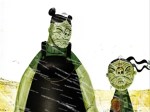 ‘The Pearce Sisters’ is an atypical product from the Aardman studio, as it does not use claymation, but 2D computer animation.
Cook tells a tale by Mick Jackson about two ugly sisters who live on a windy beach, far from the rest of the world. Their life is harsh, but they have each other. Then, one day, they save a man out of the sea…
The short is a rather morbid tale, but Cook manages to focus on the relationship between the two sisters, making the film gentler than one would expect. Cook’s style is completely his own – and owes nothing to Aardman’s general ‘Nick Park’ style. Cook tells his tale in great silent scenes, enhanced by a superb audio design – there’s only one line of dialogue in the entire film.
Watch ‘The Pearce Sisters’ yourself and tell me what you think:
‘The Pearce Sisters’ is available on the DVD Box ‘The Animation Show of Shows Box Set 6’ and on the French DVD box set ‘Annecy – Le coffret du 50e anniversaire’
Directors: The Blackheart Gang
Release Date: March 2006
Rating: ★★½
Review:
 ‘The Tale of How’ is a tale about birds trapped on an island by a large sea monster, but rescued by a mouse.
In this short the Blackheart Gang has used a mix of 2D and 3D computer techniques to make a film that is baroque in its complexity of images and intricate designs. The combination of weird surrealism and quasi-medieval ornamentation give the film its unique atmosphere. Unfortunately, the film’s story is less compelling than the images: the tale is sung in an all too uninteresting quasi-operatic style and very hard to follow, indeed.
Watch ‘The Tale of How’ yourself and tell me what you think:
‘The Tale of How’ is available on the French DVD box set ‘Annecy – Le coffret du 50e anniversaire’
Director: Gil Alkabetz
Release Date: April 29, 2007
Rating: ★★★★★
Review:
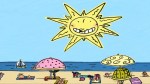
‘Ein sonniger Tag’ is a charming little film with no less than the sun itself as its star.
In Alkabetz’s short the sun tries to impress the people, and one little girl in particular. Unfortunately, he only manages to make them feel hot, and they all try to get away from him. Only when he gives up, and sinks back into the sea, he gets the attention and appreciation he had longed for all day long.
Alkabetz’s style is loose and cartoony, and his film is full of clever sight gags, like the sun using clouds as shaving cream, or the sun blushing red when being photographed at sunset. The result is a film that’s not only charming and funny, but also impresses in how it manages to follow its inner logic from start to end, with surprising results.
Even if ‘Ein sonniger Tag’ is far from an ambitious short, it shows the skill of a true master. The short is a great example of the endless possibilities of animation, in which there’s no limit to the imagination.
Watch ‘Ein sonniger Tag’ yourself and tell me what you think:
‘Ein sonniger Tag’ is available on the Belgian DVD ‘Kleine helden & rare kwasten – 14 animatiefilms voor kinderen’
Director: Milen Vitanov
Release Date: April, 2007
Rating: ★★★½
Review:
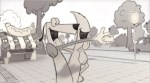 ‘My Happy End’ is an enjoyable little children’s film about a dog being in love with its own tail, which in Vitanov’s film also has a mouth.
The most remarkable aspect of Vitanov’s film is its technique: Vitanov blends traditional pencil animation with 3D computer effects, making the dog look like a single piece op paper moving around in a paper world. This illusion is enhanced by using only grey-tones, giving ‘My Happy End’ a sketchy look.
Unfortunately, Vitanov’s cartoon style is less original, and his story rather stretches the imagination (I could hardly swallow the concept of both the humanized tail and the regeneration which takes place in the end). The result is an amiable, if unassuming little film.
Watch ‘My Happy End’ yourself and tell me what you think:
‘My Happy End’ is available on the Belgian DVD ‘Kleine helden & rare kwasten – 14 animatiefilms voor kinderen’
Director: Sergei Ryabov
Release Date: February 20, 2007
Rating: ★★★½
Review:
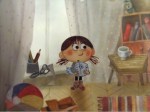 ‘The Tiny Fish’ is a charming little children’s film with a winter setting.
We follow a little girl who encounters an evil fisherman catching a fish. Shocked by this event the girl stays at home, leaving it to other kids to play outside in the snow. She draws a picture of the fish and then dreams that she and the fish are attacked by a giant version of the fisherman, who grows bigger and bigger in size. With her paper fish the girl returns to the ice hole where the fish had been caught. She returns her paper fish to the water, which immediately comes to life.
‘The Tiny Fish’ is made with a virtuoso cut-out technique. The designs are soft and tender, if a little old-fashioned. The story is told without words, and with a great feel of atmosphere. The girl’s emotions are not shown all too explicitly, but one immediately feels with her. The magical transformation of the paper fish is in complete agreement with the child’s world of wonder.
Watch ‘The Tiny Fish’ yourself and tell me what you think:
‘The Tiny Fish’ is available on the Belgian DVD ‘Kleine helden & rare kwasten – 14 animatiefilms voor kinderen’
Director: UrumaDelvi
Release Date: 2005
Rating: ★★★★★
Review:
 ‘(A Long Day for) Mr. Calpaccio’ does not have much of a story: Mr. Calpaccio goes to work, even flies to another place to work there, and returns home to do some shopping and outdoor eating with his family. That’s about it.
But boy, the looks of this cartoon! ‘(A Long Day for) Mr. Calpaccio’ boasts a completely unique style, with circus-like designs with stark black and white contrasts, and no shading whatsoever. There’s a very strange mix of expressionism and genuine silliness. The cartoon simply bubbles with weird images and original animation cycles, to a psychedelic effect. The bubbly images are accompanied by a fitting circus-like musical score by Yoshiyuki Usui.
The world of Mr. Calpaccio, its dull subject notwithstanding, is a magical place, a place of wonder. And this little gem by UrumaDelvi (a rather mysterious Japanese couple) by all means deserves to be seen. It’s a pity the film cannot be found online.
‘(A Long Day for) Mr. Calpaccio’ is available on the Belgian DVD ‘Kleine helden & rare kwasten – 14 animatiefilms voor kinderen’
Director: George Pal
Release Date: March 27, 1942
Rating: ★★★½
Review:
 ‘Sky Princess’ tells the tale of a prince rescuing a princess from a witch, who holds her in a castle in the sky.
In the beginning the story is told by a voice over. But all too soon the prince arrives, serenading his love with a violin. The love between the two destroys the witch’s power, and a great deal of the cartoon is devoted to the couple dancing in the castle in the sky. This sequence reflects the MGM musicals of the era, and excels in lighting and staging. Yet, as nothing really is happening, it’s also a bit boring. In the end we watch the couple sail away on the prince’s sky ship.
‘Sky Princess’ is a lovely cartoon, full of pretty colors, and a feast for the eye. The score makes great use of Pyotr Ilyich Tchaikovsky’s Flower Waltz. What the short lacks in story, it covers with its beautiful looks and dreamlike atmosphere.
‘Sky Princess’ is available on the Blu-Ray ‘The Puppetoon Movie’
Director: George Pal
Release Date: December 26, 1941
Rating: ★★★★
Review:
 In ‘Rhythm in the Ranks’ the action already starts during the opening titles, when we watch a package unwrap itself. The package reveals to contain a battalion of toy soldiers, who quickly come to life.
Our hero is ‘Little Jim’, a toy soldier who has to carry a large cannon. When he meets a skating girl in Dutch costume, he forgets the cannon. He gets punished, having to paint the barracks, which he does with invisibility paint, anticipating the Donald Duck short ‘The Vanishing Private‘ (1942), which uses the same story idea.
Both the vanishing paint and the cannon come in handy, when an evil army invades the countryside, although it remains pretty unclear how our hero conquers the foreign troops. Nevertheless, in the end he’s decorated and earns a kiss from the Dutch girl.
‘Rhythm in the Ranks’ is a charming, but uneven cartoon that suffers from an erratic story. The models, colors and staging, on the other hand, are top notch, as always in Pal’s works. The trickery used to make things becoming invisible is very well done.
The evil army of mindless robots, which invade the toy countryside reflect the war era. Yet, Pal’s film never becomes really topical, sticking to the fairy tale world of wonder. ‘Rhythm in the Ranks’ makes great use of two Raymond Scott compositions: ‘Toy Trumpet’ for the marching soldiers, and ‘Powerhouse’ to accompany the evil army.
‘Rhythm in the Ranks’ is available on the Blu-Ray ‘The Puppetoon Movie’
Director: George Pal
Release Date: June 27, 1941
Rating: ★★★½
Review:
 Jim Darcy, the main protagonist in ‘Hoola Boola’, must be the most relaxed castaway in animated history.
In the opening scene we watch him sailing on a series of rafts from his stranded ship, relaxing in his chair, and listening to the radio. Almost immediately he hits an island, where his house builds itself. Soon he meets a native woman called Sarong-Sarong, and the two fall in love instantly. Then a canoe full of cannibals appear, capturing Jim. However, with help of some magic Sarong-Sarong rescues our hero, reuniting the two lovers.
‘Hoola Boola’ is a wonderful example of George Pal’s art, if not among his best films. One can marvel at the lovely decors, the bright colors, the cinematic staging and clever lighting. Yet, the facial expressions of the sailor and Sarong-Sarong are poor and primitive, and, of course, the story is drenched in cliches, with its castaway-meets-noble savage-and-cannibals story. Even Sarong-Sarong’s rescue is a cliche, with the black cannibals fleeing in terror, all too easily. On the other hand, Sarong-Sarong manages to summon five goblins out of nowhere to chase the cannibals away. I’d be scared of them, too…
‘Hoola Boola’ is available on the Blu-Ray ‘The Puppetoon Movie’
Director: Norman McLaren
Release Date: 1938
Rating: ★★★½
Review:
 ‘Mony a Pickle’ is a compilation film for the British ‘General Post Office’, made by several directors. In his contribution Norman McLaren turns to his homeland Scotland to tell a story about a poor young couple, still living with their family, but dreaming of a place of their own.
The dream sequence transforms the poor and crowded living room into a new stylish one, and uses a lot of stop motion of furniture. There’s a humorous sequence in which the two lovers argue about the legs of a table, which change back and forth for our very eyes. Unfortunately, in the end a little brother scatters all their dreams and puts them back into reality again.
‘Mony a Pickle’ is a nice blend of live action and stop-motion. The stop motion sequences in a long tradition of furniture animation, which started with Stuart J. Blackton’s ‘The Haunted Hotel’ (1908). McLaren’s animation is not too remarkable, but effective, and completely in service of the story.
‘Mony a Pickle’ is available on the DVD-box set ‘Norman McLaren – The Master’s Edition’


 Dr. Grob's Animation Review