You are currently browsing the category archive for the ‘Independent film makers’ category.
Director: Norman McLaren
Production Date: 1938
Rating: ★★★★★
Review:
 In the late 1930s Scottish film maker Norman McLaren made several films for the British Post, like the promotional live action films ‘Book Bargain’ (1937) about how telephone books were made, and ‘News for the Navy’ about how letters were delivered worldwide.
Much more interesting than these films, however, is the small advertisement film McLaren made for Empire Air Mail, ‘Love on the Wing’. The film is clearly strongly influenced by the surreal movement. It uses, for example, music from Jacques Ibert’s quirky ‘Divertissement’, which was by that time only eight years old, and the film’s opening images are reminiscent of works by Max Ernst and Salvador Dalí.
In ‘Love on the Wing’ McLaren’s exploits his trademark technique of drawing direct on film, and he combines these images with beautiful painted and highly surreal backgrounds, reminiscent of the otherworldly landscape paintings by Giorgio De Chirico and Yves Tanguy.
The film tells a little love story, but is wildly associative, with metamorphosis and symbolism simply exploding from the screen. The three protagonists change into letters and back again, as well in numerous other symbols of love. So much is happening in the mere four minutes, it leaves the viewer breathless.
‘Love on the Wing’ surely must be one of the most avant-garde advertisement films ever made, and the short is without doubt McLaren’s first animated masterpiece. Unfortunately, the film displeased the authorities of the post office, and they never distributed this extraordinary short.
Watch ‘Love on the Wing’ yourself and tell me what you think:
‘Love on the Wing’ is available on the DVD-box set ‘Norman McLaren – The Master’s Edition’
Director: Władysław Starewicz
Release Date: 1933
Stars: Fétiche
Rating: ★★★★
Review:
 ‘The Mascot’ shows that by 1933 Starewicz was the undisputed master of stop motion.
This 26 minute long film starts with live action, and is a typical melodramatic product of its time: we watch a poor mother making a dog doll, while her ill child lies in the back of the small room with fever. When she sheds a tear on the puppy doll, it comes alive. The puppy doll makes friends with the little girl, but the next day he’s about to be sold by a poor mother together with several other dolls she made.
On the way, however, a thief doll cuts a hole through the cardboard box they’re in, and all dolls leave the box, except for the little dog, who’s sold and hung in a car. Finally the dog makes his way home and rescues the little ill girl from a certain death by fetching her an orange.
The plot is more complicated than this main narrative, however, and features countless puppets. Besides the dog’s story, there’s a menage à trois featuring a ballet dancer, a Pierrot and the thief doll, and there are also a monkey doll and a cat doll involved.
Highlight of the film is a night scene, in which everything comes alive, from pieces of paper to skeletons of fish and birds. No less than the devil himself invites all creatures inside his cavern, where an grand ball is taking place. This sequence has a nightmarish character comparable to Alexeïeff’s ‘Une nuit sur le mont chauve’ from the same year.
The whole film has a unique, gritty atmosphere, however. Throughout, the animation ranges from primitive to astounding. Starewicz especially excels in facial expressions, which really make some of the characters come alive. The dog, for example, clearly is a timid, reluctant character.
Unfortunately, the film is completely silent, despite a sparsity of dialogue and sound effects, and sometimes Starewicz’s dolls fall prone to overacting to overcome the lack of sound. Edouard Flament’s angular soundtrack doesn’t help either. Moreover, the all too complex plot hampers the film, making it meander too much. The melodrama, too, is a little too much for present day audiences.
Nevertheless, ‘The Mascot’ is a tour de force of stop motion animation. At least it provided Starewicz with a contract for eleven more films about the cute little dog, which was baptized Fétiche and finally starred five more films.
Watch ‘The Mascot’ yourself and tell me what you think:
https://archive.org/details/The_Mascot_Complete
‘The Mascot’ is available on the DVD ‘The Cameraman’s Revenge & other Fantastic Tales’
Director: Ted Esbaugh
Release Date: 1933
Rating: ★★★★
Review:
 Ted Esbaugh was one of the very few American animators operating independently during the 1930s.
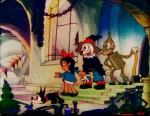
With ‘The Wizard of Oz’ Esbaugh could make use of Technicolor’s three-way process, if only outside the U.S., as Walt Disney had the exclusive rights to its use in the States themselves.
With this film Esbaugh was the first to bring Frank L. Baum’s famous fantasy to the film screen in full color. Like the latter, much more familiar live action version from 1939, Esbaugh paints the Kansas opening in sepia tones, and unleashes full color only in the land of Oz.
Lasting only eight minutes, the film’s plot is simple, and only superficially taken from the book: when Dorothy plays with Toto, a tornado takes her to Oz, where she lands on the scarecrow. Together they walk through the forest, where they encounter the tin man. The quartet (the lion is nowhere to be found) walk into the emerald city, where they’re taken to the wizard of Oz.
In Esbaugh’s version, the wizard of Oz is a real wizard, and he performs some tricks for our heroes, e.g. eight dolls dancing in a Busby Berkeley ballet-like fashion, and an egg growing into gigantic proportions, threatening our heroes, until it explodes, revealing a tiny chicken.
‘The Wizard of Oz’ boasts music by Carl Stalling, who’s in top form here, while the colorful images splash from the scene, and the animation can compete with contemporary cartoons by Warner Bros. and Disney in quality. However, the short’s story is hardly gripping, and although enjoyable, more forgettable than one would expect.
Because of Disney’s deal with Technicolor, Esbaugh’s film was never seen in the United States, and only shown in Canada and the UK, and it never received the fame it could have had otherwise.
Watch ‘The Wizard of Oz’ yourself and tell me what you think:
‘The Wizard of Oz’ is available on the Blu-Ray/DVD-set ‘Technicolor Dreams and Black & White Nightmares’
Director: Berthold Bartosch
Production Date: 1930-1932
Rating: ★★★★★
Review:
 While the cartoon industry flourished in the United States, animation film was developed as an art form in Europe.
In the 1920s Germany had lead the way, with films by Lotte Reiniger, Walter Ruttman and Oskar Fischinger, but by the early 1930’s France had taken over, albeit almost exclusively by foreigners, with great films like ‘Le roman de Renard’ (1929-1930) by Russian animator Władysław Starewicz, ‘Une nuit sur le mont chauve‘ (1933) by his compatriot Alexandre Alexeïeff, ‘La joie de vivre’ (1934) by British artist Anthony Gross and American artist Hector Hoppin, and ‘L’idée’ (1930-1932) by Austro-Hungarian animator Berthold Bartosch (1893-1968).
‘L’idée’ was based on a wordless novel of the same name by Belgian woodcut-artist Frank Masereel (1889-1972), who initially co-operated on the film, until he discovered how laborious animating really was. Masereel’s groundbreaking work has a strong expressionistic quality, which is also very present in Bartosch’s film.
Both the international character and the mood of the wordless film are greatly enhanced by the beautiful musical score by Swiss composer Arthur Honegger, who used the whooping sounds of the Ondes Martenot, an early electronic instrument invented in 1928, to great effects. According to Wikipedia, this makes Honegger’s score for ‘L’idée’ the first film music to employ and electronic instrument.
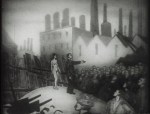
The film tells how an idea can originate and grow, despite dejection, oppression and censorship by the establishment. In practice, Bartosch’s idea has a strong socialist character, becoming an idea of the working class, and being oppressed by clear capitalistic forces. The idea itself is presented as a naked woman, symbol of innocence and purity, and she grows, accompanying the people who become victim of the oppression to the very end. The emotional highlight of the film is when she visits the very person who had invented her the night before his death sentence.
Bartosch had previously worked on Lotte Reiniger’s films, and used her cut-out technique on Frank Masereel’s stark cut-outs to a great effect. The imagery of Bartosch’s film is much more poetic, however, than Masereel’s own work, with a lot of soft-focus, and milky effects, especially on the idea itself, which Bartosch created with the help of soap. The film is also noteworthy for its great sense of depth in some scenes, which can reach a stunning level of complexity. There is for example a scene showing crowds and cars passing by a window, and another with numbers of soldiers marching. Bartosch achieved this sense of depth with a multi-plane camera of his own design, using several glass plates below each other. It’s interesting to note that his device predated Disney’s multiplane camera by five years. True, these soap- and multiplane techniques at times blur the images too much, rendering them too murky to understand what’s happening on the screen, but mostly the film is an excellent example of expressionistic storytelling, and what animation can do.
Unfortunately, the film itself suffered from censorship, delaying its release, which often only happened with an altered, less provocative intro text, and Bartosch never gained any money from it. Nevertheless, it was released in 1934, creating a sensation in Europe, with exception, of course, of Nazi Germany, where it was banned. Bartosch’s second film, ‘Saint Francis: Dreams and Nightmares’ (1933-1938), apparently an anti-war film, was destroyed by the Nazis in World War II. After that Bartosch tried to work on a third film about the Cosmos, but because of his deteriorating health work was abandoned. He devoted the rest of his life to painting. Thus ‘L’idée’ sadly remains his only surviving film, but it’s a great testimony of Bartosch’s art, and without doubt it single-handedly places him in the pantheon of great animation film makers.
Watch ‘L’idée’ yourself and tell me what you think:
‘L’idée’ is available on the Re:Voir DVD ‘Berthold Bartosch – l’idée’
Director: Oskar Fischinger
Release Date: December 1933
Rating: ★★★★★
Review:
 ‘Kreise’ is most probably the first full color film made in Europe.
Made with ‘Gaspar Color’ it certainly makes clever use of color’s new possibilities. ‘Gaspar Color’ required too much exposure time for live action, but for Fischinger’s animations it was perfect.
Color certainly added a great deal to Fischinger’s films. ‘Kreise’, for example, literally explodes with color. As its title implies, the film is composed of circles, only, which move and grow in various ways on an instrumental excerpt from Richard Wagner’s Tannhäuser.
The film ends with a slogan: “Alle Kreise erfasst Tolirag” (Tolirag reaches all circles [of society]), revealing that this totally abstract film is actually a commercial for an advertising agency. This was Fischinger’s trick to get the film past the Nazi censors, who in 1933 had come to power, and who were strongly opposed to abstract art.
Later the film also advertised other companies, like the Dutch Van Houten chocolate company. The film clearly shows that Walt Disney was not the only one who knew how to deal with color, but one wonders whether Tolirag (or Van Houten for that matter) did get a lot of new customers out of it.
Watch an excerpt from ‘Kreise’ yourself and tell me what you think:
‘Kreise’ is available on the DVD ‘Oskar Fischinger: Ten Films’
Director: Oskar Fischinger
Production Date: 1930-1931
Rating: ★★★★★ ♕
Review:
 In Fischinger’s study No. 7 , made in 1930-1931, the shapes of Study No. 6 move to the 5th Hungarian dance by Johannes Brahms.
Like Study No. 6 Fischinger made this film with charcoal on paper. In this short the synchronization of music and movement is even better than in Study No. 6. Fischinger uses less diverse shapes than in No. 6, making the film more consistent. Some of them look like fluttering and folding pieces of paper.
According to William Moritz this particular film prompted four film makers into animation: Norman McLaren, Alexandre Alexeieff, Claire Parker and Len Lye. These four all became major players in avant-garde animation. This fact makes Study No. 7 one of the most important animation films in history.
Watch ‘Studie nr. 7’ yourself and tell me what you think:
‘Studie nr. 7′ is available on the DVD ‘Oskar Fischinger: Ten Films’
Director: Oskar Fischinger
Production Date: 1930
Rating: ★★★★★
Review:
 In this short study we watch white shapes moving on a black canvas to upbeat dance music (‘Los Verderones’ by Jacinto Guerrero).
Made with charcoal on paper, the result looks like a filmed sketch by Wassily Kandinsky. The only recognizable shape is an eye, which reoccurs a few times.
The twirling shapes are elegantly drawn, their movements match the jolly music perfectly, and there’s a feeling of gaiety that transcends the film’s abstraction.
In 1931 Oskar Fischinger’s friend Paul Hindemith and some of his students made new scores for this film, but unfortunately they were all lost in World War II.
Watch ‘Studie nr. 6’ yourself and tell me what you think:
http://www.tudou.com/listplay/R8qsaMltb9Y.html
‘Studie nr. 6′ is available on the DVD ‘Oskar Fischinger: Ten Films’
Director: Priit Pärn
Release Date: 1992
Rating: ★★★★★ ♕
Review:
 If ‘Breakfast on the Grass‘ was a dark and disturbing portrait of life in the Soviet Union, Priit Pärn’s next film, ‘Hotel E’, took off the mask from the former Soviet state like no other film.
Released shortly after Estonia’s declaration of independence on 20 August 1991, it’s the film on the fall of the iron curtain, seen from an Eastern European perspective. Pärn paints Eastern and Western Europe in the most extreme contrasts, and with different animation styles.
The film starts with two short legends: the legend of the traitor. Told in cut out animation, it tells the story of a young man who looks, when a door opens to a more colorful world…
The second legend is called ‘The legend of the redeemer’. This is set in a rather renaissance sunny landscape, and tells of an outcast who can bridge the missing parts in an otherwise perfect society. This part features virtuoso painted rotoscope animation in the style of Paul Rubens and Frans Hals. Both legends are worked out in detail in the rest of the film, which forms ‘Hotel E’ proper.
‘Hotel E’ (Hotel Europe) starts with a depiction of Western Europe (named ‘The American Dream’) as a lethargic dream room, filled with rich, lazy, and spoiled people, filling their empty, purposeless lives with petty problems, and hardly capable of communicating with each other. This world is filmed in slow, rotoscoped movements in the most colorful pop-art style.
Meanwhile, next door, in the Eastern European room, things are very different indeed. This world is depicted in Pärn’s crude scratchy animation style, and accompanied by nervous, dissonant music. Here it’s dark, it’s filthy, it’s full of flies, and life there is extremely stressful. The inhabitants all sit around a round table, and their presence is constantly checked by a moving clock hand. The room is frequently illuminated by search lights, and if one fails to stay in place for whatever reason, he’s executed immediately. Paranoia and secrecy reign. Moreover, chances can change randomly, and someone who was in favor first, can be out of luck next time.
One of the inhabitants of this cruel world manages to break free and he’s capable to visit the other world next door. He repeats his visits, despite the fact that he has to leave his concerned wife behind, and despite the fact he’s increasingly seen as a traitor by his fellow citizens. Even worse, he seemingly has little to add to the luxurious world of the West, and his longings there are hardly answered, let alone his problems understood. Only in the end he manages to find his place in this society, when only he turns out to be able to restore the inhabitants’ happiness. At that point we watch the wall between the two rooms collapsing, exposing the rotten world of the East and its eager inhabitants, and we hear one Western woman exclaim ‘o, shit…’.
‘Hotel E’ is Pärn’s most openly political film. It must be regarded as one of his masterpieces, and because of its historical significance, the most important film by the Estonian master. Pärn’s visual language is at its most extreme here, and the film is very difficult to decipher. In fact, much of what is happening is hard to comprehend. But anyone who takes the plunge, is rewarded by a most moving, and impressive film, indeed, the message of which still rings today.
Watch ‘Hotel E’ yourself and tell me what you think:
Director: Priit Pärn
Release Date: 1987
Rating: ★★★★★
Review:
 Made directly after ‘Time Out’, ‘Breakfast on the Grass’ is one of Priit Pärn’s most powerful films.
It’s also one of his most difficult, and its message is at times hard to decipher. Pärn doesn’t tell straightforward stories, and much remains unexplained. Most importantly, it’s one of the few films showing insight in Eastern European life under the communist oppression. Its atmosphere is gloomy, its graphic style crude and scratchy, its humor dark, and its surrealism disturbing.
In ‘Breakfast on the Grass’ we follow four people, two men and two women, who struggle in their daily life. The first, Anna, strongly feels she’s an outcast in the society. She’s not really part of the system, and misses out on its benefits, as exemplified by her search for rare apples. The second, Georg, imagines himself a playboy, but reality is harder. In pursuit of a suit, with which he can fulfill his playboy dreams he has to go through a grind of corruption. Everyone wants something rare in exchange for offered service. Berta has lost her face as soon she became a mother. She only regains it when she finds the attention of a man. And finally, Eduard shrinks when he needs a paper signed from a very high official. Luckily he gets help from a female friend…
Also starring in these stories is an anonymous artist, who is constantly followed by a flock of crows or dragged around by two state officials. A clearer statement of oppression is hard to find in any Soviet film.
In the end, the four people succeed in their aim, and together they go to a park, where they form a life tableau of Edouard’s Manet’s painting ‘Déjeuner sur l’herbe‘ (1863) which lends its name to the film’s title. This hopeful statement of beauty, freedom and art is as quickly dismantled, however, and the final shot is for the artist, whose arm is smacked by a steam roller…
Like few other films ‘Breakfast on the Grass’ shows what life is like in an oppressed state, where food is scarce, where bureaucracy and corruption run freely, and where the role you play is more important than your personal preferences. Even though the Glasnost was in full flight in 1987, it’s a wonder such a dark accusation was possible in the Soviet Union, of which Estonia was then still part.
Watch ‘Breakfast on the Grass’ yourself and tell me what you think:
Director: Jan Švankmajer
Release Date: 1989
Rating: ★★★★
Review:
 ‘Flora’ is an ultra-short film made for MTV. It only lasts 30 seconds.
In it we watch a woman who’s tied down to a hospital bed. She apparently consists partly of vegetables, which are quickly rotting away, as if life is leaving her by the seconds. There’s a relieving glass of water nearby, but out of her reach. This is a puzzling and rather unsettling image, which knows no release.
Flora was the Roman goddess of flowers, and her features resemble that of a Giuseppe Arcimboldo-character, another homage by Švankmajer to the Renaissance-master, after ‘Dimensions of Dialogue‘ (1982). But how did the goddess come into this setting of utter distress? Watching her decaying alive is painful, even within this short time-frame.
Watch ‘Flora’ yourself and tell me what you think:
‘Flora’ is available on the DVD ‘Jan Svankmajer – The Complete Short Films’
Director: Jan Švankmajer
Release Date: 1989
Rating: ★★★★★
Review:
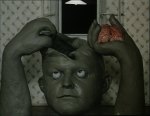 In ‘Darkness Light Darkness’ we watch several body parts entering a small room in order to assemble a complete man.
Together with ‘The Death of Stalinism in Bohemia’ (1990), ‘Darkness Light Darkness’ is Švankmajer’s last classic animated short film before he embarked on a career of directing features, which featured less and less animation.
‘Darkness Light Darkness’ is on the same level of virtuosity as ‘Dimensions of Dialogue‘ (1982): its stop motion animation, by star animator Bedřich Glaser, and its sound design, by Ivo Špalj, are both no less than perfect. However, it’s much lighter of tone than the earlier film. In this short film Švankmajer and Bedřich Glaser use a particularly cartoony type of animation. For example, the entry of the genitalia is a hilarious highlight.
Nevertheless, even this film has a darker side: when the man is complete, he completely fills the room, which is way too small for him. We hear him breathing heavily, and can assume he his in great pain in his cramped position. The cartoon ends with this claustrophobic image before darkness enters again. So, somehow, even this enjoyable film tells something about the human condition, how during our lifetimes we can develop ourselves only to end in the eternal dark again…
Because of its unity of space and time, and because of its unique inner logic, ‘Darkness Light Darkness’ is one of the best told animated shorts ever. It shows Švankmajer’s mastery. In that respect it’s unfortunate that in the 1990s he moved on to live action films.
Watch ‘Darkness Light Darkness’ yourself and tell me what you think:
‘Darkness Light Darkness’ is available on the DVD ‘Jan Svankmajer – The Complete Short Films’ and on the DVD ‘Alice’
Director: Jan Švankmajer
Release Date: September 1988
Rating: ★★★★
Review:
 ‘Another Kind of Love’ is a beautiful result of the glory days of MTV: A video clip by Jan Švankmajer!
Švankmajer treats Hugh Cornwell’s charming if rather forgettable song in his own typical way: the setting is one windowless room, he films the ex-Stranglers singer’s mouth a lot in close-up, there are objects with tongues (in this case singing shoes) and there’s a beautiful clay woman, who shares features with the woman in ‘Dimensions of Dialogue‘ (1982), apparently because the same template has been used.
Highlights form the deformations of the singer’s head, whose features have been reproduced very well in the clay model, and the clip’s finale, in which the woman emerges from the wall to embrace the singer, and drawing him into the wall, leaving the room empty.
Watch ‘Another Kind of Love’ yourself and tell me what you think:
‘Another Kind of Love’ is available on the DVD ‘Jan Svankmajer – The Complete Short Films’
Director: Jan Švankmajer
Release Date: 1988
Rating: ★★★★½
Review:
 Švankmajer’s films in the communist years preceding the velvet revolution of 1989 show a lighter tone than his earlier films. It’s like one can breath some of the thawing atmosphere in Czechoslovakia during the Perestroika years.
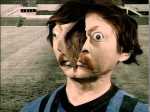
‘Virile games’ is a typical example. Although the film contains some very graphic violence, the film remains a rather cartoony atmosphere, and its end is rather tongue-in-cheek.
In ‘Virile Games’ we follow a mustached man watching a football match on the television. It’s a very weird soccer match, however: all players have the spectator’s face, and scoring happens by killing the opponents. These killings occur in the most bizarre ways, all deforming the opponent’s head till the player drops dead. One opponent for example is killed with cake forms, another by toy train….
In the second half the football match moves to the spectator’s own home, and the killing continues with the man’s own kitchen tools. However, tied to his screen, the man keeps watching the television set, not noticing that the violence occurs just around him.
In this film Švankmajer blends live action, stop motion, rather Terry Gilliam-like cut-out animation and pixilation with the stunning self-assurance of a mature film maker. Especially the clay-animation is top-notch. Like Georges Schwizgebel’s ‘Hors-jeu‘ (1977) the film directly couples soccer to violence, a clear indication of the author’s worries about growing football hooliganism. Apart from that, the film shows the maker’s trademark ingredients, like his obsession with food.
Watch ‘Virile Games’ yourself and tell me what you think:
‘Virile Games’ is available on the DVD ‘Jan Svankmajer – The Complete Short Films’
Director: Mark Baker
Release Date: 1988
Rating: ★★★★★
Review:
 ‘The Hill Farm’ is a long animation film exploring man’s relation to nature.
First we watch the inhabitants of the hill farm themselves: simple farmers, who know the dangers and hardships of nature, and who treat their livestock without romanticism (as exemplified by the farmer’s wife killing chicken without ado).
At one point the hill farm is visited by tourists, who are completely alienated from nature. One of them faints at the sight of the farmer’s wife killing a chicken. When confronted by nature’s dangers (as embodied by a gigantic bear-like beast) they don’t recognize the danger at all. To them nature is something to visit, something to make snapshots from. The third party is a group of huntsmen, who (try to) kill everything in sight, including even the farmer’s bees.
The whole film takes place at a leisurely speed, without dialogue. Mark Baker’s visual style is simple, but very effective. His angular designs and graphic backgrounds are beautiful, and his animation has a unique timing, which is as comical as it is to the point. The narration is very open, leaving the interpretation to the viewer. The end result is one of the most beautiful animation films of the 1980’s.
Watch ‘The Hill Farm’ yourself and tell me what you think:
‘The Hill Farm’ is available on the DVD Box Set ‘Annecy – Le coffret du 50e Anniversaire’
Director: René Laloux
Release Date: January 28, 1988
Rating: ★★½
Review:
 ‘Gandahar’ was to be René Laloux’s last feature, and like his former two feature films, ‘La planète sauvage‘ (1973) and ‘Les maîtres du temps‘ (1982), it’s a science fiction film set on a strange planet.
The film is especially related to ‘Les maîtres du temps’. Not only in visual style, but also with its story line involving mindless oppressors and time travelling. This time we’re on the paradise-like planet Gandahar, which is suddenly attacked by a powerful, yet unknown force. Soldier Sylvain is send away to find out who these enemies are…
‘Gandahar’ is the least successful of Laloux’s features. Its story, based on a 1969 novel by Jean-Pierre Andrevon, is entertaining enough, but the film’s narrative style is terrible. Practically everything that’s happening is explained by the main characters to us, even when we as viewers had come to our own conclusions. This is most preposterous in an early scene in which Sylvain finds his love interest Airelle, who immediately exclaims she’s falling in love with our hero. This must be one of the worst love scenes ever put to the animated screen.
The film’s ultimate villain is rather surprising, as is his downfall, even though he’s killed off ridiculously easily. Strangely enough the creature is given a long death scene, before the film abruptly ends. We don’t even watch Sylvain reunite with his love interest! Not that we did care, anyway, for the film’s main protagonists are as characterless as possible.
It’s a pity, for the film’s aesthetics are quite okay for a 1980s film. The animation, by a North-Korean studio, is fair, if not remarkable, and the designs by French comic book artist Philippe Caza are adequately otherwordly. Sure, he’s no Moebius, let alone a Roland Topor, and he never reaches the strangeness of the latter’s fantastic planet from 1973. In fact the film rarely succeeds in escaping the particularly profane visual style of the 1980s (e.g. ‘Heavy Metal’). Most interesting are the backgrounds, and Gabriel Yared’s musical score, which is inspired and which elevates the film to a higher level.
Watch ‘Gandahar’ yourself and tell me what you think:
Director: Osamu Tezuka
Release Date: 1987
Rating: ★★★★★
Review:
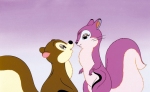 ‘Legend of the Forest’ is Tezuka’s longest and most ambitious short film.
Like many of his films it shows Tezuka’s concern with environmental issues. However, foremost, this film is Tezuka’s answer to Disney’s ‘Fantasia’ (1940). Based on the first and last movement of Pyotr Ilyich Tchaikovsky’s 4th Symphony it portraits the fight of forest creatures against the demolition of their forest.
The first movement tells about the struggle of a lone flying squirrel against one lumberjack and against the jealous fellow-forest animals. This part is the most extraordinary for its diversity in styles. It is as if Tezuka wanted to show the evolution of animation itself within his emotional story. At first, the story is told in manga-images only. There’s no movement, even though the realistic images are very lively. The next episode is in Émile Cohl’s style, followed by a very convincing homage to Winsor McCay’s ‘Gertie the Dinosaur‘ (1914). This is followed by a scene in which the little squirrel looks like Otto Messmer’s Felix the Cat or as an early Disney character. This episode is particularly beautifully animated. When a man comes into the forest with a chainsaw, Tezuka’s jumps to the style of Fleischer’s Popeye, including Fleischer’s tabletop-technique for 3d effects.
It’s followed by the first episode in color, in which the squirrel finds a female companion. This part starts as a clear tribute to the very first animation film in technicolor, Disney’s ‘Flowers and Trees‘ (1932), but is mostly drawn like a 1940s cartoon. The final episode of the first part, in which the man shoots his girl and the squirrel sacrifices himself, is quite Bambi-like. Interestingly, throughout the episode, the backgrounds and the staging retain a typical anime-like character.
The second part, using the symphony’s final movement, is less impressing than the first part. It starts with a very Fantasia-like fairy scene, but when we watch very anime-like breasted foxes, we know we’re in a different film. This part tells how magical forest characters (including a few dwarfs) win a war over a forest from a Hitler-like foreman. This part in particular resonates in several Ghibli-films with similar themes, like ‘Pom Poko‘ (1994) or ‘Princess Mononoke’ (1997).
The complete film is an original and unique statement, which deserves to be much more famous than it actually is. Tezuka’s animated output was of a high quality anyhow, but this film may stand as a particularly artistic highlight within his extraordinary career.
Watch ‘Legend of the Forest’ yourself and tell me what you think:
Director: Nicole van Goethem
Release Date: 1985
Rating: ★
Review:
 ‘A Greek Tragedy’ won an Academy Award and the first prize at the Annecy Inernational Film Festival. I remain puzzled why.
‘A Greek Tragedy’ was Van Goethem’s first own film. It’s a classic gag cartoon featuring three living, scarcely clad female caryatids supporting an old ruin. When the ruin crumbles, and they’re finally free, we watch them dancing into the distance.
The designs are trite, the synthesizer music is ugly, the humor is poor, and the story forgettable. If this short has a hidden, perhaps feminist message, it’s lost on me. And then to imagine, that one of the short’s competitors for the Oscars was ‘Luxo jr.’, a far more convincing and rewarding film in every respect!
Watch ‘Een Griekse tragedie’ yourself and tell me what you think:
‘Een Griekse tragedie’ is available on the DVD Box Set ‘Annecy – Le coffret du 50e Anniversaire’
Director: Jan Švankmajer
Release Date: August 3, 1988
Rating: ★★★★★ ♕
Review:
 Of all classic literature, Lewis Carroll’s ‘Alice in Wonderland’ is certainly the most dreamlike, and it’s no wonder that it came to the attention of Czech master surrealist Jan Švankmajer.
Already in 1971 he had made a film on Carroll’s poem Jabberwocky, but arguably, this film has little to do with the poem. ‘Alice’ continues the surreal atmosphere of his earlier film and remains faithful to the book.
‘Alice’ was Jan Švankmajer’s first feature length film, and it really shows his craft and strikingly original vision. It is one of the best, probably the most original, and certainly the most disturbing film adaptation of Lewis Carroll’s world famous book. In any case, it’s among the best animated features of all time.
Where the Walt Disney version focused on the loony, fantastic parts of the story, Švankmajer emphasizes its irrational, surreal character. Švankmajer puts the story in a setting completely his own. Although the film opens with the classic opening near the brook, after the titles, the action takes place mostly indoors, creating a claustrophobic atmosphere typical for this film, only matched by Švankmajer’s second feature film, ‘Faust’ (1994). In Švankmajer’s film ‘wonderland’ consists of an endless string of dirty old rooms, connected by many doors and desks with drawers, all of which the knob comes off. Even the lovely garden is no more than a stage with props.
The drawer knobs form the running gag in a movie which is low on humor, but high on unsettling and impressive images, starting with the stuffed rabbit suddenly coming to life and smashing the glass of its glass display with its scissors. Other highly memorable scenes are the stuffed rabbit eating sawdust, which falls out again its open belly; the mouse cooking on Alice’s head, the room of hole-digging socks; and the mindless and mechanical repetition of the mad tea-party scene, timed to perfection.
Švankmajer’s wonderland is a morbid world. Its inhabitants are stuffed animals, dolls, playing cards, and even a bunch of macabre fantasy creatures, oddly joined together from body parts from different animals and lifeless objects, and which form a real threat to the little girl. In this world, anything can become alive, as demonstrated by e.g. Alice’s own socks. At the same time, Alice remains the only really living thing, and even she turns into a doll three times. Death, too, is near: at one point in the film we see the mouse, still in his clothes, caught by a mousetrap, dead. And in Švankmajer’s wonderland, the queen of heart’s orders are executed, and several characters are decapitated, including the mad hatter and the march hare…
‘Alice’ uses a perfect blend of stop motion and live action, and has an excellent protagonist in young actor Kristýna Kohoutová. If the film has one flaw, it must be the girl’s voice, which provides all the dialogue and narration. It’s often unwelcome and out of place, and it doesn’t really work well in dialogue-rich scenes, like the mad tea scene or the trial scene.
Švankmajer is at his best when the action is silent and the images speak for themselves. These scenes are greatly added by superb sound design, provided by Ivo Špalj and Robert Jansa, which add to the creepy, wretched atmosphere of the film. ‘Alice’ is certainly not your average family film, but the viewer who dares to enter this film’s unique world, will not be disappointed.
Watch the trailer for ‘Alice’ yourself and tell me what you think:
‘Alice’ is available on DVD and Blu-Ray
Director: Osamu Tezuka
Release Date: 1987
Rating: ★★★½
Review:
 This film is named after a medieval sword smith who made swords that were supposedly cursed, creating blood lust in its wielder and finally making him commit suicide.
The film is an illustration of this curse and of its own motto: “A man with arms which can kill people like puppets is not aware that he himself has already become a puppet”. For this dark anti-violence film Tezuka uses realistic imagery and limited animation, which make the film look a little like an animated comic.
The film’s visual language is utterly Japanese, accompanied by equally Japanese music. But its message is universal, and another example of Tezuka’s strong dislike of war and violence. Even if it is not amongst his most impressive works, the film still manages to deliver its dark message.
Watch ‘Muramasa’ yourself and tell me what you think:
Director: Osamu Tezuka
Release Date: 1984
Rating: ★★★★★ ♕
Review:
 Osamu Tezuka is known as the founder of commercial animation in Japan, but he never lost sight of the artistic possibilities of animation.
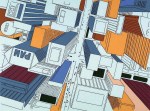
No film of his shows this more clearly than ‘Jumping’, arguably the best film he ever made. In ‘Jumping’ we watch the world from the eyes of rope jumping girl. As the short progresses she jumps higher and higher, and further and further, even jumping to Africa, to a war-ridden country and into a mushroom cloud, straight into hell.
‘Jumping’ is not only strikingly original, it is very well-made with its constantly moving backgrounds, and as funny as it is disturbing in its finale. The mushroom cloud, the nightmare of man, but especially of the Japanese, the only nation to have experienced it, is a frightful sight, even in this animated short. Together with the girl, we sigh with relief when in the end of the film we return to the familiar and peaceful territory of our home street.
‘Jumping’ maybe a clear product of the cold war era, its impact is still at work today, and its message still as significant.
Watch ‘Jumping’ yourself and tell me what you think:


 Dr. Grob's Animation Review