You are currently browsing the category archive for the ‘Independent film makers’ category.
Director: Sabrina Peña Young
Release Date: October 5, 2013
Rating: ★
Review:
 ‘Libertaria: The Virtual Opera’ must be one of the most unwatchable animated features ever made.
This science fiction film is utterly pretentious, using heavy texts to tell a dystopian story about some post-apocalyptic America. The film makes use of some interesting split-screen techniques, but is hampered by erratic storytelling and the most primitive computer animation techniques. The animation of the characters is appallingly poor and amateurish, and the designs hideously ugly. The emotions of the songs are not mirrored in the images, at all. Even the cheapest video game looks better than this.
This combination of dead serious pretentiousness and extremely poor execution make the film a nightmare to watch. Its best aspect is its music, because that, at least, has some quality. Indeed, Sabrina Peña Young is a composer, not an animator, and it remains puzzling why she wanted to make this film in the first place.
Cobbler, stick to your last!
[UPDATE: Sabrina Peña Young reacted to this blog post to explain why she made this film. Please read her response below]
Watch ‘Libertaria: The Virtual Opera’ yourself and tell me what you think:
Director: Bill Plympton
Release Date: October 11, 2013
Rating: ★★★½
Review:
 ‘Cheatin’ is Plympton’s sixth feature – no small achievement for an independent animator who insists on drawing everything on his own.
‘Cheatin’ is no exception to his rule. True, for this film Plympton had hired some staff to reproduce the looks of his watercolor illustration style, but he still drew every single frame himself. According to Plympton*, the costs of the extra staff broke him, and he had to go for a (luckily successful) Kickstarter campaign to be able to finish his film. Unfortunately, distribution in his homeland, the United States, will remain problematic, as, according to Plympton, ‘Cheatin’ is 1) no computer animation film, and 2) it’s not directed at children. Both ‘handicaps’ are enough to alienate the average American distributor. Add the absence of dialogue, and ‘Cheatin”s chances become mighty low, indeed…
This is a pity, for Plympton is in great shape in this film. His sketchy drawing style is as virtuoso as ever, and his human protagonists are drawn to the extreme – using weird camera angles and outrageous exaggeration. Practically every single frame is a beauty.
‘Cheatin’ is a surprisingly lighthearted love story. It tells about Ella and Jake, who meet each other at a bumper car stand – and it’s love at first sight. They marry shortly after, and nothing seems to stand in the way of their happiness. Unfortunately, more women take interest in the muscular Jake, and one of them frames Ella – making Jake belief she meets other men. Prostrated with grief, Jake decides to take revenge, and to pick up as many girls as possible himself…
At this point, the film starts to falter a little. Plympton steers away from reality to plunge into a weird plot using a strange machine to get to his happy end. This is a pity, for his outrageous portraits of the common aspects of love are perfect in itself. To me the film would have been better if he’d stuck to a more familiar pattern of love, rut, adultery, and revenge. For example, Plympton’s depiction of Ella opening her heart to let love in is the most endearing sequence in the whole film. And his depiction of the married couple’s happiness accounts for the film’s most stream-of-consciousness-like sequence, accompanied by the drinking song from Giuseppe Verdi’s ‘La Traviata’.
When Jake starts cheating, Plympton focuses on his behavior at the EZ motel. However, it remains a rather unclear how Jake behaves at home. He has clearly become cold and distant, and denies Ella the love and sex she desires. But at no point in the film there’s any trace of irritations, rows or fights between the two lovers.
Plympton says the film is based on a experience of his own, in which he discovered he wanted to strangle and to make love to his girl at the same time. There’s indeed a scene depicting this feeling. However, it gets a little lost in the strange plot twist. What it does show is that Ella’s desire to hurt Jake is weaker than her desire to be loved by him. Although both characters look rather cliche, in the end Ella is a far more interesting character than Jake, who remains a rather simple strong man loaded with testosteron. Plympton doesn’t show much of Ella’s character, but her more complex inner feelings can be distilled from several scenes.
Despite the plot flaws, ‘Cheatin’ remains a well-told film throughout, making clever use of Nicole Renaud’s gorgeous score, and of some classical pieces – apart from Verdi, e.g. Leoncavallo’s ‘Ridi Pagliaccio’ sung by Caruso, and Maurice Ravel’s Bolero. The absence of dialogue never becomes a handicap – on the contrary. And the emotions of the characters are played out well – sometimes grotesquely cliche, like Jake’s ride of grief; sometimes subtle and sincere, like Ella’s suffering from Jake’s rejection.
Plympton calls his film ‘anti-Disney’, but ‘Cheatin” is in no way a reaction to Disney’s world. One can say it’s decidedly non-Disney: the film stands on its own and shows us an animation world totally different from Disney’s, one in which American animated features are not synonymous to family films, but can be as wildly diverse as live action features.
I certainly hope Plympton’s world will once come true.
Watch the trailer for ‘Cheatin’ yourself and tell me what you think:
* quotations from Bill Plympton are taken from his introduction to the film at the screening at the Holland Animation Film Festival, March 19, 2014.
Director: Alexandre Alexeieff
Release Date: 1933
Rating: ★★★½
Review:
 Predating Disney’s film to the same classical piece by seven years, this ‘video clip’ to the music of ‘Night on Bald Mountain’ by Modest Mussorgsky is an impressive mood piece.
The Russian-French artist Alexeieff animated ‘Une nuit sur le mont chauve’ on a so-called pinscreen, a device he invented himself , and which consists of a screen with numerous pins, which can be pushed further in or out, to produce a shadowy image together. This technique is highly original, and the images produced are totally unique.The film’s imagery has more in common with surreal paintings from the era than with any other animation film from the 1930s. ‘Une nuit sur le mont chauve’ was Alexeieff’s first film on the pinscreen. Together with his wife Claire Parker he would animate five more, of which ‘The Nose’ (1963) is arguably the best.
The film does not tell a story, but shows us a string of expressionistic images of animal and human forms, floating through air, and morphing into disturbing creatures. The animation is sometimes excellent (with a human figure circling through the air as a particular standout), but at times primitive, too, and the film suffers a little from the crude montage. Both shortcomings are a direct result of the limitations of the pinscreen. However, Alexeieff’s vision overcomes the film’s drawbacks, and ‘Une nuit sur le mont chauve’ is rightly considered an animation classic.
Watch ‘Une nuit sur le mont chauve’ yourself and tell me what you think:
‘Une nuit sur le mont chauve’ is available on the DVD ‘Alexeïeff – le cinéma épinglé’
Director: Ruth Lingford
Release Date: 1997
Rating: ★★★★★ ♕
Review:
 When death takes away her child, a mother gives up everything to get her back.
‘Death and the Mother’ is Ruth Lingford’s re-telling of a classic fairy-tale by Hans Christian Andersen. It’s an animation masterpiece: its strong and gritty animation, the beautiful string quartet music by Nigel Broadbent, the subtle sound effects – all add up to a very strong, dark and emotional film. Lingford makes clever use of the computer to create a very graphic film that looks like an animated woodcut. In an age in which computer animation almost equals 3D animation, this is a refreshing technique, with a stark impact and an imagery unparalleled in the animation field.
Moreover, Lingford captures Andersen’s tale of grief, love and sacrifice very well, without trying to update it. Just by staying true to the essence of the original story she has made a timeless classic. Her wordless film is as universal as it can get, and capable of communicating to audiences worldwide. It’s a welcome antidote to the Disney fairy tale retellings, which get more and more watered down, and which lose a lot of the originals’ charm with it.
Watch ‘Death and the mother’ yourself and tell me what you think:
‘Death and the Mother’ is available on the DVD inside the book ‘Animation Now!’
Director: Osvaldo Cavandoli
Release Date: 1991
Stars: La Linea
Rating: ★★
Review:
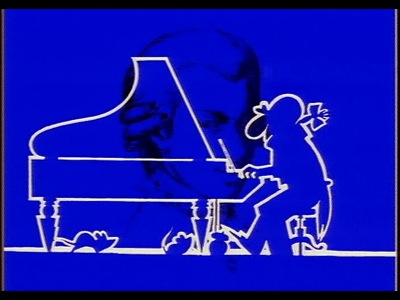 Trazom, A.W. Is W.A. Mozart spelled backwards and it’s Cavandoli’s hommage to the composer.
We watch La Linea dressed like an 18th century composer playing Mozart’s K545 sonata on the grand piano. Meanwhile he encounters several animals and people.
Unfortunately, the cartoon is slow, repetitive and rather unfunny. La Linea’s irresistible voice is hardly heard and this cartoon lacks the brazen humor of the earlier entries. And it completely pales when compared to classic piano concerto cartoons like ‘Rhapsody Rabbit‘ (1946) or ‘The Cat Concerto‘ (1947).
‘Trazom, A.W.’ is available on the DVD ‘La Linea 3’
Director: René Laloux
Release Date: 1988
Rating: ★★★★½
Review:
 ‘La Prisonnière’ is a short, rather surrealistic science fiction film about two children.
They visit an extraterrestrial monastery and witness a rescue of a prisoner by naked women who step out of a stranded whale.
The film looks like an animated version of designer Caza’s source comic, Équinoxe (which can be found here), and contains only a limited amount of animation. In his designs Caza’s style is very reminiscent of that of his fellow french comic artist Moebius.
‘La prisonnière’ seems like an etude for Laloux’s and Caza’s much bigger project, the feature film ‘Gandahar‘ (1988). The atmosphere of the short is poetic, if completely incomprehensible.
Watch ‘La Prisonnière’ yourself and tell me what you think:
‘La Prisonnière’ is available on the DVD ‘Gandahar’
Director: Paul Driessen
Release Date: 1988
Rating: ★★★★★ ♕
Review:
 In an old castle a medieval writer is writing such lively stories, it attracts Death’s attention.
The writer tells a story about a peddler and his son, who has a touch of magic. All goes well, until Death comes in, and messes with the writer’s stories to ruin them and fill them with death and misery. Nevertheless, he fails to kill the son, who’s the writer’s main protagonist. With his magical powers the young boy escapes certain death several times. However, when in the end, the writer turns out to be same man as the little boy in his stories, Death has the last laugh.
‘De schrijver en de dood’ is one of Paul Driessen’s darkest and gloomiest films. His typical black humor is not absent, and is best visible in the little snapshots, which disrupt the story’s continuity for small morbid gags. But more than in any other of his films death is more disturbing than funny, and the sadness and misery are heartfelt. At the same time, it’s also one of Driessen’s most poetical films. The images are rich and full of fantasy, and in his own way Driessen creates a convincing medieval world to marvel at.
Watch ‘De schrijver en de dood’ yourself and tell me what you think:
‘De schrijver en de dood’ is available on the DVD ‘The Dutch Films of Paul Driessen’
Director: Paul Driessen
Release Date: 1985
Rating: ★★★★★
Review:
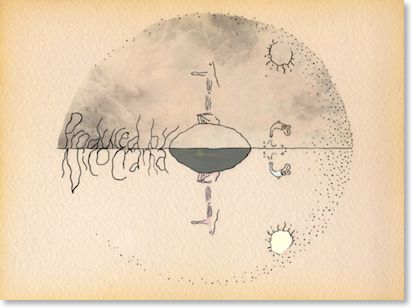 ‘Spiegeleiland’ is a short and stylized animation film, which uses one scene and one perspective only.
We watch a castaway on an island and his reflection. The castaway is visited by a female companion and rescued by a ship. Or is he? The reflection tells another tale…
This simple story is told without dialogue and with the greatest economy. Like ‘Ei om zeep’ (The Killing of an Egg’) and ‘Het treinhuisje’ (Home on the Rails) we watch a single tableau. In ‘Spiegeleiland’ Driessen takes this format even further, limiting his action to a circle with only a tiny island within.
The result is without doubt one of Driessen’s strongest and most poetic films. Driessen would reuse this method of parallel depiction of reality and fantasy to a great effect in the tragic ‘The Boy Who Saw the Iceberg’ from 2000.
Watch ‘Spiegeleiland’ yourself and tell me what you think:
‘Spiegeleiland’ is available on the DVD ‘The Dutch Films of Paul Driessen’
Director: Paul Driessen
Release Date: 1982
Rating: ★★★★
Review:
 ‘Oh What a Knight’ is a short and funny gag film in which a knight rescues a princess from a dragon, a cyclope, a snake and a villain, only to watch her fall in love with his empty shiny armor.
Driessen’s unique animation style is most present in this cartoon. For example, the knight has an odd way of falling to pieces and reassembling himself. ‘Oh What a Knight’ is one of Driessen’s funniest films. In fact it would not be surpassed until his ‘3 Misses’ from 1998.
Watch ‘Oh What a Knight’ yourself and tell me what you think:
‘Oh What a Knight’ is avaiable on the DVD ‘The Dutch Films of Paul Driessen’
Director: Georges Schwizgebel
Release Date: 1992
Rating: ★★★★½
Review:
 ‘La course à l’abîme’ is a depiction of the final ride into hell from ‘La Damnation de Faust’ (1846) by Hector Berlioz.
The film consists of a very associative series of images, tied together by the two riders, Faust & Méphistophélès. Like in Schwizgebel’s earlier film ‘78 tours‘ (1985) we watch images changing perspective and morphing into each other, to stunning effects. All builds up to a spectacular finale, in which we see all the animation within one frame.
‘La course à l’abîme’is the first film showing Schwizgebel’s interest in classic European stories. It’s a clear precursor of later films, like ‘L’année du daim’ (1995), ‘La jeune fille et les nuages’ (2000) and ‘L’homme sans ombre’ (2004), in which he uses his stunning techniques for narrative purposes.
Watch ‘La course à l’abîme’ yourself and tell me what you think:
‘La course à l’abîme’ is available on the DVD ‘Les Peintures animées de Georges Schwizgebel’
Director: Georges Schwizgebel
Release Date: 1985
Rating: ★★★★½
Review:
 In ’78 Tours’ Schwizgebel uses his technique of rotating perspectives and metamorphosis, which he had developed in films like ‘Perspectives‘ (1975) to stunning effects.
’78 Tours’ is a short film set to accordion music, which uses circles as a leitmotiv, as well as coffee and a park. The film is completely painted, using deep colors and stark shadows. Schwizgebel’s unique virtuoso style really comes to a full bloom in this film, which must be regarded as his first masterpiece.
Watch ‘78 Tours’ yourself and tell me what you think:
’78 Tours’ is available on the DVD ‘Les Peintures animées de Georges Schwizgebel’
Director: Georges Schwizgebel
Release Date: 1982
Rating: ★★★★
Review:
 ‘Le ravissement de Frank N. Stein’ starts with very abstract images, which resolve into Frankenstein’s laboratory as depicted in the film from 1931.
After 1’40 we become the monster itself, walking through endless chambers and corridors and staircases in an almost computer animation-like long sequence of perspective animation. The rooms, initially filled with abstract shapes, become more and more complex. They contain more and more windows and human forms, and finally moving human forms, ending with multiple copies of the monster’s bride. In the end we watch the monster itself, in his depiction by Boris Karloff. he smiles at his bride, but she only screams…
This film, which is set to very nervous electronic music, is a very impressive study of perspective: we really feel we are walking. The film has a repetitive and dreamlike quality, which is enhanced by its surreal settings, reminiscent of paintings by Giorgio de Chirico.
Watch ‘Le ravissement de Frank N. Stein’ yourself and tell me what you think:
‘Le ravissement de Frank N. Stein’ is available on the DVD ‘Les Peintures animées de Georges Schwizgebel’
Director: Erica Russell
Release Date: 1989
Rating: ★★★★★
Review:
 ‘Feet of song’ is a non-narrative film about dance and Russell’s solo debut film.
It uses semi-abstract human forms, akin to those by painter Kazimir Malevich. The human forms feel both futuristic and African at the same time, and have a timeless appeal. The images get more and more abstract as the film progresses, but the sense of dance is never lost.
‘Feet of Song’ features African-sounding world music by Charlie Hart, but the music is in service to the beautiful images, not the other way round. Made for Channel 4, ‘Feet of Song’ is a prime testimony of Erica Russel’s unique style, clearly influenced by Oskar Fischinger, but firmly rooted in both her South African roots and dancer background.
Unfortunately, Russell made only two other independent films, ‘Triangle‘ in 1994, and ‘Soma’ in 2001, devoting most of her time to commissioned work (her images for example appear in the Madonna video-clip ‘Dear Jessie’ from 1989).
Watch ‘Feet of Song’ yourself and tell me what you think:
‘Feet of Song’ is available on the DVD inside the book ‘Animation Now!’
Compiler: Marv Newland
Release Date: 1985
Rating: ★★★★
Review:
 Anijam is a compilation cartoon, organized by Marv Newland, and animated by 22 different animators.
The short features a strange yellow fellow on high heels called Foska. All scenes start and end with this character, and most of the animators feature him in their own scenes. The result is a dazzling string of totally unrelated scenes, some funny, some weird and some totally abstract.
A few animators bring their own typical style strongly into their scenes, like Zdenko Gašparović, Sally Cruikshank and Paul Driessen, others turn to abstract patterns, like Kathy Rose, Kazurai Furuya, and Per Lygum. The latter’s contribution is an early computer animation, featuring geometrical forms only. Highlight, however, is Frank Nissen’s contribution, in which a swimming octopus transforms into a naked woman.
The complete film is an ode to the imagination of the animators and the endless possibilities of the medium.
Watch ‘Anijam’ yourself and tell me what you think:
‘Anijam’ is available on the DVD inside the book ‘Animation Now!’
Director: Jan Švankmajer
Release Date: 1971
Rating: ★★½
Review:
 Animated sketches of drawings by Leonardo da Vinci are alternated with excerpts from stock live action films.
Atypically for Jan Švankmajer, this film uses pencil animation only (except for a short stop motion segment of a pencil drawing a hand). The animation of Leonardo da Vinci’s drawings is both stunning and very convincing. Unfortunately, the nonsensical interruptions with stock film wear the film down, rendering a boring film with an unclear message.
Nevertheless, the Czech communist authorities responded negatively to Švankmajer’s unauthorized post-production of this film, with the incorporation of images related to daily life – presuming a hidden political message. So after ‘Leonardo’s Diary’ Švankmajer was forced to lay down his work for seven years. Only in 1979 he would make the start of a second career, in which he would produce his best films. However, Švankmajer would never return to drawn animation, and ‘Leonardo’s Diary’ remains the only testimony of his skills in this form of art.
Watch ‘Leonardo’s Diary’ yourself and tell me what you think:
‘Leonardo’s Diary’ is available on the DVD ‘Jan Svankmajer – The Complete Short Films’
Director: Jan Švankmajer
Release Date: 1971
Rating: ★★★★★ ♕
Review:
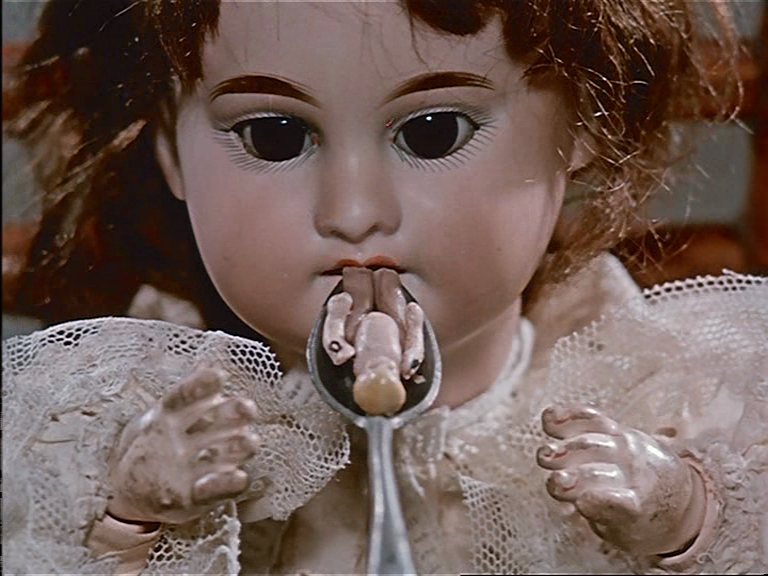 ‘Jabberwocky’ has little to do with the poem from Lewis Carroll’s ‘Through The Looking Glass’, although we hear it being recited by a little girl during the opening sequence.
The film it is Švankmajer’s surrealistic masterpiece on the loss of childhood, depicted by several episodes, which are separated by a box of bricks, a labyrinth and a black cat crushing the box of bricks.
During the episodes we are treated on extremely surrealistic images of very active inanimate objects in a child’s room. First we watch a boy’s suit growing a forest in his room, defying both time and authority (symbolized by the portrait in the room). Then we watch large cannibalistic dolls grinding, ironing and eating little dolls, a china baby in a cradle destroying two tin armies, a pocket knife performing acrobatic tricks until it makes an ill-fated fall and stabs itself, and finally, schoolbooks producing paper boats and planes, which fly out of the window, while the father’s portrait produces pictures of beautiful women.
This last episode shows the child’s changing interests. In the end the labyrinth is solved, the cat – the only living thing in the entire film – is caged, and the boy’s suit is replaced by an adult one. The boy is free from his parent, but the days of imagination are over, the fantasy is gone.
For this film Švankmajer makes excellent use of 19th century imagery (sailor suit, vintage dolls and toys) to create a completely unique world. It’s the film maker’s most typical film, partly expanding on ideas explored in ‘Historia Naturae, Suita‘ (1967), and showing his fascination with fantasy, cruelty and decay, which roam freely in the child’s self-contained room. The rather morbid behavior of the everyday objects is quite unsettling and it shows how a child’s fantasy can be both imaginative and cruel.
‘Jabberwocky’ is without doubt one of Švankmajer’s most powerful films. He would only top it eleven years later, with ‘Dimensions of a Dialogue‘ (1982). Švankmajer would explore the imagination of children further in the moving ‘Down to the Cellar‘ (1983), and in his unique adaptation of Lewis Carroll’s most famous work ‘Alice‘ (1987).
Watch ‘Jabberwocky’ yourself and tell me what you think:
‘Jabberwocky’ is available on the DVD ‘Jan Svankmajer – The Complete Short Films’
Director: Jan Švankmajer
Release Date: 1970
Rating: ★★★
Review:
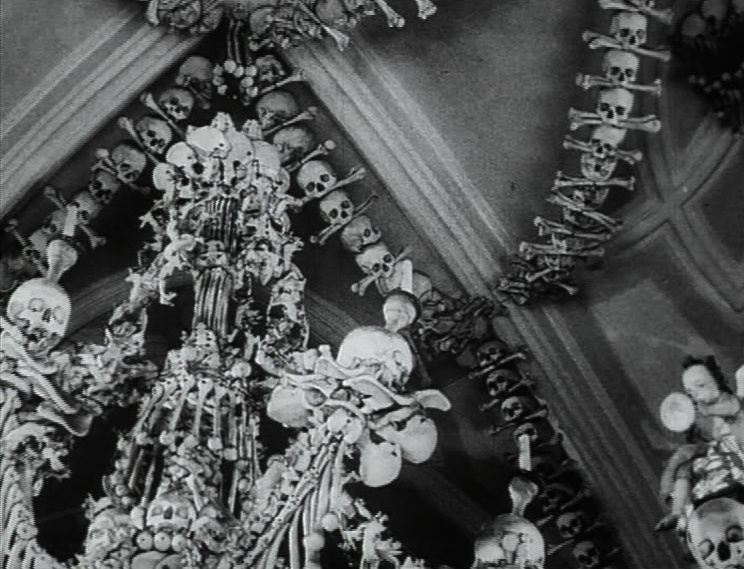 ‘The Ossuary’ is a commissioned documentary film about a Czech chapel in Sedlec, which is decorated with thousands of bones and skulls of victims of the 1318 plague and of the Hussite wars of 1421.
Two versions of this film exists: one with a soundtrack of a rather mundane guide guiding a group of children, in which she repeatedly warns not to touch the bones on a penalty of fifty crowns. Her tour is mixed with the uncanny sound of a rattling bicycle. For unclear reasons this soundtrack was considered subversive and forbidden by the Czechoslowakian regime. Therefore a second version was made using a jazz soundtrack.
In both versions the soundtrack conflicts with the morbid images, which are composed in a rhythmical way that even appeals when watched silently. The film contains no animation, but is full of Švankmajer’s idiosyncratic cinematography.
Watch ‘The Ossuary’ yourself and tell me what you think:
‘The Ossuary’ is available on the DVD ‘Jan Svankmajer – The Complete Short Films’
Director: Raoul Servais
Release Date:1968
Rating: ★★★★★
Review:
 In a sinister harbor, where cranes behave like giant dinosaurs and where pterodactyli fly a young flute player brings a mermaid to life. Unfortunately, the mermaid is captured by one of the cranes and dropped to death.
‘Sirene’ is a beautiful, surrealistic film with its own creepy and somber atmosphere. Luckily, there’s also space for some dark humor when the authorities arrest an innocent fisherman and when a zoo and a hospital argue about the mermaid’s body. ‘Sirene’ definitely among Servais’s best films, arguably only equaled by ‘To Speak or not to Speak (1970) and ‘Harpya‘.
Watch ‘Sirene’ yourself and tell me what you think:
Director: Jan Švankmajer
Release Date: 1969
Rating: ★★★
Review:
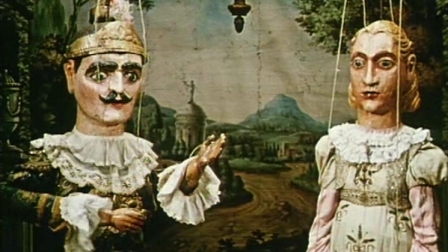 In ‘Don Juan’ Švankmajer’s retells a classic tale from the marionette theater.
The story unfolds in half an hour: Don Juan is a rogue who kills his father, the father of his beloved and his own brother, only to be taken into the depths off hell.
Oddly enough the film is enacted by people dressed as marionettes and behaving accordingly. This allows the marionettes to leave the theater and to perform in the real world, which is strangely intermingled with the marionette theater. This blend of the real and the artificial gives the film a weird and disturbing atmosphere. Švankmajer would reuse and improve upon this mix in his masterpiece, the feature film ‘Faust‘ (1994).
This film contains hardly any animation, and may therefore not be included in this blog. However, it takes a central part in Švankmajer’s oeuvre, who has always blended several different techniques into his works. It’s best to review his oeuvre as a whole, being animated or not.
Watch ‘Don Šajn’ yourself and tell me what you think:
‘Don Šajn’ is available on the DVD ‘Jan Svankmajer – The Complete Short Films’
Director: Jan Švankmajer
Release Date: 1969
Rating: ★★
Review:
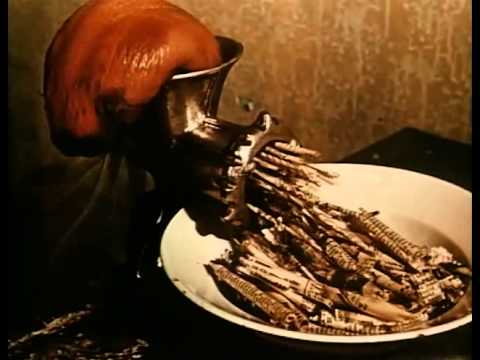 ‘A Quiet Week in the House’ is the last film in a series of four involving people facing surreal settings, which Švankmajer made in 1968-1969.
in this film a fugitive seeks shelter in an abandoned house. Every day he digs a hole in one of the doors of the corridor in which he sleeps. Every day he looks through the hole to watch weird surrealistic images of inanimate things behaving strangely. After a week he sets up a device to blow up all doors.
The live action footage is shot in black-and-white, and is accompanied by the sound of a camera. The surrealistic images, on the other hand, are shot in color and completely silent. Unfortunately, the film is too long, and it fails to be as impressive as related films like ‘The flat’ (1968) or ‘Jabberwocky‘ (1971), being neither completely disturbing nor very entertaining. ‘A Quiet Week in the House’ remains one of Švankmajer’s rare weak films.
Watch ‘A Quiet Week in the House’ yourself and tell me what you think:
http://www.dailymotion.com/video/xpfbvj_a-quiet-week-in-the-house-de-jan-svankmajer_shortfilms
‘A Quiet Week in the House’ is available on the DVD ‘Jan Svankmajer – The Complete Short Films’


 Dr. Grob's Animation Review