
You are currently browsing the category archive for the ‘Independent film makers’ category.
Director: Harry S. Palmer
Release Date: 1916
Rating: ★★
 ‘Professor Bonehead Is Shipwrecked’ is a short animator Harry S. Palmer made for Mutual-Gaumont. Little can be found about this artist, except that his most well-known series was called ‘Keeping up with the Joneses’, which he had to quit in 1916 because J.R. Bray sued him for infringement of his cel patent.
It’s not even clear whether Professor Bonehead was the star of a series or not. In any case this film is the only one I can find. Perhaps it was a one-shot attempt. I wouldn’t be surprised, because so much is happening in this brief rather stream-of-consciousness-like film the result is hard to comprehend.
The film starts with a drawing of Professor Bonehead out of an inkwell. Then we watch him riding the waves, and being washed ashore carrying a huge egg, which hatches into a miniature duck-billed man. The duck-billed man chases Bonehead, who makes a jump to escape, right into the cook pot of a cannibal tribe, etc. and so on. The film ends with Bonehead and the duck-billed man making a car out of a log.
The film uses stop-motion, cut-out and full animation, but is completely devoid of timing. Some of the animation is remarkably good, however. Especially the rolling waves during the opening scene are very impressive. Nevertheless, the film is too random to be truly enjoyable, and it clearly didn’t secure Palmer’s position in the animation canon.
Watch ‘Professor Bonehead Is Shipwrecked’ yourself and tell me what you think:
‘Professor Bonehead Is Shipwrecked’ is available on the Thunderbean DVD ‘Uncensored Animation 2: Cannibals!’
Director: Émile Cohl
Release Date: 1916
Rating: ★★★
 ‘Les exploits de Farfadet’ is a very short cut-out animation film, not even clocking two minutes.
In this short a man dreams he loses his hat at sea, drowns and gets swallowed by a huge fish.
The atmosphere of this film is very surreal and, indeed, dream-like, with a clear feel of unreality, and an illogical flow of events. The man speaks in text balloons , and in the end he blames his bad dream on rum, very much like Winsor McCay’s rarebit fiends.
Watch ‘Les exploits de Farfadet’ yourself and tell me what you think:
‘Les exploits de Farfadet’ is available on the DVD-set ‘Émile Cohl – L’agitateur aux mille images’
Director: Émile Cohl
Release Date: 1914
Rating: ★★★★
 ‘L’avenir dévoilé par les lignes de pied’ is a short comedy in which a fortune teller, Mrs. Sarafine, decides she should marry.
At that point Mister le vicomte Kelly d’Yeaut enters (his name’s pronounced as ‘quelle idiot’ meaning ‘what an idiot’). The viscount wants to know if he should marry, and if yes, to whom. Mrs. Sarafine makes a print of his hand using photographic paper, puts it in a box, and asks Mr. d’Yeaut to take a look inside.
What follows is some pen animation in Cohl’s idiosyncratic stream-of-consciousness-like style. We watch the hand poking in a nose and in one’s eye, and morphing into a man that melts and burns away. Mrs. Sarafine concludes the lines of the hand inconclusive, and makes a print of Mr. d’Yeaut’s foot. The second piece of animation shows images of loving couples, interchanged by decorative forms, although one of the last images shows a beautiful woman changing into an old hag.
Mrs. Sarafine explains those images to Mr. d’Yeaut that he’ll be happy with the first woman he’ll speak to, which is, of course, herself. In the end the two embrace.
Cohl’s animation is rather poor in this short, but his style of morphing and association remains mesmerizing. The live action scenes are entertaining, too, with subtle comedy revealing the two distinct characters by rather small gestures.
Watch ‘L’avenir dévoilé par les lignes de pied’ yourself and tell me what you think:
‘L’avenir dévoilé par les lignes de pied’ is available on the DVD-set ‘Émile Cohl – L’agitateur aux mille images’
Director: Gene Deitch
Release Date: September 1960
Rating: ★★★★
 ‘Munro’ is a charming little film which understandably won an academy award.
Jules Feiffer wrote the story based on a short story of his own. Howard Morris narrates the story and does all the voices of the cartoon except Munro’s, which is done by Deitch’s son Seth. The story tells about Munro, a little boy of four, who is drafted and who has a hard time convincing all the officials he’s only four.
Despite its fully American setting, director Gene Deitch made this film in Czechoslovakia. When one of his clients of his commercial work, Rembrandt films, promised to fund the film Deitch moved his production company to Prague, home of Rembrandt films. Deitch planned only to stay there for a few days, but on meeting his future second wife, he stayed there for the rest of his life.
Deitch uses very pleasant cartoon modern designs and monochrome painted backgrounds which fit the story very well. The Czech animators do an excellent job at the simple and limited, yet effective animation. There’s an undercurrent of anti-militarism in the cartoon that’s never played out in the open. The most critical scene is when the general explains why they’re fighting: “our side is on the fave of God, and the other side isn’t”.
But more importantly, the film is about how so-called authorities abuse and bully people, making them even believe themselves they are something they’re not. In this respect, the story of Munro is very akin to Frank Tashlin’s children’s book ‘The Bear That Wasn’t (1946), which was turned into an animated short itself in 1967.
Watch ‘Munro’ yourself and tell me what you think:
As far as I know ‘Munro’ has not yet been released on DVD or Blu-Ray‘Munro’ is available on the DVD ‘Rembrandt Films’ Greatest Hits’ (thank you, Jonathan Wilson!)
Director: Jiří Brdečka
Release Date: 1963
Rating: ★★★½
 In ‘Spatne namalovana slepice (which translates as ‘Badly Drawn Hens’)’ we watch three kids in a school class: a dreamy boy, a little girl who sits next to him, and a nerdy boy with glasses.
When the teacher orders the class to reproduce an intricate drawing of a chicken, the bespectacled boy reproduces the poster with photographic accuracy. The dreamy boy, however, makes a semi-abstract interpretation of the subject and the teacher reprimands the little boy. But then, at night, his colorful drawing comes to life…
This film is a clear ode to fantasy and celebrates the breaking of rules. This is a subject that’s often encountered in European animation films from the 1950s and 1960s, and which would have special appeal in the Eastern Bloc, with its repressive communist regimes.
Brdečka uses an idiosyncratic angular style, clearly influenced by the cartoon modern movement of the 1950s, but especially akin to contemporary developments at Zagreb film in Yugoslavia. His film uses vocal sounds, but no dialogue, and relies mostly on visual gags. However, there’s one great scene in which a famed ornithologist called Dr. Vogelbird repeatedly listens to a tape recorder saying his own name.
In the end, the film is a little too inconsistent and too wandering to become a classic, but its sympathetic story and charming drawing style make the short a nice watch.
Watch ‘Spatne namalovana slepice’ yourself and tell me what you think:
‘Spatne namalovana slepice’ is available on the DVD-box ‘Annecy – Le coffret du 50e Anniversaire’
Director: George Dunning
Release Date: 1962
Rating: ★★
 ‘The Flying Man’ is a very short absurdist film in which a man drops his coat to take a swim in mid air. Another man with a dog drops by, tries the same thing, but with his coat on, to no avail.
Dunning uses a single tableau and no perspective. On his white canvas he paints the three characters (two men and dog) with bold paint strokes. Dunning’s characters consist of loose joints, similar to characters by John Hubley. Unfortunately, this design makes it rather hard to decipher the action, especially when both men are on the ground.
The action is accompanied by short but effective clarinet music by Ron Goodwin.
Watch ‘The Flying Man’ yourself and tell me what you think:
‘The Flying Man’ is available on the DVD-box ‘Annecy – Le coffret du 50e Anniversaire’
Director: Břetislav Pojar
Release Date: 1959
Rating: ★★½
 ‘Lev a písnicka’ is a Czech puppet film in the tradition of Jiří Trnka.
The short tells about a bandoneon-playing actor who travels through the desert, but who finds a resting place at an abandoned ruin. There he performs before a small crowd of animals (two lizards, a fennec, and an antelope). But then a ferocious lion enters the scene…
In ‘Lev a písnicka’ Pojar tells a surprising story. Moreover, he uses a small but effective decor, and some spectacular cinematography. He shows he’s a clear master of animation, making the inner feelings of expressionless puppets come to life by movement only. Especially the animation of the lizards is well done. But the film’s animation highlight goes to the scene that shows the lion’s despair after he has swallowed the bandoneon, which keeps on playing in his stomach, robbing him from his stealth, and thus of a welcome meal.
Nevertheless, the film is hampered by a slow speed, and several scenes are unessential to the story. In the end Pojar’s film is too long and too unfocused to become a real classic.
Watch ‘Lev a písnicka’ yourself and tell me what you think:
‘Lev a písnicka’ is available on the DVD-box ‘Annecy – Le coffret du 50e Anniversaire’
Director: John Hubley
Release Date: 1959
Rating: ★★★½
Review:
 With ‘Moonbird’ John and Faith Hubley entered the field of animated documentary.
The film is an illustration of a nightly fantasy adventure by their own two little boys Mark and Humpy (ca. five and three). The main narrative of their fantasy is that they try to catch a large bird, using candy for a bait. But being two little boys, their story meanders a lot, and is interrupted by random singing, and even crying.
John and Faith Hubley illustrated this unedited piece of recorded dialogue as if the boys’ adventure were real. What’s more, they added subtle action that is not in the soundtrack. For example, the Moonbird itself is seen much earlier than heard.
The background art is pretty avant-garde, rendered in bold black, blue and pink brush strokes. These images verge on the abstract, but manage to evoke a nightly garden, nonetheless. Animators Bobe Cannon and Ed Smith, however, animated the two boys in classic Disney style, even though they are rendered in monochromes and with the pencil lines still visible.
‘Moonbird’ is a charming little film, and an ode to children’s fantasy. It was immediately recognized as something new, and it won the Academy Award for best animated short.
Later, the Hubley’s made more films based on unedited dialogue, e.g. ‘The Hole’ (1962), ‘The Hat’ (1964) and ‘Windy Day’ (1968), the last film starring their two daughters. In the late 1970s the fledgling Aardman studio followed suit with their Animated conversations series (e.g. ‘Down & Out‘ and ‘Confessions of a Foyer Girl‘).
Watch ‘Moonbird’ yourself and tell me what you think:
‘Moonbird’ is available on the DVD’s ‘Selected Films of John and Faith Hubley 1956-1973’ within The Believer Magazine March/April 2014 and ‘The Hubley Collection Volume 2’
Director: John Hubley
Release Date: 1958
Rating: ★★★★
Review:
 By the end of the 1950s John Hubley had survived the McCarthy era that had hit him hard*, and with his Storyboard studio he could finally make the films he really wanted to.
‘The Tender Game’ is a wonderful example of Hubley’s great and gentle art. The short is a delightful little wordless film about love set to the song ‘Tenderly’, sung by Ella Fitzgerald, and accompanied by the Oscar Peterson trio. The cartoon’s setting is a city, vaguely reminiscent of Paris. Here a flower girl falls in love with a street cleaner.
The designs of this cartoon are very bold: for example, the two main protagonists don’t have solid bodies, but consist of loose parts, and sometimes it seems as if they’ve walked straight from a Pablo Picasso painting. Both their designs and that of the backgrounds have a strong painting quality, being rendered in broad brush strokes, and verging on the abstract.
The poetic artwork contrasts a little with the animation, done e.g. by fellow-UPA alumnus Bobe Cannon, which is still clearly rooted in the comic tradition. Highlight is the interior scene, in which the two lovers reluctantly try to court each other. This is a marvelous little piece of character animation, full of telling expressions and poses.
Watch ‘The Tender Game’ yourself and tell me what you think:
‘The Tender Game’ is available on the DVD’s ‘Selected Films of John and Faith Hubley 1956-1973’ within The Believer Magazine March/April 2014 and ‘Art and Jazz in Animation’
* for a full account on how McCarthyism affected the animation world see Adam Abraham’s excellent book ‘When Magoo Flew – The Rise and Fall of Animation Studio UPA’.
Directors: Norman McLaren & Evelyn Lambart
Release Date: 1960
Rating: ★★★½
Review:

‘Lines Vertical’ is one of the most extreme films Norman McLaren ever made.
Together with collaborator Evelyn Lambart he manages to make a film consisting of vertical lines only, made directly on film. The whole film consists of white vertical lines moving across the screen against monochrome backgrounds. The film starts with one line, then two, then three, and so on, until ca. twenty lines fill the screen in a constant ballet.
At one point the lines get a three-dimensional quality, resembling rotating columns. The movements of the lines follow Maurice Blackburn’s serene score, which is clearly inspired by Chinese classical music. It’s a testimony of the genius of both McLaren & Lambart that they can even pull off such a boring concept, and turn it into a successful film, even if it’s not the most engaging one.
Watch ‘Lines Vertical’ yourself and tell me what you think:
‘Lines Vertical’ is available on the DVD-box set ‘Norman McLaren – The Master’s Edition’
Director: Norman McLaren
Release Date: 1959
Rating: ★★★½
Review:
 In ‘Short and Suite’ a jazzy score for clarinet, piano and double bass by E. Rathburn is interpreted by dots, shapes and lines, scratched directly on film.
The film knows no narrative, and is highly abstract, but at one point one can clearly see flowers and even human shapes. The film consists of several episodes, following more or less frantic parts within the score. McLaren’s images are very well-timed to the music, and the shapes get extra dimensions by the shadows they cast on the black and monochrome backgrounds.
‘Short and Suite’ may not be among McLaren’s best, it’s still a nice example of his great art.
Watch ‘Short and Suite’ yourself and tell me what you think:
‘Short and Suite’ is available on the DVD-box set ‘Norman McLaren – The Master’s Edition’
Director: Norman McLaren
Release Date: 1959
Rating: ★★★
Review:
 ‘Serenal’ is a film made directly on film and set to a Caribean score by the Grand Cunucaya String Orchestra Trinidad.
The images consist mostly of purely abstract shapes flashing on a black screen. The shapes are very rough, but surely colorful (the film was hand-colored), and the end result is a nice piece of abstract expressionism, if still one of McLaren’s less engaging films.
Watch ‘Serenal’ yourself and tell me what you think:
‘Serenal’ is available on the DVD-box set ‘Norman McLaren – The Master’s Edition’
Director: Norman McLaren
Release Date: 1959
Rating: ★★★★
Review:
 ‘Mail Early for Christmas’ is a short commercial, the message of which is in the title.
Set to a rather loud dixieland score McLaren has put his expressionistic and frantic direct-on-film style into action to make this message come across. The film lasts only 39 seconds and was made in chronological order, without any cuts. The film thus has a very spontaneous feel and features all kinds of abstract shapes splashing from the screen. In between we can see the words ‘Mail early for Xmas’ appearing and disappearing again.
It’s a wonder that such avant-garde film making was used for a message directed at such a general public.
Watch ‘Mail Early for Christmas’ yourself and tell me what you think:
‘Mail Early for Christmas’ is available on the DVD-box set ‘Norman McLaren – The Master’s Edition’
Director: Norman McLaren
Release Date: 1958
Rating: ★★★★
Review:
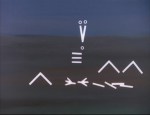 ‘Le Merle’ is based on a French-Canadian addition song, in which a blackbird loses body parts, but regains them manyfold.
Sung by le trio lyrique, this spirited song is illustrated by cut-out animation of the simplest shapes, which together form the bird, which hops and flies around. However, during the film the bird undergoes constant metamorphosis, forever changing into pure abstract patterns and back again, and losing and gaining body parts, following the song closely. All the action takes place against a simple surreal, but long vertical background, which suggests that during the song the bird moves skyward, past the clouds and into a starry night. There’s also a mind-blowing scene in which the bird travels through the starry space.
‘Le Merle’ is as mesmerizing as it is pure fun. The film takes the cartoon modern style to the max in its elementary designs, and must be counted among McLaren’s masterpieces.
Watch ‘Le Merle’ yourself and tell me what you think:
‘Le Merle’ is available on the DVD-box set ‘Norman McLaren – The Master’s Edition’
Director: Lucjan Dembiński
Release Date: 1959
Rating: ★★
Review:
 ‘Pyza’ is based on children’s books by Polish author Hanna Januszewska (1905-1980).
‘Pyza’ starts with a mother making dumplings for her numerous children. One of the dumplings changes into a girl, who soon goes for a walk. Outside she meets a rabbit, and the two become friends and have some little adventures together.
‘Pyza’ features no dialogue and uses the simplest puppet designs. This children’s film looks attractive, but emotion is more suggested than felt, and the animation is rather lifeless and stiff. Moreover, Dembiński’s timing is pretty relaxed, and the film balances on the verge of boring. In the end, the directionless story and the uninspired animation render a film too poor to enjoy.
Watch ‘Pyza’ yourself and tell me what you think:
‘Pyza’ is available on the DVD set ‘Anthology of Polish Children’s Animation’
Directors: Jerzy Zitman & Lechosław Marszałek
Release Date: 1959
Rating: ★★½
Review:
 ‘Bulandra i diabel’ retells a story by Polish writer Gustaw Morcinek (1891-1963).
Unfortunately, the story is very hard to follow, not to say incomprehensible. It doesn’t help that there’s no dialogue (when the protagonists talk, you hear some sped up tape sounds). At least the narrative features a miner, a goat, a king and a devil.
Zitman and Marszałek have designed their film like a picture book, and all action takes place in absolute flat space. Neither the background art nor the cut-out figures get any feeling of depth. The background art is neatly designed, combining a naive folk-like quality with a stark cartoon modern design. The cut-out figures however, are animated rather poorly, and hardly display any sense of emotion. The result is rather disappointing.
In fact, ‘Bulandra i diabel’ is most interesting for featuring music by avant-garde composer Krzysztof Penderecki. During this time Penderecki was already experimenting with stochastic techniques and new timbres, but none of that in this film. Here he sticks to a way more accessible rather gritty Béla Bartók-like mid-century modernism.
Watch ‘Bulandra i diabel’ yourself and tell me what you think:
‘Bulandra i diabel’ is available on the DVD set ‘Anthology of Polish Children’s Animation’
Director: Władysław Nehrebecki
Release Date: 1958
Rating: ★★★★★
Review:
 ‘Myszka i kotek’ is a very beautiful example of the cartoon modern style of the 1950s.
The film is a very playful tale of a real mouse chased by a line drawing kitten, which has jumped from a postcard. During the chase the cat repeatedly dissolves into a line only, and the animators play with the fact that the animal is outline only.
Both cat and mouse are pleasantly designed and very well animated, but it’s the gorgeous background art that draws the main attention. Every single panel is a beauty, depicting a nightly room in bold designs, verging on the abstract. The main background color is black, and the light blue outline of the kitten reads very well against the background art.
In short, ‘Myszka i kotek’ is a Polish little gem that deserves to be better known.
Watch ‘Myszka i kotek’ yourself and tell me what you think:
‘Myszka i kotek’ is available on the DVD set ‘Anthology of Polish Children’s Animation’
Director: Władysław Starewicz
Release Date: 1958
Stars: Patapouf
Rating: ★★
Review:
 Władysław Starewicz was a stop motion pioneer, who had made some very important films in the 1910s, 1920s and 1930s. ‘Winter Carousel’ was the last film he completed, and the short’s style is practically the same as that of his films of forty years earlier: the film is essentially silent, and populated by various animals, whose rather gritty look is typical for the Polish-Russian filmmaker.
‘Winter Carousel’ stars brown bear Patapouf and his rather mischievous friend Rabbit, who had been introduced in Starewicz previous film, ‘Nez au Vent’ (Nose in the Wind, 1956). In ‘Winter Carousel’ the duo encounters a jolly snowman, who apparently is father Winter, and a female polar bear. Both Patapouf and Rabbit are clearly interested in the female creature, and the three go skating together, playing blind man’s buff, and riding a Christmas tree carousel. This part of the film is a delightful sequence: Starewicz’s arctic backgrounds are pretty evoking, there’s a unique sense of poetry in the images, and his suggestion of speed during the skating and carousel scenes is impressive.
But then suddenly Father Winter starts to melt and reveals a female wooden creature (clearly a goddess of spring) underneath. Thus, strangely, the last five minutes of the film take place in spring. Unfortunately, from that moment all suggestions of narrative are thrown out of the window, and things just happen on the screen. We watch Patapouf en Rabbit gamble with some dice, watching a performance by a grasshopper and drinking in a long, plotless and completely superfluous kind of epilogue. None of theses spring images matches the winter scenes, and in the end the film is too uneven and too rambling to be a lasting work.
The animation is at times quite good, especially in Rabbit’s and Patapouf’s little gestures, but the complete result is unfortunately rather boring. In fact, this product, already old-fashioned and hopelessly dated by its release, is a rather sad ending to Starewicz’s great career. With this film he only managed to proof that he was a relic from another era.
Watch ‘Winter Carousel’ yourself and tell me what you think:
‘Winter Carousel’ is available on the DVD ‘The Cameraman’s Revenge & other Fantastic Tales’
Director: Norman McLaren
Release Date: 1956
Rating: ★★★★
Review:
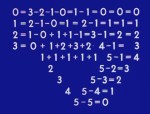 With ‘Rythmetic’ McLaren attempted to make arithmetic more fun for children.
Indeed, the complete film consists of additions and subtractions of numbers up to 8. The white numbers slowly fill the blue screen, accompanied by McLaren’s trademark rhythmical electronic sounds, which he made by scratching directly on film.
The complete film may be a little dry, it is nevertheless surprisingly playful, especially given the fact one watches only one blue screen filling with numbers and equations. McLaren manages to evoke something human in those numbers, through subtle animation. For example, in the end some zeros start fooling around, disrupting the equations, much to the distress of some equation marks who repeatedly try to get the zeros back in line. This finale in itself is so much fun to watch, it alone makes watching the film worthwhile.
Watch ‘Rythmetic’ yourself and tell me what you think:
‘Rythmetic’ is available on the DVD-box ‘Norman McLaren – The Master’s Edition’
Directors: Włodzimierz Haupe & Halina Bielińska
Release Date: 1958
Rating: ★★★½
Review:
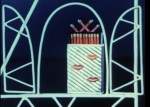
‘The Changing of the Guard’ is a stop motion film that tells a story with the simplest of means.
The background consists of highly graphical wiry outlines of buildings set in an empty stage. The ‘actors’ are matchboxes. We watch them marching, while one of them, a night guard, falls in love with a female matchbox in a window (the matchbox is recognizable as a woman, because of the three lips painted on its front). When the two meet at night, they catch flame, which devours the complete regiment. So, the next day the civilians put up a ‘no smoking’ sign.
Haupe’s and Bielińska’s stop motion is very primitive, yet effective, and their minimalist approach shows how little one needs to tell a communicating and resonating story. Admittedly, their story is not too interesting, verging on the brink of a farce, but the elegant designs and effective animation make it a short fun to watch.
Watch ‘Zmiana warty’ yourself and tell me what you think:
‘Zmiana warty’ is available on the DVD-set ‘Anthology of Polish Animated Film’


 Dr. Grob's Animation Review