
You are currently browsing the category archive for the ‘★★★½’ category.
Director: Jack Kinney
Release Date: December 4, 1942
Stars: Goofy
Rating: ★★★½
Review:

‘How to fish’ kicks off nonsensically when the narrator explains how astrology gives ‘man’ (Goofy) an urge to fish.
The cartoon consists of blackout gags involving various types of fishing, like angling and lake fishing. In the end Goofy manages to capture one fish, which turns out to be his own outboard motor.
‘How to Fish’ is one of Goofy’s less inspired sports cartoons, even though it’s pretty enjoyable. It is the first Goofy short to use oil background paintings. It contains one discontinuity incident: when he fishes himself into a tree, he shortly wears his socks again.
Watch ‘How To Fish’ yourself and tell me what you think:
This is Goofy cartoon No. 9
To the previous Goofy cartoon: How to Swim
To the next Goofy cartoon: Victory Vehicles
Director: Jack Kinney
Release Date: October 9, 1942
Stars: Goofy
Rating: ★★★½
Review:
 ‘The Olympic Champ’ is Goofy’s fourth sports cartoon. Here, Goofy demonstrates the athletic sports of the Olympics: running, hurdles, pole vault jumping, hammer drawing and the decathlon.
Goofy has particular problems with the narrator in this short: he’s almost burned by the eternal flame while the narrator pompously chatters away, and he has to try to balance on a pole, while the narrator is reciting a poem.
‘The Olympic Champ’ is not the best of Goofy’s sports cartoons, but it is enjoyable in its successful blend of blackout gags and great animation.
Watch ‘The Olympic Champ’ yourself and tell me what you think:
This is Goofy cartoon No. 7
To the previous Goofy cartoon: How to Play Baseball
To the next Goofy cartoon: How to Swim
Director: Jack King
Release Date: April 10, 1942
Stars: Donald Duck, Huey, Dewey and Louie
Rating: ★★★½
Review:
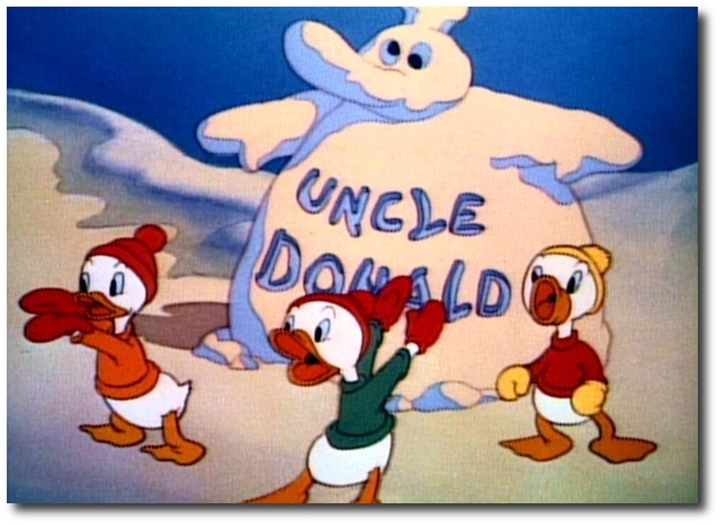 The world is covered in snow, and Donald goes for a sled ride, wearing a ridiculously broad fur overcoat.
He purposely ruins Huey, Dewey and Louie’s snowman by sledding right through it. They seek revenge and build a snowman resembling Donald around a rock. This feud leads to a snow-fight between admiral Donald on a battle ship made out of ice and his three nephews on an ice fort.
‘Donald’s Snow Fight’ is a classic Donald vs. his nephews cartoon, but the complete film is quite slow, due to Jack King’s tame directing. Despite some excellent gags, it doesn’t live up to ‘The Hockey Champ‘ (1939), the other classic winter cartoon featuring Donald and his nephews, or ‘Truant Officer Donald‘ (1941), which also features a battle between Donald and his nephews.
The short’s excellent story is by Carl Barks, who reused its theme two years later in his Donald Duck comic WDC 44-442.
Watch ‘Donald’s Snow Fight’ yourself and tell me what you think:
This is Donald Duck cartoon No. 31
To the previous Donald Duck cartoon: The Village Smithy
To the next Donald Duck cartoon: Donald Gets Drafted
Director: Jack King
Release Date: November 6, 1942
Stars: Donald Duck, Pete
Rating: ★★★½
Review:
 Sky Trooper’ is the third of six shorts dealing with Donald in the army.
The cartoon starts where ‘Donald Gets Drafted‘ ended: with Donald peeling potatoes. And like in the former cartoon Donald Duck wants to fly.
Sergeant Pete gives him a chance, letting him do some ridiculous test and sending him up to be a paratrooper. Unfortunately, Donald doesn’t want to jump and clings to Sergeant Pete. They both end up falling without a parachute but with a huge bomb in their hands. Surprisingly, they survive the fall, because in the end-shot we can see them both peeling potatoes.
‘Sky Trooper’ is surprisingly similar to the Woody Woodpecker cartoon ‘Ace in the Hole’ from five months earlier. However, the cartoon is an improvement on the former two Donald Duck army cartoons. The next ones would even be better…
Watch ‘Sky Trooper’ yourself and tell me what you think:
This is Donald Duck cartoon No. 36
To the previous Donald Duck cartoon: The Vanishing Private
To the next Donald Duck cartoon: Bellboy Donald
Directors: Aleksandr Ivanov & I. Vano
Release Date: 1941
Rating: ★★★½
Review:
 Like ‘4 Newsreels‘, ‘Fascist Boots on our Homeland’ is a so-called ‘political poster’, a short propaganda film that knows no competition in its vicious imagery.
In ‘Fascist Boots on our Homeland’ a horrific fascist pig marches on, trembling several European countries until he gets beaten by the Red Army. The film also contains a very patriotic song and rather associative imagery, including that of Russian soldiers riding horseback, a heroic image from the Russian civil war (1917-1923).
It’s interesting to compare the Soviet images of Nazis with that of American propaganda films from the same era. Whereas in American propaganda, like ‘Der Fuehrer’s Face‘ fascist leaders were caricatured and ridiculed, in the Soviet Union they were depicted as monsters and swines. The whole difference may be that the Soviet Union was invaded, while the United States were not.
Indeed, the US were less kind to the Japanese, who did stain American soil: they were all portrayed as silly, but treacherous Untermenschen, whom one could easily kill without remorse (e.g. in ‘Bugs Bunny nips the Nips’ from 1944 and the Popeye film ‘You’re a sap, Mr. Jap‘ from 1942).
Watch ‘Fascist Boots on our Homeland’ yourself and tell me what you think:
‘Fascist Boots on our Homeland’ is available on the DVD box set ‘Animated Soviet Propaganda’
Director: Clyde Geronimi
Release Date: May 22, 1942
Stars: Pluto
Rating: ★★★
Review:
 ‘The Army Mascot’ is the first of two World War Two cartoons starring Pluto (the other one being ‘Private Pluto‘ from 1943).
Pluto never gets really involved in the war, though, he only joins the army. He was the second Disney character to do so, following Donald Duck, who had been drafted only three weeks earlier, in ‘Donald Gets Drafted‘.
However, Pluto’s reasons to join the army are doubtful, to say the least: only when he sees the enormous portions of meat an army mascot gets, he wants to be one, too. He tries to replace “Gunther Goat”, mascot of the Yoo-hoo Division, but all he gets is cans. In his second attempt he tries to chew tobacco like Gunther can, to impress the soldiers. But Gunther makes Pluto swallow the whole piece, making him sick. This sequence is the highlight of the cartoon, as Pluto’s sickness is animated in the most ridiculous way.
Gunther then tries to finish his rival off by bumping Pluto into the munition depot, but it’s Gunther himself who bumps into the depot, which explodes, blasting the wicked goat up into the air, where he’s caught by a plane and carried away into the distance. Now Pluto takes Gunther’s place, and gets his steak after all.
‘The Army Mascot’ is a rather odd cartoon, where both main characters show unpleasant behavior: Pluto envy and trickery and Gunther haughtiness and wrath. Thus, ‘The Army Mascot’, although war-themed, can hardly be called a patriotic film.
Watch ‘The Army Mascot’ yourself and tell me what you think:
This is Pluto cartoon No. 6
To the previous Pluto cartoon: Pluto Junior
To the next Pluto cartoon: The Sleep Walker
Director: Władysław Starewicz
Release Date: 1913
Rating: ★★★½
Review:
 ‘The Insects’ Christmas’ is Starewicz’s next film after his masterpiece ‘The Cameraman’s Revenge‘.
Although the short uses insects again, it’s a whole different film, turning to the sweet subject of Christmas. It’s probably the first animated film about Christmas ever made.
The plot is surprisingly simple: Father Christmas climbs down a Christmas tree, awakes some insects and a frog, who are hibernating underground, and he invites them to a Christmas party. He gives them presents and they all go skiing and skating.
This film’s story cannot be compared to the mature plot of ‘The Cameraman’s revenge‘. It’s more like a child’s dream of Christmas. The film reuses puppets from ‘The Cameraman’s Revenge’ and others, and even though the animation is less engaging than in Starewicz’s earlier film, it is still of a stunning virtuosity, making the result still a delight to watch. Note, for example, the illusion of wind in the animation of Father Christmas’s coat.
Watch ‘The Insects’ Christmas’ yourself and tell me what you think:
‘The Insects’ Christmas’ is available on the DVD ‘The Cameraman’s Revenge & other Fantastic Tales’
Director: Vitold Bordzilovsky
Release Date: 1966
Rating: ★★★½
Review:
 ‘Proud Little Ship’ is a Soviet propaganda film, which is clearly directed to children.
Three little boys make a small red ship as a copy of the famous cruiser ‘The Aurora’. This little ship sails the seas and is greeted with enthusiasm among all the people of the world.
There are some mean militarists who try to destroy the little ship, but they do not succeed. These militarists are drawn extremely silly, while the rest of the people are drawn rather realistically and appear as noble and gentle. Nevertheless, these drawing styles blend surprisingly well. Moreover the design and choreography of movement is often gorgeous.
All the action is silent, while the story is told by a narrator, who provides the clearest propagandistic message of the film: “the proud little ship sailed as a messenger of a happy life, which, as spring after winter, would certainly come to all people”.
Although ‘Proud Little Ship’ is overtly propagandistic, it’s also an enjoyable and beautiful film. One almost forgets that the message is not concerning world peace, but the ‘glorious’ communist revolution…
Watch ‘Proud Little Ship’ yourself and tell me what you think:
‘Proud Little Ship’ is available on the DVD box set ‘Animated Soviet Propaganda’
Director: Hawley Pratt
Release Date: May 25, 1966
Stars: The Pink Panther, The Little Guy
Rating: ★★★½
Review:
 The little guy from ‘The Pink Phink‘ (1964) and ‘We Give Pink Stamps’ (1965) returns and this time to stay.
Luckily so, for the little guy unwillingly helped to make better Pink Panther cartoons, being the perfect foil for the panther’s antics.
In ‘The Pink Blue Print’ the little guy is a construction worker trying to build a house. He’s hindered by the Pink Panther the same way he was in ‘The Pink Phink‘, leading to nice blackout gags.
Watch ‘The Pink Blue Print’ yourself and tell me what you think:
‘The Pink Blue Print’ is available on the DVD Box set ‘The Pink Panther Cartoon Collection’
Director: Chuck Jones
Release Date: February 17, 1966
Stars: Tom & Jerry
Rating: ★★★½
Review:
 In ‘Jerry Jerry Quite Contrary’ Jerry is a somnambulist who teases Tom in his sleep, much to his own dismay.
This is a good story idea, and it leads to a wonderful scene of Jerry trying to stay awake, but also to a weak ending of Tom migrating to a distant desert and Jerry sleepwalking after him.
Two other things are noteworthy about ‘Jerry Jerry Quite Contrary’: it reuses the wire gag from Chuck Jones own classic cartoon ‘Mouse Wreckers‘ (1949), and Don Elliott’s music is even better here than in ‘Duel Personality‘.
Watch ‘Jerry Jerry Quite Contrary’ yourself and tell me what you think:
This is Tom & Jerry cartoon No. 145
To the previous Tom & Jerry cartoon: Duel Personality
To the next Tom & Jerry cartoon: Jerry-Go-Round
Director: Chuck Jones
Release Date: April 7, 1965
Stars: Tom & Jerry
Rating: ★★★½
Review:
 ‘I’m Just Wild About Jerry’ is a chase cartoon taking place in a department store. It’s Jones’ fifth Tom & Jerry chase cartoon, ending a mini-series of chase cartoons within Chuck Jones’s Tom & Jerry series.
Although not hilarious, ‘I’m Just Wild About Jerry’ is particularly inspired, and arguably the best of the five. It contains a great gag in which Tom deftly catches a falling pot, but not the bowling ball that follows after. It also contains a running gag involving a streetcar.
Watch ‘I’m Just Wild About Jerry’ yourself and tell me what you think:
http://www.izlesem.org/tom-and-jerry-i-m-just-wild-about-jerry-19651.html
This is Tom & Jerry cartoon No. 139
To the previous Tom & Jerry cartoon: Haunted Mouse
To the next Tom & Jerry cartoon: Of Feline Bondage
Director: Chuck Jones
Release Date: May 12, 1964
Stars: Tom & Jerry
Rating: ★★★½
Review:
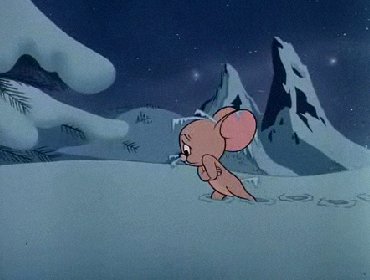 In ‘Snowbody Loves Me’ we see Jerry freezing in the Swiss Alps, but then he finds a cheese shop.
Jerry manages to enter it, but locks Tom outside by doing so. Tom manages to throw Jerry out again, but like in the early Tom & Jerry cartoon ‘The Night before Christmas‘ (1941) his conscience plagues him, and he subsequently rescues Jerry from death.
Like ‘Much Ado About Mousing‘ ‘Snowbody Loves Me’ borrows a theme from an earlier Hanna-Barbera cartoon, and again, the result cannot stand the comparison to its source of inspiration. ‘Snowbody Loves Me’ is cute alright, typical for Jones’s late style, and its colors and designs are beautiful. However, the action is slow, and the gags are mediocre.
Watch an excerpt from ‘Snowbody Loves Me’ yourself and tell me what you think:
This is Tom & Jerry cartoon No. 132
To the previous Tom & Jerry cartoon: Much Ado About Mousing
To the next Tom & Jerry cartoon: The Unshrinkable Jerry Mouse
Director: Chuck Jones
Release Date: April 14, 1964
Stars: Tom & Jerry
Rating: ★★★½
Review:
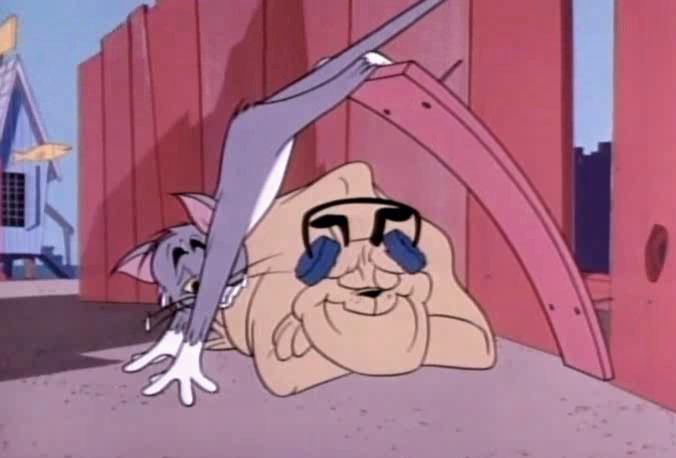 In the opening scene of ‘Much Ado About Mousing’ we see Tom fishing for Jerry in a harbor, using cheese. But Jerry seeks help from a yellow bulldog. The bulldog gives Jerry a whistle with which he can call for the Bulldog’s help.
Sounds familiar? Indeed, this idea is borrowed from the early Tom & Jerry short ‘The Bodyguard’ (1944). ‘Much Ado About Mousing’ is not bad, but it pales when compared to the former cartoon. Its story and its gags are fine, but the music, by Eugene Poddany, wears the action down, despite his effective use of Ludwig van Beethoven’s famous fate theme from his fifth symphony.
Watch ‘Much Ado About Mousing’ yourself and tell me what you think:
This is Tom & Jerry cartoon No. 131
To the previous Tom & Jerry cartoon: Is There A Doctor in the Mouse?
To the next Tom & Jerry cartoon: Snowbody Loves Me
Director: Gene Deitch
Release Date: August, 1962
Stars: Tom & Jerry
Rating: ★★★½
Review:

‘The Tom and Jerry Cartoon Kit’ is based on an original idea and this makes the short arguably the best of the Gene Deitch Tom & Jerry cartoons.
Nevertheless, the initial idea of a ‘Tom and Jerry cartoon kit’ is badly developed, as it is based on two extended gag routines: one featuring water melon seeds, and another focusing on Jerry’s judo skills (which the animators confuse with karate).
The cartoon is rescued by some clever gags and by daring monochrome featureless backgrounds, creating a fairly surreal atmosphere. The dancing animation, too, is nice to watch, and the montage in which Tom learns boxing is well-timed for a change. Moreover, this short contains probably the most original gag of all Gene Deitch’s Tom & Jerry cartoons: the one in which Tom’s thinking process makes his eyebrows knit a sweater.
Watch ‘The Tom and Jerry Cartoon Kit’ yourself and tell me what you think:
This is Tom & Jerry cartoon No. 123
To the previous Tom & Jerry cartoon: Dicky Moe
To the next Tom & Jerry cartoon: Tall in the Trap
‘The Tom and Jerry Cartoon Kit’ is available on the DVD-set ‘Tom and Jerry – The Gene Deitch Collection’
Director: Burt Gillett
Release Date: February 28, 1933
Stars: Mickey Mouse, Minnie Mouse, Pluto
Rating: ★★★½
Review:
 ‘Mickey’s Pal Pluto’ shows how important Pluto had become by 1933.
It’s the first cartoon having the sympathetic mutt in its title, and it’s he, not Mickey or Minnie, who’s the real star of this short, arguably making ‘Mickey’s Pal Pluto’ Pluto’s first own cartoon.
In ‘Mickey’s Pal Pluto’ Pluto saves a few little kittens from drowning. Mickey and Minnie take them home, but there Pluto grows jealous of the intruders, exemplified by a conflict between his devilish and angelic sides, who materialize outside him, and who speak in rhyme. Unfortunately, when Pluto listens to his little devil, this leads to Mickey putting him outside. Nevertheless, when the kittens fall into a well, Pluto rescues the kittens from drowning again, almost drowning himself in the act. In the end he’s rewarded for this unselfish behavior with a roast chicken.
The moral clearly is that being good will be rewarded, as Pluto’s angel character clearly states in the end. So some of the childish sentimentality that had entered the Silly Symphonies in 1933 sneaks in to the Mickey Mouse series, as well.
‘Mickey’s Pal Pluto’ marks the first appearance of Pluto’s imaginary little devil and angel, symbolizing his inner conflict. This cartoon was more or less remade in color in 1941, titled ‘Lend a Paw’. Pluto’s little devil would reappear in ‘Mickey’s Elephant‘ (1936).
Watch ‘Mickey’s Pal Pluto’ yourself and tell me what you think:
This is Mickey Mouse cartoon No. 53
To the previous Mickey Mouse cartoon: The Mad Doctor
To the next Mickey Mouse cartoon: Mickey’s Mellerdrammer
Director: David Hand
Release Date: July 29, 1933
Rating: ★★★½
Review:

Old King Cole throws an annual party at his castle, which ends at midnight.
One can regard ‘Old King Cole’ as a remake of ‘Mother Goose Melodies‘ from 1931. Both cartoons feature nursery rhyme characters singing and dancing. Although King Cole himself still has the same design he had in the earlier cartoon, the complete short shows an enormous progress in animation, which is elaborate and fluent throughout.
In ‘Old King Cole’ the long song-and-dance routine is executed much more complexly than in the earlier short. Indeed, at times it is even reminiscent of the musicals of the era. It belongs to the operetta-Silly Symphonies of the mid-1930s, with all characters singing their lines. It features several original arrangements of classic nursery rhymes, with the sequence of the nine little Indians leading to a stunning finale, with all characters dancing to an Ellingtonian jungle rhythm.
But then Hickory, Dickory and Dock spoil the fun, telling the audience it’s midnight, and all nursery rhyme characters flee back to their books. King Cole himself has the last shot, singing goodnight to the audience.
‘Old King Cole’ contains no story whatsoever, but the film’s sheer joy, its complex designs and its bright colors make this cartoon yet another highlight within the Silly Symphony series.
Watch ‘Old King Cole’ yourself and tell me what you think:
This is Silly Symphony No. 37
To the previous Silly Symphony: Three Little Pigs
To the next Silly Symphony: Lullaby Land
Director: Burt Gillett
Release Date: February 27, 1932
Stars: Mickey Mouse, Pete, Pluto
Rating: ★★★½
Review:
 When Mickey is washing Pluto, Pluto accidentally swallows a piece of soap.
He runs into the street where he’s seen as a mad dog. There he confronts Pete (with peg leg), who is a dog catcher and who wants to shoot Pluto…
‘The Mad dog’ is a fast gag cartoon with a clear story from the beginning to the end. By now, the Disney studio could produce amazingly consistent stories. Moreover, effect animation had fully penetrated the Mickey Mouse cartoons. The washing scene, for example, is full of difficult and extraordinarily lifelike animation of splashing water.
Watch ‘The Mad Dog’ yourself and tell me what you think:
This is Mickey Mouse cartoon No. 39
To the previous Mickey Mouse cartoon: The Grocery Boy
To the next Mickey Mouse cartoon: Barnyard Olympics
Director: Wilfred Jackson
Release Date: February 8, 1932
Stars: Mickey Mouse, Minnie Mouse, Pluto
Rating: ★★★½
Review:
 Mickey has to deliver groceries to Minnie. When he arrives, she’s baking a stuffed turkey in the kitchen. Mickey helps her cooking in a musical scene, based on the 12th Street Rag. But then Pluto steals the turkey, an event that leads to a grand finale in which Minnie’s kitchen is completely ruined. Nevertheless, Mickey and Minnie retain their optimistic spirit.
‘The Grocery Boy’, contains many fine gags, the best of which is Mickey throwing a dish in the trash can immediately after he has finished preparing it. The structure of this short is very similar to those of the earlier ‘Mickey Steps Out‘ and ‘Mickey Cuts Up‘ from 1931, being part musical number and part gags leading to ruin. The finale is fast-paced and gag-rich, and saves a film that started a little bit dull.
Watch ‘The Grocery Boy’ yourself and tell me what you think:
This is Mickey Mouse cartoon No. 38
To the previous Mickey Mouse cartoon: The Duck Hunt
To the next Mickey Mouse cartoon: The Mad Dog
Director: Burt Gillett
Release Date: October 28, 1931
Stars: Clarabelle Cow, Horace Horsecollar, Mickey Mouse, Minnie Mouse, Pluto
Rating: ★★★½
Review:
 In ‘The Beach Party’ Mickey, Minnie, Clarabelle Cow, Horace Horsecollar and Pluto go picnicking on the beach. All goes well, until an evil octopus ruins their picnic, and they all have to battle against him.
‘The Beach Party’ is one of four 1931 Mickey Mouse cartoons to feature no musical routine, at all. Clearly, the Disney studio grew more and more confident in telling stories instead of musical numbers. And rightfully so, because ‘The Beach Party’ shows that Disney studio was more capable than any other studio in telling a good gag-filled story leading to a great finale. These were a welcome replacement to the tiring song-and-dance-routines. And so, by 1932, the musical numbers had almost disappeared from the Mickey Mouse cartoons.
Nonetheless, ‘The Beach Party’ knows no dialogue, and most of the movement is rhythmical, and set to a musical beat. The film’s greatest idea is the battle, because the gang’s means to chase the octopus away are entirely based on their eating habits as shown before. Such subtle and sophisticated story telling was unknown outside the Walt Disney studio at that time.
Notice, too, how Pluto and the crab resolve into speed lines when fighting. This effect was still pretty new at the time. The gag with the crab would be reused six years later to much better effects in ‘Hawaiian Holiday’.’The Beach Party’ is no classic, but secretly this film, too, shows Disney’s ambitions.
‘The Beach Party’ is also the first of only two shorts in which Mickey, Minnie, Clarabelle Cow and Horace Horsecollar are presented as four close friends, the other one being ‘Camping Out’ from 1934. Their friendship would become common practice in Floyd Gottfredson’s Mickey Mouse comics, starting with ‘Mickey Mouse and the Ransom Plot’ (July-November 1931).
In these comic strips Clarabelle Cow and Horace Horsecollar would become real personalities, something that never happened in the Mickey Mouse films. Indeed, soon after Mickey changed to color in 1935, Clarabelle Cow and Horace Horsecollar vanished from the screen, apart from an occasional cameo. Unfortunately, the same thing occurred in the Mickey Mouse strips: Horace’s and Clarabelle’s last major adventure with Mickey was ‘Race for Riches’ (July-September 1935), after which they were replaced by Goofy.
Watch ‘The Beach Party’ yourself and tell me what you think:
This is Mickey Mouse cartoon No. 34
To the previous Mickey Mouse cartoon: The Barnyard Broadcast
To the next Mickey Mouse cartoon: Mickey Cuts Up
Director: Burt Gillett
Release Date: April 30, 1931
Stars: Mickey Mouse, Pluto
Rating: ★★★½
Review:
 In ‘The Moose Hunt’ Mickey and Pluto are hunting moose.
They finally find a moose (or more exactly, the moose finds them). Unfortunately, in front of the moose, Mickey’s gun fails and soon the moose hunts both Mickey and Pluto. The chase ends with Mickey escaping on a flying Pluto.
‘The Moose Hunt’ is Mickey’s third gag only short, after ‘The Fire Fighters‘ (1930) and ‘Traffic Troubles‘ from earlier that year. It’s hardly as good as those earlier entries, though. Its pace is slow, and it contains some awkward gags, like the flying Pluto finale. It also contains a rare gag breaking the fourth dimension: when Mickey accidentally shoots Pluto, he suddenly addresses the audience with a “Is there a doctor in the house?”. Then, when Mickey begs Pluto to speak to him, Pluto actually speaks!
The self-conscious audience gag would remain a rarity at Disney, but it would become a staple gag at Warner Bros. when Tex Avery joined that studio. The two Pluto gags are totally out of character, and have nothing to do with him being a dog. After ‘The Moose Hunt’ we would never see Pluto flying or speaking again (apart from a short ‘Mammy’ at the end of ‘Mickey Steps Out‘), and after watching ‘The Moose Hunt’ it is easily understandable why not.
Luckily, there are other scenes that are more inspired, and in which Pluto behaves like a dog throughout. Indeed, in his very first solo scene, which reuses a little animation from ‘The Chain Gang‘ (1930), Pluto’s character as a little dumb and a little cowardly dog is pretty well established. Pluto’s looks are still unstable, but he’s excellently animated, throughout.
In ‘The Moose Hunt’ Pluto also gets his name (he was called ‘Rover’ in his first appearance in ‘The Picnic‘ from six months earlier). He now clearly is Mickey’s dog, not Minnie’s, like in the earlier film. It’s clear that the Mickey Mouse films could use an extra character, and after this film Pluto would appear in almost all succeeding Mickey Mouse films, stealing more and more screen time from Mickey.
Mickey would go hunting moose again in the way funnier ‘Moose Hunters’ from 1937, which, incidentally, doesn’t star Pluto.
Watch ‘The Moose Hunt’ yourself and tell me what you think:
This is Mickey Mouse cartoon No. 28
To the previous Mickey Mouse cartoon: The Castaway
To the next Mickey Mouse cartoon: The Delivery Boy


 Dr. Grob's Animation Review