You are currently browsing the category archive for the ‘★★★½’ category.
Director: Rudolf Ising
Release Date: October 3, 1931
Stars: Foxy
Rating: ★★★½
Review:
 ‘One More Time’ is an aptly titled short, as it marks the third and last cartoon to star Foxy, Warner Bros.’ fox-like Mickey Mouse rip-off.
In this cartoon he’s a police officer, fining a hippo lady for driving too fast, and rescuing his Minnie Mouse-like girlfriend from some thugs. He does so riding a mechanical horse, a relic from the Oswald the Lucky rabbit cartoons (e.g. ‘Ozzie of the Mounted‘, 1927), on which Harman and Ising had worked previously. Strangely enough, Foxy is machine-gunned by one of the gangsters in the end. Perhaps this is why he never returned to the animated screen…
The short has a strong urban setting, uncommon in the Hollywood cartoons of the time, and it features some dazzling perspective animation, but otherwise it’s just another mediocre entry in the early Merrie Melodies canon.
Watch ‘One More Time’ yourself and tell me what you think:
‘One More Time’ is available on the DVD ‘Looney Tunes Golden Collection Volume Six’
Director: Chuzo Aoji
Release Date: 1931
Stars: Momotaro
Rating: ★★★½
Review:
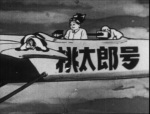 In ‘Momotaro’s Sky Adventure’ (also known as ‘Aerial Momotaro’) Japanese animation pioneers Aoji and Yasuji Murata tell a tale about that great and friendly warrior from Japanese folklore, Momotaro, who had been brought to the animated screen by Takamasa Eigasha in ‘Momotaro the Undefeated’ (1928).
Surprisingly, Aoji and Murata move our hero into the present. Momotaro is visited by a couple of Antarctic island birds who call for help against an evil (American?) eagle. Together with his loyal friends, monkey, dog and pheasant, he flies to the remote island in a propeller plane, being fueled twice by birds on the way. When the quartet arrives, they battle the eagle in the air in an overlong fighting sequence, which at times is strangely reminiscent of a modern computer game. Momotaro finally decides to capture the fiend alive, and he’s celebrated as a hero by the grateful birds.
‘Momotaro’s Sky Adventure’ is Japan’s very first propaganda cartoon. It shows an early form of nationalism and anti-Americanism. Momotaro would grow very popular during World War II, representing Japan in many wartime films, and starring Japan’s very first animated feature, ‘Momotaro’s Divine Sea Warriors’ (1945), commissioned by the Japanese navy. This transformation of the folk hero into a nationalistic figure begins with this cartoon from 1931. Indeed, ultra-nationalism and militarism overtook Japan in the early 1930s, which e.g. resulted in the annexation of Manchuria in the summer of 1931.
Importantly, ‘Momotaro’s Sky Adventure’ shows Japan’s national hero as the military strong friend of its weaker neighbors. This portrait of Japan as a benevolent big brother to all other Asian nations was played out throughout Japan’s militaristic period, and this propaganda story indeed managed to delude people like for example those Malay who, when Japan invaded their country in 1941, at first welcomed the Japanese as liberators from colonial Britain, only to find them far worse oppressors than the British had ever been…
‘Momotaro’s Sky Adventure’ is available on the Japanese DVD Box Set ‘Japanese Anime Classic Collection’.
Director: Dave Fleischer
Release Date: April 16, 1931
Rating: ★★★½
Review:
 ‘Any Little Girl That’s A Nice Little Girl’ is a Screen Song about a cat who’s dating several girls at the same time.
First we watch him dating his girls through the telephone, then he goes through a bunch of photographs and chooses to visits hot Lulu Belle. When he tries to sneak out, Lulu Belle hits him with the couch. Enter the Screen Song, which is accompanied with images of e.g. a naked woman in a bath(!) and a picture of Betty Boop, who otherwise does not appear in this cartoon.
Only the first scene features lip-synch, and the scene with Lulu Belle also features an excerpt from the 1929 hit song ‘What Wouldn’t I Do for That Man’, popularized by Annette Hanshaw and Ruth Etting. This excerpt is much more interesting than the 1910 vaudeville title song. The last chorus features some nice interplay between the words and the animated characters, typical for the Screen Songs of this era.
Watch ‘Any Little Girl That’s A Nice Little Girl’ yourself and tell me what you think:
‘Any Little Girl That’s A Nice Little Girl’ is available on the French DVD Box Set ‘Betty Boop Coffret Collector’
Director: Rudolf Ising
Release Date: August, 1931
Stars: Foxy
Rating: ★★★½
Review:
 After twelve Looney Tunes, all starring Bosko, Harman and Ising started a new cartoon series for Warner Bros. with the clearly Silly Symphonies-inspired name ‘Merrie Melodies’.
Unlike the Looney Tunes, the Merrie Melodies would be one-off cartoons, each one promoting a different song from the Warner Bros. song catalog. Indeed, the Merrie Melodies should at least feature one complete chorus of a Warner Bros.-owned tune. This rule continued until the end of the 1930s, and rather hampered the series, for the obligate song sequence would often stop the action of the cartoon.
‘Lady Play Your Mandolin’ is the very first of the Merrie Melodies. It features the title song, which is sung twice during the cartoon. Without explanation, the cartoon features a Mexican cafe setting, which is visited by the hero, Foxy, who was to be Warner Bros.’ answer to Mickey Mouse.
Although not as blatant an imitation as Van Beuren’s Milton Mouse (see ‘Circus Capers‘ and ‘The Office Boy‘), Foxy clearly is Mickey Mouse but with pointed ears and a fluffy tail. Indeed, when watching this cartoon my girlfriend thought it was an early forerunner of Mickey. Foxy never came near Mickey’s popularity, however, and was abandoned after a mere three cartoons.
‘Lady Play Your Mandolin’ is the character’s great testimony. The film is completely plotless, but simply bursts with joy. The short features a lot of flexible animation and everyone moves to Frank Marsales’s peppy music (played by Abe Lyman’s Brunswick Recording Orchestra), including the tables, the cacti, the trees and the cafe itself. There are plenty of gags all around, the most extraordinary one being Foxy’s drunken horse playing its own head as a trombone.
Foxy also started a long Warner Bros. tradition of Al Jolson imitations, when singing the main melody, while his girlfriend (Minnie Mouse but with pointed ears) boop-oop-a-doops. None of the cartoon makes any sense, but its sheer joy makes watching it a highly entertaining experience.
Watch ‘Lady, Play Your Mandolin’ yourself and tell me what you think:
‘Lady, Play Your Mandolin’ is available on the DVD ‘Little Caesar’
Director: Wilfred Jackson
Release Date: July 28, 1931
Rating: ★★★½
Review:
 A cat is put out. When he tries to catch a bird, he falls down and gets knocked unconscious by a wind-flower.
Enter a nightmarish sequence, in which the cat imagines his lives are fleeing him, and that he’s being attacked by giant birds, hooting owls, bats, giant spiders and hollow trees. Luckily, in the morning it all appears to have been a dream.
‘The Cat’s Out’ is not devoid of dance routines (there are two dance scenes featuring scarecrows and a bat), but it has a surprisingly clear story, unmatched by earlier Silly Symphonies. It is arguably the first Silly Symphony with such a clear story, anticipating the straightforward storytelling of ‘The Ugly Duckling‘ of the end of the same year. This makes the short one of the most interesting Silly Symphonies of 1931.
Watch ‘The Cat’s Out’ yourself and tell me what you think:
This is Silly Symphony No. 20
To the previous Silly Symphony: The Busy Beavers
To the next Silly Symphony: Egyptian Melodies
‘The Cat’s Out’ is available on the DVD ‘Walt Disney Treasures: More Silly Symphonies’
Director: Walter Lantz or Bill Nolan
Release Date: July 14, 1930
Stars: Oswald the Rabbit, Kitty
Rating: ★★★½
Review:
 ‘Spooks’ is a nice early Oswald cartoon from the Walter Lantz studio.
It takes place in a theater where Oswald performs. It features a mysterious phantom who helps Oswald’s girlfriend Kitty to become a great singer by putting a record player in her dress. This leads to an absurd performance. The phantom fancies Kitty, but she prefers Oswald, who has to rescue her from the phantom’s clutches. This part of the film has horror overtones, commonplace in the early 1930s. The film ends with a rather lame gag.
‘Spooks’ features some very Mickey Mouse-like mice. Its animation, by Bill Nolan, Clyde Geronimi and Pinto Colvig is fair, and the story enjoyable, even if it’s rather inconsistent.
Watch ‘Spooks’ yourself and tell me what you think:
Director: Mannie Davis & John Foster
Release Date: April 27, 1930
Stars: Waffles and Don
Rating: ★★★½
Review:
 When the Van Beuren studio lost their main character, Farmer Al Falfa to Paul Terry, they had to come up with new stars. Their first attempt was the animal duo Waffles and Don, a tall cat and a small dog who are the precursors of Van Beuren’s Tom and Jerry.
In their first film we watch them flying a plane before lightning strikes them down deep into the ocean. Here they meet an opera-singing walrus (probably inspired by Walt Disney’s ‘Wild Waves‘ (1929), which also features one). Then they enter the shipwreck ‘Davy Jones’, which is full of monsters swooping into the camera, and a skeleton. The skeleton orders Waffles and Don to play the piano and xylophone, which starts the song-and-dance-routine-part of this cartoon.
Most interesting are four drunken tortoises singing ‘Sweet Adeline’ (probably inspired by ‘The Karnival Kid‘ (1929) in which two cats sing exactly the same song). The dance routine ends when Davy Jones himself appears and chases Waffles and Don away. However, the last shot is for the singing turtles.
‘The Haunted Ship’ clearly shows Walt Disney’s influence on other studios. It’s obvious that The Van Beuren studio tried its best to copy Walt Disney’s formulas and standards. Indeed, the cartoon is a great improvement on ‘The Iron Man‘ from three months earlier. There’s song and there’s dance, and music and animation now are closely intertwined. The Van Beuren studio would never reach Walt Disney’s sophistication, but in these early years they were at least able to come somewhere near.
Waffles and Don’s career, however, proved to be short-lived. They only starred in three other 1930 cartoons: ‘Jungle Jazz‘, ‘Frozen Frolics‘ and ‘Gypped in Egypt‘.
Watch ‘The Haunted Ship’ yourself and tell me what you think:
‘The Haunted Ship’ is available on the DVDs ‘Aesop’s Fables – Cartoon Classics from the Van Beuren Studio’ and ‘The Complete Animated Adventures of Van Beuren Studio’s Tom and Jerry’
Director: Lotte Reiniger
Release Date: 1928
Rating: ★★★★
Review:
 ‘Der scheintote Chinese’ is a short film by Lotte Reiniger, made in the same vein as her stunning feature film ‘Die Abenteuer des Prinzen Achmed’ from 1926. Unlike her feature, this isn’t a romantic film, however, but a comical one, exploiting some surprisingly dark humor.
It starts when a couple makes fun with Ping Pong, the emperor’s favorite humpback. Unfortunately he chokes on a fishbone, leaving the couple believe he’s dead. They try to get rid of him, and so does every other citizen who finds the body on his doorstep. Finally a drunk is caught and sentenced to death for the brutal murder on Ping Pong. When the innocent drunk is almost hung at the gallows, the other people get remorse, and each pleads guilty in succession. Luckily, at that moment, Ping Pong awakes.
‘Der scheintote Chinese’ is an entertaining story, and Reiniger’s designs are as delicate as ever. But the animation is crude and stiff, and her timing rather tiresome. Thus the film fails short to become a timeless classic.
Watch ‘Der scheintote Chinese’ yourself and tell me what you think:
‘Der scheintote Chinese’ is available on the DVD ‘Die Abenteuer des Prinzen Ahmed’
Director: Unknown
Release Date: June 25, 1928
Stars: Oswald the Lucky Rabbit
Rating: ★★★½
Review:
 Oswald has a relatively small part in this cartoon, with many gags going to the fox outwitting the dogs.
This Oswald cartoon is noteworthy for a trio of original sight gags: in the first Oswald winds his elongated legs back into shape, in the second the fox pulls a pond to another place, and in the third Oswald’s squeezes a log like a tube of toothpaste.
‘The Fox Chase’ is the first of three cartoons in which Disney explores the humor of fox hunting, the other two, both titled ‘The Fox Hunt’ are a Silly Symphony from 1931 and a cartoon starring Donald Duck and Goofy from 1938. Curiously, all share the end gag involving a skunk.
Watch ‘The Fox Chase’ yourself and tell me what you think:
This is Oswald the Lucky Rabbit cartoon No. 22
To the previous Oswald the Lucky Rabbit cartoon: Sky Scrappers
To the next Oswald the Lucky Rabbit cartoon: Tall Timber
Director: Osamu Tezuka
Release Date: 1987
Rating: ★★★½
Review:
 This film is named after a medieval sword smith who made swords that were supposedly cursed, creating blood lust in its wielder and finally making him commit suicide.
The film is an illustration of this curse and of its own motto: “A man with arms which can kill people like puppets is not aware that he himself has already become a puppet”. For this dark anti-violence film Tezuka uses realistic imagery and limited animation, which make the film look a little like an animated comic.
The film’s visual language is utterly Japanese, accompanied by equally Japanese music. But its message is universal, and another example of Tezuka’s strong dislike of war and violence. Even if it is not amongst his most impressive works, the film still manages to deliver its dark message.
Watch ‘Muramasa’ yourself and tell me what you think:
Directors: Ron Clements, Burny Mattinson, Dave Michener & John Musker
Release Date: July 2, 1986
Rating: ★★★½
Review:
 In the dark ages of animation that were the 1970s and most of the 1980s, the Disney studio produced two animated features that shone just more brightly than the others: ‘The Rescuers’ (1977) and ‘The Great Mouse Detective’, coincidentally both about mice.
Thirty years later ‘The Rescuers’ has gained some kind of classic status, whereas ‘The Great Mouse Detective’ has not. That’s a pity, for it’s a surprisingly entertaining film, far outshining all other Disney features between ‘The Rescuers’ and ‘The Little Mermaid’ (1989).
Based on the children’s book series ‘Basil from Baker Street’ by Eve Titus, ‘The Great Mouse Detective’ tells about the Sherlock Holmes-like mouse Basil, who – indeed – lives in the same house as his far more widely known human counterpart.
The story is propelled by an intro, a story device also used in ‘The Rescuers’, in which the father of little mouse Olivia Flaversham is kidnapped. Enter Dr. Dawson, a Watson-like mouse, who, like Watson, is the narrator of the story, and who teams up with Olivia to find Basil, the famous detective. Soon the plot directs to the film’s supervillain, Professor Ratigan, brilliantly voiced by Vincent Price, who had collaborated with Disney before in the Tim Burton short ‘Vincent’.
Although all characters are voiced and animated well, Ratigan, animated by Glen Keane, arguably the best animator of his generation, stands in a class at his own: every single frame of his screen presence is a delight. He even gets the first of only two songs in the movie, and his pompous screen persona, both enjoyable and threatening, is comparable with the other classic Disney villains Hook (‘Peter Pan’, 1953), Shere Khan (‘Jungle Book’, 1967) and the later Jafar (‘Aladdin’, 1992).
In its final scene ‘The Great Mouse Detective’ introduces one novelty: computer-animated backgrounds, which blend surprisingly well with the hand-drawn characters. It’s an impressive piece of work, and it shows the possibilities of computer animation. Needless to say, more was to come later.
‘The Great Mouse Detective’ covers much more familiar ground than the erratic ‘The Black Cauldron’ did, and indeed the studio feels clearly more at ease with this picture. It doesn’t really look forward, except for the stunning computer animated clockwork backgrounds of the final scene, but who cares? It is the first film by the new young team to show sheer joy. ‘The Great Mouse Detective’ is a delight from the introduction scene to its grand finale. By now, the studio could leave its lowest point behind.
Watch an excerpt from ‘The Great Mouse Detective’ yourself and tell me what you think:
Director: Chuck Jones
Release Date: January 9, 1943
Stars: Daffy Duck, Elmer Fudd
Rating: ★★★½
Review:
 In ‘To Duck or not to Duck’ Elmer Fudd shoots Daffy out of the sky. The duck then challenges the ‘sportsman’ for a boxing match, something which takes place immediately for a crowd of ducks. Needless to say, the match is far from fair.
‘To Duck or not to Duck’ is the first Warner Bros. cartoon to star both Daffy and Elmer. The poor hunter is good fowl for the foul-playing duck and his brethren. When Elmer gets his revenge in the end, we’re almost surprised.
The cartoon knows some good gags, but Jones’s timing is still sloppy, and not every gag hits the screen well. Highlight may be Daffy’s ridiculously haughty humphing at Elmer Fudd’s apology for shooting him.
Note the surprisingly empty backgrounds in this cartoon.
Watch ‘To Duck or not to Duck’ yourself and tell me what you think:
This is Daffy Duck cartoon No. 17
To the previous Daffy Duck cartoon: My Favorite Duck
To the next Daffy Duck cartoon: The Wise Quacking Duck
‘My Favorite Duck’ is available on the DVD-set ‘Looney Tunes Golden Collection Volume Six’
Director: Dick Lundy
Release Date: March 12, 1943
Stars: Donald Duck
Rating: ★★★½
Review:
 Donald Duck is looking for a plane at ‘Ben Buzzard’s (crashed) used planes’.
Ben Buzzard sells a ramshackle plane to Donald and makes him signing a swindling contract in which an insurance company will pay the swindler $10,000,- in case of an accident. The buzzard then tries to make Donald crash.
Unfortunately, the comedy doesn’t quite work. First, because it’s hard to believe that the anthropomorphized buzzard can fly on his own, while the equally anthropomorphized Donald cannot. Second, Ben Buzzard’s attacks become more open and open, but at no point it’s made clear whether Donald realizes why he’s being attacked.
‘Flying Jalopy ‘was the last cartoon Dick Lundy directed at Disney. In October 1943 he left Disney to become an animator and director at Walter Lantz, where he directed several Woody Woodpecker shorts, including ‘Wet Blanket Policy‘, which uses the same idea, but with way better results, resulting in a far more hilarious cartoon. It even uses the same buzzard character, but Lantz’s Buzz Buzzard would become way more famous than Ben Buzzard ever was.
Watch ‘Flying Jalopy’ yourself and tell me what you think:
This is Donald Duck cartoon No. 40
To the previous Donald Duck cartoon: Donald’s Tire Trouble
To the next Donald Duck cartoon: Fall out – Fall in
Directors: Clyde Geronimi, Wilfred Jackson & Hamilton Luske
Release Date: July 26, 1951
Rating: ★★★½
Review:
 Of all the classic Walt Disney features, ‘Alice in Wonderland’ had the longest and most troublesome history.
Lewis Carroll’s book had intrigued Walt Disney for years. It had inspired the Alice cartoons, if only in name, and already in 1933 the first ideas appeared to turn the literary classic into an animated feature, starring Mary Pickford as Alice – being Disney’s first feature idea ever. Unfortunately, the idea was dropped because in 1933 Paramount released their version of the classic tale.
More serious work on Alice started in 1939/1940 when illustrator David Hall made numerous, exceptionally beautiful concept drawings. After the failures of ‘Pinocchio‘ and ‘Fantasia’ (both 1940) at the box office, these ideas were shelved, and virtually nothing of Hall’s ideas entered the final film. At one point even novelist Aldous Huxley cooperated, turning in a literary script in 1945, which the Disney studio found useless. Only in 1949 real work on the film began, resulting in Disney’s second feature of the 1950s, after the successful ‘Cinderella‘.
The final film unfortunately was poorly received when it was finally released in 1951. It performed rather badly at the box office, losing the studio almost a million dollars, practically evaporating the profits that ‘Cinderella’ had made the previous year. The film was critisized even by its own animators. Marc Davis said the film “gave us nothing to work it” and called it a “cold film”. Frank Thomas and Ollie Johnston hardly mention the film in their elaborate book ‘The Illusion of Life’. In ‘The Disney Villain’ they reveal why: they felt they “had failed to find the intriguing combination of fantasy, satire and whimsy that made the original book popular”. Even Walt Disney himself denounced the film, saying it lacked heart.
However, ‘Alice in Wonderland’ has aged suprisingly well. In fact, it has turned out to be one of the best adaptations of the book to the screen, its only serious rivals being Jan Švankmajer’s disturbing stop motion film from 1987, and a NBC production from 1999. Certainly not Disney’s feature from 2010, which, although visually stunning, owes very little to the original story.
The film’s most overt weakness, its episodic character (which, of course, it shares with the original book), is also its strong point: none of the Disney story cliches are apparent, and there’s a welcome lack of sentimentality to the film. In fact, the film’s low point is reached when the studio does try to squeak sentimentality into the story: in the Tulgey Wood scene, an invention of the story department and not found in the original book, Alice has enough of nonsense, wants to go home and feels lost. She sings the feature’s weakest and most forgettable song with a sobbing voice, with some fantasy birds sympathizing with her in stereotypical Disney fashion. Despite the inventive bird designs, this scene is wide of the mark.
Luckily, it is one of only two weak scenes (the other one being the flower scene, squeaked in from ‘Through the Looking Glass’) amidst the wonderful series of utter nonsense, which evoke the zany spirit of the book very well. The film is literally stuffed with great characters, most of them voiced by well-known British and American actors: the white rabbit (Bill Thompson, the voice of Droopy), the dodo, Tweedledee and Tweedledum (Pat O’Malley), the caterpillar (Richard Haydn), The Cheshire Cat (Disney favorite Sterling Holloway), The Mad Hatter and the Marc Hare (Ed Wynn & Jerry Colonna), the Queen of Hearts (Verna Felton), and the little king. Eleven year old Kathryn Belmont is a perfect Alice: pleasantly normal, and a little pedantic, just like the one in the book.
Of all Nine Old Men, the Disney animators who worked on the film, Ward Kimball in particular seems in his element, as Lewis Carroll’s work has much in common with his own zany type of humor. Kimball supervised animation on Tweedledee and Tweedledum, the Walrus and the Carpenter, the Mad Tea Party and the Cheshire Cat, and all characters are delightfully loony.
However, the film’s strongest point may be in its design, which is nothing like Sir John Tenniel. In contrast to his gloomy black-and-white engravings, styling artists Mary Blair, John Hench, Claude Coats and Ken Anderson present a vibrant world of colors. The stylized backgrounds are superb with their angular designs and highly original color combinations, evoking a perfect dream world. It’s these designs that give the movie unity. They are matched by the looniest animation within any Disney feature, all bringing the zany Lewis Carroll perfectly to life. Both the animation and the countless visual gags complement the textual madness of the original book. Moreover, the film is surprisingly speedy, and still enjoyable for a 21st century audience.
‘Alice in Wonderland’ may not be Disney’s best or most successful feature, it’s a very pleasant ride through a colorful world, and more of a timeless classic than anyone would have imagined in 1951.
Watch ‘Alice in Wonderland’ yourself and tell me what you think:
Director: Walter Lantz
Release Date: October 29, 1951
Stars: Woody Woodpecker, Wally Walrus
Rating: ★★★½
Review:
 ‘The Woody Woodpecker Polka’ is one of several cartoons in which Woody Woodpecker tries to get some food.
In this cartoon Woody Woodpecker tries to enter a barn dance, but only for the food that is served there. The usher, Wally Walrus, doesn’t let him in however, for Woody can’t pay the one dollar entrance fee. Luckily, ladies are free of admission, so Woody dresses like one and makes Wally accompany him to the dance floor. What follows is a dancing scene in which Woody tries to eat as much food as he can, a story idea the studio borrowed from Walt Disney’s ‘The Legend of Sleepy Hollow‘ (1949).
The dancing scene is enhanced by the intoxicating title song, sung by the Starlighters, and for a change Clarence Wheeler’s music is inspired during this sequence.
Watch ‘The Woody Woodpecker Polka’ yourself and tell me what you think:
This is Woody Woodpecker cartoon No. 37
To Woody Woodpecker’s debut film: Redwood Sap
To the next Woody Woodpecker cartoon: Destination Meatball
‘The Woody Woodpecker Polka’ is available on the DVS-set ‘The Woody Woodpecker and Friends Classic Cartoon Collection’
Director: Michel Ocelot
Airing Date: December 21, 1983 – ?
Rating: ★★★½
Review:
 After the artistic successes of ‘Les trois inventeurs‘ (1979) and ‘La légende du pauvre bossu‘ (1982) Ocelot turned his skills to a gentle and entertaining television series for children.
The series, called ‘La princesse insensible’ (the insensitive princess), consists of thirteen episodes and has a very simple story line: a princess is so bored that nothing can amuse her. The king declares that when a prince manages to amuse the princess nonetheless, he will win her. In the 4 minute long episodes we watch several young princes, sorcerers in fact, trying to amuse her in her own theater, all in vain.
‘La princesse insensible’ uses a mixture of traditional and cut-out animation. Ocelot’s animation may be simple, no doubt due to a limited budget, but it’s very effective in its pantomimed action. The series’ design is elegant in its recreation of an 18th century atmosphere. The framing story is told in silhouettes, reminiscent of the work by Lotte Reiniger, but the theater scenes are in bright colors. The atmosphere is fairy-like and surreal throughout, helped by Christian Maire’s otherworldly music. In all, ‘La princesse insensible’ is a little charming series, which shows Ocelot’s delicate and unique voice in the animation world.
The separate episodes of ‘La princesse insensible’ are listed below:
1. Le Prince dompteur (The Tamer Prince)
This episode tells the framing story and shows us the first prince. He has a menagerie of trained fairy tale animals: a unicorn, a three-headed dog, a Chinese dragon and a phoenix.
2. Le Prince jardinier (The Gardener Prince)
The second episode, like all following episodes of ‘La princesse insensible’, starts without the framing story. Instead the story is told in the title song. After the intro, we watch the second prince performing right away. He’s a garden prince, able to make plants and flowers grow on the bare floors and pillars of the princess’s theater. When he fails to impress the princess, he disappears on an ever-growing tree.
3. Le Prince à transformations (The Transforming Prince)
The third prince trying to impress the insensible princess is the most interesting to animation fans. Being called the metamorphosis prince, he’s able to transform himself into all kinds of people and things. Ocelot uses some beautiful metamorphosis animation in doing so. The prince’s performance builds up to a great finale, in which the prince transforms himself into seemingly hundreds of things, which is depicted by the rapid showing of random pictures. This simple device works because we’ve seen the process of transformation just before that. It also adds a humorous touch to the fairy-like atmosphere, because many of the objects are anachronisms in the 18th century setting.
4. Le Prince sourcier (The Dowser Prince)
The fourth prince, the ‘diviner prince’, is able to sprout water everywhere, using a divining-rod, turning the princess’s theater into a fountain. One of the more fairy-like episodes of ‘la princesse insensible’, ‘Le prince sourcier’ is less impressive than the first three episodes. After these three, the diviner prince even fails to impress we viewers.
5. Le Prince qui fait semblant (The Pretender Prince)
The fifth prince trying to impress the princess is almost typically french: he’s a mime artist, miming (among others) that he plays the piano, rides a bicycle and even a motorcycle inside the princess’s theater. When he fails to impress the princess he even mimes that he commits suicide. Like ‘le prince à transformation’ this episode has an extra touch because of the anachronisms.
6. Le Prince météorologue (The Meteorologist Prince)
The sixth prince is called the weather prince, and he’s able to make clouds dancing within the princess’s theater. He also makes rain, lightning and a rainbow. When he leaves the princess unimpressed, he covers himself in snow. One of the lesser episodes of ‘la princesse insensible’, ‘le prince météorologue’ nevertheless shows Ocelot’s fantasy. When one doesn’t expect any more meteorological wonders, the prince transforms the rainbow into numbers and patterns.
7. Le Prince sous-marin (The Underwater Prince)
The seventh prince arrives in a fish-like submarine inside an enormous fish-tank. Compared to the other princes, his antics are relatively believable, although he seems to have the ability to make fish forming patterns. This episode is one of the lesser entries in the series, despite the beautiful old-fashioned design of the princes’ submarine.
8. Le Prince volant (The Flying Prince)
The eight prince, the flying prince, looks like a Japanese superhero with wings. During his flight, we see more of the theater than in any other episode. Apparently there’s more public than the princess alone.
9. Le Prince décorateur (The Decorator Prince)
The decorator prince is able to turn the complete theater upside-down, to change its colors by clever lighting. When the princess is unimpressed as ever, he descends into the basements.
10. Le Prince magicien (The Magician Prince)
This prince is called the ‘magician prince’, even though many of the other princess were skilled magicians as well. The prince enters on a flying carpet and turns the pillars of the theater into palm trees, the chandelier into a beach ball and the stone ornaments into butterflies. Then he turns his own hat into a zeppelin and the furniture into a train. Enraged by the princess’s non-reaction, the prince makes everything disappear again, including the theater and himself.
11. Le Prince peintre (The Painter Prince)
The Painter prince episode, unlike the other episodes, has some false starts, as the prince repeatedly forgets something he needs to paint his enormous canvas. The painter exactly copies the theater on his canvas, then paints a happy portrait of the princess. But when she remains unimpressed, he violates his own drawings. It’s charming to see the shadows of Ocelot’s paper figure of the painter, while he’s painting the enormous canvas. It gives the series its handicraft appeal.
12. Le Prince artificier (The Artificer Prince)
The fireworks prince, like the painter prince, knows some false starts, when he has troubles preparing the fireworks in the dark. The fireworks effects are created nicely with kaleidoscope effects into beautiful abstract patterns. The prince also illuminates the theater with neon lights. In the end the prince disappears on a rocket, after which the complete theater explodes.
13. Le Prince écolier (The Schoolboy Prince)
The last prince, ‘the schoolboy prince’, is much less skilled than the other princes, but he immediately solves the princess’s problem: she appears to be terribly nearsighted, and he helps her with his glasses. They are married, and the other princes perform for the princess once again, which leads to a sequence with highlights from the previous episodes.
‘La princesse insensible’ is available on the DVD ‘Les trésors cachés de Michel Ocelot’
Director: Burny Mattinson
Release date: December 16, 1983
Stars: Mickey Mouse, Scrooge McDuck, Donald Duck, Daisy Duck, Goofy, Jiminy Cricket, Pete, Willie the Giant
Rating: ★★★½
Review:
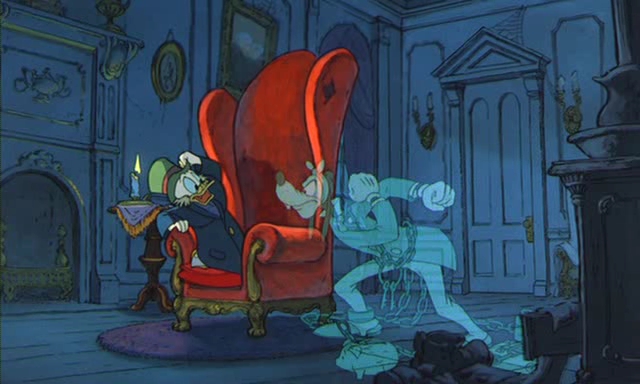 Mickey’s Christmas Carol’ is one of countless cinema versions of Charles Dickens’s classic tale, this time using Disney characters.
Star of the film is Scrooge McDuck, which of course comes natural to the old miser as the character was actually named after Dickens’ main protagonist. Unlike the other characters Scrooge McDuck was mainly a comics hero, created by Carl Barks, and he had appeared on the screen only one time before, in the educational film ‘Scrooge McDuck and Money’ (1967). However, only four years later he would be animated extensively, in the highly successful televison series, Ducktales.
Most people however will remember ‘Mickey’s Christmas Carol’ as Mickey’s return to the screen for the first time since his retirement in 1953. But it also marks the return of Donald (as Scrooge’s nephew Fred) and Goofy (as his former partner Jacob Marley) to the screen after a 22 year absence. The film has an all-star cast in any case, reviving many other classic Disney stars, like Jiminy Cricket (as the ghost of Christmas Past), Daisy (as Scrooge’s former love interest) and Pete (as the ghost of Christmas future). Also featured is Willie the giant from ‘Fun and Fancy Free‘ (1948) as the ghost of Christmas present, and several characters from ‘The Wind in the Willows‘ (1949). Apart from these we can see glimpses of the Big Bad Wolf and the three little pigs, Clarabella Cow, Horace Horsecollar, Huey, Dewey and Louie, Minnie Mouse and some characters from ‘Robin Hood‘.
This all-star cast gives the film a nostalgic feel that fits the story. Indeed, with hindsight, one can see ‘Mickey’s Christmas Carol’ as an early example of the Renaissance that was about to happen, in which the classic cartoon style was revived after ca. twenty dark years.
‘Mickey’s Christmas Carol’ is no ‘Who Framed Roger Rabbit‘, however, and it only looks back, not forward. For example, the rather uninspired score is by Irwin Kostal, who had been composing for Disney since ‘Mary Poppins’ (1964). Moreover, the film’s design, using xerox cells and graphic backgrounds, is firmly rooted in the tradition of the 1960’s and 1970’s.
‘Mickey’s Christmas Carol’ is a nice and entertaining movie, but it would take another five years for the Renaissance hitting Disney in full glory, with inspired and innovative films as ‘Who Framed Roger Rabbit’ (1988) and ‘The Little Mermaid’ (1989).
Watch ‘Mickey’s Christmas Carol’ yourself and tell me what you think:
http://www.dailymotion.com/video/xmq7ql_1983-mickey-s-christmas-carol_shortfilms
This is Mickey Mouse cartoon No. 126
To the previous Mickey Mouse cartoon: The Simple Things
To the next Mickey Mouse cartoon: The Prince and the Pauper
Director: Albert Barillé
Airing date: February 5?, 1983
Rating: ★★★½
Review:
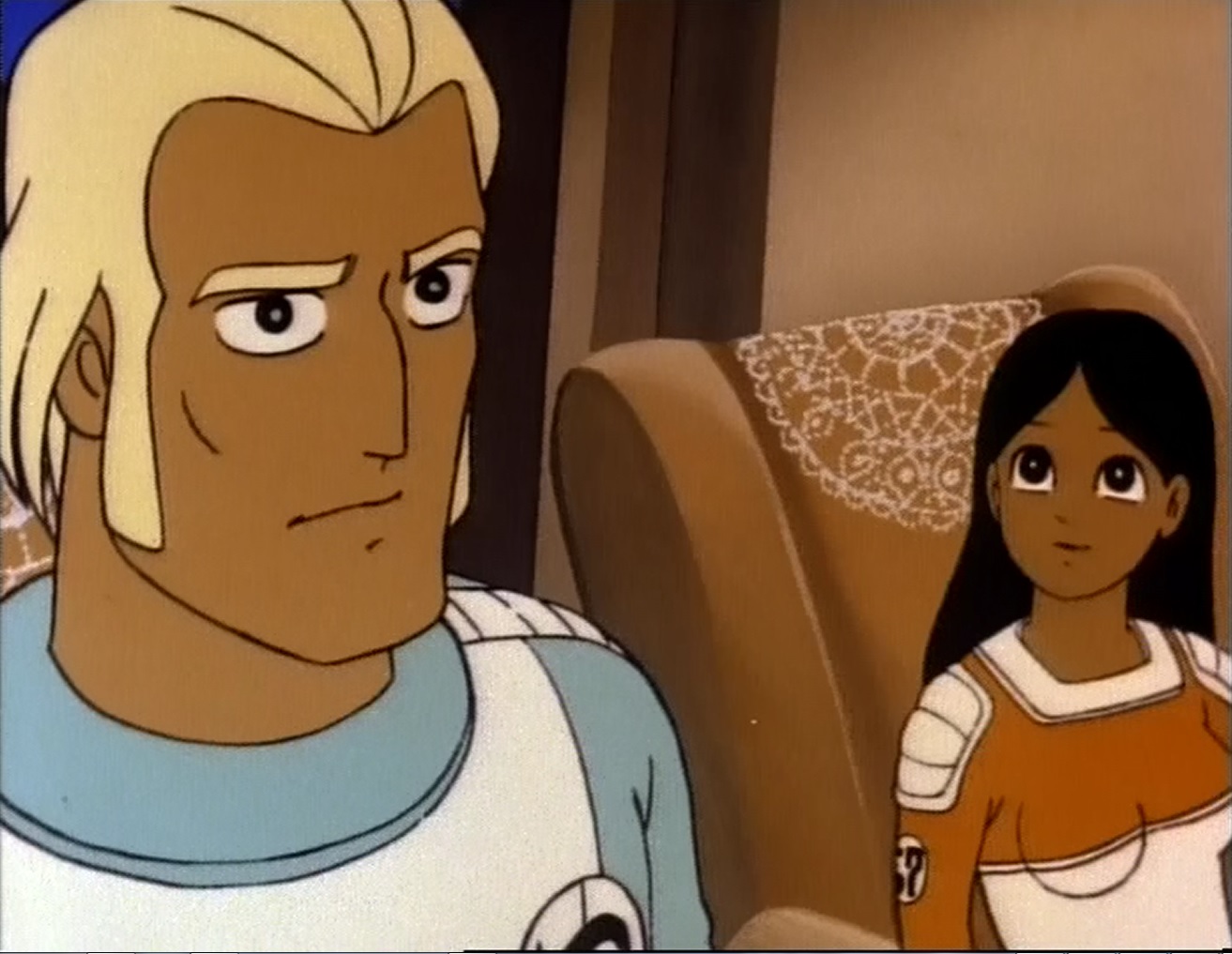 ‘L’Atlantide’ is the second episode that takes place on earth, after ‘Terre!‘.
It starts with Petit Gros’s departure. Old Maestro and Pierrot go visit some underwater cities, where they meet a strange captain, who appears to be from Atlantis. When confronted with Psi, whom he knows as his mother in a former life, he tells our heroes the story of Atlantis. This is another example of Barillé’s fondness of Erich von Däniken’s “the gods were cosmonauts” ideas, after ‘Les Cro-Magnons‘, ‘La planète Mytho‘ and ‘Les Incas‘.
Unfortunately, this episode is rather boring, except for the Atlantean’s account, which is a classic story of greed, strive and doom.
Watch ‘L’Atlantide’ yourself and tell me what you think:
This is the 18th episode of ‘Il était une fois… l’espace’ (Once Upon a Time… Space)
To the 17th episode: Terre! (Earth)
To the 19th episode: L’étrange retour vers Oméga (The Strange Return to Omega)
Director: Vladimir Tarasov
Release date: 1988
Rating: ★★★½
Review:
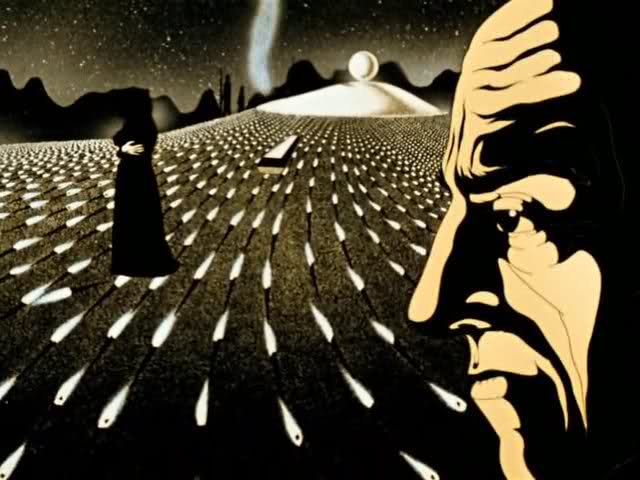 ‘Pereval’ (The Pass) is a science fiction film from the Soviet Union about three youngsters, descendants of some astronauts stranded on a strange, alien planet, who make a quest to the original spaceship.
The film is dark and moody and the atmosphere contemplative, even in the action scenes. Nevertheless, there is a weak comic relief in the form of an eight-eyed, elephant-like creature, which the youngsters encounter on their way to the ship.
In this film Tarasov uses a bold, realistic style with sharp contrasts: he juxtaposes stark shadows with monochrome yellows and reds to create a unique graphic atmosphere, reminiscent of the work by Frank Miller. The planet is portrayed as barren, disturbing and threatening. The images are often very surreal, and no attemption is made to give the backgrounds any sense of realism. This makes this film comparable to Laloux’s ‘La Planète sauvage‘, despite its difference in style. The spaceship, for example, looks more like an alien temple, and one gets the idea that the journey of the three is more symbolical than real. The mood is enhanced by a Dio-like hard rock song.
‘Pereval’ was the last animation film Tarasov made during the Soviet era. See the modest Wikipedia article to learn what happened to him after the fall of the Soviet Union.
Director: Albert Barillé
Airing date: November 6?, 1982
Rating: ★★★½
Review:
 This is the fourth episode of ‘Il était une fois… l’espace’ in which the evil constellation of Cassiopeia threatens a green and primitive planet in the Andromeda galaxy.
This time it’s the planet Diane, which is inhabited by humans, who apparently have descended from humans from earth. Against the regulations, Pierot and Psi visit the small population, who, like the title suggests, live like Cro-Magnons.
Like in ‘Il était une fois… l’homme’ this population knows its own versions of our main protagonists, so they have their own Pierrette, Maestro, le Teigneux and le Nabot. In the end, the visit by the people from Omega induces tales of Gods within the Cro-Magnon population, echoing the ideas of Erich von Däniken.
This episode opens in a neighborhood and a bar on Omega that is very similar to Mos Eisley in ‘Star Wars’ (1977), one of quite a few influences of that film on Barillé’s series. The most interesting part, however, is the computer search for the planet Cassiopeia probably wants to invade, showing several planets inhabited by weird alien creatures.
Watch ‘Les Cro-Magnons’ yourself and tell me what you think:
This is the 5th episode of ‘Il était une fois… l’espace’ (Once Upon a Time… Space)
To the 4th episode: Du côté d’Andromède (Towards Andromeda)
To the 5th episode: La révolte des robots (The Revolt of the Robots)


 Dr. Grob's Animation Review