
You are currently browsing the category archive for the ‘★★★★’ category.
Director: Chuck Jones
Release date: August 8, 1955
Stars: Porky Pig, Sylvester
Rating: ★★★★
Review:
 ‘Jumpin’ Jupiter’ was the last of three cartoons in which director Chuck Jones employed Porky Pig, and Sylvester as his frightened cat.
This time they’re camping out when they’re visited by a bird-like alien. The alien takes their complete camping site to outer space. As in the former cartoons, Porky remains completely unaware of what’s happening, while Sylvester sees it all, much to his horror. In the end we see them drive off into the horizon on a strange, strange planet.
‘Jumpin’ Jupiter’ is a beautiful and well animated cartoon, and arguably the most enjoyable of the Porky-Sylvester pairings. The action is helped by Carl Stalling’s particularly inspired music, which matches the science fiction setting perfectly.
Watch ‘Jumpin’ Jupiter’ yourself and tell me what you think:
https://www.dailymotion.com/video/xk2yb4_porky-pig-jumpin-jupiter_tv
This is Porky Pig cartoon no. 145
To the previous Porky Pig cartoon: My Little Duckaroo
To the next Porky Pig cartoon: Dime to Retire
Director: Friz Freleng
Release Date: August 7, 1954
Stars: Tweety & Sylvester
Rating: ★★★★
Review:
 During a chase Sylvester falls down and ceases to be.
He goes straight to hell, where a bulldog-like devil tells him he can return to earth because he has still eight lives left. Unfortunately, back on earth Sylvester loses his lives fast, especially during a chase at a carnival.
‘Satan’s Waitin’ shows some similarities to the Tom & Jerry cartoon ‘Heavenly Puss‘ (1949), including bulldog devils and a heavenly escalator. Nevertheless, it’s one of the most original and most inspired of the Tweety and Sylvester cartoons, on par with the celebrated ‘Birds Anonymous’ from 1957.
Watch ‘Satan’s Waitin’’ yourself and tell me what you think:
http://www.dailymotion.com/video/x1z2hgt_sylvester-the-cat-ep-46-satan-s-waitin_fun
Director: Jack Hannah
Release Date: January 14, 1955
Stars: Donald Duck
Rating: ★★★★
Review:
 In ‘No Hunting’ Donald is encouraged by an off-screen narrator and by the spirit of his grandfather to join the hunting season.
This leads to a great satirical cartoon, ridiculing hunting and hunters. It even contains a parody on ‘Bambi‘!
‘No hunting’ feels like a Goofy short featuring Donald. Like in the Goofy shorts, most of the humor comes from the contrast between the narrator’s lines and what is shown on the screen. It’s a very enjoyable Cinemascope cartoon, which deserves to be more widely known.
Watch ‘No Hunting’ yourself and tell me what you think:
This is Donald Duck cartoon No. 110
To the previous Donald Duck cartoon: Grand Canyonscope
To the next Donald Duck cartoon: Bearly Asleep
Director: Jack Hannah
Release Date: August 13, 1954
Stars: Donald Duck, Humphrey the Bear
Rating: ★★★★
Review:
 ‘Grin and Bear it’ was the second of six cartoons featuring the nervous bear Humphrey, Disney’s last cartoon star to hit the cinema screen.
It also introduces the fidgety park ranger, voiced by Bill Thompson (more commonly known as the voice of Droopy and Mr. Smee in ‘Peter Pan’, 1953). The park ranger would star in five cartoons. In this short he orders the bears to mix with the tourists, something they gladly do, because this means getting fed. Humphrey, however, is stuck to Donald, who doesn’t share a crumb with the bear. This leads to Humphrey making more and more desperate attempts to obtain food.
Donald is hardly anything more than a straight man in this short. But it’s an entertaining film, nonetheless, featuring beautiful backgrounds.
Watch ‘Grin and Bear it’ yourself and tell me what you think:
This is Donald Duck cartoon No. 107
To the previous Donald Duck cartoon: Dragon Around
To the next Donald Duck cartoon: The Flying Squirrel
Director: Jack Kinney
Release Date: March 5, 1954
Stars: Donald Duck, Daisy Duck, Huey, Dewey and Louie
Rating: ★★★★
Review:
 In this strange and original cartoon Donald is a bachelor in San Francisco during the 1920s, who falls in love with Daisy, but who flees from the prospect of marriage, after having a horrible nightmare.
Like Mickey in ‘Mickey’s Nightmare‘ (1932), Donald has a rather distorted view of married life. While Mickey was haunted by hundreds of little kids, Donald’s fear is virtual slavery.
This short is narrated by an eloquent voice over (reminiscent of Donald’s dream voice in the cartoon of the same name from 1948), supposedly Donald’s ‘written’ voice. Most of the gags originate in the contrast between what’s being said and what the viewer sees.
‘Donald’s Diary’ is a very atypical Donald Duck cartoon. Maybe because it was not directed by his regular director Jack Hannah, but by Jack Kinney, whose own Goofy series had stopped the previous year. The short uses strong and beautiful 1950s backgrounds, more angular animation, and a very different design of Daisy. Moreover, Huey, Dewey and Louie are not Donald’s nephews here, but Daisy’s little brothers.
‘Donald’s Diary’ was the fourth of five Donald Duck cartoons Jack Kinney directed. In it he reused some animation from his first Donald Duck cartoon, ‘Der Fuehrer’s Face‘ from 1943.
Watch ‘Donald’s Diary’ yourself and tell me what you think:
This is Donald Duck cartoon No. 105
To the previous Donald Duck cartoon: Spare the Rod
To the next Donald Duck cartoon: Dragon Around
Director: Friz Freleng
Release Date: May 8, 1948
Stars: Bugs Bunny, Yosemite Sam
Rating: ★★★★
Review:
 Already in his third cartoon Yosemite Sam is used outside his original Western setting, and changed into a timeless adversary of Bugs Bunny.
In ‘Buccaneer Bunny’ he’s a 18th century pirate called Seagoin’ Sam. This idea of Sam as a timeless foe was a masterstroke, and in the following years, Sam would be Bugs Bunny’s nemesis in a wide variety of settings, like the American war of independence, the Sahara desert, ancient Rome and the middle ages.
‘Buccaneer Bunny’ is a wonderful start of this series, consisting of wonderful gags, including a beautifully timed multiple door gag. Bugs Bunny also does a great Charles Laughton parody, disguising as captain Bligh, as portrayed by Laughton in ‘Mutiny on the Bounty’ (1935).
Watch ‘Buccaneer Bunny’ yourself and tell me what you think:
https://www.dailymotion.com/video/x5jma78
This is Bugs Bunny cartoon No. 49
To the previous Bugs Bunny cartoon: Rabbit Punch
To the next Bugs Bunny cartoon: Bugs Bunny Rides Again
Director: Jack Hannah
Release Date: November 28, 1947
Stars: Donald Duck, Chip and Dale
Rating: ★★★★
Review:
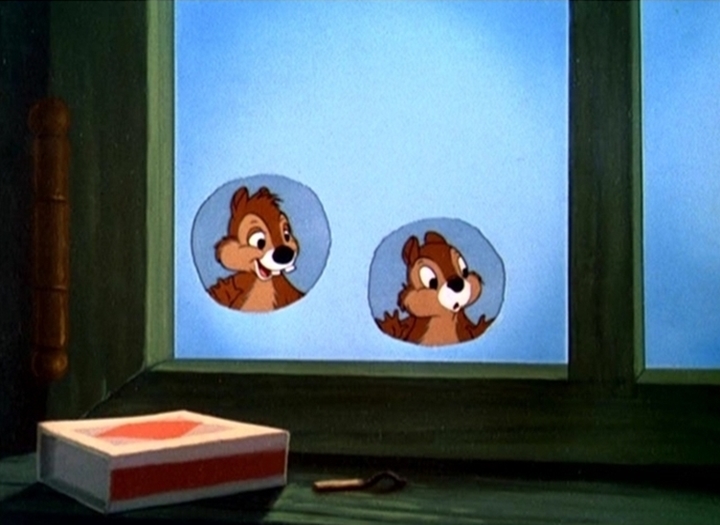 After two early appearances (‘Private Pluto‘ from 1943 and ‘Squatter’s Rights‘ from 1946) ‘Chip ‘n Dale’ marks the true debut of those lovable two little chipmunks, Chip and Dale.
In this cartoon they are named for the first time, and it’s also the first cartoon in which they are two distinct characters, although Dale still lacks his characteristic red nose here. Here they’re teamed against Donald Duck for the first time, their former adversary being Pluto. The short marks the beginning of a series of twenty cartoons, only ending in 1956, at the very end of the era of Disney shorts.
The story of ‘Chip an’ Dale’ provides the blueprint for the series: Donald wants to chop some wood for his winter cottage, and chops down the dead tree in which Chip and Dale live with their storage of nuts. In the subsequent scenes the lively duo tries to prevent Donald from burning up their tree and to get it back. The result is a cartoon of excellent comedy, not only between the chipmunks and Donald, but also between the two little critters themselves.
Watch ‘Chip an’ Dale’ yourself and tell me what you think:
This is Donald Duck cartoon No. 66
To the previous Donald Duck cartoon: Wide Open Spaces
To the next Donald Duck cartoon: Drip Dippy Donald
Director: Dick Lundy
Release Date: June 9, 1947
Stars: Woody Woodpecker
Rating: ★★★★
Review:
 Woody wants to get up early, at 5:00 Am, but he’s kept awake all night, especially by an annoying cuckoo clock.
‘Coo-Coo Bird’ is the second and the better of two Woody Woodpecker cartoons from 1947 about sleeplessness, the other one being ‘Smoked Hams’. In his struggle with inanimate things, Woody resembles Donald Duck a lot in this cartoon, not too surprising as Donald Duck was well-known to director Dick Lundy, who co-created that character. Thus, ‘Coo-Coo Bird’ is very reminiscent of the Donald Duck short ‘Early to Bed‘ (1941), and itself anticipates the Donald Duck cartoon ‘Drip Dippy Donald’ (1948) in which Donald is kept awake by a dripping tap.
Watch ‘Coo-Coo Bird’ yourself and tell me what you think:
This is Woody Woodpecker cartoon No. 22
To the previous Woody Woodpecker cartoon: Smoked Hams
To the next Woody Woodpecker cartoon: Well Oiled
‘Wet Blanket Policy’ is available on the DVD-set ‘The Woody Woodpecker and Friends Classic Cartoon Collection’
Director: Tim Burton & Mike Johnson
Release Date: September 23, 2005
Rating: ★★★★
Review:
 The shy Victor and Victoria are forced by their unsympathetic parents to marry each other.
Luckily, they actually like each other, but then Victor accidentally marries the deceased Emily who takes him to a world underground, while Victoria is forced to marry the evil lord Barkis…
‘Corpse Bride’ is a typical Tim Burton film, especially in its art direction, in its 19th century, gothic setting, in its dark humor, and in its jolly portrait of death. Because the film is also a Danny Elfman-penned musical, it feels like a successor to ‘The Nightmare before Christmas‘ (1993). Nevertheless, it is far more enjoyable than that sometimes tiresome film: ‘Corpse Bride’ features only three songs, two of which help to tell the story. So, even though one could do without the musical element, it doesn’t dominate the complete film.
Also, the art of ‘Corpse Bride’ is a great improvement on ‘Nightmare before Christmas’. The dull greys and blues of the living world contrast greatly with the vivid colors of the underworld, which is clearly more fun to ‘live’ in. The designs of the puppets are extreme, and their almost flawless animation is jawdroppingly rich and expressive. The story is lean, and focuses on the three protagonists, Victor, Victoria and Emily, who all three are very likable characters. The voice cast is impressive, and includes Johnny Depp (Victor), Emily Watson (Victoria), Helena Bonham Carter (Emily) and Christopher Lee (Pastor Gallswells).
All this make ‘Corpse Bride’, together with that other stop-motion film ‘Wallace and Gromit: the Curse of the Were-Rabbit‘, the best animated feature of 2005/2006, surpassing all computer animated films of those years. It proves that traditional animation is still viable and relevant in the computer age.
Watch the tailer for ‘Tim Burton’s Corpse Bride’ yourself and tell me what you think:
Director: Gitanjali Rao
Release Date: May 2006
Rating: ★★★★
Review:
 An old woman lives in a little flat and uses her collection of matchboxes to dream away to more adventurous lives.
In this film Rao contrasts the dull and lonely reality (in grey tones) with the colorful matchbox-based fantasies. The mood is poetic, and the film progresses at a gentle speed. Rao’s designs are sometimes naive, but her animation skills are splendid. She’s absolutely one of the masters of painted animation. Especially noteworthy is her animation of the cat. Also important is Rajivan Ayyappan’s sound design, which is spot on.
‘Printed Rainbow’ is by all means a mature work. Rao’s work is even more impressive, when one considers that she wrote, animated, directed and produced the film on her own in India, a country with a rather short animation history. Although India has made some strides in commercial animation, independent animation is still very rare. Thus Rao’s work is all the more wonderful. Luckily, more people saw it that way and Rao’s film won no less than 22 awards.
Watch ‘Printed Rainbow’ yourself and tell me what you think:
‘Printed Rainbow’ is available on the DVD ‘International Animation: Modern Classics’
Director: Gil Alkabetz
Release Date: 2004
Rating: ★★★★
Review:
 Two parrots in a cage relive the day they were caught, while their owner is asleep. Unknowingly, they betray a secret to their owner, with deadly results.
‘Morir d’Amor’ (the title comes from a Mexican song of the same name) is a funny and sweet film about love. It is told basically through the imitations the parrots make of real sounds, which evoke their memories of that fateful day. The film contrasts the dull present (in black and white) with their colorful memories of the forest.
Alkabetz shows some impressive handling of perspectives that is reminiscent of the work of George Schwizgebel. Despite the fast montage, the film suffers from a slow timing, however, and perhaps it is a bit too long. Nevertheless, its gentle humor makes it one of Alkabetz’s most accessible films, lacking the experimentalism of much of his earlier work.
Watch ‘Morir de Amor’ yourself and tell me what you think:
‘Morir de Amor’ is available on the DVD ‘International Animation: Modern Classics’
Director: Chuck Jones
Release Date: March 8, 1958
Stars: Daffy Duck, Porky Pig
Rating: ★★★★
Review:
 ‘Robin Hood Daffy’ is the last of Chuck Jones’s great series of Daffy and Porky pairings.
Like earlier entries, such as ‘Drip-along Daffy‘ (1951) or ‘Deduce You Say’ (1956), Daffy fails completely in acting out the hero he is supposed to be. In this cartoon Daffy Duck is Robin Hood, but he has a hard time proving that to a skeptical Friar Tuck (Porky Pig). He does so by relentlessly trying to rob a rich nobleman who rides on a remarkably little donkey in a hilariously silly fashion.
This nobleman character is totally unaware of the antics around him and is a late addition to a series of similar odd characters that populated many of Jones’s early films, like the Minah Bird (1941-1947) and the bearded sailor in ‘The Dover Boys‘ (1942). Daffy’s attempts, on the other hand, are more akin to those of the Coyote in the Road Runner series. The best gag is when he tries to swing on a rope, Errol Flynn-style, shouting “Yoicks and away”, only to crash into multiple tree trunks.
Porky is redesigned completely into Chuck Jones’s late design: with ridiculously cute eyelashes, anticipating similar redesigns of Jerry in Jones’s Tom & Jerry cartoons seven years later. The redesign is not a success: Porky looks a little too feminine and too cute for the purposes of the cartoon.
Watch ‘Robin Hood Daffy’ yourself and tell me what you think:
http://www.b99.tv/video/robin-hood-daffy/
This is Porky Pig cartoon no. 150
To the previous Porky Pig cartoon: Boston Quackie
To the next Porky Pig cartoon: China Jones
This is Daffy Duck cartoon No. 83
To the previous Daffy Duck cartoon: Don’t Axe Me
To the next Daffy Duck cartoon: China Jones
‘Robin Hood Daffy’ is available on the DVD-set ‘Looney Tunes Golden Collection Volume Three’
Director: Robert McKimson
Release Date: July 20, 1957
Stars: Speedy Gonzales
Rating: ★★★★
Review:
 It was Robert McKimson, not Friz Freleng, who directed the first Speedy Gonzales film ‘Cat-Tails for Two’. But it took four years before McKimson revisited this character.
By then Friz Freleng had redesigned McKimson’s creation in ‘Speedy Gonzales’, which had won an Academy Award.
McKimson’s returns to Speedy Gonzales actually results in one of Speedy’s finest films. Here Speedy tries to protect two drunken mice called Pablo and Fernando from a large grey cat. ‘Tabasco Road’ is a very talkative cartoon, but it’s also inspired and charming, especially because of the characters of Pablo and Fernando, who are as intoxicating as they are intoxicated. The best gag, however, is when Speedy’s action appears too fast for the viewer, and Speedy replays it for us in slow motion.
Watch ‘Tabasco Road’ yourself and tell me what you think:
Director: Chuck Jones
Release Date: November 10, 1956
Stars: Road Runner, Wile E. Coyote
Rating: ★★★★
Review:
 This ninth Road Runner cartoon has a deviant opening, in which we watch the coyote baking a chicken out of clay.
Of course he rather has real meat, and his attempts to catch the Road Runner include a spear on a chord, a revolver on a spring, a catapult, a bundle of maces, a half-sewn-through ladder, a wheel of dynamite sticks and a rocket.
The best gag is saved for last, in which the coyote has assembled several rocks above the road. When these fail to fall on the Road Runner, the coyote nervously tries to make them fall until he realizes that he succeeds and they will fall on him. He then brings forth a sign saying “In Heaven’s name, what am I doing?”.
‘There they Go-Go-Go’ contains the most abstract backgrounds ever conceived in a Road Runner cartoon – Maurice Noble really pushes the limits here. Nevertheless they were reused the next year in ‘Scrambled Aches’.
Watch ‘There They Go-Go-Go!’ yourself and tell me what you think:
Director: Chuck Jones
Release Date: January 5, 1945
Stars: Pepe le Pew
Rating: ★★★★
Review:
 ‘Odor-able Kitty’, marks the debut of that French-speaking, amorous skunk Pepe le Pew.
In his book ‘Chuck Amuck’ Jones reveals that this character was based on story man Tedd Pierce. In any case, Pierce wrote the story, but how much of himself he had put self-knowingly into this smelly Don Juan remains a mystery.
Oddly enough, in his first cartoon Pepe turns out to be a fraud, being married and having two children. Even his voice changes in the end of the cartoon. But before this surprising finale he’s genuinely Pepe, complete with quasi-French accent, strange hop (including Stalling’s typical theme music), and a love for cats that look like skunks.
Only, in ‘Odor-able Kitty’ this is a male cat, who deliberately disguises himself as a skunk to get a happier life. He has one, until Pepe hops along. In the end, the cat washes himself and returns to his former life as victim of maltreatment, exclaiming “this is the life!”.
Pepe le Pew’s character didn’t really develop after this film, and all his films have more or less the same story as his debut film. Nevertheless Pepe would be one of the most successful of the characters conceived by Chuck Jones, second to the Road Runner and the Coyote, only. He lasted until 1962, starring fourteen more cartoons.
Watch ‘Odor-able Kitty’ yourself and tell me what you think:
http://www.220.ro/desene-animate/12-Odor-Able-Kitty/GcMYA69rME/
Director: Shamus Culhane
Release Date: October 4, 1944
Rating: ★★★★
Review:
 Woody Woodpecker enters a barbershop to get a ‘victory’ haircut.
When the barber appears to be gone away, Woody himself steps in, maltreating a large chief and giving an Italian construction worker ‘the works’, singing the complete aria ‘Largo el factotum’ from Gioachino Rossini’s opera ‘The Barber of Seville’.
‘Barber of Seville’ is probably inspired by the barber scene from Charlie Chaplin’s ‘The Great Dictator’ (1940), which is set to a Hungarian dance by Brahms. The cartoon in its turn probably inspired Chuck Jones, who would use the opera’s overture in ‘Rabbit of Seville‘ (1950), with even better results.
‘Barber of Seville’ was the first Woody Woodpecker directed by Shamus Culhane. Culhane was an animation veteran, who had worked at Max Fleischer, Ub Iwerks, Van Beuren, Walt Disney and Warner Bros. Culhane obviously understood the character better than his predecessor Alex Lovy did: the gags in ‘Barber of Seville’ are faster and funnier, and the story is more consistent than in most of the earlier Woody Woodpecker cartoons.
Moreover, Woody Woodpecker looks better than ever before. Layout man and color stylist Art Heinemann redesigned the character to make him less grotesque, and more appealing. Unfortunately, Culhane would direct only ten Woody Woodpecker shorts, before he left the studio to set up one of his own to make animation films for television.
Watch ‘Barber of Seville’ yourself and tell me what you think:
This is Woody Woodpecker cartoon No. 10
To the previous Woody Woodpecker cartoon: Ration Bored
To the next Woody Woodpecker cartoon: The Beach Nut
‘Barber of Seville’ is available on the DVD-set ‘The Woody Woodpecker and Friends Classic Cartoon Collection’
Director: Frank Tashlin
Release Date: November 3, 1944
Rating: ★★★★
Review:
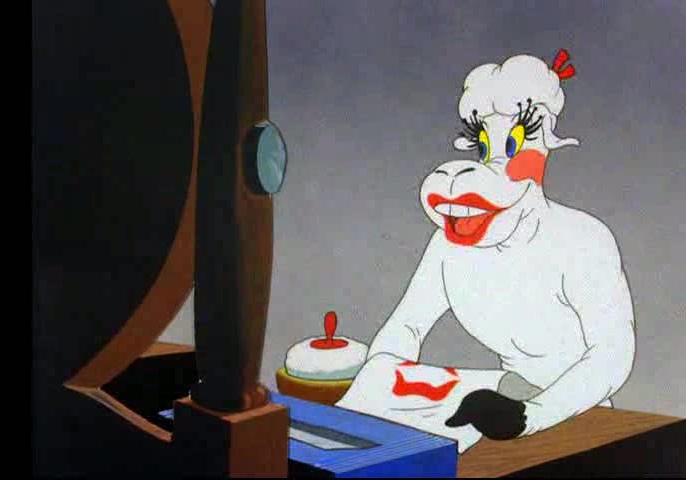 ‘I Got Plenty of Mutton’ opens with a hungry wolf reading in the newspaper that the sheepdog is drafted, leaving the sheep unprotected.
Unfortunately, Killer-Diller, “the wolf destroying ram” is now in charge, giving the wolf a hard time, especially when the wolf dresses up as a sexy female sheep tot lure the ram away. When to get rid of the horny ram, the wolf reveals himself as being a wolf, the ram simply replies “so am I!”.
This cartoon is full of zany silent comedy, with frequent looks into the camera by the poor wolf, anticipating similar looks by Chuck Jones’ Coyote in his Road Runner series.
Watch an excerpt from ‘I Got Plenty of Mutton’ yourself and tell me what you think:
Director: Chuck Jones
Release Date: December 12, 1942
Stars: Bugs Bunny
Rating: ★★★★
Review:
 Bugs Bunny is bullied by a large magician, leading to his catch phrase “Of course you realize this means war”. In the second part of the film Bugs Bunny wrecks the magician’s show, and finally the magician himself.
Bugs’s catch phrase was borrowed from Groucho Marx, an important inspiration on Bugs Bunny’s character anyhow. The line would become typical for Bugs as directed by Chuck Jones. Unlike Bob Clampett, Jones would treat the rabbit not as intrinsically mischievous, but as reacting to injustice placed on him.
The large magician in ‘Case of the Missing Hare’ is the first of many particularly large adversaries Jones gave to Bugs, all bullying the rabbit into action. Thus, the magician is the direct forerunner of e.g. the warehouse keeper in ‘Hare Conditioned‘ (1945), the crusher in ‘Rabbit Punch‘ (1948) and Giovanni Jones in ‘Long-Haired Hare‘ (1949).
‘Case of the Missing Hare’ shows that by the end of 1942 Chuck Jones’s mastery over material had become fully realized. The cartoon features his typical character designs, extravagant key poses, original camera angles and sense of design. The latter is exemplified by background artists Gene Fleury and John McGrew’s very unnatural backgrounds. In the first part we watch pink trees and yellow skies. In the second part they got even bolder, reducing the backgrounds to abstract forms in two colors, only.
In its typical and original design and cinematography ‘Case of the Missing Hare’ looks forward to Jones’ mature work of the late forties and fifties.
Watch ‘Case of the Missing Hare’ yourself and tell me what you think:
This is Bugs Bunny cartoon No. 14
To the previous Bugs Bunny cartoon: The Hare-Brained Hypnotist
To the next Bugs Bunny cartoon: Tortoise Wins by a Hare
Director: Friz Freleng
Release Date: March 28, 1942
Stars: Bugs Bunny, Elmer Fudd
Rating: ★★★★
Review:
 Elmer Fudd will inherit three million dollars from Uncle Louie, if he doesn’t hurt any animal, especially rabbits. Bugs, of course, takes advantage of the situation.
‘The Wabbit Who Came to Supper’ was Friz Freleng’s second Bugs Bunny cartoon, only, but he understood the brassy character completely. The highlight of the cartoon is the scene in which in the middle of a chase a clock chimes and Bugs bursts into a convincing New Year routine… in July. This scene not only shows the fresh character’s overpowering personality, it also shows Bugs Bunny’s ability to produce necessary attributes out of nowhere, this time confetti and streamers.
Bugs’ design, however, is rather unappealing and uncertain in this cartoon. And Elmer Fudd, too, has the less appealing alternate fatty design, which Robert Clampett had introduced in ‘Wabbit Twouble‘ (1941). Luckily, this design was short-lived and lasted only four cartoons.
Two years later Hanna and Barbera would use the same plot idea in the Tom and Jerry cartoon ‘Million Dollar Cat’ (1944) with even better results.
Watch ‘The Wabbit Who Came to Supper’ yourself and tell me what you think:
This is Bugs Bunny cartoon No. 8
To the previous Bugs Bunny cartoon: Wabbit Twouble
To the next Bugs Bunny cartoon: The Wacky Wabbit
Director: Chris Wedge
Release Date: March 15, 2002
Rating: ★★★★
Review:
 Set in the last ice age (ca. 20,000 years ago), a mammoth and a ground sloth try to return a human baby to its tribe, helped by a saber-toothed tiger with a hidden agenda.
The Ice Age itself is depicted well, with lots of crispy ice and snow, and fauna that matches the period. We watch various North-American ice age mammals, like mammoths, ground sloths, saber-toothed tigers, Glyptodonts, and even the South American species Macrauchenia (which looks like a llama with a trunk). The only mishaps are the two Brontotheres, mistakenly referred to as “rhinos”, a group of species that had died out 34 million years earlier. Fortunately, the makers didn’t fall for the trap of making dinosaurs co-exist with early humans (although we see one trapped in the ice, in a scene that is nonsensical anyhow).
‘Ice Age’ was Blue Sky’s first feature film. It was made for 20th Century Fox, who had just dumped Don Bluth’s Phoenix Studio. With this film Blue Sky/20th Century Fox posed serious competition to Dreamworks and Pixar with a different, yet equally interesting style of computer animation, which was more based on caricature, exaggerated animation and angular designs. The latter unfortunately lead to rather ugly designed humans.
The story of ‘Ice Age’ has uncanny similarities to the computer animation successes of 2001, ‘Shrek’ (a moody giant and an annoying chatterbox travel together), and ‘Monsters, Inc.‘ (strange creatures trying to get a little human kid home). So in this respect, the film tells us nothing new. Its extras can be found in the cartoony character Scrat, whose antics bridges the main action, and in the numerous gags on evolution.
The highlight of the film, however, is the 2D animation of mural paintings depicting Mannie the mammoth’s painful memory of the loss of his wife and son. This is a stunning tour-de-force of both daring and emotional animation, still a rare feat in computer animated feature films.
‘Ice Age’ was a huge success, and has spawned a number of sequels, none of witch mastered to keep the lean storytelling of the first film. Moreover, the stories had less and less to do with the ice age setting. Even worse, in ‘Ice Age 3’ dinosaurs had to come along, after all…
Watch the trailer for ‘Ice Age’ yourself and tell me what you think:


 Dr. Grob's Animation Review