
You are currently browsing the category archive for the ‘★★★★’ category.
Director: Bruno Bozzetto
Release Date: October 31, 1968
Rating: ★★★★
Review:

‘Vip mio fratello superuomo’* is Bozzetto’s second feature, and it a great improvement on his first (‘West and Soda‘ from 1965).
The designs are bolder, the pace is higher, the timing sharper, and the story more original. The film starts rightaway with a hilarious history of the VIP superheroes through time. It then introduces our heroes, the superhero SuperVIP and his weak little bespectacled brother, MiniVIP. They end upon an island where a super-villain plans to turn mankind into brainless consumers.
The result is a very nonsensical superhero story, told to a great effect, with the minimum of means and very limited animation. It also shows Bozzetto’s aversion against consumerism, a theme he would expand upon in his masterpiece ‘Allegro non troppo’ (1976). Unlike that latter feature, ‘Vip mio fratello superuomo’ remains virtually unknown. This is a pity, for this funny film deserves a wider audience.
Watch and excerpt from ‘Vip mio fratello superuomo’ yourself and tell me what you think:
* also known as ‘My Brother Superman’
Director: Bruno Bozzetto
Release Date: 1967
Rating: ★★★★
Review:
 The title of this cartoon can be translated as ‘life in a tin can’ and this is an apt title.
In this cartoon Bozzetto reduces a man’s whole life to several minutes. The main character’s life takes place in and between depressingly tall grey buildings. He is only allowed brief episodes of sheer joy: during is boyhood, when he falls in love, and when he becomes a father. These short episodes are depicted by colorful pictures of nature, accompanied by lyric music.
‘Una vita in scatola’ must be Bozzetto’s most perfectly timed cartoon, and it is his first real masterpiece.
Watch ‘Una vita in scatola’ yourself and tell me what you think:
Director: Unknown
Release Date: October 31, 1927
Stars: Oswald the Lucky Rabbit
Rating: ★★★★
Review:
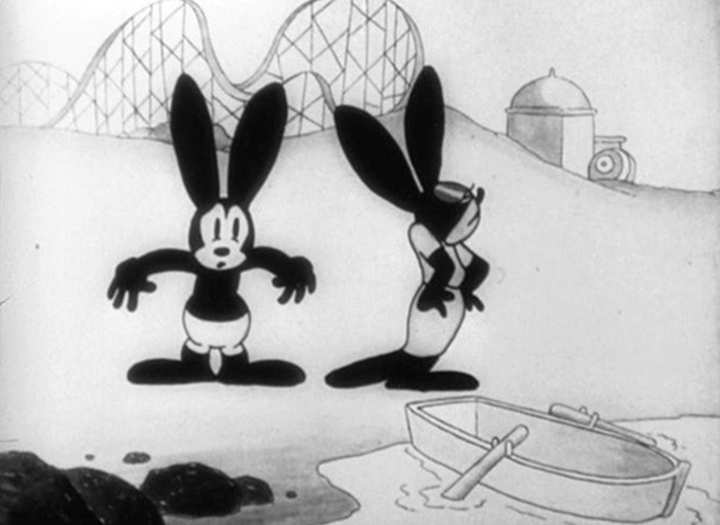 In his fifth film Oswald is a hot dog vendor at the beach.
At one point his girlfriend drops by, only to give him the cold shoulder, so Oswald pretends to be a lifeguard. The girl in turn pretends to drown, but then she really get suck into the ocean by a giant fish. Oswald comes to the rescue and earns a passionate kiss.
Although this film still contains some stiff animation and designs from the early 1920s (for example the dog customer), most of the animation is very flexible and lively, especially that of Oswald and the sea. Many of the hot dog gags were reused in the Mickey short ‘The Karnival Kid‘ (1929).
Watch ‘All Wet’ yourself and tell me what you think:
This is Oswald the Lucky Rabbit cartoon No. 5
To the previous Oswald the Lucky Rabbit cartoon: Great Guns
To the next Oswald the Lucky Rabbit cartoon: The Ocean Hop
Director: Kōji Morimoto, Tensai Okamura & Katsuhiro Otomo
Release Date: December 23, 1995
Rating: ★★★★
Review:
Seven years after ‘Akira‘, Katsuhiro Otomo returned to the animated screen with ‘Memories’, a package film, which impresses, but fails to reach the heights of ‘Akira’. Indeed, the film is much, much less well known than either Otomo’s previous film, or ‘Ghost in the Shell‘, which was the anime hit of 1995.
Based on his own short stories, ‘Memories’ consists of three unrelated parts: ‘Magnetic Rose’, ‘Stink Bomb’ and ‘Cannon Fodder’, which are discussed separately below.
 Magnetic Rose
Director: Kōji Morimoto
Rating: ★★★★★
‘Magnetic Rose’ starts the Memories trilogy, and it’s arguably the feature’s most satisfying episode. Animated by Morimoto’s own Studio 4°C, it is the only part that clearly deals with memories.
In this episode a rescuing squad of space garbage collectors is ensnared in the memories of a long deceased opera singer, who still seems alive in her remote satellite home in space, blurring the boundaries of reality. This accounts for an exciting story, greatly enhanced by Yoko Kanno’s superb soundtrack, in which she mixes an eerie choir, ambient guitar work and dark electronic with bites of Giacomo Puccini (the famous aria ‘un bel di vedremo’ and the finale from ‘Madame Butterfly’, an opera set in Japan, and a small soundbite from ‘Turandot’, which is set in China). Also featured is a stage set from Puccini’s ‘Tosca’, in which the opera singer, as Tosca, stabs Heinz, one of the rescuers.
Even though the science fiction setting with its touches of horror is typical anime, the underlying drama is very mature and quite unique. This episode’s screenplay was penned by future director Satoshi Kon. Kon certainly established himself with this screenplay, and he would further explore the theme of memory and loss in ‘Millennium Actress’ (2001), and the blurring of reality and fantasy in both that film and ‘Paprika’ (2006) with even more spectacular results. Director Kōji Morimoto, meanwhile, would prove his worth as a director in ‘Beyond’, the best episode of ‘The Animatrix‘ (2003).
In ‘Magnetic Rose’ the characters are from all over the world, and this is one of the few anime, in which the Japanese character looks distinctively Asian compared to the European characters.
 Stink Bomb
Director: Tensai Okamura
Rating: ★★★
Penned by Katsuhiro Otomo, but directed by Tensai Okamura, and animated by the Madhouse animation studio, ‘Stink Bomb’ feels like a comical interlude between the two more serious outer episodes. The story is set in present day Japan and features a very stupid, but surprisingly indestructible protagonist who turns into a nonsensical weapon of mass destruction. The story is simple: Nobue Tanake, our ‘hero’, works in a biochemical laboratory. To cure his cold one of his colleagues suggests he takes a sample of the new medicine they’ve developed at the lab. But Tanake accidentally swallows the wrong pills, which turn him into a lethal weapon, sweating poisonous gasses that kill everything in sight. Although he remains unaware of this, he becomes the cause of the annihilation of Japan.
This story is rather silly – there’s a lot of broad comic acting, and it even ends with a kind of punch-line. And yet, the episode manages to be unnerving at the same time; the short has some disturbing undertones, with the fear of mass destruction weapons and corrupt governments played out well. The unsettling atmosphere is greatly enhanced by Jun Miayke’s score, in which he uses nervous free jazz saxophones to a great effect.
 Cannon Fodder
Director: Katsuhiro Otomo
Rating: ★★★★½
Otomo himself directed the last and most beautiful sequence of Memories. This episode once again is animated by Studio 4°C, but has a distinctive graphic style that doesn’t resemble any other anime. Especially the background art and character design are highly original. But even more startling is the fact that the film is ‘shot’ in one long camera take (with a little bit of smuggling, but very impressive nonetheless). The cinematography is outstanding, and uses a little bit of computer animation. One moving shot of a colonel ascending on a platform is a great piece of character animation. Nevertheless, the boys’ own dream of becoming a colonel himself, done in charming children’s drawings, may be the highlight of the entire film.
‘Cannon Fodder’ deals with an alternative, distinctively European world, where a totalitarian military regime enters every aspect of life. It’s a kind of steam punk, vaguely based on images of the first world war, with its giant cannons, gas masks, and pompous generals. We’re following one day in the life of a single family. They live in a city were all work and school is directed to a war with a mysterious city, which remains unseen throughout the movie. This war is fought entirely by using cannons, fired at the distant enemy.
Despite the caricatured humans, the atmosphere is hardly comical, but dark and disturbing. The unseen foe reminds one of ‘1984’, and one wonders whether the enemy is real – but then, in the end, the air alarm kicks in. ‘Cannon Fodder’ is more a film of concept than of drama, and thus less engaging than ‘Magnetic Rose’. Still, because of its unique style, and strict control of cinematography, ‘Cannon Fodder’ is a small masterpiece.
Watch the trailer for ‘Memories’ yourself and tell me what you think:
‘Memories’ is available on DVD and Blu-Ray
Director: Hayao Miyazaki
Release Date: August 2, 1986
Rating: ★★★★
Review:
 Drawing inspiration from Jonathan Swift’s ‘Gulliver’s Travels’, ‘Laputa, Castle in the Sky’ takes Miyazaki’s love for flying machines to the max, introducing a humongous flying island.
Its story is set in a parallel world, which has a genuinely late 19th century European feel, but where flying machines are very common. The strange machines imagined for the film are both wonderful and convincing.
We follow the two orphan children Pazu, a poor mine worker, and Sheeta, who falls from the sky carrying a mysterious amulet, which reveals that she’s a Laputan princess. Followed by the Dola clan, a gang of pirates led by an old pink-haired woman, and by the military led by the enigmatic gentleman Muska, the children seek out to find the flying island.
Unlike other films by Miyazaki, ‘Laputa’ knows a real villain, the ruthless prince Muska. While the children admire Laputa for its nature, and while the pirates and the soldiers are only after its treasures, Muska seeks the island’s destructive possibilities to obtain world power. On the way, the film moves to a grander and grander scale, with a finale on the floating island that shows us dazzling heights, and which doesn’t eschew many killings, making ‘Laputa: Castle in the Sky’ Miyazaki’s most violent movie.
‘Laputa: Castle in the Sky’ is Studio Ghibli’s very first feature film. It’s akin to the earlier ‘Nausicaä of the Valley of Wind‘ (which predates the studio’s foundation) in its focus on the importance of love and nature and its aversion to short-minded people only interested in power and destruction. Despite its violent finale, ‘Laputa’ is more overtly a film for children than ‘Nausicaä’. Its focus stays with the rather naive children, and it contains more humor, especially in the depiction of the pirates, who are almost used as a comic relief only.
In any sense, ‘Laputa’ is a powerful film: its depiction of an original made-up world is convincing, its animation is outstanding, and its message complex and far from black and white. It once again shows the mastery of Miyazaki and the Ghibli studio.
Watch the trailer for ‘Laputa: Castle in the Sky’ yourself and tell me what you think:
Director: Ah Da
Release Date: 1980
Rating: ★★★★
Review:
 In ‘Three Monks’* Ah Da retells an ancient Chinese proverb: one monk can carry two buckets of water, two can carry one, but three…
Three monks visit a house on a hill top to meditate and to worship Buddha. Unfortunately, they have to fetch their water in the lake below. Only after a fire they are willing to cooperate in this.
The film uses clear and simple designs and very elementary backgrounds. Its storytelling is very lean, and uses no dialogue. Unfortunately, like many other Chinese animation films, it also suffers from slowness. Ah Da clearly takes his time, telling his story on a leisurely speed. The result is a meditative film, the comedy notwithstanding.
Watch ‘Three Monks’ yourself and tell me what you think:
‘Three Monks’ is available on the French DVD ‘Impression de montagne et d’eau’
* this film is also known by its French title: ‘Les trois moines’
Director: Frank Tashlin
Release Date: October 30, 1937
Stars: Porky Pig, Petunia Pig
Rating: ★★★★
Review:
 In this cartoon Porky suddenly has three elder brothers (Peter, Portus, and Percy), while Petunia appears to be his sister.
The siblings inherit their estate from their late uncle Solomon (who’s a caricature of Oliver Hardy). Unfortunately, the evil lawyer Goodwill is after them, changing himself into a Dr. Hyde-like character. Strangely enough he insults somebody in the audience, the “guy in the third row”. This to his own regret, for it’s this guy who saves Porky and his siblings in the end! This type of dimension-defying humor was a novelty at the time and would become a Warner Bros. trademark in the late 1930s and early 1940s.
Watch ‘The Case of the Stuttering Pig’ yourself and tell me what you think:
This is Porky Pig cartoon no. 31
To the previous Porky Pig cartoon: Rover’s Rival
To the next Porky Pig cartoon: Porky’s Double Trouble
Director: Frank Tashlin
Release Date: August 22, 1936
Stars: Porky Pig
Rating: ★★★★
Review:
 Both director Frank Tashlin and composer Carl Stalling make their Warner Bros. debut in this film in which Porky (with his old ugly voice) has a fowl farm, threatened by a bunch of evil buzzards.
‘Porky’s Poultry Plant’ looks primitive when compared to Disney films of the same time, looking more like a Disney film from 1932-1933. Its story is sweet, and not very funny, but Carl Stalling’s music is fresh, and Tashlin’s staging is already very impressive. Especially the air battle sequence (in which Porky, in a small army plane, fights an air fleet of hawks ) is remarkably stunning, showing unparalleled fast montage and original ‘camera’ shots. Both these techniques would become Tashlin trademarks, and would contribute to a faster, more gag-orientated style at Warner Bros. Tashlin had replaced Jack King, who had returned to Disney, and with his first Warner Bros. cartoon he immediately proves to be a more inventive director than his predecessor.
Watch ‘Porky’s Poultry Plant’ yourself and tell me what you think:
http://www.supercartoons.net/cartoon/822/porky-pig-porkys-poultry-plant.html
This is Porky Pig cartoon no. 12
To the previous Porky Pig cartoon: Porky the Rainmaker
To the next Porky Pig cartoon: Milk and Money
Director: Boris Kossmehl
Release Date: 1993
Rating: ★★★★
Review:
 When she hasn’t paid her washing machine, a girl’s aunt has to go to hell.
However, she soon returns as a zombie to fetch her handbag. The devil tries to take her once again, this time disguised as the handbag.
Atypical for the Aardman studios, ‘Not Without My Handbag’ features puppet animation and hardly any clay animation. It’s a highly designed film, using stark colors, extreme camera angles and expressionistic decors. Its unique style is somewhat akin to that of Tim Burton, but is even more idiosyncratic. Despite its horror theme, the film is more lighthearted than the earlier Aardman films ‘Adam‘ (1991) or ‘Loves Me, Loves Me Not‘ (1992), because of its zany humor and matter-of-fact dialogue. For example, when her aunt returns as a zombie, the girl suddenly turns to camera and says proudly: “My auntie is a zombie from hell!”.
‘Not Without My Handbag’ is a modest masterpiece: it’s unpretentious, but it combines originality with virtuosity. The animation of the evil handbag is particularly good. Director-animator Boris Kossmehl later moved to 3D computer animation, performing character animation for Dreamworks’ ‘Antz’ and ‘Shrek’.
Watch ‘Not Without My Handbag’ yourself and tell me what you think:
‘Not Without My Handbag’ is available on the DVD ‘Aardman Classics’
Director: ?
Release Date: 1987
Rating: ★★★★
Review:
 ‘My Baby Just Cares For Me’ was Aardman Studio’s second video clip, after ‘Sledgehammer’ for Peter Gabriel (1986).
‘My Baby Just Cares For Me’ is not quite as elaborate, however. It’s a sweet little video in mostly black and white. It’s set to Nina Simone’s 1958 recording of the song, which was reissued in 1987 after being used in a successful commercial for Chanel No.5.
The clip features cat characters, including a black female cat singer, and a white cat who’s in love with her. It also features some live action footage showing details of a piano, brushes on a snare drum, and a double bass.
The smoky nightclub atmosphere is captured very well, and the animation, joyful if a little crude, matches the song perfectly. The result is one of the most enjoyable little stop motion films of the 1980s.
Watch ‘My Baby Just Cares For Me’ yourself and tell me what you think:
‘My Baby Just Cares For Me’ is available on the DVD ‘Aardman Classics’
Director: Paul Driessen
Release Date: 1982
Rating: ★★★★
Review:
 ‘Oh What a Knight’ is a short and funny gag film in which a knight rescues a princess from a dragon, a cyclope, a snake and a villain, only to watch her fall in love with his empty shiny armor.
Driessen’s unique animation style is most present in this cartoon. For example, the knight has an odd way of falling to pieces and reassembling himself. ‘Oh What a Knight’ is one of Driessen’s funniest films. In fact it would not be surpassed until his ‘3 Misses’ from 1998.
Watch ‘Oh What a Knight’ yourself and tell me what you think:
‘Oh What a Knight’ is avaiable on the DVD ‘The Dutch Films of Paul Driessen’
Director: Georges Schwizgebel
Release Date: 1982
Rating: ★★★★
Review:
 ‘Le ravissement de Frank N. Stein’ starts with very abstract images, which resolve into Frankenstein’s laboratory as depicted in the film from 1931.
After 1’40 we become the monster itself, walking through endless chambers and corridors and staircases in an almost computer animation-like long sequence of perspective animation. The rooms, initially filled with abstract shapes, become more and more complex. They contain more and more windows and human forms, and finally moving human forms, ending with multiple copies of the monster’s bride. In the end we watch the monster itself, in his depiction by Boris Karloff. he smiles at his bride, but she only screams…
This film, which is set to very nervous electronic music, is a very impressive study of perspective: we really feel we are walking. The film has a repetitive and dreamlike quality, which is enhanced by its surreal settings, reminiscent of paintings by Giorgio de Chirico.
Watch ‘Le ravissement de Frank N. Stein’ yourself and tell me what you think:
‘Le ravissement de Frank N. Stein’ is available on the DVD ‘Les Peintures animées de Georges Schwizgebel’
Compiler: Marv Newland
Release Date: 1985
Rating: ★★★★
Review:
 Anijam is a compilation cartoon, organized by Marv Newland, and animated by 22 different animators.
The short features a strange yellow fellow on high heels called Foska. All scenes start and end with this character, and most of the animators feature him in their own scenes. The result is a dazzling string of totally unrelated scenes, some funny, some weird and some totally abstract.
A few animators bring their own typical style strongly into their scenes, like Zdenko Gašparović, Sally Cruikshank and Paul Driessen, others turn to abstract patterns, like Kathy Rose, Kazurai Furuya, and Per Lygum. The latter’s contribution is an early computer animation, featuring geometrical forms only. Highlight, however, is Frank Nissen’s contribution, in which a swimming octopus transforms into a naked woman.
The complete film is an ode to the imagination of the animators and the endless possibilities of the medium.
Watch ‘Anijam’ yourself and tell me what you think:
‘Anijam’ is available on the DVD inside the book ‘Animation Now!’
Director: Te Wei
Release Date: 1960
Rating: ★★★★
Review:
 ‘Where is Mama’* is a charming little film in which we watch a school tadpoles seeking their mother.
They mistake two shrimps, a goldfish, a crab, a turtle and a catfish for their mother, before their real mother finds them.
Told by a voice-over, ‘Where is Mama’ is a genuinely Chinese film: it is based on an ancient Chinese fable, it is typically preoccupied with nature and water, its watercolor and ink style is based on classic Chinese painters (most obviously Qi Baishi), and it is set to a serene and leisurely speed.
The result is a film that is a bit slow, but poetic in feel and strikingly beautiful. The short looks timelessly Chinese, but at the time of its release the film’s style was completely new and daring within the Chinese animation film world. However, it would take ca. twenty years before its influence became clear, because five years after the making of this cartoon the Shanghai Animation Studio was shut down as part of the Cultural Revolution, and many of its employees were sent to re-education camps in the countryside. Only in the late seventies it would be up and running again. In the following decade ‘Where is Mama’ would be an inspiration to many Chinese animators, who would reuse several of this film’s key elements. In that decade, too, Te Wei made his own masterpiece, ‘Feeling from Mountain and Water‘ (1988).
Watch ‘Where is Mama’ yourself and tell me what you think:
‘Where is Mama’ is available on the French DVD ‘Impression de montagne et d’eau’
* this film probably is best known by its French title: ‘Les têtards à la recherche de leur maman’
Directors: John Halas & Joy Batchelor
Release Date: 1948
Rating: ★★★★
Review:
 ‘Magic Canvas’ is rather pretentiously introduced as “something different (….), new and exciting”.
Luckily, the film is rather original and exciting: using a rather abstract score by Hungarian composer Mátyás Seiber, it consists of associative images with a strong sense of surrealism. It loosely tells the story of man struggling to be free. Even though it has to pay its debts to Disney’s ‘Fantasia’ (1940), ‘The Magic Canvas’ surely is one of the most avant-gardistic films of its time, and a testimony of Halas & Batchelor’s animation ambitions.
Watch ‘Magic Canvas’ yourself and tell me what you think:
‘Magic Canvas’ is available on the DVD inside the book ‘Halas & Batchelor Cartoons’
Director: Lev Atamanov
Release Date: 1951
Rating: ★★★★
Review:
 ‘The Yellow Stork’ is a Russian fairy tale film set in China.
The film tells about a flute player, whose music is so vivid, it can bring a drawing of a stork to life. An evil mandarin captures the bird, demanding it to perform for him. But the stork will only dance to the flute player’s music, and when it hears this music, it flies away through the window.
This film, which uses song, seems to celebrate music and freedom and appears to be a pamphlet against oppression, which is remarkable for a film made under Stalin’s rule. The animation in this short is very good, with beautifully animated humans. The result is one of the more enjoyable Soviet films of the era.
Watch ‘The Yellow Stork’ yourself and tell me what you think:
Director: Dmitry Babichenko
Release Date: 1950
Rating: ★★★★
Review:
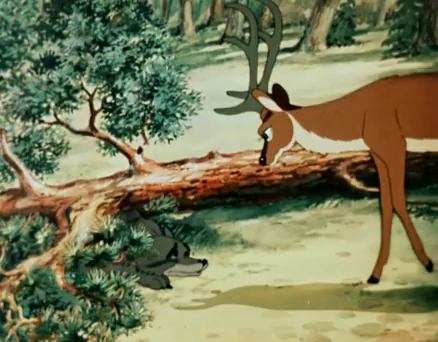 A wolf gets trapped under a tree. A stag helps him out, but as soon as he is free, the wolf tries to catch and eat his helper.
The stag claims this to be unjust, and the two animals ask a bear to be a referee. The bear restores the initial situation to be able to judge the argument, but then runs off with the deer, leaving the wolf under the tree again.
‘The Stag and the Wolf’ is a typical Russian animation film from the early fifties, this time based on an ancient tale (it’s even found among folk tales in Cameroon, albeit with different animals). Like contemporary Soviet films, it has the distinct flavor of Russified Disney. The film pushes the limits of Soviet naturalism, especially in the backgrounds. The bear, however, is very Disney-like, and a little at odds with the particularly realistically designed stag.
Watch ‘The Stag and the Wolf’ yourself and tell me what you think:
Director: Olga Khodatayeva
Release Date: 1950
Rating: ★★★★
Review:
 ‘The Magic Windmill’ is one of the classic fairy-tale films produced by the Soviet Union in the 1950s.
In this short an old man, a cat and a cock are having trouble to feed all the animals who seek shelter at their place. Therefore they ask the mountain god for help, who gives them a magical little windmill, which produces endless amounts of breads out of of a few grains of corn. Unfortunately, rumor spreads, and soon the little windmill is stolen by a greedy king. But the cock flies to his palace and brings back the magical object, despite several attempts on his life.
‘The Magic Windmill’ is a gentle, if what overlong little film based on a Russian fairy-tale. It uses a naturalistic style, clearly influenced by Disney, with watercolor backgrounds, and a multiplane camera effect in its opening scene . The animal designs are an interesting mix of the Disney style and Russian illustration art. The animation, however, leaves a lot to desire. The animation of movement is awkward, with most characters moving in a slow, all too constant speed. The film uses dialogue in rhyme, but the lip synchronization with the characters is poor.
Despite these flaws, ‘The Magic Windmill’ is a film of great poetry, and one of the best of the Russian fairy tale films of the fifties. Indeed, director Khodatayeva was a veteran of soviet animation, having made films since the 1920s.
Watch ‘The Magic Windmill’ yourself and tell me what you think:
Director: Paul Driessen
Release Date: 1980
Rating: ★★★★
Review:
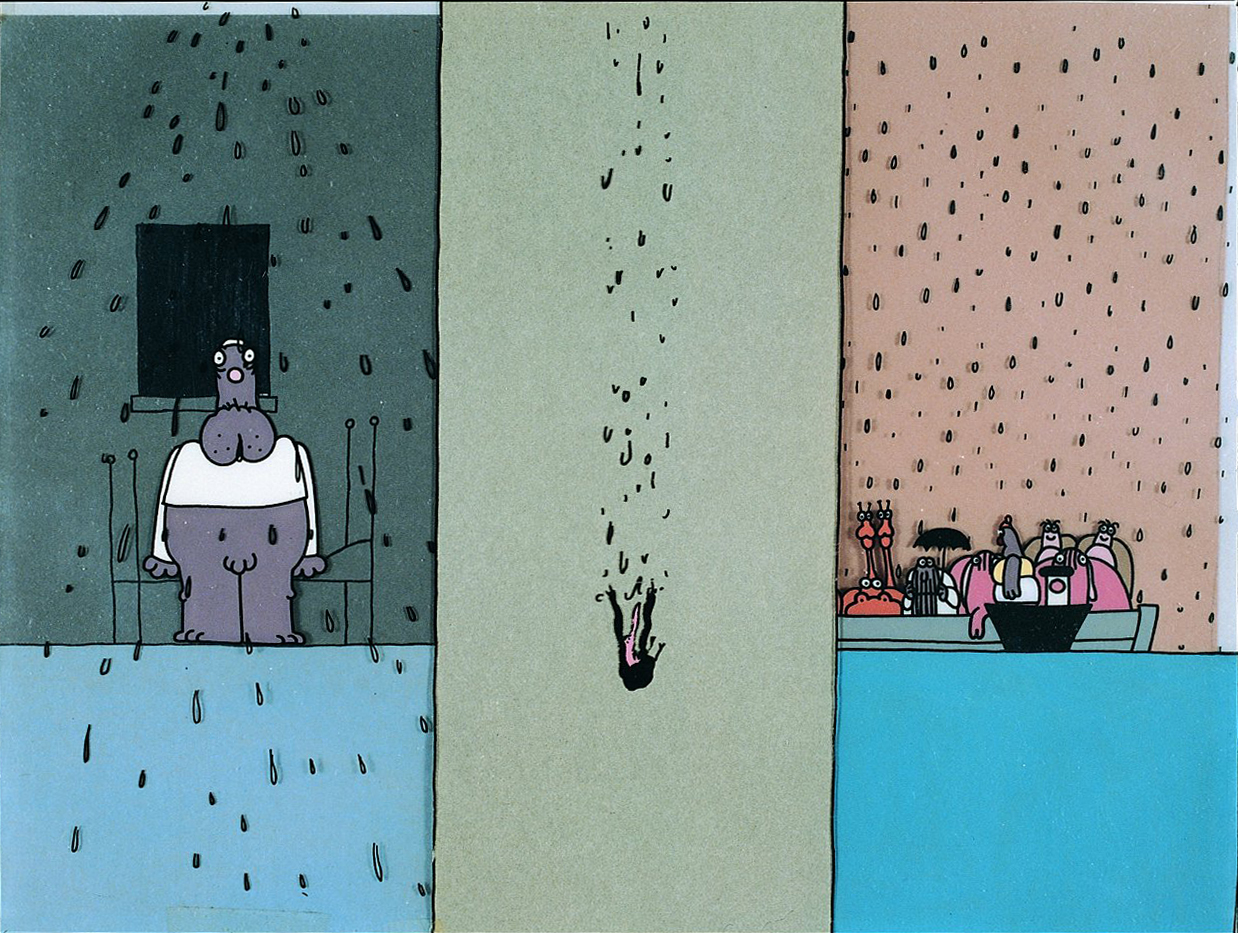 In this film Paul Driessen experiments with the split screen for the first time.
Here we see three narrow frames: the left frame (Land) depicting a sleeping man, the middle one (Air) a bird, and the right one (Sea) a couple on a boat on the ocean. The story involves several themes explored in all three frames, which at times interact but only come together in the end
Like many of Paul Driessen’s shorts ‘Te land ter zee en in de lucht’ involves morbid humor, including a running gag of an ark sinking several times. The film uses no dialogue and no music, only sound effects with very effective results.
Driessen would take the split screen technique to the max in ‘The End of the World in Four Seasons’ (1995), but the genius of ‘Te land, ter zee en in de lucht’ would only be topped by his melancholy film ‘The Boy Who Saw the Iceberg’ from 2000.
Watch ‘Te land, ter zee en in de lucht’ yourself and tell me what you think:
‘Te land, ter zee en in de lucht’ is available on the DVD ‘The Dutch Films of Paul Driessen’
Director: Georges Schwizgebel
Release Date: 1974
Rating: ★★★★
Review:
 In ‘le vol d’Icare’ a man wants to fly like the birds. In the end he succeeds.
More important than the plot, however, is the technique of this film, which makes use of huge pixels, giving it a very digital look. Even though the man and the birds are extremely simplified, their motions are instantly recognizable. Even more remarkable is that the film contains some kind of baroque feel, amplified by Louis Couperin’s harpsichord music.
‘Le Vol d’Icare’ was Swiss animator Georges Schwizgebel’s first animated film. It doesn’t resemble his later films. In fact, it doesn’t resemble any other animation film. But it already shows Schwizgebel’s originality and virtuosity, and it can be considered his first masterpiece.
Watch ‘Le vol d’Icare’ yourself and tell me what you think:
‘Le vol d’Icare’ is available on the DVD ‘Les Peintures animées de Georges Schwizgebel’


 Dr. Grob's Animation Review