
You are currently browsing the category archive for the ‘★★★★’ category.
Director: Osvaldo Cavandoli
Release Date: 1974
Stars: La Linea
Rating: ★★★★
Review:
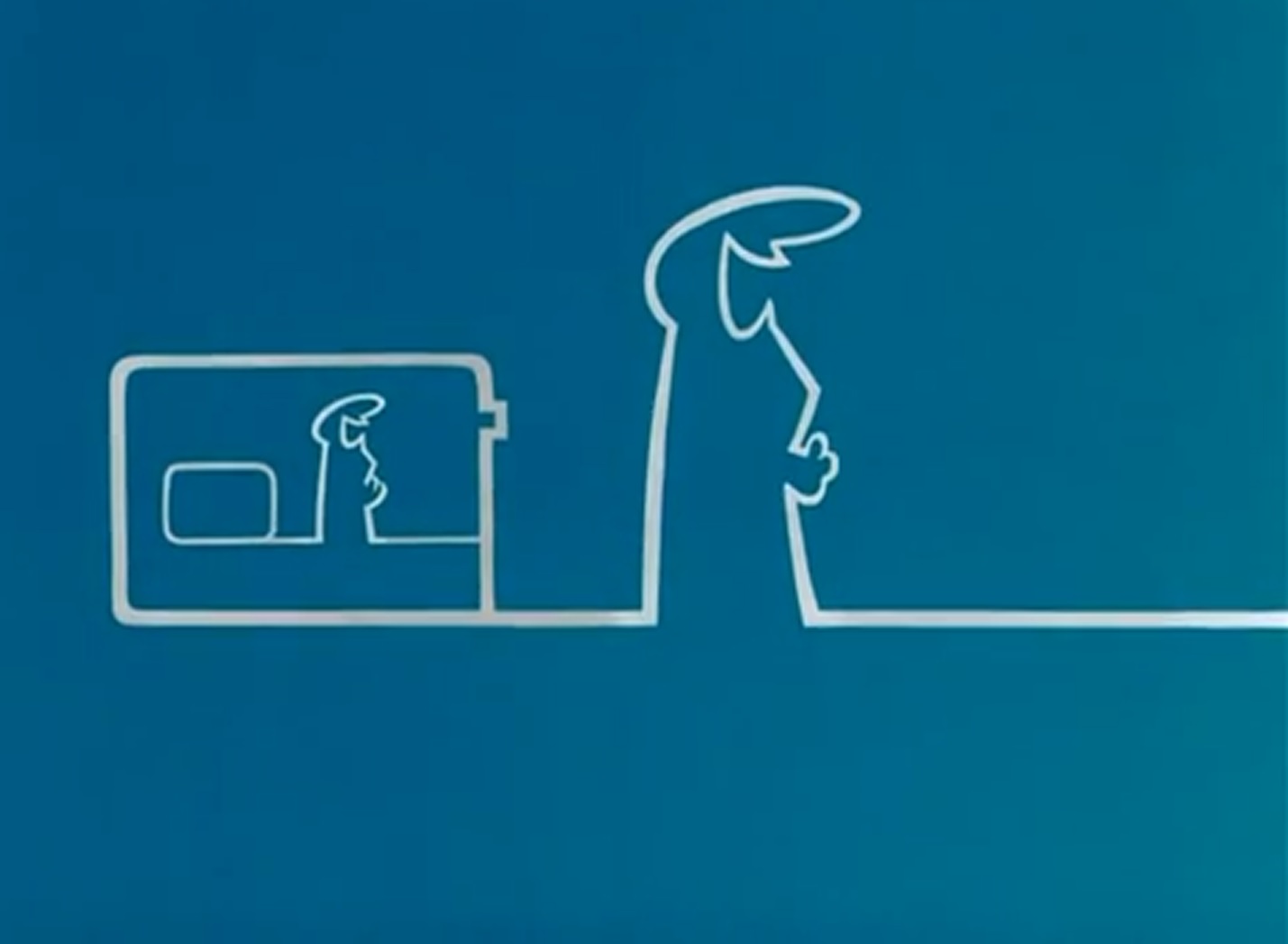 La Linea is an Italian television series, which takes graphic design, introduced by UPA to the animated screen, to the max.
The first of all La Linea shorts defines the complete series: it consists of numerous unrelated gags around the jabbering little man Linea, who lives in a 2-dimensional world, consisting of only one white line, of which he is part.
This cheerful, but temperamental guy has some characteristics that return in every single episode: First, he talks an Italian-sounding sort of gibberish, provided by voice actor Carlo Bonomi. Second, he always walks to the left of the screen. Third, he always encounters at least one interruption of the line during his walk. Fourth, he frequently argues with his off-screen creator, of whom we only see his hand drawing things for the little guy. And Fifth, our hero has also has an intoxicating laugh, which is heard at least once.
All designs are extremely stylized, yet perfectly recognizable, and beautifully animated. The backgrounds are monochromic, changing from green to red to blue etc. All these elements make this series such a classic, even though most of the episodes are completely plotless, and only last about 2 minutes.
In this particular episode La Linea encounters a turtle, a television set, a tap and a woman. He plays golf and takes a rollercoaster ride. It doesn’t make any sense, but it’s fun. Franco Godi’s music in this particular cartoon is more present than in the following ones, using a tune with voices instead of the instrumental background music of later cartoons.
Watch ‘La Linea episode 1’ yourself and tell me what you think:
‘La Linea episode 1’ is available on the DVD ‘La Linea 1’
Director: Jack Hannah
Release Date: May 30, 1953
Stars: Donald Duck, Huey, Dewey and Louie
Rating: ★★★★
Review:
 Donald and the boys are on a holiday in Latin America. But Huey, Dewey and Louie only have eyes for their comic book.
Donald then fools them by pretending a fountain of youth has made him younger. He even uses an alligator egg to make them believe he turned into an egg again. This leads to an encounter with the mother alligator, whose not amused. In the end we watch Donald and the boys fleeing into the distance.
The backgrounds in this cartoon are extraordinarily colorful. The characters don’t really read well against these backgrounds, but their lushness is overwhelming and an extra highlight besides the gags.
Watch ‘Don’s Fountain of Youth’ yourself and tell me what you think:
This is Donald Duck cartoon No. 99
To the previous Donald Duck cartoon: Trick or Treat
To the next Donald Duck cartoon: The New Neighbor
Director: Chuck Jones
Release Date: April 19, 1952
Stars: Bugs Bunny
Rating: ★★★★
Review:
 Six years after ‘Hair-raising Hare’ (1946) Bugs Bunny faces the orange monster in sneakers again.
‘Water, Water Every Hare’ is a horror cartoon featuring almost everything a horror movie should have: an evil scientist, a monster, a mummy and a robot. This story is rather awkwardly framed, however, by a story about the river flooding Bugs’s home and transporting him to and from the castle. Facing the monster Bugs repeats his manicure-tric from the earlier film, although this time he pretends to be a hair dresser. He also makes himself invisible and he makes the monster shrink.
If not as funny as ‘Hair-raising Hare’, ‘Water, Water Every Hare’ is full of clever gags. It moves at a relatively relaxed pace, which only a very confident film maker could use with such effect. In that respect, ‘Water, Water Evey Hare’ shows the mastery director Chuck Jones had achieved. He needn’t be fast and furious to be funny and he knew it.
Watch ‘Water, Water Every Hare’ yourself and tell me what you think:
http://www.metacafe.com/watch/7621186/water_water_every_hare_1952/
‘Water, Water Every Hare’ is available on the DVD set ‘Looney Tunes Golden Collection, Vol. 1’
This is Bugs Bunny cartoon No. 90
To the previous Bugs Bunny cartoon: Foxy Proxy
To the next Bugs Bunny cartoon: Hasty Hare
Director: Friz Freleng
Release Date: May 2, 1953
Stars: Bugs Bunny, Yosemite Sam
Rating: ★★★★
Review:

When his home country looks like a desert and he becomes short of carrots, Bugs migrates to Alabama.
Unfortunately, the ‘Mason Dixie Line’, the border between the North (desert) and the South (beautiful green landscape), is protected by Southerner Sam, who isn’t aware that the civil war has ended ages ago. This preposterous idea leads to great gags involving several impersonations by Bugs, a.o. of Abraham Lincoln.
Watch ‘Southern Fried Rabbit’ yourself and tell me what you think:
http://archive.org/details/SouthernFriedRabbit_35
This is Bugs Bunny cartoon No. 98
To the previous Bugs Bunny cartoon: Upswept Hare
To the next Bugs Bunny cartoon: Hare-Trimmed
‘Southern Fried Rabbit’ is available on the DVD set ‘Looney Tunes Golden Collection Volume Four’
Directors: William Hanna & Joseph Barbera
Release Date: February 16, 1952
Stars: Tom & Jerry
Rating: ★★★★
Review:
 Tom is hunting ducks and he hits a little drake.
Jerry helps the duckling, dressing his wounds, but he has a hard time preventing the careless duck of being shot again. This cartoon builds up to a great finale involving an anvil.
The little drake looks and behaves like Little Quacker (see ‘Little Quacker‘ from 1950), but differs in having mature feathering. In fact, this overenthusiastic, but not too clever drake leads to greater comedy than the more famous little duckling. As a result ‘Duck Doctor’ is very entertaining, and one of the more inspired of the latter day Tom & Jerry cartoons.
Watch ‘Duck Doctor’ yourself and tell me what you think:
http://www.dailymotion.com/video/x2i51fs
This is Tom & Jerry cartoon No. 64
To the previous Tom & Jerry cartoon: The Flying Cat
To the next Tom & Jerry cartoon: Two Mouseketeers
Director: Friz Freleng
Release Date: February 24, 1951
Stars: Tweety & Sylvester
Rating: ★★★★
Review:
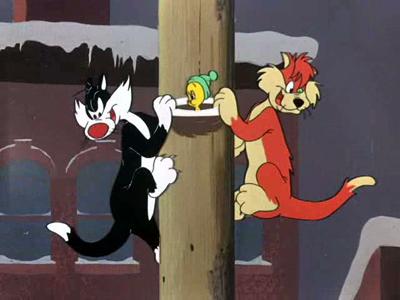 It’s winter and Tweety is troubled by two cats (Sylvester and a red cat with a bad eye), who fight over him. Most of the comedy derives from the feud between the two, and only in the end Tweety himself comes into action, making the two cats fall into an icy pond.
With ‘Putty Tat Trouble’ Freleng returns to Tweety’s first solo films, Bob Clampett’s ‘A Tale of Two Kitties’ (1942) and ‘A Gruesome Twosome‘ (1945), in which also two cats fought for the little bird. Freleng’s humor is different from Bob Clampett’s, but once again, the feud works very well. Apart from Tweety’s talking, all the comedy is silent and brilliantly executed, too. This makes ‘Putty Tat Trouble’ one of the better Tweety and Sylvester cartoons.
In one scene we can see a Friz Freleng portrait in the background.
Watch an excerpt from ‘Putty Tat Trouble’ yourself and tell me what you think:
‘Putty Tat Trouble’ is available on the DVD set ‘Looney Tunes Golden Collection, Vol. 1’
Directors: William Hanna & Joseph Barbera
Release Date: October 21, 1950
Stars: Tom & Jerry, Spike
Rating: ★★★★
Review:
 Tom frames Jerry for eating a chicken leg only to eat the chicken leg himself.
Jerry revenges himself on Tom by repeatedly framing him for stealing Spike’s bone. The cartoon ends with a wonderfully elaborate magnet gag, repeatedly tying Tom unwillingly to Spike’s bone.
Even though it’s not among Tom & Jerry’s most memorable entries, ‘The Framed Cat’ is a fun cartoon. It’s one of those rare cartoons in which Tom speaks a little. It’s also noteworthy for its backgrounds, which are more stylized than usual.
Watch ‘The Framed Cat’ yourself and tell me what you think:
This is Tom & Jerry cartoon No. 53
To the previous Tom & Jerry cartoon: Tom and Jerry in the Hollywood Bowl
To the next Tom & Jerry cartoon: Cueball Cat
Director: Jack Kinney
Release Date: August 26, 1949
Stars: Goofy
Rating: ★★★★
Review:
 After four years of working on feature films, Jack Kinney returns as a director of Goofy shorts to remain Goofy’s sole director until the series’ end in 1953.
Kinney’s first Goofy film in four years, ‘Tennis Racquet’ is a transitional film: together with the next Goofy short, ‘Goofy Gymnastics‘, it’s firmly rooted in the 1940s Goofy tradition, being a sports cartoon, similar in content to ‘How to Play Football‘ (1944) and ‘Hockey Homicide‘ (1945). Moreover, in the first scene we hear one of the Goofy characters (the cartoon contains several of them) singing Goofy’s own theme song “the world owes me a living”, and in the end we can hear the typical Goofy yell, introduced in ‘The Art of Skiing‘ (1941). The short even features a slow motion gag, not seen since ‘How to swim‘ (1942).
On the other hand, it can also be seen as the first entry of Goofy’s second series, for the character has been completely redesigned. The next year this new, redesigned Goofy would turn into Mr. Geef, the everyman.
Like ‘How to Play Football’ and ‘Hockey Homicide’, ‘Tennis Racquet’ has no educational value: the cartoon consists of one frantic tennis match between two Goofy characters. It’s a fast and funny cartoon, full of silly gags. The highlight may be the running gag of the stoic gardener, who enters the game at several points, undisturbed by the frantic action around him.
Watch ‘Tennis Racquet’ yourself and tell me what you think:
This is Goofy cartoon No. 23
To the previous Goofy cartoon: The Big Wash
To the next Goofy cartoon: Goofy Gymnastics
Director: Charles Nichols
Release Date: January 6, 1950
Stars: Pluto, Butch, Dinah
Rating: ★★★★
Review:
 It seems that at the end of the Pluto series, the animators had found new inspiration, for most of Pluto’s best cartoons were made in the series’ last two years. In fact, almost every Pluto cartoon from 1950/1951, Pluto’s last two solo years, is a winner.
‘Pluto’s Heart Throb’ is a good example. In this rather weird short both Butch an Pluto fall in love with Dinah (whom we hadn’t seen since ‘In Dutch‘ from 1946). They’re acting like rivals, but they have to pretend to be friends when she’s watching. When Pluto saves Dinah from drowning, he gains her love and Butch makes a sad retreat.
Penned by Roy Williams, one of the most original of the Disney story men, this short is stuffed with silly ideas, starting with the silly little pink dog cupid, who makes Pluto and Dinah fall in love with each other. The animation is extremely flexible, with wonderful expressions on all three characters. The excellent silent comedy is further enhanced by a very lively score. In all, ‘Pluto’s Heart Throb’ is a great improvement on the earlier in-love-with-Dinah-cartoon: ‘Canine Casanova’ from 1945.
Watch ‘Pluto’s Heart Throb’ yourself and tell me what you think:
This is Pluto cartoon No. 33
To the previous Pluto cartoon: Sheep Dog
To the next Pluto cartoon: Pluto and the Gopher
Director: Chuck Jones
Release Date: March 11, 1950
Stars: Bugs Bunny
Rating: ★★★★
Review:
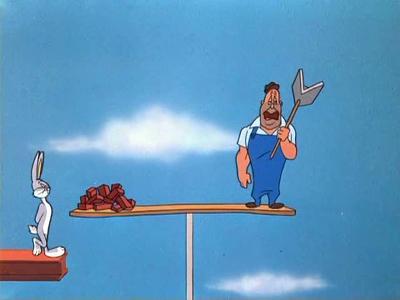 In ‘Homeless Hare’ Bugs’s home happens to be in a construction site.
When the excavator driver ignores Bugs’s pleas for leaving his home alone, Bugs nags him until the bully can’t take no more.
This film contains a gag of a half conscious Bugs walking at great heights without falling, a scene that is clearly borrowed from earlier shorts, like the Popeye cartoon ‘A Dream Walking’ from 1934 and the classic Disney short ‘Clock Cleaners’ from 1937. It also contains an elaborate final gag with a hot rivet, a type of gag Chuck Jones invented. It anticipates similar gags in the Road Runner series and Jones’s Tom and Jerry films from the 1960s. The Highlight of the cartoon, however, is a gag with the bully balancing on a plank with a bunch of bricks, which Bugs slowly withdraws…
Watch ‘Homeless Hare’ yourself and tell me what you think:
This is Bugs Bunny cartoon No. 70
To the previous Bugs Bunny cartoon: Mutiny on the Bunny
To the next Bugs Bunny cartoon: Big House Bunny
Director: Friz Freleng
Release Date: January 15, 1949
Stars: Bugs Bunny, Elmer Fudd
Rating: ★★★★
Review:
 This Bugs Bunny short starts with Elmer Fudd hunting our hero with a “wabbit detector”.
Like Freleng’s quite similar ‘Stage Door Cartoon‘ (1944), the action soon shifts into a theater, with wonderful comedy with Bugs’s and Elmer’s repeatedly passing past sitting people, continuously using the phrases ‘pardon me’ and ‘excuse me’ as a major highlight. Other great gags are Bugs’s playing with the intermission switch (which immediately causes the public to rush outside to smoke) and the finale, in which Bugs manages to get a blinded Elmer into a lion’s beak.
Despite the wonderful comedy, the film nevertheless fails to reach the heights of ‘Stage Door Cartoon’, falling short, due to some bad designs of Elmer and to a sense of routine.
Watch ‘Hare Do’ yourself and tell me what you think:
This is Bugs Bunny cartoon No. 56
To the previous Bugs Bunny cartoon: My Bunny Lies over the Sea
To the next Bugs Bunny cartoon: Mississippi Hare
Director: Robert McKimson
Release Date: October 9, 1948
Stars: Foghorn Leghorn, Henery Hawk
Rating: ★★★★
Review:
 Henery Hawk’s cowardly dad forbids his little son to chase chickens, but Henery does it anyway.
Unfortunately, he doesn’t know what a chicken looks like, and he repeatedly ends up catching the barnyard dog, while the Foghorn Leghorn makes feeble attempts in convincing the little chicken hawk, that he‘s a chicken.
This premise is a great twist on the stories of the first two Henery Hawk/Foghorn Leghorn cartoons (‘Walky Talky Hawky‘ from 1946 and ‘Crowing Pains‘ from 1947). It’s clear from the title that by now Foghorn Leghorn had become the real star of the Henery Hawk cartoons, and deservedly so, because in his third appearance, this broad gesturing and talkative rooster is stealing the show.
At the same time, this is a transitional cartoon, in which the original looniness of McKimson’s first cartoons gradually makes way for a more dialogue-driven approach, as is perfectly illustrated by Foghorn Leghorn’s endless jabbering.
Watch ‘The Foghorn Leghorn’ yourself and tell me what you think:
https://www.dailymotion.com/video/x6ecxr1
‘The Foghorn Leghorn’ is available on the Blu-Ray-set ‘Looney Tunes Platinum Collection: Volume 2’ and on the DVD-box ‘Looney Tunes Golden Collection Volume 1’
Director: Robert McKimson
Release Date: August 7, 1950
Stars: Porky Pig, Daffy Duck
Rating: ★★★★
Review:
 In ‘Boobs in the Woods’ Porky wants to paint in a forest, but he’s bothered by a particularly loony Daffy.
This cartoon is a typical example of Warren Foster-penned zaniness. Daffy makes no mistake about his zany character, which is similar to the one in the Foster/McKimson outings, like ‘Daffy Doodles’ (1946), ‘Daffy Duck Slept Here‘ (1948) and ‘Daffy Duck Hunt‘ (1949): in the opening scene he introduces himself in a loony song.
Nevertheless, ‘Boobs in the Woods’ is one of the last cartoons featuring this loony version of Daffy. Two months later Jones would introduce a different type in ‘The Scarlet Pumpernickel‘.
Apart from the excellent gags, ‘Boobs in the Woods’ is noteworthy for its extremely stylized and surprisingly flat backgrounds by Cornett Wood and Richard H. Thomas.
Watch ‘Boobs in the Woods’ yourself and tell me what you think:
https://www.dailymotion.com/video/x6egzhi
This is Porky Pig cartoon no. 130
To the previous Porky Pig cartoon: Bye, Bye Bluebeard
To the next Porky Pig cartoon: The Scarlet Pumpernickel
This is Daffy Duck cartoon No. 50
To the previous Daffy Duck cartoon: Daffy Duck Hunt
To the next Daffy Duck cartoon: The Scarlet Pumpernickel
‘Boobs in the Woods’ is available on the DVD-set ‘Looney Tunes Golden Collection Volume One’
Directors: William Hanna & Joseph Barbera
Release Date: April 30, 1949
Stars: Tom & Jerry, Nibbles
Rating: ★★★★
Review:
 ‘The Little Orphan’ can be summarized as ‘The Milky Waif’ (1946) at Thanksgiving.
Little Nibbles is sent over to Jerry as a Thanksgiving guest. They both patrol the dining table, dressed like pioneers, when Tom, dressed like an Indian, attacks them. He’s won over, however, and in the last shot they all share the dining table, but it is little Nibbles who eats the complete turkey, alone.
Apart from ‘The Milky Waif’, ‘The Little Orphan’ resembles ‘Yankee Doodle Mouse‘ (1943). Both feature a battle fought in a household setting. What makes ‘The Little Orphan’ so great is that Hanna and Barbera are able to play the complete pilgrims and Indians setting at a dinner table.
Watch an excerpt from ‘The Little Orphan’ yourself and tell me what you think:
This is Tom & Jerry cartoon No. 40
To the previous Tom & Jerry cartoon: Polka Dot Puss
To the next Tom & Jerry cartoon: Hatch Up Your Troubles
Director: Chuck Jones
Release Date: July 24, 1948
Stars: Bugs Bunny, Marvin the Martian
Rating: ★★★★
Review:
 ‘Haredevil Hare’ Bugs opens with two headlines of the ‘Daily Snooze’: ‘Scientist to Launch First Rocket to the Moon’ and ‘Heroic Rabbit Volunteers to Be First Passenger’.
Cut to Bugs Bunny ‘volunteering’ (he’s literally dragged towards the spaceship by two men). Bugs changes his mind however, when he notices the supply of carrots dumped into the rocket. And so he’s off to the moon.
Bugs has a hard landing on the moon, which destroys his vesssel and leaves him in shock. But just when he’s adjusted to the fact that he’s alone on the moon, Bugs encounters Marvin the Martian (in his first screen appearance) and his green, talking Martian dog, who is designed like a green version of Charlie Dog and who speaks with the dumb voice of Junior Bear, provided by voice actor Stan Freberg.
The two Martians are on the first Mars-Moon expedition and want to blow up the Earth. But it’s Bugs who blows up the two and accidentally half the moon, too. In the end we see the three hanging on the left piece of the moon with bugs screaming to the control room: “Get me outa here!”.
‘Haredevil Hare’ is one of the first science fiction-themed films that flooded the post-war era. It even predates the first post-war live action features set in outer space, ‘Rocketship X-M’ and ‘Destination Moon’ by two years. In the 1950s outer space would become a popular film setting. Indeed, Chuck Jones himself would revisit outer space several times in his cartoons, most notably in ‘Jumpin’ Jupiter‘ (1955), ‘Rocket Squad’ (1956), and the greatest of all science fiction cartoons, ‘Duck Dodgers in the 24½th Century‘ (1953).
The latter cartoon also features Marvin the Martian, who would reappear in three more Bugs Bunny cartoons: ‘The Hasty Hare’ (1951), ‘Hare-Way to the Stars’ (1958) and ‘Mad as a Mars Hare’ (1963). Of all cartoon villains, Marvin the Martian is the most extraordinary. He’s as gentle, polite and mild-mannered as he is destructive. Although he would never become a major star, he’s still popular today.
Apart from introducing Marvin, ‘Haredevil Hare’ is a notable cartoon because of some nice and weird animation by Ben Washam of Bugs being a nervous wreck after his voyage to the moon: we watch him changing from one bizarre pose into the other, almost without any animation in between. The scenes inside the rocket scene are reminiscent of Bob Clampett’s ‘Falling Hare’ (1943).
Watch ‘Haredevil Hare’ yourself and tell me what you think:
http://www.supercartoons.net/cartoon/661/haredevil-hare.html
‘Haredevil Hare’ is available on the DVD set ‘Looney Tunes Golden Collection, Vol. 1’
This is Bugs Bunny cartoon No. 51
To the previous Bugs Bunny cartoon: Bugs Bunny Rides Again
To the next Bugs Bunny cartoon: Hot Cross Bunny
Director: Charles Nichols
Release Date: November 4, 1949
Stars: Pluto, Bent-Tail & Bent-Tail junior
Rating: ★★★★
Review:
 In this follow-up to ‘The Legend of Coyote Rock’ (1945), Pluto is a sheep dog bothered by two coyotes, Bent-Tail and his not too clever son (in his debut), who want to steal his sheep.
In the end Bent-tail finally succeeds in stealing one, but it turns out to be his own son in disguise.
Like ‘Pluto’s Sweater‘ of the same year, ‘Sheep Dog’ plays more on gags than on cuteness, which results in one of Pluto’s best cartoons. Especially the interplay between Bent-Tail and his son is a delight to watch. Indeed, the duo was successful enough to return the following year in the equally entertaining ‘Pests of the West‘ and ‘Camp Dog’.
Watch ‘Sheep Dog’ yourself and tell me what you think:
This is Pluto cartoon No. 32
To the previous Pluto cartoon: Bubble Bee
To the next Pluto cartoon: Pluto’s Heart Throb
Director: Chuck Jones
Release Date: November 12, 1949
Stars: Pepe le Pew
Rating: ★★★★
Review:
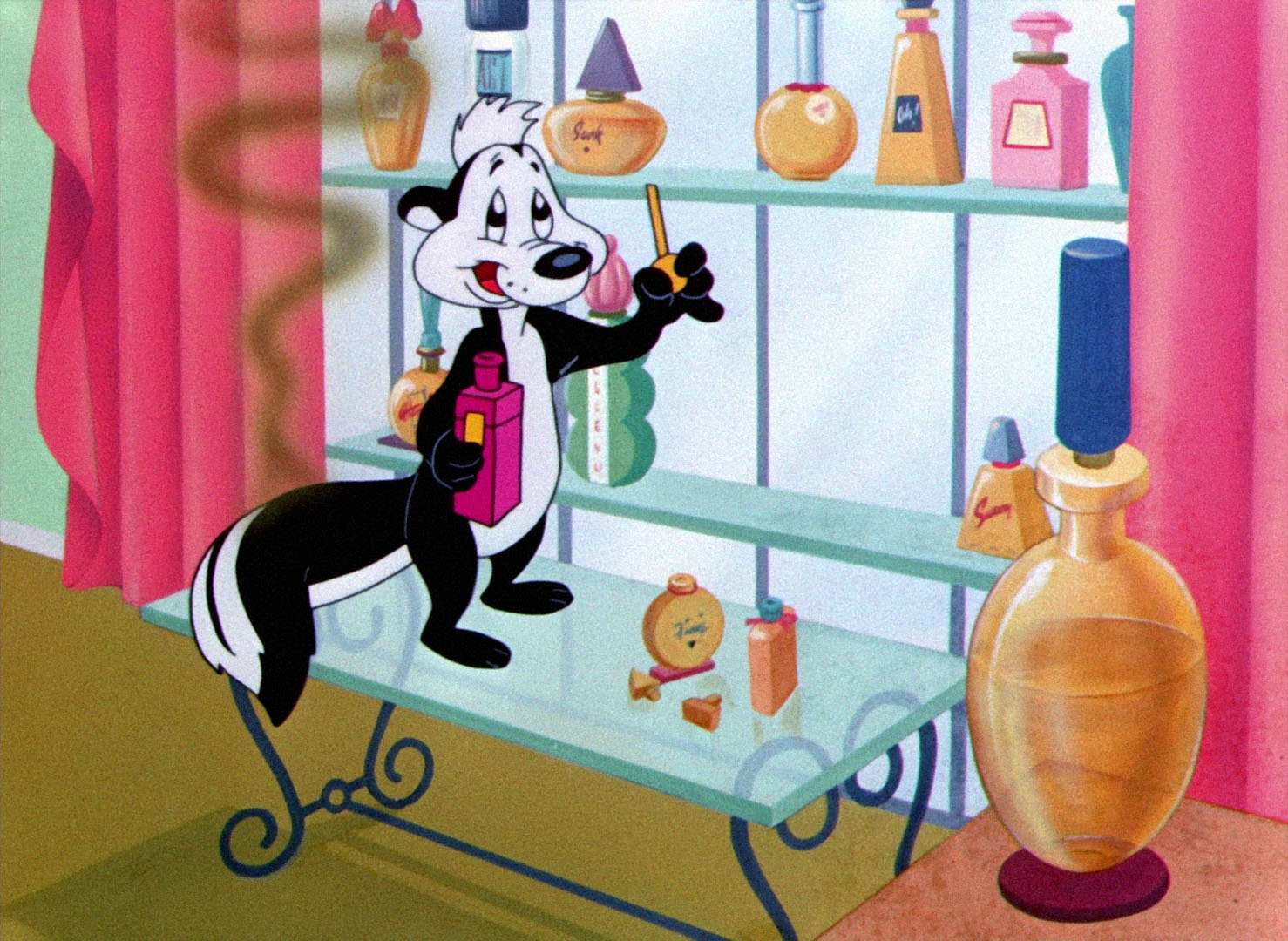 ‘For Scent-imental Reasons’ is the fourth Pepe Le Pew cartoon, and one of his best.
In this short a French perfume shop owner discovers Pepe le Pew in his shop and throws in his female cat to chase away our romantic skunk. Of course, she accidentally gets a white stripe on her back and she’s chased by the smelly Latin lover. But when Pepe accidentally falls into a barrel of blue paint, the tables are turned and he’s chased by the cat.
This short features an excellent scene of Pepe arguing with the cat through a glass window in silent pantomime.
Watch ‘For Scent-imental Reasons’ yourself and tell me what you think:
‘For Scent-imental Reasons’ is available on the DVD set ‘Looney Tunes Golden Collection, Vol. 1’ and ‘Warner Bros. Home Entertainment Academy Awards Animation Collection: 15 winners’
Director: Robert McKimson
Release Date: October 14, 1949
Rating: ★★★★
Review:
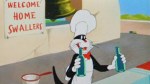 At the San Juan Capistrano mission a cat is waiting for the swallows to return. Unfortunately, the swallows have sent a scout who is too clever for him.
This cartoon contains of several blackout gags, and, unusual for a Robert McKimson cartoon, practically no dialogue. Actually, the cartoon is reminiscent of the silent blackout gag comedy of the Road Runner series, which were introduced only one month earlier. ‘Swallow The Leader’ may be atypical for McKimson, it’s well-directed,with the gags coming in fast and well-timed.
The mission featured does really exists and is indeed famous for its nesting swallows. The cat is a typical McKimson design, and very reminiscent of the Supreem Cat in ‘Paying the Piper’ from earlier that year. Typically, he wears a collar, which makes him look like a forerunner of the standard Hanna-Barbera television studio design.
Director: Art Davis
Release Date: August 14, 1948
Rating: ★★★★
Review:
Art Davis is one of the unsung heroes of Warner Brothers animation. His unit existed for only three years, but in this short time period he released many fine cartoons, with a distinct and recognizable style.
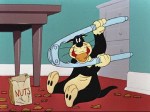
‘Dough Ray Me-Ow’ is one of his best cartoons, and a rather macabre one, too. This short features a cat, called Heathcliff, who is even too dumb to breathe. Heathcliff, without knowing it, inherits an enormous sum of money. When his ‘pal’ Louie, a cynical parrot, discovers that if Heathcliff dies, this fortune will come to him, he tries to kill Louie in great, funny gags. Surprisingly, in the end he even succeeds, but when he tells the dying Heathcliff his secret, the cat’s nine lives simply refuse to go to heaven!
Apart from the main story, the cartoon contains a small running gag in which we see Heatcliff cracking nuts in ridiculously elaborate ways, always involving his own head.
‘Dough Ray Me-Ow’ features watercolor backgrounds, very unusual for Warner Brothers at the time.
Watch an excerpt from ‘Dough Ray Me-ow’ yourself and tell me what you think:
‘Dough Ray Me-Ow’ is available on the Blu-Ray-set ‘Looney Tunes Platinum Collection: Volume 2’ and on the DVD-set ‘Looney Tunes Golden Collection Volume Four’
Directors: William Hanna & Joseph Barbera
Release Date: October 30, 1948
Stars: Tom & Jerry
Rating: ★★★★
Review:
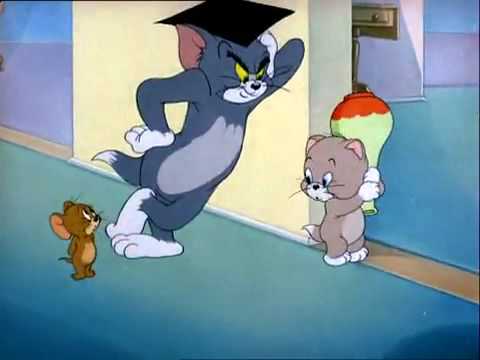 In ‘Professor Tom’ Tom is teaching a small kitten to chase mice.
Unfortunately for Tom, the unwilling kitten rather wants to befriend Jerry, and they both team up against the disappointed teacher. The result is a fast and funny cartoon with wonderful character animation and great silent acting.
Watch ‘Professor Tom’ yourself and tell me what you think:
https://www.dailymotion.com/video/x2moc3c
This is Tom & Jerry cartoon No. 37
To the previous Tom & Jerry cartoon: Old Rockin’ Chair Tom
To the next Tom & Jerry cartoon: Mouse Cleaning


 Dr. Grob's Animation Review