
You are currently browsing the category archive for the ‘★★★’ category.
Director: Chuck Jones
Release Date: February 10, 1965
Stars: Tom & Jerry
Rating: ★★★
Review:
 ‘Bad Day at Cat Rock’ is a third chase cartoon with blackout gags, this time on a building site.
Although it is one of the weaker chase cartoons, this cartoon features particularly nice opening credits and a very funny Road Runner-like series of gags in which Tom tries to launch himself numerous times using a boulder. Unfortunately, it ends abruptly, when Jerry draws an end to the cartoon.
Watch ‘Bad Day at Cat Rock’ yourself and tell me what you think:
http://www.dailymotion.com/video/x2qovbm
This is Tom & Jerry cartoon No. 136
To the previous Tom & Jerry cartoon: Tom-ic Energy
To the next Tom & Jerry cartoon: The Brothers Carry-Mouse-Off
Director: Chuck Jones
Release Date: January 27, 1965
Stars: Tom & Jerry
Rating: ★★★
Review:‘
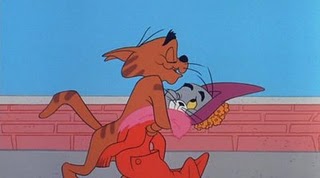 ‘Tom-ic Energy’ is Chuck Jones’s second Tom & Jerry chase cartoon with blackout gags, this time situated in the city streets.
The short contains elements from two of Chuck Jones’ earlier series: Road Runner and Pepe Le Pew. It’s fast, it’s well-animated, its music (by Eugene Poddany) is not bad, and yet, it never becomes really funny. It’s difficult to tell why not.
Watch ‘Tom-ic Energy’ yourself and tell me what you think:
http://www.dailymotion.com/video/x2ofgp7?GK_FACEBOOK_OG_HTML5=1
This is Tom & Jerry cartoon No. 135
To the previous Tom & Jerry cartoon: Ah, Sweet Mouse Story of Life
To the next Tom & Jerry cartoon: Bad Day at Cat Rock
Director: Chuck Jones
Release Date: January 20, 1965
Stars: Tom & Jerry
Rating: ★★★
Review:
 ‘Ah, Sweet Mouse Story of Life’ is the first of a short series of five classic chase cartoons with blackout gags, resembling Chuck Jones’ own Road Runner series.
The gags are good, but somehow surprisingly unfunny at the same time. Most remarkably, this cartoon revives an ancient cartoon power, frequently used by Felix the cat in the twenties: the ability to use one’s question marks and thoughts.
Watch ‘Ah, Sweet Mouse Story of Life’ yourself and tell me what you think:
http://www.dailymotion.com/video/x3yzc0k
This is Tom & Jerry cartoon No. 134
To the previous Tom & Jerry cartoon: The Unshrinkable Jerry Mouse
To the next Tom & Jerry cartoon: Tom-ic Energy
Director: Chuck Jones
Release Date: March 24, 1964
Stars: Tom & Jerry
Rating: ★★★
Review:
 In ‘Is There a Doctor in the Mouse?’ Jerry invents a potion, which makes him lightning fast.
Jerry uses his new speed to eat everything that Tom wants to eat. When he runs out of speed he drinks a potion, which makes him enormous, thus abruptly ending the film.
Like the Hanna-Barbera Tom & Jerry cartoon ‘The Invisible Mouse‘ (1947), ‘Is There a Doctor in the Mouse?’ suffers from an all too powerful Jerry. When Tom is bullied, it’s not comical, it’s sad. The result is one of the weaker entries in Jones’ Tom & Jerry series.
‘Is There A Doctor in the Mouse’ has the questionable honor to be the first Chuck Jones Tom & Jerry cartoon with a pun in the title. Titles like these would dominate the Chuck Jones Tom & Jerries. They were not their best feature. Apart from being rather trite, they more often than not had nothing to do with the content, at all.
Watch ‘Is There a Doctor in the Mouse?’ yourself and tell me what you think:
http://www.dailymotion.com/video/x2ofixi
This is Tom & Jerry cartoon No. 130
To the previous Tom & Jerry cartoon: The Cat Above, The Mouse Below
To the next Tom & Jerry cartoon: Much Ado About Mousing
Director: Chuck Jones
Release Date: July 27, 1963
Stars: Tom & Jerry
Rating: ★★★
Review:
 ‘Penthouse Mouse’ was the first cartoon in a series of 34 Tom & Jerry cartoons produced by Chuck Jones, after he was fired by Warner Brothers.
Jones had taken all his staff with him, including writer Michael Maltese and co-director Maurice Noble. Even Warner Bros. voice Mel Blanc contributes to the film. The result is typical Chuck Jones: highly stylized backgrounds, excellent animation, and great facial expressions and poses. All this makes a great improvement on the Gene Deitch films.
Oddly enough ‘Penthouse Mouse’ borrows its theme precisely from one of Jones’ predecessor’s films: the Gene Deitch’s Tom & Jerry short ‘Buddies Thicker than Water‘ (1962). But now the story is reversed: Tom has made it on the top floor of a skyscraper, while Jerry is the hungry tramp, roaming the streets. Unfortunately, the story is not very consistent, and the result is not really good. Jones could do better as he was going to show in his next Tom & Jerry cartoon, ‘The Cat Above, The Mouse Below‘.
Watch ‘Penthouse Mouse’ yourself and tell me what you think:
This is Tom & Jerry cartoon No. 128
To the previous Tom & Jerry cartoon: Carmen Get It
To the next Tom & Jerry cartoon: The Cat Above, The Mouse Below
Director: Bruno Bozzetto
Release Date: October 1, 1965
Rating: ★★★
Review:
 ‘West And Soda’ has a classic Western story: an evil villain is after the land owned by the lovely Clementine. Luckily she is rescued by our cool hero, Johnny, who doesn’t talk much, but who can shoot!
‘West and Soda’ is Bruno Bozzetto’s first feature film and unfortunately, it shows. The Italian animator is at his best in short, well-timed pantomime gags, and he clearly has difficulties with this longer medium. Neither the animation nor the designs are particularly appealing, and the feature suffers a little from its length. Generously mocking almost every aspect of the classic western, ‘West and Soda’ is as silly as it is predictable. Luckily there are many throwaway gags to keep the viewer laughing from time to time.
However, Bozzetto’s comic genius really shines through in two offbeat scenes, in which Bozzetto does what he does best: like his funny short ‘I Due Castelli’ from 1963, these two scenes use a fixed long distance perspective, pantomimed action and a perfect timing, with hilarious results. The first of these two scenes shows us several failing attacks of ferocious ants on Johnny, who is buried up to his head in the desert. The second depicts the villain’s attempts to drop a huge rock on our hero.
Watch the ant scene from ‘West And Soda’ yourself and tell me what you think:
Director: Charles Nichols
Release Date: March 16, 1961
Rating: ★★★
Review:

‘The Saga of Windwagon Smith’ was Disney’s last tall tale cartoon after entries like ‘Pecos Bill‘ (from ‘Melody Time‘, 1948) and ‘Paul Bunyan‘ (1958).
Unlike the former, which were rooted in American folklore, this story seems to be an original, although it retains a traditional feel. The story, which is narrated in rhyme, and partly sung by Rex Allen and the Sons of the Pioneers, tells about Windwagon Smith, a sailor who arrives at Westport, a small town in Kansas on a wagon with a sail. He convinces the villagers to make even a larger one to sail the prairies to Santa Fe with. But when it’s ready the villagers get scared and abandon the ‘ship’, except for Molly, the mayor’s daughter, who’s in love with Smith. Together they vanish into a storm.
‘The Saga of Windwagon Smith’ was the last cartoon to be directed by Charles Nichols. It’s also the last of only six shorts directed by him not to feature Pluto. It’s moderately stylized except for Molly, who’s conceived and animated in a charmingly stylized way, seeming to float more than to walk. Nichols left Disney in 1962 for Hanna-Barbera, where he worked on countless television series. In the late 1980s he returned to Disney, where he worked onto his death in 1992, 81 years old.
Watch ‘The Saga of Windwagon Smith’ yourself and tell me what you think:
‘The Saga of Windwagon Smith’ is available on the DVD ‘Walt Disney Treasures: Disney Rarities’
Director: David Hand
Release Date: June 16, 1934
Stars: Mickey Mouse, Minnie Mouse, the orphan mice
Rating: ★★★
Review:
 Two of the orphan mice used in ‘Giantland‘ (1933) and ‘Gulliver Mickey’ (1934) appear in this cartoon.
It’s unclear whether these two brats are Mickey’s nephews Morty and Ferdy, who were created by Floyd Gottfredson in the Mickey Mouse comic in 1932, as they’re not named in this short. If they are, this film marks their only screen appearance, for, unlike Donald’s nephews, they don’t appear in any other film. Anyway, as in the comic strip, these two brats are full of mischief.
This time they steal Mickey’s anthropomorphized steam roller, while Mickey’s flirting with Minnie. The two kids manage to destroy a bridge, a streetcar, a complete hotel and the steamroller itself, but in the end Mickey’s not mad at them, just laughing.
‘Mickey’s Steamroller’ is a real gag-cartoon. Yet, it is not particularly funny and it has an old-fashioned feel to it, especially after such elaborate entries in the Mickey Mouse series, as ‘Mickey’s Gala Premier‘ and ‘Giantland‘.
Watch ‘Mickey’s Steamroller’ yourself and tell me what you think:
This is Mickey Mouse cartoon No. 67
To the previous Mickey Mouse cartoon: Gulliver Mickey
To the next Mickey Mouse cartoon: Orphan’s Benefit
Director: Burt Gillett
Release Date: September 30, 1933
Stars: Mickey Mouse, Minnie Mouse
Rating: ★★★
Review:
 Mickey is a jockey in a horse race.
Unfortunately, his horse Thunderbolt gets drunk just before the race starts. So he rides a pantomime horse, with his two black stable boys in it, instead. Remarkably, they win, due to a colony of angry and determined wasps, who chase the two poor black boys to the finish and into the distance, while Mickey receives all the glory.
‘The Steeple Chase’ is one of those ‘adventure type stories’ Mickey began having in 1932, and which were undoubtedly inspired by Floyd Gottfredson’s comic strip. ‘The Steeple Chase’ is a prime example: it shows clear similarities to ‘Mickey Mouse and his horse Tanglefoot‘, which ran about the same time (from June to October 1933). The colonel from ‘The Steeple Chase’ returns in that comic strip as a grumpy judge.
The early scenes firmly state why Mickey should win the race, e.g. when Minnie tells him “you gotta win, Mickey, or you’ll break the colonel’s heart”. Thus we are more involved in the horse race then in Mickey’s boxing game in ‘Mickey’s Mechanical Man‘ from earlier that year. Nevertheless, it remains a fact that Mickey’s actually cheating in both these cartoons, and misusing the two black stable boys while doing so. This makes it rather difficult to sympathize with Mickey. Moreover, the race is hardly as exciting as the one in ‘Barnyard Olympics‘ (1932), and the cartoon is by all means inferior to Gottfredson’s classic comic strip. The best gags come from the numerous ways in which the wasps attack Mickey and his fake horse.
Watch ‘The Steeple Chase’ yourself and tell me what you think:
This is Mickey Mouse cartoon No. 60
To the previous Mickey Mouse cartoon: Puppy Love
To the next Mickey Mouse cartoon: The Pet Store
Director: David Hand
Release Date: March 11, 1933
Rating: ★★★
Review:

‘Birds in the Spring’ is a Silly Symphony about a mischievous little bird who encounters a.o. a rattlesnake and some angry bees.
This short can be regarded a study in realism, using birds. The realistic birds portrayed here are a far cry from the primitive and cartoony designs of ‘Birds of a Feather‘ from 1931. They fit perfectly in the equally realistic and elaborate backgrounds. The difference between the two shorts shows the enormous and unbelievable growth the Disney studio had made in a mere two years. The snake and the bugs in this cartoon, on the other hand, are not half as good, and fail to evoke any feeling of realism. A cousin of the badly designed snake would appear, however, in ‘Mickey’s Garden‘ (1935).
In his autobiography Pinto Colvig reveals that all the chirps, whistles, warbles and tweets in this cartoon are made by two women, Esther Campbell and Marion Darlington.
‘Birds in the Spring’ may have inspired ‘Morning Noon and Night‘ (released October 1933), the first of several Silly Symphony-like cartoons produced by the rival Fleischer studio.
Watch ‘Birds in the Spring’ yourself and tell me what you think:
This is Silly Symphony No. 34
To the previous Silly Symphony: Santa’s Workshop
To the next Silly Symphony: Father Noah’s Ark
Director: Burt Gillett
Release Date: September 30, 1931
Stars: Clarabelle Cow, Horace Horsecollar, Mickey Mouse, Minnie Mouse, Pluto
Rating: ★★★
Review:
 Mickey’s got his own radio station at the barn. There, Minnie, Horace Horsecollar and Clarabelle Cow perform some music to broadcast.
All goes well, until a cat and her little kittens cause havoc in the studio. Mickey has a hard time chasing them away, and during his efforts all instruments are destroyed.
‘The Barnyard Broadcast’ reuses the cat from ‘Mickey Steps Out‘ from two months earlier, and it introduces the numerous kittens that would cause Mickey lots of trouble in the subsequent films ‘Mickey’s Orphans‘ (1931) and ‘Mickey’s Revue‘ (1932). After that their role would be taken over by the orphan mice, introduced in ‘Mickey’s Nightmare‘ (1932).
After ‘Mickey Steps Out’, ‘The Barnyard Broadcast’ is another attempt in building a finale in a string of gags. The film is not entirely successful in this and only gains momentum when Mickey chases the cat away with a broom. The technique would be perfected in the subsequent films, ‘The Beach Party‘ and ‘Mickey Cuts Up‘.
Watch ‘The Barnyard Broadcast’ yourself and tell me what you think:
This is Mickey Mouse cartoon No. 33
To the previous Mickey Mouse cartoon: Fishin’ Around
To the next Mickey Mouse cartoon: The Beach Party
Director: Dave Fleischer
Release Date: August 9, 1930
Stars: Betty Boop (unnamed)
Rating: ★★★
Review:

‘Dizzy Dishes’ is a jazzy cartoon about a waiter in a restaurant who should bring a roast duck to an extremely hungry customer, but who does anything but serving. While the waiter is performing on stage together with the roast duck, the hungry customer eats almost everything in sight.
The cartoon is very typical of Fleischer’s early Talkartoons. The animation is rather crude, and outside the songs there’s no lip synch, but there’s a lot of metamorphosis going on. Apart from that, practically everything can grow hands and feet, creating an urban and surreal world, very different from the merry worlds of nature and farmlands of the rival Walt Disney studio.
‘Dizzy Dishes’ is not too interesting, but it marks the debut of Betty Boop. She’s introduced as an unnamed and rather fat and unappealing dog singer. The animation on her is erratic to say the least, but it already contains some specks of eroticism. She was designed as a caricature of singer Helen Kane, who was the first to sing ‘I Wanna Be Loved By You’, which contains the Boop-Boop-a-Doop-phrases with which Betty Boop became famous.
Betty Boop’s creation is attributed to animator Grim Natwick (1890-1990), a veteran animator, who, according to his fellow animators, was the only animator able to handle the feminine figure. Interestingly enough, Grim Natwick later worked for Walt Disney, animating Snow White, the first realistically animated heroine, in ‘Snow White and the Seven Dwarfs’ (1937).
Betty Boop was in fact the only successful cartoon star conceived by the Fleischer studio after Koko the Clown. Later they had considerable success with Popeye and Superman, but these characters were owned by King Features and DC Comics, respectively.
Betty Boop would become more and more erotic, and she would soon rise to stardom, changing from dog to human in 1931, and getting her own series in 1932, which lasted until 1939. But by then the Fleischer’s years of surrealism and eroticism were long gone.
Watch ‘Dizzy Dishes’ yourself and tell me what you think:
This is Talkartoon No. 8
To the previous Talkartoon: Wise Flies
To the next Talkartoon: Barnacle Bill
‘Dizzy Dishes’ is available on the French DVD Box Set ‘Betty Boop Coffret Collector’
Director: Burt Gillett
Release Date: October 9, 1930
Stars: Mickey Mouse, Minnie Mouse, Pluto (as Rover)
Rating: ★★★
Review:
 Mickey’s driving to Minnie’s house singing his own theme song. They both are going on a picnic. While Mickey and Minnie are singing and dancing across the field to the tune of ‘In the Good Old Summertime’, hundreds of wild animals take their food away. The picnic ends in rain.
‘The Picnic’ is a rather plotless and unremarkable cartoon. It nevertheless contains a nice surreal gag in which a rabbit pulls away a hole. This kind of surrealism was rare at Disney’s at that time, but later, Tex Avery would reuse this gag many times at Warner Brothers and MGM.
‘The Picnic’ would have been forgettable, did it not mark the debut of Pluto. He is called Rover in this cartoon, and appears to be Minnie’s dog rather than Mickey’s, but he’s Pluto alright. At this point there’s no reason to believe that Disney intended to make the dog a regular character. Floyd Gottfredson’s Mickey Mouse comics of January 1931 cover similar grounds, but feature a very large dog called “Tiny”.
Nevertheless, in April 1931 Pluto would return in ‘The Moose Hunt‘. This time to stay*. In fact Pluto would become a more and more important character in the Mickey Mouse cartoons, at times stealing most of the screen time from Mickey, who would become more and more a ‘straight man’. Eventually, Pluto would be given his own series, in 1937.
Watch ‘The Picnic’ yourself and tell me what you think:
This is Mickey Mouse cartoon No. 23
To the previous Mickey Mouse cartoon: The Gorilla Mystery
To the next Mickey Mouse cartoon: Pioneer Days
* Gottfredson’s Mickey Mouse comics followed three months later, introducing Pluto on July the 8th.
Director: Burt Gillett
Release Date: July 11, 1930
Stars: Clarabelle Cow, Horace Horsecollar, Mickey Mouse, Minnie Mouse
Rating: ★★★
Review:
 There’s a party at the barn. Mickey and Minnie make some music and Mickey dances with Clarabelle Cow, with a dachshund and with a fat pig, but not with Minnie, who plays the piano.
The short contains no story, but is one of sheer joy. Mickey and Minnie perform folk tunes like ‘Turkey in the Straw’, ‘Pop goes the Weasel’ (in which Mickey repeatedly grabs Minnie’s knickers), and ‘Old Folks at Home’, performed by Mickey on a mouth organ. The cartoon ends when the pig lands on Mickey.
‘The Shindig’ marks Horace Horsecollar’s first appearance as a completely humanized horse. It also contains the first love scene between him and Clarabelle Cow, whose name is written on the shed in which she lives.
In Clarabelle’s first scene, we watch her read Elinor Glyn’s novel ‘Three Weeks’. When she discovers an audience is watching her, she blushes, and quickly hides the book away. No wonder, ‘Three Weeks’ was a scandalous book, an erotic romance from 1907, apparently still controversial in 1930.
The party idea of ‘The Shindig’ was elaborated on in ‘The Whoopee Party‘ (1932), producing a cartoon full of party delight, compared to which ‘The Shindig’ pales.
Watch ‘The Shindig’ yourself and tell me what you think:
This is Mickey Mouse cartoon No. 20
To the previous Mickey Mouse cartoon: The Fire Fighters
To the next Mickey Mouse cartoon: The Chain Gang
Director: Burt Gillett
Release Date: March 15, 1930
Rating: ★★★
Review:
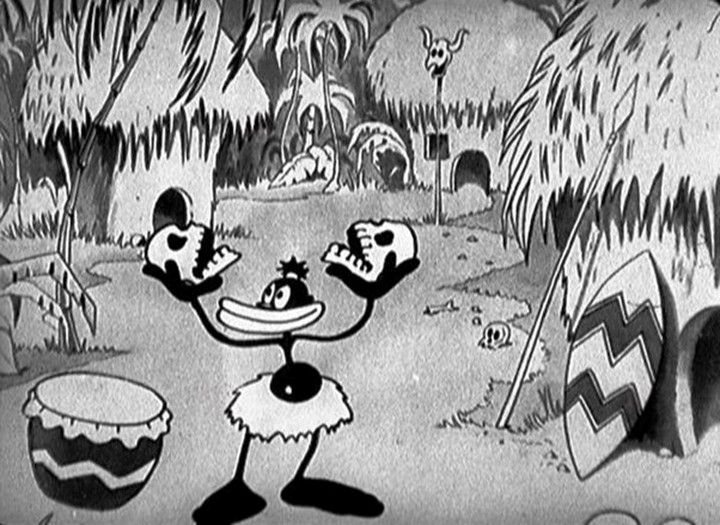 ‘Cannibal Capers’ is a typical early dance routine Silly Symphony. This time we watch dancing cannibals, followed by the antics of one poor cannibal chased by a lion.
The caricatures of the ‘primitive’ blacks are backward and quite extreme in this cartoon: the cannibals have such huge lips, they almost look like ducks(!). Nevertheless, the cartoon is less offensive than a later film like ‘Mickey’s Man Friday‘ (1935), because the cannibals at least look sympathetic (despite the skulls that lie everywhere), and are not compared to apes, like in the latter cartoon.
It also fairs better than the Betty Boop cartoon ‘I’ll Be Glad When You’re Fead You Rascal You‘ (1932), which also features cannibals, but here they’re linked to musicians of Louis Armstrong’s orchestra, making a direct connection between the racist caricatures and real Afro-Americans.
Cannibals were staple characters of cartoons from the thirties, but the caricatures managed to stay well into the fifties, being featured in shorts such as ‘His Mouse Friday‘ (Tom & Jerry, 1951), ‘Spare The Rod’ (Donald Duck, 1954) and ‘Boyhood Daze’ (Merrie Melodies, 1957).
‘Cannibal Capers’ is noteworthy, because it contains the only animation by Floyd Gottfredson that hit the screen: that of the lion running out of the jungle and of a cannibal beating the drum. Around the time this cartoon was released, Gottfredson was asked to take over the Mickey Mouse comic strip (then still written by Walt Disney himself), something he would do until 1975.
Watch ‘Cannibal Capers’ yourself and tell me what you think:
This is Silly Symphony No. 8
To the previous Silly Symphony: Autumn
To the next Silly Symphony: Night
Director: Ub Iwerks
Release Date: February 15, 1930
Rating: ★★★
Review:
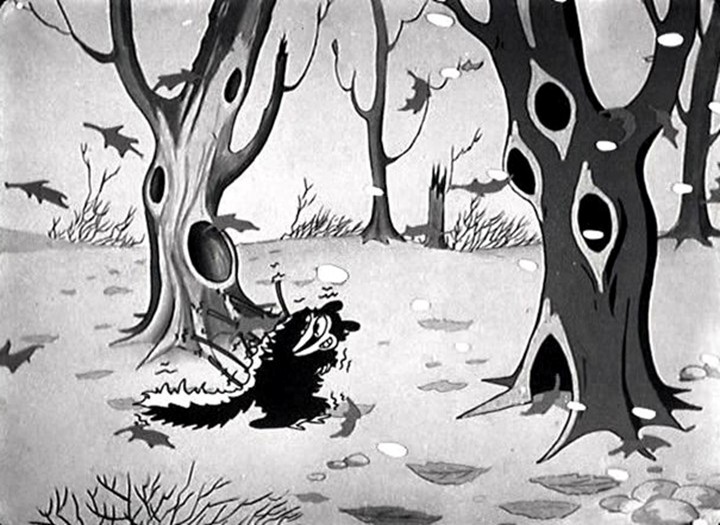 Autumn is the third entry in the season series, and it shows a small improvement in story development on the first two entries, Springtime and Summer. This time we don’t see animals just dancing, but collecting food for the winter in rhythmical fashion on Carl Stalling’s music.
We watch squirrels, crows, a skunk, a porcupine and some beavers collecting food (Disney would return to the latter species one year later in ‘The Busy Beavers‘). Then a cold winter wind make the ducks fly south and the other animals seek for shelter. At that point the cartoon suddenly ends.
Besides the tiny story element, notice the numerous falling leaves and elaborate reflections in the water, proof of Disney’s efforts to use ‘superfluous’ animation to give the cartoons more atmosphere and quality.
Watch ‘Autumn’ yourself and tell me what you think:
This is Silly Symphony No. 7
To the previous Silly Symphony: Summer
To the next Silly Symphony: Cannibal Capers
Director: Ub Iwerks
Release Date: October 4, 1929
Rating: ★★★
Review:
 ‘Springtime’, the third entry in the Silly Symphony series, is also the first of four Silly Symphonies devoted to the seasons.
Animated by Ub Iwerks, Les Clark and Wilfred Jackson, it sets the tone for many Silly Symphonies to come: the atmosphere is fairy-tale-like, there is no story whatsoever, but only one long dance routine. One had to wait two years, until ‘The Ugly Duckling‘, to watch a Silly Symphony escaping this rather limited format.
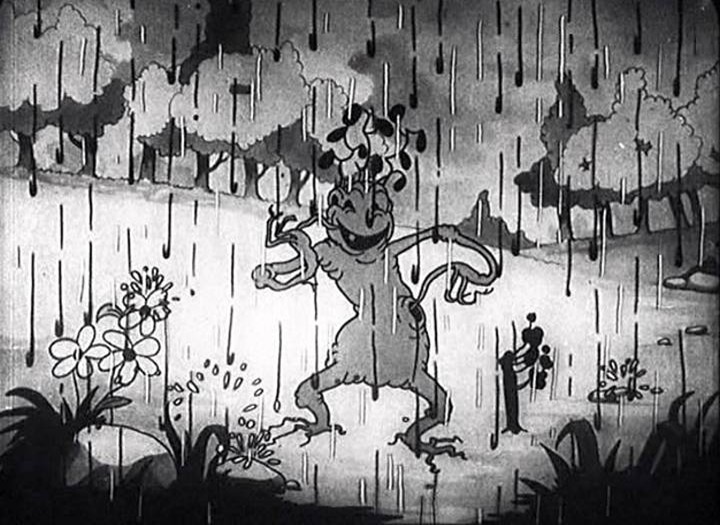
In this particular short we watch flowers dancing to Edvard Grieg’s ‘Morning’ from ‘Peer Gynt’. The flowers are very similar to the ones in ‘Flowers and Trees‘ from 1932. There are also several dancing animals: bugs, a caterpillar, crows, grasshoppers, frogs, a spider and a heron. The latter three dance to Amilcare Ponchielli’s ‘Dance of the hours’, which would be reused in the much more famous ‘Fantasia’ (1940). Besides the dancing there’s a remarkable portion of devouring: the crow eats the caterpillar, the heron eats the four frogs. The most extraordinary scene is the short rain storm scene, in which we watch a tree bathing in the rain.
However, one other scene particularly deserves our attention: in it we watch a rippled reflection of a dancing frog in the water, an early and interesting attempt of realism. Many of these attempts were soon to follow, and the Silly Symphonies became Disney’s laboratories for experimentation towards better animation.
In ‘One Hundred and One Dalmatians‘ (1961) ‘Springtime’ is shown on television during a scene at the old De Vil mansion: we can watch the dancing flowers and frogs, and the short’s score provides the background music for a large part of the scene.
Watch ‘Springtime’ yourself and tell me what you think:
This is Silly Symphony No. 3
To the previous Silly Symphony: El Terrible Toreador
To the next Silly Symphony: Hell’s Bells
Director: Walt Disney
Release Date: September 7, 1929
Rating: ★★★
Review:
 ‘El Terrible Toreador’ is the second entry of the Silly Symphonies. It has been far lesser known than the first, ‘The Skeleton Dance‘, which is no surprise, because it contains none of the ingredients which made ‘The Skeleton Dance’ a classic: there’s no interesting mood, no spectacular animation, and there are hardly any funny gags.
Unlike the other early Silly Symphonies, ‘El Terrible Toreador’ is more silly than symphony-like. That is: it’s more of a ‘story’ consisting of silly gags than the song-and-dance-routine typical of the Silly Symphonies up to 1931.
The cartoon consists of two parts: in the first part we watch a Spanish canteen, where a large officer and a toreador are fighting for the love of a waitress. In the second part, the toreador is fighting and dancing with a bull in the arena. Surprisingly, the story of the first part is hardly developed here: the cartoon ends when the toreador has pulled the bull inside out, thus ending the fight.
‘El Terrible Toreador’ is notable for being Disney’s first attempt at the human form since the early 1920s. However, the humans are a far cry from ‘Snow White and the Seven Dwarfs’ from (only) eight years later. In this early cartoon the human characters are extraordinarily flexible and they do not move lifelike at all (I noticed I thought of them as bugs some of the time).
The most interesting feature of this short is Carl Stalling’s score. His music already bears his signature and contains many citations from ‘Carmen’ by Georges Bizet.
Watch ‘El Terrible Toreador’ yourself and tell me what you think:
This is Silly Symphony No. 2
To the previous Silly Symphony: The Skeleton Dance
To the next Silly Symphony: Springtime
Director: Walt Disney
Release Date: July 25, 1927
Stars: Lois Hardwick (Alice)
Rating: ★★★
Review:
 ‘Alice the Whaler’ was one of the last of the Alice Comedies. It was only followed by two other titles, before Alice was replaced by Oswald the Lucky Rabbit. It features Lois Hardwick as Alice, who had replaced Margie Gay at the end of 1926.
‘Alice the Whaler’ is a cartoon that consists of rather unrelated gags. This time Alice and the gang are on a ship, looking for whales. In this cartoon both Disney’s character designs as the flexible animation have matured. Gone are the goggly eyes, and even one character (a cat cook) is wearing Mickey Mouse-type gloves. Also starring is a small mouse that peels potatoes just the way Mickey would do a year later in ‘Steamboat Willie‘.
Alice has almost disappeared from the screen, by now: she’s visible in four shots only, two total shots of the ships and two close ups that contain no animation whatsoever. Indeed, in his next series, Walt Disney would abandon live action altogether, relying on animation only, which by now already was the best in the business.
Watch ‘Alice the Whaler’ yourself and tell me what you think:
‘Alice the Whaler’ is available on the DVD ‘Walt Disney Treasures: Disney Rarities’
Director: Wilfred Jackson
Release Date: May 11, 1935
Rating: ★★★
Review:
 ‘Water Babies’ is sugary cute, contains a lot of repetitive animation and is one of those Silly Symphonies obsessed with babies and their bare behinds (other examples are ‘Lullaby Land’ (1933) and ‘Wynken, Blynken and Nod’ (1938)).
There is not much of a story either: the sexless water babies wake up, make fun and go to bed again (apparently a day only lasts seven minutes in their world).
And yet, this is undoubtedly one of Disney’s most impressive efforts of the era. It feels like a showcase cartoon of the Disney studio, excelling in lush pictures, great effect animation and beautiful theme music by Leigh Harline. Especially the opening scene (dawn) and the last shot (night) are stunningly beautiful. The Disney staff had reached yet another peak, and more was still to come.
‘Water Babies’ itself at least must have been a success, for it was followed by the similar ‘Merbabies’ in 1938, featuring more or less girl characters instead of the boy-like babies in ‘Water Babies’.
Watch ‘Water Babies’ yourself and tell me what you think:
This is Silly Symphony No.52
To the previous Silly Symphony: The Robber Kitten
To the next Silly Symphony: The Cookie Carnival


 Dr. Grob's Animation Review